


2021 માં પૂછાયેલાં પ્રકરણ
26 પ્રકરણ- 5પ્રશ્નો STD 11 7.રેડોક્ષ પ્રક્રિયાઓ
- 16પ્રશ્નો STD 11 સંતુલન - ૨
- 21પ્રશ્નો STD 12 જૈવિક અણુઓ
- 24પ્રશ્નો STD 12 એમાઇન સંયોજનો
- 7પ્રશ્નો STD 12 કાર્બોકિસલિક ઍસિડ
- 4પ્રશ્નો STD 12 આલ્કોહૉલ, ફિનોલ અને ઇથર સંયોજનો
- 9પ્રશ્નો STD 12 હેલોઆલ્કેન અને હેલોએરિન સંયોજનો
- 2પ્રશ્નો STD 11 કાર્બનિક રસાયણશાસ્ત્ર પ્રતિક્રિયા પદ્ધતિ
- 35પ્રશ્નો STD 12 સવર્ગ સંયોજનો સૌથી વધુ પૂછાયેલ
- 27પ્રશ્નો STD 12 D અને f-વિભાગનાં તત્ત્વો સૌથી વધુ પૂછાયેલ
- 28પ્રશ્નો STD 12 P-વિભાગનાં તત્ત્વો - 2 સૌથી વધુ પૂછાયેલ
- 23પ્રશ્નો STD 12 રાસાયણિક ગતિકી
- 20પ્રશ્નો STD 12 વિદ્યુત-રસાયણવિજ્ઞાન
- 25પ્રશ્નો STD 12 Solution and colligative properties
- 27પ્રશ્નો STD 11 રસાયણવિજ્ઞાનની કેટલીક પાયાની સંકલ્પનાઓ
- 10પ્રશ્નો STD 11 હાઇડ્રોકાર્બન
- 2પ્રશ્નો STD 11 કાર્બનિક રસાયણવિજ્ઞાન કાર્બનિક સંયોજનોનું નામકરણ
- 21પ્રશ્નો STD 11 કાર્બનિક રસાયણશાસ્ત્ર શુદ્ધિકરણ અને લાક્ષણિકતા
- 10પ્રશ્નો STD 12 આલ્ડિહાઇડ અને કિટોન
- 7પ્રશ્નો STD 11 કાર્બનિક રસાયણવિજ્ઞાન સમઘટકતા
- 25પ્રશ્નો STD 11 રાસાયણિક બંધન અને આણ્વીય રચના
- 8પ્રશ્નો STD 11 તત્ત્વોનું વર્ગીકરણ અને ગુણધર્મોમાં આવર્તિતા
- 15પ્રશ્નો STD 11 સંતુલન - ૧
- 23પ્રશ્નો STD 11 ઉષ્માગતિશાસ્ત્ર
- 4પ્રશ્નો STD 11 P-વિભાગના તત્ત્વો - ૧
- 22પ્રશ્નો STD 11 2.પરમાણુનું બંધારણ
JEE Mains 2021 Chemistry ના બધા પ્રશ્નો
26 પ્રકરણ420 માંથી 1–50 પ્રશ્નો
-
- (A) \(22\)
- (B) \(10\)
- (C) \(14\)
- (D) \(16\)
જવાબ અને ઉકેલ જુઓ
સાચો જવાબ: (D)
Writting the half reaction oxidation half reaction\(MnO _{4}^{-} \rightarrow Mn ^{2+}\)
balancing oxygen
\(MnO _{4}^{-} \rightarrow Mn ^{2+}+4 H _{2} O\)
balancing Hydrogen
\(8 H ^{+}+ MnO _{4}^{-} \rightarrow Mn ^{2+}+4 H _{2} O\)
balancing charge
\(5 e ^{-}+8 H ^{+}+ MnO _{4}^{-} \rightarrow Mn ^{2+}+4 H _{2} O\)
Reduction half
\(C _{2} O _{4}^{2-} \rightarrow CO _{2}\)
Balancing carbon
\(C _{2} O _{4}^{2-} \rightarrow 2 CO _{2}\)
Balancing charge
\(C _{2} O _{4}^{2-} \rightarrow 2 CO _{2}+2 e ^{-}\)
Net equation
\(16 H ^{+}+2 MnO _{4}^{-}+5 C _{2} O _{4}^{2-} \rightarrow 10 CO _{2}+2 Mn ^{2+}+8 H _{2} O\)
So \(\quad c=16\)
-
- (A) સમીકરણો \((A)\) અને \((B)\) માં \(H _{2} O _{2}\) અનુક્રમે ઓક્સિડેશન અને રિડક્ષન કર્તા તરીકે વર્તે છે.
- (B) સમીકરણો \((A)\) અને \((B)\) માં \(H _{2} O _{2}\) અનુક્રમે રિડક્ષન અને ઓક્સિડેશન કર્તા તરીકે વર્તે છે.
- (C) સમીકરણો \((A)\) અને \((B)\) માં \(H _{2} O _{2}\) એ રિડકક્ષનકર્તા તરીકે વર્તે છે.
- (D) સમીકરણો \((A)\) અને \((B)\) માં \(H _{2} O _{2}\) એ ઓકિસડેશનકર્તા તરીકે વર્તે છે.
જવાબ અને ઉકેલ જુઓ
સાચો જવાબ: (C)
\((A)\) \(HOCl + H _{2} O _{2} \rightarrow H _{3} O ^{+}+ Cl ^{-}+ O _{2}\)In this equation, \(H _{2} O _{2}\) is reducing chlorine from \(+1\) to \(-1\)
\((B)\) \(I _{2}+ H _{2} O _{2}+2 OH^- \rightarrow 2 I ^{-}+2 H _{2} O + O _{2}\)
In this equation, \(H _{2} O _{2}\) is reducing iodine from \(0\) to \(-1\)
-
- (A) \({BrO}_{2}^{-}\)
- (B) \({BrO}_{4}^{-}\)
- (C) \({BrO}^{-}\)
- (D) \({BrO}_{3}^{-}\)
જવાબ અને ઉકેલ જુઓ
સાચો જવાબ: (B)
In \({BrO}_{4}^{\ominus}, {Br}\) is in highest oxidation state \((+7),\) Soit cannot oxidise further it only reduced hence it cannot show disproportionation reaction -
- (A) \({C}_{2} {O}_{4}^{2-} \rightarrow 2 {CO}_{2}\)
- (B) \({CrO}_{4}^{2-} \rightarrow {Cr}^{3+}\)
- (C) \({Cr}_{2} {O}_{7}^{2-} \rightarrow 2 {Cr}^{3+}\)
- (D) \({MnO}_{4}^{-} \rightarrow {Mn}^{2+}\)
જવાબ અને ઉકેલ જુઓ
સાચો જવાબ: (D)
\(\underset{(+7)}{{MnO}_{4}^{-}} \rightarrow \underset{(+2)}{{Mn}^{2+}} 5 {e}^{-}\)change -
- (A) \(29\)
- (B) \(17\)
- (C) \(12\)
- (D) \(22\)
જવાબ અને ઉકેલ જુઓ
સાચો જવાબ: (C)
\(16 e ^{\ominus}+ S _{8} \longrightarrow 8 S ^{2-}\)\(\frac{12 H _{2} O + S _{8} \longrightarrow 4 S _{2} O _{3}^{2-}+24 H ^{+}+16 e ^{\circ}}{2 S _{8}+12 H _{2} O \longrightarrow 8 S ^{2-}+4 S _{2} O _{3}^{2-}+24 H }\)
for balancing in basic medium add equal number of \(OH ^{\ominus}\) that of \(H ^{+}\)
\(2 S _{8}+12 H _{2} O +24 OH ^{\ominus} \longrightarrow 8 S ^{2-}+4 S _{2} O _{8}^{2-}\)
\(+24 H _{2} O\)
\(2 S _{8}+24 OH ^{\ominus} \rightarrow 8 S ^{2-}+4 S _{2} O _{8}^{2-}+12 H _{2} O\)
\(S _{8}+12 OH ^{\ominus} \rightarrow 4 S ^{2-}+2 S _{2} O _{8}^{2-}+6 H _{2} O\)
\(a =12\)
-
- (A) \(1\)
- (B) \(3\)
- (C) \(2\)
- (D) \(4\)
જવાબ અને ઉકેલ જુઓ
સાચો જવાબ: (C)
\({Zn}({OH})_{2}({~s}) \rightleftharpoons {Zn}^{+2}({aq})+2 {OH}^{-}({aq})\)\(\quad\quad\quad\quad\quad\quad\quad S\quad\quad\quad\quad (0.1+2S) \simeq\,0.1\)
\({K}_{{sp}}={S}(0.1)^{2}\)
\(2 \times 10^{-20}={s} \times 10^{-2} \Rightarrow {S}=2 \times 10^{-18}\)
\(={x} \times 10^{-18}\)
\({x}=2\)
-
- (A) \(3\)
- (B) \(4\)
- (C) \(5\)
- (D) \(6\)
જવાબ અને ઉકેલ જુઓ
સાચો જવાબ: (A)
\(\left[{NH}_{4}^{+}\right]=0.0504 \,\&\,\left[{NH}_{3}\right]=0.0210\)So \({K}_{b}=\frac{\left[{NH}_{4}^{+}\right]\left[{HO}^{-}\right]}{\left[{NH}_{3}\right]}\)
\(\left[{HO}^{-}\right]=\frac{{K}_{{b}} \times\left[{NH}_{3}\right]}{\left[{NH}_{4}^{+}\right]} =1.8 \times 10^{-5} \times \frac{2}{5} \times \frac{210}{504}\)
\(=3 \times 10^{-6}\)
-
- (A) \(5021\)
- (B) \(6021\)
- (C) \(2211\)
- (D) \(3211\)
જવાબ અને ઉકેલ જુઓ
સાચો જવાબ: (B)
\(\quad\quad\quad{HCl}(\) aq. \()+{NaOH}\) (aq.) \(\rightarrow {NaCl}(\) aq. \()+{H}_{2} {O}(\ell)\)\(\quad\quad\quad50\, {ml}, 1\, {M} \quad 30\, {ml}, 1\, {M} \quad\quad\quad\quad-\quad\quad\quad\quad\quad-\)
\({t}=0 \,\quad 50 \,{~mm} \,\quad\quad 30\, {~mm}\)
\({t}=\infty\quad 20\, {~mm} \quad\quad\quad\, -\)
\([{HCl}]=\frac{20}{80}=\frac{1}{4}\, {M}=2.5 \times 10^{-1}\, {M}\)
\({pH}=-\log 2.15 \times 10^{-1}=1-0.3979=0.6021\)
\({pH}=6021 \times 10^{-4}\)
-
- (A) \(18\)
- (B) \(150\)
- (C) \(308\)
- (D) \(108\)
જવાબ અને ઉકેલ જુઓ
સાચો જવાબ: (D)
\({A}_{3} {~B}_{2}({~s}) \rightleftharpoons 3 {~A}_{({xa})}^{+2}+2 {~B}_{(4)}^{-3}\)\(\quad\quad\quad\quad\quad\quad3 {~s}\quad\quad \quad 2 {~s}\)
\({~K}_{{sp}}=(3 {~s})^{3}(2 {~s})^{2}\)
\({~K}_{{SP}}=108 {~S}^{5} \& {~s}=({X} / {M})\)
\({K}_{{SP}}=108\left(\frac{{x}}{{m}}\right)^{5}\)
\(\text { given } {K}_{{SP}}={a}\left(\frac{{x}}{{m}}\right)^{5}\)
comparing a \(=108\)
-
- (A) \(2\)
- (B) \(1\)
- (C) \(3\)
- (D) \(4\)
જવાબ અને ઉકેલ જુઓ
સાચો જવાબ: (B)
\({Ba}({OH})_{2} \rightarrow {Ba}^{+2}+2 {OH}^{-} \rightarrow 2 \times 0.005=0.01=10^{-2}\)At \(298\, {~K}:\) in aq. solution \([H3O^{+}][{OH}^{-}]=10^{-14}\)
\({\left[{H}_{3} {O}^{+}\right]=\frac{10^{-14}}{10^{-2}}=10^{-12}}\)
\({\left[{H}_{3} {O}^{+}\right]=1 \times 10^{-12}\, {M}}\)
-
- (A) \(40\)
- (B) \(50\)
- (C) \(45\)
- (D) \(55\)
જવાબ અને ઉકેલ જુઓ
સાચો જવાબ: (B)
For \(A _{2} X\)\(A _{2} X \rightarrow 2 A ^{+}+ X ^{2-}\)
\(2 S _{1} \quad S _{1}\)
\(K _{ sp }=4 S _{1}^{3}=4 \times 10^{-12}\)
\(S _{1}=10^{-4}\)
for \(MX\)
\(MX \rightarrow M ^{+}+ X ^{-}\)
\(\begin{array}{ll} S _{2} S _{2}\end{array}\)
\(K _{ sp }= S _{2}^{2}=4 \times 10^{-12}\)
\(S _{2}=2 \times 10^{-6}\)
so \(\frac{ S _{ A _{2} x }}{ S _{ MX }}=\frac{10^{-4}}{2 \times 10^{-6}}=50\)
-
- (A) પહેલા \({AgCl}\)ના અવક્ષેપ પડશે કારણ કે અવક્ષેપ માટે જરૂરી \({Ag}^{+}\) ની માત્રા ઓછી છે.
- (B) પહેલા \({AgCl}\)ના અવક્ષેપ પડે છે કારણ કે તેની \({K}_{{sp}}\) મૂલ્ય ઉંચુ છે.
- (C) પહેલા \({Ag}_{2} {CrO}_{4}\)ના અવક્ષેપ પડે છે કારણ કે \({Ag}^{+}\) ની જરૂરિયાત ઓછી છે.
- (D) પહેલા \({Ag}_{2} {CrO}_{4}\)ના અવક્ષેપ પડે છે કારણ કે તેનું \({K}_{{sp}}\) મૂલ્ય ઓછું છે.
જવાબ અને ઉકેલ જુઓ
સાચો જવાબ: (A)
\((i)\) \(\left[{Ag}^{+}\right]\)required to \({ppt} {AgCl}({s})\)\({Ksp}={IP}=\left[{Ag}^{+}\right]\left[{Cl}^{-}\right]=1.7 \times 10^{-10}\) \(\left[{Ag}^{+}\right]=1.7 \times 10^{-9}\)
\((ii)\) \(\left[{Ag}^{+}\right]\)required to \({ppt} {Ag}_{2} {CrO}_{4}({~s})\)
\({Ksp}={IP}=\left[{Ag}^{+}\right]^{2}\left[{CrO}_{4}^{-2}\right]=1.9 \times 10^{-12}\) \(\left[{Ag}^{+}\right]=4.3 \times 10^{-5}\)
\(\left[{Ag}^{+}\right]\)required to \({ppt} {AgCl}\) is low so \({AgCl}\) will \({ppt}\) \({1}^{{st}}\).
-
- (A) \(6\)
- (B) \(3\)
- (C) \(2\)
- (D) \(7\)
જવાબ અને ઉકેલ જુઓ
સાચો જવાબ: (C)
\(\,\,\,\,\,\,\,\,\,\,\,\,\,\,\,\,\,\,\quad\quad\quad HA \rightleftharpoons \quad H ^{+}+\quad A ^{-}\)Initial conc. \(\quad0.01 M\quad \, 0.1 M \quad\quad 0\)
Equ. conc. \(\,(0.01- x )\quad(0.1+ x )\quad xM\)
Now, \(K_{a}=\frac{\left[x^{+}\right]\left[A^{-}\right]}{[H A]} \Rightarrow 2 \times 10^{-6}=\frac{0.1 \times x}{0.01}\)
\(\therefore \quad x=2 \times 10^{-7}\)
Now, \(\alpha=\frac{x}{0.01}=\frac{2 \times 10^{-7}}{0.01}=2 \times 10^{-5}\)
-
- (A) \(11\)
- (B) \(9\)
- (C) \(7\)
- (D) \(8\)
જવાબ અને ઉકેલ જુઓ
સાચો જવાબ: (C)
Since \(\left( NH _{4}\right)_{3} PO _{4}\) is salt of weak acid \(\left( H _{3} PO _{4}\right)\) and weak base \(\left( NH _{4} OH \right)\)\(pH =7+\frac{1}{2}( pka - pkb )\)
\(=7+\frac{1}{2}(5.23-4.75)\)
\(=7.24 \approx 7\)
-
- (A) વિધાન \( (I) \) ખોટું છે પણ વિધાન \( (II) \) સાચું છે.
- (B) વિધાન \( (I) \) સાચું છે પણ વિધાન \( (II) \) ખોટું છે.
- (C) વિધાન \( (I) \) અને વિધાન \( (II) \) બંને સાચા છે.
- (D) વિધાન \( (I) \) અને વિધાન \( (II) \) બંને ખોટા છે.
જવાબ અને ઉકેલ જુઓ
સાચો જવાબ: (B)
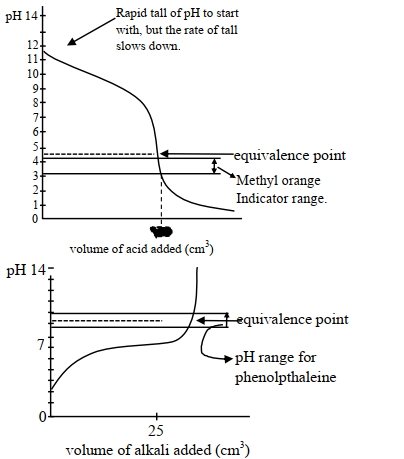
Titration curve for strong acid and weak base initially a buffer of weak base and conjugate acid is:Formed, thus \({pH}\) falls slowly and after equivalence point, so the \({pH}\) falls sharply so methyl arrange, having \({pH}\) range of \(3.2\) to \(4.4\) will weak as indicator. So statement\(-I\) is correct.
Titration curve for weak acid and strong base \(({NaOH})\) Initially weak acid will form a buffer so \({pH}\) increases slowly but after equivalence point. it rises sharply covering range of phenolphthalein so it will be suitable indicator so statement\(-II\) is false.
-
- (A) \(NF _{3}\)
- (B) \(PCl _{5}\)
- (C) \(SF _{4}\)
- (D) \(ClF _{3}\)
જવાબ અને ઉકેલ જુઓ
સાચો જવાબ: (B)
Lewis base : Chemical species which has capability to donate electron pair.In \(NF _{3}, SF _{4}, ClF _{3}\) central atom (i.e. \(\left. N , S , Cl \right)\) having lone pair therefore act as lewis base.
In \(PCl _{5}\) central atom \((P)\) does not have lone pair therefore does not act as lewis base.
-
- (A) \(1.77 \times 10^{-6}\)
- (B) \(1.11 \times 10^{-6}\)
- (C) \(1.11 \times 10^{-2}\)
- (D) \(1.77 \times 10^{-2}\)
જવાબ અને ઉકેલ જુઓ
સાચો જવાબ: (C)
\(Ca ( OH )_{2} \rightleftharpoons Ca ^{2+}( aq )+2 OH ^{-}( aq )\)\(\quad \quad \quad \quad \quad \quad \quad \quad s\quad \quad \quad \quad \quad 2s\)
\(k _{ sp }= s (2 s )^{2} \Rightarrow 5.5 \times 10^{-6}=4 s ^{3}\)
\(\Rightarrow s =\left(\frac{5.5}{4}\right)^{\frac{1}{3}} \times 10^{-2}=1.11 \times 10^{-2}\)
-
- (A) \(196\)
- (B) \(169\)
- (C) \(112\)
- (D) \(141\)
જવાબ અને ઉકેલ જુઓ
સાચો જવાબ: (D)
Given : \(\left[ K _{ sp }\right]_{ PbI _{2}}=8 \times 10^{-9}\)To calculate : solubility of \(PbI _{2}\) in \(0.1 \,M\) sol of \(Pb \left( NO _{3}\right)_{2}\)
\((I)\) \(Pb \left( NO _{3}\right)_{2} \rightarrow Pb _{\text {(aq) }}^{+2}+2 NO _{3}^{-}( aq )\)
\(0.1\,M\quad \quad \quad \quad \quad -\quad \quad \quad \quad \quad -\)
\(-\quad \quad \quad \quad \quad \quad \quad 0.1\,M\quad \quad \quad0.2\,M\)
\((II)\) \(PbI _{2}( s ) \rightleftharpoons Pb ^{+2}( aq )+2 I ^{-}( aq )\)
\(\quad \quad \quad \quad \quad \quad \quad \quad s\quad \quad \quad \quad \quad 2s\)
\(= s +0.1\)
\(\simeq 0.1\)
Now : \(K _{ sp }=8 \times 10^{-9}=\left[ Pb ^{+2}\right][ I^- ]^{2}\)
\(\Rightarrow 8 \times 10^{-9}=0.1 \times(2 s )^{2}\)
\(\Rightarrow 8 \times 10^{-8}=4 s ^{2} \Rightarrow s =\sqrt{2} \times 10^{-4}\)
\(\Rightarrow S =141 \times 10^{-6} \,M\)
\(\Rightarrow x =141\)
-
- (A) \(0.625 \times 10^{-6}\)
- (B) \(1.9 \times 10^{-5}\)
- (C) \(2.2 \times 10^{-16}\)
- (D) \(1.6 \times 10^{-6}\)
જવાબ અને ઉકેલ જુઓ
સાચો જવાબ: (B)
\(\frac{ K _{ sp }}{ Ka }=\frac{ s ^{2}}{\left( H ^{+}\right)} ; \quad s =\sqrt{\frac{ K _{ sp }}{ K _{ a }}\left( H ^{+}\right)}\)\(s=\sqrt{\frac{2.2 \times 10^{-16}}{6.2 \times 10^{-10}} \times 10^{-3}}\)
\(s =1.9 \times 10^{-5}\)
-
- (A) \(5\)
- (B) \(15\)
- (C) \(20\)
- (D) \(10\)
જવાબ અને ઉકેલ જુઓ
સાચો જવાબ: (D)
\(pH = pKa +\log \frac{[ CB ]}{[ WA ]}\)\(5.74=4.74+\log \frac{[ CB ]}{1}\)
\(\Rightarrow[ CB ]=10 M\)
-
- (A) \(2\)
- (B) \(1\)
- (C) \(3\)
- (D) \(4\)
જવાબ અને ઉકેલ જુઓ
સાચો જવાબ: (B)
\(H _{2} SO _{3}\) [Dibasic acid]\(c=0.588 \,M\)
\(\Rightarrow \quad pH\) of solution \(P\) due to First dissociation only
since \(K _{ a },>> Ka _{2}\)
\(\Rightarrow\) First dissociation of \(H _{2} SO _{3}\)
\(H _{2} SO _{3}( aq ) \rightleftharpoons H ^{\oplus}( aq )+ HSO _{3}^{-}( aq ): ka _{1}=1.7 \times 10^{-2}\)
\(t=0\) \(\;\;C\)
\(t\) \(\quad\;\;\;\;C - x\;\; \, x \;\;\, x\)
\(\Rightarrow \quad Ka _{1}=\frac{1.7}{100}=\frac{\left[ H ^{\oplus}\right]\left[ HSO _{3}^{-}\right]}{\left[ H _{2} SO _{3}\right]}\)
\(\Rightarrow \frac{1.7}{100}=\frac{ x ^{2}}{(0.58- x )}\)
\(\Rightarrow 1.7 \times 0.588-1.7 x =100 x ^{2}\)
\(\Rightarrow \quad 100 x^{2}+1.7 x-1=0\)
\(\Rightarrow \quad\left[ H ^{\oplus}\right]= x =\frac{-1.7+\sqrt{(1.7)^{2}+4 \times 100 \times 1}}{2 \times 100}=0.09186\)
Therefore \(pH\) of sol. is \(: pH =-\log \left[ H ^{\oplus}\right]\)
\(\Rightarrow \quad pH =-\log (0.09186)=1.036 \simeq 1\)
-
- (A) એમાયલેઝ અને ઇન્વર્ટેઝ
- (B) ઇન્વર્ટેઝ અને એમાયલેઝ
- (C) ઇન્વર્ટેઝ અને ઝાયમેઝ
- (D) ઝાયમેઝ અને ઇન્વર્ટેઝ
જવાબ અને ઉકેલ જુઓ
સાચો જવાબ: (C)
Informative\(OR\)
\(C _{12} H _{22} O _{11}+ H _{2} O \stackrel{\text { Invertase }}{\longrightarrow} C _{6} H _{12} O _{6}+ C _{6} H _{12} O _{6}\)
\(\quad \quad\quad\quad\quad\quad\quad\quad\quad\quad\quad\)Glucose \(\quad\quad\) Fructose
\(C _{6} H _{12} O _{6} \stackrel{\text { Zymase }}{\longrightarrow} 2 C _{6} H _{5} OH +2 CO _{2}\)
- 23. એક નોન રિડ્યુસિંગ શર્કરા \("A"\) ના જળવિભાજન પર બે રિડ્યુસિંગ મોનો સેકેરાઈડ આપે છે. શર્કરા \(A\) શું છે? 2021 મધ્યમ
- (A) ફ્રૂક્ટોઝ
- (B) ગેલેક્ટોઝ
- (C) ગ્લુકોઝ
- (D) સુક્રોઝ
જવાબ અને ઉકેલ જુઓ
સાચો જવાબ: (D)
Sucrose \(\quad \stackrel{ H _{2} O }{\longrightarrow}\) glucose \(+\) Fructose(Non reducing sugar) \(\quad\) (Re ducing sugar) \(\quad\) (Reducing sugar)
-
- (A) ગેલેક્ટોઝનો \(C -1\) અને ગ્લુકોઝનો \(C -4\)
- (B) ગેલેક્ટોઝનો \(C -1\) અને ગ્લુકોઝનો \(C -6\)
- (C) ગ્લુકોઝનો \(C -1\) અને ગેલેક્ટોઝનો \(C -4\)
- (D) ગ્લુકોઝનો \(C -1\) અને ગેલેક્ટોઝનો \(C -6\)
જવાબ અને ઉકેલ જુઓ
સાચો જવાબ: (A)
In lactose linkage is formed between \(C _{1}\) of galactose and \(C _{4}\) of gluocse.
- 25. મોનોસેકરાઇડને ડાઈસેકેરાઇડથી અલગ કરવા માટે નીચેનામાંથી કયા રાસાયણિક કસોટીનો ઉપયોગ થાય છે? 2021 સરળ
- (A) બેરફોઈડ કસોટી
- (B) સેલિવનોફ્ કસોટી
- (C) ટોલેન્સ કસોટી
- (D) આયોડીન કસોટી
જવાબ અને ઉકેલ જુઓ
સાચો જવાબ: (A)
Barford test is used for distinguish mono-saccharide from disaccharide -
- (A) \( {A} \) અને \( {R} \) બંને સાચા છે પણ \( {R} \) એ \( {A} \) ની સાચી સમજૂતી નથી.
- (B) \( A \) સાચુ નથી પણ \( {R} \) સાચુ છે.
- (C) \( A \) સાચું છે પણ \( {R} \) સાચું નથી.
- (D) \( {A} \) અને \( {R} \) બંને સાચા છે અને \( {R} \) એ \( {A} \) ની સાચી સમજૂતી છે.
જવાબ અને ઉકેલ જુઓ
સાચો જવાબ: (C)
Surcrose is example of disaccharide and non reducing sugarAssertion : correct
Sucrose involves glycosidic linkage between \(\mathrm{C}_{1}\) of \(\alpha-\mathrm{D}\)-glucose \(\mathrm{C}_{2}\) of \(\beta\)-D-fructose
Reason : Incorrect
-
- (A) ગ્લાયકોજનને એનિમલ સ્ટાર્ચ કહેવામાં આવે છે.
- (B) \(\beta\)-ગ્લાયકોસિડિક જોડાણ સેલ્યુલોઝ પોલિમર બનાવે છે
- (C) એમાઇલોઝ એ ગ્લુકોઝનું શાખાવાળું સાંકળ પોલિમર છે
- (D) સ્ટાર્ચ \(\alpha-D\) ગ્લુકોઝનું પોલિમર છે.
જવાબ અને ઉકેલ જુઓ
સાચો જવાબ: (C)
Amylose is a linear chain polymer of \(\alpha-D-\)glucosewhile amylopectine is branched chain polymer of \(\alpha-D-\)glucose. -
- (A) પ્રાથમિક એમાઇન્સમાં આંતરઆણ્વિય સંયોજન એ સેકન્ડરી એમાઇન્સમાં આંતરઆણ્વિય સંયોજન કરતા ઓછું છે.
- (B) નાઈટ્રસ એસિડ દ્રાવણ સાથેની પ્રક્રિયા પર પ્રાથમિક એમાઈન્સ મિથાઈલ એમાઈન સિવાય અનુરૂપ આલ્કોહોલ બનાવે છે.
- (C) પ્રાથમિક એમાઇન્સ દ્વિતીયક એમાઇન્સ કરતા ઓછા બેઝિક છે.
- (D) પ્રાથમિક એમાઇન્સ ગેબ્રિયલ થેલેમાઈડ સંશ્લેષણ દ્વારા તૈયાર કરી શકાય છે.
જવાબ અને ઉકેલ જુઓ
સાચો જવાબ: (A)
The intermolecular association is more prominent in case of primary amines as compared to secondary, due to the availability of two hydrogen atom. -
- (A) લેકટોઝ
- (B) સુક્રોઝ
- (C) માલ્ટોઝ
- (D) એમાયલોઝ
જવાબ અને ઉકેલ જુઓ
સાચો જવાબ: (A)
In Lactose it is \(\beta\, {C}_{1}-{C}_{4}\) glycosidic linkage.In Maltose, Amylose \(\alpha \,{C}_{1}-{C}_{4}\) glycosidic linkage is present
-
- (A) કેરેટીન
- (B) આલ્બ્યુમીન
- (C) કોલગેન
- (D) મ્યોસીન
જવાબ અને ઉકેલ જુઓ
સાચો જવાબ: (B)
Keratin, collagen and myosin are example of fibrous protein. -
- (A) જૈવરાસાયણિક પ્રક્રિયાની સક્રિયકરણ ઊર્જા ઘટાડીને ઉત્સેચકો ઉત્પ્રેરક તરીકે કામ કરે છે.
- (B) ઉત્સેચકોની ક્રિયા તાપમાન અને \({pH}\) વિશિષ્ટ છે.
- (C) પ્રોટીનના લગભગ તમામ ઉત્સેચકો.
- (D) ઉત્સેચકો પ્રક્રિયા અને સબસ્ટ્રેટ માટે બિન-વિશિષ્ટ છે.
જવાબ અને ઉકેલ જુઓ
સાચો જવાબ: (D)
Enzymes are highly specific both in the reactions that they catalyzed and in their choice of reactions, which are called substrates. -
- (A) આયોનિક બંધન
- (B) હાઈડ્રોજન બંધન
- (C) સહસંયોજક બંધન
- (D) વાન્ડર વાલ બળો
જવાબ અને ઉકેલ જુઓ
સાચો જવાબ: (B)
Hydrogen bonding is responsible for the stacking of \(\alpha\) -helix structure of protein. -
- (A) પેપ્ટાઈડ બંધ
- (B) ગ્લાયકોસાઈડીક બંધ
- (C) હાઈડ્રોજન બંધન
- (D) વાન્ડર વાલ્સ બળો
જવાબ અને ઉકેલ જુઓ
સાચો જવાબ: (C)
The secondary structure of protein includes two type :\((a)\) \(\alpha\) -Helix
\((b)\) \(\beta\) -pleated sheet
In \(\alpha\) -Helix structure, the poly peptide chain is coil around due to presence of Intramolecular H-Bonding.
-
- (A) ફાઇબ્રીન
- (B) આલ્બ્યુમીન
- (C) કોલગેન
- (D) મ્યોસીન
જવાબ અને ઉકેલ જુઓ
સાચો જવાબ: (B)
Albumin is water soluble. -
- (A) પિરાનોઝ
- (B) કિટોહેકઝોઝ
- (C) આલ્ડોહેકઝોઝ
- (D) હેપ્તોઝ
જવાબ અને ઉકેલ જુઓ
સાચો જવાબ: (B)
Fructose is a ketohexose.
- 36. સેલીવોનોફ કસોટી અને ઝેન્થોપ્રોટીક કસોટીનો ઉપયોગ અનુક્રમે ...... અને ..... શોધવા માટે થાય છે. 2021 સરળ
- (A) આલ્ડોઝ ,કિટોઝ
- (B) પ્રોટીન, કિટોઝ
- (C) કિટોઝ, પ્રોટીન
- (D) કિટોઝ, આલ્ડોઝ
જવાબ અને ઉકેલ જુઓ
સાચો જવાબ: (C)
Seliwanoff test for ketose and Xenthoprotic test for proteins. -
- (A) એડેનિન
- (B) કાયટોસીન
- (C) ગ્વાનીન
- (D) યુરેસિલ
જવાબ અને ઉકેલ જુઓ
સાચો જવાબ: (A)
Given structure is Thymine and Thymine being paired with adenine. -
- (A) લેકટોઝ
- (B) એમાઇલોઝ
- (C) સુક્રોઝ
- (D) માલ્ટોઝ
જવાબ અને ઉકેલ જુઓ
સાચો જવાબ: (A)
Lactose : It is a disaccharide of \(\beta\)-D-Galactose and \(\beta\)-D-Glucose with \({C}_{1}\) of galactose and \({C}_{4}\) of glucoselink.Lactose : \(\beta-D-\)Galactose \(+\beta-D-\)Glucose.
-
- (A) \(\alpha-{D}-(-)\)-ગ્લુકોઝ અને \(\beta-{D}-(-)\)-ફ્રૂક્ટોઝ
- (B) \(\alpha-{D}-(+)\)-ગ્લુકોઝ અને \(\alpha-{D}-(-)\)-ફ્રૂક્ટોઝ
- (C) \(\alpha-{D}-(-)\)-ગ્લુકોઝ અને \(\alpha-{D}-(+)\)-ફ્રૂક્ટોઝ
- (D) \(\alpha-D-(+)-\)ગ્લુકોઝ અને \(\beta-D-(-)-\)ફ્રૂક્ટોઝ
જવાબ અને ઉકેલ જુઓ
સાચો જવાબ: (D)
Sucrose is formed by \(\alpha-{D}(+) .\) Glucose \(+\beta-{D}(-)\) Fructose.we obtain these monomers on hydrolysis.
-
- (A) \(( a ) \rightarrow( i ),( b ) \rightarrow( iii ),( c ) \rightarrow( ii )\)
- (B) \(( a ) \rightarrow( iii ),( b ) \rightarrow( i ),( c ) \rightarrow( iii )\)
- (C) \((a) \rightarrow (ii), (b) \rightarrow (i), (c) \rightarrow (iii)\)
- (D) \((a) \rightarrow (iii), (b) \rightarrow (ii), (c) \rightarrow (i)\)
જવાબ અને ઉકેલ જુઓ
સાચો જવાબ: (C)
\((1)\) Sucrose \(\rightarrow \alpha\) -D-Glucose and \(\beta\) -D-Fructose\((2)\) Lactose \(\rightarrow \beta-D\) -Galactose and \(\beta-D\) -Glucose
\((3)\) Maltose \(\rightarrow \alpha\) -D-Glucose and \(\alpha\) -D-Glucose
\(a \rightarrow II\)
\(b \rightarrow I\)
\(c \rightarrow III\)
-
- (A) વિટામિન \({B}_{2}\) અને વિટામિન \(E\)
- (B) વિટામિન \({B}_{1}\) અને વિટામિન \({B}_{6}\)
- (C) વિટામિન \({B}_{6}\) અને વિટામિન \({B}_{2}\)
- (D) વિટામિન \(E\) અનેવિટામિન \({B}_{2}\)
જવાબ અને ઉકેલ જુઓ
સાચો જવાબ: (B)
Vitamine- \(B_{1}\) is also known as Thiamine while vitamin \(B-6\) is known as Pyridoxine - 42. ટેટ્રાપેપ્ટાઇડ \(Gly-Glu-Asp-Tyr\)માં \({pH} 12.5\) પર ઋણ ચાર્જની કુલ સંખ્યા \(......\) હશે. 2021 સરળ
- (A) \(4\)
- (B) \(3\)
- (C) \(1\)
- (D) \(2\)
જવાબ અને ઉકેલ જુઓ
સાચો જવાબ: (A)
Total negative charge produced \(=4.\)
-
- (A) \(221\)
- (B) \(243\)
- (C) \(222\)
- (D) \(313\)
જવાબ અને ઉકેલ જુઓ
સાચો જવાબ: (B)
\(M=98\quad \quad \quad \quad \quad\quad \quad \quad \quad \quad M=135\)\(C _{6} H _{5} NH _{2}\) \(\xrightarrow{{90\,\% \,efficiency}}\) \(\begin{array}{*{20}{c}} {\,\,\,\,\,\,\,\,\,\,\,\,\,\,\,\,\,\,\,\,\,O} \\ {\,\,\,\,\,\,\,\,\,\,\,\,\,\,\,\,\,\,\,\,\,||} \\ {{C_6}{H_5} - NH - C - C{H_3}} \end{array}\)
(Aniline)\(\quad \quad \quad \quad \quad\quad \quad \quad\) (Acetanilide)
Given \(1.86 \,g\)
\(\Rightarrow\) \(1\, mol\) \(C _{6} H _{5} NH _{2}\) give \(1\, mol\) \(\begin{array}{*{20}{c}} {\,\,\,\,\,\,\,\,\,\,\,\,\,\,\,\,\,\,\,\,\,O} \\ {\,\,\,\,\,\,\,\,\,\,\,\,\,\,\,\,\,\,\,\,\,||} \\ {{C_6}{H_5} - NH - C - C{H_3}} \end{array}\)
\(\therefore\) moles of \(C _{6} H _{5} NH _{2}=\) moles of \(C _{6} H _{5} NH _{2}\) give \(1\, mol\) \(\begin{array}{*{20}{c}} {\,\,\,\,\,\,\,\,\,\,\,\,\,\,\,\,\,\,\,\,\,O} \\ {\,\,\,\,\,\,\,\,\,\,\,\,\,\,\,\,\,\,\,\,\,||} \\ {{C_6}{H_5} - NH - C - C{H_3}} \end{array}\)
\(\Rightarrow \frac{1.86}{93}=\frac{ W _{\text {acetanilide }}}{135}\)
\(\Rightarrow W_{\text {acelanilide }}=\frac{1.86 \times 135}{93}\, g =2.70\, g\)
But efficiency of reaction is \(90\, \%\) only
\(\therefore\) Mass of acetanilide produced \(=2.70 \times \frac{90}{100} \,g\)
\(=2.43\, g\)
\(=243 \times 10^{-2}\, g\)
\(\Rightarrow x =243\)
-
- (A) \(A > C > B > D\)
- (B) \(D > C > B > A\)
- (C) \(D > B > C > A\)
- (D) \(A > B > C > D\)
જવાબ અને ઉકેલ જુઓ
સાચો જવાબ: (D)
\(B.S.\) order \(( A ) > ( B ) > ( C ) > ( D )\)
-
- (A) બેઝિક અશુધ્ધિઓને દૂર કરવા માટે
- (B) \(NH _{3}\) ને સક્રિય કરી તેનો ઉપયોગ પ્રક્રિયામાં
- (C) એસિડિક અશુધ્ધિઓને દૂર કરવા માટે
- (D) આલ્કાઈલ હેલાઈડની સક્રિયતા વધારવા માટે
જવાબ અને ઉકેલ જુઓ
સાચો જવાબ: (C)
So the purpose of \(NaOH\) in the above reactions in to remove acidic impurities.
-
- (A) \(C _{6} H _{5}- N -( CH _{3})_{2}\)
- (B) \(C _{6} H _{5}- NHCH _{2} -CH _{3}\)
- (C) \(C _{6} H _{5}- CH _{2} NHCH _{3}\)
- (D) \(\begin{array}{*{20}{c}} {{C_6}{H_5} - CH - N{H_2}} \\ | \\ {\,\,\,\,\,\,C{H_3}} \end{array}\)
જવાબ અને ઉકેલ જુઓ
સાચો જવાબ: (D)
Hinsberg reagent (Benzene sulphonyl chloride) gives reaction product with \(1^{\circ}\) amine and it is soluble in dil. \(NaOH\).
-
- (A) દ્વિતીયક એમાઈન , નાઇટ્રાઇલ સંયોજન , સાંદ્ર \({NaOH}\)
- (B) પ્રાથમિક એમાઈન , આઇસોનાઇટ્રાઇલ સંયોજન , સાંદ્ર. \({HCl}\)
- (C) દ્વિતીયક એમાઈન, આઇસોનાઇટ્રાઇલ સંયોજન, સાંદ્ર. \({NaOH}\)
- (D) પ્રાથમિક એમાઈન, નાઇટ્રાઇલ સંયોજન, સાંદ્ર. \({HCl}\)
જવાબ અને ઉકેલ જુઓ
સાચો જવાબ: (B)
\(\,\)\({R}-{NH}_{2} \stackrel{{CHCl}_{3}}{\longrightarrow} {R}-\stackrel{\oplus}{{N}} \equiv \stackrel{\ominus}{{C}} \xrightarrow[({HCl})]{{H}_{3} {O}^{\oplus}} {R}-{NH}_{2}+{HCOOH}\)
\(1^{\circ}\) amine \(_{(A)}\) \(\quad\quad\)Isonitrile \(_{(B)}\) \(\quad\quad(C)\)
-
- (A) \(20\)
- (B) \(80\)
- (C) \(75\)
- (D) \(50\)
જવાબ અને ઉકેલ જુઓ
સાચો જવાબ: (B)
\(1 mole \quad1 mole\)\(78 gm \quad 123 gm\)
\(3.9 gm \quad \frac{123}{78} \times 3.9=6.15 gm\)
But actual amount of nitrobenzene formed is \(4.92 gm\) and hence.
Percentage yield \(=\frac{4.92}{6.15} \times 100=80 \%\)

-
- (B) \(CH _{3} CH _{2} NH _{2}\)
- (C) \(CH _{3} CH _{2} CH _{2} NHCH _{3}\)
- (D) \(C{H_3}C{H_2}C{H_2}\mathop N\limits^H - C{H_2}C{H_3}\)
જવાબ અને ઉકેલ જુઓ
સાચો જવાબ: (D)
It has to be \(2^{\circ}\) amine because on reaction with benzene sulphonylchloride it gives water in soluble product. As it is formed by ammonolysis of ethylchloride, so it has to be \(R-NH-Et\) type.
- 50. ગ્રેબીયલ સંશ્લેષણ દ્વારા સાંશ્લેષિત કરી શકાય તેવા નીચે આપેલા એમાઈનોની કુલ સંખ્યા ..... છે.
 2021 મધ્યમ
- (A) \(3\)
- (B) \(4\)
- (C) \(2\)
- (D) \(0\)
જવાબ અને ઉકેલ જુઓ
સાચો જવાબ: (A)
Gabriel phthalimide synthesis is used to prepare \(1^{\circ}\) aliphatic/alicyclic amine in common.Hence amine which can synthesised by Gabriel phthalimide synthesis method is :
\((A)\) \(Me _{2} CH - CH _{2}- NH _{2}\)
\((B)\) \(CH _{3} CH _{2} NH _{2}\)
\((C)\) \(Ph - CH _{2}- NH _{2}\)


આ પેજ પર આ ફિલ્ટર મુજબ કોઈ પ્રશ્ન નથી.
અન્ય વર્ષ
વારંવાર પૂછાતા પ્રશ્નો
ExamBro પર JEE Mains 2021 Chemistry ના કેટલા પ્રશ્નો છે?
420 પ્રશ્નો, દરેક સાચા જવાબ અને પૂરા ઉકેલ સાથે.
JEE Mains 2021 Chemistry નું કયું પ્રકરણ સૌથી વધુ પૂછાય છે?
સવર્ગ સંયોજનો, 35 પ્રશ્નો સાથે; ત્યાર બાદ P-વિભાગનાં તત્ત્વો - 2, 28 પ્રશ્નો સાથે.
JEE Mains 2021 Chemistry ના પ્રશ્નો કેટલા અઘરા હોય છે?
25% સરળ, 50% મધ્યમ અને 25% અઘરા.