


પ્રશ્નો
નવા પહેલા48 માંથી 1–48 પ્રશ્નો
-
- (A) 30
- (B) 32
- (C) 34
- (D) 36
જવાબ અને ઉકેલ જુઓ
સાચો જવાબ: (C)
પ્રમાણભૂત ગિબ્સ મુક્ત ઉર્જા ફેરફાર નીચે મુજબ આપવામાં આવે છે:
\(\Delta G^{\theta} = -RT \ln K = -2.3 RT \log K\)
પ્રથમ, \(\log K\) ની ગણતરી કરો:
\(\log K = \log(1.8 \times 10^{-7}) = \log(18 \times 10^{-8})\)
\(\log K = \log 18 - 8 = \log(2 \times 3^2) - 8\)
\(\log K = \log 2 + 2 \log 3 - 8\)
આપેલ કિંમતો મૂકતા:
\(\log K = 0.30 + 2(0.48) - 8 = 0.30 + 0.96 - 8 = 1.26 - 8 = -6.74\)
હવે, \(\Delta G^{\theta}\) ની ગણતરી કરો:
\(\Delta G^{\theta} = -2.3 \times 8.3 \times 300 \times (-6.74) = 38599.98 \text{ J mol}^{-1}\)
સંબંધ \(\Delta G^{\theta} = \Delta H^{\theta} - T \Delta S^{\theta}\) નો ઉપયોગ કરતા:
\(38599.98 = 28400 - 300 \Delta S^{\theta}\)
\(300 \Delta S^{\theta} = 28400 - 38599.98 = -10199.98\)
\(\Delta S^{\theta} = -\dfrac{10199.98}{300} \approx -34 \text{ J K}^{-1} \text{ mol}^{-1}\)
\(\Delta S^{\theta}\) નું મૂલ્ય \(34\) છે.
જવાબ: \(34\) -
- (A) 30
- (B) 33
- (C) 35
- (D) 38
જવાબ અને ઉકેલ જુઓ
સાચો જવાબ: (B)
\(-1.664 \times 10^3=-8.3 \times 300 \ln K_{ p }\)
\(\ln K _{ p }=0.693\)
\(K_{ p }=2\)
\(2=\frac{4 \alpha^2 P _0}{1-\alpha^2}\)
\(\alpha=\frac{1}{\sqrt{3}}\)
\(\alpha=\left(\frac{100}{3} \times 10^{-2}\right)^{1 / 2}\)
\(=\left(33.33 \times 10^{-2}\right)^{1 / 2}\) -
- (A) \( \Delta_{r}G^{\circ}(1) > 0; \Delta_{r}G^{\circ}(2) < 0 \)
- (B) \( \Delta_{r}G^{\circ}(1) < 0; \Delta_{r}G^{\circ}(2) < 0 \)
- (C) \( \Delta_{r}G^{\circ}(1) < 0; \Delta_{r}G^{\circ}(2) > 0 \)
- (D) \( \Delta_{r}G^{\circ}(1) > 0; \Delta_{r}G^{\circ}(2) > 0 \)
જવાબ અને ઉકેલ જુઓ
સાચો જવાબ: (C)
\( PbO_{2} + Pb \rightarrow 2PbO \)
\( Pb^{2+} \) વધુ સ્થિર છે આથી પ્રતિક્રિયા સ્વયંસ્ફુરિત હશે. તેથી \( \Delta G^{\circ}_{r}(1) \) ઋણ છે.
\( SnO_{2} + Sn \rightarrow 2SnO \)
\( Sn^{2+} \) ઓછો સ્થિર છે, તેથી પ્રતિક્રિયા બિન-સ્વયંસ્ફુરિત હશે આથી \( \Delta G^{\circ}_{r}(2) \) ધન છે. -
- (A) \(-21000\)
- (B) \(-10\)
- (C) \(-1000\)
- (D) \(-9.012\)
જવાબ અને ઉકેલ જુઓ
સાચો જવાબ: (B)
આપેલી પ્રક્રિયા છે \(X_2(g) + Y_2(g) \rightleftharpoons 2XY(g)\).
પ્રક્રિયાની પ્રમાણભૂત એન્થાલ્પી, \(\Delta_r H^\circ\), નીચે મુજબ ગણવામાં આવે છે:
\(\Delta_r H^\circ = \sum \Delta_f H^\circ(\text{નીપજો}) - \sum \Delta_f H^\circ(\text{પ્રક્રિયકો})\)
\(\Delta_r H^\circ = 2 \Delta_f H^\circ(XY) - [\Delta_f H^\circ(X_2) + \Delta_f H^\circ(Y_2)]\)
\(\Delta_r H^\circ = 2(42) - (8 + 80) = 84 - 88 = -4 \text{ kJ mol}^{-1}\)
પ્રક્રિયાની પ્રમાણભૂત એન્ટ્રોપી, \(\Delta_r S^\circ\), નીચે મુજબ ગણવામાં આવે છે:
\(\Delta_r S^\circ = \sum S^\circ(\text{નીપજો}) - \sum S^\circ(\text{પ્રક્રિયકો})\)
\(\Delta_r S^\circ = 2 S^\circ(XY) - [S^\circ(X_2) + S^\circ(Y_2)]\)
\(\Delta_r S^\circ = 2(200) - (140 + 250) = 400 - 390 = 10 \text{ J K}^{-1} \text{ mol}^{-1}\)
\(\Delta_r S^\circ\) ને \(\text{kJ K}^{-1} \text{ mol}^{-1}\) માં રૂપાંતર કરતાં:
\(\Delta_r S^\circ = \dfrac{10}{1000} = 0.01 \text{ kJ K}^{-1} \text{ mol}^{-1}\)
હવે, ગિબ્સ મુક્ત ઊર્જા સમીકરણનો ઉપયોગ કરીને:
\(\Delta_r G^\circ = \Delta_r H^\circ - T \Delta_r S^\circ\)
\(\Delta_r G^\circ = -4 - 600 \times 0.01\)
\(\Delta_r G^\circ = -4 - 6 = -10 \text{ kJ mol}^{-1}\)
જવાબ: \(-10\) -
- (A) 725
- (B) 726
- (C) 727
- (D) 728
જવાબ અને ઉકેલ જુઓ
સાચો જવાબ: (C)
સંક્રાંતિ તાપમાન અને \(1\) atm દબાણે, બે અવસ્થાઓ \(A\) અને \(B\) સંતુલનમાં છે.
શુદ્ધ પદાર્થના \(1\) atm દબાણે થતા કલા સંક્રમણ માટે, બંને અવસ્થાઓ તેમની પ્રમાણભૂત અવસ્થામાં હોય છે, તેથી પ્રક્રિયા ભાગફળ \(Q = 1\).
સંબંધ \(\Delta G = \Delta G^0 + RT \ln Q\) નો ઉપયોગ કરતા, આપણને \(\Delta G = \Delta G^0\) મળે છે.
સંતુલન પર, \(\Delta G = 0\), જેનો અર્થ થાય છે \(\Delta G^0 = 0\).
આપેલ \(\Delta G^0 = 105 - 35\log T\) ને આપણે શૂન્ય બરાબર કરી શકીએ:
\(105 - 35\log T = 0\)
\(35\log T = 105\)
\(\log T = 3\)
\(T = 10^3 = 1000\) K
તાપમાનને સેલ્સિયસમાં રૂપાંતરિત કરતા:
\(T(^{\circ}\text{C}) = 1000 - 273 = 727^{\circ}\text{C}\)
જવાબ: \(727\) -
- (A) A-IV, B-I, C-III, D-II
- (B) A-IV, B-II, C-III, D-I
- (C) A-I, B-III, C-II, D-IV
- (D) A-II, B-I, C-III, D-IV
જવાબ અને ઉકેલ જુઓ
સાચો જવાબ: (D)
(A) \(W _{ Rev .}=-\int P _{ gas } dV\)
\(W _{\text {Rev. Isot. Exp. }}=- nRT \ln \left[\frac{ V _{ f }}{ V _{ i }}\right]\)
(A) → (II)
(B) મુક્ત વિસ્તરણ
\(W _{ irrev. }=- P _{ ext } \Delta V\)
\(P _{ ext }=0\)
\(W =0\)
\(( B ) \rightarrow( I )\)
(C) અપ્રતિવર્તી વિસ્તરણ
\(W _{\text {irrev: }}=- P _{\text {ext }} \Delta V\)
\(W_{\text {irrev: }}=-P_{\text {ext }}\left(V_f-V_i\right)\)
(C) → (III)
(D) અપ્રતિવર્તી સંકોચન
\(W _{\text {irrer: }}=- P _{\text {ext }} \Delta V\)
\(W _{\text {irrer: }}=- P _{\text {ext }}\left( V _{ i }- V _{ f }\right)\) -
- (A) \(\mathrm{T}=\mathrm{Te}\)
- (B) \(\mathrm{Te} \gt \mathrm{T}\)
- (C) \(\mathrm{T} \gt \mathrm{Te}\)
- (D) \(\mathrm{Te}=5 \mathrm{~T}\)
જવાબ અને ઉકેલ જુઓ
સાચો જવાબ: (C)
\(2^{\text {nd }}\) નિયમ અનુસાર પ્રક્રિયા સ્વયંભૂ બને તે માટે:
\(\begin{aligned}
& \Delta \mathrm{G} \lt 0 \\
& \Rightarrow \Delta \mathrm{H}-\mathrm{T} \Delta \mathrm{~S} \lt 0 \\
& \Rightarrow \mathrm{~T} \gt \left(\frac{\Delta \mathrm{H}}{\Delta \mathrm{~S}}\right)=\mathrm{T}_{\mathrm{e}} \\
& \Rightarrow \mathrm{~T} \gt \mathrm{T}_{\mathrm{e}}
\end{aligned}\) -
- (A) 2850
- (B) 2750
- (C) 2950
- (D) 2650
જવાબ અને ઉકેલ જુઓ
સાચો જવાબ: (A)
\(\begin{aligned} & \Delta \mathrm{H}_{\mathrm{rxn}}^{\mathrm{o}}=55 \mathrm{~kJ} / \mathrm{mol}, \quad \mathrm{T}=298 \mathrm{~K} \\ & \Delta \mathrm{~S}_{\mathrm{rxn}}^{\mathrm{o}}=175 \mathrm{~J} / \mathrm{mol} \\ & \Delta \mathrm{G}_{\mathrm{rxn}}^{\mathrm{o}}=\Delta \mathrm{H}_{\mathrm{rxn}}^{\mathrm{o}}-\mathrm{T} \Delta \mathrm{S}_{\mathrm{rxn}}^{\circ} \\ & \Rightarrow \Delta \mathrm{G}_{\mathrm{rxn}}^{\mathrm{o}}=55000 \mathrm{~J} / \mathrm{mol}-298 \times 175 \mathrm{~J} / \mathrm{mol} \\ & \Rightarrow \Delta \mathrm{G}_{\mathrm{rxn}}^{\mathrm{o}}=55000-52150 \\ & \Rightarrow \Delta \mathrm{G}_{\mathrm{rxn}}^{\mathrm{o}}=2850 \mathrm{~J} / \mathrm{mol}\end{aligned}\) -
- (A) મોલર ઉષ્મા ક્ષમતા
- (B) ઘનતા
- (C) સાંદ્રતા
- (D) ગિબ્સ મુક્ત ઊર્જા
જવાબ અને ઉકેલ જુઓ
સાચો જવાબ: (D)
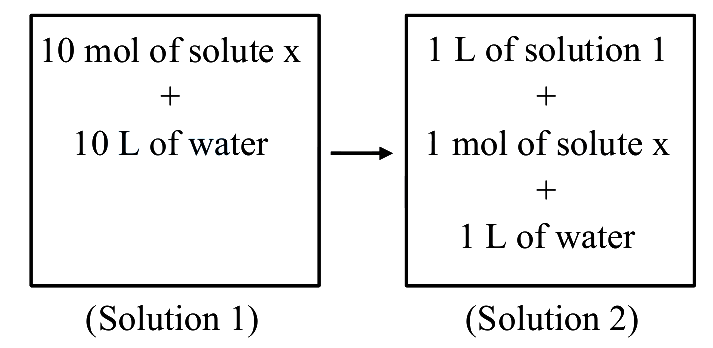
બંને દ્રાવણોની સંરચના સમાન છે, જે 1 ' \(\ell\) ' પાણીમાં ' \(x\) ' ના 1 મોલ છે, તેથી બધા સઘન ગુણધર્મો સમાન રહેશે, પરંતુ દ્રાવણ ' 1 ' માં દ્રાવણ ' 2 ' ની સરખામણીમાં કુલ જથ્થો વધુ છે. તેથી વિસ્તૃત ગુણધર્મો અલગ હશે આથી ગિબ્સ મુક્ત ઊર્જા અલગ હશે. -
- (A) (B) અને (C) માત્ર
- (B) (B) અને (D) માત્ર
- (C) (A) અને (D) માત્ર
- (D) (A) અને (C) માત્ર
જવાબ અને ઉકેલ જુઓ
સાચો જવાબ: (A)
\(\because \Delta \mathrm{G}=\Delta \mathrm{H}-\mathrm{T} \Delta \mathrm{~S}\)
પ્રક્રિયાની સ્વયંભૂતા માટે: \(\Delta \mathrm{G}\) ઋણ હોવું જોઈએ. -
- (A) એક સ્વયંભૂ (આપમેળે) પ્રક્રિયા માટે \(\Delta G\) ઋણ છે.
- (B) એક સ્વયંભૂ (આપમેળે) પ્રક્રિયા માટે \(\Delta G\) ધન છે.
- (C) એક પ્રતિવર્તી પ્રક્રિયા માટે \(\Delta G\) શૂન્ય છે.
- (D) એક સ્વયંભૂ (આપમેળે) ન થતી પ્રક્રિયા માટે \(\Delta \mathrm{G}\) ધન છે.
જવાબ અને ઉકેલ જુઓ
સાચો જવાબ: (B)
\((\Delta \mathrm{G})_{\mathrm{P}, \mathrm{T}}=(+) \text { ve for non-spontaneous process }\) -
- (A) \(37\)
- (B) \(38\)
- (C) \(39\)
- (D) \(40\)
જવાબ અને ઉકેલ જુઓ
સાચો જવાબ: (A)
\( \Delta \mathrm{G}^{\circ}=\Delta \mathrm{H}^{\circ}-\mathrm{T} \Delta \mathrm{S}^{\circ} \)\( =77.2 \times 10^3-400 \times 122=28400 \mathrm{~J} \)
\( \Delta \mathrm{G}^{\circ}=-2.303 \mathrm{RT} \log \mathrm{K} \)
\( \Rightarrow 28400=-2.303 \times 8.314 \times 400 \log \mathrm{K} \)
\( \Rightarrow \log \mathrm{K}=-3.708=-37.08 \times 10^{-1}\)
-
- (A) \(11\)
- (B) \(12\)
- (C) \(14\)
- (D) \(10\)
જવાબ અને ઉકેલ જુઓ
સાચો જવાબ: (D)
\(\Delta G ^0=\Delta H ^0- T \Delta S\)\(\Rightarrow \Delta G ^0=(-54070-10 \times 298)\)
Also, \(\Delta G ^0=(-2.303 RT \log K )\)
\(\Rightarrow(-54070-10 \times 298)\)
\(=(-2.303 \times 8.134 \times 298 \log K )\)
\(\Rightarrow \log K =10 \text { Ans: } 10\)
-
- (A) \(1411\)
- (B) \(1412\)
- (C) \(1413\)
- (D) \(1414\)
જવાબ અને ઉકેલ જુઓ
સાચો જવાબ: (A)
\(C _2 H _{4( g )}+3 O _{2( g )} \longrightarrow 2 CO _{2( g )}+2 H _2 O_{(l)}\)\(\Delta U =-1406\,KJ\,mol ^{-1}, T =300\,K\)
\(\Delta H =\Delta U +\Delta n _{ g } RT\)
\(\Delta H =-1406+(-2) \times 8.3 \times 300=-1406-4.98\)
\(=-1410.98\,KJ\,mol ^{-1} \approx-1411\)
\(\Delta H = T \Delta S =-1411\,KJ\,mol ^{-1}\)
-
- (A) \(4\)
- (B) \(6\)
- (C) \(2\)
- (D) \(8\)
જવાબ અને ઉકેલ જુઓ
સાચો જવાબ: (C)
\(\Delta G =\Delta H - T \Delta S\)\(A : \Delta G \left( J\,mol ^{-1}\right)=-25 \times 10^3+80 \times 300:- ve\)
\(B : \Delta G \left( J\,mol ^{-1}\right)=-22 \times 10^3-40 \times 300:- ve\)
\(C : \Delta G \left( J\,mol ^{-1}\right)=25 \times 10^3+300 \times 50:+ ve\)
\(D : \Delta G \left( J\,mol ^{-1}\right)=22 \times 10^3-20 \times 300:+ ve\)
Processes \(C\) and \(D\) are non-spontaneous.
-
- (A) \(1070\)
- (B) \(1060\)
- (C) \(1050\)
- (D) \(1040\)
જવાબ અને ઉકેલ જુઓ
સાચો જવાબ: (A)
\(\Delta S =\frac{\Delta H }{ T _{ mp }}\)\(28.4=\frac{30.4 \times 1000}{ T _{ mp }}\)
\(T _{ mp }=1070.422\,K\)
-
- (A) \(6\)
- (B) \(4\)
- (C) \(8\)
- (D) \(2\)
જવાબ અને ઉકેલ જુઓ
સાચો જવાબ: (D)
For, Spontaneous process \(dG < 0\)For, Equilibrium \(dG =0\)
For, Nonspontaneous process \(dG > 0\)
\(\therefore\) \(A\) Wrong
\(B\) Correct
\(C\) Correct
\(D\) Wrong
-
- (A) ફક્ત \(C\) અને \(D\)
- (B) ફક્ત \(B\) અને \(C\)
- (C) ફક્ત \(A\) અને \(B\)
- (D) ફક્ત \(B\) અને \(D\)
જવાબ અને ઉકેલ જુઓ
સાચો જવાબ: (B)
Only \((B)\) and \((C)\) are correct.\((B)\) \(G = H - TS\)
At constant \(T\)
\(\Delta G =\Delta H - T \Delta S\)
(A) First law is given by
\(\Delta U = Q + W\)
If we apply constant \(P\) and reversible work
\(\Delta U = Q - P \Delta V\)
(C)By definition of entropy change
\(dS =\frac{ dq _{ rer }}{ T }\)
At constant \(T\)
\(\Delta S=\frac{q_{\text {rev }}}{T}\)
(D) \(H = U + PV\)
For ideal gas
\(H = U + nRT\)
At constant \(T\)
\(\Delta H =\Delta U +\Delta nRT\)
-
- (A) \(6\)
- (B) \(3\)
- (C) \(12\)
- (D) \(9\)
જવાબ અને ઉકેલ જુઓ
સાચો જવાબ: (A)
\(\because \Delta G ^{\circ}=- RT \ln K _{ eq }\)\(\text { and } K _{ eq }=\frac{ K _{ f }}{ K _{ b }}\)
\(\therefore K _{ eq }=\frac{10^3}{10^2}=10\)
\(\therefore \Delta G =- RT \ln 10\)
\(\Rightarrow-(8.3 \times 300 \times 2.3)=-5.7\,kJ\,mole ^{-1} \approx 6\,kJ\)
\(\text { mole }{ }^{-1}(\text { nearest integer) }\)
\(\text { Ans }=6\)
-
- (A) \(30\)
- (B) \(300\)
- (C) \(210\)
- (D) \(670\)
જવાબ અને ઉકેલ જુઓ
સાચો જવાબ: (B)
\(\Delta G =\Delta H - T \Delta S =0\) at equilibrium\(\Rightarrow-165 \times 10^{3}- T \times(-505)=0\)
\(\Rightarrow T =300\, K\)
-
- (A) \(5\)
- (B) \(96\)
- (C) \(51\)
- (D) \(57\)
જવાબ અને ઉકેલ જુઓ
સાચો જવાબ: (C)
\(\frac{1}{2} H _{2}+ Ag ^{+} \rightarrow H ^{+}+ Ag\)\(\Delta G ^{\circ}=- nE ^{\circ} F\)
\(=-1 \times 0.5332 \times 96500 \,J\)
\(=-51.35 \,kJ\)
\(\left( n =2 \text { for } H _{2}+2 Ag ^{+} \rightarrow 2 H ^{+}+2 Ag \right)\)
-
- (A) \(\Delta H =\Delta U - P \Delta V\)
- (B) \(\Delta U = q + W\)
- (C) \(\Delta S _{ syz }+\Delta S _{ suxr } \geq 0\)
- (D) \(\Delta G =\Delta H - T \Delta S\)
જવાબ અને ઉકેલ જુઓ
સાચો જવાબ: (A)
If \(U + P _{ V }\) (By definition)\(\Delta 14=\Delta U +\Delta( Pr )\) at constant pressure
\(\Delta H =\Delta U + P \Delta V\)
-
- (A) \(( A )-( III ),( B )-( II ),( C )-( IV ),( D )-( I )\)
- (B) \(( A )-( II ),( B )-( III ),( C )-( IV ),( D )-( I )\)
- (C) \(( A )-( II ),( B )-( III ),( C )-( I ),( D )-( IV )\)
- (D) \(( A )-( II ),( B )-( I ),( C )-( III ),( D )-( IV )\)
જવાબ અને ઉકેલ જુઓ
સાચો જવાબ: (B)
\((A)\) For a spontaneous process \(\Delta G _{ T , p }\, < \,0\)\((B)\;\Delta P =0 \rightarrow\) Isobaric process
\(\Delta T =0 \rightarrow\) Isothermal process
\((C)\;\Delta H _{\text {reaction }}=(\Sigma\) Bond energies of reactants \() - (\Sigma\) bond energies of products)
\((D)\;\Delta H\, < \,0\) is for exothermic reaction
-
- (A) \(49\)
- (B) \(36\)
- (C) \(55\)
- (D) \(46\)
જવાબ અને ઉકેલ જુઓ
સાચો જવાબ: (D)
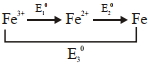
\(E _{1}^{0}+2 E _{2}^{0}=3 E _{3}^{0}\)\(E _{1}^{0}=3 E _{3}^{0}-2 E _{2}^{0}\)
\(=3(-0.036)-2(-0.44)\)
\(=+0.772 V\)
\(E _{\text {cell }}^{0}= E _{ Fe ^{3+} / Fe ^{2+}}^{0}+ E _{ I / I _{2}}^{0}=0.233\)
\(\Delta_{ r } G ^{0}=-2 \times 96.5 \times 0.233=-45 kJ\)
-
- (A) \(15\)
- (B) \(10\)
- (C) \(5\)
- (D) \(8\)
જવાબ અને ઉકેલ જુઓ
સાચો જવાબ: (C)
\(\Delta {G}=\Delta {H}-{T} \Delta {S}\)\(\Delta {G}=57.8-\frac{298(-176)}{1000}\)
\(\Delta {G}=-5.352 \,{~kJ} / {mole}\)
\(\mid\) Nearest integer value \(\mid=5\)
-
- (A) \(360\)
- (B) \(390\)
- (C) \(460\)
- (D) \(551\)
જવાબ અને ઉકેલ જુઓ
સાચો જવાબ: (A)
Given chemical reaction:\({A} \underset{{T}\, 300\, {~K}}{\longrightarrow} {B}\)
\([\Delta {G}]_{{P}, {T}}=-49.4\, {~kJ} / {mol}\)
\(\Delta {H}_{{rxn}}=51.4 \,{~kJ} / {mol}\)
\(\Delta {S}_{{rxn}}=?\)
\(\Rightarrow\) From the relation \([\Delta {G}]_{{P}, {T}}=\Delta {H}-{T} \Delta {S}\)
\(\Rightarrow \Delta S_{\text {rxn }} =\frac{\Delta H_{r x n}-[\Delta G]_{p, T}}{T}\)
\(=\frac{[51.4-(-49.4)] \times 100}{300} \,\frac{{J}}{{mol} {K}}\)
\(\Rightarrow \Delta {S}_{{rxn}} =336\, \frac{{J}}{{mol} {K}}\)
-
- (A) \(25\)
- (B) \(30\)
- (C) \(20\)
- (D) \(35\)
જવાબ અને ઉકેલ જુઓ
સાચો જવાબ: (C)
\(\Delta G ^{\circ}=- RT \ell n K _{ eq }\)Given \(\Delta G ^{\circ}=-9.478 KJ / mole\)
So \(-9.478 \times 10^{3}=-495 \times 8.314 \times \ell n K _{ eq }\)
\(\ell n K _{ eq }=2.303\)
\(=\ell n 10\)
So \(K _{ eq }=10\)
Now \(A ( g ) \rightleftharpoons B ( g )\)
\(\begin{array}{lll} t =0 & 22 0\end{array}\)
\(\begin{array}{lll}t=t 22-x x\end{array}\)
\(K _{ eq }=\frac{[ B ]}{[ C ]}=\frac{ x }{22- x }=10\)
or \(x=20\)
So millmoles of \(B =20\)
-
- (A) \(855\)
- (B) \(952\)
- (C) \(412\)
- (D) \(1054\)
જવાબ અને ઉકેલ જુઓ
સાચો જવાબ: (A)
\(3 HC \equiv CH _{( g )} \rightarrow C _{6} H _{6}(\ell): \Delta G ^{0}=- RT \ln k\)\(\Delta G _{ f }^{0}-2.04 \times 10^{5} \,\frac{ J }{ mol }-1.24 \times 10^{5}\, \,J / mol\)
\(\Rightarrow \Delta G ^{0}=\sum\left(\Delta G _{ f }^{0}\right)_{ P }-\sum\left(\Delta G _{ f }^{0}\right)_{ R }\)
\(\Rightarrow- RT \,\ell nk =1 \times\left(-124 \times 10^{5}\right)-\left(-3 \times 2.04 \times 10^{5}\right)\)
\(\Rightarrow-2.303 \times R \times T \log\, k =4.88 \times 10^{5}\)
\(\Rightarrow \log k =-\frac{4.88 \times 10^{5}}{2.303 \times R \times T }=-\frac{488000}{5705.848}=-85.52\)
\(=855 \times 10^{-1}\)
\(\Rightarrow x =855\)
-
- (A) \(50\)
- (B) \(250\)
- (C) \(200\)
- (D) \(150\)
જવાબ અને ઉકેલ જુઓ
સાચો જવાબ: (C)
\(\Delta G ^{0}=\Delta H ^{0}- T \times \Delta S ^{0}\)\(\Delta G ^{0}=\Delta H ^{0}- T \times(2 T )\)
\(T =200\, K\)
-
- (A) \(0.25\)
- (B) \(2.5\)
- (C) \(250\)
- (D) \(25\)
જવાબ અને ઉકેલ જુઓ
સાચો જવાબ: (D)
\(\Delta {G}^{\circ}=-{nFE}^{\circ}=\Delta {H}^{\circ}-{T} \Delta {S}^{\circ}\)\(=\frac{\Delta {H}^{\circ}+{nFE}^{\circ}}{{T}}\)
\(=\frac{\left(-825.2 \times 10^{3}\right)+(2 \times 96487 \times 4.315)}{298}\)
\(=\frac{-825.2 \times 10^{3}+832.682 \times 10^{3}}{298}\)
\(=\frac{7.483 \times 10^{3}}{298}=25.11\, {JK}^{-1}\, {~mol}^{-1}\)
\(\therefore\) Nearest integer answer is \(25\)
-
- (A) \(964\)
- (B) \(864\)
- (C) \(96.4\)
- (D) \(9.64\)
જવાબ અને ઉકેલ જુઓ
સાચો જવાબ: (A)
\({T}_{\min }=\left(\frac{\Delta^{0} {H}}{\Delta^{0} {~S}}\right)\)\(\Delta^{0} {H}_{{rxn}}=\left[\Delta_{{f}}^{0} {H}({Fe})+\Delta_{{f}}^{0} {H}({CO})\right]-\)
\(=\left[\Delta_{{f}}^{0} {H}({FeO})+\Delta_{{f}}^{0} {H}\left({C}_{(\text {graphite })}\right)\right]\)
\(=[0-110.5]-[-266.3+0]\)
\(=155.8 \, {~kJ} / {mol}\)
\(\Delta^{0} {~S}_{{rxn}}=\left[\Delta^{0} {~S}({Fe})+\Delta^{0} {~S}({CO})\right]-\)
\(\left[\Delta^{0} {~S}({FeO})+\Delta^{0} {~S}\left({C}_{({graphite})}\right)\right]\)
\(=[27.28+197.6]-[57.49+5.74]\)
\(=161.65 \,{~J} / {mol}-{K}\)
\({T}_{\min }=\frac{155.8 \times 10^{3} \,{~J} / {mol}}{161.65\, {~J} / {mol}-{K}}=963.8\, {~K}\)
\(\simeq 964 \,{k}\) (nearest integer)
-
- (A) \(6\)
- (B) \(8\)
- (C) \(10\)
- (D) \(12\)
જવાબ અને ઉકેલ જુઓ
સાચો જવાબ: (A)
\(\Delta G ^{\circ}=- AFE ^{\circ}=-3 \times 96500 \times E ^{\circ}\)\(\Rightarrow E ^{\circ}=-6 \times 10^{-2} V\)
-
- (A) \(-1.3\)
- (B) \(-2.7\)
- (C) \(-3.7\)
- (D) \(-4.2\)
જવાબ અને ઉકેલ જુઓ
સાચો જવાબ: (B)
\(\mathrm{A}(\ell) \longrightarrow 2 \mathrm{B}(\mathrm{g})\)\(\Delta \mathrm{U}=2.1 \mathrm{Kcal}, \Delta \mathrm{S}=20 \mathrm{cal} \mathrm{K}^{-1}\) at \(300 \mathrm{K}\)
\(\Delta \mathrm{H}=\Delta \mathrm{U}+\Delta \mathrm{n}_{\mathrm{g}} \mathrm{RT}\)
\(\Delta \mathrm{G}=\Delta \mathrm{H}-\mathrm{T} \Delta \mathrm{S}\)
\(\Delta \mathrm{G}=\Delta \mathrm{U}+\Delta \mathrm{n}_{\mathrm{g}} \mathrm{RT}-\mathrm{T} \Delta \mathrm{S}\)
\(=2.1+\frac{2 \times 2 \times 300}{1000}-\frac{300 \times 20}{1000}\)
\(\left(\mathrm{R}=2 \mathrm{cal} \mathrm{K}^{-1} \mathrm{mol}^{-1}\right)\)
\(=2.1+1.2-6=-2.70 \mathrm{Kcal} / \mathrm{mol}\)
-
- (A) \(13536.6\)
- (B) \(-13537.6\)
- (C) \(-13535.5\)
- (D) \(13530.2\)
જવાબ અને ઉકેલ જુઓ
સાચો જવાબ: (B)
\(\Delta G^{\circ}=\Delta H^{\circ}-T \Delta S^{\circ}\)\(=\left(\Delta U^{\circ}+\Delta n_{g} R T\right)-T \Delta S^{\circ}\)
\(\left.=\left[\{-20+(-1)) \frac{8.314}{1000} \times 298\right\}-\frac{298}{1000} \times(-30)\right] k J\)
\(=-13.537572 kJ\)
\(=-13537.57\) Joule
-
- (A) આપેલ તત્વના બધા પરમાણુઓ સમાન દળ સહિતના સમાન ગુણધર્મો ધરાવે છે. જુદા તત્ત્વોના પરમાણુઓના દળ જુદા હોય છે
- (B) રાસાયણિક પ્રક્રિયા દરમિયાન પરમાણુઓની પુનઃગોઠવણી થાય છે. રાસાયણિક પ્રક્રિયામાં તેઓનું સર્જન કે વિનાશ થતો નથી
- (C) બધા વાયુઓ સમાન \(T\) અને \(P\) એ હોય તો જ્યારે તેઓ સંયોજાય કે ઉત્પન્ન થાય ત્યારે કદથી એક સાદા ગુણોતરમાં હોય છે.
- (D) દ્રવ્ય સ્વતંત્ર અસ્તિત્વ ધરાવતા પરમાણુઓનું બનેલું છે
જવાબ અને ઉકેલ જુઓ
સાચો જવાબ: (C)
according to Gaylussac's law of volume combination when gases combine or reproduced in a chemical reaction they do so in a simple ratio by volume provided all gases are at the same \(T\) and \(P.\) -
- (A) \(-8\)
- (B) \(-9\)
- (C) \(-2\)
- (D) \(+10\)
જવાબ અને ઉકેલ જુઓ
સાચો જવાબ: (B)
\(W = - {P_{ext}}\,\left( {{V_2} - {V_1}} \right)\) -
- (A) \(-412.8\)
- (B) \(-384.0\)
- (C) \(1920\)
- (D) \(206.4\)
જવાબ અને ઉકેલ જુઓ
સાચો જવાબ: (A)
\(\Delta G\, = \, - \,nFE_{cell}\, = \, - \,2\) \( \times \,96500\, \times \,2\,\, = \, - \,386\,\,kJ\)\(\Delta S=nF\left( \frac{dE}{dT} \right)=2\times 96500\,\,\times (-5\times {{10}^{-4}}J{{/}^{o}}C)=-96.5\,kJ\)
at \(298\,K\)
\(T\Delta S=298\times \,(-96.5\,\,J)\,=\,-\,28.8\,kJ\)
at constant \(T\,(=\,248\,K)\) and pressure
\(\Delta G\, = \,\,\Delta H\, - \,\,T\Delta S{\mkern 1mu} \)
\(\Delta H\, = \,\,\Delta G\, + \,\,T\Delta S{\mkern 1mu} \)
\(=-386-28.8=-412.8\,kJ\)
-
- (A) \(Y\) જો \(T = 300\,K\)
- (B) \(Y\) જો \(T = 280\,K\)
- (C) \(X\) જો \(T = 350\,K\)
- (D) \(X\) જો \(T = 315\,K\)
જવાબ અને ઉકેલ જુઓ
સાચો જવાબ: (D)
\(\Delta {G^o} = (120 - \frac{3}{8}\,T) = 0\)Then \(T = 320\,K\)
Hence \(T > 320\,K\,Y\) formed
\(T < 320\,K\,X\) formed
-
- (A) \(\Delta H < 0\) અને \(\Delta S < 0\)
- (B) \(\Delta H < 0\) અને \(\Delta S > 0\)
- (C) \(\Delta H > 0\) અને \(\Delta S > 0\)
- (D) \(\Delta H > 0\) અને \(\Delta S < 0\)
જવાબ અને ઉકેલ જુઓ
સાચો જવાબ: (B)
At constant \(P\) and \(T\) and for the process to be spontaneous we should have \(\Delta G = -ve\) and we know that \(\Delta G = \Delta H - T\Delta S\) If \(\Delta H = -ve\) and \(\Delta S = +ve\) then at all the temperature the process will be spontaneous. -
- (A) \(\Delta G^o < 0, K > 1\)
- (B) \(\Delta G^o < 0, K < 1\)
- (C) \(\Delta G^o = 0, K = 1\)
- (D) \(\Delta G^o > 0, K < 1\)
જવાબ અને ઉકેલ જુઓ
સાચો જવાબ: (B)
\(\Delta G^o = -2.303\, RT\, log\, K_{eq}\) -
- (A) ઊષ્માશોષક \(A > 0\)
- (B) ઊષ્માક્ષેપક જો \(A > 0\) અને \(B < 0\)
- (C) ઊષ્માશોષક \(A < 0\) અને \(B > 0\)
- (D) ઊષ્માક્ષેપક જો \(B < 0\)
જવાબ અને ઉકેલ જુઓ
સાચો જવાબ: (A)
\(\Delta {G^o} = \Delta {H^o} - T\Delta {S^o}\) \(\Delta {G^o} = A - BT\) In endothermic reaction \(\Delta H = + ve\). Hence, \(A = +ve\) -
- (A) સંતુલન અચળાંક વધુ સૂચિત હોવાથી પ્રક્રિયા પૂર્ણતા તરફ જાય છે અને તેથી ઉદ્દીપકની જરૂર પડતી નથી
- (B) દબાણ વધતા સંતુલન પુરોગામી દિશામાં આગળ વધે છે
- (C) તાપમાન વધતા સંતુલન અચળાંક ઘટે છે
- (D) અચળ કદે નિષ્ક્રિય વાયુનો ઉમેરો સંતુલન અચળાંકને અસર કરશે નહિ
જવાબ અને ઉકેલ જુઓ
સાચો જવાબ: (A)
In option \((B)\,-\,\Delta n_g\) is \(-ve\) therefore increase in pressure will bring reaction in forward direction. In option \((C)-\) as the reaction is exothermic therefore increase in temperature will decrease the equilibrium constant. In option \((D)-\) Equilibrium constant changes only with temperature. Hence, option \((B), (C)\) and \((D)\) are correct therefore option \((1)\) is incorrect choice. -
- (A) \(2040.5\)
- (B) \(1890\)
- (C) \(2480.3\)
- (D) \(2380.5\)
જવાબ અને ઉકેલ જુઓ
સાચો જવાબ: (C)
In order to be spontaneous \(\Delta G^o\) should be \(-ve\)\(\Delta {G^o} = \Delta {H^o} - T\Delta {S^o}\)
\(0 = 491.1 \times {10^3} - T \times 198\)
\(T = \frac{{491100}}{{198}} = 2480\)
If temp is above \(2480\,K\), the reaction will be spontaneous.
-
- (A) \(100\)
- (B) \(1\)
- (C) \(10\)
- (D) \(0.1\)
જવાબ અને ઉકેલ જુઓ
સાચો જવાબ: (C)
\(\Delta G_{rxn}^o = {\Delta _f}{G^o}(vapour) - {\Delta _f}{G^o}(liquid)\)\(\Delta G_{rxn}^o = 103 - 100.7 = 2.3\,kcal/mol\)
\( = 2300\,cal/mol\)
\(\Delta G_{rxn}^o = - RT\,\ln \,K\)
\(2300\,cal/mol = - 2\,cal\,mol\,K \times 500\,K \times \ln \,K\)
\(\ln \,K = 2.3\)
\(K = 10 \,atm = \)Vapour pressure of liquid \('S'\) Vapour pressure of liquid \('S'\) at \(500\,K\) is approximately equal to \(10\,atm.\)
-
- (A) \(-112.4\)
- (B) \(-56.2\)
- (C) \(-208\)
- (D) \(-168.2\)
જવાબ અને ઉકેલ જુઓ
સાચો જવાબ: (B)
\((i)\,2F{e_2}{O_3}(s) \to 4Fe(s) + 3{O_2}(g);\)\({\Delta _r}{G^o} = + 1487.0\,kJ\,mo{l^{ - 1}}\)
\((ii)\,2CO(g) + {O_2}(g) \to 2C{O_2}(g);\)
\({\Delta _r}{G^o} = - 514.4\,kJ\,mo{l^{ - 1}}\)
Multiple reaction \((ii)\) with \(3\),we get
\((iii)\,6CO(g) + 3{O_2}(g) \to 6C{O_2}(g);\)
\({\Delta _r}{G^o} = 3 \times - 514.4 = - 1543.2\,kJ\,mo{l^{ - 1}}\)
When we add reaction \((i)\) and reaction \((iii)\), we get reaction \((iv)\)
\((iv)\,2F{e_2}{O_3}(s) + 6CO(g) \to 4Fe(s) + 6C{O_2}(g)\)
Free energy change, \({\Delta _r}{G^o}\) for the reaction will be
\(1487.0 - 1543.2 = - 56.2\,kJ\,mo{l^{ - 1}}\)
-
- (A) \(\Delta H\) ઋણ છે જ્યારે \(\Delta S\) ધન છે
- (B) Both \(\Delta H\) અને\ \(\Delta S\) બંને ઋણ છે
- (C) \(\Delta H\) ધન છે જ્યારે \(\Delta S\) ઋણ છે
- (D) બંને \(\Delta H\) અને \(\Delta S\) ધન છે
જવાબ અને ઉકેલ જુઓ
સાચો જવાબ: (D)
\(\Delta G\, = \,\Delta H - T\Delta S\) For a spontaneous reaction \(\Delta G = -ve\) which is possible when both \(\Delta H\) and \(\Delta S\) are positive at high temperature and hence the reaction becomes spontaneous. -
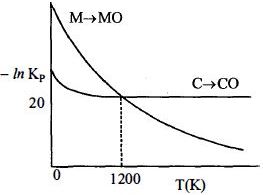
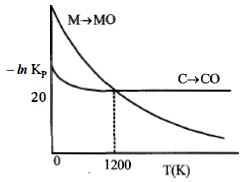
- (A) \(T < 1200\,K,\)પર, કાર્બનનું ઓક્સિડેશનની તરફેણ થતી નથી
- (B) દરેક તાપમાને કાર્બનના ઓકિસડેશનની તરફેણ થાય છે
- (C) \(T< 1200\,K,\) પર , પ્રક્રિયા \(MO(s) +C(s) \to M(s) + CO(g)\) સ્વંયભૂ છે
- (D) \(T > 1200\,K,\) પર, કાર્બન એ \(MO(s)\) નું\(M(s)\) માં રીડકશન કરશે
જવાબ અને ઉકેલ જુઓ
સાચો જવાબ: (C)
At \(< 1200\,K\), carbon will reduce \(MO(s)\) to \(M(s)\) hence, chemical reaction\(MO(s) + C(s) \to M(s) + CO(g)\) is spontaneous
-
- (A) \(1.0 \times 10^{-10}\)
- (B) \(10\)
- (C) \(1\)
- (D) \(1.0 \times 10^{10}\)
જવાબ અને ઉકેલ જુઓ
સાચો જવાબ: (C)
Given \(\Delta {H^o} = - 29.8\,kJ\,mo{l^{ - 1}}\)\(\Delta {S^o} = - 1.00\,kJ\,{K^{ - 1}}\)
From the equation
\(\Delta G = \Delta {H^o} - T\Delta {S^o} = - 29.8 - (298 \times - 0.100)\)
\( = - 29.8 + 29.8 = 0\)
Now, \(\Delta {G^o} = - 2.303\,RT\,\log \,{K_{eq}}\)
\(0 = - 2.303\,RT\,\log \,{K_{eq}}\)
\(\therefore {K_{eq}} = 1\)
આ પેજ પર આ ફિલ્ટર મુજબ કોઈ પ્રશ્ન નથી.
STD 11 - ઉષ્માગતિશાસ્ત્ર ના અન્ય ટોપિક
વારંવાર પૂછાતા પ્રશ્નો
JEE Mains માં Free energy and Work function ના કેટલા પ્રશ્નો આવ્યા છે?
2016–2026 ના 48 પ્રશ્નો, દરેક સાચા જવાબ અને પૂરા ઉકેલ સાથે.
Free energy and Work function ના પ્રશ્નો કેટલા અઘરા હોય છે?
15% સરળ, 56% મધ્યમ અને 29% અઘરા.