


2016 માં પૂછાયેલાં પ્રકરણ
20 પ્રકરણ- 2પ્રશ્નો STD 12 જૈવિક અણુઓ
- 3પ્રશ્નો STD 12 એમાઇન સંયોજનો
- 2પ્રશ્નો STD 12 આલ્કોહૉલ, ફિનોલ અને ઇથર સંયોજનો
- 1પ્રશ્નો STD 12 હેલોઆલ્કેન અને હેલોએરિન સંયોજનો
- 4પ્રશ્નો STD 12 સવર્ગ સંયોજનો સૌથી વધુ પૂછાયેલ
- 3પ્રશ્નો STD 12 D અને f-વિભાગનાં તત્ત્વો
- 5પ્રશ્નો STD 12 P-વિભાગનાં તત્ત્વો - 2 સૌથી વધુ પૂછાયેલ
- 3પ્રશ્નો STD 12 રાસાયણિક ગતિકી
- 3પ્રશ્નો STD 12 વિદ્યુત-રસાયણવિજ્ઞાન
- 3પ્રશ્નો STD 12 Solution and colligative properties
- 2પ્રશ્નો STD 11 રસાયણવિજ્ઞાનની કેટલીક પાયાની સંકલ્પનાઓ
- 3પ્રશ્નો STD 11 હાઇડ્રોકાર્બન
- 1પ્રશ્નો STD 11 કાર્બનિક રસાયણવિજ્ઞાન કાર્બનિક સંયોજનોનું નામકરણ
- 1પ્રશ્નો STD 11 કાર્બનિક રસાયણશાસ્ત્ર શુદ્ધિકરણ અને લાક્ષણિકતા
- 1પ્રશ્નો STD 12 આલ્ડિહાઇડ અને કિટોન
- 2પ્રશ્નો STD 11 રાસાયણિક બંધન અને આણ્વીય રચના
- 2પ્રશ્નો STD 11 તત્ત્વોનું વર્ગીકરણ અને ગુણધર્મોમાં આવર્તિતા
- 2પ્રશ્નો STD 11 સંતુલન - ૧
- 5પ્રશ્નો STD 11 ઉષ્માગતિશાસ્ત્ર સૌથી વધુ પૂછાયેલ
- 2પ્રશ્નો STD 11 2.પરમાણુનું બંધારણ
JEE Mains 2016 Chemistry ના બધા પ્રશ્નો
20 પ્રકરણ50 માંથી 1–50 પ્રશ્નો
- 1. એસ્પાર્ટિક એસિડ માટે નીચેની શ્રેણી ધ્યાનમાં લો એસ્પાર્ટિક એસિડનું \(pI\) (સમવિભવ બિંદુ) જણાવો.
 2016 મધ્યમ
- (A) \(3.65\)
- (B) \(2.77\)
- (C) \(5.74\)
- (D) \(1.88\)
જવાબ અને ઉકેલ જુઓ
સાચો જવાબ: (B)
In the given reaction sequence\(pH\,=\,\frac{p{{K}_{1}}\,+\,p{{K}_{2}}}{2}\,=\,\frac{1.88\,+\,3.65}{2}\)
\(=\frac{5.53}{2}\,=\,2.675\,\approx \,2.77\)
At isoelectric point of aspartic acid both carboxylic as well as amino form co-exist.
-
- (A) સ્ટાર્ચ
- (B) રિડયુસીંગ સુગર
- (C) પ્રોટીન
- (D) ક્યુપરિક આયન
જવાબ અને ઉકેલ જુઓ
સાચો જવાબ: (C)
Ninhdrin is often used to detect \(\alpha \) - amino acids and also free amino and carboxylic acid group on proteins and peptides. when about \(0.5\,ml\) of a \(0.1\%\) solution of ninhydin is boiled for one or two minutes with a few \(\,ml\) of dilute amino acid or protein solution, a blue colors decelops, ninhydrin degrades amino acids into aldehydes, ammonia, and \(CO_2\) through a series of reactions; the net result is ninhydrin in a partially reduced form hydrindantin;Ninhydrin then condenses with ammonia and hydrin dantin to produce an intensely blue or puple pigment, sometimes called Ruhemann's purple:

- 3. હોફમેન બ્રોમામાઇડ પ્રક્રિયામાં,\(NaOH\) અને \(Br_2\) ના મોલ ની સંખ્યા એમાઇનના ઉત્પાદિત મોલ દીઠ કેટલા વપરાય છે 2016 મધ્યમ
- (A) \(NaOH\) ના બે મોલ અને \(Br_2.\) ના બે મોલ
- (B) \(NaOH\) ના ચાર મોલ અને \(Br_2.\) એક મોલ
- (C) \(NaOH\) ના એક મોલ અને \(Br_2.\) ના એક મોલ
- (D) \(NaOH\) ના ચાર મોલ અને \(Br_2.\) ના બે મોલ
જવાબ અને ઉકેલ જુઓ
સાચો જવાબ: (B)
Hofmann-bromamide degradation reaction is given as\(\mathrm{RCONH}_{2}+4 \mathrm{NaOH}+\mathrm{Br}_{2} \rightarrow \)\(\mathrm{RNH}_{2}+\mathrm{Na}_{2} \mathrm{CO}_{3}+2 \mathrm{NaBr}+2 \mathrm{H}_{2} \mathrm{O}\)
Hence four moles of \(\mathrm{NaOH}\) and one mole of \(\mathrm{Br}_{2}\) are used.
-
- (A) સેન્ડમેયર પ્રકિયા
- (B) કાર્બાઈલએમાઈન પ્રકિયા
- (C) મસ્ટર્ડ ઓઇલ કસોટી
- (D) \(C_6H_5SO_2Cl\)
જવાબ અને ઉકેલ જુઓ
સાચો જવાબ: (D)
Primary, secondary and tertiary amines are distinguished by Hinsberg reagent test. The Hinsberg reagent is benzene sulphonyl chloride \((C_6H_5SO_2Cl).\) -
- (A) \(N\,9\)
- (B) \(N\,3\)
- (C) \(N\,1\)
- (D) \(N\,7\)
જવાબ અને ઉકેલ જુઓ
સાચો જવાબ: (A)
Lone pair of \(N\) is involved in aromaticity -
- (A) આલ્કાઇલ હેલાઈડ ની સાથે \(H_2/Pd\) નું રિડ્ક્ષન
- (B) આલ્કાઇલ હેલાઈડ ની સાથે \(LiAlH_4\) નું રિડ્ક્ષન
- (C) એસ્ટર ની સાથે \(Na/C_2H_5OH\) નું રીડક્ષન
- (D) કાર્બોનીલ સંયોજન ની સાથે \(Na/Hg\) અને \(HCl\) નું રિડ્ક્ષન
જવાબ અને ઉકેલ જુઓ
સાચો જવાબ: (C)
The Bouveault reduction is a reaction in which an ester is reduced to primary alcohol using absolute ethanol and sodium. \(\begin{array}{*{20}{c}} {\,O\,\,\,\,\,\,\,\,\,\,\,\,\,\,\,\,\,\,\,\,\,\,\,\,\,\,\,\,\,\,\,\,\,\,\,\,\,\,\,\,\,\,\,\,\,\,\,\,\,\,\,\,\,\,\,\,\,\,\,\,\,\,\,\,\,\,\,\,\,\,\,\,\,\,\,\,\,\,\,\,\,\,} \\ {||\,\,\,\,\,\,\,\,\,\,\,\,\,\,\,\,\,\,\,\,\,\,\,\,\,\,\,\,\,\,\,\,\,\,\,\,\,\,\,\,\,\,\,\,\,\,\,\,\,\,\,\,\,\,\,\,\,\,\,\,\,\,\,\,\,\,\,\,\,\,\,\,\,\,\,\,\,\,\,\,\,\,} \\ {R - C - OR\xrightarrow{{Na/{C_2}{H_5}OH}}RC{H_2}OH + ROH} \end{array}\) Bouveault-Blanc reduction. - 7. મિથેનોલ ની ઉપજ માં સોડિયમ મિથોક્સાઈડ સાથે \(2-\) ક્લોરો \(-2-\) મિથાઇલ પેન્ટીન ની પ્રકિયા પર શું આપશે ? 2016 અઘરું
- (A) માત્ર \((3)\)
- (B) \((1)\) અને \((2)\)
- (C) આપેલા બધાજ
- (D) \((1)\) અને \((3)\)
જવાબ અને ઉકેલ જુઓ
સાચો જવાબ: (A)
When ter - alky thalides are used in Willamson synination occurs rather than substitution resuting into formation af alkene. Here alkoxide jon abstract one of the \(\beta\) hydrogen atom along with acting as a nucleophile. -
- (A) \(NaI\)
- (B) \(NaOEt/ EtOH\)
- (C) \(NaOH/H_2O\)
- (D) \(NaOH /H_2O-EtOH\)
જવાબ અને ઉકેલ જુઓ
સાચો જવાબ: (A)
Alkyl chloride or bromide undergo substitution and get converted to an alkyl iodide on treatment with a solution of sodium iodide in acetone. e.g. \(CH_3CH_2CH_2Br + NaI\) \(\xrightarrow{{acetone}}\) \(CH_3CH_2CH_2I\) + \(NaBr\) This reaction is also known as Finkelstein Reaction - 9. નીચે આપેલ સાચું વલણ ઓળખો. (પરમાણ્વીય ક્રમાંક \(= Ti : 22,\) \(Cr : 24\) અને \(Mo : 42\) ) 2016 અઘરું
- (A) \({{[Cr{{({{H}_{2}}O)}_{6}}]}^{2+}}>\,{{[Mo{{({{H}_{2}}O)}_{6}}]}^{2+}}\) નો \({\Delta _0}\) અને \({[Ti{({H_2}O)_6}]^{3 + }} > {[Ti{({H_2}O)_6}]^{2 + }}\) નો \({\Delta _0}\)
- (B) \({[Cr{({H_2}O)_6}]^{2 + }} > {[Mo{({H_2}O)_6}]^{2 + }}\) નો \({\Delta _0}\) અને \({[Ti{({H_2}O)_6}]^{3 + }} < {[Ti{({H_2}O)_6}]^{2 + }}\) નો \({\Delta _0}\)
- (C) \({[Cr{({H_2}O)_6}]^{2 + }} < {[Mo{({H_2}O)_6}]^{2 + }}\) નો \({\Delta _0}\) અને \({[Ti{({H_2}O)_6}]^{3 + }} > {[Ti{({H_2}O)_6}]^{2 + }}\) નો \({\Delta _0}\)
- (D) \({[Cr{({H_2}O)_6}]^{2 + }} < {[Mo{({H_2}O)_6}]^{2 + }}\) નો \({\Delta _0}\) અને \({[Ti{({H_2}O)_6}]^{3 + }} < {[Ti{({H_2}O)_6}]^{2 + }}\) નો \({\Delta _0}\)
જવાબ અને ઉકેલ જુઓ
સાચો જવાબ: (C)
The splitting is affected by the oxidation state of the central metal ion. A higher oxidation state leads to larger spitting hence.\({\Delta _0}\) of \({{[Ti{{({{H}_{2}}O)}_{6}}]}^{3+}}>\) \({\Delta _0}\) of \({{[Ti{{({{H}_{2}}O)}_{6}}]}^{2+}}\) Further \({\Delta _0}\) also depends of \(Z_{eff.}\) and \(Z_{eff.}\) of \(4d\) series is more than \(3d\) series.
Hence
\({\Delta _0}\) of \({{[Cr{{({{H}_{2}}O)}_{6}}]}^{2+}}<\) \({\Delta _0}\) of \(\,{{[Mo{{({{H}_{2}}O)}_{6}}]}^{2+}}\)
-
- (A) \([Co(NH_3)_6]Cl_3\)
- (B) \([Pt(NH_3)_2Cl_2]\)
- (C) \([Co(NH_3)_4Cl_2]\)
- (D) \([Co(NH_3)_5Cl]Cl_2\)
જવાબ અને ઉકેલ જુઓ
સાચો જવાબ: (A)
Complexes having only one type of ligands are examples of homoleptic complex -
- (A) \(Na_2[CrCl_5(H_2O)]\)
- (B) \(N{a_3}[CrC{l_6}]\)
- (C) \([Cr{({H_2}O)_5}Cl]C{l_2}\)
- (D) \([Cr{({H_2}O)_6}]C{l_3}\)
જવાબ અને ઉકેલ જુઓ
સાચો જવાબ: (D)
More equivalents of \(AgNO_3\) aqueous solution will be consumed if complex will furnish more \(Cl^-\) ions in solution. Hence complex \([Cr(H_2O)_6]Cl_3\) will consume more equivalents of aqueous solution of \(AgNO_3\). - 12. સમાન ચુંબકીય ચાકમાત્રા ધરાવતી જોડ .......છે. [પ.ક્ર.: \(Cr= 24,\,Mn= 25, \,Fe= 26, \,Co= 27\)] 2016 અઘરું
- (A) \([Mn(H_2O)_6]^{2+}\) અને \([Cr(H_2O)_6]^{2+}\)
- (B) \([CoCl_4]^{2-}\) અને \([Fe(H_2O)_6]^{2+}\)
- (C) \([Cr(H_2O)_6]^{2+}\) અને \([CoCl_4]^{2-}\)
- (D) \([Cr(H_2O)_6]^{2+}\) અને \([Fe(H_2O)_6]^{2+}\)
જવાબ અને ઉકેલ જુઓ
સાચો જવાબ: (D)
magnetic moment \(\mu=\sqrt{n(n+2)}\) where \(n\) is the number of unpaired electrons.\(C r^{2+}\) and \(F e^{2+}\) has same number of unpaired electrons
\(C r^{2+}=>3 d^{4}\) four unpaired electrons
\(F e^{2+}=>3 d^{6}\) four unpaired electrons
-
- (A) \(Cr^{2+}\)
- (B) \(MnO_4^{2 - }\)
- (C) \(MnO_4^{3 - }\)
- (D) \(Cu^+\)
જવાબ અને ઉકેલ જુઓ
સાચો જવાબ: (B)
In \(MnO_4^{-2}\) manganese is in \(+6\) oxidation state which is having highest stability. \(MnO_4^{2-}\) disproportionates in neutral or acidic solution. \(3MnO_4^{2 - }\, + \,4{H^ + }\, \to \,2MnO_4^{2 - }\, + \,Mn{O_2}\, + \,2{H_2}O\) -
- (A) \(VO_2\)
- (B) \(MnO_2\)
- (C) \(TiO_2\)
- (D) \(CrO_2\)
જવાબ અને ઉકેલ જુઓ
સાચો જવાબ: (D)
Out of all the four given metallic oxides \(C r O_{2}\) is attacted by magnetic field very strongly. The effect persists even when the magnetic field is removed. Thus \(C r O_{2}\) is metallic and ferromagnetic in nature. -
- (A) \(Co^{3+}\) અને \(Cr^{3+}\)
- (B) \(Co^{3+}\) અને \(Co^{3+}\)
- (C) \(Cr^{3+}\) અને \(Cr^{3+}\)
- (D) \(Cr^{3+}\) અને \(Co^{3+}\)
જવાબ અને ઉકેલ જુઓ
સાચો જવાબ: (C)
A ruby is a crystal of alumina, aluminum oxide \((Al_2O_3)\) containing a trace of chromium \((III)\) ions replacing some of the aluminum ions. In ruby, each \(Al^{3+}\) ion and \(Cr^{3+}\) ion is surrounded by six oxide ions in an octahedral arrangement. The origin of the color of emeralds is similar to that of the color of rubies. However, the bulk of an emerald crystal is composed of beryl, beryllium aluminum silicate \((Be_3 Al_2(SiO_3)_6)\) instead of the alumina which forms rubies. The color is produced by chromium \((III)\) ions, which replace some of the aluminum ions in the crystal. In emeralds, the \(Cr^{3+}\) is surrounded by six silicate ions, rather than the six oxide ions in ruby. Therefore, the color (green) of emeralds is different from that of ruby -
- (A) તત્ક્ષણ દ્વિધ્રુવ - પ્રેરિત દ્વિધ્રુવ
- (B) આયન - દ્વિધ્રુવ
- (C) આયનીય
- (D) દ્વિધ્રુવ - દ્વિધ્રુવ
જવાબ અને ઉકેલ જુઓ
સાચો જવાબ: (A)
Instantaneous dipole-induced dipole forces are most responsible in allowing xenon gas to liquify. - 17. ઝિંકની મંદ અને સાંદ્ર નાઈટ્રિક એસિડ સાથેની પ્રક્રિયાથી અનુક્રમે ............ ઉત્પન્ન થાય છે. 2016 અઘરું
- (A) \(NO\) અને \(N_2O\)
- (B) \(NO\) અને \(N_2O\)
- (C) \(N_2O\) અને \(NO_2\)
- (D) \(NO_2\) અને \(NO\)
જવાબ અને ઉકેલ જુઓ
સાચો જવાબ: (C)
Reaction of \(Zn\) with dil. \(HNO_{3}\) \(4 \mathrm{Zn}+10 \mathrm{HNO}_{3}(\mathrm{dil}) \longrightarrow 4 \mathrm{Zn}\left(\mathrm{NO}_{3}\right)_{2}+5 \mathrm{H}_{2} \mathrm{O}+\mathrm{N}_{2} \mathrm{O}\)(\(Zn\) reacts differently with very dilute HNO \(_{3}\) )
Reaction of \(Zn\) with conc. \(HNO_{3}\) \(\mathrm{Zn}+4 \mathrm{HNO}_{3}(\mathrm{conc.}) \longrightarrow \mathrm{Zn}\left(\mathrm{NO}_{3}\right)_{2}+2 \mathrm{H}_{2} \mathrm{O}+2 \mathrm{NO}_{2}\)
-
- (A) ઓર્થોફોસ્ફરસ અને હાઇપોફોસ્ફોરિક એસિડ
- (B) પાયરોફોસ્ફરસ અને પાયરોફોસ્ફોરિક એસિડ
- (C) ઓર્થોફોસ્ફરસ અને પાયરોફોસ્ફોરિક એસિડ
- (D) પાયરોફોસ્ફરસ અને હાઇપોફોસ્ફોરિક એસિડ
જવાબ અને ઉકેલ જુઓ
સાચો જવાબ: (C)
Phosphorous acids contain \(P\) in \(+ 3\) oxidation state.\(\begin{array}{l|c|c} \hline {\text { Pyrophosphorous acid }} & {\mathrm{H}_{4} \mathrm{P}_{2} \mathrm{O}_{5}} & {+3} \\\hline {\text { Pyrophophoric acid }} & {\mathrm{H}_{4} \mathrm{P}_{2} \mathrm{O}_{7}} & {+5} \\ \hline \text { Orthophosphorous acid } & {\mathrm{H}_{3} \mathrm{PO}_{3}} & {+3} \\ \hline \text { Hypophosphoric acid } & {\mathrm{H}_{4} \mathrm{P}_{2} \mathrm{O}_{6}} & {+4} \\ \hline\end{array}\)
-
- (A) \(S_8\) અને \(S_6\) વાલયોમાં \(S-S-S\) બંધકોણ સમાન છે
- (B) રહોમ્બિક અને મોનોક્લિનિક સલ્ફર \(S_8\) અણુઓ ધરાવે છે
- (C) \(O_2\) ની જેમ \(S_2\) અનુચુંબકીય છે
- (D) \(S_8\) વલય ક્રાઉન આકારનુ છે
જવાબ અને ઉકેલ જુઓ
સાચો જવાબ: (A)
The \(S_6\) molecule has a chair-form hexagon ring with the same bond length as that in \(S_8\), but with some what smaller bond angles i.e. bond lengths are same but bond angles are different
-
- (A) ક્લોરીન
- (B) આયોડિન
- (C) ફ્લોરિન
- (D) ઓક્સિજન
જવાબ અને ઉકેલ જુઓ
સાચો જવાબ: (C)
Fluorine is most electronegative element in periodic table and exhibits \(O.S.\) value of \(- 1\) only. -
- (A) \(2.66\,L\,min^{-1}\,\) at \(STP\)
- (B) \(1.34 \times 10-^{-2} \,mol\, min^{-1}\)
- (C) \(6.96 \times 10-^{-2} \,mol\, min^{-1}\)
- (D) \(6.93 \times 10-^{-2} \,mol\, min^{-1}\)
જવાબ અને ઉકેલ જુઓ
સાચો જવાબ: (D)
\(H_{2} O_{2}(a q) \rightarrow H_{2} O(a q)+\frac{1}{2} O_{2}(g)\)For a first order reaction
\(k=\frac{2.303}{t} \log \frac{a}{(a-x)}\)
Given \(a=0.5,(a-x)=0.125,\,t=50\,min\)
\(k=\frac{2.303}{50} \log \frac{0.5}{0.125}\)
\(=2.78 \times 10^{-2} \,\mathrm{min}^{-1}\)
\(r=k\left[H_{2} O_{2}\right]=2.78 \times 10^{-2} \times 0.05\)
\(=1.386 \times 10^{-3} \,\,\mathrm{mol} \,\mathrm{min}^{-1}\)
Now
\(-\frac{d\left|H_{d} O_{2}\right|}{d t}=\frac{d\left|H_{2} O\right|}{d t}=\frac{2 d\left|O_{2}\right|}{d t}\)
\(\frac{2 d\left[O_{2}\right]}{d t}-\frac{d\left[H_{2} O_{2}\right]}{d t}\)
\(\frac{d\left[O_{2}\right]}{d t}=\frac{1}{2} \times \frac{d\left[H_{2} O_{2}\right]}{d t}\)
\(=\frac{1.386 \times 10^{-3}}{2}=6.93 \times 10^{-4}\,\, \mathrm{mol}\, \mathrm{min}^{-1}\)
-
- (A) \(1.4 \times {10^{20}}\)
- (B) \(3.1 \times {10^{10}}\)
- (C) \(5.2 \times {10^9}\)
- (D) \(2.6 \times {10^{10}}\)
જવાબ અને ઉકેલ જુઓ
સાચો જવાબ: (A)
On adding eq. \((i)\) and eq. \((ii)\) we get\({{O}_{3}}(g)+O(g)\to 2{{O}_{2}}(g)\)
Hence overall rate constant \(=\,K_i\times K_{ii}\)
\( = \,5.2 \times \,{10^9}\, \times \,2.6\, \times \,{10^{10}}\, \approx \,\) \(1.4\, \times \,{10^{20}}\,mo{l^{ - 1}}\,L{s^{ - 1}}\)
\({{O}_{3}}(g)+C{{l}^{*}}(g)\to {{O}_{2}}(g)+Cl{{O}^{*}}(g),\,\,{{K}_{i}}\)
\(Cl{{O}^{*}}(g)+{{O}^{*}}(g)\to {{O}_{2}}(g)+C{{l}^{*}}(g),\,\,{{K}_{ii}}\)
\({{O}_{3}}(g)+{{O}^{*}}(g)\to 2{{O}_{2}}(g),\) \(K_{Rate}\,=\,K_i\times K_{ii}\)
-
- (A) \(3k\)
- (B) \(9k\)
- (C) \(k/3\)
- (D) \(k\)
જવાબ અને ઉકેલ જુઓ
સાચો જવાબ: (D)
Rate constant is independent of concentration - 24. \(1\,M\,ZnSO_4\) નું દ્રાવણ ધરાવતા બીકરમાં જે કોપર ધાતુનો ચોસલો નાખવામાં આવે તો શું થશે ? 2016 અઘરું
- (A) ઓક્સિજન વાયુ ઉત્પન્ન થવાની સાથે કોપર ધાતુ દ્રાવ્ય થશે.
- (B) હાઇડ્રોજન વાયુ ઉત્પન્ન થવાની સાથે કોપર ધાતુ દ્રાવ્ય થશે.
- (C) પ્રક્રિયા થશે નહિ
- (D) કોપર ધાતુ દ્રાવ્ય થશે અને ઝિંક ધાતુ નિક્ષેપત પામશે
જવાબ અને ઉકેલ જુઓ
સાચો જવાબ: (C)
No reaction will occur as the \(Zn\) is placed above \(Cu\) in electrochemical series. Hence there will be no displacement reaction. -
- (A) \(Cu\)
- (B) \(Zn\)
- (C) \(Pb\)
- (D) \(Cr\)
જવાબ અને ઉકેલ જુઓ
સાચો જવાબ: (B)
Galvanization or galvanizing is the process of applying a protective zinc coating to steel or iron, to prevent rusting. The most common method is hot-dip galvanizing, in which the parts are submerged in a bath of molten zinc -
- (A) ઊંચા રિડક્શન પોટેન્શિયલ ધરાવતી અન્ય ધાતુઓ સાથે સંપર્ક બનાવી આયર્નનું ક્ષારણ ઓછું કરી શકાય છે
- (B) ઓક્સિજનયુક્ત પાણીમાં આયર્ન ક્ષારણ પામે છે
- (C) સપાટી પર અભેધ આવરણ (impermeable harrier) બતાવી આયર્નનું ક્ષારણ ઘટાડી શકાય છે
- (D) ક્ષારીય પાણીમાં આયર્ન ઝડપથી ક્ષારણ પામે છે કારણ કે તેનો વિધુતરાસાયણિક પોટેન્શિયલ ઊંચો છે
જવાબ અને ઉકેલ જુઓ
સાચો જવાબ: (C)
Corrosion of iron can be minimized by forming an impermeable barrier at its surface -
- (A) \(752.4\)
- (B) \(759.0\)
- (C) \(7.6\)
- (D) \(76.0\)
જવાબ અને ઉકેલ જુઓ
સાચો જવાબ: (A)
According to Raoult's Law\(\frac{P^{\circ}-P_{s}}{P_{s}}=\frac{W_{B} \times M_{A}}{M_{B} \times W_{A}} \quad \ldots(i)\)
Here \(P^{\circ}=\) Vapour pressure of pure solvent,
\(P_{s}=\) Vapour pressure of solution
\(W_{B}=\) Mass of solute,
\(W_{A}=\) Mass of solvent
\(M_{B}=\) Molar mass of solute,
\(M_{A}=\) Molar Mass of solvent
Vapour pressure of pure water at \(100\,{\,^o}C\)
(by assumption \(=760\,torr\) )
By substituting values in equation \((i)\) we get,
\(\frac{760-P_{x}}{P_{x}}=\frac{18 \times 18}{180 \times 178.2} \quad \ldots(i i)\)
On solving \((i i)\) we get
\(P_{s}=752.4\,torr\)
-
- (A) \(0.0075\)
- (B) \(0.005\)
- (C) \(0.02\)
- (D) \(0.015\)
જવાબ અને ઉકેલ જુઓ
સાચો જવાબ: (D)
According to Henry law\(\frac {P_1}{P_2}\,=\,\frac {S_1}{S_2}\)
\(\frac {500}{750}\,=\,\frac {0.01}{S_2}\)
\(\therefore \) \(=\,\frac {750\times 0.01}{500}\) \(=\,0.015\,g/L\)
- 29. કોઈ ચોક્કસ તાપમાને ક્ષાર \(MX_2\) ના જલીય દ્રાવણનો વોન્ટ હોફ અવયવ \(2\) તો આ ક્ષારના જલીય દ્રાવણ માટે વિયોજન અંશ જણાવો. 2016 મધ્યમ
- (A) \(0.50\)
- (B) \(0.33\)
- (C) \(0.67\)
- (D) \(0.80\)
જવાબ અને ઉકેલ જુઓ
સાચો જવાબ: (A)
\((a)\) Van't Hoff factore \((i)\)\(=\,\frac {No.\, of\, particles\, after \,association\, or \,dissociation}{No.\, of\, particles\, before\, association\, or \,dissociation}\)
For \(M{X_2}\, \rightleftharpoons \,{M^{2 + }}\, + \,2{X^ - }\)
\(t\,=\,0\) \(1\) \(0\) \(0\)
at.eq. \(1-\alpha \) \(\alpha \) \(2\alpha \)
Total no. of particles
\(=\,1\,-\,\alpha + \alpha +2\alpha \,=\,1+2\alpha \)
\(\therefore \) \(i\,=\,\frac {1+2\alpha }{1}\) \(=\,2\)
\(\therefore \alpha \,=\,0.50\) or \(50\%\)
-
- (A) \(400\)
- (B) \(600\)
- (C) \(200\)
- (D) \(800\)
જવાબ અને ઉકેલ જુઓ
સાચો જવાબ: (A)
Applying law of equivalenceEquivalence of acid = Equivalence of base
\(0.1 \times v = 0.04 \times 1\)
\(v = 0.4\,L = 0.4 \times 1000 = 400\,ml\)
-
- (A) \(0.25\)
- (B) \(0.50\)
- (C) \(0.333\)
- (D) \(0.125\)
જવાબ અને ઉકેલ જુઓ
સાચો જવાબ: (D)
\(\underset{1\,moles}{\mathop{\underset{2\,moles\,}{\mathop{2{{H}_{3}}As{{O}_{4}}}}\,}}\,+5{{H}_{2}}S\xrightarrow{Conc.HCl}\underset{1/2\,moles}{\mathop{\underset{1\,mole}{\mathop{A{{s}_{2}}{{S}_{5}}}}\,}}\,+8{{H}_{2}}O\)\(\therefore \) number of moles of \(H_3AsO_4\)
\(=\frac{35.5}{142}=0.25\)
\(\therefore \) number of moles of \(As_2S_5\)
\(=\frac{0.25}{2}=0.125\,mol.\)
-
- (A) \(C_4H_8\)
- (B) \(C_4H_{10}\)
- (C) \(C_3H_6\)
- (D) \(C_3H_8\)
જવાબ અને ઉકેલ જુઓ
સાચો જવાબ: (D)
\(C_{x} H_{y(g)}+\left(\frac{4 x+y}{4}\right) O_{2(g)} \rightarrow x C O_{2(g)}+\frac{y}{2} H_{2} O(l)\)Volume of \(O_{2}\) used
\(=375 \times \frac{20}{100}=75 m l\)
From the reaction of combination
\(m l C_{x} H_{y}\) requires \(=\frac{4 x+y}{4} m l O_{2}\)
\(15\left(\frac{4 x+y}{4}\right)=75\)
So, \(4 x+y=20\)
\(x=3\)
\(y=8\)
\(\therefore C_{3} H_{8}\)
-
- (A) આઇસોક્યુટેન
- (B) ઇથેન
- (C) બ્યુટેન
- (D) પ્રોપેન
જવાબ અને ઉકેલ જુઓ
સાચો જવાબ: (D)
Since the compound undergoing combustion is an alkane. Hence the combustion reaction can be written as\(\underset{5L}{\mathop{{{C}_{n}}{{H}_{2n+2}}}}\,+\underset{25L}{\mathop{\left( \frac{3n+1}{2} \right){{O}_{2}}}}\,\to \) \(nC{{O}_{2}}+(n+1){{H}_{2}}O\)
since volumes are measured at constant \(T\) & \(P\). Hence according to Avogadro's law
Volume \(\propto \) mole
\(\therefore \,{{n}_{alkane}}=\left( \frac{2}{3n+1} \right)\times {{n}_{{{O}_{2}}}}\)
\(5 = \frac{2}{{3n + 1}} \times 25\)
\(\therefore \,n = 3\)
Hence alkane is propane \((C_3H_8)\)
- 34. પ્રોપિનની \(HOCl (Cl_2 + H_2O)\) સાથેની પ્રક્રિયા ક્યા ક્રિયાશીલ મધ્યસ્થી દ્વારા આગળ વધે છે ? 2016 અઘરું
- (A) \(CH_3 -CH(OH)-CH_2^+\)
- (B) \(CH_3 -CHCl-CH_2^+\)
- (C) \(CH_3 -CH^+ -CH_2 -OH\)
- (D) \(CH_3 -CH^+ -CH_2 -Cl\)
જવાબ અને ઉકેલ જુઓ
સાચો જવાબ: (D)
\(C{{H}_{3}}-CH=C{{H}_{2}}\xrightarrow[(electrophilic\,addition)]{\overset{\delta -}{\mathop{HO}}\,-\overset{\delta +}{\mathop{Cl}}\,}\) \(\underset{(\operatorname{int}ermediate)}{\mathop{C{{H}_{3}}-\overset{+}{\mathop{C}}\,H-C{{H}_{2}}-Cl}}\,\) \(\xrightarrow{O{{H}^{-}}}C{{H}_{3}}-CH(OH)-C{{H}_{2}}-Cl\) -
- (A) \(2, 2-\) ડાયમિથાઇલ \(-4-\)પેન્ટીન
- (B) \(4, 4- \) ડાયમિથાઇલપેન્ટીન
- (C) આઇસોપ્રોપાઇલ \(-2- \)બ્યુટીન
- (D) \(2, 2-\) ડાયમિથાઇલ \(-3-\)પેન્ટીન
જવાબ અને ઉકેલ જુઓ
સાચો જવાબ: (B)
\(\begin{array}{*{20}{c}} {\begin{array}{*{20}{c}} {\,\,\,\,\,\,C{H_3}\,}\\ | \end{array}\,\,\,\,\,\,\,\,\,\,\,\,\,\,\,\,\,\,\,\,\,\,\,\,\,\,\,\,\,\,\,\,\,\,\,\,\,\,\,\,\,\,}\\ {{H_3}C - C - C{H_2} - CH = C{H_2}}\\ {\,|\,\,\,\,\,\,\,\,\,\,\,\,\,\,\,\,\,\,\,\,\,\,\,\,\,\,\,\,\,\,\,\,\,\,\,\,\,\,\,\,\,\,}\\ {\,C{H_3}\,\,\,\,\,\,\,\,\,\,\,\,\,\,\,\,\,\,\,\,\,\,\,\,\,\,\,\,\,\,\,\,\,\,\,\,\,\,\,} \end{array}\) This is the hydrocabon with \(7\) carbon atoms containing a neopentyl and a vinyl group. - 36. સાબુ ઉધોગમાં મુક્તશેષ લાઇ (spentlye) માંથી ગ્લીસરોલ છૂટો પાડવાની સૌથી અનુકૂળ નિસ્યંદન પદ્ધિત જણાવો. 2016 મધ્યમ
- (A) વરાળ નિસ્યંદન
- (B) ધટાડેલા દબાણ હેઠળ નિસ્યંદન
- (C) સાદું નિસ્યંદન
- (D) વિભાગીય નિસ્યંદન
જવાબ અને ઉકેલ જુઓ
સાચો જવાબ: (B)
Spent-lye and glycerol are separated by distillation under reduced pressure.Under the reduced pressure the liquid boil at low temperature and the temperature of decomposition will not reach. e.g. glycerol boils at \(290^{\circ} \mathrm{C}\) with decomposition but at reduced pressure it boils at \(180^{\circ} \mathrm{C}\) without decomposition.
- 37. \(PETN\) ની બનાવટ માટે ઉપયોગ માં લેવાતું \((C(CH_2OH)_4)\) એરાઇથ્રીતોલ ની સંશ્લેષણ માટે સાચું વિધાન કયું છે ? 2016 અઘરું
- (A) સંશ્લેષણમાં ત્રણ આલ્ડોલ સંઘનન અને એક કેનિઝારો પ્રક્રિયા જરૂરી છે
- (B) ઇથેનોલ અને મીથેનોલના આલ્ફા હાઇડ્રોજન આ પ્રક્રિયામાં સામેલ છે.
- (C) સંશ્લેષણમાં બે આલ્ડોલ સંઘનન અને બે કેનિઝારો પ્રક્રિયાઓની જરૂર છે
- (D) સંશ્લેષણમાં મીથેનોલ અને ઇથેનોલ વચ્ચે ચાર આલ્ડોલ સંઘનન ની જરૂર છે
જવાબ અને ઉકેલ જુઓ
સાચો જવાબ: (A)
The pentaerythritol is typically produced cia a base - catalyed reaction of acetaldehyde with excess formaldehyde. the aldol condenstion of three moles of formaldehyde with one mole of acetaldehyde is folloed by a crossed cannizzaro reaction between pentaerythritol product and sodium formate as a byproduct. These reaction are shown below\(\mathop {C{H_3}CHO\, + \,3HCHO\, \to \,}\limits_{(three\,aldol\,condensation)} C{(C{H_2}OH)_3}CHO\)
\(C{(C{H_2}OH)_3}CHO\, + \,HCHO\, + \,NaOH\) \(\mathop { \to \,C{{(C{H_2}OH)}_4}\, + \,HCOONa}\limits_{(Cannizaro's\,\,reaction)} \)
-
- (A) \(NO_3^-\)
- (B) \(NO_2\)
- (C) \(NO_2^+\)
- (D) \(NO_2^-\)
જવાબ અને ઉકેલ જુઓ
સાચો જવાબ: (C)
The hybridization of \(\mathrm{NO}_{2}^{+}\) is sp.It is a linear molecule.
Rest does not have sp hybridization.
Therefore, the correct option is C.
-
- (A) \(PCl_5,\,IF_5,\, XeO_2F_2\)
- (B) \(BF_3,\,PCl_3,\,XeO_3\)
- (C) \(SF_4,\,XeF_4,\,CCl_4\)
- (D) \(ClF_3,\, XeOF_2,\, XeF_3^+\)
જવાબ અને ઉકેલ જુઓ
સાચો જવાબ: (D)
\(Cl{I_3} \to \) Hybridisation \( = 3 + \frac{1}{2}[7 - 3] = 5\,(s{p^3}d)\)\(XeOF_2 \to \) Hybridisation \( = 3 + \frac{1}{2}[8 - 4] = 5\,(s{p^3}d)\)
\(XeF_3^+ \to \) Hybridisation \( = 3 + \frac{1}{2}[8 - 3 - 1] = 5\,(s{p^3}d)\)
All molecules have \(sp^3d\) hybridization and \(2\) lone pairs. Hence all have identical ( \(T-\) shape).
-
- (A) સમૂહ \(15\) ના તત્વો માટે સમૂહમાં નીચે \(+5\) ઓક્સિડેશન અવસ્થાની સ્થિરતા વધે છે
- (B) અનુવર્તી આવર્તમાં, સમૂહ \(15\) કરતા સમૂહ \(16\) ના તત્વોની આયનીકરણ એન્થાલ્પી ઓછી હોય છે
- (C) સમૂહ \(13\) ના બધા તત્વો ધાતુઓ છે
- (D) સમૂહ \(17\) ના બધા તત્વો વાયુઓ છે
જવાબ અને ઉકેલ જુઓ
સાચો જવાબ: (B)
Due to extra stable half-filled \(p-\) orbital electronic configurations of Group \(15\) elements, larger amount of energy is required to remove electrons compared to Group \(16\) elements - 41. ક્યા ક્ષારનું જલીય દ્રાવણ \(1s^2\,2s^2\,2p^6\,3s^2\,3p^6\) ઇલેક્ટ્રોન રચના ધરાવતા આયનો ધરાવતા નથી ? 2016 મધ્યમ
- (A) \(NaF\)
- (B) \(KBr\)
- (C) \(NaCl\)
- (D) \(CaI_2\)
જવાબ અને ઉકેલ જુઓ
સાચો જવાબ: (A)
\(NaF\) is composed of \(Na^+\) and \(F^-\)\(N{a^ + } \to [He]\,2{s^2}\,2{p^6}\)
\({F^ - } \to [He]\,2{s^2}\,2{p^6}\)
Hence do not match with the configuration given in the question.
-
- (A) \(1.818\)
- (B) \(1.182\)
- (C) \(0.182\)
- (D) \(0.818\)
જવાબ અને ઉકેલ જુઓ
સાચો જવાબ: (A)
\(A + B \rightleftharpoons C + D\)No. of moles Initialy \(1\) \(1\) \(1\) \(1\)
At equillibrium \(1-a\) \(1-a\) \(1+a\) \(1+a\)
\(\therefore K_{c}=\left(\frac{1+a}{1-a}\right)^{2}=100\)
\(\therefore \quad \frac{1+a}{1-a}=10\)
On solving
\(a=0.81\)
\([D]_{A t e q}=1+a=1+0.81=1.81\)
-
- (A) \(25\)
- (B) \(100\)
- (C) \(10\)
- (D) \(5\)
જવાબ અને ઉકેલ જુઓ
સાચો જવાબ: (A)
\(XY(s) \leftrightarrow \mathop {X(g)}\limits_P + \mathop {Y(g)}\limits_P \)At eq.,
Total pressure \( = 2P = 10\,bar\)
\(\therefore \,p = 5;\,Now\,{K_p} = ({P_x})({P_y}) = {p^2} = 25\)
-
- (A) \(\Delta H\) ઋણ છે જ્યારે \(\Delta S\) ધન છે
- (B) Both \(\Delta H\) અને\ \(\Delta S\) બંને ઋણ છે
- (C) \(\Delta H\) ધન છે જ્યારે \(\Delta S\) ઋણ છે
- (D) બંને \(\Delta H\) અને \(\Delta S\) ધન છે
જવાબ અને ઉકેલ જુઓ
સાચો જવાબ: (D)
\(\Delta G\, = \,\Delta H - T\Delta S\) For a spontaneous reaction \(\Delta G = -ve\) which is possible when both \(\Delta H\) and \(\Delta S\) are positive at high temperature and hence the reaction becomes spontaneous. -
- (A) \(124.50\)
- (B) \(249\)
- (C) \(498\)
- (D) \(62.25\)
જવાબ અને ઉકેલ જુઓ
સાચો જવાબ: (A)
\(2{H_2}{O_2}(l) \leftrightarrow 2{H_2}O(l) + {O_2}(g)\)\(W = - {P_{ext}}(\Delta V) = - ({n_{{O_2}}})RT\)
\(\because \,100\) mole \({H_2}{O_2}\) on decomposition give \(50\) mol \({O_2}\)
\(\therefore \,W = - (50)(8.3)(300) = - 124500\,J\)
\( = - 124.5\,kJ\)
-
- (A) \(-676.5\)
- (B) \(-110.5\)
- (C) \(110.5\)
- (D) \(676.5\)
જવાબ અને ઉકેલ જુઓ
સાચો જવાબ: (B)
Many enthalpy changes are difficult to measure directly under standard conditions. Hess law states that the total enthalpy change of a reaction is independent of the route taken. To find\(H _{ f }, C _{( s )}+\frac{1}{2} O _{2}( g ) \rightarrow CO ( g )\)
Given:- combustion of carbon
\(C + O _{2} \rightarrow CO _{2}: \Delta H _{1}=-393.5 KJmol\)
combination of carbon monoxide
\(CO +\frac{1}{2} O _{2} \rightarrow CO _{2}: \Delta H _{2}=-283.5 kJ mol ^{-1}\)
Formation of carbon monoxide:
\(\triangle H =\triangle H _{1}-\Delta H _{2}=-393.5-(-283.5)\)
\(=39.3 .5+283.5=-110 kJ / mol\)
-
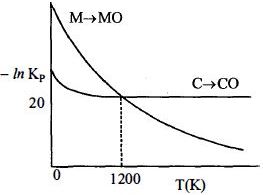
- (A) \(T < 1200\,K,\)પર, કાર્બનનું ઓક્સિડેશનની તરફેણ થતી નથી
- (B) દરેક તાપમાને કાર્બનના ઓકિસડેશનની તરફેણ થાય છે
- (C) \(T< 1200\,K,\) પર , પ્રક્રિયા \(MO(s) +C(s) \to M(s) + CO(g)\) સ્વંયભૂ છે
- (D) \(T > 1200\,K,\) પર, કાર્બન એ \(MO(s)\) નું\(M(s)\) માં રીડકશન કરશે
જવાબ અને ઉકેલ જુઓ
સાચો જવાબ: (C)
At \(< 1200\,K\), carbon will reduce \(MO(s)\) to \(M(s)\) hence, chemical reaction\(MO(s) + C(s) \to M(s) + CO(g)\) is spontaneous
-
- (A) \(1.0 \times 10^{-10}\)
- (B) \(10\)
- (C) \(1\)
- (D) \(1.0 \times 10^{10}\)
જવાબ અને ઉકેલ જુઓ
સાચો જવાબ: (C)
Given \(\Delta {H^o} = - 29.8\,kJ\,mo{l^{ - 1}}\)\(\Delta {S^o} = - 1.00\,kJ\,{K^{ - 1}}\)
From the equation
\(\Delta G = \Delta {H^o} - T\Delta {S^o} = - 29.8 - (298 \times - 0.100)\)
\( = - 29.8 + 29.8 = 0\)
Now, \(\Delta {G^o} = - 2.303\,RT\,\log \,{K_{eq}}\)
\(0 = - 2.303\,RT\,\log \,{K_{eq}}\)
\(\therefore {K_{eq}} = 1\)
-
- (A) \(\sqrt {meV}\)
- (B) \(\sqrt {2meV}\)
- (C) \(meV\)
- (D) \(2meV\)
જવાબ અને ઉકેલ જુઓ
સાચો જવાબ: (B)
Kinetic energy \(=e V=\frac{1}{2} m u^{2}\)\(u=\sqrt{\frac{2 e V}{m}}\)
Here, u is the velocity of the electron.
The de broglie wavelength is \(\lambda=\frac{h}{m u}\)
\(\frac{h}{\lambda}=m u\)
Substitute equation (1) in equation (2)
\(\frac{h}{\lambda}=m \sqrt{\frac{2 e V}{m}}=\sqrt{2 m e V}\)
-
- (A) \(20\)
- (B) \(25\)
- (C) \(10\)
- (D) \(5\)
જવાબ અને ઉકેલ જુઓ
સાચો જવાબ: (B)
Number of orbitals in a shell \(= n^2 = (5)^2 = 25.\)


આ પેજ પર આ ફિલ્ટર મુજબ કોઈ પ્રશ્ન નથી.
અન્ય વર્ષ
વારંવાર પૂછાતા પ્રશ્નો
ExamBro પર JEE Mains 2016 Chemistry ના કેટલા પ્રશ્નો છે?
50 પ્રશ્નો, દરેક સાચા જવાબ અને પૂરા ઉકેલ સાથે.
JEE Mains 2016 Chemistry નું કયું પ્રકરણ સૌથી વધુ પૂછાય છે?
P-વિભાગનાં તત્ત્વો - 2, 5 પ્રશ્નો સાથે; ત્યાર બાદ ઉષ્માગતિશાસ્ત્ર, 5 પ્રશ્નો સાથે.
JEE Mains 2016 Chemistry ના પ્રશ્નો કેટલા અઘરા હોય છે?
4% સરળ, 30% મધ્યમ અને 66% અઘરા.