


2013 માં પૂછાયેલાં પ્રકરણ
23 પ્રકરણ- 2પ્રશ્નો STD 11 7.રેડોક્ષ પ્રક્રિયાઓ
- 8પ્રશ્નો STD 11 સંતુલન - ૨ સૌથી વધુ પૂછાયેલ
- 6પ્રશ્નો STD 12 જૈવિક અણુઓ સૌથી વધુ પૂછાયેલ
- 4પ્રશ્નો STD 12 એમાઇન સંયોજનો
- 1પ્રશ્નો STD 12 કાર્બોકિસલિક ઍસિડ
- 4પ્રશ્નો STD 12 આલ્કોહૉલ, ફિનોલ અને ઇથર સંયોજનો
- 6પ્રશ્નો STD 12 હેલોઆલ્કેન અને હેલોએરિન સંયોજનો
- 4પ્રશ્નો STD 11 કાર્બનિક રસાયણશાસ્ત્ર પ્રતિક્રિયા પદ્ધતિ
- 4પ્રશ્નો STD 12 સવર્ગ સંયોજનો
- 4પ્રશ્નો STD 12 D અને f-વિભાગનાં તત્ત્વો
- 2પ્રશ્નો STD 12 P-વિભાગનાં તત્ત્વો - 2
- 3પ્રશ્નો STD 12 રાસાયણિક ગતિકી
- 5પ્રશ્નો STD 12 વિદ્યુત-રસાયણવિજ્ઞાન
- 6પ્રશ્નો STD 12 Solution and colligative properties
- 4પ્રશ્નો STD 11 રસાયણવિજ્ઞાનની કેટલીક પાયાની સંકલ્પનાઓ
- 1પ્રશ્નો STD 11 હાઇડ્રોકાર્બન
- 3પ્રશ્નો STD 11 કાર્બનિક રસાયણશાસ્ત્ર શુદ્ધિકરણ અને લાક્ષણિકતા
- 3પ્રશ્નો STD 12 આલ્ડિહાઇડ અને કિટોન
- 10પ્રશ્નો STD 11 રાસાયણિક બંધન અને આણ્વીય રચના સૌથી વધુ પૂછાયેલ
- 5પ્રશ્નો STD 11 તત્ત્વોનું વર્ગીકરણ અને ગુણધર્મોમાં આવર્તિતા
- 2પ્રશ્નો STD 11 સંતુલન - ૧
- 6પ્રશ્નો STD 11 ઉષ્માગતિશાસ્ત્ર
- 5પ્રશ્નો STD 11 2.પરમાણુનું બંધારણ
JEE Mains 2013 Chemistry ના બધા પ્રશ્નો
23 પ્રકરણ98 માંથી 1–50 પ્રશ્નો
-
- (A) \(2,1,2\)
- (B) \(2,1,3\)
- (C) \(3, 1,6\)
- (D) \(3, 1, 4\)
જવાબ અને ઉકેલ જુઓ
સાચો જવાબ: (C)
On balancing the given reaction, we find \(3Na_2HAsO_3 + NaBrO_3 + 6HCl \longrightarrow\) \(6NaCl + 3H_3AsO_4 + NaBr\) -
- (A) \(I^-\)
- (B) \(S(s)\)
- (C) \(NO_3^ - \left( {aq} \right)\)
- (D) \(Cr_2O_7^{2 - }\)
જવાબ અને ઉકેલ જુઓ
સાચો જવાબ: (A)
If an electronegative element is in its lowest possible oxidation state in a compound or in free state. It can function as a powerful reducing agent. e.g. \(I^-\) - 3. \(1\, litre\) \(HCl\) ના દ્રાવણની \(pH=1\) છે. આ જલીય દ્રાવણની \(pH=2\) કરવા માટે કેટલા લિટર પાણી ઉમેરવામાં જરૂર પડશે ? 2013 અઘરું
- (A) \(0.1\)
- (B) \(0.9\)
- (C) \(2\)
- (D) \(9\)
જવાબ અને ઉકેલ જુઓ
સાચો જવાબ: (D)
As \(p H=1 ; H^{+}=10^{-1}=0.1 \,M\)\(p H=2 ; H^{+}=10^{-2}=0.01\, M\)
\(\therefore M_{1}=0.1 ; V_{1}=1\)
\(M_{2}=0.01; V_{2}=?\)
From
\(M_{1} V_{1}=M_{2} V_{2} ; 0.1 \times 1=0.01 \times V_{2}\)
\(V_{2}=10\) litre
volume of water added \(=10-1=9\) litre.
- 4. \(330\,K\) તાપમાને \(K_w\), \(10^{-13.6}\) હોય, તો \(330\,K\) તાપમાને \(10^{-4}\, M\,OH^-\) ના દ્રાવણની \(pH\) ગણો 2013 મધ્યમ
- (A) \(4\)
- (B) \(9\)
- (C) \(10\)
- (D) \(9.6\)
જવાબ અને ઉકેલ જુઓ
સાચો જવાબ: (D)
Given at \(330\,K\)\({K_w} = {10^{ - 13.6}}\)
i.e. \(p{K_w} = pH + pOH\)
\(\because \,pOH = - \log [O{H^ - }]\)
\(13.6 = pH + pOH\)
\(pOH = - \log \,{10^{ - 4}}\)
\(13.6 = pH + 4\)
\(\therefore \,pH = 13.6 - 4\)
\( = 9.6\)
-
- (A) \(pH=4.70\)
- (B) \(pH < 4.70\)
- (C) દ્રાવણની \(pH\) એસિટિક એસિડની \(pH\) ને સમાન હશે
- (D) \(4.76 < pH < 5.0\)
જવાબ અને ઉકેલ જુઓ
સાચો જવાબ: (D)
\(pH = p{K_a} + \log \,\frac{{[salt]}}{{[acid]}}\)\( = 4.76 + \log \,\frac{{\frac{{7.5}}{{500}}}}{{\frac{5}{{500}}}} = 4.7 + \log \,1.5 = 4.87\)
Hence correct answer is \(4.76 < pH < 5.0\)
-
- (A) \(5.1 \times {10^{ - 5}}\,M\)
- (B) \(7.1 \times {10^{ - 8}}\,M\)
- (C) \(4.1 \times {10^{ - 5}}\,M\)
- (D) \(8.1 \times {10^{ - 7}}\,M\)
જવાબ અને ઉકેલ જુઓ
સાચો જવાબ: (A)
Given \(N{a_2}C{O_3} = 1.0 \times {10^{ - 4}}\,M\)\(\therefore \,[CO_3^ - ] = 1.0 \times {10^{ - 4}}\,M\)
\(i.e.\,\,\,s = 1.0 \times {10^{ - 4}}\,M\)
At equilibrium
\([B{a^{ + + }}][CO_3^ - ] = {K_{sp}}\,of\,BaC{O_3}\)
\([B{a^{ + + }}] = \frac{{{K_{sp}}}}{{[CO_3^ - ]}} = \frac{{5.1 \times {{10}^{ - 9}}}}{{1.0 \times {{10}^{ - 4}}}}\)
\( = 5.1 \times {10^{ - 5}}\,M\)
- 7. \(NaOH\) પ્રબળ બેઇઝ છે. \(5.0 \times 10^{-2}\,M\) \(NaOH\) ના દ્રાવણની \(pH\) જણાવો. \((log\,2 = 0.3)\) 2013 મધ્યમ
- (A) \(14\)
- (B) \(13.70\)
- (C) \(13\)
- (D) \(12.70\)
જવાબ અને ઉકેલ જુઓ
સાચો જવાબ: (D)
Given \([O{H^ - }] = 5 \times {10^{ - 2}}\)\(\therefore \,pOH = - \log \,5 \times {10^{ - 2}}\)
\( = - \log \,5 + 2\log \,10 = 1.30\)
\(\because \,pH + pOH = 14\)
\(\because \,pH = 14 - pOH\)
\( = 14 - 1.30 = 12.70\)
-
- (A) \({I^ - } < {F^ - } < H{S^ - } < N{H_2}^ - \)
- (B) \(H{S^ - } < N{H_2}^ - < {F^ - } < {I^ - }\)
- (C) \({F^ - } < {I^ - } < N{H_2}^ - < H{S^ - }\)
- (D) \(N{H_2}^ - < H{S^ - } < {I^ - } < {F^ - }\)
જવાબ અને ઉકેલ જુઓ
સાચો જવાબ: (A)
The species with the greatest proton affinity will be the strongest base, and its conjugate acid will be the weakest acid. The weakest acid will have the smallest value of \(K_a\). Since \(HI\) is a stronger acid than \(HF\) which is a stronger acid than \(H_2S\), a partial order of proton affinity is \({I^ - } < {F^ - } < H{S^ - }\) Since \(NH_3\) is a very weak acid, \(NH_2^ -\) must be a very strong base. Therefore the correct order of proton affinity is \(I^- < F^- < HS^- < NH_2^-\) -
- (A) \(BaSO_4 > Hg_2Cl_2 > Cr_2(SO_4)_3 > CrCl_3\)
- (B) \(BaSO_4 > Hg_2Cl_2 > CrCl_3 > Cr_2 (SO_4)_3\)
- (C) \(BaSO_4 > CrCl_3 > Hg_2Cl_2 > Cr_2(SO_4)_3\)
- (D) \(Hg_2Cl_2 > BaSO_4 > CrCl_3 > Cr_2(SO_4)_3\)
જવાબ અને ઉકેલ જુઓ
સાચો જવાબ: (B)
\(C{r_2}{(S{O_4})_3} \rightleftharpoons \mathop {2C{r^{ + 3 }}}\limits_{2s} + \mathop {3S{O_4}^{ - - }}\limits_{3s} \)\({K_{sp}} = {(2s)^2}{(3s)^2} = 4{s^2} \times 27{s^3} = 108{s^5}\)
\(s = {\left( {\frac{{{K_{sp}}}}{{108}}} \right)^{1/5}}\)
\(H{g_2}C{l_2} \rightleftharpoons \mathop {2H{g^{2 + }}}\limits_{2s} + \mathop {2C{l^ - }}\limits_{2s} \)
\({K_{sp}} = {(2s)^2} \times {(2s)^2} = 16{x^4}\)
\(s = {\left( {\frac{{{K_{sp}}}}{{16}}} \right)^{1/4}}\)
\(BaS{O_4} \rightleftharpoons \mathop {B{a^{ + 2 }}}\limits_s + \mathop {S{O_4}^{ - - }}\limits_s \)
\({K_{sp}} = {s^2}\)
\(s = \sqrt {{K_{sp}}} \)
\(CrC{l_3} \rightleftharpoons \mathop {C{r^{3 + }}}\limits_s + \mathop {3C{l^ - }}\limits_{3s} \)
\({K_{sp}} = s \times {(3s)^3} = 27\,{s^4}\)
\(s = {\left( {\frac{{{K_{sp}}}}{{27}}} \right)^{1/4}}\)
Hence the correct order of solubilities of salts is
\(\sqrt {{K_{sp}}} > {\left( {\frac{{{K_{sp}}}}{{16}}} \right)^{1/4}} > {\left( {\frac{{{K_{sp}}}}{{27}}} \right)^{1/4}} > {\left( {\frac{{{K_{sp}}}}{{108}}} \right)^{1/5}}\)
-
- (A) \(F^- < CN^- < NO_2^-\)
- (B) \(NO_2^- < CN^- < F^-\)
- (C) \(F^- < NO_2^- < CN^-\)
- (D) \(NO_2^- < F^- < CN^-\)
જવાબ અને ઉકેલ જુઓ
સાચો જવાબ: (C)
Higher the value of \(K_a\) lower will be the value of \(pK_a\) \(i.e.\) higher will be the acidic nature. Further since \(CN^-, F^-\) and \(NO_2^-\) are conjugate base of the acids \(HCN, HF\) and \(HNO_2\) respectively hence the correct order of base strength will be \(F^- < NO_2^- < CN^-\) ( \(\because \) stronger the acid weaker will be its conjugate base) -
- (A) કાર્બોનિલ બંધ
- (B) ઈથર બંધ
- (C) એસ્ટર બંધ
- (D) એમાઈડ બંધ
જવાબ અને ઉકેલ જુઓ
સાચો જવાબ: (B)
Glycosidic linkage is actually an ether bond as the linkage forming the rings in an oligosaccharide or polysaccharide is not just one bond, but the two bonds sharing an oxygen atom e.g. sucrose
-
- (A) \(- OH\) ફિશર પ્રોજેક્શનમાં બીજા કાર્બન જમણી બાજુએ છે
- (B) \(- OH\) ફિશર પ્રોજેક્શનમાં છઠ્ઠા કાર્બન જમણી બાજુએ છે
- (C) \(- OH\) ફિશર પ્રોજેક્શનમાં પાંચમા કાર્બન જમણી બાજુએ છે
- (D) તે ડેક્સ્ટ્રોરોટેટરી છે
જવાબ અને ઉકેલ જુઓ
સાચો જવાબ: (C)
Fisher gave the prefix \('D''\) to compounds whosebottom chiral hasits \(OH\) to the right. So natural glucoseis called \(D\,-\) glucose is called \(D\,-\) glucose or dextrose.Structure of \(D\,-\) glucose :

-
- (A) વિટામિન \(A\)
- (B) વિટામિન \(B\)
- (C) વિટામિન \(D\)
- (D) વિટામિન \(C\)
જવાબ અને ઉકેલ જુઓ
સાચો જવાબ: (C)
Deficiency of vitamin \(D\) causes rickets -
- (A) ડાયસ્ટેઝ
- (B) માલટેઝ
- (C) ઝાયમેઝ
- (D) ઇન્વર્ટેઝ
જવાબ અને ઉકેલ જુઓ
સાચો જવાબ: (A)
Maltose is obtained by partial hydrolysis of starch by the enzyme diastase present in Malt \(2{\left( {{C_6}{H_{10}}{O_5}} \right)_n} + n{H_2}O\xrightarrow[{^n{C_6}{H_{12}}{O_6}\,\,{\text{(Maltose)}}\,}]{{Diastase}}\) -
- (A) એમાઈલોપેક્ટિન એ \(\alpha - \) ગ્લુકોઝ નો શાખીય પોલીમર છે
- (B) સેલ્યુલોઝ એ \(\beta - \) ગ્લુકોઝ નો રેખીય પોલીમર છે
- (C) ગ્લાયકોજેન એ છોડનો આહાર અનામત છે
- (D) બધા પ્રોટીન એ f \(\alpha - \) એમીનો એસિડ ના પોલીમર્સ છે
જવાબ અને ઉકેલ જુઓ
સાચો જવાબ: (C)
Glycogen is called animal starch and is found in all animal cells. It constitutes the reserve food material -
- (A) \(ATP\) ના \(18\) અણુઓ
- (B) \(ATP\) ના \(10\) અણુઓ
- (C) \(ATP\) ના \(8\) અણુઓ
- (D) \(ATP\) ના \(6\) અણુઓ
જવાબ અને ઉકેલ જુઓ
સાચો જવાબ: (A)
\(18\) ATPs are involved in the formation of \(1\) glucose molecule as shown in the reaction below:\(6 \mathrm{CO}_{2}+12 \mathrm{N} A D P H+18 \mathrm{ATP} \rightarrow \mathrm{C}_{6} \mathrm{H}_{12} \mathrm{O}_{6}+12 \mathrm{NADP}+18 \mathrm{ADP}\)
- 17. ભોપાલ ગેસ દુર્ઘટનામાં યુનિયન કાર્બાઇડ પ્લાન્ટની સંગ્રાહક ટેકમાં લિક થયેલ વાયુ ક્યો છે ? 2013 મધ્યમ
- (A) મિથાઇલ આઇસોસાયનેટ
- (B) મિથાઇલ એમાઇન
- (C) એમોનિયા
- (D) ફોસ્જીન
જવાબ અને ઉકેલ જુઓ
સાચો જવાબ: (A)
Methyl isocyanate \(\mathrm{CH}_{3^{-}} \mathrm{N}=\mathrm{C}=\mathrm{O}(\mathrm{MlC})\) gas was leaked
from the storage tank of the union carbide plant in Bhopal gas tragedy -
- (A) \(CH_3COOH\)
- (B) \(CH_3CH_2CH_2COOH\)
- (C) \(\begin{array}{*{20}{c}} {C{H_3} - CH - COOH} \\ {|\,\,\,\,\,\,\,\,\,\,} \\ {C{H_3}\,\,\,} \end{array}\)
- (D) \(CH_3CH_2COOH\)
જવાબ અને ઉકેલ જુઓ
સાચો જવાબ: (D)
\(\underset{(A)}{\mathop{\begin{matrix}
\,\,\,\,\,\,\,\,\,\,\,\,\,\,\,\,O \\
\,\,\,\,\,\,\,\,\,\,\,\,\,\,\,\,|| \\
C{{H}_{3}}C{{H}_{2}}-C-OH \\
\end{matrix}}}\,\) \(\xrightarrow{N{{H}_{3}}}\,\underset{(B)}{\mathop{C{{H}_{3}}C{{H}_{2}}COON{{H}_{4}}}}\,\xrightarrow{\Delta }\)\(\underset{(C)}{\mathop{\begin{matrix}
\,\,\,\,\,\,\,\,\,\,\,\,\,\,\,\,\,\,\,\,O \\
\,\,\,\,\,\,\,\,\,\,\,\,\,\,\,\,\,\,\,\,|| \\
C{{H}_{3}}-C{{H}_{2}}-C-N{{H}_{2}} \\
\end{matrix}}}\,\) \(\xrightarrow[\begin{smallmatrix}
Hofmann's\,\,broamide \\
reaction
\end{smallmatrix}]{B{{r}_{2}}\,,\,KOH}\) \(C{{H}_{3}}-C{{H}_{2}}-N{{H}_{2}}\) -
- (A) \(2\)
- (B) \(5\)
- (C) \(4\)
- (D) \(6\)
જવાબ અને ઉકેલ જુઓ
સાચો જવાબ: (B)
During acetylation, one \(H\) atom with atomic mass \(1\,amu\) of \(- NH_2\) group is replaced by an acetyl group \(\mathrm{CH}_{3} \mathrm{CO}[\text { molecular mass }=434 \,\mu ]\). Thus\(-\mathrm{NH}_{2}+\mathrm{CH}_{3} \mathrm{COCl} \longrightarrow-\mathrm{NHCOCH}_{3}+\mathrm{HCl}\)
The above equation suggests that, the acylation of each \(-\mathrm{NH}_{2}\) group increases the mass by \(42 \,\mu\) \([43-1] .\) If the molecular mass of the organic compound is \(180 \,\mu\) while that of the acylated product is \(390 \,\mu\), then the increase in the mass due to acylation is given by
\(390-180=210 \,\mu\)
Hence, the number of \(-\mathrm{NH}_{2}\) groups \(=\frac{210\, \mu}{42\, \mu}=5\)
-
- (A) \(1^o > 2^o > 3^o > NH_3\)
- (B) \(3^o > 2^o > NH_3 > 1^o\)
- (C) \(3^o > 2^o > 1^o > NH_3\)
- (D) \(NH_3 > 1^o > 2^o > 3^o\)
જવાબ અને ઉકેલ જુઓ
સાચો જવાબ: (C)
The correct order of relative basicity of amines in the gas phase is \(3^o > 2^o > 1^o > NH_3\) The alkyl group releases electron and thus, tends to disperse the positive charge of the alkyl ammonium ion and therefore stabilises it. Since, \(NH_4^+\) (from \(NH_3\)) has no such alkyl group, it is not stabilised to such an extent as alkyl ammonium ion. -
- (A) ઈથર
- (B) એમાઈન
- (C) એસ્ટર
- (D) આલ્કોહોલ
જવાબ અને ઉકેલ જુઓ
સાચો જવાબ: (C)
Mono-carboxylic acids are functional isomers of esters. e.g., \(\mathop {C{H_3}COOH}\limits_{{\text{Acetic acid}}} \,\) \(\mathop {HCOOC{H_3}}\limits_{{\text{Methyl formate}}} \,\) -
- (A) \(2^o > 1^o >CH_3OH >3^o\)
- (B) \(3^o > 2^o > 1^o > CH_3OH\)
- (C) \(2^o> 3^o > 1^o > CH_3OH\)
- (D) \(CH_3OH > 1^o >2^o > 3^o\)
જવાબ અને ઉકેલ જુઓ
સાચો જવાબ: (B)
The order of dehydration among three type of alcohols is \(3^o > 2^o > 1^o > CH_3OH\). This behaviour is related to the relative stabilities of carbocations \((3^o > 2^o > 1^o)\). -
- (A) \(2-\) ઇથોક્સિપ્રોપેન
- (B) ઇથોક્સિપ્રોપેન
- (C) મિથોક્સિબ્યુટેન
- (D) \(2-\) મિથોક્સિબ્યુટેન
જવાબ અને ઉકેલ જુઓ
સાચો જવાબ: (A)
\(\mathop {C{H_3}C{H_2}OCH{{(C{H_3})}_2}}\limits_{(A)} \xrightarrow{{Conc.\,HI}}\) \(\mathop {C{H_3}C{H_2}I}\limits_{(B)} \, + \,\,\mathop {{{(C{H_3})}_2}CHI}\limits_{(C)} \)\(\mathop {C{H_3}C{H_2}I}\limits_{(B)} \,\xrightarrow{{NaOH}}C{H_3}C{H_2}OH\,\) \(\xrightarrow{{[O]}}C{H_3}COOH\)
\(\,\mathop {{{(C{H_3})}_2}CHI}\limits_{(C)} \xrightarrow{{NaOH}}{(C{H_3})_2}CHOH\) \(\xrightarrow{{[O]}}{(C{H_3})_2}CO\)
hence the \(IUPAC\) name of compound is
\(\begin{array}{*{20}{c}}
{C{H_3} - C{H_2} - O - \mathop {CH}\limits^2 - \mathop {C{H_3}}\limits^1 } \\
{\,\,\,\,\,\,\,\,\,\,\,\,\,\,\,\,\,\,\,\,\,\,\,\,\,\,\,\,\,\,\,\,\,\,\,|\,\,\,\,\,\,\,} \\
{\,\,\,\,\,\,\,\,\,\,\,\,\,\,\,\,\,\,\,\,\,\,\,\,\,\,\,\,\,\,\,\,\,\,\,\,\,\,\,{}^3C{H_3}\,\,\,\,\,\,\,}
\end{array}\) -
- (A) પાણી \(<\) મિથાઇલ આલ્કોહોલ \(<\) ડાયમિથાઇલ ઈથર \(<\) ગ્લિસરોલ
- (B) મિથાઇલ આલ્કોહોલ l\(<\) ગ્લિસરોલ \(<\) પાણી \(<\) ડાયમિથાઇલ ઈથર
- (C) ડાયમિથાઇલ ઈથર \(<\) મિથાઇલ આલ્કોહોલ \(<\) પાણી \(<\) ગ્લિસરોલ
- (D) ગ્લિસરોલ \(<\) ડાયમિથાઇલ ઈથર \(<\) પાણી \(<\) મિથાઇલ આલ્કોહોલ
જવાબ અને ઉકેલ જુઓ
સાચો જવાબ: (C)
The correct order of viscosity of the given liquids is dimethyl ether \(<\) methyl alcohol \(<\) water \(<\) glycerol -
- (A) પેન્ટાનોલ
- (B) \(2-\) મિથાઇલ બ્યુટાનોલ
- (C) \(2-\) પેન્ટાનોલ
- (D) \(2-\) મિથાઇલ બ્યુટા \(-2-\) ઓલ
જવાબ અને ઉકેલ જુઓ
સાચો જવાબ: (D)
\(ZnCl_2 +\) cone . \(HCl\) is Lucas reagent . Lucas reagent reacts fastest with tertiary alcohol. \(3^o\) alcohol \(+\) Lucas reagent \( =\) Immediate turbidity -
- (A) \({S_{{N^1}}}\) દ્વારા દ્વિતીયક આલ્કોહોલ
- (B) \({S_{{N^1}}}\) દ્વારા તૃતીયક આલ્કોહોલ
- (C) \({S_{{N^2}}}\) દ્વારા દ્વિતીયક આલ્કોહોલ
- (D) \({S_{{N^2}}}\) દ્વારા તૃતીયક આલ્કોહોલ
જવાબ અને ઉકેલ જુઓ
સાચો જવાબ: (B)
The reaction of alcohol with Lucas reagent is mostly an \({S_{{N^1}}}\) reaction and the rate of reaction is directly proportional to the stability of carbocation formed in the reaction. Since \(3^o R-O H\) forms \(3^o\) carbocation (most stable), hence it will react fastest. -
- (A) \(Br^- > I^->Cl^-\)
- (B) \({I^ - } > B{r^ - } > C{l^{^ - }}\)
- (C) \(C{l^{^ - }} > B{r^ - } > {I^ - }\)
- (D) \(C{l^{^ - }} > {I^ - } > B{r^ - }\)
જવાબ અને ઉકેલ જુઓ
સાચો જવાબ: (B)
Since the leaving group breaks away as a base, it is easier to displace weaker bases as compared to stronger bases. Thus less basic the substituent. the more easily it is displaced. Since the basic strength of the given groups is in order. \({I^ - } < B{r^ - } < Cl^-\) Thus the order of halogen leaving groups is \({I^ - } > B{r^ - } > C{l^{^ - }}\) -
- (A) \(RI > RBr > RCl\)
- (B) \(RCl > RBr> RI\)
- (C) \(RBr >RCl >RI\)
- (D) \(RBr > RI > RCl\)
જવાબ અને ઉકેલ જુઓ
સાચો જવાબ: (A)
For a given alkyl group, the order of reactivity is\(\mathop {\underline {R - I\, > \,R\, - \,Br\, > \,R\, - \,Cl\, > \,R\, - \,F} }\limits_{\;{\text{ }}increasing{\text{ }}bond{\text{ }}energy} \)
decreasing halogen reactivity.
This order depends on the carbon-halogen bond energy; the carbon-fluorine bond energy is maximum and thus fluorides are least reactive while carbon - iodide bond energy is maximum hence iodides are most reactive.
- 29. ફ્રિડલ-ક્રાફ્ટ આલ્કાઇલેશન પ્રક્રિયામાં નીચેના પૈકી ક્યુ એ \(2-\)ફિનાઇલબ્યુટેન મુખ્ય નીપજ તરીકે આપશે નહિ? 2013 અઘરું
- (A) \(1-\) બ્યુટીન \(+ HF\)
- (B) \(2-\) બ્યુટેનોલ\(+ H_2SO_4\)
- (C) બ્યુટેનોઇલ ક્લોરાઇડ \(+ AlCl_3\) , ત્યારબાદ \(Zn, HCl\)
- (D) બ્યુટાઇલ ક્લોરાઇડ \(+ AlCl_3\)
જવાબ અને ઉકેલ જુઓ
સાચો જવાબ: (C)
The fridal - crafts alkylation reaction will give propyl ohenyl ketone which further on clemmenson's reduction will give butyl benzene\({C_6}{H_6}\, + \,C{H_3}C{H_2}C{H_2}COCl\,\xrightarrow{{AlC{l_3}}}\) \({C_6}{H_5}COC{H_2}C{H_2}C{H_3}\,\xrightarrow{{Zn - Hg\,/\,HCl}}\) \(\mathop {{C_6}{H_5}C{H_2}C{H_2}C{H_2}C{H_3}}\limits_{Butyl\,\,benzene} \)
- 30. વિલિયમસન મિશ્રિત ઇથરના સંશ્લેષણમાં પ્રાથમિક અને તૃતીય આલ્કાઈલ સમૂહ છે જો ત્રીજા ભાગનો ઉપયોગ થાય છે, તો.... 2013 અઘરું
- (A) કાર્બન-હેલોજન બંધની ધીમી તંગીને કારણે પ્રતિક્રિયા દર ધીમું થશે.
- (B) આલ્કીન મુખ્ય નીપજ હશે
- (C) સરળ ઇથર મિશ્રિત ઇથરને બદલે રચાય છે.
- (D) અપેક્ષિત મિશ્ર ઇથર બનાવવામાં આવશે.
જવાબ અને ઉકેલ જુઓ
સાચો જવાબ: (B)
The tertiary alkylhalide undergo elimination reaction to give alkenes\(\begin{array}{*{20}{c}}
{\,\,\,\,\,\begin{array}{*{20}{c}}
{\,\,\,\,C{H_3}\,\,} \\
{|\,\,\,\,}
\end{array}} \\
{C{H_3} - C - X + } \\
{\,\,\,\,\,|\,\,\,\,} \\
{\,\,\,\,\,\,\,\,\,C{H_3}\,\,\,}
\end{array}\) \(NaOC_2H_5\,\to \) \(\mathop {\begin{array}{*{20}{c}}
{\,\,\,\,\,C{H_3}} \\
{|\,} \\
{C{H_3} - C = C{H_2}}
\end{array}}\limits_{2\, - \,methyl\,propane} \) -
- (A) એરાઇલ હેલાઇડના બે અણુ
- (B) એરાઇલ હેલાઇડ અને આલ્કાઇલ હેલાઇડ દરેકનો એક અણુ
- (C) એરાઇલ હેલાઇડ અને ફિનોલ દરેકનો એક અણુ
- (D) આલ્કાઇલ હેલાઇડના બે અણુ
જવાબ અને ઉકેલ જુઓ
સાચો જવાબ: (B)
Reaction between alkyl halide, aryl halide and sodium in presence of ether is known as Wurtz fitting reaction \({C_6}H_5Cl + 2Na + ClC{H_3} \to \mathop {{C_6}{H_5}C{H_3}}\limits_{{\text{Toluene}}} + 2NaCl\) -
- (A) કાર્બેનાયન
- (B) કાર્બીન
- (C) કાર્બોકેટાયન
- (D) મુક્ત મુલક
જવાબ અને ઉકેલ જુઓ
સાચો જવાબ: (C)
\(\begin{matrix}
Cl-CH-C{{H}_{3}} \\
|\,\,\,\,\,\,\,\,\, \\
\underset{(-)\,\,\,\,\,\,\,\,\,\,\,\,\,\,}{\mathop{Ph\,\,\,\,\,\,\,}}\, \\
\end{matrix}\xrightarrow[Toluene]{SbC{{l}_{5}}}\underset{\begin{smallmatrix}
(Carbocation) \\
(planar)
\end{smallmatrix}}{\mathop{Ph-\overset{\oplus }{\mathop{C}}\,H-C{{H}_{3}}}}\,+SbCl_{6}^{-}\) \(\to \underset{\begin{smallmatrix}
(d\,and\,l)\,mixture \\
+SbC{{l}_{5}}
\end{smallmatrix}}{\mathop{\begin{matrix}
Ph-CH-C{{H}_{3}} \\
\,|\,\,\,\,\,\,\,\,\, \\
Cl\,\,\,\,\,\,\,\,\, \\
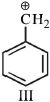
\end{matrix}}}\,\) -
- (A) \(III > II > I\)
- (B) \(I > II > III\)
- (C) \(II > III > I\)
- (D) \(III > I > II\)
જવાબ અને ઉકેલ જુઓ
સાચો જવાબ: (D)
Stability due to resonance - More the no of resonating structure more is the stability.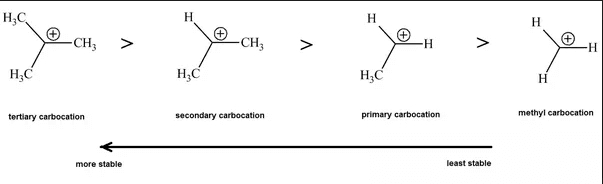
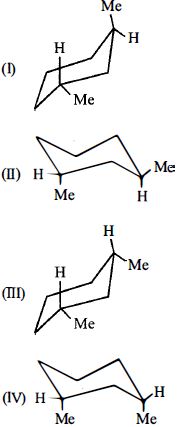
-
- (A) \((I) > (II) > (III) >(IV)\)
- (B) \((IV) > (III) > (II) \approx (I)\)
- (C) \((I) > (II) \approx (III) > (IV)\)
- (D) \((III) > (I) \approx (II) > (IV)\)
જવાબ અને ઉકેલ જુઓ
સાચો જવાબ: (C)
Disequatorial cis \(-1,\,3-\) Dimethylcyclohexane is more stable as both methyl groups are equatorial and are away from each other. (Refer to Image \(I\))It is followed by trans \(-1,\,3-\) Dimethylcyclohexane where one \(-C H_{3}\) group is equatorial and other is axial (Refer to Image \(II\))
Diaxial cis \(-1,\,3-\) Dimethylcyclohexane is less stable due to large amount of steric strain due to the interaction of axial - \(\mathrm{CH}_{3}\) groups. (Refer to Image \(III\) )
\((I) > (II) \approx (III) > (IV)\)
- 35. નીચેના સંયોજનોમાં ઇલેક્ટ્રોન અનુરાગી વિસ્થાપન પ્રક્રિયાઓમાં પ્રતિક્રિયાશીલતાનો યોગ્ય ક્રમ હશે
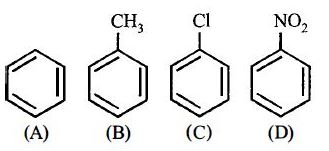 2013 અઘરું
- (A) \(B >A> C > D\)
- (B) \(D > C > B > A\)
- (C) \(A > B > C > D\)
- (D) \(B > C > A > D\)
જવાબ અને ઉકેલ જુઓ
સાચો જવાબ: (A)
\(- Cl\) and \(-CH_3\) groups are \(o\) and \(p\) directing. They are electron releasing due to \(+ E\) and \(+ M\) effects. Further since such groups increase electron density in the nucleus, they facilitate further electrophilic substitution and hence known as activating group. The activating effect of these groups is in order of \(- CH_3 > -X\) but chlorine exceptionally deactive the ring due to strong \(- I\) effect. Hence, it is difticult to carry out substitution in chlorobenzene than in benzene . Further \(- NO_2\) is a deactivating group hence deactivates the benzene nucleus, i.e. hinder the further substitution. Thus nitrobenzene undergo electrophilic substitution with a great difficulty hence the correct order will be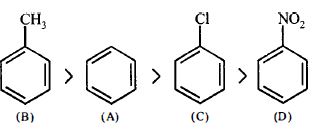
- 36. નીચે આપેલા પૈકી ક્યા સંયોજનની પ્રકાશક્રિયાશીલ સમઘટકતા દર્શાવવાની અપેક્ષા રાખી શકાય નહિ? (\(en=\) ઇથિલીન ડાય એમાઈન) 2013 મધ્યમ
- (A) \([Co(en)_3]^{3+}\)
- (B) \([Co(en)_2Cl_2]^{+}\)
- (C) \([Co(NH_3)_3Cl_3]\)
- (D) \([Co(en) (NH_3)_2 Cl_2]^+\)
જવાબ અને ઉકેલ જુઓ
સાચો જવાબ: (C)
Optical isomerism is exhibited by only those complexes which lacks elements of symmetry. \(\left[\mathrm{Co}\left(\mathrm{NH}_{3}\right)_{3} \mathrm{Cl}_{3}\right]\) shows facial as well as meridional isomerism. But both the forms contain plane of symmetry. Thus, this complex does not exhibit optical isomerism. -
- (A) \([Co(H_2O)_ 6]^{2+}\)
- (B) \([Co(CN)_6 ]^{3-}\)
- (C) \([Co(C_2O_4)_3]^{3-}\)
- (D) \([Co(NH_3)_6]^{3+}\)
જવાબ અને ઉકેલ જુઓ
સાચો જવાબ: (B)
Crystal field splitting depends upon the nature of ligand . The nature of ligand \(\Delta \) decreases as shown below \(C_2O_4^- < H_2O < NH_3 < CN^-\) hence the crystal field splitting will be maximum for \([Co(CN)_6]^{3-}\) -
- (A) \({[Fe{(CN)_6}]^{3 - }}\)
- (B) \({[Co{(C_2O_4)_3}]^{3 - }}\)
- (C) \([FeF_6]^{3-}\)
- (D) \([CoF_6]^{3-}\)
જવાબ અને ઉકેલ જુઓ
સાચો જવાબ: (B)
\([Fe(CN)_6]^{3-}\) has magnetic moment of a single unpaired electron whereas \([FeF_6]^{3-}\) has a magnetic moment of five unpaired electrons. \([CoF_6]^{3-}\) is paramagnetic with four unpaired electrons while \([Co(C_2O_4)_3]^3\) is diamagnetic. This anomaly is explained by valence bond theory in terms of formation of inner and outer orbital coordination entities. \([Co(C_2O_4)_3]^{3-}\) is an inner orbital complexes having \(d^2sp^3\) hybridization . - 39. \([Pd(C_6H_5)_2(SCN)_2]\) અને \([Pd(C_6H_5)_2(NCS)_2]\) વચ્ચે જોવા મળતી સમધટકતા જણાવો . 2013 અઘરું
- (A) બંધનીય સમઘટક્તા
- (B) સવર્ગ સમઘટક્તા
- (C) આયનીકારક સમઘટક્તા
- (D) Solvate સમઘટક્તા
જવાબ અને ઉકેલ જુઓ
સાચો જવાબ: (A)
The compound shows linkage isomerism because the ligand in the compound is an ambidenate ligand that can bond at more than one atomic site i.e., \(:NC{S^ - }\) and \(:SC{N^ - }\) -
- (A) \(MnSO_4\)
- (B) \(Mn_2O_7\)
- (C) \(MnO_2\)
- (D) \(Mn_2O_3\)
જવાબ અને ઉકેલ જુઓ
સાચો જવાબ: (B)
\(KMnO_4\) reacts with \(H_2SO_4\) to form \(Mn_2O_7\) which is highly explosive substance \(2KMn{O_4} + {H_2}S{O_4} \to {K_2}S{O_4} + M{n_2}{O_7} + {H_2}O\) -
- (A) \(CrO3\)
- (B) \(CrCl_3\)
- (C) \(CrO_2Cl_2\)
- (D) \(Cr_2O_3\)
જવાબ અને ઉકેલ જુઓ
સાચો જવાબ: (C)
Solid potassium dichromate when heated with concentrated sulphuric acid and a soluble chloride gives orange red vapours of a volatile oily liquid \(Cr{O_2}C{l_2}\) \(K_2Cr_2O_7 + 4NaCl + 6H_2SO_4\) \(\longrightarrow\) \(\begin{array}{l} 2KHS{O_4} + 4NaHS{O_4} + 2Cr{O_2}C{l_2}\\ \,\,\,\,\,\,\,\,\,\,\,\,\,\,\,\,\,\,\,\,\,\,\,\,\,\,\,\,\,\,\,\,\,\,\,\,\,\,\,\,\,\,\,\,\,\,\,{\rm{chromyl \,chloride}} \end{array}\) -
- (A) \(Cu_2O\) એ રંગવિહીન છે
- (B) કોપર \((I)\) સંયોજનો રંગહીન હોય છે સિવાય કે ચાર્જ ટ્રાન્સફરથી રંગ પરિણામ આવે છે
- (C) કોપર \((I)\) સંયોજન એ ડાયમેગ્નેટીક છે
- (D) \(Cu_2S\) કાળો છે
જવાબ અને ઉકેલ જુઓ
સાચો જવાબ: (A)
\(Cu_2O\) is red in colour. -
- (A) \(Cr(Z=24)\)
- (B) \(Mn(Z = 25)\)
- (C) \(Fe(Z=26)\)
- (D) \(Co(Z = 27)\)
જવાબ અને ઉકેલ જુઓ
સાચો જવાબ: (D)
\(E^{0}_{C r^{3+} / C r^{2+}}=\,-\,0.41\, V \)\(\mathrm{E}^{0}_{\mathrm{Fe}^{3+} / \mathrm{Fe}^{2+}}=+0.77 \,\mathrm{V}\)
\(\mathrm{E}^{0}_{\mathrm{Co}^{3+} / \mathrm{Co}^{2+}}=+1.97\, \mathrm{V}\)
\(E^{0}_{\mathrm{Mn}^{3+} / \mathrm{Mn}^{2+}}=+1.57\, \mathrm{V}\)
-
- (A) \(As < S < O < Se\)
- (B) \(Se < S < As < O\)
- (C) \(O < S < Se < As\)
- (D) \(O < S < As < Se\)
જવાબ અને ઉકેલ જુઓ
સાચો જવાબ: (C)
On moving down in a group atomic radii increases due to successive addition of extra shell hence \(O < S < Se\) Further As is in group \(15\) having one less electron in its \(p\) orbital hence have higher atomic radii than group \(16\) elements. \(i.e.,\,\,O < S < Se< As\) -
- (A) \(XeOF_2\)
- (B) \(XeO_3F_2\)
- (C) \(FXeOSO_2F\)
- (D) \([XeF_8]^{2-}\)
જવાબ અને ઉકેલ જુઓ
સાચો જવાબ: (B)
The hybridization of \(XeO_3F_2\) is \(sp^3d\) and its structure is trigonal bipyramidal in which oxygen atoms are situated on the plane and the fluoride atoms are on the top and bottom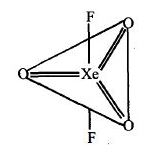
-
- (A) \(53.6 \)
- (B) \(48.6 \)
- (C) \(58.5\)
- (D) \(60.5 \)
જવાબ અને ઉકેલ જુઓ
સાચો જવાબ: (A)
Activation energy can be calculated from the equation \(\frac{\log k_{2}}{\log k_{1}}=\frac{E_{a}}{2.303 R}\left(\frac{1}{T_{1}}-\frac{1}{T_{2}}\right)\)given \(\frac{k_{2}}{k_{1}}=2 T_{2}=310 K T_{1}=300 K\)
\(=\log 2=\frac{-E_{a}}{2.303 \times 8.314}\left(\frac{1}{310}-\frac{1}{300}\right)\)
\(E_{a}=53598.6 J / \mathrm{mol}\)
\(=53.6\, \mathrm{kJ} / \mathrm{mol} .\)
-
- (A) \(0.0456\)
- (B) \(1.14\)
- (C) \(0.114\)
- (D) \(0.57\)
જવાબ અને ઉકેલ જુઓ
સાચો જવાબ: (B)
Given \( - \,\frac{{dMnO_4^ - }}{{dt}}\, = \,4.56\, \times {10^{ - 3}}\,M{s^{ - 1}}\)From the reaction given,
\( - \frac{1}{2}\,\frac{{dMnO_4^ - }}{{dt}}\, = \,\frac{{4.56 \times {{10}^{ - 3}}}}{2}\,M{s^{ - 1}}\)
\( - \frac{1}{2}\,\frac{{dMnO_4^ - }}{{dt}}\, = \,\frac{1}{5}\,\frac{{d{I_2}}}{{dt}}\)
\(\therefore \,\, - \frac{5}{2}\,\frac{{dMnO_4^ - }}{{dt}}\,\, = \frac{{d{I_2}}}{{dt}}\)
On substituting the given value
\(\therefore \frac{{d{I_2}}}{{dt}}\, = \,\frac{{4.56\, \times {{10}^{ - 3}} \times 5}}{2}\, = \,1.14\, \times \,{10^{ - 2}}\,M/s\)
-
- (A) \(0.5\)
- (B) \(1.25\)
- (C) \(12.5\)
- (D) \(1.0\)
જવાબ અને ઉકેલ જુઓ
સાચો જવાબ: (D)
For a zero order reactionRate constant \( = \,k\, = \,\frac{{a - x}}{t}\)
\(2\, \times \,{10^{ - 2}}\, = \,\frac{{a\, - \,0.5}}{{25}}\)
\(a\, - \,0.5\, = \,0.5\)
\(a\, = \,1.0\,M\)
-
- (A) \(4.5\)
- (B) \(3\)
- (C) \(5\)
- (D) \(2.5\)
જવાબ અને ઉકેલ જુઓ
સાચો જવાબ: (B)
In the reaction\(\frac{2}{3}A{l_2}{O_3}\, \to \,\frac{4}{3}Al\, + \,{O_2}\)
For the oxidation half - reaction
\(A{l^{3 + }}\, + \,3{e^ - }\, \to \,Al\)
no. of electron transfered \((n)=3\)
\(\Delta G^o\,=\,-\,nFE^o\)
\(940=3\times 96500 \times E^o\)
\(E^o\,=\,\frac {940\times 10^3\,J}{3\times 96500}\)
\(=\,3.24\,\,\approx\,3\,V\)
-
- (A) \(Mn^{2+} < Cl^- < Cr^{3+} < Cr\)
- (B) \(Mn^{2+} < Cl^{3+} < Cl^- < Cr\)
- (C) \(Cr^{3+} < Cl^- < Mn^{2+} < Cr\)
- (D) \(Cr^{3+} < Cl^- < Cr < Mn^{2+}\)
જવાબ અને ઉકેલ જુઓ
સાચો જવાબ: (A)
Lower the value of reduction potential higher will be reducing power hence the correct order will be \(Mn^{2+} < Cl^- < Cr^{3+} < Cr\)
આ પેજ પર આ ફિલ્ટર મુજબ કોઈ પ્રશ્ન નથી.
અન્ય વર્ષ
વારંવાર પૂછાતા પ્રશ્નો
ExamBro પર JEE Mains 2013 Chemistry ના કેટલા પ્રશ્નો છે?
98 પ્રશ્નો, દરેક સાચા જવાબ અને પૂરા ઉકેલ સાથે.
JEE Mains 2013 Chemistry નું કયું પ્રકરણ સૌથી વધુ પૂછાય છે?
રાસાયણિક બંધન અને આણ્વીય રચના, 10 પ્રશ્નો સાથે; ત્યાર બાદ સંતુલન - ૨, 8 પ્રશ્નો સાથે.
JEE Mains 2013 Chemistry ના પ્રશ્નો કેટલા અઘરા હોય છે?
2% સરળ, 38% મધ્યમ અને 60% અઘરા.