


પ્રશ્નો
નવા પહેલા10 માંથી 1–10 પ્રશ્નો
-
- (A) 7
- (B) 4
- (C) 6
- (D) 5
જવાબ અને ઉકેલ જુઓ
સાચો જવાબ: (D)
કુલ 5 કેન્દ્રાનુરાગીઓ હાજર છે
\(\mathrm{NH}_3, \mathrm{PhSH},\left(\mathrm{H}_3 \mathrm{C}\right)_2 \mathrm{~S}, \mathrm{CH}_2=\mathrm{CH}_2, \stackrel{\ominus}{\mathrm{O}} \mathrm{H}\) -
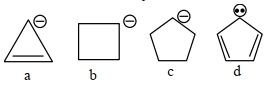
- (A) \(c>b>d>a\)
- (B) \(a>b>c>d\)
- (C) \(d>a>c>b\)
- (D) \(d>c>b>a\)
જવાબ અને ઉકેલ જુઓ
સાચો જવાબ: (D)
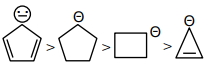
As we know compound (\(d\)) is aromatic and the compound (\(a\)) is anti-aromatic. Hence compound(\(d\))is most stable and compound (\(a\)) is least stable among these in compound (\(b\)) and (\(c\)) carbon atom of that positive charge is \(\mathrm{sp}^3\) hybridised they on the basis of angle strain theory compound (\(c\)) is more stable than compound (\(b\)).
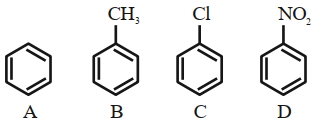
- 3. નીચેના સંયોજનોની ઇલેક્ટ્રોફિલિક વિસ્થાપન પ્રક્રિયામાં પ્રતિક્રિયાત્મકતાનો સાચો ક્રમ _______ છે.
 2024 અઘરું
- (A) \(\mathrm{B}>\mathrm{C}>\mathrm{A}>\mathrm{D}\)
- (B) \(\mathrm{D}>\mathrm{C}>\mathrm{B}>\mathrm{A}\)
- (C) \(\mathrm{A}>\mathrm{B}>\mathrm{C}>\mathrm{D}\)
- (D) \(B>A>C>D\)
જવાબ અને ઉકેલ જુઓ
સાચો જવાબ: (D)
\(-\mathrm{CH}_3\) \(+\mathrm{M}\) અને \(+\mathrm{I}\) દર્શાવે છે.
\(-\mathrm{Cl}\) \(+\mathrm{M}\) અને \(-\mathrm{I}\) દર્શાવે છે પરંતુ પ્રેરક અસર પ્રભાવી છે.
\(-\mathrm{NO}_2\) \(-\mathrm{M}\) અને \(-\mathrm{I}\) દર્શાવે છે.
ઇલેક્ટ્રોફિલિક વિસ્થાપન \(\alpha \frac{1}{-\mathrm{M} \text { અને }-\mathrm{I}}\)
\(\alpha+\mathrm{M} \text { અને }+\mathrm{I}\)
આથી, ક્રમ \(\mathrm{B}>\mathrm{A}>\mathrm{C}>\mathrm{D}\) છે.
-
- (A) \((A)\) માત્ર
- (B) \((C)\) માત્ર
- (C) \((B)\) માત્ર
- (D) \((D)\) અને \((E)\) માત્ર
જવાબ અને ઉકેલ જુઓ
સાચો જવાબ: (C)
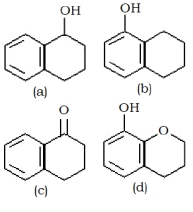
બંધનું વિષમવિભાજન આયનોની રચના તરફ દોરી જાય છે. - 5. નીચે આપેલા સંયોજનોને એરોમેટિક ઇલેકટ્રોન અનુરાગી વિસ્થાપન પ્રક્રિયાના વેગના ચઢતાક્રમમાં ગોઠવો.
 2023 અઘરું
- (A) \(d, b, c, a\)
- (B) \(b, c, a, d\)
- (C) \(c, a, b, d\)
- (D) \(d, b, a, c\)
જવાબ અને ઉકેલ જુઓ
સાચો જવાબ: (C)
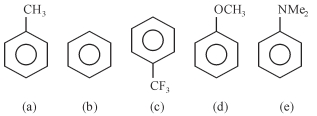
Benzene becomes more reactive towards EAS when any substituent raises the electron density.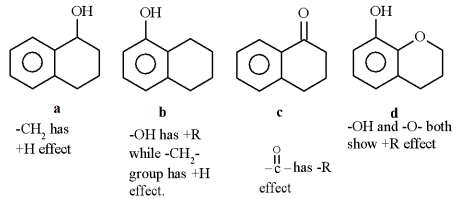
-
- (A) \(c > b > a > d > e\)
- (B) \(e > d > a > b > c\)
- (C) \(a > d > e > b > c\)
- (D) \(d > a > e > c > b\)
જવાબ અને ઉકેલ જુઓ
સાચો જવાબ: (B)
Higher the electron density on Benzene Ring, Higher its Reactivity towards electrophilic substitution Reaction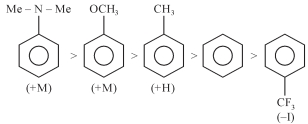
-
- (A) \(F ^{-}> OH ^{-}\)
- (B) \({{H}_{2}}\underset{\scriptscriptstyle\centerdot\centerdot}{\ddot{O}} > OH ^{-}\)
- (C) \(R \underset{\scriptscriptstyle\centerdot\centerdot}{\ddot{O}} H> RO ^{-}\)
- (D) \(NH _{2}^{-}> NH _{3}\)
જવાબ અને ઉકેલ જુઓ
સાચો જવાબ: (D)
Nucleophilicity \(\propto\) electro density on donor atom\(\propto\) size of donor atom (in gas)
\(\propto \frac{1}{\text { EN of atom }}\) (for period)
-
- (A) માત્ર \((B)\) અને \((C)\)
- (B) માત્ર \((A)\)
- (C) માત્ર \((A)\) અને \((C)\)
- (D) માત્ર \((B)\)
જવાબ અને ઉકેલ જુઓ
સાચો જવાબ: (C)
Ambident nucleophile\((A)\) \(KCN\) And \(AgCN\)
\((C)\) \(AgNO _{2}\) And \(KNO _{2}\)
-
- (A) \((b) < (c) < (a) < (d)\)
- (B) \((a) < (d) < (c) < (b)\)
- (C) \((d) < (a) < (c) < (b)\)
- (D) \((b) < (c) < (d) < (a)\)
જવાબ અને ઉકેલ જુઓ
સાચો જવાબ: (A)
\(\underset{Ch\arg ed\,ion}{\mathop{\underset{\_\_\_\_\_\_\_\_\_\_\_\_\_\_\_\_\_\_\_\_\_\_\_\_\_\_\_\_\_\_\_\_\_\_\_\_\_\_\_\_\_\_\_\_\_\_\_\_\_\_\_\_\_\_\_\_\_}{\mathop{O{{H}^{-}}>\begin{matrix}
C{{H}_{3}}-C-{{O}^{-}} \\
\,\,\,|| \\
\,\,\,O \\
\end{matrix}>\begin{matrix}
\,\,\,\,O \\
\,\,\,\,|| \\
C{{H}_{3}}-S-{{O}^{-}} \\
\,\,\,\,|| \\
\,\,\,\,O \\
\end{matrix}>}}\,}}\,\) \(\underset{\begin{smallmatrix}
neutral \\
system
\end{smallmatrix}}{\mathop{\underset{\_\_\_\_\_\_\_}{\mathop{{{H}_{2}}O}}\,}}\,\)ione pair donating tendency on oxygen is reduced, nucleophilicity reduced \(b < c < a < d\)
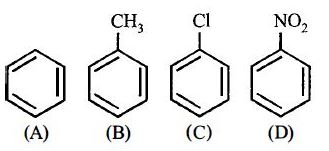
- 10. નીચેના સંયોજનોમાં ઇલેક્ટ્રોન અનુરાગી વિસ્થાપન પ્રક્રિયાઓમાં પ્રતિક્રિયાશીલતાનો યોગ્ય ક્રમ હશે
 2013 અઘરું
- (A) \(B >A> C > D\)
- (B) \(D > C > B > A\)
- (C) \(A > B > C > D\)
- (D) \(B > C > A > D\)
જવાબ અને ઉકેલ જુઓ
સાચો જવાબ: (A)
\(- Cl\) and \(-CH_3\) groups are \(o\) and \(p\) directing. They are electron releasing due to \(+ E\) and \(+ M\) effects. Further since such groups increase electron density in the nucleus, they facilitate further electrophilic substitution and hence known as activating group. The activating effect of these groups is in order of \(- CH_3 > -X\) but chlorine exceptionally deactive the ring due to strong \(- I\) effect. Hence, it is difticult to carry out substitution in chlorobenzene than in benzene . Further \(- NO_2\) is a deactivating group hence deactivates the benzene nucleus, i.e. hinder the further substitution. Thus nitrobenzene undergo electrophilic substitution with a great difficulty hence the correct order will be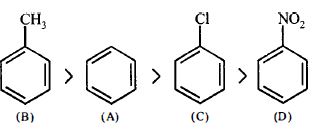
આ પેજ પર આ ફિલ્ટર મુજબ કોઈ પ્રશ્ન નથી.
STD 11 - કાર્બનિક રસાયણશાસ્ત્ર પ્રતિક્રિયા પદ્ધતિ ના અન્ય ટોપિક
વારંવાર પૂછાતા પ્રશ્નો
JEE Mains માં Attacking reagents ના કેટલા પ્રશ્નો આવ્યા છે?
2013–2025 ના 10 પ્રશ્નો, દરેક સાચા જવાબ અને પૂરા ઉકેલ સાથે.
Attacking reagents ના પ્રશ્નો કેટલા અઘરા હોય છે?
10% સરળ, 40% મધ્યમ અને 50% અઘરા.