


Chapters asked in 2021
26 chapters- 21Qs STD 11 Organic chemistry purification and characterization
- 27Qs STD 12 D and f- block elements Most asked
- 5Qs STD 11 Redox reactions
- 21Qs STD 12 Biomolecules
- 16Qs STD 11 Equilibrium - II (icon Equilibrium)
- 23Qs STD 12 Chemical kinetics
- 2Qs STD 11 Organic chemistry reaction mechanism
- 24Qs STD 12 Amines
- 7Qs STD 12 Carboxylic acids and their derivative
- 10Qs STD 12 Aldehydes and ketones
- 4Qs STD 12 Alcohol, phenol and ethers
- 9Qs STD 12 Haloalkanes and Haloarenes
- 7Qs STD 11 Organic chemistry isomerism
- 35Qs STD 12 Co-ordination chemistry Most asked
- 28Qs STD 12 P -Block elements - ll Most asked
- 20Qs STD 12 Electrochemistry
- 25Qs STD 12 Solution and colligative properties
- 27Qs STD 11 Some basic concept of chemistry
- 10Qs STD 11 Hydricarbon
- 2Qs STD 11 Organic chemistry Nomenclature of organic compounds
- 25Qs STD 11 Chemical bonding and molecular structure
- 8Qs STD 11 Classification of elements and periodicity in properties
- 15Qs STD 11 Equilibrium - 1 (chemical Equilibrium)
- 23Qs STD 11 Thermodynamics and thermochemistry
- 4Qs STD 11 P-Block elements - I
- 22Qs STD 11 Structure of atom
All JEE Mains 2021 Chemistry questions
26 chaptersShowing 1–50 of 420 questions
-
- (A) \(8\)
- (B) \(9\)
- (C) \(41\)
- (D) \(12\)
Show answer and solution
Correct Answer: (D)
Organic compound : \(0.8 \,\mathrm{gm}\)wt. of \(\mathrm{N}=\left(\frac{42}{100} \times 0.8\right)\, \mathrm{gm}\)
mole of \(N=\frac{42 \times 0.8}{100 \times 14}=\frac{2.4}{100}\, \mathrm{~mol}\)
moles of \(\mathrm{NH}_{3}=\frac{2.4}{100}\)
\(2 \mathrm{NH}_{3}+\mathrm{H}_{2} \mathrm{SO}_{4} \rightarrow\left(\mathrm{NH}_{4}\right)_{2} \mathrm{SO}_{4}\)
\(\quad\downarrow\quad\quad\quad\downarrow\)
\(\frac{2.4}{100}\) \(mole\) \(\quad\frac{1.2}{100}\) \(mole\)
For \(\mathrm{H}_{2} \mathrm{SO}_{4} \quad \frac{1.2}{100}=1 \times \mathrm{V}(\ell)\)
\(\Rightarrow \mathrm{V}_{\mathrm{H}_{2} \mathrm{SO}_{4}}=\frac{1.2}{100} \,\ell=12 \,\mathrm{~m} \ell\)
-
- (A) \(\mathrm{Fe}_{4}\left[\mathrm{Fe}(\mathrm{CN})_{6}\right]_{3}\)
- (B) \(\mathrm{K}_{5} \mathrm{Fe}\left[\mathrm{Fe}(\mathrm{CN})_{6}\right]_{2}\)
- (C) \(\mathrm{HFe}\left[\mathrm{Fe}(\mathrm{CN})_{6}\right]\)
- (D) \(\mathrm{KFe}\left[\mathrm{Fe}(\mathrm{CN})_{6}\right]\)
Show answer and solution
Correct Answer: (D)
\(\mathrm{FeCl}_{3}+\mathrm{K}_{4}\left[\mathrm{Fe}(\mathrm{CN})_{6}\right](\text { excess })\)\(\quad\quad\quad\downarrow\)
\(\mathrm{K} \mathrm{Fe}\left[\mathrm{Fe}(\mathrm{CN})_{6}\right]\)
Colloidal species
-
- (A) \(19\)
- (B) \(21\)
- (C) \(25\)
- (D) \(80\)
Show answer and solution
Correct Answer: (A)
\(\mathrm{n}_{\mathrm{cl}} \text { in compound }=\mathrm{n}_{\mathrm{AgCl}}=\frac{0.3849 \mathrm{~g}}{(107.87+35.5)}\, \mathrm{g} / \mathrm{mol}\)\(\Rightarrow \text { mass of chlorine }=\mathrm{n}_{\mathrm{Cl} } \times 35.5=0.0953\, \mathrm{gm}\)
\(\Rightarrow\, \% \text { wt of chlorine }=\frac{0.0953}{0.5} \times 100\)
\(\quad=19.06\, \%\)
-
- (A) \(1\)
- (B) \(6\)
- (C) \(3\)
- (D) \(8\)
Show answer and solution
Correct Answer: (C)
\(44 gm CO _{2}\), have \(12 gm\) carbonSo, \(420 gm CO _{2} \Rightarrow \frac{12}{44} \times 420\)
\(\Rightarrow \frac{1260}{11} gm\) carbon
\(\Rightarrow 114.545\) gram carbon
So, \(\%\) of carbon \(=\frac{114.545}{750} \times 100\)
\(=15.3 \%\)
\(18 gm H _{2} O \Rightarrow 2 gm H _{2}\)
\(210 gm \Rightarrow \frac{2}{18} \times 210\)
\(=23.33 gm H _{2}\)
\(So , \% H _{2} \Rightarrow \frac{23.33}{750} \times 100=3.11 \%\)
\(\approx 3 \%\)
-
- (A) \((A)\) is false but \((R)\) is true.
- (B) Both \((A)\) and \((R)\) are correct but \((R)\) is not the correct explanation of \((\mathrm{A})\)
- (C) \((A)\) is true but \((R)\) is false
- (D) Both \((A)\) and \((R)\) are correct and \((R)\) is the correct explanation of \((\mathrm{A})\)
Show answer and solution
Correct Answer: (D)
Both assertion \(\&\) reason are correct \(\&\) \((\mathrm{R})\) is the correct explanation of \((A)\) -
- (A) Statement\(-I\) is false but Statement \(II\) is true
- (B) Both Statement\(-I\) and Statement \(II\) are false
- (C) Statement\(-I\) is true but Statement \(II\) is false
- (D) Both Statement\(-I\) and Statement \(II\) are true
Show answer and solution
Correct Answer: (D)
Statement \(1: B.P.\) of chloroform \(=334 K\)\(B.P.\) of aniline \(=457 K\)
thus can be seprated of simple distillation.
Statement \(2 :\) Mixture of aniline and water seprated by simple distillation.
-
- (A) Both statement \(I\) and statement \(II\) are true
- (B) Statement \(\mathrm{I}\) is incorrect but statement \(II\) is true
- (C) Statement \(I\) is correct but statement \(II\) is false
- (D) Both Statement \(I\) and statement \(II\) are false.
Show answer and solution
Correct Answer: (C)
Statement \(I:\) It is correct statementStatement \(II:\) \(\mathrm{CH}_{3}-\mathrm{C^+H}_{2}\) involve \(\mathrm{C}_{\mathrm{sp}^{3}}-\mathrm{H}_{1 \mathrm{~s}}\) bond with empty \(2 \mathrm{p}\) orbital hence given statement is false.
-
- (A) Statement\(-I\) is true but statement\(-II\) is false
- (B) Both statement\(-I\) and statement\(-II\) are true
- (C) Both statement\(-I\) and statement\(-II\) are false
- (D) Statement\(-I\) is false but statement-II is true
Show answer and solution
Correct Answer: (C)
\(R _{ f }=\) retardation factorDistance travelled by the substance from
\(R _{ f }=\frac{\text { reference line }( c \cdot m )}{\text { Distan ce travelled by the solvent from }}\)
reference line \((c.m)\)
Note : \(R _{ f }\) value of different compounds are different.
-
- (A) \(4\)
- (B) \(400\)
- (C) \(40\)
- (D) \(0.40\)
Show answer and solution
Correct Answer: (C)
\(\mathrm{n}_{\mathrm{AgBr}}=\frac{0.188 \mathrm{~g}}{188 \mathrm{~g} / \mathrm{mol}}=10^{-3}\, \mathrm{~mol}\)\(\Rightarrow \mathrm{n}_{\mathrm{Br}}=\mathrm{n}_{\lambda_{\mathrm{kBt}}}=0.001\, \mathrm{~mol}\)
\(\Rightarrow \text { mass }_{\mathrm{Bz}}=(0.001 \times 80) \,\mathrm{gm}=0.08 \,\mathrm{gm}\)
\(\Rightarrow \text { mass } \%=\frac{0.08 \times 100}{0.2}=40 \,\%\)
- 10. In Carius method, halogen containing organic compound is heated with fuming nitric acid in the presence of : 2021 Hard
- (A) \(\mathrm{AgNO}_{3}\)
- (B) \(\mathrm{HNO}_{3}\)
- (C) \(\mathrm{BaSO}_{4}\)
- (D) \(\mathrm{CuSO}_{4}\)
Show answer and solution
Correct Answer: (A)
Organic compound is heated with fuming nitric acid in the presence of silver nitrate in carius method.Lunar caustic \(\left(\mathrm{AgNO}_{3}\right)\) is used as reagent hare to distinguish \(\mathrm{Cl}^{-}, \mathrm{Br}\) and \(\mathrm{I}^{-}\)respectively as follows.
\(\mathrm{Cl}^{-}(\mathrm{aq}) \stackrel{\mathrm{AgNO}_{3}}{\longrightarrow} \mathrm{AgCl} \downarrow_{\mathrm{ppt}}\) white
\(\mathrm{Br}^{-}(\mathrm{aq})\stackrel{\mathrm{AgNO}_{3}}{\longrightarrow} \mathrm{AgBr} \downarrow_{\mathrm{ppt}} \mathrm{pale}\) yellow
\(\mathrm{I}^{-}(\mathrm{aq}) \stackrel{\mathrm{AgNO}_{3}}{\longrightarrow} \mathrm{AgNO}_{3} \mathrm{AgI} \downarrow_{\mathrm{ppt}}\) Dark yellow
-
- (A) Mobility or flow of solvent system
- (B) Solubility of the compound
- (C) Length of the column or \(TLC\) Plate
- (D) Physical state of the pure compound
Show answer and solution
Correct Answer: (D)
In chromotography technique, the purification of a compound is independent of the physical -
- (A) \(25\)
- (B) \(19\)
- (C) \(32\)
- (D) \(16\)
Show answer and solution
Correct Answer: (B)
In Duma's method of estimation of Nitrogen.\(0.1840\, gm\) of organic compound gave \(30 \,mL\) of nitrogen which is collected at \(287\, K\) And \(758\,mm\) of \(Hg\).
Given ; Aqueous tension at \(287 \,K =14 \,mm\) of \(Hg\). Hence actual pressure \(=(758-14)\)
\(=744\, mm \text { of } Hg \text { . }\)
Volume of nitrogen at \(STP =\frac{273 \times 744 \times 30}{287 \times 760}\)
\(V =27.935 \,mL\)
\(\because 22400 mL\) of \(N _{2}\) at STP weighs \(=28\, gm .\)
\(\therefore 27.94 mL\) of \(N _{2}\) at STP weighs \(=\)
\(\left(\frac{28}{22400} \times 27.94\right)\, gm\)
\(=0.0349 \,gm\)
Hence \(=\left(\frac{0.0349}{0.1840} \times 100\right)\)
\(=18.97\, \%\)
Rond off. Answer \(=19 \,\%\)
-
- (A) \(142\)
- (B) \(42\)
- (C) \(471\)
- (D) \(233\)
Show answer and solution
Correct Answer: (B)
Molecular mass of \(\mathrm{BaSO}_{4}=233 \,\mathrm{~g}\)\(\because 233 \,g\,\mathrm{BaSO}_{4}\) contain \(\rightarrow 32\, \mathrm{~g}\) sulphur
\(\therefore 1.44\, \mathrm{~g} \,\mathrm{BaSO}_{4}\) contain \(\rightarrow \frac{32}{233} \times 1.44\, \mathrm{~g}\) sulphur
given : \(0.471\, \mathrm{~g}\) of organic compound
\(\%\) of \(\mathrm{S}=\frac{32 \times 1.44}{233 \times 0.471} \times 100=41.98 \,\% \approx 42\, \%\)
-
- (A) \((a)-(iii), (b)-(i), (c)-(ii), (d)-(iv)\)
- (B) \((a)-(i), (b)-(iv), (c)-(iii), (d)-(ii)\)
- (C) \((a)-(iii), (b)-(i), (c)-(iv),(d)-(ii)\)
- (D) \((a)-(i), (b)-(ii), (c)-(iv), (d)-(iii)\)
Show answer and solution
Correct Answer: (C)
Match List :-\((a)\) Lassaigne's Test \((iii)\) \(N , S , P ,\) and halogen \((b)\) \(Cu ( II )\) oxide \((i)\) Carbon \((c)\) Silver nitrate \((iv)\) Halogen Specifically \((d)\) The sodium fusion extract gives black precipitate with acetic acid and lead acetate \((ii)\) Sulphur -
- (A) \(1963\)
- (B) \(8510\)
- (C) \(1125\)
- (D) \(7412\)
Show answer and solution
Correct Answer: (C)
Moles of \(\mathrm{N}\) in \(\mathrm{N}, \mathrm{N}\) - dimethylaminopentane\(=\left(\frac{57.5}{115}\right)=0.5\, \mathrm{~mol}\)
\(\Rightarrow \mathrm{C}_{7} \mathrm{H}_{17} \mathrm{~N}+\frac{45}{2} \mathrm{CuO} \rightarrow 7 \mathrm{CO}_{2}+\frac{17}{2} \mathrm{H}_{2} \mathrm{O}+\frac{1}{2} \mathrm{~N}_{2}+\frac{45}{2} \mathrm{Cu}\)
\(\frac{\mathrm{n}_{\mathrm{cuo}} \text { reacted }}{\left(\frac{45}{2}\right)}=\frac{\mathrm{n}_{\mathrm{C_7} \mathrm{H}_{17} \mathrm{N}} \text { reacted }}{1}\)
\(\Rightarrow \mathrm{n}_{\mathrm{C} \mathrm{u} O}\) reacted \(=\left(\frac{45}{2}\right) \times 0.5=11.25\)
-
- (A) \(2\)
- (B) \(7\)
- (C) \(1\)
- (D) \(15\)
Show answer and solution
Correct Answer: (B)
\(\mathrm{C}_{2} \mathrm{H}_{7} \mathrm{~N}+\left(2 \mathrm{x}+\frac{\mathrm{y}}{2}\right) \mathrm{CuO} \rightarrow \mathrm{x} \mathrm{CO}_{2}+\frac{\mathrm{y}}{2} \mathrm{H}_{2} \mathrm{O}+\frac{\mathrm{z}}{2} \mathrm{~N}_{2}+\left(2 \mathrm{x}+\frac{\mathrm{y}}{2}\right) \mathrm{Cu}\)On balancing
\(\mathrm{C}_{2} \mathrm{H}_{7} \mathrm{~N}+\frac{15}{2} \mathrm{CuO} \rightarrow 2 \mathrm{CO}_{2}+\frac{7}{2} \mathrm{H}_{2} \mathrm{O}+\frac{1}{2} \mathrm{~N}_{2}+\frac{15}{2} \mathrm{Cu}\)
On comparing
\(\mathrm{y}=7\)
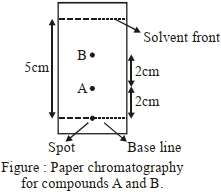
- 17. Using the provided information in the following paper chromatogram the calculate \(R _{ f }\) value of \(A\) .......... \(\times 10^{-1}\)
 2021 Medium
- (A) \(2\)
- (B) \(1\)
- (C) \(4\)
- (D) \(3\)
Show answer and solution
Correct Answer: (C)
\(R _{ f }=\frac{\text { Distance travelled by compound }}{\text { Distance travelled by solvent }}\)on chromatogram distance travelled by cmopound is \(\rightarrow 2 \,cm\)
Distance travelled by solvent \(=5\, cm\)
So \(R _{ f }=\frac{2}{5}=4 \times 10^{-1}=0.4\)
-
- (A) \(96\)
- (B) \(12\)
- (C) \(85\)
- (D) \(68\)
Show answer and solution
Correct Answer: (D)
Moles of \(\mathrm{Br}=\) Moles of \(\mathrm{AgBr}\) obtained\(\Rightarrow \quad\) Mass of \(\mathrm{Br}=\frac{0.2397}{188} \times 80\, \mathrm{~g}\)
therefore \(\%\) Br in the organic compound
\(=\frac{W_{\text {Br }}}{W_{T}} \times 100\)
\(=\frac{0.2397 \times 80}{188 \times 0.15} \times 100=0.85 \times 80\)
\(=68\)
\(\Rightarrow\) Nearest integer is \('68^{\prime}\)
- 19. Which of the following compound is added to the sodium extract before addition of silver nitrate for testing of halogens? 2021 Easy
- (A) Nitric acid
- (B) Ammonia
- (C) Hydrochloric acid
- (D) Sodium hydroxide
Show answer and solution
Correct Answer: (A)
For testing of halogens, Nitric acid is added to the sodium extract because if \(CN ^{-}\) or \(S ^{2-}\) are present then they will be oxidised and removed before the test of halides. -
- (A) Carius tube is used in the estimation of sulphur in an organic compound
- (B) Carius method is used for the estimation of nitrogen in an organic compound
- (C) Phosphoric acid produced on oxidation of phosphorus present in an organic compound is precipitated as \(Mg _{2} P _{2} O _{7}\) by adding magnesia mixture.
- (D) Kjeldahl's method is used for the estimation of nitrogen in an organic compound
Show answer and solution
Correct Answer: (B)
Carius method is used in the estimation of halogen in organic compounds. - 21. Which purification technique is used for high boiling organic liquid compound (decomposes near its boiling point)? 2021 Medium
- (A) Steam distillation
- (B) Simple distillation
- (C) Fractional distillation
- (D) Reduced pressure distillation
Show answer and solution
Correct Answer: (D)
Reduced pressure distillation used for the purification of high boiling organic liquids which decomposes at or below their boiling point. - 22. Dichromate ion is treated with base, the oxidation number of \(Cr\) in the product formed is .... . 2021 Easy
- (A) \(3\)
- (B) \(4\)
- (C) \(5\)
- (D) \(6\)
Show answer and solution
Correct Answer: (D)
\(Cr _{2} O _{7}^{2-}+ OH ^{-} \longrightarrow CrO _{4}^{2-}\)Oxidation state of \(Cr\) in \(CrO _{4}^{2-}\) is \(+6\)
-
- (A) \(4\)
- (B) \(6\)
- (C) \(5\)
- (D) \(7\)
Show answer and solution
Correct Answer: (D)
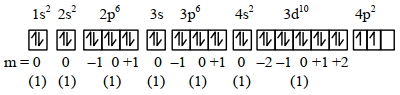
Completely filled orbital with \(\mathrm{m}_{\ell}=0\) are\(=1+1+1+1+1+1+1\)
\(=7\)
So Answer is \(7\)
-
- (A) Statement \(I\) is false but statement \(II\) is true
- (B) Statment \(I\) is true but statement \(II\) is false
- (C) Both statement \(I\) and statement \(II\) are true
- (D) Both statement \(I\) and statement \(II\) are false
Show answer and solution
Correct Answer: (C)
The \(+3\) oxidation state of lanthanide is most stable and therefore lanthanide in \(+4\) oxidation state has strong tendence to gain \(e ^{-}\) and converted into \(+3\) and therefore act as strong oxidizing agent.\(eg Ce ^{+4}\) And there fore \(CeO _{2}\) is used to oxidized alcohol aldehyde and ketones.
Lanthanide in \(+2\) oxidation state has strong tendency to loss \(e ^{-}\) and converted into \(+3\) oxidation state therefore act as strong reducing agent.
\(\therefore EuSO _{4}\) act as strong reducing agent.
-
- (A) Statement \(I\) is true but statement \(II\) is false
- (B) Both statement \(I\) and statement \(II\) are true
- (C) Statement \(I\) is false but statement \(II\) is true
- (D) Both statement \(I\) and statement \(II\) are false
Show answer and solution
Correct Answer: (A)
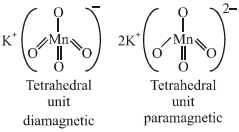
\(2 KMnO _{4} \stackrel{573 K }{\longrightarrow} K _{2} MnO _{4}+ MnO _{2}+ O _{2}\)Potassium Potassium
permanganate \(\quad\) manganate
Statement\(-I\) is correct.
Statement\(-II\) is incorrect
-
- (A) Both statement \(I\) and statement \(II\) are correct
- (B) Statement \(I\) is incorrect but statement \(II\) is correct
- (C) Both statement \(I\) and statement \(II\) are incorrect
- (D) Statement \(I\) is correct but statement \(II\) is incorrect
Show answer and solution
Correct Answer: (D)
The \(E ^{\circ}\) value for \(Ce ^{4+} / Ce ^{3+}\) is \(+1.74 V\) because the most stable oxidation state of lanthanide series elements is \(+3\) .It means \(Ce ^{3+}\) is more stable than \(Ce ^{4+}\)
-
- (A) \(170\)
- (B) \(173\)
- (C) \(181\)
- (D) \(141\)
Show answer and solution
Correct Answer: (B)
\(gm\) equi. of \(CrO _{4}^{2-}= S _{2} O _{3}^{2-}\)\(0.154 \times 3 \times v =0.25 \times 40 \times 8\)
\(v =173.16=173 \,ml\)

-
- (A) linear symmetrical \(\mathrm{Cr}-\mathrm{O}-\mathrm{Cr}\) bond.
- (B) non-linear symmetrical \(\mathrm{Cr}-\mathrm{O}-\mathrm{Cr}\) bond.
- (C) linear unsymmetrical \(\mathrm{Cr}-\mathrm{O}-\mathrm{Cr}\) bond.
- (D) non-linear unsymmetrical \(\mathrm{Cr}-\mathrm{O}-\mathrm{Cr}\) bond.
Show answer and solution
Correct Answer: (B)
dichromate ion contain non-linear symmetrical \(\mathrm{Cr}-\mathrm{O}-\mathrm{Cr}\) Bond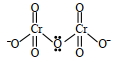
- 29. In which of the following pairs, the outer most electronic configuration will be the same ? 2021 Easy
- (A) \(Cr ^{+}\) and \(Mn ^{2+}\)
- (B) \(Ni ^{2+}\) and \(Cu ^{+}\)
- (C) \(Fe ^{2+}\) and \(Co ^{+}\)
- (D) \(V ^{2+}\) and \(Cr ^{+}\)
Show answer and solution
Correct Answer: (A)
\(\begin{array}{ll}\text { Option }-1 & Mn ^{+2}[ Ar ] 3 d ^{5}, Cr ^{+}[ Ar ] 3 d ^{5} \\ \text { Option }-2 & Ni ^{+2}[ Ar ] 3 d ^{8}, Cu ^{+}[ Ar ] 3 d ^{10} \\ \text { Option }-3 & Fe ^{+2}[ Ar ] 3 d ^{6}, Co ^{+}[ Ar ] 3 d ^{7} 4 s ^{1} \\ \text { Option }-4 & V ^{+2}[ Ar ] 3 d ^{3}, Cr ^{+}[ Ar ] 3 d ^{5}\end{array}\) -
- (A) \(\mathrm{ClO}_{2}^{-}, \mathrm{F}_{2}, \mathrm{MnO}_{4}^{-}\)and \(\mathrm{Cr}_{2} \mathrm{O}_{7}^{2-}\)
- (B) \(\mathrm{Cr}_{2} \mathrm{O}_{7}^{2-}, \mathrm{MnO}_{4}^{-}, \mathrm{ClO}_{2}^{-}\)and \(\mathrm{Cl}_{2}\)
- (C) \(\mathrm{MnO}_{4}^{-}, \mathrm{ClO}_{2}^{-}, \mathrm{Cl}_{2}\) and \(\mathrm{Mn}^{3+}\)
- (D) \(\mathrm{ClO}_{4}^{-}, \mathrm{MnO}_{4}^{-}, \mathrm{ClO}_{2}^{-}\)and \(\mathrm{F}_{2}\)
Show answer and solution
Correct Answer: (C)
No option contains all species that show disproportionation reaction.\(\mathrm{MnO}_{4}^{-}\)
\(Mn\) is in \(+7\) oxidation state (highest) hence cannot be simultaneously oxidized or reduced
-
- (A) \(10\)
- (B) \(15\)
- (C) \(20\)
- (D) \(36\)
Show answer and solution
Correct Answer: (A)
\(\mathrm{Ho}=[\mathrm{Xe}] 4 \mathrm{f}^{11} 6 \mathrm{~s}^{2}\)\(\mathrm{Ho}^{3+}=[\mathrm{Xe}] 4 \mathrm{f}^{10}\)
So number of \(\mathrm{e}^{-}\)present \(4 \mathrm{f}\) is \(10 .\)
- 32. Number of electrons that Vanadium \((Z=23)\) has in p-orbitals is equal to \(......\) 2021 Medium
- (A) \(24\)
- (B) \(66\)
- (C) \(89\)
- (D) \(12\)
Show answer and solution
Correct Answer: (D)
\({ }_{23} V: 1 s^{2} 2 s^{2} 2 p^{6} 3 s^{2} 3 p^{6} 3 d^{3} 4 s^{2}\)Number of electrons in p-orbitals is equal to \(12.00\)
-
- (A) \(X = SO _{2}, Y = Cr _{2} O _{3}\)
- (B) \(X = SO _{3}, Y = Cr _{2} O _{3}\)
- (C) \(X = SO _{2}, Y = Cr _{2}\left( SO _{4}\right)_{3}\)
- (D) \(X = SO _{3}, Y = Cr _{2}\left( SO _{4}\right)_{3}\)
Show answer and solution
Correct Answer: (C)
\(SO _{2}+ dil H _{2} SO _{4} \longrightarrow SO _{3}( g )\)\(Cr _{2}\left( SO _{4}\right)_{3}\)
- 34. Potassium permanganate on heating at \(513\, \mathrm{~K}\) gives a product which is : 2021 Medium
- (A) paramagnetic and colourless
- (B) diamagnetic and green
- (C) diamagnetic and colourless
- (D) paramagnetic and green
Show answer and solution
Correct Answer: (D)
\(2 \mathrm{KMnO}_{4} \xrightarrow[200^{o}C]{\Delta} \mathrm{K}_{2} \mathrm{MnO}_{4}+{+\mathrm{MnO}_{2}}+\mathrm{O}_{2}\)\(\quad \quad \quad \quad \quad \quad \quad Green\quad \quad \quad Black\)
In \(\mathrm{K}_{2} \mathrm{MnO}_{4}\), manganese oxidation state is \(+6\) and hence it has one unpaired \(\mathrm{e}^{-}\).
- 35. The Azimuthal quantum number for the valence electrons of \(\mathrm{Ga}^{+}\)ion is \(.....\) (Atomic number of \(\mathrm{Ga}=31\) ) 2021 Medium
- (A) \(0\)
- (B) \(1\)
- (C) \(2\)
- (D) \(3\)
Show answer and solution
Correct Answer: (A)
\(\mathrm{Ga}^{+}: \mathrm{1s}^{2} \,2 \mathrm{~s}^{2}\, 2 \mathrm{P}^{6}\, 3 \mathrm{~s}^{2} \,3 \mathrm{p}^{6}\, 3 \mathrm{~d}^{10} \,4 \mathrm{~s}^{2}\)last orbital \(=\) \(\mathrm{s}\)
The azimuthal quantum number for the valenceelectrons \((4s-\)subshell) of \(\mathrm{Ga}+\) ion is zero\((0).\)
-
- (A) \((a)>(d)>(c)>(b)>(e)\)
- (B) \((\mathrm{d})>(\mathrm{a})>(\mathrm{b})>(\mathrm{c})>(\mathrm{e})\)
- (C) \((a)>(c)>(d)>(b)>(e)\)
- (D) \((c)>(a)>(d)>(e)>(b)\)
Show answer and solution
Correct Answer: (A)
\((a)\) \(\stackrel{+6}{{C}} {rO}_{3}\)\((b)\) \(\stackrel{+3} {Fe}_{2} {O}_{3}\)
\((c)\) \(\stackrel{+4} {MnO}_{2}\)
\((d)\) \(\stackrel{+5} {V}_{2} {O}_{5}\)
\((e)\) \(\stackrel{+1} {Cu}_{2} {O}\)
So order of oxidation state \(a>d>c>b>e\)
- 37. The electrode potential of \(M ^{2+} / M\) of \(3 d-\) series elements shows positive value of 2021 Easy
- (A) \(Zn\)
- (B) \(Fe\)
- (C) \(Co\)
- (D) \(Cu\)
Show answer and solution
Correct Answer: (D)
Only copper shows positive value for electrode potential of \(M ^{2+} / M\) of \(3 d-\)series elements.\(E ^{\Theta} / V _{\left( Cu ^{2+} / Cu \right)}:+0.34\)
-
- (A) \(4 f^{7} 6 \mathrm{~s}^{2}\)
- (B) \(4 f^{6}\)
- (C) \(4 f^{7}\)
- (D) \(4 f^{6} 6 \mathrm{~s}^{2}\)
Show answer and solution
Correct Answer: (C)
\(\mathrm{Eu} \rightarrow[\mathrm{Xe}] 4 \mathrm{f}^{7} 6 \mathrm{~s}^{2}\)\(\mathrm{Eu}^{2+} \rightarrow[\mathrm{Xe}] 4 \mathrm{f}^{7}\)
-
- (A) \(\mathrm{X}=\) basic \(\quad \mathrm{Y}=\) amphoteric
- (B) \(\mathrm{X}=\) amphoteric \(\quad \mathrm{Y}=\) basic
- (C) \(\mathrm{X}=\) acidic \(\quad \mathrm{Y}=\) acidic
- (D) \(\mathrm{X}=\) basic \(\quad \mathrm{Y}=\) basic
Show answer and solution
Correct Answer: (D)
\(\mathrm{V}_{2} \mathrm{O}_{3}-\) basic\(CrO-\) basic
-
- (A) \(7\)
- (B) \(6\)
- (C) \(1\)
- (D) \(8\)
Show answer and solution
Correct Answer: (A)
The electronic configuration of\({ }_{64} \mathrm{Gd}:[\mathrm{Xe}] 4 \mathrm{f}^{7} 5 \mathrm{~d}^{1} 6 \mathrm{~s}^{2}\)
So the electronic configuration of
\({ }_{64} \mathrm{Gd}^{2+}:[\mathrm{Xe}] 4 \mathrm{f}^{7} 5 \mathrm{~d}^{1} 6 \mathrm{~s}^{0}\)
\(i.e.\) the number of \(4 \mathrm{f}\) electrons in the ground state electronic configuration of \(\mathrm{Gd}^{2+}\) is \(7\)
- 41. The number of \(f\) electrons in the ground state electronic configuration of \(\mathrm{Np}(\mathrm{Z}=93)\) is ....... . 2021 Easy
- (A) \(2\)
- (B) \(5\)
- (C) \(4\)
- (D) \(6\)
Show answer and solution
Correct Answer: (C)
\(\mathrm{Np}=1 \mathrm{~s}^{2} 2 \mathrm{~s}^{2} 2 \mathrm{p}^{6} 3 \mathrm{~s}^{2} 3 \mathrm{p}^{6} 4 \mathrm{~s}^{2} 3 \mathrm{~d}^{10} 4 \mathrm{p}^{6} 5 \mathrm{~s}^{2} 4 \mathrm{~d}^{10} 5 \mathrm{p}^{6} 6 \mathrm{~s}^{2}\)\(4 \mathrm{f}^{14} 5 \mathrm{~d}^{10} 6 \mathrm{p}^{6} 7 \mathrm{~s}^{2}-5 \mathrm{f}^{4} 6 \mathrm{~d}^{1}\)
Total no. of \('f'\) electron \(=14 \mathrm{e}^{-}+4 \mathrm{e}^{-}=18\)
-
- (A) \(\mathrm{Sc}^{3+}, \mathrm{V}^{5+}, \mathrm{Ti}^{4+}\)
- (B) \(\mathrm{Cu}^{2+}, \mathrm{Cr}^{3+}, \mathrm{Sc}^{+}\)
- (C) \(\mathrm{Ni}^{2+}, \mathrm{Mn}^{7+}, \mathrm{Hg}^{2+}\)
- (D) \(\mathrm{Cu}^{+}, \mathrm{Zn}^{2+}, \mathrm{Mn}^{4+}\)
Show answer and solution
Correct Answer: (B)
\(\mathrm{Cu}^{2+}:[\mathrm{Ar}] 3 \mathrm{~d}^{9} 4 \mathrm{~s}^{0}\)\(\mathrm{Cr}^{3+}:[\mathrm{Ar}] 3 \mathrm{~d}^{3} 4 \mathrm{~s}^{0}\)
\(\mathrm{Sc}^{+}:[\mathrm{Ar}] 3 \mathrm{~d}^{1} 4 \mathrm{~s}^{1}\)
All are coloured and paramagnetic due to presence of unpaired \(\mathrm{e}^{-}\)
-
- (A) \(1.73,3.87,0\)
- (B) \(0,3.87,1.73\)
- (C) \(3.87,1.73,0\)
- (D) \(1.73,0,3.87\)
Show answer and solution
Correct Answer: (A)
\(\mu=\sqrt{n(n+2)} B M\)\(n=\) number of unpaired electrons
\(T_{i}^{i+3}=\text { Ar }] 3 d^{1} \quad \quad\quad n=1 \quad \quad \mu=1.73\, \mathrm{BM}\)
\(\mathrm{V}^{+2}= \text { [Ar]3d }^{3} \quad \quad \quad \mathrm{n}=3 \quad \quad \mu=3.87\, \mathrm{BM}\)
\(\mathrm{Sc}^{+3}=[\mathrm{Ar}] 3 \mathrm{~d}^{0} 4 \mathrm{~s}^{0} \quad \quad \mathrm{n}=0 \quad \quad \mu=0\)
-
- (A) \(Cr < Zn < Co < Cu < Fe\)
- (B) \(Zn < Cu < Co < Fe < Cr\)
- (C) \(Zn < Cr < Fe < Co < Cu\)
- (D) \(Cr < Fe < Co < Cu < Zn\)
Show answer and solution
Correct Answer: (C)
\(Density /g cm^{-3}\)\(\begin{array}{*{20}{c}} {Zn}& < &{Cr}& < &{Fe}& < &{Co}& < &{Cu} \\ \downarrow &{}& \downarrow &{}& \downarrow &{}& \downarrow &{}& \downarrow \\ {7.1}&{}&{7.19}&{}&{7.8}&{}&{8.7}&{}&{8.9} \end{array}\)
-
- (A) \(\mathrm{Nd}\)
- (B) \(\mathrm{Yb}\)
- (C) \(\mathrm{La}\)
- (D) \(\mathrm{Ce}\)
Show answer and solution
Correct Answer: (B)
Ytterbium shows \(+2\) oxidation state with diamagnetic nature - 46. Which one of the following lanthanoids does not form \(MO _{2} ?\) [\(M\) is lanthanoid metal] 2021 Easy
- (A) \(\operatorname{Pr}\)
- (B) \(Dy\)
- (C) \(Nd\)
- (D) \(Yb\)
Show answer and solution
Correct Answer: (D)
\(Y b\) is the only element that do not form \(MO _{2}\) type oxide -
- (A) \(Fe\)
- (B) \(\mathrm{Mn}\)
- (C) \(\mathrm{Cr}\)
- (D) \(Co\)
Show answer and solution
Correct Answer: (C)
Elements of group \(7,8,9\) do not form hydrides thus \(\mathrm{Cr}\) will only form hydride among the given elements \((Fe, \mathrm{Mn}, \mathrm{Co})\) - 48. Which one of the following when dissolved in water gives coloured solution in nitrogen atmosphere? 2021 Hard
- (A) \(\mathrm{CuCl}_{2}\)
- (B) \(\mathrm{AgCl}\)
- (C) \(\mathrm{ZnCl}_{2}\)
- (D) \(\mathrm{Cu}_{2} \mathrm{Cl}_{2}\)
Show answer and solution
Correct Answer: (A)
\((A)\) \(\mathrm{CuCl}_{2}+\mathrm{nH}_{2} \mathrm{O} \rightarrow \mathrm{Cu}_{\left(\mathrm{aq}_{.}\right)}^{+2}\)\(\quad\quad\quad\quad\quad\quad\quad\quad\)blue colour
\((B)\) \(\mathrm{AgCl}+\mathrm{nH}_{2} \mathrm{O} \rightarrow\) Insoluble
\((C)\) \(\mathrm{ZnCl}_{2}+\mathrm{nH}_{2} \mathrm{O} \rightarrow \mathrm{Zn}_{\left(\mathrm{aq}_{.}\right)}^{+2}\)
\(\quad\quad\quad\quad\quad\quad\quad\quad\)Colourless
\((D)\) \(\mathrm{Cu}_{2} \mathrm{Cl}_{2}+\mathrm{nH}_{2} \mathrm{O} \rightarrow\) Insoluble
-
- (A) \(22\)
- (B) \(10\)
- (C) \(14\)
- (D) \(16\)
Show answer and solution
Correct Answer: (D)
Writting the half reaction oxidation half reaction\(MnO _{4}^{-} \rightarrow Mn ^{2+}\)
balancing oxygen
\(MnO _{4}^{-} \rightarrow Mn ^{2+}+4 H _{2} O\)
balancing Hydrogen
\(8 H ^{+}+ MnO _{4}^{-} \rightarrow Mn ^{2+}+4 H _{2} O\)
balancing charge
\(5 e ^{-}+8 H ^{+}+ MnO _{4}^{-} \rightarrow Mn ^{2+}+4 H _{2} O\)
Reduction half
\(C _{2} O _{4}^{2-} \rightarrow CO _{2}\)
Balancing carbon
\(C _{2} O _{4}^{2-} \rightarrow 2 CO _{2}\)
Balancing charge
\(C _{2} O _{4}^{2-} \rightarrow 2 CO _{2}+2 e ^{-}\)
Net equation
\(16 H ^{+}+2 MnO _{4}^{-}+5 C _{2} O _{4}^{2-} \rightarrow 10 CO _{2}+2 Mn ^{2+}+8 H _{2} O\)
So \(\quad c=16\)
-
- (A) \(H _{2} O _{2}\) acts as reducing and oxidising agent respectively in equation \((A)\) and \((B)\)
- (B) \(H _{2} O _{2}\) acts as oxidising agent in equation \((A)\) and \((B)\)
- (C) \(H _{2} O _{2}\) acts as reducing agent in equation \((A)\) and \(( B )\)
- (D) \(H _{2} O _{2}\) act as oxidizing and reducing agent respectively in equation \((A)\) and \((B)\)
Show answer and solution
Correct Answer: (C)
\((A)\) \(HOCl + H _{2} O _{2} \rightarrow H _{3} O ^{+}+ Cl ^{-}+ O _{2}\)In this equation, \(H _{2} O _{2}\) is reducing chlorine from \(+1\) to \(-1\)
\((B)\) \(I _{2}+ H _{2} O _{2}+2 OH^- \rightarrow 2 I ^{-}+2 H _{2} O + O _{2}\)
In this equation, \(H _{2} O _{2}\) is reducing iodine from \(0\) to \(-1\)
No questions on this page match these filters.
Other years
Frequently asked
How many JEE Mains 2021 Chemistry questions are on ExamBro?
420 questions, each with the correct answer and a full solution.
Which JEE Mains 2021 Chemistry chapter is asked the most?
Co-ordination chemistry, with 35 questions, followed by P -Block elements - ll with 28.
How difficult are JEE Mains 2021 Chemistry questions?
25% are easy, 50% medium and 25% hard.