


JEE Mains 2021 Chemistry ના બધા પ્રશ્નો
26 પ્રકરણ420 માંથી 251–300 પ્રશ્નો
- 251. \(10\, {~g}\) બેન્ઝીનનું મિથાઇલેશન પર \(9.2\, {~g}\) ટોલ્યુઇન આપ્યું. ટોલ્યુઇન નીપજની ટકાવારીની ગણતરી કરો. (નજીકના પૂર્ણાંકમાં) 2021 મધ્યમ
- (A) \(75\)
- (B) \(78\)
- (C) \(81\)
- (D) \(96\)
જવાબ અને ઉકેલ જુઓ
સાચો જવાબ: (B)
Moles of \({C}_{6} {H}_{6}=10 / 78\)moles of toluene \(=10 / 78\)
\({w}_{{t}}\) of toluene should be \(=10 / 78 \times 92\)
\(\%\) yield \(=\frac{9.2}{\frac{10}{78} \times 92} \times 100=78\, \%\)
-
- (A) \(19\)
- (B) \(1900\)
- (C) \(190\)
- (D) \(1.9\)
જવાબ અને ઉકેલ જુઓ
સાચો જવાબ: (A)
\({C}_{3} {H}_{8({~s})}+5 {O}_{2({~g})} \longrightarrow 3 {CO}_{2({~g})}+4 {H}_{2} {O}_{(b)}\)\({t}=0\quad 2.27\, {~mole} \quad 31.25\, {~mol}\)
\({t}=\infty \quad 0 \quad\quad\quad\quad 19.9 \,{~mol} \quad 6.81\, {~mol} \quad 9.08\, {~mol}\)
mole fraction of \({CO}_{2}\) in the final reaction mixture (heterogenous)
\({X}_{{CO}_{2}}=\frac{6.81}{19.9+6.81+9.08}\)
\(=0.1902=19.02 \times 10^{-2}\)
\(\Rightarrow 19\)
-
- (A) \(500\)
- (B) \(50\)
- (C) \(5\)
- (D) \(0.50\)
જવાબ અને ઉકેલ જુઓ
સાચો જવાબ: (B)
\({Na}_{3} {PO}_{4} \longrightarrow \quad3 {Na}\)\(\frac{1}{3} \times \frac{3.45}{23} {~mol} \quad\) \(3.45 {~g}\)
\(\quad\quad\quad\quad\quad\quad\quad\frac{3.45}{23} {~mol}\)
therefore molarity of \({Na}_{3} {PO}_{4}\) Solution =
\(\frac{{n}_{{Na}_{3} {PO}_{4}}}{\text { volume of solution in } {L}}\)
\(=\frac{\frac{1}{3} \times \frac{3.45}{23}\, {~mol}}{0.1\, {~L}}\)
\(=0.5=50\, \times 10^{-2}\)
- 254. \(100\) મોલલ જલીય દ્રાવણમાં દ્રાવકનો મોલ અંશ ........... \(\times 10^{-2}\) [આપેલ છે: આણ્વિય દળ : \(H : 1.0 \,u , O : 16.0\, u\) ] 2021 અઘરું
- (A) \(64\)
- (B) \(52\)
- (C) \(44\)
- (D) \(62\)
જવાબ અને ઉકેલ જુઓ
સાચો જવાબ: (A)
\(100\) molal aqueous solution means there is \(100\) mole solute in \(1 kg =1000 gm\) water. Now,mole-fraction of solute \(=\frac{ n _{\text {solute }}}{ n _{\text {solute }}+ n _{\text {solvent }}}\)
\(=\frac{100}{100+\frac{1000}{18}}=\frac{1800}{2800}=0.6428\)
\(=64.28 \times 10^{-2}\)
-
- (A) \(0.20\)
- (B) \(2\)
- (C) \(200\)
- (D) \(20\)
જવાબ અને ઉકેલ જુઓ
સાચો જવાબ: (D)
\({\left[{H}_{2} {C}_{2} {O}_{4} \cdot 2 {H}_{2} {O}\right]=\frac{\text { weight } / {M}_{{w}}}{{V}({L})}}\)\(\Rightarrow {x} \times 10^{-2}=\frac{6.3 / 126}{250 / 1000}\)
\({x}=20\)
-
- (A) \(1\)
- (B) \(2\)
- (C) \(3\)
- (D) \(4\)
જવાબ અને ઉકેલ જુઓ
સાચો જવાબ: (B)
સ્પષ્ટીકરણ:
1. સંયોજન A ના મોલની સંખ્યાની ગણતરી:
\( \text{દ્રાવ્યના મોલ} = \frac{\text{આપેલ દળ}}{\text{આણ્વિય ભાર}} = \frac{4.5 \text{ g}}{90 \text{ g/mol}} = 0.05 \text{ mol} \)
2. દ્રાવણના કદને લીટરમાં ફેરવવું:
\( \text{દ્રાવણનું કદ} = \frac{250 \text{ mL}}{1000} = 0.25 \text{ L} \)
3. દ્રાવણની મોલારિટી (M) ની ગણતરી:
\( \text{મોલારિટી} = \frac{\text{દ્રાવ્યના મોલ}}{\text{દ્રાવણનું કદ લીટરમાં}} = \frac{0.05 \text{ mol}}{0.25 \text{ L}} = 0.2 \text{ M} \)
4. \( x \) નું મૂલ્ય નક્કી કરવું:
પ્રશ્ન મુજબ, મોલારિટીને \( x \times 10^{-1} \text{ M} \) તરીકે દર્શાવવામાં આવી છે:
\( 0.2 = 2 \times 10^{-1} \)
બંને બાજુની સરખામણી કરતાં, \( x = 2 \) મળે છે.
આથી, વિકલ્પ B એ સાચો વિકલ્પ છે. -
- (A) \(5\)
- (B) \(8\)
- (C) \(2\)
- (D) \(10\)
જવાબ અને ઉકેલ જુઓ
સાચો જવાબ: (B)
\(\underline{50000.020} \times 10^{-3}\) -
- (A) \(6\)
- (B) \(8\)
- (C) \(2\)
- (D) \(34\)
જવાબ અને ઉકેલ જુઓ
સાચો જવાબ: (C)
\(\text { No. of atoms }=\frac{8}{23} \times 6.02 \times 10^{23}= 2.09 \times 10^{23}\)\(\quad\quad\quad\quad\quad\quad\quad\quad\quad\quad\quad\quad\quad\quad\simeq 2 \times 10^{23}\)
\(\quad\quad\quad\quad\quad\quad\quad\quad\quad\quad\quad\quad\quad\quad={x} \times 10^{23}\)
\({x}=2\)
-
- (A) \(123\)
- (B) \(742\)
- (C) \(652\)
- (D) \(464\)
જવાબ અને ઉકેલ જુઓ
સાચો જવાબ: (D)
\({C}_{4} {H}_{10}+\frac{13}{2} {O}_{2} \longrightarrow 4 {CO}_{2}+5 {H}_{2} {O}\)Moles of \({H}_{2} {O}=\frac{72}{18}=4\)
Moles of \({C}_{4} {H}_{10}\) used \(=\frac{1}{5} \times 4\)
Weight of \({C}_{4} {H}_{10}\) used \(=\frac{4}{5} \times 58\)
\(=46.4\, {gm} \Rightarrow 464 \times 10^{-1}\, {gm}\)
-
- (A) \(13\)
- (B) \(10\)
- (C) \(8\)
- (D) \(5\)
જવાબ અને ઉકેલ જુઓ
સાચો જવાબ: (C)
Combustion \(rx ^{ n }:\)\(C _{ x } H _{ y ( g )}+\left( x +\frac{ y }{4}\right) O _{2}( g ) \rightarrow x CO _{2}( g )+\frac{ y }{2} H _{2} O (\ell)\)
\(V\,\quad\quad\quad\quad\quad6V\quad\quad\quad\quad\quad\quad-\)
\(-\,\quad\quad\quad\quad\quad-\quad\quad\quad\quad\quad Vx=4V\)
\(\Rightarrow x=4\)
Sinc: \((I)\) \(Vo _{2}=6 \times V _{ c _{ x } H _{y}}\)
\(\Rightarrow V \left( x +\frac{ y }{4}\right)=6 V\)
\(\left.\Rightarrow\left( x +\frac{ y }{4}\right)=6\right] \Rightarrow 4+\frac{ y }{4}=6\)
\(\Rightarrow y =8\)
-
- (A) \(32\)
- (B) \(20\)
- (C) \(24\)
- (D) \(42\)
જવાબ અને ઉકેલ જુઓ
સાચો જવાબ: (C)
\(n _{ eq } Fe ^{2+}= n _{ eq } Cr _{2} O _{7}^{2-}\)or, \(\left(\frac{15 \times M _{ Fe ^{2+}}}{1000}\right) \times 1=\left(\frac{20 \times 0.03}{1000}\right) \times 6\)
\(\therefore M _{ Fe ^{2+}}=0.24 M =24 \times 10^{-2} M\)
-
- (A) \(24\)
- (B) \(22\)
- (C) \(20\)
- (D) \(18\)
જવાબ અને ઉકેલ જુઓ
સાચો જવાબ: (D)
moles of ethane \(=\frac{3 \mathrm{~g}}{30 \mathrm{~g} / \mathrm{mol}}=0.1 \mathrm{~mol} \)\(\mathrm{C}_2 \mathrm{H}_6+3.5 \mathrm{O}_2 \rightarrow 2 \mathrm{CO}_2+3 \mathrm{H}_2 \mathrm{O}\)
\(1 \mathrm{~mol}\) of ethane gives \(3 \mathrm{~mol}\) of water
\(0.1 \mathrm{~mol}\) ethane gives \(0.3 \mathrm{~mol}\) of water
Number of molecules in \(0.3 \mathrm{~mol}\) water
\(=0.3 \times 6 \times 10^{23}=18 \times 10^{22}\) molecules
value of \(x\) is 18
-
- (A) \(20\)
- (B) \(18\)
- (C) \(36\)
- (D) \(48\)
જવાબ અને ઉકેલ જુઓ
સાચો જવાબ: (B)
\({Fe}^{+2}+{Cr}_{2} {O}_{7}^{-2} \rightarrow {Fe}^{+3}+{Cr}^{+3}\)Milli-equivalents of \({Fe}^{2+}=\) milli-equivalents of \({K}_{2} {Cr}_{2} {O}_{7}\)
\({M} \times 10 \times 1=0.02 \times 15 \times 6\)
\({M}=0.18=18 \times 10^{-2} \,{M}\)
-
- (A) \(565\)
- (B) \(525\)
- (C) \(235\)
- (D) \(412\)
જવાબ અને ઉકેલ જુઓ
સાચો જવાબ: (B)
\(3 Pb \left( NO _{3}\right)_{2}+ Cr _{2}\left( SO _{4}\right)_{3} \rightarrow 3 PbSO _{4}+2 Cr \left( NO _{3}\right)_{3}\)\(35\, ml \quad 20\, ml\)
\(0.15\, M \quad 0.12\, M\)
\(5.25\, m \cdot mol =2.4\, m \cdot mol \quad 5.25 \,m \cdot mol\)
\(=5.25 \times 10^{-3} \,mol\)
therefore moles of \(PbSO _{4}\) formed \(=5.25 \times 10^{-3}\) \(=525 \times 10^{-5}\)
-
- (A) \(3\)
- (B) \(2\)
- (C) \(1\)
- (D) \(4\)
જવાબ અને ઉકેલ જુઓ
સાચો જવાબ: (A)
\(1000\, {~kg}\) solvent has \(3.3\) \(moles\) of \({KCl}\)\(1000\, {~kg} \text { solvent } \longrightarrow 3.3 \times 74.5\, {gm} {KCl}\)
\(\quad\quad\quad\quad\quad\quad\quad \longrightarrow 245.85\)
Weight of solution \(=1245.85\, {gm}\)
Volume of solution \(=\frac{1245.85}{1.2}\, {ml}\)
So molarity \(=\frac{3.3 \times 1.2}{1245.85} \times 1000=3.17\)
-
- (A) \(4\)
- (B) \(7\)
- (C) \(9\)
- (D) \(11\)
જવાબ અને ઉકેલ જુઓ
સાચો જવાબ: (A)
molarty \(=\) moles/volume\(=\frac{0.72}{180}=4 \times 10^{-3}={M}\)
-
- (A) \(3\)
- (B) \(4\)
- (C) \(9\)
- (D) \(7\)
જવાબ અને ઉકેલ જુઓ
સાચો જવાબ: (C)
\(6.5\) molal \(KOH =1000\, gm\) solvent has \(6.5\) moles \(KOH\)so wt of solute \(=6.5 \times 56\)
\(=364\, gm\)
wt of solution \(=1000+364=1364\)
Volume of solution \(=\frac{1364}{1.89} m \ell\)
Molarity \(=\frac{\text { mole of solute }}{ V _{\text {solution }} \text { in Litre }}\)
\(=\frac{6.5 \times 1.89 \times 1000}{1364}\)
\(=9.00\)
- 268. મોહર ક્ષાર અને પોટાશ ફટકડીમાં પાણીના અણુઓની સંખ્યાનો ગુણોત્તર \(....\,\times 10^{-1}\) છે. 2021 અઘરું
- (A) \(5\)
- (B) \(3\)
- (C) \(4\)
- (D) \(1\)
જવાબ અને ઉકેલ જુઓ
સાચો જવાબ: (A)
Mohr's salt : \(\left({NH}_{4}\right)_{2} {Fe}\left({SO}_{4}\right)_{2} \cdot 6 {H}_{2} {O}\)The number of water molecules in Mohr's salt \(=6\)
Potash alum : \({KAl}\left({SO}_{4}\right)_{2} \cdot 12 {H}_{2} {O}\)
The number of water molecules in potash alum \(=12\)
So ratio of number of water molecules in Mohr's salt and potash alum \(=\frac{6}{12}\)
\(=\frac{1}{2}\)
\(=0.5\)
\(=5 \times 10^{-1}\)
-
- (A) \(19\)
- (B) \(13\)
- (C) \(17\)
- (D) \(10\)
જવાબ અને ઉકેલ જુઓ
સાચો જવાબ: (B)
\(Na ^{+}\) present in \(50\, ml\)\(=\frac{70\, mg }{1\, ml } \times 50\, ml =3500 mg =3.5\, gm\)
moles of \(Na ^{+}=\frac{3.5}{23}=\) moles of \(NaNO _{3}\)
weight of \(NaNO _{3}=\frac{3.5}{23} \times 85=12.993\, gm\)
-
- (A) \(6\)
- (B) \(5\)
- (C) \(4\)
- (D) \(1\)
જવાબ અને ઉકેલ જુઓ
સાચો જવાબ: (B)
Consider \(1\, \ell\) solutionmass of solution \(=(1.2 \times 1000)\, {g}\)
\(=1200\, {gm}\)
Neglecting volume of \({NaOH}\)
Mass of water \(=1000\, {gm}\)
\(\Rightarrow\) Mass of \({NaOH}=(1200-1000)\, {gm}\)
\(=200\, {gm}\)
\(\Rightarrow\) Moles of \({NaOH}=\frac{200\, {~g}}{50\, {~g} / {mol}}=5\, {~mol}\)
\(\Rightarrow\) molality \(=\frac{5 \,{~mol}}{1\, {~kg}}=5\, {~m}\)
-
- (A) \(6\)
- (B) \(16\)
- (C) \(32\)
- (D) \(1\)
જવાબ અને ઉકેલ જુઓ
સાચો જવાબ: (A)
\(V _{ NaOH }=4.4\, ml\)eq. of \(NaOH =\) eq. of \(H _{2} C _{2} O _{4}\)
or, \(M \times 4.4 \times 1=1.25 \times 10 \times 2\)
or, \(M =5.68\, M\)
\(\therefore\) Nearest integer answer is \(6.\)
- 272. \(\left({P}+\frac{{an}^{2}}{{~V}^{2}}\right)({V}-{nb})={n} {RT}\)માં વાન ડર વાલ્સ વાયુ સમીકરણમાં પેરામીટર \('a'\)નો એકમ છે: 2021 સરળ
- (A) \({kg} \,{m} \,{s}^{-2}\)
- (B) \({dm}^{3}\, {~mol}^{-1}\)
- (C) \({kg} \,{m}\, {s}^{-1}\)
- (D) \({atm} \,{dm}^{6} \,{~mol}^{-2}\)
જવાબ અને ઉકેલ જુઓ
સાચો જવાબ: (D)
\(\frac{{an}^{2}}{{~V}^{2}}={atm} \Rightarrow {a}={atm} \times \frac{{d} {m}^{6}}{{~mol}^{2}}\) -
- (A) \(62\)
- (B) \(13\)
- (C) \(20\)
- (D) \(10\)
જવાબ અને ઉકેલ જુઓ
સાચો જવાબ: (B)
\({Na}_{2} {O}+{H}_{2} {O} \rightarrow 2 {NaOH}\)\(\frac{20}{62} {moles}\)
Moles of \({NaOH}\) formed \(=\frac{20}{62} \times 2\)
\([{NaOH}]=\frac{\frac{40}{62}}{\frac{500}{1000}}=1.29\, {M}=13 \times 10^{-1} \,{M}\)
(Nearest integer)
-
- (A) ટર્ટ\(-\)બ્યુટાઇલ આલ્કોહોલ
- (B) બ્યુટ\(-2-\)આઇન
- (C) ઇથાઇન
- (D) વાયુમય એમોનિયા
જવાબ અને ઉકેલ જુઓ
સાચો જવાબ: (B)
Metallic sodium do not react with \(2-\)butyne because \(2-\)butyne does not have acidic hydrogen -
- (A) \(30\)
- (B) \(3\)
- (C) \(0.3\)
- (D) \(4\)
જવાબ અને ઉકેલ જુઓ
સાચો જવાબ: (B)
\(448\, {ml}\) of \({A} \Rightarrow 1.53 \,{gm} {A}\)\(22400\, {ml}\) of \({A} \Rightarrow \frac{1.53}{445} \times 22400\, {gm} \,{A}=7650\)
\({H}_{3} {CHC}-{CH}-{Cl} \quad \xrightarrow[Zn/ H_2O]{{O}_{3}} {CH}_{3}-{CH}={O}\)
It has \(3\) carbon atoms \(\quad\quad\quad\quad\quad\) Aldehyde
\(\ \, {~mm}\) is \(36+5+35.5=76.5\)
- 276. નાઈટ્રેશન પર બેન્ઝીન \({HNO}_{3}\) અને \({H}_{2} {SO}_{4}\) મિશ્રણની હાજરીમાં નાઈટ્રોબેન્ઝિન આપે છે, જ્યાં: 2021 અઘરું
- (A) \({HNO}_{3}\) એસિડ તરીકે કામ કરે છે અને \({H}_{2} {SO}_{4}\) એક બેઇઝ તરીકે કામ કરે છે.
- (B) \({H}_{2} {SO}_{4}\) અને \({HNO}_{3}\) બંને બેઇઝ તરીકે કાર્ય કરે છે.
- (C) \({HNO}_{3}\) બેઇઝ તરીકે કામ કરે છે અને \({H}_{2} {SO}_{4}\) એસિડ તરીકે કામ કરે છે.
- (D) \({H}_{2} {SO}_{4}\) અને \({HNO}_{3}\) બંને એસિડ તરીકે કામ કરે છે.
જવાબ અને ઉકેલ જુઓ
સાચો જવાબ: (C)
Reagent for nitration of Benzene\(\underset{(\text { Acid })}{{H}_{2} {SO}_{4}}+\underset{(\text { Base })} {HNO} \rightleftarrows {HSO}_{4}^{-}+{H}_{2} \stackrel{\oplus} {NO}_{2}\)
\({H}_{2} \stackrel{\oplus}N {O}_{3} \rightleftarrows {H}_{2} {O}+\stackrel{\oplus}N {O}_{2}\)
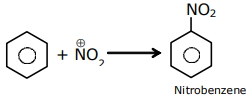
-
- (A) \(3\)
- (B) \(9\)
- (C) \(4\)
- (D) \(7\)
જવાબ અને ઉકેલ જુઓ
સાચો જવાબ: (D)
In benzaldehyde total number of \(sp ^{2}{ }^{\prime} C ^{\prime}\) are 7 .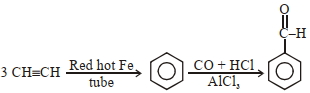
-
- (A) \( {A} \) અને \( {R} \) બંને સાચા છે પણ \( {R} \) એ \( {A} \) ની સાચી સમજૂતી નથી.
- (B) \( A \) સાચુ નથી પણ \( {R} \) સાચુ છે.
- (C) \( {A} \) અને \( {R} \) બંને સાચા છે અને \( {R} \) એ \( {A} \) ની સાચી સમજૂતી છે.
- (D) \( A \) સાચું છે પણ \( {R} \) સાચું નથી.
જવાબ અને ઉકેલ જુઓ
સાચો જવાબ: (C)
Its \(IUPAC\) name \(1-\)bromopropan\(-2-\)ol\({A}\) and \({R}\) are true and \(({R})\) is the correct explanation of \(({A})\)

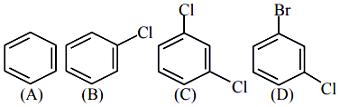
- 279. નીચે પૈકી ચક્રીય સંયોજનો ક્યા છે? \(\{\) ચિત્ર \(\}\) નીચેના વિકલ્પોમાંથી સાચો જવાબ પસંદ કરો
 2021 મધ્યમ
- (A) માત્ર \((A)\) અને \((B)\)
- (B) માત્ર \((B)\) અને \((C)\)
- (C) માત્ર \((B), (C)\) અને \((D)\)
- (D) માત્ર \((A), (B)\) અને \((C)\)
જવાબ અને ઉકેલ જુઓ
સાચો જવાબ: (B)
\((A)\) Non-Aromatic\((B)\) Aromatic
\((C)\) Aromatic
\((D)\) Anti-Aromatic
-
- (A) \((D)>(C)>(B)>(A)\)
- (B) \((C)>(B)>(A)>(D)\)
- (C) \((C)>(D)>(A)>(B)\)
- (D) \((A)>(B)>(C)>(D)\)
જવાબ અને ઉકેલ જુઓ
સાચો જવાબ: (A)
The density order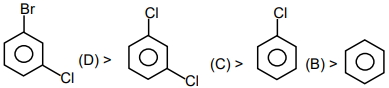
-
- (A) ઝિંક ક્લોરાઇડ અને \(HCl\)
- (B) \(KMnO _{4}\)નું ઠંડુ ,મંદ દ્રાવણ
- (C) સોડિયમ અને પ્રવાહી \(NH _{3}\)
- (D) આંશિક રૂપે નિષ્ક્રિય પેલેડાઇઝ્ડ ચારકોલ
જવાબ અને ઉકેલ જુઓ
સાચો જવાબ: (D)
Partially deactivated palladised charcoal \(\left( H _{2} / pd / CaCO _{3}\right)\) is lindlar catalyst. -
- (A) \({CH}_{3} {CH}_{2} {CH}_{2} {CONH}_{2}\)
- (C) \({CH}_{3} {CH}_{2} {OCH}={CH}_{2}\)
- (D) \({CH}_{3} {CH}_{2} {CH}={CHCH}_{2} {NH}_{2}\)
જવાબ અને ઉકેલ જુઓ
સાચો જવાબ: (D)
\({CH}_{3}-{CH}_{2}-{CH}={CH}-{CH}_{2}-{NH}_{2}\)This is non conjugated compound.
-
- (A) \(78\)
- (B) \(70\)
- (C) \(78\)
- (D) \(52\)
જવાબ અને ઉકેલ જુઓ
સાચો જવાબ: (C)
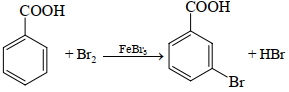
Moles of Benzoic acid \(=\frac{6.1}{122}\)\(=\) moles of m-bromobenzoic acid
So, weight of m-bromobenzoic acid
\(=\frac{6.1}{122} \times 201\, gm\)
\(=10.05\, gm\)
\(\%\) yield \(=\frac{\text { Actual weight }}{\text { Theoretical weight }} \times 100\)
\(=\frac{7.8}{10.05} \times 100\)
\(=77.61 \,\%\)
-
- (A) \(sp ^{3}, sp , sp ^{3}, sp ^{3}\)
- (B) \(sp ^{2}, sp ^{2}, sp ^{2}, sp ^{3}\)
- (C) \(sp ^{2}, sp , sp ^{2}, sp ^{3}\)
- (D) \(sp ^{2}, sp ^{3}, sp ^{2}, sp ^{3}\)
જવાબ અને ઉકેલ જુઓ
સાચો જવાબ: (C)
\(CH _{2} = C = C H - C H _{3}\)\(\quad 1\quad \quad 2\quad \quad 3\quad \quad \quad 4\)
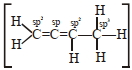
-
- (A) \(10\)
- (B) \(11\)
- (C) \(12\)
- (D) \(13\)
જવાબ અને ઉકેલ જુઓ
સાચો જવાબ: (A)
Numbers of \(\sigma\) bonds \(=10\)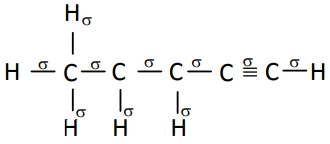
-
- (A) \(8\)
- (B) \(9\)
- (C) \(41\)
- (D) \(12\)
જવાબ અને ઉકેલ જુઓ
સાચો જવાબ: (D)
Organic compound : \(0.8 \,{gm}\)wt. of \({N}=\left(\frac{42}{100} \times 0.8\right)\, {gm}\)
mole of \(N=\frac{42 \times 0.8}{100 \times 14}=\frac{2.4}{100}\, {~mol}\)
moles of \({NH}_{3}=\frac{2.4}{100}\)
\(2 {NH}_{3}+{H}_{2} {SO}_{4} \rightarrow\left({NH}_{4}\right)_{2} {SO}_{4}\)
\(\quad\downarrow\quad\quad\quad\downarrow\)
\(\frac{2.4}{100}\) \(mole\) \(\quad\frac{1.2}{100}\) \(mole\)
For \({H}_{2} {SO}_{4} \quad \frac{1.2}{100}=1 \times {V}(\ell)\)
\(\Rightarrow {V}_{{H}_{2} {SO}_{4}}=\frac{1.2}{100} \,\ell=12 \,{~m} \ell\)
-
- (A) \(19\)
- (B) \(21\)
- (C) \(25\)
- (D) \(80\)
જવાબ અને ઉકેલ જુઓ
સાચો જવાબ: (A)
\({n}_{{cl}} \text { in compound }={n}_{{AgCl}}=\frac{0.3849 {~g}}{(107.87+35.5)}\, {g} / {mol}\)\(\Rightarrow \text { mass of chlorine }={n}_{{Cl} } \times 35.5=0.0953\, {gm}\)
\(\Rightarrow\, \% \text { wt of chlorine }=\frac{0.0953}{0.5} \times 100\)
\(\quad=19.06\, \%\)
-
- (A) \(1963\)
- (B) \(8510\)
- (C) \(1125\)
- (D) \(7412\)
જવાબ અને ઉકેલ જુઓ
સાચો જવાબ: (C)
Moles of \({N}\) in \({N}, {N}\) - dimethylaminopentane\(=\left(\frac{57.5}{115}\right)=0.5\, {~mol}\)
\(\Rightarrow {C}_{7} {H}_{17} {~N}+\frac{45}{2} {CuO} \rightarrow 7 {CO}_{2}+\frac{17}{2} {H}_{2} {O}+\frac{1}{2} {~N}_{2}+\frac{45}{2} {Cu}\)
\(\frac{{n}_{{cuo}} \text { reacted }}{\left(\frac{45}{2}\right)}=\frac{{n}_{{C_7} {H}_{17} {N}} \text { reacted }}{1}\)
\(\Rightarrow {n}_{{C} {u} O}\) reacted \(=\left(\frac{45}{2}\right) \times 0.5=11.25\)
-
- (A) \(2\)
- (B) \(7\)
- (C) \(1\)
- (D) \(15\)
જવાબ અને ઉકેલ જુઓ
સાચો જવાબ: (B)
\({C}_{2} {H}_{7} {~N}+\left(2 {x}+\frac{{y}}{2}\right) {CuO} \rightarrow {x} {CO}_{2}+\frac{{y}}{2} {H}_{2} {O}+\frac{{z}}{2} {~N}_{2}+\left(2 {x}+\frac{{y}}{2}\right) {Cu}\)On balancing
\({C}_{2} {H}_{7} {~N}+\frac{15}{2} {CuO} \rightarrow 2 {CO}_{2}+\frac{7}{2} {H}_{2} {O}+\frac{1}{2} {~N}_{2}+\frac{15}{2} {Cu}\)
On comparing
\({y}=7\)
-
- (A) \(4\)
- (B) \(400\)
- (C) \(40\)
- (D) \(0.40\)
જવાબ અને ઉકેલ જુઓ
સાચો જવાબ: (C)
\({n}_{{AgBr}}=\frac{0.188 {~g}}{188 {~g} / {mol}}=10^{-3}\, {~mol}\)\(\Rightarrow {n}_{{Br}}={n}_{\lambda_{{kBt}}}=0.001\, {~mol}\)
\(\Rightarrow \text { mass }_{{Bz}}=(0.001 \times 80) \,{gm}=0.08 \,{gm}\)
\(\Rightarrow \text { mass } \%=\frac{0.08 \times 100}{0.2}=40 \,\%\)
- 291. હેલોજનોની કસોટી માટે, સોડીયમ નિષ્કર્ષણમાં સિલ્વર નાઈટ્રેટ ઉમેરતાં પહેલા નીચેનામાંથી કયું સંયોજન ઉમેરવામાં આવે છે ? 2021 સરળ
- (A) નાઈટ્રીક એસિડ
- (B) એમોનિયા
- (C) હાઈડ્રોક્લોરીક એસિડ
- (D) સોડીયમ હાઈડ્રોક્સાઈડ
જવાબ અને ઉકેલ જુઓ
સાચો જવાબ: (A)
For testing of halogens, Nitric acid is added to the sodium extract because if \(CN ^{-}\) or \(S ^{2-}\) are present then they will be oxidised and removed before the test of halides. -
- (A) \(96\)
- (B) \(12\)
- (C) \(85\)
- (D) \(68\)
જવાબ અને ઉકેલ જુઓ
સાચો જવાબ: (D)
Moles of \({Br}=\) Moles of \({AgBr}\) obtained\(\Rightarrow \quad\) Mass of \({Br}=\frac{0.2397}{188} \times 80\, {~g}\)
therefore \(\%\) Br in the organic compound
\(=\frac{W_{\text {Br }}}{W_{T}} \times 100\)
\(=\frac{0.2397 \times 80}{188 \times 0.15} \times 100=0.85 \times 80\)
\(=68\)
\(\Rightarrow\) Nearest integer is \('68^{\prime}\)
-
- (A) ગતિશીલતા અથવા દ્રાવક પદ્ધતિનો પ્રવાહ
- (B) સંયોજનની દ્રાવ્યતા
- (C) સ્તંભની લંબાઈ અથવા \(TLC\) પ્લેટ
- (D) શુદ્ધ સંયોજનની ભૌતિક સ્થિતિ
જવાબ અને ઉકેલ જુઓ
સાચો જવાબ: (D)
In chromotography technique, the purification of a compound is independent of the physical -
- (A) \(1\)
- (B) \(6\)
- (C) \(3\)
- (D) \(8\)
જવાબ અને ઉકેલ જુઓ
સાચો જવાબ: (C)
\(44 gm CO _{2}\), have \(12 gm\) carbonSo, \(420 gm CO _{2} \Rightarrow \frac{12}{44} \times 420\)
\(\Rightarrow \frac{1260}{11} gm\) carbon
\(\Rightarrow 114.545\) gram carbon
So, \(\%\) of carbon \(=\frac{114.545}{750} \times 100\)
\(=15.3 \%\)
\(18 gm H _{2} O \Rightarrow 2 gm H _{2}\)
\(210 gm \Rightarrow \frac{2}{18} \times 210\)
\(=23.33 gm H _{2}\)
\(So , \% H _{2} \Rightarrow \frac{23.33}{750} \times 100=3.11 \%\)
\(\approx 3 \%\)
- 295. કેરિયસ પદ્ધતિમાં, હેલોજન ધરાવતુંકાર્બનિક સંયોજન \(.......\) હાજરીમાં ધુમાડાયુક્ત નાઈટ્રિક એસિડ સાથે ગરમ થાય છે. 2021 અઘરું
- (A) \({AgNO}_{3}\)
- (B) \({HNO}_{3}\)
- (C) \({BaSO}_{4}\)
- (D) \({CuSO}_{4}\)
જવાબ અને ઉકેલ જુઓ
સાચો જવાબ: (A)
Organic compound is heated with fuming nitric acid in the presence of silver nitrate in carius method.Lunar caustic \(\left({AgNO}_{3}\right)\) is used as reagent hare to distinguish \({Cl}^{-}, {Br}\) and \({I}^{-}\)respectively as follows.
\({Cl}^{-}({aq}) \stackrel{{AgNO}_{3}}{\longrightarrow} {AgCl} \downarrow_{{ppt}}\) white
\({Br}^{-}({aq})\stackrel{{AgNO}_{3}}{\longrightarrow} {AgBr} \downarrow_{{ppt}} {pale}\) yellow
\({I}^{-}({aq}) \stackrel{{AgNO}_{3}}{\longrightarrow} {AgNO}_{3} {AgI} \downarrow_{{ppt}}\) Dark yellow
-
- (A) \(25\)
- (B) \(19\)
- (C) \(32\)
- (D) \(16\)
જવાબ અને ઉકેલ જુઓ
સાચો જવાબ: (B)
In Duma's method of estimation of Nitrogen.\(0.1840\, gm\) of organic compound gave \(30 \,mL\) of nitrogen which is collected at \(287\, K\) And \(758\,mm\) of \(Hg\).
Given ; Aqueous tension at \(287 \,K =14 \,mm\) of \(Hg\). Hence actual pressure \(=(758-14)\)
\(=744\, mm \text { of } Hg \text { . }\)
Volume of nitrogen at \(STP =\frac{273 \times 744 \times 30}{287 \times 760}\)
\(V =27.935 \,mL\)
\(\because 22400 mL\) of \(N _{2}\) at STP weighs \(=28\, gm .\)
\(\therefore 27.94 mL\) of \(N _{2}\) at STP weighs \(=\)
\(\left(\frac{28}{22400} \times 27.94\right)\, gm\)
\(=0.0349 \,gm\)
Hence \(=\left(\frac{0.0349}{0.1840} \times 100\right)\)
\(=18.97\, \%\)
Rond off. Answer \(=19 \,\%\)
- 297. નીચે આપેલ પેપર ક્રોમેટોગ્રાફીની માહિતીનો ઉપયોગ કરતાં \(A\) નું ગણતરી કરેલ \(R_f\) મૂલ્ય .......... \(\times 10^{-1}\) છે.
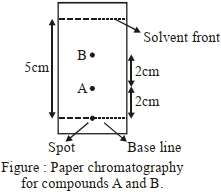 2021 મધ્યમ
- (A) \(2\)
- (B) \(1\)
- (C) \(4\)
- (D) \(3\)
જવાબ અને ઉકેલ જુઓ
સાચો જવાબ: (C)
\(R _{ f }=\frac{\text { Distance travelled by compound }}{\text { Distance travelled by solvent }}\)on chromatogram distance travelled by cmopound is \(\rightarrow 2 \,cm\)
Distance travelled by solvent \(=5\, cm\)
So \(R _{ f }=\frac{2}{5}=4 \times 10^{-1}=0.4\)
-
- (A) કાર્બનિક સંયોજનમાં સલ્ફરનાં પરિમાપન માટે કેરિયસ નળીનો ઉપયોગ થાય છે.
- (B) કાર્બનિક સંયોજનમાં નાઈટ્રોજનનાં પરિમાપન માટે કેરિયસ નળીનો ઉપયોગ થાય છે.
- (C) કાર્બનિક સંયોજનમાં હાજર ફોસ્ફરસનાં ઓક્સિડેશન થી ફોસ્ફોરિક એસિડ ઉત્પન્ન થાય છે જેમાં મેગ્નેશિઆ મિશ્રણ ઉમેરતાં \(Mg _{2} P _{2} O _{7}\), અવક્ષેપિત થાય છે.
- (D) કાર્બનિક સંયોજનમાં નાઈટ્રોજનનાં પરિમાપન માટે જેલ્ડાહલ પધ્ધતિનો ઉપયોગ થાય છે.
જવાબ અને ઉકેલ જુઓ
સાચો જવાબ: (B)
Carius method is used in the estimation of halogen in organic compounds. -
- (A) વિધાન \(-I\) સાચું છે પણ વિધાન \(-II\) ખોટું છે.
- (B) બંને વિધાન \(-I\) અને વિધાન \(-II\) સાચા છે.
- (C) બંને વિધાન \(-I\) અને વિધાન \(-II\) ખોટા છે.
- (D) વિધાન \(-I\) ખોટું છે પણ વિધાન \(-II\) સાચું છે.
જવાબ અને ઉકેલ જુઓ
સાચો જવાબ: (C)
\(R _{ f }=\) retardation factorDistance travelled by the substance from
\(R _{ f }=\frac{\text { reference line }( c \cdot m )}{\text { Distan ce travelled by the solvent from }}\)
reference line \((c.m)\)
Note : \(R _{ f }\) value of different compounds are different.
-
- (A) બંને વિધાન \(I\) અને \(II\) સાચા છે.
- (B) વિધાન \(I\) ખોટું છે પરંતુ વિધાન \(II\) સાચું છે.
- (C) વિધાન \(I\) સાચું છે પરંતુ વિધાન \(II\) ખોટું છે.
- (D) બંને વિધાન \(I\) અને \(II\) ખોટા છે.
જવાબ અને ઉકેલ જુઓ
સાચો જવાબ: (C)
Statement \(I:\) It is correct statementStatement \(II:\) \({CH}_{3}-{C^+H}_{2}\) involve \({C}_{{sp}^{3}}-{H}_{1 {~s}}\) bond with empty \(2 {p}\) orbital hence given statement is false.
આ પેજ પર આ ફિલ્ટર મુજબ કોઈ પ્રશ્ન નથી.