


2018 માં પૂછાયેલાં પ્રકરણ
21 પ્રકરણ- 1પ્રશ્નો STD 11 7.રેડોક્ષ પ્રક્રિયાઓ
- 2પ્રશ્નો STD 11 સંતુલન - ૨
- 1પ્રશ્નો STD 12 જૈવિક અણુઓ
- 2પ્રશ્નો STD 12 એમાઇન સંયોજનો
- 1પ્રશ્નો STD 12 આલ્કોહૉલ, ફિનોલ અને ઇથર સંયોજનો
- 1પ્રશ્નો STD 11 કાર્બનિક રસાયણશાસ્ત્ર પ્રતિક્રિયા પદ્ધતિ
- 5પ્રશ્નો STD 12 સવર્ગ સંયોજનો સૌથી વધુ પૂછાયેલ
- 1પ્રશ્નો STD 12 D અને f-વિભાગનાં તત્ત્વો
- 3પ્રશ્નો STD 12 P-વિભાગનાં તત્ત્વો - 2
- 3પ્રશ્નો STD 12 રાસાયણિક ગતિકી
- 2પ્રશ્નો STD 12 વિદ્યુત-રસાયણવિજ્ઞાન
- 2પ્રશ્નો STD 12 Solution and colligative properties
- 3પ્રશ્નો STD 11 રસાયણવિજ્ઞાનની કેટલીક પાયાની સંકલ્પનાઓ
- 1પ્રશ્નો STD 11 હાઇડ્રોકાર્બન
- 1પ્રશ્નો STD 11 કાર્બનિક રસાયણવિજ્ઞાન કાર્બનિક સંયોજનોનું નામકરણ
- 1પ્રશ્નો STD 11 કાર્બનિક રસાયણશાસ્ત્ર શુદ્ધિકરણ અને લાક્ષણિકતા
- 4પ્રશ્નો STD 11 રાસાયણિક બંધન અને આણ્વીય રચના સૌથી વધુ પૂછાયેલ
- 2પ્રશ્નો STD 11 તત્ત્વોનું વર્ગીકરણ અને ગુણધર્મોમાં આવર્તિતા
- 4પ્રશ્નો STD 11 સંતુલન - ૧ સૌથી વધુ પૂછાયેલ
- 4પ્રશ્નો STD 11 ઉષ્માગતિશાસ્ત્ર
- 3પ્રશ્નો STD 11 2.પરમાણુનું બંધારણ
JEE Mains 2018 Chemistry ના બધા પ્રશ્નો
21 પ્રકરણ47 માંથી 1–47 પ્રશ્નો
-
- (A) સુપરઓકસાઈડ અને \(-1\)
- (B) સુપરઓકસાઈડ અને \(-1/2\)
- (C) પેરોકસાઈડ અને \(-1/2\)
- (D) ઓકસાઈડ અને \(-2\)
જવાબ અને ઉકેલ જુઓ
સાચો જવાબ: (B)
In \(KO_2\), the mature of oxygen species and the oxidation state of oxygen atom are siperoxide (superoxide ion is \(O_2^-\)) and \(-1/2\) respectively.Let \(x\) be oxidation state of oxygen. The oxidation state of \(K\) is \(+1.\) Hence
\(+1+2(x)=0\)
\(2x=-1\)
\(x=-\frac {1}{2}\)
-
- (A) \(1.798\)
- (B) \(0.36\)
- (C) \(17.95\)
- (D) \(0.18\)
જવાબ અને ઉકેલ જુઓ
સાચો જવાબ: (D)
\({({K_{sp}})_{PbC{l_2}}} = 3.2 \times {10^{ - 8}} = 32 \times {10^{ - 9}}\)\(PbC{l_2} \leftrightarrow \mathop {P{b^{2 + }}}\limits_s + \mathop {2C{l^ - }}\limits_{2s} \)
\({K_{sp}} = [p{b^{2 + }}]{[C{l^ - }]^2}\)
\({K_{sp}} = 4{s^3} = 32 \times {10^{ - 9}}\)
\({s^3} = 8 \times {10^{ - 9}}\)
\(s = 2 \times {10^{ - 3}}\,M\)
\(\frac{w}{{M.W.}} \times \frac{1}{{{V_L}}} = 2 \times {10^{ - 3}}\)
\(\frac{{0.1}}{{278}} \times \frac{1}{{{V_L}}} = 2 \times {10^{ - 3}}\)
\({V_L} = \frac{{0.1 \times 1000}}{{278 \times 2}} = 0.18\,L\)
-
- (A) \(55\,mL\,\frac{M}{{10}}\,HCl + 45\,mL\,\frac{M}{{10}}\,NaOH\)
- (B) \(75\,mL\,\frac{M}{5}\,HCl + 25\,mL\,\frac{M}{5}\,NaOH\)
- (C) \(100\,mL\,\frac{M}{{10}}\,HCl + 100\,mL\,\frac{M}{{10}}\,NaOH\)
- (D) \(60\,mL\,\frac{M}{{10}}\,HCl + 40\,mL\,\frac{M}{{10}}\,NaOH\)
જવાબ અને ઉકેલ જુઓ
સાચો જવાબ: (B)
\(75\,mL\,\frac{M}{5}\,HCl + 25\,ml\,\frac{M}{5}\,NaOH\)\(25\,mL\,\frac{M}{5}\,NaOH\,\) will neutralise \(25\,mL\,\frac{M}{5}\,HCl\)
\(75 - 25 = 50\,mL\,\frac{M}{5}\,HCl\) will remain.
Total volume will be \(75 + 25 = 100\,mL\)
\(50\,mL\,\frac{M}{5}\,HCl\) is diluted to \(100\,mL\)
\([{H^ + }] = [HCl] = \frac{M}{5} \times \frac{{50}}{{100}} = \frac{M}{{10}}\)
\(pH = - {\log _{10}}[{H^ + }] = - {\log _{10}}\frac{M}{{10}} = 1\)
-
- (A) સેલ્યુલોઝ અને એમાયલોઝ એ \(1,4-\) ગ્લાયકોસીડીક લિંકેજ ધરાવે છે.
- (B) લેક્ટોઝમાં \(\beta -D-\) ગેલેકટોઝ અને \(\beta -D-\) ગ્લુકોઝ હોય છે.
- (C) માલ્ટોઝ અને લેકટોઝ \(1,4-\) ગ્લાયકોસીડીક લિંકેજ ધરાવે છે
- (D) સુક્રોઝ અને એમાયલોઝ \(1,4-\) ગ્લાયકોસીડીક લિંકેજ ધરાવે છે
જવાબ અને ઉકેલ જુઓ
સાચો જવાબ: (D)
In amylose \(1, 4-\alpha -\) glycosidic linkage is present -
- (A) \((D) < (C) < (B) < (A)\)
- (B) \((A) < (D) < (B) < (C)\)
- (C) \((A) < (B) < (C) < (D)\)
- (D) \((A) < (D) < (C) < (B)\)
જવાબ અને ઉકેલ જુઓ
સાચો જવાબ: (B)
Aromatic diazonium salts are more stable than aliphatic diazonium salts. The higher stability of aryl diazonium salts is due to resonance. Electron donating substituents increase electron density on benzene ring. Hereby they increase the stability of diazonium salts. Electron withdrawing substituents decrease electron density on benzene ring. Hereby they decrease the stability of diazonium salts. \(-COCH_3\) group is electron withdrawing and hence, diazonium salts from \((D)\) is less stable than that from \((B)\). Although \(- O- COCH_3\) is electron donating substituent, but it is present in meta position. Hence, it will not have significant effect on stability. the increasing order of diazotisation is \((A) < (D) < (B) < (C)\). -
- (A) \((A) < (B) < ( D) < (C)\)
- (B) \((A)<(B) <(C) <(D)\)
- (C) \((B) <(A) < (C) <(D)\)
- (D) \((B) <(A) <(D)<(C)\)
જવાબ અને ઉકેલ જુઓ
સાચો જવાબ: (A)
In the given substituted benzene rings, the substitutents methoxy \((- OCH_3)\) and amino \((-NH_2)\) are strongly activating groups while methyl \((- CH_3)\) is weakly activating and chloro \((- Cl) \) is a deactivating group towards electrophilic aromatic substituation reaction. Since among methyl and methoxy group, methoxy group is more reactive than methyl group, \(( c)\) is more reactive than \((d)\). Although amino group is strongly activating group, it gets protonated in presence of acid to form anilinium ion \(\left( { - \mathop N\limits^ + {H_3}} \right)\) which is strongly deactivating. Hence, \((a)\) is less reactive than \((c)\) and \((d)\) . Chloro group is also deactivating group but less deactivating than \(\left( { - \mathop N\limits^ + {H_3}} \right)\). Thus order is \((a) < (b) < (d) < (c)\). Note: The activating groups increases the electron density on benzene ring and increases the rate of electrophilic aromatic substitution reaction. The deactivating groups decreases the electron density on benzene ring and decreases the rate of electrophilic aromatic substitution reaction. - 7. નીચેની પ્રક્રિયા માં ઉત્પન્ન થતી પ્રકાશક્રિયાશીલ સંયોજન ના કુલ સંખ્યા ...... હશે? \([Figure]\) \(\xrightarrow{{HBr}}\)
 2018 અઘરું
- (A) \(0\)
- (B) \(6\)
- (C) \(4\)
- (D) \(2\)
જવાબ અને ઉકેલ જુઓ
સાચો જવાબ: (C)
The total number of optically active compounds formed is four. The product has two chiral \(C\) atoms. Thus, it has \(2^n\, = 2^2\, = 4\) stereoisomers
- 8. નીચેના સંયોજનની પ્રબળ એસિડ સાથેની પ્રક્રિયામાં બંધના ખંડન માટે સૌથી વધુ અસર પામતુ સ્થાન જણાવો.
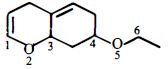 2018 અઘરું
- (A) \(O2- C3\)
- (B) \(O5 - C6\)
- (C) \(C4- O5\)
- (D) \(C1 - O2\)
જવાબ અને ઉકેલ જુઓ
સાચો જવાબ: (B)
The lone pair of electrons on \(O2\) is involved in resonance with \(C= C\). Hence \(O2\) will not be protonated. The lone pair of electrons on \(O5\) is not involved in resonance with \(C\, = C\). Hence, \(O5\) will be protonated. Chloride ion will then attack least substituted \(C\) atom \((C6)\) - 9. નીચેના પૈકી ફકત સ્પીન આધારિત ચુંબકીય ચાકમાત્રાનો સાચો ક્રમ જણાવો. (પ.ક્ર.: \(Mn\, = 25, Co\, = 27, Ni\, = 28, Zn\, = 30\)) 2018 અઘરું
- (A) \({\left[ {ZnC{l_4}} \right]^{2 - }} > {\left[ {NiC{l_4}} \right]^{2 - }} > {\left[ {CoC{l_4}} \right]^{2 - }} > {\left[ {MnC{l_4}} \right]^{2 - }}\)
- (B) \({\left[ {CoC{l_4}} \right]^{2 - }} > {\left[ {MnC{l_4}} \right]^{2 - }} > {\left[ {NiC{l_4}} \right]^{2 - }} > {\left[ {ZnC{l_4}} \right]^{2 - }}\)
- (C) \({\left[ {NiC{l_4}} \right]^{2 - }} > {\left[ {CoC{l_4}} \right]^{2 - }} > {\left[ {MnC{l_4}} \right]^{2 - }} > {\left[ {ZnC{l_4}} \right]^{2 - }}\)
- (D) \({\left[ {MnC{l_4}} \right]^{2 - }} > {\left[ {CoC{l_4}} \right]^{2 - }} > {\left[ {NiC{l_4}} \right]^{2 - }} > {\left[ {ZnC{l_4}} \right]^{2 - }}\)
જવાબ અને ઉકેલ જુઓ
સાચો જવાબ: (D)
The complex having higher number of unpaired electrons will have higher value of spin only magnetic moment.In all these complexes, the central metal ion is in \(+2\) oxidation state.
\(Zn^{2+}\) has \(3d^{10}\) outer electronic configuration with \(0\) unpaired electron.
\(Ni^{2+}\) has \(3d^8\) outer electronic configuration with \(2\) unpaired electrons.
\(Co^{2+}\) has \(3d^7\) outer electronic configuration with \(3\) unpaired electrons.
\(Mn^{2+}\) has \(3d^5\) outer electronic configuration with \(5\) unpaired electrons.
Hence the correct order of spin - only magnetic moments is
\({[MnC{l_4}]^{2 - }}\, > \,{[CoC{l_4}]^{2 - }}\, > \,{[NiC{l_4}]^{2 - }}\, > \,{[ZnC{l_4}]^{2 - }}\)
-
- (A) પોટેશિયમ ટ્રિસ (ઓકઝેલેટો) ક્રોમેટ \((III)\)
- (B) પેન્ટાએકવાક્લોરો ક્રોમિયમ \((III)\) ક્લોરાઈડ
- (C) એકવાક્લોરો બીસ ( ઈથિલીન ડાયએમાઈન ) કોબાલ્ટ \((II)\) ક્લોરાઈડ
- (D) પોટેશિયમ એમાઈન ટ્રાય ક્લોરો પ્લટીનેટ \((II)\)
જવાબ અને ઉકેલ જુઓ
સાચો જવાબ: (C)
\([Co(H_2O)Cl(en)_2]Cl\)
-
- (A) \([NiCl_4]^{2-} -\) સમતલીય સમચોરસ ; \([Ni(CN)_4]^{2-} -\) અનુચુબકીય
- (B) \([Ni( CN)_4]^{2-} -\) સમચતુષ્ફલકીય ; \([Ni(CO)_4] -\) અનુચુબકીય
- (C) \([NiCl_4]^{2-} -\) અનુચુબકીય; \([Ni(CO)_4] -\) સમચતુષ્ફલકીય
- (D) \([NiCl_4]^{2-} -\) પ્રતિચુબકીય ; \([Ni(CO)_4] -\) સમતલીય સમચોરસ
જવાબ અને ઉકેલ જુઓ
સાચો જવાબ: (C)
\([Ni(CN)]^{2-}\) is square planar, diamagnetic (\(0\) unpaired electrons) with \(dsp^2\) hybridisation.\([Ni(CO)_4] -\) is tetrahedral,diamagnetic (\(0\) unpaired electrons) with \(sp^3\) hybridisation. \([NiCl_4]^{2-}\) is tetrahedral, paramagnetic (\(2\) unpaired electrons) with \(sp^3\) hybridisation.Hence, the option \((c)\) is the correct answer - 12. સમતલીય ચોરસ સંકીર્ણ \([Pt(Cl)(NO_2)(NO_3)(SCN)]^{2-}\) ના શકય સમઘટકોની કુલ સંખ્યા જણાવો. 2018 અઘરું
- (A) \(16\)
- (B) \(12\)
- (C) \(8\)
- (D) \(24\)
જવાબ અને ઉકેલ જુઓ
સાચો જવાબ: (B)
The square planar complex of the type \([Mabcd]^{n±}\), where all four ligands are different, has \(3\) geometrical isomers. But if one of the ligands is ambidentate, then \(2\times3\, = 6\) geometrical isomers are possible. But if two ligands are ambidentate, then \(4\times3\, = 12\) geometrical isomers are possible. In the given example, \(NO_2^-\) and \(SCN^-\) are ambidentate ligands -
- (A) \(sp^3d,\) ત્રિકોણીય દ્રીપિરામિડ
- (B) \(d^2sp^3,\) અષ્ટફલકીય
- (C) \(dsp^2,\) સમતલીય સમચોરસ
- (D) \(sp^3,\) સમચતુષ્ફલકીય
જવાબ અને ઉકેલ જુઓ
સાચો જવાબ: (C)
Wilkinson catalyst is \([RhCl(PPh_3)_3].\) -
- (A) \(Mn\)
- (B) \(Cr\)
- (C) \(V\)
- (D) \(Ti\)
જવાબ અને ઉકેલ જુઓ
સાચો જવાબ: (A)
\(Mn{O_2} + KOH + KN{O_3} \to \mathop {{K_2}Mn{O_4}}\limits_{(dark\,\,green)} + KN{O_2} + {H_2}O\) \(MnO_4^{2 - } + 4{H^ + }\xrightarrow[{tionation}]{{dispropor}}\mathop {2MnO_4^ - }\limits_{(dark\,purple)} + Mn{O_2} + 2{H_2}O\) -
- (A) \(XeOF_4(+6)\) અને \(XeO_3(+6)\)
- (B) \(XeO_2(+4)\) અને \(XeO_3(+6)\)
- (C) \(XeOF_4(+6)\) અને \(XeO_2F_2(+6)\)
- (D) \(XeO_2F_2(+6)\) અને \(XeO_2(+4)\)
જવાબ અને ઉકેલ જુઓ
સાચો જવાબ: (C)
\(Xe{{F}_{6}}\,+\,{{H}_{2}}O\,\xrightarrow[hydrolysis]{particle}\underset{'X'}{\mathop{\overset{+6}{\mathop{Xe}}\,O{{F}_{4}}}}\,\,+\,2HF\)\(Xe\mathop {O{F_4}}\limits_{'X'} \, + {H_2}O\, \to \mathop {\mathop {Xe}\limits^{ + 6} {O_2}{F_2}}\limits_{'Y'} \, + \,2HF\)
-
- (A) \(9\)
- (B) \(6\)
- (C) \(12\)
- (D) \(18\)
જવાબ અને ઉકેલ જુઓ
સાચો જવાબ: (C)
The number of \(P-O\) bonds in \(P_4O_6\, = 12\)
-
- (A) \(5, 3, 0\)
- (B) \(5, 2, 0\)
- (C) \(4,2,2\)
- (D) \(4,4,0\)
જવાબ અને ઉકેલ જુઓ
સાચો જવાબ: (A)
Structure of \(XeO_3F_2\)
- 18. જો એક પ્રક્રિયા \(100\) સેકંડમાં \(50\%\) થાય અને \(200\) સેકંડમાં \(75\%\) થાય, તો પ્રક્રિયાનો ક્રમ જણાવો. 2018 અઘરું
- (A) \(2\)
- (B) \(3\)
- (C) \(0\)
- (D) \(1\)
જવાબ અને ઉકેલ જુઓ
સાચો જવાબ: (D)
First order reaction as halflife is constant.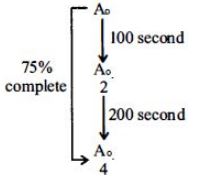
-
- (A) \(136.25\)
- (B) \(106.25\)
- (C) \(175.0\)
- (D) \(116.25\)
જવાબ અને ઉકેલ જુઓ
સાચો જવાબ: (B)
\({N_2}{O_5}\, \to \,2N{O_2}\, + \,\frac{1}{2}{O_2}\)At \(t=0\) \(50\) \(0\) \(0\)
At \(t=50\,min\) \(50-p_1\) \(2p_1\) \(\frac {p_1}{2}\)
Total pressure at \(50\,\min\)
\(=\,50-p_1+2p_1+\frac {p_1}{2}=87.5\)
\(50+\frac {3p_1}{2}=87.5\)
\(\frac{{3{p_1}}}{2}\, = \,37.5\)
\(\therefore \,\,{p_1}\, = \frac{{\,37.5\, \times 2}}{3}\, = \,25\)
At \(t=100\,min\) \(50-p_2\) \(2p_2\) \(\frac {p_2}{2}\)
\(50\,\min\) is half life period
For \(100\,\min\) i.e., for \(2\) half lives \(50-p_2=12.5\)
\(\therefore \,\,{p_2}\, = 37.5\,mm\) of \(Hg\)
Total pressure at \(100\,\min\)
\( = {\mkern 1mu} 50 - {p_2} + 2{p_2} + \frac{{{p_2}}}{2}\)
\( = {\mkern 1mu} 50 + \frac{{3{p_2}}}{2}\, = \,50 + \frac{3}{2} \times 37.5\)
\(=\,50\,+\,56.25\)
\(=\,106.25\,mm\) of \(Hg\)
-
- (A) \(3.2\)
- (B) \(2.5\)
- (C) \(4.1\)
- (D) \(5\)
જવાબ અને ઉકેલ જુઓ
સાચો જવાબ: (C)
The half life \(t_{1/2}\,=\,10\,days\)The decay constant
\(k\, = \,\frac{{0.693}}{{{t_{1/2}}}}\, = \,\frac{{0.693}}{{10\,\,days}}\, = \,0.0693\,\,day{s^{ - 1}}\)
The time required for one fourth conversion
\(t\, = \,\frac{{2.303}}{k}\,{\log _{10}}\frac{a}{{a - x}}\)
\( = \,\frac{{2.303}}{{0.0693\,\,da{y^{ - 1}}}}\,{\log _{10}}\,\frac{1}{{1 - (1/4)}} = 4.1\,days\)
-
- (A) \(109\)
- (B) \(98.1\)
- (C) \(9.81\)
- (D) \(10.9\)
જવાબ અને ઉકેલ જુઓ
સાચો જવાબ: (C)
\(9. 65\) ampere current was passed for \(1 .0\) hour ( \(3600\) seconds) Number of moles of electrons passed \( = \frac{{I(A) \times t(s)}}{{96500}} = \frac{{9.65A \times 3600s}}{{96500}} = 0.36\,moles\)\({C_6}{H_5}N{O_2}\, + \,4{e^ - } + 4{H^ + } \to \,{\text{p - Aminophenol}} + {H_2}O\)
\(4\) moles of electrons will reduce \(1\) mole of nitrobenzene to \(p-\) aminophenol. \(0.36\) moles of electrons will reduce \(\frac{{0.36}}{4} = 0.09\) moles of nitrobenzene to \(p-\) aminophenol \(p-\) aminophenol molar mass \(= 109 .14\,\,g/mol\) Mass of \(p-\) aminophenol obtained \(= 109.14\,g/mol \times 0.09\,mol = 9.81\,g\)
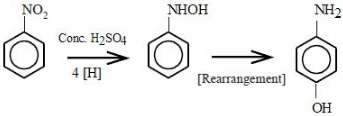
-
- (A) \(2.0\)
- (B) \(0.1\)
- (C) \(0.5\)
- (D) \(1.0\)
જવાબ અને ઉકેલ જુઓ
સાચો જવાબ: (D)
Reduction at cathode:\(2{e^ - }\, + \,2{H_2}O\, \to \,{H_2}\, + \,2O{H^ - }\)
(valence factor) \(H_2=2\)
At \(NTP\) \(22400\,mL\) of \(H_2=1\,mole\) of \(H_2\,\,112\,mL\) of
\({H_2}\, = \,\frac{1}{{22400}}\, \times \,112\, = \,0.005\,mole\) of \(H_2\)
Moles of \(H_2\) produced
\( = \frac{{I\, \times t}}{{96500}}\, \times \) mole ratio
\(0.05 = \frac{{I\, \times 965}}{{96500}}\, \times \frac{{1\,\,mole\,\,of\,\,{H_2}}}{{2\,\,mole\,\,of\,\,{e^ - }}}\)
\(I\,=\,1.0\,A\)
-
- (A) \(37.5\)
- (B) \(75\)
- (C) \(150\)
- (D) \(50\)
જવાબ અને ઉકેલ જુઓ
સાચો જવાબ: (C)
Molar mass of octane \(=\,114\,g/mol\)From the lowering of vapour pressure we have,
\(\frac{{\Delta P}}{P} = \frac{{\frac{{{W_2}}}{{{M_2}}}}}{{\frac{{{W_2}}}{{{M_2}}} + \frac{{{W_1}}}{{{M_1}}}}}\)
\(\frac{{75}}{{100}} = \frac{{\frac{{{W_2}}}{{50\,g/mol}}}}{{\frac{{{W_2}}}{{50\,g/mol}} + \frac{{114\,g}}{{114\,g/mol}}}}\)
\(0.75 = \frac{{\frac{{{W_2}}}{{50\,}}}}{{\frac{{{W_2}}}{{50\,}} + 1}}\)
\(\frac{{{W_2}}}{{50}} + 1\, = \,\frac{{{W_2}}}{{50\, \times \,0.75}}\)
\({W_2}\, = \,150\,g\)
Note : \(W_2\) vand \(M_2\) are mass and molar mass of solute and \(W_1\) and \(M_1\) are mass and molar mass of octane.
-
- (A) \(\frac{3}{4}\)
- (B) \(\frac{1}{2}\)
- (C) \(\frac{1}{4}\)
- (D) \(\frac{4}{3}\)
જવાબ અને ઉકેલ જુઓ
સાચો જવાબ: (A)
The relationship between molar masses of the two solvents is\(M_X\,=\,\frac {3}{4}M_Y\) .... \((i)\)
The relative lowering of vapour pressure of two solution is
\({\left( {\frac{{\Delta P}}{P}} \right)_X}\, = \,m{\left( {\frac{{\Delta P}}{P}} \right)_Y}\)
But, the relative loering of vaoour pressure of solutin is directly proportional to the mole fraction of solution.
Given \(5\,molal\) solution , mans \(5\,molal\) of solute are dissolved in \(1\,kg\) (or \(1000\,g\)) of solvent.
The number of moles of solvent \(=\,\frac {1000\,g}{M}\)
The mole fraction of solution \(=\,\frac {5}{1000/M}\)
\(=M\times \,\frac {5}{1000}\)
hence \(M_X\times \frac {5}{1000}\) \(=\,m\times M_Y\times \frac {5}{1000}\) .... \((ii)\)
Substitute equation \((i)\) in equation \((ii)\)
\(\frac {3}{4}\times M_Y\times \frac {5}{1000}\) \(=\,m\times M_Y\times \frac {5}{1000}\)
\(m=\frac {3}{4}\)
-
- (A) \(6.023 \times {10^9}\)
- (B) \(6.023 \times {10^{23}}\)
- (C) \(6.023 \times {10^{21}}\)
- (D) \(6.023 \times {10^{20}}\)
જવાબ અને ઉકેલ જુઓ
સાચો જવાબ: (D)
Given percentage of chlorine in an hydrocarbon \(= 3.55\%\) i,e.,\(100\,g\) of chlorohydrocarbon has \(3.55\,g\) of chlorine.
\(1\,g\) of chlorohydrocarbon will have \(\frac{{3.55}}{{100}} = 0.0355\,g\) of chlorine.
Atomic wt. of \(Cl = 35.5\,g/mol\)
Number of moles of \(Cl\) \( = \frac{{0.0355\,g}}{{35.5\,g/mol}} = 0.001\) \(mole\)
Number of atoms of \(Cl = 0.001\,mole\) \(\times 6.023 \times 10^{23}\,mol^{-1}\)
\(= 6.023 \times 10^{20}\)
-
- (A) \(0.35\)
- (B) \(0.54\)
- (C) \(0.41\)
- (D) \(0.48\)
જવાબ અને ઉકેલ જુઓ
સાચો જવાબ: (D)
No of moles of oxygen in \(0.16\,g\) of oxygen molecule\( = \frac{{0.16\,g}}{{32\,g/mol}} = 0.005\,mole\)
\(2NaCl{O_3}\xrightarrow{\Delta }2NaCl + 3{O_2}\)
According to the reaction,
\(3\) moles of \(O_2\) \(=\) \(2\) moles of \(NaCl\) \(=\) \(2\) moles of \(AgCl\)
Molar mass of \(AgCl = 143.5\,g/mol\)
\(0.005\) moles of \(O_2\) will ppt. \( = 0.005 \times \frac{2}{3}\) moles \(AgCl\)
\(= 0.0033\) moles of \(AgCl\)
\(\therefore \) Mass of \(AgCl\) (in \(g\)) obtained will be
\(= 143.5\,g/mol \times 0.0033\) \(moles\) \(= 0.48\,g\)
- 27. પ્રક્રિયકના પ્રતિ ગ્રામ માટે , નીચેનામાંથી કઈ ઉષ્મિય વિઘટન પ્રક્રિયામાં મહત્તમ પ્રમાણમાં \(N_2\) વાયુ ઉત્પન્ન થાય છે? 2018 અઘરું
- (A) \(Ba(N_3)_2(s)\to Ba(C) + 3N_2(g)\)
- (B) \((NH_4)_2Cr_2O_7(s) \to N_2(g) + 4H_2O(g) + Cr_2O_3(s)\)
- (C) \(2NH_3(g)\to N_2(g) + 3H_2(g)\)
- (D) \(2NH_4NO_3(s) \to 2N_2(g) + 4H_2O(g) + O_2(g)\)
જવાબ અને ઉકેલ જુઓ
સાચો જવાબ: (C)
\((a)\) Molar mass of \(Ba(N_3)_2(s) = 221\,g/mol\)\(1\) mole of \(Ba(N_3)_2(s)\) will give \(3\) moles of \(N_2\)
hence \(\frac{{1\,g}}{{221\,g/mol}}\) moles of \(Ba(N_3)_2(s)\) will give \(3 \times \frac{1}{{221}} = 0.014\) moles of \(N_2\)
\((b)\) Molar mass of \({(N{H_4})_2}C{r_2}{O_7} = 252\,g/mol.\,\)
\(1\) mole of \({(N{H_4})_2}C{r_2}{O_7}\) will give \(1\) mole of \(N_2\)
hence \(\frac{{1\,g}}{{252\,g/mol}}\) moles of \({(N{H_4})_2}C{r_2}{O_7}\) will give \(1 \times \frac{1}{{252}} = 0.0039\) moles of \(N_2\)
\((c)\) Molar mass of \(NH_3 = 17\,g/mol.\)
\(2\) mole of \(NH_3\) will give \(1\) mole of \(N_2\)
hence \(\frac{{1\,g}}{{17\,g/mol}}\) moles of \(NH_3\) will give \(\frac{1}{{2 \times 17}} = 0.0297\) moles of \(N_2.\)
\((d)\) Molar mass of \(NH_4NO_3 = 80\,g/mol.\)
\(1\) mole of \(NH_4NO_3\) will give \(1\) mole of \(N_2\)
hence \(\frac{{1\,g}}{{80\,g/mol}}\) moles \(NH_4NO_3\) will give \(1 \times \frac{1}{{80}} = 0.0125\) moles of \(N_2\)
Hence Thermal decomposition of \(NH_3\) will produce maximum amount of \(N_2\)
-
- (A) \(X\) કરતાં \(Y\) વધારે દ્વિધ્રુવીય ચાકમાત્રા અને ઊંચું ઉત્કલન બિંદુ ધરાવશે.
- (B) \(X\) કરતાં \(Y\) વધારે દ્વિધ્રુવીય ચાકમાત્રા અને નીચું ઉત્કલન બિંદુ ધરાવશે.
- (C) \(Y\) કરતાં \(X\) ઓછી દ્વિધ્રુવીય ચાકમાત્રા અને નીચું ઉત્કલન બિંદુ ધરાવશે.
- (D) \(Y\) કરતાં \(X\) ઊંચી દ્વિધ્રુવીય ચાકમાત્રા અને ઊચું ઉત્કલન બિંદુ ધરાવશે.
જવાબ અને ઉકેલ જુઓ
સાચો જવાબ: (D)
When \(2-\) butyne is treated with \(H_2/\) Lindlar's catalyst, compound \(X\) (cis \(-2-\) butene) is produced as the major product; and when treated with \(Na/liq\,NH_3\) it produces \(Y\) (trans \(-2-\) butene) as the major product. Cisisomer \((X)\) will have higher dipole moment and higher boiling point than trans \((Y)\). -
- (A) \((A)-(s); (B)-(r); (C)-(q); (D)-(p)\)
- (B) \((A)-(r); (B)-(s); (C)-(p); (D)-(q)\)
- (C) \((A)-(r); (B)-(s); (C)-(q); (D)-(p)\)
- (D) \((A)-(s); (B)-(r); (C)-(p); (D)-(q)\)
જવાબ અને ઉકેલ જુઓ
સાચો જવાબ: (B)
\(\to \) Phenelzine contains hydrazine
\(\to \) Chloroxylenol contains phenol
\(\to \) Uracil is the pyrimidine base
\(\to \) Ranitidine contains furan ring - 30. \(I\) અને \(II\) બે સંયોજનોનું નિક્ષાલન સ્તંભ ક્રોમેટોગ્રાફી દ્વારા થાય છે.( \(I> II\) નું અધિશોષણ) નીચેના પૈકી કયું વિધાન સાચું છે? 2018 અઘરું
- (A) \(I\) કરતાં \(II\) ધીમે ખસે છે અને ઊંચું \(R_f\) મૂલ્ય ધરાવે છે
- (B) \(I\) કરતાં \(II\) ઝડપી ખસે છે અને ઊંચું \(R_f\) મૂલ્ય ધરાવે છે
- (C) \(II\) કરતાં \(I\) ઝડપી ખસે છે અને ઊંચું \(R_f\) મૂલ્ય ધરાવે છે
- (D) \(II\) કરતાં \(I\) ધીમું ખસે છે અને ઊંચું \(R_f\) મૂલ્ય ધરાવે છે
જવાબ અને ઉકેલ જુઓ
સાચો જવાબ: (B)
Since, adsorption of \(I > II\), \(I\) is firmly attached to column (stationary phase). Hence, it will move slowly and will move little distance. Also \(II\) is loosely attached to column (stationary phase). Hence, it will move faster and will move large distance - 31. આણ્વિય આયન \(N_2^ + \) માટે, આણ્વિય કક્ષક આલેખમાં \({\sigma _{2p}}\) આણ્વિય કક્ષકમાં ઇલેક્ટ્રોનની સંખ્યા જણાવો. 2018 મધ્યમ
- (A) \(0\)
- (B) \(2\)
- (C) \(3\)
- (D) \(1\)
જવાબ અને ઉકેલ જુઓ
સાચો જવાબ: (D)
Total electrons in \(N_2^ + = (7 \times 2) - 1 = 13\)\(N_2^ + \to {\sigma _{1{s^2}}},\sigma _{1{s^2}}^*,{\sigma _{2{s^2}}},\sigma _{2{s^2}}^*,[\pi _{2{p_x}}^2 = \pi _{2{p_y}}^2]\sigma _{2{p_z}}^1\)
Number of electron in \({\sigma _2}_{{p_z}}\) is \(1\)
-
- (A) \(NF_3-\) સમતલીય ત્રિકોણ
- (B) \(BF_3-\) સમતલીય ત્રિકોણ
- (C) \(AsF_5-\) ત્રિકોણીય દ્વિપિરામિડ
- (D) \(H_2O-\) વળેલ \((bent)\)
જવાબ અને ઉકેલ જુઓ
સાચો જવાબ: (A)
\(NF_3\) has trigonal pyramidal geometry. \(N\) atom has one lone pair and three bond pairs of electrons. The electron pair geometry is tetrahedral and molecular geometry is trigonal pyramidal . The bond angles are lower than tetrahedral bond angles due to lone pair - lone pair and lone pair - bond pair repulsions. \(N\) atom is \(sp^3\) hybridised
-
- (A) બંધકારક \(\pi \) કક્ષક
- (B) અબંધકારક કક્ષક
- (C) બંધપ્રતિકારક \(\sigma \) કક્ષક
- (D) બંધપ્રતિકારક \(\pi \) કક્ષક
જવાબ અને ઉકેલ જુઓ
સાચો જવાબ: (D)
An antibonding \(\pi \) orbital best describes the diagram of a molecular orbital. Two orbitals laterally overlap to form pi bond. Out of phase combination, of these two \(p-\) orbitals, give \(\pi ^*\, MO\). -
- (A) \({H_2}O\, \to \,{H_3}{O^ + }\)
- (B) \(B{F_3}\, \to \,BF_4^ - \)
- (C) \(C{H_4}\, \to \,{C_2}{H_6}\)
- (D) \(N{H_3}\, \to \,NH_4^ + \)
જવાબ અને ઉકેલ જુઓ
સાચો જવાબ: (B)
\(B{F_3}\, \to \,BF_4^ - \)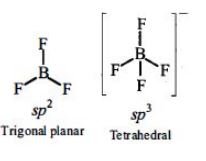
-
- (A) \(O> F > Cl\)
- (B) \(F > O > Cl\)
- (C) \(F > Cl > O\)
- (D) \(Cl> F > O\)
જવાબ અને ઉકેલ જુઓ
સાચો જવાબ: (D)
On moving from left to right across a period, the electron affinity becomes more negative. On moving from top to bottom in a group, the electron affinity becomes less negative. Chlorine has more negative electron affinity than fluorine, Because adding an electron to fluorine (\(2p\) orbital) causes greater repulsion than adding an electron to chlorine (\(3p\) orbital) which is larger in size -
- (A) \({O^{2 - }} < {F^ - } < N{a^ + } < M{g^{ 2+}}\)
- (B) \(N{a^ + } < M{g^{ 2+}} < {F^ - } < {O^{2 - }}\)
- (C) \(M{g^{ 2+}} < N{a^ + } < {F^ - } < {O^{2 - }}\)
- (D) \(M{g^{ 2+}} < {O^{2 - }} < N{a^ + } < {F^ - }\)
જવાબ અને ઉકેલ જુઓ
સાચો જવાબ: (C)
All species are isoelectronic \((10e^-)\). isoelectronic series, when negative charge increases the radius of ion increases \(\therefore M{g^{ 2+}} < N{a^ + } < {F^ - } < {O^{2 - }}\) -
- (A) \(1844\)
- (B) \(2068\)
- (C) \(4281\)
- (D) \(4763\)
જવાબ અને ઉકેલ જુઓ
સાચો જવાબ: (C)
In the reaction \({A_2} \leftrightarrow 2A\)Initially, Let \([{A_2}] = 1\,M\) and \([A] = 0\,M\)
After \(20\%\) dissociation , \(80\%\) of \(A_2\) remains.
\([{A_2}] = 1 \times \frac{{80}}{{100}} = 0.8\,M\)
\(20\%\) of \(1\,M\) is
\(1 \times \frac{{20}}{{100}} = 0.2.\,[A] = 2 \times 0.2 = 0.4\,M\)
The equilibrium constant
\(K = \frac{{{{[A]}^2}}}{{[{A_2}]}};\) \(K = \frac{{{{[0.4]}^2}}}{{[0.8]}} = 0.2\)
\(\Delta {G^o} = - RT\,\ln \,K = - 8.314\,J{K^{ - 1}}\,mo{l^{ - 1}}\)
\( \times 320\,K \times \ln \,0.2 = 4281\,J/mol\)
-
- (A) \(2.5\)
- (B) \(4\)
- (C) \(2\)
- (D) \(3\)
જવાબ અને ઉકેલ જુઓ
સાચો જવાબ: (A)
Initially \(2\) moles of \(CO\) are present.At equilibrium, \(1\) mole of \(CO\) is present
Hence, \(2-1=1\) moles of \(CO\) has reacted.
\(1\) mole of \(CO\) will react with \(1\) mole of \(Cl_2\) to from \(1\) mole of \(COCl_2\).
\(3-1=2\) moles of \(Cl_2\) remains at equilibrium
The equlibrium constant
\({K_c} = \frac{{[COC{l_2}]}}{{[CO][C{l_2}]}} = \frac{{\frac{{1\,mol}}{{5\,L}}}}{{\frac{{1\,mol}}{{5\,L}} \times \frac{{2\,mol}}{{5\,L}}}} = 2.5\)
-
- (A) \(4NH_3(g) + 5O_2(g)\) \(\rightleftharpoons\) \(4NO(g) + 6H_2O(l)\)
- (B) \(2NO_2(g)\) \(\rightleftharpoons\) \(2NO(g)+O_2(g)\)
- (C) \(3O_2\) \(\rightleftharpoons\) \(2O_3(g)\)
- (D) \(H_2(g)+I_2(g)\) \(\rightleftharpoons\) \(2HI(g)\)
જવાબ અને ઉકેલ જુઓ
સાચો જવાબ: (B)
Volume \( \uparrow P \downarrow \), reaction proceeds in which direction where the number of moles of gases increases. -
- (A) અચળ દબાણે નિષ્ક્રિય વાયુ ઉમેરીને
- (B) તાપમાન ધટાડીને
- (C) દબાણ વધારીને
- (D) અચળ કદે નિષ્ક્રિય વાયુ ઉમેરીને
જવાબ અને ઉકેલ જુઓ
સાચો જવાબ: (A)
Reaction at equilibirium \({N_2}{O_4}\, \rightleftharpoons \,2N{O_2}\) According to Le chatelier's principle- \((a)\) addition of an inert gas at constant pressure will increase volume and equilibirium shifts towards more number of molecules. \((b)\) Decomposition of \(N_2O_4\) will be endothermic, so reaction wil move in forward reaction when temperature is increased.So, It is incorrect. It will not effect reaction (volume is constant) \((c)\) Increasing the pressure on a gas reaction shifts the position of equilibirium towards the side with fewer molecules. So, It will move in backward direction which leads to formation of \(N_2O_4\) from \(NO_2\) -
- (A) \(100\)
- (B) \(1\)
- (C) \(10\)
- (D) \(0.1\)
જવાબ અને ઉકેલ જુઓ
સાચો જવાબ: (C)
\(\Delta G_{rxn}^o = {\Delta _f}{G^o}(vapour) - {\Delta _f}{G^o}(liquid)\)\(\Delta G_{rxn}^o = 103 - 100.7 = 2.3\,kcal/mol\)
\( = 2300\,cal/mol\)
\(\Delta G_{rxn}^o = - RT\,\ln \,K\)
\(2300\,cal/mol = - 2\,cal\,mol\,K \times 500\,K \times \ln \,K\)
\(\ln \,K = 2.3\)
\(K = 10 \,atm = \)Vapour pressure of liquid \('S'\) Vapour pressure of liquid \('S'\) at \(500\,K\) is approximately equal to \(10\,atm.\)
-
- (A) \(-112.4\)
- (B) \(-56.2\)
- (C) \(-208\)
- (D) \(-168.2\)
જવાબ અને ઉકેલ જુઓ
સાચો જવાબ: (B)
\((i)\,2F{e_2}{O_3}(s) \to 4Fe(s) + 3{O_2}(g);\)\({\Delta _r}{G^o} = + 1487.0\,kJ\,mo{l^{ - 1}}\)
\((ii)\,2CO(g) + {O_2}(g) \to 2C{O_2}(g);\)
\({\Delta _r}{G^o} = - 514.4\,kJ\,mo{l^{ - 1}}\)
Multiple reaction \((ii)\) with \(3\),we get
\((iii)\,6CO(g) + 3{O_2}(g) \to 6C{O_2}(g);\)
\({\Delta _r}{G^o} = 3 \times - 514.4 = - 1543.2\,kJ\,mo{l^{ - 1}}\)
When we add reaction \((i)\) and reaction \((iii)\), we get reaction \((iv)\)
\((iv)\,2F{e_2}{O_3}(s) + 6CO(g) \to 4Fe(s) + 6C{O_2}(g)\)
Free energy change, \({\Delta _r}{G^o}\) for the reaction will be
\(1487.0 - 1543.2 = - 56.2\,kJ\,mo{l^{ - 1}}\)
-
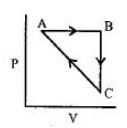
- (A) \( - 5\)
- (B) \( + 5\)
- (C) \( 18\)
- (D) \( -18\)
જવાબ અને ઉકેલ જુઓ
સાચો જવાબ: (B)
\(\Delta {U_{AB}} = {q_{AB}} + {W_{AB}} = 2 + ( - 5) = - 3\,kJ/mol\)\(\Delta {U_{BC}} = - 5\,kJ/mol\)
For cyclic procrss, \(\Delta U=0\)
\(\Delta {U_{AB}} + \Delta {U_{BC}} + \Delta {U_{CA}} = 0\)
\(\Delta {U_{CA}} = - \Delta {U_{AB}} - \Delta {U_{BC}}\)
\(\Delta {U_{CA}} = - ( - 3) - ( - 5) = 8\,kJ/mol\)
\(\Delta {U_{CA}} = {q_{CA}} + {W_{CA}}\)
\(8 = {q_{CA}} + 3\)
\({q_{CA}} = + 5\,kJ/mol\)
Heat absorbed has positive sign.
-
- (A) \(C\) (હીરો) \(\to\) \(C\) (ગ્રેફાઇટ)
- (B) \(N_2(g,\,1\,atm) \to N_2(g,\,5\,atm)\)
- (C) \(N_2(g,\,273\,K) \to N_2(g,\,300\,K)\)
- (D) \(H_2(g) \to 2H(g)\)
જવાબ અને ઉકેલ જુઓ
સાચો જવાબ: (B)
\((a)\) When diamond is converted into graphite when it is heated to \(1500\,^oC\) and entropy is increased so \(\Delta S > 0\) \((b)\) When pressure increases then molecules of gas will come closer and intermolecular distance decreases so entropy will also decrease and \(\Delta S < 0\) \((c)\) When we increase the temperature of a gas then random ness is increased due to kinetic energy gained by molecules. So, \(\Delta S > 0\) \((d)\) \(H_2\) molecule is converted into atoms, the no. of particles increases . Thus entropy will increase. So, \(\Delta S > 0\) -
- (A) \(4 \times 0.529\,\mathop A\limits^o \)
- (B) \(2\pi \times 0.529\,\mathop A\limits^o \)
- (C) \(\frac{{0.529}}{{2\pi }}\mathop A\limits^o \)
- (D) \(0.529\,\mathop A\limits^o \)
જવાબ અને ઉકેલ જુઓ
સાચો જવાબ: (B)
First Bohr orbit of \(H\) atom has radius\(r = 0.529\,\mathop A\limits^o \)
Also, the angular momentum is quantised.
\(mvr = \frac{h}{{2\pi }}\)
\(2\pi r = \frac{h}{{mv}} = \lambda \)
\(\lambda = 2\pi \times 0.529\,\mathop A\limits^o \)
-
- (A) વિધુતક્ષેત્રમાં વર્ણપટ રેખાઓનુ વિભાજન સ્ટાર્ક અસર કહેવાય છે
- (B) તાપમાન વધતા, કાળા પદાર્થમાંથી ઉત્સર્જિત વિકિરણની આવૃતી નીચી તરંગલંબાઈ થી ઊંચી તરંગલંબાઈ તરફ જાય છે.
- (C) ફોટોનને વેગમાન તેમજ તરંગલંબાઈ હોય છે
- (D) રિડબર્ગ આચળાંક ઊર્જાનો એકમ ધરાવે છે
જવાબ અને ઉકેલ જુઓ
સાચો જવાબ: (B)
When temperature is increased, black bodyemit high energy radiation, from higher wavelength to lower wavelength . Rydberg constant has unit of length i.e. \(cm^{-1}\) -
- (A) \(4\)
- (B) \(5.5\)
- (C) \(4.5\)
- (D) \(5\)
જવાબ અને ઉકેલ જુઓ
સાચો જવાબ: (C)
\(\lambda = 250\,nm = 2500\,\mathop A\limits^o \)\(E = \frac{{hc}}{\lambda } = \frac{{12400}}{{2500}} = 4.96\,eV\)
\(KE = \) stopping potential \( = 0.5\,eV\)
\(E = {W_0} + K.E.\)
\(4.96 = {W_0} + 0.5\)
\({W_0} = 4.46 \approx 4.5\,eV\)


આ પેજ પર આ ફિલ્ટર મુજબ કોઈ પ્રશ્ન નથી.
અન્ય વર્ષ
વારંવાર પૂછાતા પ્રશ્નો
ExamBro પર JEE Mains 2018 Chemistry ના કેટલા પ્રશ્નો છે?
47 પ્રશ્નો, દરેક સાચા જવાબ અને પૂરા ઉકેલ સાથે.
JEE Mains 2018 Chemistry નું કયું પ્રકરણ સૌથી વધુ પૂછાય છે?
સવર્ગ સંયોજનો, 5 પ્રશ્નો સાથે; ત્યાર બાદ રાસાયણિક બંધન અને આણ્વીય રચના, 4 પ્રશ્નો સાથે.
JEE Mains 2018 Chemistry ના પ્રશ્નો કેટલા અઘરા હોય છે?
0% સરળ, 23% મધ્યમ અને 77% અઘરા.