


2017 માં પૂછાયેલાં પ્રકરણ
19 પ્રકરણ- 2પ્રશ્નો STD 11 7.રેડોક્ષ પ્રક્રિયાઓ
- 5પ્રશ્નો STD 11 સંતુલન - ૨ સૌથી વધુ પૂછાયેલ
- 2પ્રશ્નો STD 12 જૈવિક અણુઓ
- 1પ્રશ્નો STD 12 એમાઇન સંયોજનો
- 1પ્રશ્નો STD 12 આલ્કોહૉલ, ફિનોલ અને ઇથર સંયોજનો
- 4પ્રશ્નો STD 12 હેલોઆલ્કેન અને હેલોએરિન સંયોજનો
- 2પ્રશ્નો STD 12 સવર્ગ સંયોજનો
- 5પ્રશ્નો STD 12 P-વિભાગનાં તત્ત્વો - 2 સૌથી વધુ પૂછાયેલ
- 3પ્રશ્નો STD 12 રાસાયણિક ગતિકી
- 5પ્રશ્નો STD 12 વિદ્યુત-રસાયણવિજ્ઞાન
- 3પ્રશ્નો STD 12 Solution and colligative properties
- 2પ્રશ્નો STD 11 રસાયણવિજ્ઞાનની કેટલીક પાયાની સંકલ્પનાઓ
- 1પ્રશ્નો STD 11 હાઇડ્રોકાર્બન
- 1પ્રશ્નો STD 11 કાર્બનિક રસાયણશાસ્ત્ર શુદ્ધિકરણ અને લાક્ષણિકતા
- 2પ્રશ્નો STD 11 રાસાયણિક બંધન અને આણ્વીય રચના
- 2પ્રશ્નો STD 11 તત્ત્વોનું વર્ગીકરણ અને ગુણધર્મોમાં આવર્તિતા
- 1પ્રશ્નો STD 11 સંતુલન - ૧
- 6પ્રશ્નો STD 11 ઉષ્માગતિશાસ્ત્ર સૌથી વધુ પૂછાયેલ
- 4પ્રશ્નો STD 11 2.પરમાણુનું બંધારણ
JEE Mains 2017 Chemistry ના બધા પ્રશ્નો
19 પ્રકરણ52 માંથી 1–50 પ્રશ્નો
- 1. કઈ જોડીમાં ધાતુઓ ધરાવતા સંયોજનોમાં તેમના ઉચ્ચતમ ઓક્સિડેશન અવસ્થામાં ધાતુઓ ધરાવતા સંયોજનોની જોડી છે 2017 અઘરું
- (A) \(MnO_4 ^-\) અને \(CrO_2Cl_2\)
- (B) \([NiCl_4]^{2-}\) અને \([CoCl_4]^{2-}\)
- (C) \([Fe(CN)_6]^{3-}\) અને \([Cu(CN)_2]^{2-}\)
- (D) \([FeCl_4]^-\) અને \(Co_2O_3\)
જવાબ અને ઉકેલ જુઓ
સાચો જવાબ: (A)
\((1)\,Cr\mathop {{O_2}}\limits^{2 - } \mathop {C{l_2}}\limits^{ - 1} \,\,Cr = + 6;\,Mn\mathop {{O_2}}\limits^{2 - } \,\,Mn = + 4\)(Highest oxidation state)
\((2)\,{[Ni\mathop {C{l_4}}\limits^{ - 1} ]^{2 - }}\,\,Ni = + 2;\,{[Co\mathop {C{l_4}}\limits^{ - 1} ]^{2 - }}\,\,Co = + 2\)
\((3)\,{[Fe{(\mathop {CN}\limits^{ - 1} )_6}]^{3 - }}\,\,Fe = + 3;\,{[Cu{(\mathop {CN}\limits^{ - 1} )_4}]^{2 - }}\,\,Cu = + 2\)
\((4)\,{[Fe\mathop {C{l_4}}\limits^{ - 1} ]^ - }\,\,Fe = + 3;\,C{o_2}\mathop {{O_3}}\limits^{ - 2} \,Co = + 3\)
-
- (A) \(XeF_4 + O_2F_2 \rightarrow XeF_6 + O_2\)
- (B) \(XeF_2 + PF_5 \rightarrow [XeF]^+ PF_6^-\)
- (C) \(XeF_6 + H_2O \rightarrow XeOF_4 + 2HF\)
- (D) \(XeF_6 + 2H_2O \rightarrow XeO_2F_2 + 4HF\)
જવાબ અને ઉકેલ જુઓ
સાચો જવાબ: (A)
The following reaction is an example of redox reaction as xenon undergoes oxidation from state \(+4\) to \(+6\) and oxygen undergoes reduction from state \(+1\) to \(0 .\)\(\stackrel{+4}{\mathrm{X}} \mathrm{eF}_{4}+\stackrel{+1}{\mathrm{O}_{2}} \mathrm{F}_{2} \rightarrow \stackrel{+6}{\mathrm{Xe}} \mathrm{F}_{6}+\stackrel{0}{\mathrm{O}_{2}}\)
-
- (A) \(3.75\)
- (B) \(4.75\)
- (C) \(8.25\)
- (D) \(9. 25\)
જવાબ અને ઉકેલ જુઓ
સાચો જવાબ: (D)
\(N{H_3} + HCl \to N{H_4}Cl\)moles of \(HCl = 0.2\,M \times 25 \times {10^{ - 3}}\,L = 0.005\)
moles \(HCl\) (total consumed)
moles of \(N{H_3} = 0.2\,M \times 50 \times {10^{ - 3}}\,L = 0.01\)
moles \(HCl\)
excess \(N{H_3} = 0.01 - 0.005 = 0.005\) moles
\(1\) mole ammonia \(= 1 \) mole \(N{H_4}Cl\)
\(0.005\,N{H_3} = 0.005\,N{H_4}Cl\)
Total volume
\( = {V_{HCl}} + {V_{N{H_3}}} = 25 + 50\, = 75\,ml\)
\([N{H_3}] = [N{H_4}Cl] = \frac{{0.005\,mole}}{{75 \times {{10}^{ - 3}}\,L}} = 0.066\,M\)
\(pOH = p{K_b} + \log \frac{{[N{H_4}Cl]}}{{[N{H_3}]}}\)
\(pOH = 4.75 + \log \frac{{[0.066]}}{{[0.066]}}\)
\(pOH = 4.75\)
\(pH = 14 - pOH \Rightarrow pH = 9.25\)
-
- (A) \(320\)
- (B) \(325\)
- (C) \(316\)
- (D) \(330\)
જવાબ અને ઉકેલ જુઓ
સાચો જવાબ: (C)
\(\frac{{V \times 45}}{{100}} + \frac{{(800 - V) \times 20}}{{100}} = \frac{{800 \times 29.875}}{{100}}\)\( \Rightarrow \frac{{9V}}{{20}} + 160 - \frac{V}{5} = 239\)
\( \Rightarrow V = 136\)
-
- (A) \(7.2\)
- (B) \(6.9\)
- (C) \(7.0\)
- (D) \(1.0\)
જવાબ અને ઉકેલ જુઓ
સાચો જવાબ: (B)
For the salt of weak acid and weak base, we have\(\mathrm{pH} =7+\frac{1}{2} \mathrm{p} K_{\mathrm{a}}-\frac{1}{2} \mathrm{p} K_{\mathrm{b}} \)
\(=7+\frac{1}{2}(3.2)-\frac{1}{2}(3.4) \)
\(=6.9\)
-
- (A) બેઈઝ અને એસિડ
- (B) બેઈઝ અને બેઈઝ
- (C) એસિડ અને એસિડ
- (D) એસિડ અને બેઈઝ
જવાબ અને ઉકેલ જુઓ
સાચો જવાબ: (D)
Zinc oxide is an amphoteric oxide, as indicated by the following reactions:\( {\mathrm{ZnO}+\mathrm{Na}_{2} \mathrm{O} \rightarrow \mathrm{Na}_{2} \mathrm{ZnO}_{2}} \)
\({ { (Acid)\quad (Base) \quad (Salt)}} \)
\({\mathrm{ZnO}+\mathrm{CO}_{2} \rightarrow \mathrm{ZnCO}_{3}} \)
\({ { (Base) } \quad { (Acid) \quad (Salt)}}\)
-
- (A) \(4: 5\)
- (B) \(1 : 10\)
- (C) \(10 : 1\)
- (D) \(5 : 4\)
જવાબ અને ઉકેલ જુઓ
સાચો જવાબ: (C)
\(HA \leftrightarrow {H^ + } + {A^ - }\)(Unionized, weak acid and common ion effect)
\(HA + NaOH \to NaA + {H_2}O\)
\(NaA \to N{a^ + } + {A^ - }\) (ionized)
\({K_a} = \frac{{[{H^ + }][{A^ - }]}}{{[HA]}}\)
Given, \(pH = 6,\,[{H^ + }] = 1 \times {10^{ - 6}}\)
\([{H^ + }] = \frac{{{K_a}[Acid]}}{{[Salt]}}\)
\(\frac{{[Salt]}}{{[Acid]}} = \frac{{{K_a}}}{{[{H^ + }]}} = \frac{{{{10}^{ - 5}}}}{{{{10}^{ - 6}}}} = 10:1\)
-
- (A) ઉત્સેચકોની સક્રિય જગ્યા પર ઉલટું બંધનકર્તા
- (B) ઉત્સેચકની બંધનકર્તા જગ્યામાં કન્ફર્મેશનલ પરિવર્તન લાવવું
- (C) ઉત્સેચકોની સક્રિય જગ્યા પર અફર રીતે બંધનકર્તા
- (D) એન્ઝાઇમની એલોસ્ટેરિક જગ્યા પર બંધનકર્તા
જવાબ અને ઉકેલ જુઓ
સાચો જવાબ: (C)
Enzyme inhibition can be either reversible or irreversible. In case of irreversible inhibition the inhibitor dissociates very slowly from its target enzyme because it has become tightly bound to the enzyme either covalently or non-covalently. Some irreversible inhibitors are important drugs like Penicilline and Aspirin. Thus "drug induced poisoning" may bound irreversibly to the active site of the enzyme -
- (A) એલેનિન
- (B) વેલીન
- (C) એસ્પાર્ટીક ઍસિડ
- (D) સીરીન
જવાબ અને ઉકેલ જુઓ
સાચો જવાબ: (B)
Those amino acids that cannot be synthesized in our body and must be supplied in diet is called esseniial amino acid for ex. valine, Histidine, Isoluecine etc. - 10. નીચેના ચાર સંયોજનો સાથેનું મિશ્રણ \(1 \,M\, HCl\) સાથે કાઢવામાં આવશે . તો કયું સંયોજન જે જલીય સ્તર પર જાય છે?
 2017 અઘરું
- (A) \((I)\)
- (B) \((II)\)
- (C) \((III)\)
- (D) \((IV)\)
જવાબ અને ઉકેલ જુઓ
સાચો જવાબ: (B)
when the given mixture is shaken with \(1\, M HCl\), amine get protonated and becomes cation \(\left( {RNH_2^ \oplus } \right)\) , which does not dissolve in organic solvent but usually dissolve in \(H_2O\) due to its charge. So, shaking with aqueous \(HCl\) will pull amines into the aqueous phase and leave all other compounds in organic layer -
- (A) \((IIl) < (IV) <(II) <(I)\)
- (B) \((IV) < (III) < (I) < (II)\)
- (C) \((II) < (III) < (IV) < (I)\)
- (D) \((III) < (II) < (I) < (IV)\)
જવાબ અને ઉકેલ જુઓ
સાચો જવાબ: (A)
\((I)\) \(C_2H_5OH\) Hydrogen bonding Hydrogen bonding \(>\) Dipole -Dipole\((II)\) \(C_2H_5Cl\) Dipole-Dipole \(C_2H_5Cl\) is more polar than \(C_2H_5OCH_3\) so, Dipole-Dipole \(C_2H_5Cl\) \(>\) Dipole-Dipole \(C_2H_5OCH_3\)
\((III)\) \(C_2H_5CH_3\) No hydrogen bonding and dipole- dipole interaction
\((IV)\) \(C_2H_5OCH_3\) Dipole-Dipole
Boiling points order is-
\((III) < (IV) < (II) < (I) \).
-
- (A) \(\begin{array}{*{20}{c}}
{C{H_2} - CH - C{H_3}} \\
{|\,\,\,\,\,\,\,\,\,\,\,\,\,\,\,\,\,\,|\,\,\,\,\,\,\,\,\,\,\,\,\,\,\,\,\,\,\,\,\,\,\,\,\,} \\
{Cl\,\,\,\,\,\,\,\,\,\,\,\,\,Cl\,\,\,\,\,\,\,\,\,\,\,\,\,\,\,\,\,\,\,\,\,\,}
\end{array}\) - (B) \(\begin{array}{*{20}{c}}
{C{H_2} - C{H_2} - C{H_2}\,\,\,\,\,\,\,\,\,\,\,\,\,\,\,\,\,\,\,\,\,\,\,\,\,\,\,\,} \\
{\,|\,\,\,\,\,\,\,\,\,\,\,\,\,\,\,\,\,\,\,\,\,\,\,\,\,\,\,\,\,\,\,\,\,\,\,\,\,\,\,|\,\,\,\,\,\,\,\,\,\,\,\,\,\,\,\,\,\,\,\,\,\,\,\,\,\,\,\,\,\,\,\,\,\,\,} \\
{\,\,\,\,\,\,\,\,\,\,\,\,\,\,\,Cl\,\,\,\,\,\,\,\,\,\,\,\,\,\,\,\,\,\,\,\,\,\,\,\,\,\,\,\,\,\,\,\,\,Cl\,\,\,\,\,\,\,\,\,\,\,\,\,\,\,\,\,\,\,\,\,\,\,\,\,\,\,\,\,\,\,\,\,\,\,\,\,\,\,\,\,\,\,\,\,\,\,\,\,}
\end{array}\) - (C) \(\begin{array}{*{20}{c}}
{CH - CH - C{H_2} - C{H_3}} \\
{\,\,\,|\,\,\,\,\,\,\,\,\,\,\,\,\,\,\,\,\,\,\,\,\,\,\,\,\,\,\,\,\,\,\,} \\
{Cl\,\,\,\,\,\,\,\,\,\,\,\,\,\,\,\,\,\,\,\,\,\,\,\,}
\end{array}\) - (D) \(\begin{array}{*{20}{c}} {Cl} \\ | \\ {C{H_3} - C - C{H_3}} \\ | \\ {Cl} \end{array}\)
જવાબ અને ઉકેલ જુઓ
સાચો જવાબ: (D)
\(\underset{(I)}{\mathop{\underset{({{C}_{3}}{{H}_{6}}C{{l}_{2}})}{\mathop{\begin{matrix}
\begin{matrix}
\,\,Cl \\
| \\
\end{matrix} \\
{{H}_{3}}C-C-C{{H}_{3}} \\
| \\
\,\,Cl \\
\end{matrix}}}\,}}\,\) \(\xrightarrow[{(aq.)}]{{KOH}}\) \(\mathop {\mathop {\begin{array}{*{20}{c}}
{\begin{array}{*{20}{c}}
{\,\,\,\,OH} \\
|
\end{array}} \\
{C{H_3} - C - C{H_3}} \\
| \\
{\,\,\,\,OH}
\end{array}}\limits_{Unstable} }\limits \xrightarrow{{{H_2}O}}\) \(\mathop {\begin{array}{*{20}{c}}
O \\
{||} \\
{C{H_3} - C - C{H_3}}
\end{array}}\limits_{(II)} \) \(\xrightarrow[{(II)\,{H_2}O\,/\,{H^ \oplus }}]{{(I)\,C{H_3}MgBr}}\) \({\mathop {\begin{array}{*{20}{c}}
{\begin{array}{*{20}{c}}
{\,\,\,\,OH} \\
|
\end{array}} \\
{C{H_3} - C - C{H_3}} \\
| \\
{\,\,\,\,C{H_3}}
\end{array}}\limits_{{3^0}\,alcohol} }\) \(\xrightarrow[{Lucas\,\,\,Test}]{{Anhy.\,ZnC{l_3}\, + \,HCl}}\) Gives turbidity immediately - (A) \(\begin{array}{*{20}{c}}
-
- (A) \(( \pm ){C_6}{H_5}CH({O^t }Bu)C{H_2}{C_6}{H_5}\)
- (B) \(C_6H_5CH=CHC_6H_5\)
- (C) \(( + ){C_6}{H_5}CH({O^t }Bu)C{H_2}{C_6}{H_5}\)
- (D) \(( - ){C_6}{H_5}CH({O^t }Bu)C{H_2}{C_6}{H_5}\)
જવાબ અને ઉકેલ જુઓ
સાચો જવાબ: (B)
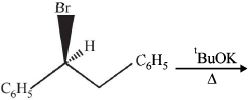
Carrying out dehydrohalogenation with a bulky base such as potassium tert-butoxide ( \(t\) -\(BuOK\) ) in \(1,2\) -diphenyl1-bromoethane \((t-\mathrm{BuOH})\) favors the formation of the alkene via \(E_2\) mechanism. The reaction involved is
-
- (A) \(CH_2 = CHCH_2CH = CHCH_3\)
- (B) \(CH_2= CHCH = CHCH_2CH_3\)
- (C) \(CH_3CH = C = CHCH_2CH_3\)
- (D) \(CH_3CH = CH - CH = CHCH_3\)
જવાબ અને ઉકેલ જુઓ
સાચો જવાબ: (D)
\(\,\begin{array}{*{20}{c}}
{C{H_3} - CH - C{H_2} - CH - C{H_2} - C{H_3}}\\
{\,\,\,\,\,\,\,\,\,\,\,\,\,\,\,\,\,\,\,\,\,\,\,\,\,\,\,\,\,\,|\,\,\,\,\,\,\,\,\,\,\,\,\,\,\,\,\,\,\,\,\,\,\,\,\,\,\,\,\,\,\,\,\,\,\,|\,\,\,\,\,\,\,\,\,\,\,\,\,\,\,\,\,\,\,\,\,\,\,\,\,\,\,\,\,\,\,\,\,\,\,\,\,\,\,\,\,\,\,\,\,\,\,\,\,\,\,\,}\\
{\,\,\,\,\,\,\,\,\,Br\,\,\,\,\,\,\,\,\,\,\,\,\,\,\,\,\,\,\,\,\,\,\,\,\,\,\,\,\,\,\,Br\,\,\,\,\,\,\,\,\,\,\,\,\,\,\,\,\,\,\,\,\,\,\,\,\,\,\,\,\,\,}
\end{array}\) \(\xrightarrow[{{E_2}}]{{KOH,\,C{H_3}OH\,\Delta }}\) \(\mathop {C{H_3} - CH = CH - CH = CH - C{H_3}}\limits_{{\text{(Saytzeff product)}}} \) -
- (A) \((III) < (II) < (I)\)
- (B) \((II) < (I) < (III)\)
- (C) \((I) < (III) < (II)\)
- (D) \((II) < (III) < (I)\)
જવાબ અને ઉકેલ જુઓ
સાચો જવાબ: (B)
Secondary, tertiary and benzylic halides appear to react by a mechanism that involves the formation of a carbocation and proceeds through \(\mathrm{S}_{\mathrm{N}} 1\) mechanism which takes place in two steps. The first step is the slow step \(-\) it is the rate-determining step. In this step, a molecule of alkyI halide ionizes and becomes an alkyl cation. Therefore, greater the stability of carbocation greater will be its tendency to react via \(S_{N} 1\) mechanism.\(\mathrm{R}-\mathrm{X} \rightleftharpoons \mathrm{R}^{+}+\mathrm{X}^{-}\)
In the second step, the intermediate alkyl cation reacts rapidly with water to produce alcohol.
\(\mathrm{R}^{+}+\mathrm{H}_{2} \mathrm{O} \rightleftharpoons \mathrm{ROH}\)
Hence, the order of reactivity of halides for the \(\mathrm{S}_{\mathrm{N}} 1\) mechanism is \(\mathrm{II}<\mathrm{I}<\mathrm{III}\).
-
- (A) \([Co(H_2O)_4 Cl_2]Cl \cdot 2H_2O\)
- (B) \([Co(H_2O)_3 Cl_3] \cdot 3H_2O\)
- (C) \([Co(H_2O)_6]Cl_3\)
- (D) \([Co(H_2O)_5 Cl]Cl_2 \cdot H_2O\)
જવાબ અને ઉકેલ જુઓ
સાચો જવાબ: (D)
\(\text{CoC}{{\text{l}}_{3}}\cdot 6{{\text{H}}_{2}}\text{O}+\text{AgN}{{\text{O}}_{3}}\) \((\text{ excess })\to \text{AgCl}\)\(100\, \mathrm{mL}, 0.1 \,\mathrm{M}\) \(1.2\, \times 10^{22} \text { ion }\)
\(\text {moles }\;\; 0.01 \,\mathrm{mol}\) \(\frac{1.2 \times 10^{22}}{6 \times 10^{23}}=0.02\, \mathrm{mol}\)
since, \(0.01\, \mathrm{mol}\) of \(\mathrm{CoCl}_{3} \cdot 6 \mathrm{H}_{2} \mathrm{O}\) produce \(0.02\,\mathrm{mol}\) of \(\mathrm{AgCl}\)
Therefore, \(1\,mol\) of \(\mathrm{CoCl}_{3} \cdot 6 \mathrm{H}_{2} \mathrm{O}\) will produce \(2\, \mathrm{mol}\) of \(\mathrm{AgCl}\)
Thus, the complex is \(\left[\mathrm{Co}\left(\mathrm{H}_{2} \mathrm{O}\right)_{5} \mathrm{Cl}\right] \mathrm{Cl}_{2} \cdot \mathrm{H}_{2} \mathrm{O}\)
-
- (A) \(NO\)
- (B) \(CO\)
- (C) \(O_2\)
- (D) \(B_2\)
જવાબ અને ઉકેલ જુઓ
સાચો જવાબ: (B)
The electronic configuration of the given species is as follows:\(\mathrm{O}_{2}: \sigma 1 s^{2}, \sigma^{*} 1 s^{2}, \sigma 2 s^{2}, \sigma^{*} 2 s^{2}, \sigma 2 p_{x}^{2},\left\{\begin{array}{l}{\pi 2 p_{y}^{2},} \\ {\pi 2 p_{z}^{2},}\end{array}\left\{\begin{array}{l}{\pi^{*} 2 p_{y}^{1}} \\ {\pi^{*} 2 p_{z}^{1}}\end{array}\right.\right.\)
\(\mathrm{B}_{2}: \sigma 1 s^{2}, \sigma^{*} 1 s^{2}, \sigma 2 s^{2}, \sigma^{*} 2 s^{2},\left\{\begin{array}{l}{\pi 2 p_{y}^{1}} \\ {\pi 2 p_{z}^{1}}\end{array}\right.\)
\(\mathrm{NO}: \sigma 1 s^{2}, \sigma^{*} 1 s^{2}, \sigma 2 s^{2}, \sigma^{*} 2 s^{2}, \sigma 2 p_{x}^{2},\left\{\begin{array}{l}{\pi 2 p_{y}^{2}, } \\ {\pi 2 p_{z}^{2},}\end{array}\left\{\begin{array}{l}{\pi^{*} 2 p_{y}^{1}} \\ {\pi^{*} 2 p_{z}^{0}}\end{array}\right.\right.\)
\(CO\): No unpaired electron is present in the molecule, therefore, is not paramagnetic.
- 18. \(H_2SO_3, H_2SO_4\) અને \(H_2S_2O_7\) ના બંધારણમાં \(\pi -\) બંધની સંખ્યાનો સાચો ક્રમ જણાવો. 2017 અઘરું
- (A) \({H_2}S{O_3}\, > \,{H_2}S{O_4}\, > \,{H_2}{S_2}{O_7}\)
- (B) \({H_2}S{O_4}\, > {H_2}{S_2}{O_7}\, > {H_2}S{O_3}\)
- (C) \({H_2}{S_2}{O_7} > {H_2}S{O_4} > {H_2}S{O_3}\)
- (D) \({H_2}{S_2}{O_7} > {H_2}S{O_3} > {H_2}S{O_4}\)
જવાબ અને ઉકેલ જુઓ
સાચો જવાબ: (C)
Number of \(\pi \) - bonds\(H_2S_2O_7\,=\) \(\begin{array}{*{20}{c}}
{\begin{array}{*{20}{c}}
{\,\,O\,\,\,\,\,\,\,\,\,\,\,\,\,\,\,\,O\,} \\
{\,||\,\,\,\,\,\,\,\,\,\,\,\,\,\,\,\,\,||}
\end{array}} \\
{HO - S - O - S - OH} \\
{||\,\,\,\,\,\,\,\,\,\,\,\,\,\,\,\,\,\,||\,} \\
{\,\,\,\,O\,\,\,\,\,\,\,\,\,\,\,\,\,\,\,O\,\,\,\,}
\end{array}\) \(4\)\(H_2SO_4\,=\) \(\begin{array}{*{20}{c}}
{\begin{array}{*{20}{c}}
O \\
{||}
\end{array}} \\
{HO - S - OH} \\
{||} \\
O
\end{array}\) \(2\)\(H_2SO_3\,=\) \(\begin{matrix}
HO-\overset{\centerdot \,\,\centerdot }{\mathop{S}}\,-OH \\
|| \\
O \\
\end{matrix}\) \(1\) - 19. જ્યારે ક્લોરિન વાયુ ઠંડા અને મંદ જલીય \(NaOH\) સાથે પ્રક્રિયા કરે ત્યારે મળતી નીપજો જણાવો. 2017 મધ્યમ
- (A) \(ClO^-\) અને \(ClO_3^-\)
- (B) \(ClO_2^-\) અને \(ClO_3^-\)
- (C) \(Cl^-\) અને \(ClO^-\)
- (D) \(Cl^-\) અને \(ClO_2^-\)
જવાબ અને ઉકેલ જુઓ
સાચો જવાબ: (C)
Dissolving the halogens in \(NaOH\) can in principle be used to make all the hypohalite ions. The reaction is\(\mathrm{Cl}_{2}+2 \mathrm{NaOH}(\mathrm{cold} / \mathrm{dilute}) \rightarrow \mathrm{NaCl}+\mathrm{NaOCl}+\mathrm{H}_{2} \mathrm{O}\)
-
- (A) \(CH_4, O_3, N_2, SO_2\)
- (B) \(O_3, N_2, CO_2, NO_2\)
- (C) \(O_3, NO_2, SO_2, Cl_2\)
- (D) \(CO_2, CH_4, N_2O, O_3\)
જવાબ અને ઉકેલ જુઓ
સાચો જવાબ: (D)
Green house gases are those gases that absorbs and emits radiation within the thermal \(IR\) range. The process is the fundamental cause of the green house effect. These are \(CO_2, CH_4, N_2O\) and \(O_3\) - 21. પાયરોફોસ્ફોરિક એસિડ \((H_4P_ 2O_7)\) માં \(P-OH\) બંધની સંખ્યા અને ફૉસ્ફરસની અવસ્થા અનુક્રમે જણાવો. 2017 અઘરું
- (A) ચાર અને ચાર
- (B) પાંચ અને ચાર
- (C) પાંચ અને પાંચ
- (D) ચાર અને પાંચ
જવાબ અને ઉકેલ જુઓ
સાચો જવાબ: (D)
Oxidation state :Each \(P\) atom is bound to one oxygen \(=-\,1\)
\(2OH=-\,1\times 2\,=\,-\,2\)
\(1\) oxygen \(-\,2\)
Total \(=\,-\,5\)
\(P\,=\,+5\)

-
- (A) \(XeF_2\)
- (B) \(XeF_4\)
- (C) \(XeOF_4\)
- (D) \(XeO_3\)
જવાબ અને ઉકેલ જુઓ
સાચો જવાબ: (C)
\(Xe{F_6}\, + \,{H_2}O\, \to \mathop {XeO{F_4}\, + \,2HF}\limits_{(partial\,\,\,hydrolysis)} \)\(Xe{F_6} + 2{H_2}O\, \to Xe{O_2}{F_2}+ \,4HF\)
\(Si{O_2}\, + \,2Xe{F_6}\, \to \mathop {\,2XeO{F_4}\, + \,Si{F_4}}\limits_{(Xenoneoxy\,\,\,tetra\,\,fluoride)} \)
-
- (A) \(8\)
- (B) \(12\)
- (C) \(6\)
- (D) \(4\)
જવાબ અને ઉકેલ જુઓ
સાચો જવાબ: (D)
According to Arrhenius equation\( k=A e^{-E_{2} / R T} \)
\( k_{1} =A e^{-E_{\mathrm{A} 1} / R T} \quad (1)\)
\(k_{2} =A e^{-E_{22} / R T} \quad (2)\)
Dividing Eq. \(( 2 )\) by Eq. \(( 1 )\), we get
\(\frac{k_{2}}{k_{1}}=e^{\left(\frac{E_{21}-E_{22}}{R T}\right)}\)
Taking natural logarithm of both sides, we get
\(\ln \left(\frac{k_{2}}{k_{1}}\right) =\frac{E_{\mathrm{al}}-E_{\mathrm{a} 2}}{R T} \)
\(=\frac{10,000}{8.314 \times 300}=4\)
-
- (A) \(107.2\)
- (B) \(53.6\)
- (C) \(26.8\)
- (D) \(214.4\)
જવાબ અને ઉકેલ જુઓ
સાચો જવાબ: (A)
\(\ln \,\frac{{{K_2}}}{{{K_1}}}\, = \,\frac{{{E_a}}}{R}\,\left( {\frac{1}{{{T_1}}}\, - \,\frac{1}{{{T_2}}}} \right)\)\(\ln \,\,4\, = \,\frac{{{E_a}}}{{8.314}}\left( {\frac{{310 - 300}}{{310 \times 300}}} \right)\)
\(2\,\ln \,2\, = \,\frac{{{E_a}}}{{8.314}}\left( {\frac{{310 - 300}}{{310 \times 300}}} \right)\)
\({E_a} = \frac{{0.693\, \times 2\, \times \,8.314 \times 300 \times 310}}{{10}}\)
\( = 107.2\,\,kJ/mol\)
-
- (A) \(9.84\)
- (B) \(4.92\)
- (C) \(2.45\)
- (D) \(19.67\)
જવાબ અને ઉકેલ જુઓ
સાચો જવાબ: (B)
In order to calculate the enthalpy change for \(H_2O\) at \(5\,^oC\) to ice at \(-\,5\,^oC\) , we need to calculated the enthalpy change of all the transformation involved in the process.\((a)\) Energy change of \(1\,mol\), \(H_2O\,(l)\), at \(5\,^oC\)
\(\to \,1\,mol\), \(H_2O\,(l)\) , \(0\,^oC\)
\((b)\) Energy change of \(1\,mol\), \(H_2O\,(l)\), at \(0\,^oC\)
\(\to \,1\,mol\), \(H_2O\,(s)\) (ice) , \(0\,^oC\)
\((c)\) Energy change of \(1\,mol\), Ice \((s)\), at \(0\,^oC\)
\(\to \,1\,mol\), Ice \((s)\) , \(-5\,^oC\)
Total \(\Delta H\)
\( = \,{C_P}\,[{H_2}O\,(l)]\,\,\Delta T\,\, + \,\Delta H\) freezing \( + \,\,{C_P}\,[{H_2}O\,(s)]\,\,\Delta T\)
\( = \,(75.3\,\,J\,\,mo{l^{ - 1}}\,{K^{ - 1}})\,( - 5)\,K\, + ( - \,6\, \times \,{10^3}\,\,J\,mo{l^{ - 1}}\,{K^{ - 1}})\) \(+ \,(36.8\,\,J\,mo{l^{ - 1}}\,{K^{ - 1}})\,( - 5)\,K\)
\(\Delta H\,\, = \,\, - \,6.56\,\,kJ\,mo{l^{ - 1}}\) (exothermic process)
So, \(\Delta H\,\, = \,\,6.56\,\,kJ\,mo{l^{ - 1}}\)
\( \Rightarrow \,{T_2}\, = \,304.92\,\,K\)
\({T_1}\, = \,300\,\,K,\,\) \({T_2}\, = 304.92\,\,K\)
\(\Delta T\, = \,\,{T_1}\, - {T_2}\, = 4.92\,\,K\)
-
- (A) \(Cr\)
- (B) \(Mn^{2+}\)
- (C) \(Cr^{+3}\)
- (D) \(Cl^-\)
જવાબ અને ઉકેલ જુઓ
સાચો જવાબ: (A)
Lower the reduction potential, greater is the tendency of the element to get oxidized, hence, greater is the reducing ability. Since, chromium system has lowest reduction potential; therefore, it is the strongest reducing agent. -
- (A) \(-0.057\)
- (B) \(+0.057\)
- (C) \(+0.30\)
- (D) \(-0.30\)
જવાબ અને ઉકેલ જુઓ
સાચો જવાબ: (A)
\(\Delta {G^o}\, = \, - nF{E^o}\)\((i)\,F{e^{2 + }}\, + \,2{e^ - }\, \to \,Fe;\) \({E^o}\, = \, - 0.47\,\,V;\)
\((ii)\,F{e^{3 + }}\, + \,{e^ - }\, \to \,F{e^{2 + }};\) \({E^o}\, = \, + 0.77\,\,V;\)
\((iii)\,F{e^{3 + }}\, + \,3{e^ - }\, \to Fe\)
\((i)\,\Delta {G^o}\, = \, - nF{E^o}\, = \, - \,2\,( - 0.47)F\, = \,0.94\,F\)
\((ii)\,\Delta {G^o}\, = \, - nF{E^o}\, = \, - \,1\,( + 0.77)F\, = \, - 0.77F\)
\((iii)\) on adding \(:\,\Delta {G^o}\, = \, + \,0.17\,F\)
\(\Delta {G^o}\, = \, - nF{E^o}\,{E^o}\) for
\((F{e^{3 + }} \to Fe)\, = \,\frac{{\Delta {G^o}}}{{ - nF}}\,\) \( = \,\frac{{0.17F}}{{ - 3F}}\, = \, - \,0.057\,V\)
-
- (A) \(Tl^+\) એ \(Al^{3+}\) કરતા વધુ થાય છે
- (B) \(Al^+\) એ \(Al^{3+}\) કરતા વધુ થાય છે
- (C) \(Tl^+\) એ \(Al^+\) કરતા વધુ થાય છે
- (D) \(Tl^{3+}\) એ \(Al^{3+}\) કરતા વધુ થાય છે
જવાબ અને ઉકેલ જુઓ
સાચો જવાબ: (C)
\((i)\,\mathop {A{l^{3 + }}}\limits_{Most\,\,stable} \,\xrightarrow{{{E^o}\, = \, - \,1.66}}Al\,\xleftarrow{{{E^o}\, = \, + \,0.55}}\mathop {A{l^ + }}\limits_{Less\,\,stable} \)\((ii)\mathop {T{l^{3 + }}}\limits_{Less\,\,stable} \,\xrightarrow{{{E^o}\, = \, - + 1.26}}Tl\,\xleftarrow{{{E^o}\, = \, - 0.34}}\mathop {T{l^ + }}\limits_{Most\,\,\,stable} \)
\(Tl^+\) has negative electrode potential \((E^o = - 0.34)\) means, it does not prefer to convert into \(Tl\) but reverse must be preferred that's why it is more stable than \(Tl^{3+}\) \((E^o\,=\,+\,1.26)\) In \(Al\), \(Al^{3+}\) is more stable \(E^o=\,-\,1.66\) than \(Al^+\) \((E^o\,=\,+0.55)\) and also from \(Tl^+\) due to more negative value of \(E^o\). Therefore, by comparison it confirms that \(Tl^+\) is more stable than \(Al^+\).
-
- (A) \(0.38\)
- (B) \(0.32\)
- (C) \(1.28\)
- (D) \(0.66\)
જવાબ અને ઉકેલ જુઓ
સાચો જવાબ: (B)
Cell reaction :\(M\, + \,3A{g^ + }(aq)\, \to \,{M^{3 + }}\, + \,3Ag(s)\)
\(E\, = \,{E^o}\, - \,\frac{{0.0591}}{n}\log \,\) \(\frac{{[\operatorname{Re} duction\,\,state]}}{{[Oxidised\,\,\,state]}}\)
\(0.421\, = \,{E^o}\, - \,\frac{{0.0591}}{3}\log \,\frac{{0.001}}{{{{(0.01)}^3}}}\)
\({E^o}\, = \,0.48\)
\({E^o}\, = \,E_{A{g^ + }/Ag}^o\, - \,E_{{M^{3 + }}/M}^o\)
\(E_{{M^{3 + }}/M}^o\, = \,0.8\,V\, - \,0.48\,V\, = \,0.32\,volt\)
-
- (A) \(Ti^{2+}\)
- (B) \(V^{2+}\)
- (C) \(Cr^{2+}\)
- (D) \(Mn^{2+}\)
જવાબ અને ઉકેલ જુઓ
સાચો જવાબ: (D)
ions \(E^o\,(V)\)\(Ti^{2+}\) \(-0.37\)
\(V^{2+}\) \(-0.26\)
\(Cr^{2+}\) \(-0.41\)
\(Mn^{2+}\) \(+1.57\)
Negative value of \(E^o\) means these metals librate hydrogen from dilute acid.
\(({M^{2 + }}\, + \,2{H^ + }\, - \,{e^ - }\, \to \,{M^{3 + }}\, + \,{H_2})\)
-
- (A) \(15\)
- (B) \(25\)
- (C) \(45\)
- (D) \(65\)
જવાબ અને ઉકેલ જુઓ
સાચો જવાબ: (C)
Molality (experimental)\( = \,\frac{{\Delta {T_f}}}{{{K_f}}}\, = \,\frac{{3.82}}{{1.86}}\, = \,2.054\,mol/1000\,g\) solvent
Molality (theoretical)
\( = \,\frac{{mole\,\,of\,solute}}{{wt.\,of\,solventing\,(g)}} \times 1000\)
\( = \,\frac{{5\,g\,/\,142\,g\,/\,mole}}{x} \times 1000\)
\(N{a_2}S{O_4}\, \to \,2N{a^ + }\, + \,SO_4^{2 - }\)
Moles before dissociation \(1\) \(0\) \(0\)
Moles after dissociation \(1-x\) \(2x\) \(x\)
Von't Hoff Factor \((i) = \,\frac{{Moles\,after\,\,dissociation}}{{Moles\,before\,\,dissociation}}\)
\( = \frac{{(1 - x)\, + \,2x\, + \,x}}{1}\)
\(Na_2SO_4\) is ionised \(81.5\%\) means \(x\,=\,0.815\)
\( = \frac{{(1 - 0.815)\, + \,2 \times 0.815\, + \,0.815}}{1}\)
\(=\,2.63\)
\(i\, = \,\frac{{Observed\,\,molarrity}}{{Calculated\,\,molarity}}\)
\( \Rightarrow \,2.63\, = \,\frac{{2.054}}{{\frac{{0.0352}}{x} \times 1000}}\, = \,45.07\,g\)
-
- (A) \(0.162\)
- (B) \(0.675\)
- (C) \(0.325\)
- (D) \(0.486\)
જવાબ અને ઉકેલ જુઓ
સાચો જવાબ: (C)
Molar mass of \(CHCl_3\,=\,119.5\,g/mol.\)Molar mass of \(CH_2Cl_2\,=\,85\,g/mol.\)
Molar of \(CHCl_3\,=\,\frac {11.95}{119.5}\,=\,0.1\,mol.\)
Molar of \(CH_2Cl_2\,=\,\frac {8.5}{85}\,=\,0.1\,mol.\)
Mole fraction of \(CHCl_3\,=\,\frac {0.1}{0.2}\,=\,0.5\,mol\)
Mole fraction of \(CH_2Cl_2\,=\,\frac {0.1}{0.2}\,=\,0.5\,mol\)
(Given-
Vapour pressure of \(CHCl_3\,=\,200\,mm\) \(Hg\,=\,0.263\,atm\).
Vapour pressure of \(CH_2Cl_2\,=\,415\,mm\) \(Hg\,=\,0.546\,atm\).)
\((1\,atm\,=\,760\,mm\,Hg)\)
\(\therefore P_{(abovesolution)}\) \(=\) Mole fractiion of \(CHCl_3\times \) (Vapour pressure of \(CHCl_3\) ) \(+\) Mole fractiion of \(CH_2Cl_2\times \) (Vapour pressure of \(CH_2Cl_2\) )
\(=\,0.5\times 0.263\,+\,0.5\times 0.546\,=\,0.4045\)
Mole fraction of \(CHCl_3\) in vapour form
\(=\,\frac {0.1315}{0.4045}\,=\,0.325\)
-
- (A) \(64.6\)
- (B) \(80.4\)
- (C) \(74.6\)
- (D) \(94.6\)
જવાબ અને ઉકેલ જુઓ
સાચો જવાબ: (D)
\( \quad \quad \quad \quad 2 \mathrm{CH}_{3} \mathrm{COOH} \rightleftharpoons\left(\mathrm{CH}_{3} \mathrm{COOH}\right)_{2} \)\(Initial\; moles\quad \quad 1 \quad \quad \quad \quad 0\)
\(at\; equilibrium \quad 1-\alpha\quad \quad \alpha / 2\)
Total number of moles at equilibrium \(=1-\alpha+\alpha / 2 \Rightarrow i=1-\alpha / 2(\text { association })\)
\(\Delta T_{\mathrm{r}}=K_{\mathrm{r}} \times m \times i\)
\(0.45=(5.12) \times \frac{(0.2 / 60)}{(20 / 1000)} \times\left(1-\frac{\alpha}{2}\right)\)
\(\left(1-\frac{\alpha}{2}\right)=0.527 \Rightarrow \alpha=0.945\)
So, the percentage of acetic acid that dimerizes \(=94.5 \%\)
-
- (A) \(0.2\)
- (B) \(0.3\)
- (C) \(0.6\)
- (D) \(1.8\)
જવાબ અને ઉકેલ જુઓ
સાચો જવાબ: (A)
\(\underset{\begin{smallmatrix}
\lim iting \\
reagent
\end{smallmatrix}}{\mathop{FeC{{l}_{3}}(aq.)}}\,+\underset{\begin{smallmatrix}
(Excess\,amount) \\
not\,behave\,as
\\
\lim iting\,reagent
\end{smallmatrix}}{\mathop{3NaOH(aq.)}}\,\to \) \(Fe{(OH)_3}(s) + 3NaCl(aq.)\)Moles of \(Fe(OH)_3\) \( = \frac{{weight\,in\,g}}{{M.\,weight\,of\,Fe{{(OH)}_3}}}\)
\( = \frac{{2.14\,g}}{{107\,g/mol}} = 0.02\,mol.\)
\(1.0\) mole of \(Fe(OH)_3\) is obtained from \(= 1.0\) mole of \(FeCl_3\)
\(0.02\) mole of \(Fe(OH)_3\) is obtained from \(0.02\) mole of \(FeCl_3\)
Molarity
\( = \frac{{No.\,of\,moles}}{{Volume\,in\,L}} = \frac{{0.02\,mole}}{{0.1\,L}} = 0.2\,M\)
-
- (A) \(1186\)
- (B) \(84.3\)
- (C) \(118.6\)
- (D) \(11.86\)
જવાબ અને ઉકેલ જુઓ
સાચો જવાબ: (B)
\(\mathrm{M}_{2} \mathrm{CO}_{3}+2 \mathrm{HCl} \rightarrow 2 \mathrm{MCl}+\mathrm{H}_{2} \mathrm{O}+\mathrm{CO}_{2}\)\(n=\frac{\text { Mass given }}{\text { Molar mass }}\)
\(0.01186=\frac{1}{M} \Rightarrow M=84.3\, \mathrm{g\,mol}^{-1}\)
-
- (A) \(6\)
- (B) \(0\)
- (C) \(2\)
- (D) \(4\)
જવાબ અને ઉકેલ જુઓ
સાચો જવાબ: (D)
When alkenes are treated with \(HBr\) in the presence of peroxides, an anti-Markovnikov addition occurs in the sense that the hydrogen atom becomes attached to the carbon atom with the fewer hydrogen atoms.The product formed has two chirality centres, therefore, four stereoisomers \(\left(2^{2}\right)\) will exist.
\(\begin{array}{*{20}{c}}
{\,\,\,\,\,C{H_3}} \\
| \\
{C{H_3} - C{H_2} - C = CH - C{H_3}}
\end{array}\) \(\xrightarrow[{Peroxide}]{{HBr}}\) \(\mathop {\begin{array}{*{20}{c}}
{\,\begin{array}{*{20}{c}}
{\,\,\,\,\,\,C{H_3}} \\
|
\end{array}} \\
{C{H_3} - C{H_2} - {}_*CH - \mathop {CH}\limits^{*\,} - C{H_3}} \\
{\,\,\,\,\,\,\,\,\,\,\,\,\,\,\,\,\,\,\,\,\,\,\,\,\,\,\,\,\,\,\,\,\,\,\,|} \\
{\,\,\,\,\,\,\,\,\,\,\,\,\,\,\,\,\,\,\,\,\,\,\,\,\,\,\,\,\,\,\,\,\,\,\,\,\,Br}
\end{array}}\limits_{Major\,\,product} \) -
- (A) ચલિત કલા વાયુ હોઇ શકે
- (B) સ્થાયી કલા એ ખૂબ ઝીણો ધન અધિશોષક હોય છે
- (C) અલગીકરણ એ દ્રાવ્યના ચલિત અને સ્થાયી ક્લા વચ્ચેના સંતુલન પર આધાર રાખે છે.
- (D) પેપર ક્રોમેટોગ્રાફી એ Partition ક્રોમેટોગ્રાફીનો પ્રકાર છે
જવાબ અને ઉકેલ જુઓ
સાચો જવાબ: (B)
Partition chromatography is the process of separation where by the component of the mixture get distributed into two phases that may be liquid-liquid, liquid gas but not to solid-gas. -
- (A) \(N{O^ + }\)
- (B) \(CO\)
- (C) \(O_2^{2 - }\)
- (D) \(B_2\)
જવાબ અને ઉકેલ જુઓ
સાચો જવાબ: (D)
Total electron\(NO^+\) \(14\)
\(CO\) \(14\)
\(O_2^{2-}\) \(18\)
\(B_2\) \(10\)
\(N{O^ + } \Rightarrow KK.\sigma {(2s)^2}{\sigma ^*}{(2s)^2}.{(\pi 2{p_x})^2}\)
\( = {(\pi 2{p_y})^2}.{(\sigma 2{p_z})^2}\) diamagnetic
\(CO \Rightarrow KK.\sigma {(2s)^2}{\sigma ^*}{(2s)^2}.{(\pi 2{p_x})^2}\)
\( = {(\pi 2{p_y})^2}.{(\sigma 2{p_z})^2}\) diamagnetic
\(O_2^{2 - } \Rightarrow KK.\sigma {(2s)^2}{\sigma ^*}{(2s)^2}.\sigma {(2{p_z})^2}{(\pi 2{p_x})^2}\)
\( = {(\pi 2{p_y})^2}.{\pi ^*}{(2{p_x})^2} = {\pi ^*}{(2{p_y})^2}\) diamagnetic
\({B_2} \Rightarrow KK.\sigma {(2s)^2}{\sigma ^*}{(2s)^2}.\pi {(2{p_x})^1} = \pi {(2{p_y})^1}\) paramagnetic
-
- (A) \(BF_3, NF_3, CO_3^{2 - }\)
- (B) \(CO_3^{2 - } , NO_3^- , SO_3\)
- (C) \(NH_3, SO_3, CO_3^{2 - }\)
- (D) \(NCl_3, BCl_3, SO_3\)
જવાબ અને ઉકેલ જુઓ
સાચો જવાબ: (B)
Group Hybridization Shape \((1)\) \(BF_3\)
\(NF_3\)
\(CO_3^{2-}\)
\(sp^2\)
\(sp^3\)
\(sp^2\)
Triangular Planar \((TP)\)
Tetrahedral \((T)\)
\(T.P.\)
\((2)\) \(CO_3^{2-}\)
\(NO_3^-\)
\(SO_3\)
\(sp^2\)
\(sp^2\)
\(sp^2\)
\(\left. \begin{gathered}
T.P. \hfill \\
T.P. \hfill \\
T.P. \hfill \\
\end{gathered} \right\}\) (all have same hybridization)\((3)\) \(NH_3\)
\(SO_3\)
\(CO_3^{2-}\)
\(sp^3\)
\(sp^2\)
\(sp^2\)
\(T\)
\(T.P.\)
\(T.P.\)
\((4)\) \(NCl_3\)
\(BCl_3\)
\(SO_3\)
\(sp^3\)
\(sp^2\)
\(sp^2\)
\(T\)
\(T.P.\)
\(T.P.\)
-
- (A) \([Ne]\, 3s^2\,3p^1\)
- (B) \([Ne]\, 3s^2\,3p^2\)
- (C) \([Ne]\, 3s^2\,3p^3\)
- (D) \([Ar]\, 3d^{10}\,4s^2\,4p^3\)
જવાબ અને ઉકેલ જુઓ
સાચો જવાબ: (C)
The smaller the atomic size, larger is the value of \(IP\). Further the atoms having half filled or fully filled orbitals are comparatively more stable, hence more energy required to remove the electron from such atoms. -
- (A) \(O^{-2} , F^-, Na^+, Mg^{2+}\)
- (B) \(O^-, F^-, Na, Mg^+\)
- (C) \(O^{-2} , F^-, Na, Mg^{2+}\)
- (D) \(O^-, F^-, Na^+, Mg^{2+}\)
જવાબ અને ઉકેલ જુઓ
સાચો જવાબ: (A)
Isoclectronic species have the same number of electrons. The following ionic species are isoclectronic.\(\begin{array}{lcc}\hline \text { Ions } & {\text { Atomic number }} & {\text { Number of electrons }} \\ \hline 0^{2-} & {8} & {10} \\ {\mathrm{F}^{-}} & {9} & {10} \\ {\mathrm{Na}^{+}} & {11} & {10} \\ {\mathrm{Mg}^{2+}} & {12} & {10} \\ \hline\end{array}\)
-
- (A) \(CO\) ને દૂર કરવો
- (B) \(CO_2\) ને દૂર કરવો
- (C) \(CO_2\) ઉમેરવો
- (D) \(Fe_2O_3\) ઉમેરવો
જવાબ અને ઉકેલ જુઓ
સાચો જવાબ: (D)
Perturbation Shifts reaction which way?Removal of \(CO\) Left
Removal of \(CO_2\) Right
Addition of \(CO_2\) Left
Addition of \(Fe_2O_3\) No change
(This is a solid compound. Its concentration has no effect on the equilibrium).
-
- (A) \(5.44\)
- (B) \(5.81\)
- (C) \(6.56\)
- (D) \(6.00\)
જવાબ અને ઉકેલ જુઓ
સાચો જવાબ: (C)
In order to calculate the enthalpy change for \(H_2O\) at \(5\,^oC\) to ice at \(-\,5\,^oC\) , we need to calculated the enthalpy change of all the transformation involved in the process.\((a)\) Energy change of \(1\,mol\), \(H_2O\,(l)\), at \(5\,^oC\)
\(\to \,1\,mol\), \(H_2O\,(l)\) , \(0\,^oC\)
\((b)\) Energy change of \(1\,mol\), \(H_2O\,(l)\), at \(0\,^oC\)
\(\to \,1\,mol\), \(H_2O\,(s)\) (ice) , \(0\,^oC\)
\((c)\) Energy change of \(1\,mol\), Ice \((s)\), at \(0\,^oC\)
\(\to \,1\,mol\), Ice \((s)\) , \(-5\,^oC\)
Total \(\Delta H\)
\( = \,{C_P}\,[{H_2}O\,(l)]\,\,\Delta T\,\, + \,\Delta H\) freezing \( + \,\,{C_P}\,[{H_2}O\,(s)]\,\,\Delta T\)
\( = \,(75.3\,\,J\,\,mo{l^{ - 1}}\,{K^{ - 1}})\,( - 5)\,K\, + ( - \,6\, \times \,{10^3}\,\,J\,mo{l^{ - 1}}\,{K^{ - 1}})\) \(+ \,(36.8\,\,J\,mo{l^{ - 1}}\,{K^{ - 1}})\,( - 5)\,K\)
\(\Delta H\,\, = \,\, - \,6.56\,\,kJ\,mo{l^{ - 1}}\) (exothermic process)
So, \(\Delta H\,\, = \,\,6.56\,\,kJ\,mo{l^{ - 1}}\)
-
- (A) \(+ 74.8\)
- (B) \(+ 144.0\)
- (C) \(- 74.8\)
- (D) \(- 144.0\)
જવાબ અને ઉકેલ જુઓ
સાચો જવાબ: (C)
\(C(graphite) +\mathrm{O}_{2}(\mathrm{g}) \rightarrow \mathrm{CO}_{2}(\mathrm{g})\) \(\Delta_{r} H^{\circ}=-393.55\,\mathrm{kJ}\, \mathrm{mol}^{-1}\)\(\mathrm{H}_{2}(\mathrm{g})+\frac{1}{2} \mathrm{O}_{2}(\mathrm{g}) \rightarrow \mathrm{H}_{2} \mathrm{O}(\mathrm{l}) ; \)\(\quad \Delta_{r} H^{\circ}=-285.8\, \mathrm{kJ}\, \mathrm{mol}^{-1}\)
\(\mathrm{CO}_{2}(\mathrm{g})+2 \mathrm{H}_{2} \mathrm{O}(\mathrm{l}) \rightarrow \mathrm{CH}_{4}(\mathrm{g})+2 \mathrm{O}_{2}(\mathrm{g}) ;\)\( \Delta_{r} H^{\circ}=+890.3\,\mathrm{kJ}\,\mathrm{mol}^{-1}\)
\(C(graphite) +2 \mathrm{H}_{2}(\mathrm{g}) \rightarrow \mathrm{CH}_{4}(\mathrm{g}) ; \)\(\quad \Delta_{r} H^{\circ}=?\)
Now, Eq. \((4)= \) Eq. \((1)+2 \times\) Eq. \((2)+\) Eq. \(( 3)\)
\(\Delta_{r} H^{\circ}=-393.55+2(-285.8)+890.3\)
\(=-74.8\,\mathrm{kJ} \,\mathrm{mol}^{-1}\)
-
- (A) એન્થાલી વધે છે પરંતુ એન્ટ્રોપી ઘટે છે
- (B) એન્થાલ્પી અચળ રહે છે પરંતુ એન્ટ્રોપી વધે છે
- (C) એન્થાલ્પી ધટે છે પરંતુ એન્ટ્રોપી વધે છે
- (D) એન્થાલ્પી અને એન્ટ્રોપી બંને અચળ રહે છે
જવાબ અને ઉકેલ જુઓ
સાચો જવાબ: (B)
\(\Delta H = n{c_p}\Delta T = 0\) means \(\Delta H\) constant.\(\Delta S = nR\,\ln {\kern 1pt} \left( {\frac{{{v_f}}}{{{v_i}}}} \right) \geqslant 0\) \(\Delta S\) increases.
-
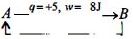
- (A) વાયુ દ્વારા \(10\, J\) કાર્ય થશે
- (B) વાયુ દ્વારા \(6\, J\) કાર્ય થશે
- (C) પર્યાવરણ દ્વારા વાયુ પર \(10\, J\) કાર્ય થશે
- (D) પર્યાવરણ દ્વારા વાયુ પર \(6\, J\) કાર્ય થશે
જવાબ અને ઉકેલ જુઓ
સાચો જવાબ: (D)
\(\Delta {U_{AB}} = q + w = + 5 + ( - 8) = - 3\)\(q = - 3,\,\Delta {U_{BA}} = + 3\)
\(\Delta {U_{BA}} = q + w\)
\( \Rightarrow 3 = - 3 + w \Rightarrow w = + 6\)
(work done on the system)
- 47. પ્રક્રિયા \(A(g) \to A(l)\) માટે \(\Delta H = - 3RT\) છે. તો પ્રક્રિયા માટે સાચો સંબંધ જણાવો. 2017 અઘરું
- (A) \(\Delta H = \Delta U \ne O\)
- (B) \(\Delta H = \Delta U = O\)
- (C) \(\left| {\Delta H} \right| < \left| {\Delta U} \right|\)
- (D) \(\left| {\Delta H} \right| > \left| {\Delta U} \right|\)
જવાબ અને ઉકેલ જુઓ
સાચો જવાબ: (D)
\(A(g) \to A(1)\)\(\Delta H = \Delta U + \Delta {n_g}RT\)
Given, \(\Delta H = - 3RT\)
Here
\(\Delta {n_g} = {n_p} - {n_r} = 0 - 1 = - 1\)
\(\Delta H = \Delta U - RT\)
\( \Rightarrow - 3RT = \Delta U - RT\)
\( \Rightarrow - 3RT + RT = \Delta U\)
\( \Rightarrow - 2RT = \Delta U\)
\(|\Delta H|\, > \,|\Delta U|\)
-
- (A) સમકદ કાર્ય
- (B) સમદાબી કાર્ય
- (C) સમોષ્મી કાર્ય
- (D) સમતાપી કાર્ય
જવાબ અને ઉકેલ જુઓ
સાચો જવાબ: (C)
\(\Delta U = Q +\Delta W\)In adiabatic process no exchange of heat occurs between system and surrounding so \(Q =0\).
Thus, \(\Delta U\) is equal to adiabatic work.
-
- (A) \(1.65\)
- (B) \(4.76\)
- (C) \(0.529\)
- (D) \(2.12\)
જવાબ અને ઉકેલ જુઓ
સાચો જવાબ: (D)
According to Bohr's theory\(r =0.529 \times \frac{n^{2}}{Z} \mathop A\limits^o \)
\( = 0.529 \times \frac{{{2^2}}}{1} = 2.116{\mkern 1mu} \,\mathop A\limits^o \)
-
- (A) લાયમેન શ્રેણી
- (B) બામર શ્રેણી
- (C) પાશ્ચન શ્રેણી
- (D) બ્રેકેટ શ્રેણી
જવાબ અને ઉકેલ જુઓ
સાચો જવાબ: (B)
\(r = 0.529 \times \frac{{{n^2}}}{Z}\)\(r = 211.6\,pm = 2.11\,\mathop A\limits^o \)
\( \Rightarrow 0.529 \times \frac{{{n^2}}}{Z} = 2.11\,\mathop A\limits^o \)
\(n = 2\) (Balmer series)
આ પેજ પર આ ફિલ્ટર મુજબ કોઈ પ્રશ્ન નથી.
અન્ય વર્ષ
વારંવાર પૂછાતા પ્રશ્નો
ExamBro પર JEE Mains 2017 Chemistry ના કેટલા પ્રશ્નો છે?
52 પ્રશ્નો, દરેક સાચા જવાબ અને પૂરા ઉકેલ સાથે.
JEE Mains 2017 Chemistry નું કયું પ્રકરણ સૌથી વધુ પૂછાય છે?
ઉષ્માગતિશાસ્ત્ર, 6 પ્રશ્નો સાથે; ત્યાર બાદ સંતુલન - ૨, 5 પ્રશ્નો સાથે.
JEE Mains 2017 Chemistry ના પ્રશ્નો કેટલા અઘરા હોય છે?
8% સરળ, 19% મધ્યમ અને 73% અઘરા.