


પ્રશ્નો
નવા પહેલા45 માંથી 1–45 પ્રશ્નો
-
- (A) 4
- (B) 5
- (C) 6
- (D) 7
જવાબ અને ઉકેલ જુઓ
સાચો જવાબ: (B)
બનેલા \(AgBr\) નું દળ = \(3.36\) g
\(AgBr\) નું મોલર દળ = \(108 + 80 = 188\) g mol\(^{-1}\)
બનેલા \(AgBr\) ના મોલ = \(\dfrac{3.36}{188} \approx 0.01787\) mol
કારણ કે \(AgBr\) ના \(1\) મોલમાં \(Br\) નો \(1\) મોલ હોય છે, તેથી સંયોજનમાં \(Br\) ના મોલ = \(0.01787\) mol.
\(Br\) નું દળ = \(0.01787 \times 80 = 1.43\) g
સંયોજન \((X)\) માં \(Br\) ની ટકાવારી = \(\dfrac{1.43}{2.0} \times 100 = 71.5\%\)
આપેલ કાર્બનની ટકાવારી = \(26.7\%\)
હાઇડ્રોજનની ટકાવારી = \(100\% - (71.5\% + 26.7\%) = 1.8\%\)
હવે, આપણે સંયોજનમાં તત્ત્વોનો મોલર ગુણોત્તર શોધીએ:
\(C\) ના મોલ = \(\dfrac{26.7}{12} = 2.225\)
\(H\) ના મોલ = \(\dfrac{1.8}{1} = 1.8\)
\(Br\) ના મોલ = \(\dfrac{71.5}{80} = 0.893\)
સૌથી નાના મૂલ્ય (\(0.893\)) વડે ભાગતા, સરળતમ ગુણોત્તર મળે છે:
\(C : H : Br = \dfrac{2.225}{0.893} : \dfrac{1.8}{0.893} : \dfrac{0.893}{0.893}\)
\(C : H : Br \approx 2.5 : 2 : 1\)
પૂર્ણાંક સંખ્યાઓ મેળવવા માટે \(2\) વડે ગુણતા, આપણને \(5 : 4 : 2\) નો ગુણોત્તર મળે છે.
સંયોજનનું પ્રમાણસૂચક સૂત્ર \(C_5H_4Br_2\) છે.
પ્રમાણસૂચક સૂત્રમાં કાર્બન પરમાણુઓની કુલ સંખ્યા \(5\) છે.
જવાબ: \(5\) -
- (A) 2%
- (B) 6%
- (C) 1%
- (D) 4%
જવાબ અને ઉકેલ જુઓ
સાચો જવાબ: (D)
\(\begin{array}{cl} C _{ x } H _{ y } Br _{ z } & \rightarrow \quad CO _2 \\ 1 g & 1.32 g\end{array}\)
\(\% C=\frac{1.32 \times 12}{44 \times 1} \times 100=36 \%\)
\(\begin{array}{clc} C _{ x } H _{ y } Br _{ z } & \rightarrow & AgBr \\ 0.53 g & & 0.75 g\end{array}\)
\(\% Br =\frac{0.75 \times 80}{188 \times 0.53} \times 100=60.2 \%\)
\(\% H =100-(36+60.2)\)
\(\% H \simeq 4 \%\) -
- (A) 42.10%
- (B) 63.15%
- (C) 21.05%
- (D) 48.24%
જવાબ અને ઉકેલ જુઓ
સાચો જવાબ: (C)
\(\% S=\frac{32}{233} \times \frac{0.4813}{0.314} \times 100\)
\(=21.052 \%\) -
- (A) 21
- (B) 0.42
- (C) 42
- (D) 0.21
જવાબ અને ઉકેલ જુઓ
સાચો જવાબ: (C)
\(H_{2}SO_{4}\) ના તુલ્યભાર = એમોનિયાના તુલ્યભાર
\(\Rightarrow \frac{15 \times 1 \times 2}{1000}\) = એમોનિયાના મોલ \(\times 1\)
\(\Rightarrow\) એમોનિયાના મોલ = 'N' ના મોલ
\(\Rightarrow\) નાઇટ્રોજનનું વજન = \(\frac{15 \times 1 \times 2}{1000} \times 14 = 0.42\)
'N' ની વજન ટકાવારી = \(\frac{0.42}{1} \times 100 = 42\)% -
- (A) 73%
- (B) 71%
- (C) 76%
- (D) 68%
જવાબ અને ઉકેલ જુઓ
સાચો જવાબ: (A)
\(\begin{array}{l}\quad { C _{ x } H _{ z }}+ O _2 \rightarrow CO _2+ H _2 O \\ t =0 \quad 0.25 gm \\ t _{ eq }\quad-\quad 0.18 gm \quad 0.15 gm \end{array}\)
' H ' નું દળ \(=\frac{0.15}{18} \times 2=0.016 \simeq 0.017 gm\).
' O ' નું દળ \(=0.25-0.05-0.017=0.1833 gm\)
' O ' ની દળ \(\%\) \(=\frac{0.1833}{0.25} \times 100=73.32 \%\). -
- (A) 40
- (B) 43
- (C) 45
- (D) 48
જવાબ અને ઉકેલ જુઓ
સાચો જવાબ: (B)
આયોડિન જાંબલી રંગ આપે છે.
\(I\) ની \(\%\) \(=\frac{\text { Atomic weight of I }}{\text { Molecular weight of AgI }} \times \frac{ m }{ W } \times 100\)
\(=\frac{127}{235} \times \frac{0.12}{0.15} \times 100\)
\(I\) ની \(\%\) \(=43.23 \% \approx 43 \%\) -
- (A) 41
- (B) 42
- (C) 43
- (D) 44
જવાબ અને ઉકેલ જુઓ
સાચો જવાબ: (A)
કાર્બનિક સંયોજનનું દળ, \(W = 0.2\) g
બનેલા \(\text{BaSO}_4\) નું દળ, \(m = 0.6\) g
\(\text{BaSO}_4\) નું મોલર દળ \(= 233 \text{ g mol}^{-1}\)
\(\text{S}\) નું મોલર દળ \(= 32 \text{ g mol}^{-1}\)
કાર્બનિક સંયોજનમાં સલ્ફરની ટકાવારી નીચેના સૂત્ર દ્વારા અપાય છે:
\(\% \text{S} = \dfrac{32}{233} \times \dfrac{m}{W} \times 100\)
આપેલ કિંમતો મૂકતા:
\(\% \text{S} = \dfrac{32}{233} \times \dfrac{0.6}{0.2} \times 100\)
\(\% \text{S} = \dfrac{32}{233} \times 3 \times 100\)
\(\% \text{S} = \dfrac{9600}{233} \approx 41.20\%\)
નજીકના પૂર્ણાંકમાં આસન્ન મૂલ્ય લેતા, સલ્ફરની ટકાવારી \(41\) છે.
ઉત્તર: \(41\) - 8. કેરિયસ પદ્ધતિમાં, 0.2425 g કાર્બનિક સંયોજનમાંથી 0.5253 g સિલ્વર ક્લોરાઇડ મળ્યો. કાર્બનિક સંયોજનમાં ક્લોરિનની ટકાવારી છે 2026 અઘરું
- (A) 53.58%
- (B) 87.65%
- (C) 37.57%
- (D) 34.79%
જવાબ અને ઉકેલ જુઓ
સાચો જવાબ: (A)
કાર્બનિક સંયોજન 0.2425 gm
પ્રાપ્ત AgCl: 0.5253 gm
કેરિયસ પદ્ધતિમાં હેલોજનના અનુમાન માટે, 0.2425 gm કાર્બનિક સંયોજનમાંથી 0.5253 gm AgCl પ્રાપ્ત થાય છે.
આથી Cl ની ટકાવારી.
ક્લોરિનની ટકાવારી \( Cl = \frac{35.5}{143.5} \times \frac{0.5253}{0.2425} \times 100 = 53.58\% \) -
- (A) 4.55%
- (B) 10.30%
- (C) 21.97%
- (D) 16.48%
જવાબ અને ઉકેલ જુઓ
સાચો જવાબ: (C)
\( \frac{n_{BaSO_{4}} \times 32}{W_{(unknown comp.)}} \times 100 \)
\( = \frac{1.2 \times 32}{233} \times \frac{100}{0.75} = 21.97\% \) -
- (A) 10
- (B) 15
- (C) 20
- (D) 25
જવાબ અને ઉકેલ જુઓ
સાચો જવાબ: (B)
\(P_{ N _2}=(715-15) mm =\frac{700}{760} atm\)
\(V _{ N _2}=70 ml =\frac{70}{1000} l\)
\(n _{ N _2}=\frac{ PV }{ RT }=\frac{\left(\frac{700}{760}\right) \times\left(\frac{70}{1000}\right)}{0.0821 \times 300}\)
\(W _{ N _2}=\frac{700}{760} \times \frac{\frac{70}{1000}}{0.0821 \times 300} \times 28\)
\(\% N=\frac{ W _{ N _2}}{0.5} \times 100=\frac{700}{760} \times \frac{\frac{70 / 1000}{0.0821 \times 300} \times 28}{0.5} \times 100\)
\(=14.65 \% \approx 15\) -
- (A) 50
- (B) 30
- (C) 20
- (D) 40
જવાબ અને ઉકેલ જુઓ
સાચો જવાબ: (A)
\(P\) ની ટકાવારી \(= \frac{n_{Mg_{2}P_{2}O_{7}} \times 2 \times 31}{w_{(unknown~compound)}} \times 100\)
\(= \frac{(\frac{1.79}{222} \times 2 \times 31)}{1} \times 100\)
\(= 49.99\% \approx 50\%\) -
- (A) \(273\)
- (B) \(27\)
- (C) \(2730\)
- (D) \(227\)
જવાબ અને ઉકેલ જુઓ
સાચો જવાબ: (A)
સંયોજનમાં કાર્બનનું દળ, ઉત્પન્ન થયેલ \(CO_2\) ના દળ પરથી ગણવામાં આવે છે:
C નું દળ= (12/44) × CO2 નું દળ = (12/44) × 0.25 = 3/44) g
આપેલ છે કે સંયોજનમાં કાર્બનની ટકાવારી \(25\%\) છે:
\(\% \text{ C ની} = \dfrac{\text{C નું દળ}}{\text{કુલ દળ } X} \times 100\)
\(25 = \dfrac{\dfrac{3}{44}}{X} \times 100\)
\(X = \dfrac{3}{44} \times \dfrac{100}{25} = \dfrac{3}{44} \times 4 = \dfrac{3}{11}\) g
\(X \approx 0.2727\) g
હાઇડ્રોજનની ટકાવારીનો ઉપયોગ કરીને આની ચકાસણી કરતા:
H નું દળ = 2/18 x H2O નું દળ = 2/18 x 0.12 = 1/75 g
\(\% \text{ H ની} = \dfrac{\dfrac{1}{75}}{X} \times 100 = 4.89\)
\(X = \dfrac{100}{75 \times 4.89} \approx 0.2727\) g
આમ, \(X = 272.7 \times 10^{-3}\) g.
નજીકના પૂર્ણાંકમાં ફેરવતા, માંગેલ મૂલ્ય \(273\) છે.
જવાબ: \(273\) -
- (A) \(50\)
- (B) \(56\)
- (C) \(70\)
- (D) \(80\)
જવાબ અને ઉકેલ જુઓ
સાચો જવાબ: (B)
\(\mathrm{H}_2 \mathrm{SO}_4+2 \mathrm{NH}_3 \rightarrow\left(\mathrm{NH}_4\right)_2 \mathrm{SO}_4\)\(\mathrm{H}_2 \mathrm{SO}_4\) ના મિલીમોલ \(\rightarrow 10 \times 2\)
તેથી \(\mathrm{NH}_3\) ના મિલીમોલ \(=20 \times 2=40\)
કાર્બનિક \(\rightarrow\) \(\mathrm{NH}_3\)
સંયોજન 40 મિલીમોલ
\(\therefore\) \(\mathrm{N}\) ના મોલ \(=\frac{40}{1000}\)
\(\mathrm{N}\) નું વજન \(=\frac{40}{1000} \times 14\)
કાર્બનિક સંયોજનમાં \(\mathrm{N}\) ની ટકાવારી
\(=\frac{40 \times 14}{1000 \times 1} \times 100\)
\(=56 \%\)
- 14. જેલ્ડાહલ પદ્ધતિમાં નાઇટ્રોજનના આંકલન માટે, \(\mathrm{CuSO}_4\) _______ તરીકે કાર્ય કરે છે. 2024 અઘરું
- (A) રિડક્શનકર્તા
- (B) ઉદ્દીપક
- (C) જળવિભાજન કર્તા
- (D) ઑક્સિડેશનકર્તા
જવાબ અને ઉકેલ જુઓ
સાચો જવાબ: (B)
જેલ્ડાહલ પદ્ધતિનો ઉપયોગ નાઇટ્રોજનના આંકલન માટે થાય છે જ્યાં \(\mathrm{CuSO}_4\) ઉદ્દીપક તરીકે કાર્ય કરે છે. -
- (A) બંને વિધાન \(I\) અને વિધાન \(II\) ખોટા છે
- (B) વિધાન \(I\) ખોટું છે પરંતુ વિધાન \(II\) સાચું છે
- (C) બંને વિધાન \(I\) અને વિધાન \(II\) સાચા છે
- (D) વિધાન \(I\) સાચું છે પરંતુ વિધાન \(II\) ખોટું છે
જવાબ અને ઉકેલ જુઓ
સાચો જવાબ: (A)
પિરિડિનમાં હાજર નાઇટ્રોજનને જેલ્ડાહલ પદ્ધતિ દ્વારા અંદાજ કરી શકાતો નથી કારણ કે પિરિડિનમાં હાજર નાઇટ્રોજનને સરળતાથી એમોનિયમ સલ્ફેટમાં રૂપાંતરિત કરી શકાતો નથી. -
- (A) \(42\)
- (B) \(43\)
- (C) \(48\)
- (D) \(44\)
જવાબ અને ઉકેલ જુઓ
સાચો જવાબ: (D)
weight of \(C\) in \(0.792\,gm CO _2\)\(=\frac{12}{44} \times 0.792=0.216\)
\(\% \text { of } C \text { in compound }=\frac{0.216}{0.492} \times 100\)
\(=43.90 \%\)
Ans:\(44\)
-
- (A) \(20\)
- (B) \(30\)
- (C) \(50\)
- (D) \(40\)
જવાબ અને ઉકેલ જુઓ
સાચો જવાબ: (D)
mole of \(AgBr =\frac{0.376}{188}\)mole of \(Br ^{-}=\)mole of \(AgBr =\frac{0.376}{188}\)
mass of \(Br ^{-}=\frac{0.376}{188} \times 80\)
\(\%\) of \(Br ^{-}=\frac{0.376 \times 80}{188 \times 0.4} \times 100=40 \%\)
-
- (A) \(10\)
- (B) \(11\)
- (C) \(12\)
- (D) \(13\)
જવાબ અને ઉકેલ જુઓ
સાચો જવાબ: (B)
Percentage of Carbon\(=\frac{12}{44} \times \frac{\text { mass of } CO _2 \text { formed }}{\text { mass of compound taken }} \times 100\)
\(60=\frac{12}{44} \times \frac{\text { mass of } CO _2 \text { formed }}{0.5} \times 100\)
Mass of \(CO _2\) formed \(=\frac{60 \times 44 \times 0.5}{12 \times 100}\,g\)
\(=1.1 \text { gram }\)
\(=11 \times 10^{-1} \text { gram }\)
-
- (A) \(41\)
- (B) \(42\)
- (C) \(40\)
- (D) \(38\)
જવાબ અને ઉકેલ જુઓ
સાચો જવાબ: (B)
\(\%\) sulphur \(=\frac{32}{233} \times \frac{\text { weight of } BaSO _4 \text { formed }}{\text { weight of organic compound }} \times 100\)\(=\frac{32}{233} \times \frac{1.4439}{0.471} \times 100\)
\(=42.10\)
Nearest integer \(42\)
-
- (A) \(22\)
- (B) \(23\)
- (C) \(21\)
- (D) \(20\)
જવાબ અને ઉકેલ જુઓ
સાચો જવાબ: (A)
\(V =22.78\,ml , T =280\,K\)\(P _{\text {total }}=759\,mmHg\)
\(P _{ N _{2}}=759-14.2=744.8\,mmHg\)
\(n _{ N _{2}}=\frac{744.8 \times 22.78}{760 \times 1000 \times 0.082 \times 280}=0.00097\)
\(W _{\text {Nitrogen }}=0.02716\)
\(\% N =\frac{0.02716}{0.125} \times 1000=21.728\)
-
- (A) \(14\)
- (B) \(21\)
- (C) \(18\)
- (D) \(56\)
જવાબ અને ઉકેલ જુઓ
સાચો જવાબ: (A)
weight of organic compound \(=0.2\, g\)\(\text { mass of } N _{2}( g ) \text { evolved }=\frac{22.4 \times 10^{-3}}{22.4} \times 28\)
\(=28 \times 10^{-3} \,g\)
\(\% \text { of } N =\frac{28 \times 10^{-3}}{0.2} \times 100=14\)
-
- (A) \(40\)
- (B) \(140\)
- (C) \(80\)
- (D) \(143\)
જવાબ અને ઉકેલ જુઓ
સાચો જવાબ: (A)
wt. of organic compound \(=0.25 \,g\)mass of \(Cl =\frac{35.5}{143.5} \times 0.4\, g\)
mass \(\%\) of \(Cl\) in the organic compound
\(=\frac{35.5 \times 0.4}{143.5 \times 0.25} \times 100\)
\(=39.58 \,\%\)
-
- (A) \(18\)
- (B) \(180\)
- (C) \(65\)
- (D) \(74\)
જવાબ અને ઉકેલ જુઓ
સાચો જવાબ: (A)
\(C _{ x } HyOz +\left( x +\frac{ y }{4}-\frac{ z }{2}\right) O _{2} \rightarrow xCO _{2}+\frac{ y }{2} H _{2} O\)\(0.3g\quad\quad\quad\quad\quad\quad\quad\quad0.2g\quad\quad\quad0.1g\)
\(\frac{ n _{ CO _{2}}}{ n _{ H _{2} O }}=\frac{ x }{ y / 2}=\frac{0.2 / 44}{.1 / 18}\)
\(\frac{2 x }{ y }=\frac{36}{44}=\frac{9}{11}\)
\(x =\frac{9 y }{22}\)
\(\frac{ n _{ C _{ x } H _{ y } O_{ z } }}{ nCO _{ 2 } }=\frac{1}{ x }\)
\(\frac{0.3 }{12 x + y +16 z } \times \frac{44}{0.2}=\frac{1}{ x }\)
\(66 x =12 x + y +16 z\)
\(54 x = y +16 z\)
\(\frac{54 \times 9 y }{22}- y =16 z\)
\(\frac{464 y }{22}=16 z\)
\(z =\frac{29 y }{22}\)
\(C _{ x } H _{ y } O _{z}= C _{ x } H _{ y } O _{z}\)
\(C _{\frac{9 y}{22}} H _{ y } O _{\frac{29 y}{22}}^{22}\)
\(C _{9} H _{22} O _{29}\)
\(\,\%\) of \(C =\frac{12 \times 9}{(12 \times 9+22+29 \times 16)} \times 100=\frac{108}{594} \times 100\)
\(18.18 \,\%\)
-
- (A) \(64\)
- (B) \(92\)
- (C) \(50\)
- (D) \(46\)
જવાબ અને ઉકેલ જુઓ
સાચો જવાબ: (D)
Mole of \(CO _{2}=\) Moles of \(C =\frac{0.793}{44}\)Weight of ' \(C\) ' \(=\frac{0.793}{44} \times 12=0.216 \,gm\)
Moles of ' \(H ^{\prime}=\frac{0.442}{18} \times 2\)
Weight of ' \(H ^{\prime}=\frac{0.442}{18} \times 2 \times 1=0.049 \,gm\)
\(\therefore\) Weight of ' \(O\) ' \(=0.492-0.216-0.049=0.227\, gm\) \(\,\%\) of ' \({ }^{\prime}{ }^{\prime}=\frac{0.227}{0.492} \times 100=46.13\, \%\)
-
- (A) \(340\)
- (B) \(90\)
- (C) \(188\)
- (D) \(34\)
જવાબ અને ઉકેલ જુઓ
સાચો જવાબ: (D)
\(O . C \longrightarrow AgBr\)\(0.5\, g \quad 0.4\, g\)
\(mol\) of \(Br = mol\) of \(AgBr =\frac{0.4}{188}\)
\(\%\, Br =\%\, Br =\frac{\frac{0.4}{188} \times 80}{0.5} \times 100\)
\(=34.04\, \%\)
-
- (A) \(46\)
- (B) \(44\)
- (C) \(43\)
- (D) \(42\)
જવાબ અને ઉકેલ જુઓ
સાચો જવાબ: (A)
\(0.492\,g\) of \(C _{ x } H _{ y } O _{z}\)Gives \(0.7938\,g\,CO _{2}=0.018\) moles
\(0.4428\,g\,H _{2} O =0.0246\) moles
So moles of \(C =0.018 \Rightarrow 0.216\,g\)
Moles of \(H =0.049 \Rightarrow 0.049\,g\)
\(\therefore\) wt. of Oxygen \(=0.492-0.216-0.049\)
\(\%\) of Oxygen \(=\frac{0.227}{0.492} \times 10046\) (approx.)
-
- (A) \(1\)
- (B) \(84\)
- (C) \(32\)
- (D) \(64\)
જવાબ અને ઉકેલ જુઓ
સાચો જવાબ: (D)
Meq of \(H _{2} SO _{4}\) used by \(NH _{3}=12.5 \times 1 \times 2=25\)\(\%\) of \(N\) in the compound \(=\frac{25 \times 10^{-3} \times 14 \times 100}{0.55}=63.6\)
-
- (A) \(34.04 \%\)
- (B) \(40.04 \%\)
- (C) \(36.03 \%\)
- (D) \(38.04 \%\)
જવાબ અને ઉકેલ જુઓ
સાચો જવાબ: (A)
Mass of organic compound \(=0.45\,gm\)Mass of \(AgBr\) obtained \(=0.36\,gm\)
\(\therefore\) Moles of \(AgBr =\frac{0.36}{188}\)
\(\therefore\) Mass of Bromine \(=\frac{0.36}{188} \times 80=0.1532\,gm\)
\(\therefore \% Br\) in compound \(=\frac{0.1532}{0.45} \times 100=34.04 \%\)
-
- (A) \(55\)
- (B) \(56\)
- (C) \(54\)
- (D) \(53\)
જવાબ અને ઉકેલ જુઓ
સાચો જવાબ: (B)
\(\% N =\frac{1.4\left( N _{1} V _{1}\right)}{\text { mass of organic compound }}\)\(\% N =\frac{1.4(2.5 \times 2 \times 2)}{0.25}=56\)
-
- (A) \(8\)
- (B) \(9\)
- (C) \(41\)
- (D) \(12\)
જવાબ અને ઉકેલ જુઓ
સાચો જવાબ: (D)
Organic compound : \(0.8 \,{gm}\)wt. of \({N}=\left(\frac{42}{100} \times 0.8\right)\, {gm}\)
mole of \(N=\frac{42 \times 0.8}{100 \times 14}=\frac{2.4}{100}\, {~mol}\)
moles of \({NH}_{3}=\frac{2.4}{100}\)
\(2 {NH}_{3}+{H}_{2} {SO}_{4} \rightarrow\left({NH}_{4}\right)_{2} {SO}_{4}\)
\(\quad\downarrow\quad\quad\quad\downarrow\)
\(\frac{2.4}{100}\) \(mole\) \(\quad\frac{1.2}{100}\) \(mole\)
For \({H}_{2} {SO}_{4} \quad \frac{1.2}{100}=1 \times {V}(\ell)\)
\(\Rightarrow {V}_{{H}_{2} {SO}_{4}}=\frac{1.2}{100} \,\ell=12 \,{~m} \ell\)
-
- (A) \(19\)
- (B) \(21\)
- (C) \(25\)
- (D) \(80\)
જવાબ અને ઉકેલ જુઓ
સાચો જવાબ: (A)
\({n}_{{cl}} \text { in compound }={n}_{{AgCl}}=\frac{0.3849 {~g}}{(107.87+35.5)}\, {g} / {mol}\)\(\Rightarrow \text { mass of chlorine }={n}_{{Cl} } \times 35.5=0.0953\, {gm}\)
\(\Rightarrow\, \% \text { wt of chlorine }=\frac{0.0953}{0.5} \times 100\)
\(\quad=19.06\, \%\)
-
- (A) \(1963\)
- (B) \(8510\)
- (C) \(1125\)
- (D) \(7412\)
જવાબ અને ઉકેલ જુઓ
સાચો જવાબ: (C)
Moles of \({N}\) in \({N}, {N}\) - dimethylaminopentane\(=\left(\frac{57.5}{115}\right)=0.5\, {~mol}\)
\(\Rightarrow {C}_{7} {H}_{17} {~N}+\frac{45}{2} {CuO} \rightarrow 7 {CO}_{2}+\frac{17}{2} {H}_{2} {O}+\frac{1}{2} {~N}_{2}+\frac{45}{2} {Cu}\)
\(\frac{{n}_{{cuo}} \text { reacted }}{\left(\frac{45}{2}\right)}=\frac{{n}_{{C_7} {H}_{17} {N}} \text { reacted }}{1}\)
\(\Rightarrow {n}_{{C} {u} O}\) reacted \(=\left(\frac{45}{2}\right) \times 0.5=11.25\)
-
- (A) \(2\)
- (B) \(7\)
- (C) \(1\)
- (D) \(15\)
જવાબ અને ઉકેલ જુઓ
સાચો જવાબ: (B)
\({C}_{2} {H}_{7} {~N}+\left(2 {x}+\frac{{y}}{2}\right) {CuO} \rightarrow {x} {CO}_{2}+\frac{{y}}{2} {H}_{2} {O}+\frac{{z}}{2} {~N}_{2}+\left(2 {x}+\frac{{y}}{2}\right) {Cu}\)On balancing
\({C}_{2} {H}_{7} {~N}+\frac{15}{2} {CuO} \rightarrow 2 {CO}_{2}+\frac{7}{2} {H}_{2} {O}+\frac{1}{2} {~N}_{2}+\frac{15}{2} {Cu}\)
On comparing
\({y}=7\)
-
- (A) \(4\)
- (B) \(400\)
- (C) \(40\)
- (D) \(0.40\)
જવાબ અને ઉકેલ જુઓ
સાચો જવાબ: (C)
\({n}_{{AgBr}}=\frac{0.188 {~g}}{188 {~g} / {mol}}=10^{-3}\, {~mol}\)\(\Rightarrow {n}_{{Br}}={n}_{\lambda_{{kBt}}}=0.001\, {~mol}\)
\(\Rightarrow \text { mass }_{{Bz}}=(0.001 \times 80) \,{gm}=0.08 \,{gm}\)
\(\Rightarrow \text { mass } \%=\frac{0.08 \times 100}{0.2}=40 \,\%\)
-
- (A) \(96\)
- (B) \(12\)
- (C) \(85\)
- (D) \(68\)
જવાબ અને ઉકેલ જુઓ
સાચો જવાબ: (D)
Moles of \({Br}=\) Moles of \({AgBr}\) obtained\(\Rightarrow \quad\) Mass of \({Br}=\frac{0.2397}{188} \times 80\, {~g}\)
therefore \(\%\) Br in the organic compound
\(=\frac{W_{\text {Br }}}{W_{T}} \times 100\)
\(=\frac{0.2397 \times 80}{188 \times 0.15} \times 100=0.85 \times 80\)
\(=68\)
\(\Rightarrow\) Nearest integer is \('68^{\prime}\)
-
- (A) \(1\)
- (B) \(6\)
- (C) \(3\)
- (D) \(8\)
જવાબ અને ઉકેલ જુઓ
સાચો જવાબ: (C)
\(44 gm CO _{2}\), have \(12 gm\) carbonSo, \(420 gm CO _{2} \Rightarrow \frac{12}{44} \times 420\)
\(\Rightarrow \frac{1260}{11} gm\) carbon
\(\Rightarrow 114.545\) gram carbon
So, \(\%\) of carbon \(=\frac{114.545}{750} \times 100\)
\(=15.3 \%\)
\(18 gm H _{2} O \Rightarrow 2 gm H _{2}\)
\(210 gm \Rightarrow \frac{2}{18} \times 210\)
\(=23.33 gm H _{2}\)
\(So , \% H _{2} \Rightarrow \frac{23.33}{750} \times 100=3.11 \%\)
\(\approx 3 \%\)
-
- (A) \(25\)
- (B) \(19\)
- (C) \(32\)
- (D) \(16\)
જવાબ અને ઉકેલ જુઓ
સાચો જવાબ: (B)
In Duma's method of estimation of Nitrogen.\(0.1840\, gm\) of organic compound gave \(30 \,mL\) of nitrogen which is collected at \(287\, K\) And \(758\,mm\) of \(Hg\).
Given ; Aqueous tension at \(287 \,K =14 \,mm\) of \(Hg\). Hence actual pressure \(=(758-14)\)
\(=744\, mm \text { of } Hg \text { . }\)
Volume of nitrogen at \(STP =\frac{273 \times 744 \times 30}{287 \times 760}\)
\(V =27.935 \,mL\)
\(\because 22400 mL\) of \(N _{2}\) at STP weighs \(=28\, gm .\)
\(\therefore 27.94 mL\) of \(N _{2}\) at STP weighs \(=\)
\(\left(\frac{28}{22400} \times 27.94\right)\, gm\)
\(=0.0349 \,gm\)
Hence \(=\left(\frac{0.0349}{0.1840} \times 100\right)\)
\(=18.97\, \%\)
Rond off. Answer \(=19 \,\%\)
-
- (A) \(142\)
- (B) \(42\)
- (C) \(471\)
- (D) \(233\)
જવાબ અને ઉકેલ જુઓ
સાચો જવાબ: (B)
Molecular mass of \({BaSO}_{4}=233 \,{~g}\)\(\because 233 \,g\,{BaSO}_{4}\) contain \(\rightarrow 32\, {~g}\) sulphur
\(\therefore 1.44\, {~g} \,{BaSO}_{4}\) contain \(\rightarrow \frac{32}{233} \times 1.44\, {~g}\) sulphur
given : \(0.471\, {~g}\) of organic compound
\(\%\) of \({S}=\frac{32 \times 1.44}{233 \times 0.471} \times 100=41.98 \,\% \approx 42\, \%\)
-
- (B) \(H _{3} C - CH _{2}- Br\)
- (D) \(H _{3} C - Br\)
જવાબ અને ઉકેલ જુઓ
સાચો જવાબ: (A)
In Carius methodmass of organic compound \(=0.172 gm\) mass of Bromine \(=0.08 gm\)
Hence \(\%\) of Bromine \(=\frac{0.08}{0.172} \times 100\)
\(=46.51 \%\)
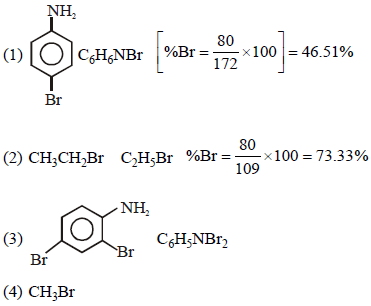
-
- (A) \(50\)
- (B) \(55\)
- (C) \(45\)
- (D) \(40\)
જવાબ અને ઉકેલ જુઓ
સાચો જવાબ: (A)
Carius method\(\%\) of \(Br =\frac{\text { wt of } AgBr }{\text { wt. of organic compound }} \times 100 \times \frac{\text { molar mass of Br }}{\text { AgBr }}\)
\(=\frac{1.88}{1.6} \times \frac{80}{188} \times 100=\frac{15040}{300.8}=50 \%\)
-
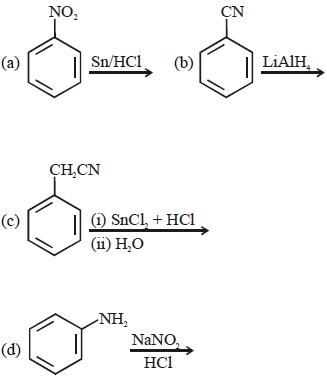
- (A) \(a\) અને \(d\)
- (B) \(c\) અને \(d\)
- (C) \(a, c\) અને \(d\)
- (D) \(b\) અને \(c\)
જવાબ અને ઉકેલ જુઓ
સાચો જવાબ: (B)
Kjeldahl method is used for \(N\) estimation But not given by 'Diazo' compounds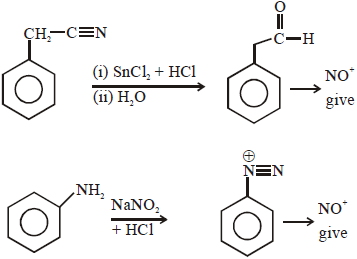
-
- (A) \(C_{12}H_8N\)
- (B) \(C_{12}H_8N_2\)
- (C) \(C_6H_8N_2\)
- (D) \(C_6H_8N\)
જવાબ અને ઉકેલ જુઓ
સાચો જવાબ: (C)
\(CO_2 = 6\,mole,\,N_1 = 1\,mole\) \(C_{atom}= 6,\,N_{atom} = 2\) Hence \(C_6H_8N_2\) -
- (A) \(10\)
- (B) \(3\)
- (C) \(24\)
- (D) \(5\)
જવાબ અને ઉકેલ જુઓ
સાચો જવાબ: (A)
Mili equivalents of \(H_2SO_4\)\( = 60 \times \frac{{M \times 2}}{{10}} = 12\)
Mili equivalents of \(NaOH = 20 \times \frac{M}{{10}} = 2\)
Mili equivalents of \(N{H_3} = 12 - 2 = 10\)
\(\% \,\) of nitrogen \( = \frac{{1.4 \times (N \times V)N{H_3}}}{{(Wt.\,of\,organic\,compound)}}\)
\(\frac{{1.4 \times 10}}{{1.4}} = 10\)
-
- (A) \(6\)
- (B) \(10\)
- (C) \(3\)
- (D) \(5\)
જવાબ અને ઉકેલ જુઓ
સાચો જવાબ: (B)
\(\%\) of \(N=\frac{1.4 \times \text { meq.of acid }}{\text { mass of organic compound }}\)meq. of \(H_{2} S O_{4}=60 \times \frac{M}{10} \times 2=12\)
meq. of \(N a O H=20 \times \frac{M}{10}=2\)
meq. of acid consumed \(=12-2=10\)
\(\therefore \% \quad N=\frac{1.4 \times 10}{1.4}=10 \%\)
- 45. નીચેનામાંથી કયા સંયોજન માટે જેલ્ડાહલ પદ્ધતિનો ઉપયોગ નાઇટ્રોજનની ટકાવારી નક્કી કરવા માટે કરી શકાય છે. 2013 મધ્યમ
- (A) નાઇટ્રોબેંઝિન
- (B) પિરિડિન
- (C) એલેનાઇન
- (D) ડાઇએઝોમિથેન
જવાબ અને ઉકેલ જુઓ
સાચો જવાબ: (C)
Kjeldahl's method is not applicable for cpmpounds containing nitrogen in nitro and azo group and nitrogen present in the ring. Because nitrogen of these compounds does not change to ammonium sulphate under these conditions.Hence only Alanine can be used to determine percentage of nitrogen.
\(\underset{Alanine}{\mathop{\begin{matrix}
{{H}_{2}}N-CH-COOH \\
|\,\,\,\,\,\,\,\,\, \\
\,\,\,\,\,\,\,\,\,CH{{(C{{H}_{3}})}_{2}} \\
\end{matrix}}}\,\)
આ પેજ પર આ ફિલ્ટર મુજબ કોઈ પ્રશ્ન નથી.
STD 11 - કાર્બનિક રસાયણશાસ્ત્ર શુદ્ધિકરણ અને લાક્ષણિકતા ના અન્ય ટોપિક
વારંવાર પૂછાતા પ્રશ્નો
JEE Mains માં Quantitative Analysis ના કેટલા પ્રશ્નો આવ્યા છે?
2013–2026 ના 45 પ્રશ્નો, દરેક સાચા જવાબ અને પૂરા ઉકેલ સાથે.
Quantitative Analysis ના પ્રશ્નો કેટલા અઘરા હોય છે?
13% સરળ, 49% મધ્યમ અને 38% અઘરા.