


પ્રશ્નો
નવા પહેલા10 માંથી 1–10 પ્રશ્નો
-
- (A) CoS
- (B) ZnS
- (C) NiS
- (D) MnS
જવાબ અને ઉકેલ જુઓ
સાચો જવાબ: (A)
આપેલી પ્રક્રિયા શ્રેણીમાં સંયોજન \((A))\) CoS હોવાની શક્યતા છે.
\(\begin{aligned} \mathrm{CoS}+\mathrm{HNO}_3+3 \mathrm{HCl} \rightarrow \mathrm{Co}^{2+} & +\mathrm{S} \downarrow+\mathrm{NOCl} \uparrow \\ & +2 \mathrm{Cl}^{-}+2 \mathrm{H}_2 \mathrm{O}\end{aligned}\)
ઉપરોક્ત દ્રાવણને \(\mathrm{NH}_4 \mathrm{OH}\) વડે તટસ્થ કરવામાં આવે છે.
\(\mathrm{Co}^{2+}\) ના તટસ્થ દ્રાવણમાં, એસિટિક એસિડ અને \(\mathrm{KNO}_2\) નું સંતૃપ્ત દ્રાવણ ઉમેરવામાં આવે છે, જેના પરિણામે \(\mathrm{K}_3\left[\mathrm{Co}\left(\mathrm{NO}_2\right)_6\right]\) નો પીળો અવક્ષેપ બને છે.
\(\mathrm{Co}^{2+}+7 \mathrm{NO}_2^{-}+2 \mathrm{H}^{+}+3 \mathrm{~K}^{+} \rightarrow \mathrm{K}_3\left[\mathrm{Co}\left(\mathrm{NO}_2\right)_6\right]+\mathrm{NO} \uparrow+\mathrm{H}_2 \mathrm{O}\) -
- (A) (A), (D) અને (E) જ
- (B) (D) અને (E) જ
- (C) (A) અને (B) જ
- (D) (A) અને (C) જ
જવાબ અને ઉકેલ જુઓ
સાચો જવાબ: (B)
\(\mathrm{As}_2 \mathrm{~S}_3\) અને \(\mathrm{As}_2 \mathrm{~S}_5\) પીળા રંગના સલ્ફાઇડ્સ છે, \(\left(\mathrm{NH}_4\right)_2 \mathrm{~S}\) રંગહીન છે, PbS કાળો છે, CuS કાળા રંગનો છે. -
- (A) વિધાન I અને વિધાન II બંને સાચા છે.
- (B) વિધાન I સાચું છે પરંતુ વિધાન II ખોટું છે.
- (C) વિધાન I ખોટું છે પરંતુ વિધાન II સાચું છે.
- (D) વિધાન I અને વિધાન II બંને ખોટા છે.
જવાબ અને ઉકેલ જુઓ
સાચો જવાબ: (A)
પોટેશિયમ હાઇડ્રોજન ફેથાલેટનો ઉપયોગ NaOH દ્રાવણના પ્રમાણભૂતકરણ માટે થાય છે.
અનુમાપનની પૂર્ણતા શોધવા માટે ફિનોલ્ફ્થેલીનનો સૂચક તરીકે ઉપયોગ થાય છે. -
- (A) નિર્બળ એસિડ વિરુદ્ધ નિર્બળ બેઈઝ અનુમાપન માટે મિથાઈલ ઓરેન્જનો ઉપયોગ કરી શકાય છે.
- (B) પ્રબળ એસિડ વિરુદ્ધ નિર્બળ અનુમાપનમાં મિથાઈલ ઓરેન્જ સુયોગ્ય સૂચક છે.
- (C) નિર્બળ એસિડ વિરુદ્ધ પ્રબળ બેઈઝ અનુમાપન માટે ફિનોલ્ફથેલીન સુયોગ્ય (સુસંગત) સૂચક છે
- (D) પ્રબળ એસિડ વિરુદ્ધ પ્રબલ બેઈઝ અનુમાપન માટે ફિનોલ્ફથેલીન નો ઉપયોગ કરી શકાય છે.
જવાબ અને ઉકેલ જુઓ
સાચો જવાબ: (A)
Indicator \(pH\) range Methyl orange \(3.2-4.5\) Phenolpthalein \(8.3-10.5\) Methyl orange may be used for a strong acid vs strong base and strong acid vs weak base titration. Phenolpthalein may be used for a strong acid vs strong base and weak acid vs strong base titration.
-
- (A) વિધાન \(I\) સાચું છે.પરંતુ વિધાન \(II\) ખોટું છે.
- (B) વિધાન \(I\) ખોટું છે. પરંતુ વિધાન \(II\) સાચું છે.
- (C) બંને વિધાન \(I\) અને વિધાન \(II\) ખોટા છે.
- (D) બંને વિધાન \(I\) અને વિધાન \(II\) સાચાં છે.
જવાબ અને ઉકેલ જુઓ
સાચો જવાબ: (C)
Methyl orange is weak base .Benzenoid structure (Yellow Coloured) \(\rightleftharpoons\) Quinonoid structure (Red Coloured)
Statement \(I\) - FALSE
Statement \(II\) - FALSE
-
- (A) \(1\)
- (B) \(2\)
- (C) \(3\)
- (D) \(4\)
જવાબ અને ઉકેલ જુઓ
સાચો જવાબ: (B)
\((B)\) \(pk _{ In }=-\log \left(4 \times 10^{-10}\right)=9.4\)Indicator range
\(\Rightarrow pk _{\text {In }} \pm 1\)
i.e. \(8.4\) to \(10.4\)
\((D)\) In acidic medium, phenolphthalein is in unionized form and is colourless.
-
- (A) બંને \(A\) અને \(R\) સાચાં છે અને \(R\) એ \(A\)ની સચોટ સમજુતી છે.
- (B) બંને \(A\) અને \(R\) સાચા છે અને \(R\) એ \(A\)ની સાચી સમજૂતી નથી.
- (C) \(A\) ખોટું છે, પરંતુ \(R\) સાચુ છે.
- (D) \(A\) સાચુ છે, પરંતુ \(R\) ખોટું છે.
જવાબ અને ઉકેલ જુઓ
સાચો જવાબ: (D)
Phenolphthalein dissociate in basic medium\(HPh ( aq ) \rightleftharpoons H ^{+}+ Ph ^{-}\)
-
- (A) મિથાઈલ ઓરેન્જ
- (B) મિથાઈલ રેડ
- (C) ફિનોલ્ફથેલીન
- (D) ઈરીયોક્રોમ બલેક \(T\)
જવાબ અને ઉકેલ જુઓ
સાચો જવાબ: (C)
Phenolphthalein is weak acid give colour in basic medium. -
- (A) વિધાન \( (I) \) ખોટું છે પણ વિધાન \( (II) \) સાચું છે.
- (B) વિધાન \( (I) \) સાચું છે પણ વિધાન \( (II) \) ખોટું છે.
- (C) વિધાન \( (I) \) અને વિધાન \( (II) \) બંને સાચા છે.
- (D) વિધાન \( (I) \) અને વિધાન \( (II) \) બંને ખોટા છે.
જવાબ અને ઉકેલ જુઓ
સાચો જવાબ: (B)
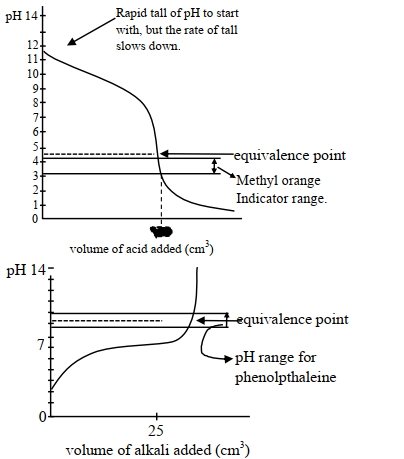
Titration curve for strong acid and weak base initially a buffer of weak base and conjugate acid is:Formed, thus \({pH}\) falls slowly and after equivalence point, so the \({pH}\) falls sharply so methyl arrange, having \({pH}\) range of \(3.2\) to \(4.4\) will weak as indicator. So statement\(-I\) is correct.
Titration curve for weak acid and strong base \(({NaOH})\) Initially weak acid will form a buffer so \({pH}\) increases slowly but after equivalence point. it rises sharply covering range of phenolphthalein so it will be suitable indicator so statement\(-II\) is false.
-
- (A) \((a)\)
- (B) \((c)\)
- (C) \((d)\)
- (D) \((b)\)
જવાબ અને ઉકેલ જુઓ
સાચો જવાબ: (A)
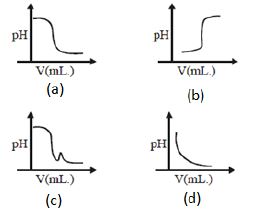
The nature of the curve is such that the \(pH\) change of the reaction becomes larger for very small change in volume of titrant.
આ પેજ પર આ ફિલ્ટર મુજબ કોઈ પ્રશ્ન નથી.
STD 11 - સંતુલન - ૨ ના અન્ય ટોપિક
- 37પ્રશ્નો Solubility product
- 20પ્રશ્નો બફર દ્રાવણો
- 10પ્રશ્નો ઍસિડ અને બેઈઝના આયનીકરણમાં સમાન આયન અસર
- 19પ્રશ્નો PH of strong Acids and strong Bases
- 8પ્રશ્નો PH of weak Acids and weak Bases
- 6પ્રશ્નો Water hydrolysis and pH scale
- 10પ્રશ્નો ક્ષારનું જળવિભાજન
- 4પ્રશ્નો ઍસિડ, બેઇઝ
- 2પ્રશ્નો Electrical conductors and Ostwald's dilution law
વારંવાર પૂછાતા પ્રશ્નો
JEE Mains માં Acid and base indicators ના કેટલા પ્રશ્નો આવ્યા છે?
2019–2025 ના 10 પ્રશ્નો, દરેક સાચા જવાબ અને પૂરા ઉકેલ સાથે.
Acid and base indicators ના પ્રશ્નો કેટલા અઘરા હોય છે?
0% સરળ, 50% મધ્યમ અને 50% અઘરા.