


2020 માં પૂછાયેલાં પ્રકરણ
25 પ્રકરણ- 5પ્રશ્નો STD 11 7.રેડોક્ષ પ્રક્રિયાઓ
- 7પ્રશ્નો STD 11 સંતુલન - ૨
- 7પ્રશ્નો STD 12 જૈવિક અણુઓ
- 2પ્રશ્નો STD 12 એમાઇન સંયોજનો
- 3પ્રશ્નો STD 12 કાર્બોકિસલિક ઍસિડ
- 2પ્રશ્નો STD 12 આલ્કોહૉલ, ફિનોલ અને ઇથર સંયોજનો
- 4પ્રશ્નો STD 12 હેલોઆલ્કેન અને હેલોએરિન સંયોજનો
- 3પ્રશ્નો STD 11 કાર્બનિક રસાયણશાસ્ત્ર પ્રતિક્રિયા પદ્ધતિ
- 26પ્રશ્નો STD 12 સવર્ગ સંયોજનો સૌથી વધુ પૂછાયેલ
- 8પ્રશ્નો STD 12 D અને f-વિભાગનાં તત્ત્વો
- 9પ્રશ્નો STD 12 P-વિભાગનાં તત્ત્વો - 2
- 13પ્રશ્નો STD 12 રાસાયણિક ગતિકી
- 14પ્રશ્નો STD 12 વિદ્યુત-રસાયણવિજ્ઞાન સૌથી વધુ પૂછાયેલ
- 16પ્રશ્નો STD 12 Solution and colligative properties સૌથી વધુ પૂછાયેલ
- 11પ્રશ્નો STD 11 રસાયણવિજ્ઞાનની કેટલીક પાયાની સંકલ્પનાઓ
- 1પ્રશ્નો STD 11 હાઇડ્રોકાર્બન
- 2પ્રશ્નો STD 11 કાર્બનિક રસાયણવિજ્ઞાન કાર્બનિક સંયોજનોનું નામકરણ
- 6પ્રશ્નો STD 11 કાર્બનિક રસાયણશાસ્ત્ર શુદ્ધિકરણ અને લાક્ષણિકતા
- 5પ્રશ્નો STD 12 આલ્ડિહાઇડ અને કિટોન
- 8પ્રશ્નો STD 11 રાસાયણિક બંધન અને આણ્વીય રચના
- 13પ્રશ્નો STD 11 તત્ત્વોનું વર્ગીકરણ અને ગુણધર્મોમાં આવર્તિતા
- 5પ્રશ્નો STD 11 સંતુલન - ૧
- 13પ્રશ્નો STD 11 ઉષ્માગતિશાસ્ત્ર
- 1પ્રશ્નો STD 11 P-વિભાગના તત્ત્વો - ૧
- 9પ્રશ્નો STD 11 2.પરમાણુનું બંધારણ
JEE Mains 2020 Chemistry ના બધા પ્રશ્નો
25 પ્રકરણ193 માંથી 1–50 પ્રશ્નો
-
- (A) \(55\)
- (B) \(52\)
- (C) \(60\)
- (D) \(50\)
જવાબ અને ઉકેલ જુઓ
સાચો જવાબ: (D)
\(K _{2} Cr _{2} O _{7}+ FeC _{2} O _{4} \longrightarrow Cr ^{+3}+ Fe ^{+3}+ CO _{2}\)\(n=6 \quad \quad n=3\)
\(\frac{0.02 \times 6 \times V ( mL )}{1000}=\frac{0.288}{144} \times 3\)
\(\Rightarrow \quad V =50 mL\)
-
- (A) \(12\)
- (B) \(25\)
- (C) \(19\)
- (D) \(22\)
જવાબ અને ઉકેલ જુઓ
સાચો જવાબ: (C)
\(K _{2} Cr _{2} O _{7}\)\(2(+1)+2 x+7(-2)=0\)
\(x=+6\)
In \(K _{2} Cr _{2} O _{7},\) Transition metal \(( Cr )\) present in +6
oxidation state.
\(KMnO _{4}\)
\((+1)+y+4(-2)=0\)
\(x=+7\)
In \(KMnO _{4}\), transition metal (Mn) present in \(+7\) oxidation state
\(K _{2} FeO _{4}\)
\(2(+1)+z+4(-2)=0\)
\(x=+6\)
In \(K _{2} FeO _{4},\) transition metal (Fe) present in \(+6\) oxidation state
So \(x=+6\)
\(y=+7\)
\(z=+6\)
____________
\(x+y+z=19\)
- 3. ક્રોમેટ અને ડાયક્રોમેટ આયનમાં ક્રોમિયમ અને ઓક્સિજન પરમાણુઓ વચ્ચેના કુલ બંધની સંખ્યા જણાવો. 2020 અઘરું
- (A) \(12\)
- (B) \(13\)
- (C) \(14\)
- (D) \(15\)
જવાબ અને ઉકેલ જુઓ
સાચો જવાબ: (A)
Total number of bonds between chromium and oxygen in both structures are \(18\)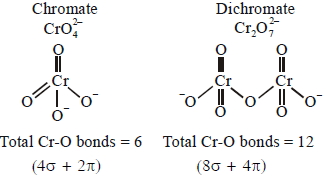
-
- (A) \(0\)
- (B) \(5\)
- (C) \(2\)
- (D) \(19\)
જવાબ અને ઉકેલ જુઓ
સાચો જવાબ: (D)
\(\left[ Fe ^{2+} \rightarrow Fe ^{3+}+ e ^{-}\right] \times 2\)\(\frac{ H _{2} O _{2}+2 e ^{-} \rightarrow 2 HO ^{\ominus}}{2 Fe ^{2+}+ H _{2} O _{2} \rightarrow 2 Fe ^{3+}+2 HO _{(q\omega)}^{\ominus}}\)
\(x =2 \quad y =2\)
\(\left[8 H ^{+}+ MnO _{4}^{-}+5 e ^{-} \rightarrow Mn ^{2+}+4 H _{2} O \right] \times 2\)
\(\left[ H _{2} O _{2} \rightarrow O _{2( g )}+2 H ^{+}+2 e ^{-}\right] \times 5\)
\(\Rightarrow 16 H ^{+}+2 MnO _{4}^{-}+5 H _{2} O _{2}\)
\(\rightarrow 2 Mn ^{2+}+8 H _{2} O +5 O _{2(g)}+10 H ^{+}\)
\(\Rightarrow 6 H ^{+}+2 MnO _{4}^{-}+5 H _{2} O _{2}\)
\(\rightarrow 2 Mn ^{2+}+8 H _{2} O +5 O _{2( g )}\)
So \(\quad x^{\prime}=2 \quad y^{\prime}=8 \quad z^{\prime}=5\)
so \(\quad x+y+x^{\prime}+y^{\prime}+z^{\prime}\)
\(\Rightarrow 2+2+2+8+5\)
\(\Rightarrow 19\)
-
- (A) \(14\)
- (B) \(16\)
- (C) \(18\)
- (D) \(20\)
જવાબ અને ઉકેલ જુઓ
સાચો જવાબ: (C)
\(4 \mathrm{NaCl}+\mathrm{K}_{2} \mathrm{Cr}_{2} \mathrm{O}_{7}+6 \mathrm{H}_{2} \mathrm{SO}_{4}\)\(\quad \quad \quad \quad \quad \downarrow\)
\(2 \mathrm{CrO}_{2} \mathrm{Cl}_{2}+4 \mathrm{NaHSO}_{4}+2 \mathrm{KHSO}_{4}+3 \mathrm{H}_{2} \mathrm{O}\)
\((\mathrm{A})\)
\(\mathrm{CrO}_{2} \mathrm{Cl}_{2}+4 \mathrm{NaOH} \longrightarrow \mathrm{Na}_{2} \mathrm{CrO}_{4}+2 \mathrm{NaCl}+2 \mathrm{H}_{2} \mathrm{O}\)
\(\quad \quad \quad \quad \quad \quad \quad \quad \quad \quad \quad (B)\)
\(\mathrm{Na}_{2} \mathrm{CrO}_{4}+2 \mathrm{H}_{2} \mathrm{SO}_{4}+2 \mathrm{H}_{2} \mathrm{O}_{2}\)
\(\mathrm{CrO}_{5}+2 \mathrm{NaHSO}_{4}+3 \mathrm{H}_{2} \mathrm{O}\)
\((\mathrm{C})\)
\(A=C r O_{2} C l_{2}\)
\({B}=\mathrm{Na}_{2} \mathrm{CrO}_{4}\)
\({C}={C r O}_{5}\)
Total number of atom in \(\mathrm{A}+\mathrm{B}+\mathrm{C}=18\)
-
- (A) \(\left(18 \times 10^{-31}\right)^{1 / 4}\)
- (B) \(\left(2.22 \times 10^{-31}\right)^{1 / 4}\)
- (C) \(\left(4.86 \times 10^{-29}\right)^{1 / 4}\)
- (D) \(\left(18 \times 10^{-31}\right)^{1 / 2}\)
જવાબ અને ઉકેલ જુઓ
સાચો જવાબ: (A)
\(\mathrm{Cr}(\mathrm{OH})_{3}(\mathrm{s}) \rightleftharpoons \mathrm{Cr}^{3+}(\mathrm{aq} .)+3 \mathrm{OH}^{-}(\mathrm{aq} .)\)\(\mathrm{k}_{\mathrm{sp}}=27(\mathrm{s})^{4}=6 \times 10^{-31}\)
\(\Rightarrow[3(\mathrm{s})]^{4}=18 \times 10^{-31}\)
\(\left[\mathrm{OH}^{-}\right]=3(\mathrm{s})=\left[18 \times 10^{-31}\right]^{1 / 4}\)
-
- (A) \(7.3\)
- (B) \(8.7\)
- (C) \(9.6\)
- (D) \(10.6\)
જવાબ અને ઉકેલ જુઓ
સાચો જવાબ: (D)
\(4 \mathrm{gm}\) of \(\mathrm{NaOH}\) in \(100 \mathrm{L}\) sol. \(\Rightarrow 10^{-3} \mathrm{M}\) sol.\(9.8 \mathrm{gm}\) of \(\mathrm{H}_{2} \mathrm{SO}_{4}\) in \(100 \mathrm{L}\) sol. \(\Rightarrow 10^{-3} \mathrm{M}\) sol.
Mixture : \(40 L\) of \(10^{-3} \mathrm{M} \mathrm{NaOH}\) and \(10 \mathrm{L}\) of
\(10^{-3} \mathrm{M} \mathrm{H}_{2} \mathrm{SO}_{4}\) sol.
Final Conc. of \(OH^-=\frac{10^{-3}(40 \times 1-10 \times 1 \times 2)}{40+10}=6 \times 10^{-4} \mathrm{M}\)
\(\mathrm{pOH}=-\log \left(6 \times 10^{-4}\right)\)
\(=4-\log 6=4-0.60=3.40\)
\(\mathrm{pH}=14-3.40=10.60\)
-
- (A) \(8\)
- (B) \(4\)
- (C) \(2\)
- (D) \(10\)
જવાબ અને ઉકેલ જુઓ
સાચો જવાબ: (C)
\(\begin{array}{*{20}{c}} {A{B_2}\left( S \right) \rightleftharpoons A_{\left( {aq.} \right)}^{ + 2} + 2B_{\left( {aq.} \right)}^ - \,:\,{K_{sp}}} \\ {\,\,\,\,\,\,\,\,\,\,S\,\,\,\,\,\,\,\,\,\,\,\,2s} \end{array}\)\(K _{ SP }= S ^{1} \times(2 s )^{2}=4 s ^{3}\)
\(3.2 \times 10^{-11}=4 \times S ^{3}\)
\(S =2 \times 10^{-4} M / L\)
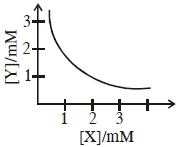
- 9. નીચે આપેલા દ્રાવ્યતા વક્ર સાથેના ક્ષારની તત્ત્વયોગમિતી અને દ્રાવ્યતા ગુણાકાર અનુક્રમે જણાવો.
 2020 અઘરું
- (A) \(\mathrm{X}_{2} \mathrm{Y}, 2 \times 10^{-9} \;\mathrm{M}^{3}\)
- (B) \(\mathrm{XY}_{2}, 1 \times 10^{-9} \;\mathrm{M}^{3}\)
- (C) \(\mathrm{XY}_{2}, 4 \times 10^{-9}\; \mathrm{M}^{3}\)
- (D) \(\mathrm{XY}, 2 \times 10^{-6} \;\mathrm{M}^{3}\)
જવાબ અને ઉકેલ જુઓ
સાચો જવાબ: (C)
From the graph and dimensions salt is : \(\mathrm{XY}_{2}\)\([\mathrm{X}]=1 \times 10^{-3} \mathrm{M}\)
\([\mathrm{Y}]=2 \times 10^{-3} \mathrm{M}\)
\(\mathrm{XY}_{2}(\mathrm{s}) \rightleftharpoons \mathrm{X}_{(\mathrm{aq}, )}^{2+}+2 \mathrm{Y}_{(\mathrm{aq})}^{-}\)
\(\mathrm{K_{sp}}=\left[\mathrm{X}^{2+}\right][\mathrm{Y}^-]^{2}\)
\(=\left(10^{-3}\right)\left(2 \times 10^{-3}\right)^{2}\)
\(=4 \times 10^{-9} \mathrm{M}^{3}\)
-
- (A) \((B)>(C)>(D)>(A)\)
- (B) \(( A )>( C )>( D )>( B )\)
- (C) \((B)>(D)>(C)>(A)\)
- (D) \(( A )>( D )>( C )>( B )\)
જવાબ અને ઉકેલ જુઓ
સાચો જવાબ: (D)
\((i)\) \(10^{-2} M HCl \Rightarrow\left[ H ^{+}\right]=10^{-2} M \rightarrow pH =2\)\((ii)\) \(10^{-2} M NaOH \Rightarrow\left[ OH ^{-}\right]=10^{-2} M \rightarrow PoH =2\)
\((iii)\) \(10^{-2} M CH _{3} COO ^{- Na ^{+}} \Rightarrow\left[ OH ^{+}\right]>10^{-7} \Rightarrow poH <7\)
\((iv)\) \(10^{-2} M NaCl \Rightarrow\) Neutral pot \(=7\)
\((i)>(i v)>(i i i)>(i i)\)
-
- (A) વિધાન અને કારણ બને સાચા છે પરંતુ કારણ એ વિધાનની સાચી સમજૂતી નથી
- (B) વિધાન અને કારણ બને ખોટા છે
- (C) વિધાન સાચુ નથી પરંતુ કારણ સાચુ છે
- (D) વિધાન અને કારણે બંને સાચા છે પરંતુ કારણ એ વિધાનની સાચી સમજૂતી છે
જવાબ અને ઉકેલ જુઓ
સાચો જવાબ: (B)
\(\mathrm{H}_{2} \mathrm{O}(\ell) \rightleftharpoons \mathrm{H}_{(\mathrm{aq})}^{+}+\mathrm{OH}_{(\mathrm{aq})}^{-}\)For ionization of \(\mathrm{H}_{2} \mathrm{O}: \Delta \mathrm{H}>\mathrm{O}\) \(\Rightarrow\) Endothermic
On temperature increase reaction shifts forward
\(\Rightarrow\) both \(\left[\mathrm{H}^{+}\right]\) and \(\left[\mathrm{OH}^{-}\right]\) increase
\(\Rightarrow \mathrm{pH} \;and\; \mathrm{pOH}\) decreases.
-
- (A) બંને \(( A )\) અને \(( R )\) સાચા છે અને \(( R )\) એ \((A)\) ની સાબિતી આપે છે
- (B) \((A)\) અને \((R)\) બંને ખોટા છે
- (C) \((A)\) એ ખોટુ છે \(( R )\) એ સાચું છે
- (D) બંને \(( A )\) અને \(( R )\) સાચા છે અને \(( R )\) એ \((A)\) ની સાબિતી આપતું નથી
જવાબ અને ઉકેલ જુઓ
સાચો જવાબ: (D)
Slow or fast process is kinetic parameter but extent less or more is hermodynamic parameter. -
- (A) \(A =\) ગ્લુકોઝ, \(B =\) ફ્રૂક્ટોઝ, \(C =\) આલ્બુમીન
- (B) \(A =\) લેકટોઝ, \(B =\) ફ્રૂક્ટોઝ, \(C =\) એલેનાઇન
- (C) \(A =\) લેકટોઝ, \(B =\) ગ્લુકોઝ, \(C =\) એલેનાઇન
- (D) \(A =\) લેકટોઝ, \(B =\) ગ્લુકોઝ, \(C =\) આલ્બુમીન
જવાબ અને ઉકેલ જુઓ
સાચો જવાબ: (D)
Alanine does not show Biuret test because Biuret test is used for deduction of peptide linkage & alanine is amino acid.Albumine is protein so have paptide linkage so it gives positive Biuret test.
Positive Barfoed test is shown by monosaccharide but not disaccharide. Positive Molisch's test is shown by glucose.
-
- (A) \(A \): એસ્પાર્ટેમ ; \(B \): સિરીન; \(C \): સુક્રાલોઝ;\( D \); એલિટેમ
- (B) \(A\) : એલિટેમ; \(B \): સિરીન; \(C\) : એસ્પાર્ટેમ ; \(D\) ; સુક્રાલોઝ
- (C) \(A\) : સિરીન; \(B\) : એલિટેમ; \(C\) : સુક્રાલોઝ; \(D\) ; એસ્પાર્ટેમ
- (D) \(A\) : એસ્પાર્ટેમ ; \(B\) : એલિટેમ; \(C\) : સિરીન;\( D\) ; સુક્રાલોઝ
જવાબ અને ઉકેલ જુઓ
સાચો જવાબ: (A)
(i) Blue voilet color with Ninhydrine \(\rightarrow\) amino acid derivative. So it cannot be saccharide or sucralose.(ii) Lassaigne extract give + ve test with \(\mathrm{AgNO}_{3} .\) So \(\mathrm{Cl}\) is present, -ve test with \(\mathrm{Fe}_{4}\left[\mathrm{Fe}(\mathrm{CN})_{6}\right]_{3}\) means \(\mathrm{N}\) is absent. So it can't be Aspartame or Saccharine or Alitame, so \(\mathrm{C}\) is sucralose.
(iii) Lassaigne solution of \(B\) and \(D\) given \(+ve\) sodium nitroprusside test, so it is having \(S\), so it is Saccharine and Alitame.

-
- (A) \(\alpha-D-\) ગ્લુકોઝ અને \(\beta-\mathrm{D}-\) ગ્લુકોઝ
- (B) \(\alpha-D-\) ગ્લુકોઝ અને \(\alpha -D-\)ફ્રૂક્ટોઝ
- (C) \(\alpha-D-\) ગ્લુકોઝ અને \(\alpha -D-\)ગ્લુકોઝ
- (D) \(\alpha-D-\) ગ્લુકોઝ અને \(\alpha -D-\)ગેલેક્ટોઝ
જવાબ અને ઉકેલ જુઓ
સાચો જવાબ: (C)
Two monomers in maltose are \(\alpha\) -D-glucose and \(\alpha\) -D-glucose -
- (A) ઓક્સાઇમ આપવા માટે ગ્લુકોઝનું પેન્ટાએસિટેટ હાઇડ્રોક્સિલએમાઇન સાથે પ્રક્રિયા આપતું નથી.
- (B) ગ્લુકોઝ આલ્ડિહાઇડ માટે શિફની કસોટી આપે છે.
- (C) ગ્લુકોઝ \(\alpha\) અને \(\beta\) એમ બે સ્ફટિકીય સ્વરૂપોમાં અસ્તિત્વમાં છે
- (D) ગ્લુકોઝ ઓક્સાઇમ બનાવવા માટે હાઇડ્રોક્સિલએમાઇન સાથે પ્રક્રિયા આપે છે
જવાબ અને ઉકેલ જુઓ
સાચો જવાબ: (B)
Glucose gives negative test with Schiff reagent -
- (A) વેલિન
- (B) લ્યુસીન
- (C) લાયસીન
- (D) ટ્રાયોસીન
જવાબ અને ઉકેલ જુઓ
સાચો જવાબ: (D)
Tyrosine is not an essential amino acid. -
- (A) વાદળી રંગની રચના
- (B) જાંબલી રંગની રચના
- (C) લાલ રંગની રચના
- (D) રંગ આપતું નથી
જવાબ અને ઉકેલ જુઓ
સાચો જવાબ: (C)
Seliwanoff's test is used to distinguish between aldose and ketone sugars; when added to a solution containing ketose, red colour is formed rapidlySucrose.\(\xrightarrow{{{\text{Hydrolysis}}}}\)\(\begin{array}{*{20}{c}} {{\text{Glucose}}} \\ + \\ {{\text{Fructose}}} \end{array}\)\(\xrightarrow[{{\text{reagent}}}]{{{\text{Seliwanoff's}}}}\,\)Red colour
-
- (A) \(5,6, \& 5\)
- (B) \(4,5 \& 5\)
- (C) \(5,4 \& 5\)
- (D) \(4,6 \& 5\)
જવાબ અને ઉકેલ જુઓ
સાચો જવાબ: (D)
\((i)\) Glucose \(+\) dry \(HCl\) \(\xrightarrow{{ROH}}\) Acetal \(\xrightarrow[{{{\left( {C{H_3}CO} \right)}_2}O}]{{x\,\,Eq}}\) acetyl derivative\((ii)\) Glucose \(\xrightarrow{{Ni/{H_2}}}A\xrightarrow[{{{\left( {C{H_3}CO} \right)}_2}O}]{{y\,Eq}}\) Acetyl derivative
\((iii)\) Glucose \(\xrightarrow[{{{\left( {C{H_3}CO} \right)}_2}O}]{{z\,Eq}}\) Acetyl derivative due to presence of \(- OH\) group in Glucose the reaction is
\((ii)\)\(\begin{array}{*{20}{c}} {CH = O\,\,\,\,\,\,\,\,\,\,\,\,\,} \\ {|\,\,\,\,\,\,\,\,\,\,\,\,\,\,\,\,\,\,\,\,\,\,\,\,\,\,\,\,\,\,\,\,\,} \\ {{{\left( {CH - OH} \right)}_4}} \\ {|\,\,\,\,\,\,\,\,\,\,\,\,\,\,\,\,\,\,\,\,\,\,\,\,\,\,\,\,\,\,} \\ {C{H_2} - OH\,\,\,\,\,\,} \end{array}\)\(\xrightarrow[{{H_2}}]{{Ni}}\begin{array}{*{20}{c}} {C{H_2} - OH\,\,\,\,\,\,\,\,\,\,} \\ {|\,\,\,\,\,\,\,\,\,\,\,\,\,\,\,\,\,\,\,\,\,\,\,\,\,\,\,\,\,\,\,\,\,\,\,\,\,\,} \\ {{{\left( {CH - OH} \right)}_4}\,\xrightarrow[{A{c_2}O}]{{6\,Eq.}}} \\ {|\,\,\,\,\,\,\,\,\,\,\,\,\,\,\,\,\,\,\,\,\,\,\,\,\,\,\,\,\,\,\,\,\,\,\,\,\,\,\,\,} \\ {C{H_2} - OH\,\,\,\,\,\,\,\,\,\,\,\,\,} \end{array}\)
\(\begin{array}{*{20}{c}} {C{H_2} - OAc\,\,\,\,\,\,\,} \\ {|\,\,\,\,\,\,\,\,\,\,\,\,\,\,\,\,\,\,\,\,\,\,\,\,\,\,\,\,\,\,\,\,\,\,} \\ {\left( {C{H_2} - OAc} \right)} \\ {|\,\,\,\,\,\,\,\,\,\,\,\,\,\,\,\,\,\,\,\,\,\,\,\,\,\,\,\,\,\,\,\,\,} \\ {C{H_2} - OAc\,\,\,\,\,\,} \end{array}\)

- 20. \(C _{2} H _{5} CN\) ને \(CH _{3} CH _{2} CH _{2} NH _{2}\)માં રૂપાંતર કરવા માટે સૌથી યોગ્ય પ્રક્રિયક છે. 2020 મધ્યમ
- (A) \(Na ( CN ) BH _{3}\)
- (B) \(LiAlH _{4}\)
- (C) \(NaBH _{4}\)
- (D) \(CaH _{2}\)
જવાબ અને ઉકેલ જુઓ
સાચો જવાબ: (B)
\(CH _{3}- CH _{2}- C \equiv N\)\(\xrightarrow{?}\)\(CH _{3}- CH _{2}- CH _{2}- NH _{2}\)\(CH _{3}- CH _{2}- C \equiv N\)\(\xrightarrow{{LiAl{H_4}}}\)\(CH _{3}- CH _{2}- CH _{2}- NH _{2}\)
-
- (A) \(NH _{4} Cl\) અને \(N _{2}\)
- (B) \(NCl _{3}\) અને \(NH _{4} Cl\)
- (C) \(NH _{4} Cl\) અને \(HCl\)
- (D) \(NCl _{3}\) અને \(HCl\)
જવાબ અને ઉકેલ જુઓ
સાચો જવાબ: (D)
\(\begin{array}{*{20}{c}} {N{H_3} + 3C{l_2} \to NC{l_3} + 3HCl} \\ {excess\,\,\,\,\,\,\,\,\,\,\,\,\,\,\,\,\,\,\,\,\,} \end{array}\) -
- (A) \(b > c > d > a\)
- (B) \(c > b > a > d\)
- (C) \(b > a > c > d\)
- (D) \(c > b > d > a\)
જવાબ અને ઉકેલ જુઓ
સાચો જવાબ: (A)
\(\begin{array}{*{20}{c}} {O\;\;} \\ {||\;\;} \\ {R - C - OH} \end{array} > R - OH > R - C \equiv CH\)Reason: \(\begin{array}{*{20}{c}} O \\ {||} \\ {R - C - {O^\theta }} \end{array}\) stable by equivalent resonance.
Stable:
So answer is \(b > c > d > a\)
-
- (A) \(LiAlH_4\)
- (B) \(NaBH_4\)
- (C) \(H_2/Pd\)
- (D) \(B_2H_6\)
જવાબ અને ઉકેલ જુઓ
સાચો જવાબ: (D)
Most suitable reagent for given conversion is \(\mathrm{B}_{2} \mathrm{H}_{6}\) (electrophilic reducing agent)
-
- (A) \((C)<(A)<(B)<(D)\)
- (B) \((B)<(C)<(A)<(D)\)
- (C) \(( A )<( C )<( D )<( B )\)
- (D) \((D)<(C)<(A)<(B)\)
જવાબ અને ઉકેલ જુઓ
સાચો જવાબ: (D)
\(D\)
- 25. નીચેના સંયોજનોમાં \(C-OH\) બંધ લંબાઈ નો વધતો ક્રમ ગોઠવો મિથેનોલ, ફિનોલ, \(p-\) ઇથોક્સિફિનોલ 2020 મધ્યમ
- (A) ફિનોલ < મિથેનોલ< \(p-\)ઇથોક્સિફિનોલ
- (B) ફિનોલ < \(p-\)ઇથોક્સિફિનોલ< મિથેનોલ
- (C) મિથેનોલ< \(p-\)ઇથોક્સિફિનોલ< ફિનોલ
- (D) મિથેનોલ< ફિનોલ < \(p-\)ઇથોક્સિફિનોલ
જવાબ અને ઉકેલ જુઓ
સાચો જવાબ: (B)
\(CH_3 -OH\) (\(100\%\) single bond)
-
- (A) \(70.56\)
- (B) \(68.85\)
- (C) \(65.52\)
- (D) \(60.75\)
જવાબ અને ઉકેલ જુઓ
સાચો જવાબ: (B)
Molecular weight of \(C _{7} H _{6} O _{2}=122\)\(\% C =\frac{12 \times 7 \times 100}{122}=68.85 \approx 69\)

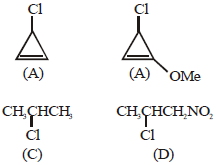
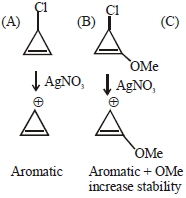
- 27. \(AgNO\) \(_{3}\) દ્રાવણ તરફ નીચેના કાર્બનિક પરમાણુઓની પ્રતિક્રિયાશીલતાનો ક્રમ ઘટતો ક્રમ કયો છે?
 2020 મધ્યમ
- (A) \(( A )>( B )>( D )>( C )\)
- (B) \(( A )>( B )>( C )>( D )\)
- (C) \((C)>(D)>(A)>(B)\)
- (D) \((B)>(A)>(C)>(D)\)
જવાબ અને ઉકેલ જુઓ
સાચો જવાબ: (D)
\((C)\) \(\begin{gathered} \begin{array}{*{20}{c}} {C{H_3} - CH - C{H_3}} \\ {|\,\,\,\,\,\,\,\,\,\,\,\,} \\ {Cl\,\,\,\,\,\,\,\,\,\,} \\ {\,\,\,\,\,\,\,\,\,\, \downarrow AgN{O_3}} \end{array} \hfill \\ \begin{array}{*{20}{c}} { \oplus \,\,\,\,} \\ {C{H_3} - CH - C{H_3}} \\ {({2^o}\,Cation)} \end{array} \hfill \\ \end{gathered} \)\((D)\) \(\begin{gathered} \begin{array}{*{20}{c}} {C{H_3} - CH - C{H_3}} \\ {|\,\,\,\,\,\,\,\,\,\,\,\,} \\ {Cl\,\,\,\,\,\,\,\,\,\,} \\ {\,\,\,\,\,\,\,\,\, \downarrow AgN{O_3}} \end{array} \hfill \\ \begin{array}{*{20}{c}} { \oplus \,\,\,\,\,\,\,\,\,\,\,\,\,\,\,\,\,\,\,\,} \\ {C{H_3} - CH - C{H_2} - N{O_2}} \\ {{2^o}\,Cation\,and\,\left( { - I\,of\,N{O_2}} \right)} \end{array} \hfill \\ \end{gathered}\)
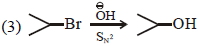
- 28. નીચેના કયા સંયોજનોમાં કેન્દ્રાનુરાગી વિસ્થાપન પર \(OH ^{-}\) આયન દ્વારા બંધારણમાં રીટેન્શન બતાવશે? 2020 મધ્યમ
- (A) \(\begin{array}{*{20}{c}} {C{H_3} - CH - C{H_2}Br} \\ {|\,\,\,\,\,\,\,\,\,\,\,\,} \\ {{C_2}{H_5}\,\,\,\,} \end{array}\)
- (B) \(\begin{array}{*{20}{c}} {C{H_3} - CH - Br} \\ {|\,\,\,} \\ {\,\,\,\,\,\,\,{C_6}{H_5}} \end{array}\)
- (C) \(\begin{array}{*{20}{c}} {C{H_3} - CH - Br} \\ {|\,\,\,} \\ {\,\,\,\,C{H_3}} \end{array}\)
- (D) \(\begin{array}{*{20}{c}} {\,\,\,\,\,\,Br} \\ {\,\,\,|\,} \\ {C{H_3} - C - H} \\ {\,\,\,|} \\ {\,\,\,\,\,\,\,\,\,\,\,\,\,\,\,{C_6}{H_{13}}} \end{array}\)
જવાબ અને ઉકેલ જુઓ
સાચો જવાબ: (A)
\((1)\)\(\begin{array}{*{20}{c}} { * \,\,\,\,\,\,\,\,\,\,\,\,\,\,\,\,\,\,\,\,\,\,\,\,\,\,\,\,\,\,\,} \\ {C{H_3} - CH - C{H_2} - Br\,\xrightarrow[{{S_{{N^2}}}}]{{\mathop O\limits^ \ominus H}}} \\ {|\,\,\,\,\,\,\,\,\,\,\,\,\,\,\,\,\,\,\,\,\,\,\,\,\,\,\,\,\,\,\,\,} \\ {Et\,\,\,\,\,\,\,\,\,\,\,\,\,\,\,\,\,\,\,\,\,\,\,\,\,\,\,\,\,} \end{array}\)\(\begin{array}{*{20}{c}} { * \,\,\,\,\,\,\,\,\,\,\,\,} \\ {C{H_3} - CH - C{H_2}OH} \\ {|\,\,\,\,\,\,\,\,\,\,\,\,\,\,} \\ {Et\,\,\,\,\,\,\,\,\,\,\,} \end{array}\)\((2)\)\(\begin{array}{*{20}{c}} {C{H_3} - CH - Br\,\xrightarrow[{{S_{{N^2}}}}]{{\mathop O\limits^ \ominus H}}} \\ {|\,\,\,\,\,\,\,\,\,\,\,\,\,\,\,\,\,\,\,} \\ {ph\,\,\,\,\,\,\,\,\,\,\,\,\,\,\,} \end{array}\)\(\begin{array}{*{20}{c}} {ph - CH - OH} \\ {|\,\,\,\,\,\,\,\,} \\ {C{H_3}} \end{array}\)
\((4)\)\(\begin{array}{*{20}{c}} {C{H_3} - CH - Br\,\xrightarrow[{{S_{{N^2}}}}]{{\mathop O\limits^ \ominus H}}} \\ {|\,\,\,\,\,\,\,\,\,\,\,\,\,\,\,\,\,\,\,} \\ {{C_6}{H_{13}\,\,\,\,\,\,}} \end{array}\)\(\begin{array}{*{20}{c}} {C{H_3} - CH - OH} \\ {|\,\,\,\,\,} \\ {\,\,\,\,{C_6}{H_3}} \end{array}\)
As language given, we have to go with option \((1)\) as stereochemistry of chiral centre is not distortet.
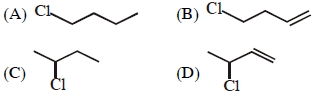
- 29. નીચેના સંયોજનોમાં ડિહાઈડ્રોહેલોજીનેશન \((E_1)\) પ્રક્રિયાનો પ્રતિક્રિયાશીલતાનો ઘટતો ક્રમ કયો છે?
 2020 અઘરું
- (A) \(B > D > A > C\)
- (B) \(B > D > C > A\)
- (C) \(D > B > C > A\)
- (D) \(B > A > D > C\)
જવાબ અને ઉકેલ જુઓ
સાચો જવાબ: (C)
Reactivity \(D > B > C > A\) Carbocation formed from \(D\) is most stable Carbocation formed from \(A\) is least stable - 30. નીચેની પ્રક્રિયામાં મુખ્ય નીપજ કઈ છે: \(CH _{3} CH = CHCH \left( CH _{3}\right)_{2} \stackrel{ HBr }{\longrightarrow}\) 2020 મધ્યમ
- (A) \(CH _{3} CH _{2} CH _{2} C ( Br )\left( CH _{3}\right)_{2}\)
- (B) \(Br \left( CH _{2}\right)_{3} CH \left( CH _{3}\right)_{2}\)
- (C) \(CH _{3} CH _{2} CH ( Br ) CH \left( CH _{3}\right)_{2}\)
- (D) \(CH _{3} CH ( Br ) CH _{2} CH \left( CH _{3}\right)_{2}\)
જવાબ અને ઉકેલ જુઓ
સાચો જવાબ: (A)
\(CH _{3} CH = CHCH \\left( CH _{3}\\right)_{2} + H^{+} \longrightarrow CH _{3} CH _{2} \stackrel{+}{C} H CH \\left( CH _{3}\\right)_{2}\)
\(CH _{3} CH _{2} \stackrel{+}{C} H CH \\left( CH _{3}\\right)_{2} \stackrel{1,2-H\, shift}{\longrightarrow} CH _{3} CH _{2} CH _{2} \stackrel{+}{C} \\left( CH _{3}\\right)_{2}\)
\(CH _{3} CH _{2} CH _{2} \stackrel{+}{C} \\left( CH _{3}\\right)_{2} + Br^{-} \longrightarrow CH _{3} CH _{2} CH _{2} C ( Br )\\left( CH _{3}\\right)_{2}\)
-
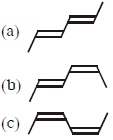
- (A) \((a) < (b) < (c)\)
- (B) \((b) < (c) < (a)\)
- (C) \((c) < (b) < (a)\)
- (D) \((a) < (c) < (b)\)
જવાબ અને ઉકેલ જુઓ
સાચો જવાબ: (A)
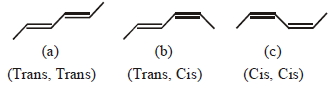
Generally trans is more stable then cis formHeat of combustion (HOC) \(\propto \frac{1}{\text { Stability }}\)
Stability : \(a>b>c\)
\(\mathrm{HOC}: \mathrm{c}>\mathrm{b}>\mathrm{a}\)
-
- (A) \((v) < (i) < (iv) < (ii) < (iii)\)
- (B) \((iii) < (i) < (ii) < (iv) < (v)\)
- (C) \((v) < (iii) < (ii) < (iv) < (i)\)
- (D) \((iii) < (iv) < (ii) < (i) < (v)\)
જવાબ અને ઉકેલ જુઓ
સાચો જવાબ: (C)
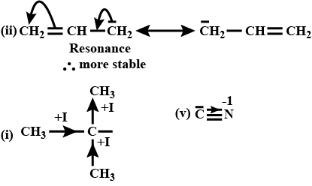
Basicity \(\propto \frac{1}{\text { Stability }}\)\((v)\) In figure \(5 , sp\) hybridised carbon is more electronegative. -ve charge on more electronegative atom makes it more stable. [ref. image]
Also, there is \(-I\) effect.
\(\therefore\) It is most stable.
\((iii)\) \(H - C \equiv \overline{ C }\)
sp hybridized carbon carry -ve charge.
\(\therefore\) Hence, it is also more stable
\((ii)\) In figure \(2\), resonance is taking place. [ref. image]
\(\therefore\) It is more stable.
\((iv)\) \(\overline{ C } H _3\)
-ve charge is carried by \(sp ^3\) hybridised carbon.
\(\therefore\) It is less stable.
\((i)\) In figure \(1\) , the central \(C\) is surrounded by \(CH _3\) and hence it shows \(+ I\) effect from \(3\) sides. [ref. image]
\(\therefore\) Hence, it is least stable.
\(\therefore \text { (v) }\,<\,\text { (iii) }\,<\,\text { (ii) }\,<\,\text { (iv) }\,<\,\text { (i) }\)
-
- (A) \(b\) અને \(d\)
- (B) \(a, b\) અને \(c\)
- (C) \(a\) અને \(c\)
- (D) \(a\) અને \(b\)
જવાબ અને ઉકેલ જુઓ
સાચો જવાબ: (B)
\(S _{ N }{ }^{1}\) favours\((a)\) The reaction is favoured by weak nucleophiles
\((b)\) \(R^ \oplus\) would be easily formed if the substituents are bulky
\((c)\) The reaction is accompained by recemization
-
- (A) \((d)\) અને \((a)\)
- (B) \((a)\) અને \((b)\)
- (C) \((b)\) અને \((c)\)
- (D) \((c)\) અને \((d)\)
જવાબ અને ઉકેલ જુઓ
સાચો જવાબ: (D)
\(\left[\mathrm{Pt}\left(\mathrm{NH}_{3}\right)_{3} \mathrm{Cl}\right]^{+}\) and \(\left[\mathrm{Pt}\left(\mathrm{NH}_{3}\right) \mathrm{Cl}_{5}\right]^{-}\) does not show geometrical isomerism
-
- (A) જ્યારે \(\Delta_{ o }< P\) ત્યારે \(t _{2 g }^{4} e _{ g }^{0}\)
- (B) જ્યારે \(\Delta_{ O }< P\) ત્યારે \(e _{ g }^{2} t _{2 g }^{2}\)
- (C) જ્યારે \(\Delta_{ O }< P\) ત્યારે \(t _{2 g }^{3} e _{ g }^{1}\)
- (D) જ્યારે \(\Delta_{ O }> P\) ત્યારે \(t _{2 e }^{3} e _{ e }^{1}\)
જવાબ અને ઉકેલ જુઓ
સાચો જવાબ: (C)
back pairing is not possible because pairing energy \(>\Delta_{0}\)
-
- (A) માત્ર \(( I ),( III )\) અને \(( IV )\)
- (B) માત્ર \(( II ),( III )\) અને \(( IV )\)
- (C) માત્ર \(( I ),( II )\) અને \(( III )\)
- (D) માત્ર \((I)\) અને \((II)\)
જવાબ અને ઉકેલ જુઓ
સાચો જવાબ: (C)
\((I)\) Under weak field ligand, octahedral \(Mn(II)\) and tetrahedral \(Ni(II)\) both the complexes are high spin complex.\((II)\) Tetrahedral \(Ni(II)\) complex can very rarely be low spin because square planar (under strong ligand) complexes of \(Ni ( II )\) are low spin complexes.
\((III)\) With strong field ligands \(Mn (II)\) complexes can be low spin because they have less number of unpaired electron (unpaired electron \(=1\) )
While with weak field ligands \(Mn(II)\) complexes can be high spin because they have more number of unpaired electron (unpaired electron \(=5)\)
\((IV)\) Aqueous solution of \(Mn(II)\) ions is pink in colour.
-
- (A) \(3,\) પ્રતિચુંબકીય
- (B) \(2 \frac{1}{2},\) અનુચુંબકીય
- (C) \(3,\) અનુચુંબકીય
- (D) \(2 \frac{1}{2},\) પ્રતિચુંબકીય
જવાબ અને ઉકેલ જુઓ
સાચો જવાબ: (A)
According to \(MOT\) (If \(z\) is internuclear axis)The configuration of
\(\mathrm{CN}^{-}: \sigma_{1 \mathrm{s}}^{2}, \sigma_{1 \mathrm{s}}^{* 2}, \sigma_{2 \mathrm{s}}^{2}, \sigma_{2 \mathrm{s}}^{*2}, \pi_{2 \mathrm{p}_{\mathrm{x}}}^{2}=\pi_{2 \mathrm{p}_{\mathrm{y}}}^{2}, \sigma_{2 \mathrm{p}_{\mathrm{z}}}^{2}\)
Bond order \(=\frac{1}{2}(10-4)\)
\(=3\)
\(\mathrm{CN}^{-}\) is diamagnetic due to absence of unpaired electron
-
- (A) મેરીડિયોનલ અને ટ્રાન્સ
- (B) સિસ અને ટ્રાન્સ
- (C) ફ્ક્ત ટ્રાન્સ
- (D) ફ્ક્ત સિસ
જવાબ અને ઉકેલ જુઓ
સાચો જવાબ: (D)
\(\left.\mathrm{Co}\left(\mathrm{NH}_{3}\right)_{4} \mathrm{Cl}_{2}\right]\) has 2 geometrical isomerscis isomer has \(\mathrm{Cl}-\mathrm{Co}-\mathrm{Cl}\) angle of \(90^{\circ}\)

- 39. \(\left[ CoF _{3}\left( H _{2} O \right)_{3}\right]\left(\Delta_{0}< P \right)\)ની સ્ફટિક ક્ષેત્ર સ્થાયીકરણ ઊર્જા કેટલી છે? 2020 અઘરું
- (A) \(-0.8 \Delta_{0}\)
- (B) \(-0.4 \Delta_{0}+ p\)
- (C) \(-0.8 \Delta_{0}+2 P\)
- (D) \(-0.4 \Delta_{0}\)
જવાબ અને ઉકેલ જુઓ
સાચો જવાબ: (D)
\(\left[ CoF _{3}\left( H _{2} O \right)_{3}\right] \quad \Delta_{0}< P\)Means all ligands behaves as weak field ligands
\(=[-0.4 \times 4+0.6 \times 2] \Delta_{0}\)
\(=[-1.6+1.2] \Delta_{0}\)
\(=\left[-0.4 \Delta_{0}\right]\)

-
- (A) ચતુષ્ફલકીય અને \(-1.6 \Delta_{ t }+1 P\)
- (B) ચતુષ્ફલકીય અને \(-0.6 \Delta_{ t }\)
- (C) અષ્ટફલકીય અને \(-1.6 \Delta_{0}\)
- (D) અષ્ટફલકીય અને \(-2.4 \Delta_{0}+2 P\)
જવાબ અને ઉકેલ જુઓ
સાચો જવાબ: (B)
If spin only magnetic moment of the complex is \(4.90 BM ,\) it means number of unpaired electrons should be \(4.\)\((A)\) In octahedral complex: \(\left[ M \left( H _{2} O \right)_{6}\right]^{2+}\)
\(C.F.S.E.\) \(=\left(-0.4 \Delta_{0}\right) \times 4+\left(+0.6 \Delta_{0}\right) \times 2+0 \times P\)
\((B)\) In tetrahedral complex: \(\left[ M \left( H _{2} O \right)_{4}\right]^{2+}\)
\(C.F.S.E.\) \(=\left(-0.6 \Delta_{t}\right) \times 3+\left(+0.4 \Delta_{t}\right) \times 3+0 \times P\)
\(=-0.6 \Delta_{ t }\)

-
- (A) \(\mathrm{Mg}\) અને \(\mathrm{Mg}_{3} \mathrm{N}_{2}\)
- (B) \(Na\) અને \(\mathrm{NaNO}_{3}\)
- (C) \(\mathrm{Mg}\) અને \(\mathrm{Mg}\left(\mathrm{NO}_{3}\right)_{2}\)
- (D) \(\mathrm{Na}\) અને \(\mathrm{Na}_{3} \mathrm{N}\)
જવાબ અને ઉકેલ જુઓ
સાચો જવાબ: (A)
\(3 \mathrm{Mg} (A)+\mathrm{N}_{2} \stackrel{\Delta}{\longrightarrow} \mathrm{Mg}_{3} \mathrm{N}_{2} (B)\stackrel{6H_2O}{\longrightarrow}\)\(3Mg(OH)_2+2NH_3 (colorless\; gas)\)\(\mathrm{CuSO}_{4}+4 \mathrm{NH}_{3} \rightarrow\left[\mathrm{Cu}\left(\mathrm{NH}_{3}\right)_{4}\right] \mathrm{SO}_{4}\) deep blue solution
- 42. ઇથિલીનડાયએમાઇનટેટ્રાએસિટેટ \((EDTA^ {4 -})\) માં સવર્ગ-સહ નિર્દેશની કુલ સંખ્યા કેટલી છે? 2020 મધ્યમ
- (A) \(15\)
- (B) \(8\)
- (C) \(6\)
- (D) \(10\)
જવાબ અને ઉકેલ જુઓ
સાચો જવાબ: (C)
\(EDTA^{4-}\) is hexadentate ligand, so its donation sites are six.
-
- (A) \(\left[ Ni \left( NH _{3}\right)_{4}\left( H _{2} O \right)_{2}\right]^{2+}\)
- (B) \(\left[ Ni \left( NH _{3}\right)_{2} Cl _{2}\right]\)
- (C) \(\left[ Pt \left( NH _{3}\right)_{2} Cl _{2}\right]\)
- (D) \(\left[ Ni ( en )_{3}\right]^{2+}\)
જવાબ અને ઉકેલ જુઓ
સાચો જવાબ: (B)
\(\left[ Ni \left( NH _{3}\right)_{2} Cl _{2}\right]\) is tetrahedral complex, therefore does not show geometrical and optical isomerism.\(\left[ Ni \left( NH _{3}\right)_{2} Cl _{2}\right]\) does not show structural isomerism
\(\left[ Ni \left( NH _{3}\right)_{4}\left( H _{2} O \right)_{2}\right]^{2+} \&\left[ Pt \left( NH _{3}\right)_{2} Cl _{2}\right]\) show geometrical isomerism
\(\left[ Ni ( en )_{3}\right]^{2+}\) show optical isomerism
-
- (A) \(\left[\operatorname{Mn}\left( H _{2} O \right)_{6}\right]^{2+}\) અને \(\left[ Cr \left( H _{2} O \right)\right]^{2+}\)
- (B) \(\left[ Cr \left( H _{2} O \right)_{6}\right]^{2+}\) અને \(\left[ CoCl _{4}\right]^{2-}\)
- (C) \(\left[ Cr \left( H _{2} O \right)_{6}\right]^{2+}\) અને \(\left[ Fe \left( H _{2} O \right)_{6}\right]^{2+}\)
- (D) \(\left[ Co ( OH )_{4}\right]^{2-}\) અને \(\left[ Fe \left( NH _{3}\right)_{6}\right]^{2+}\)
જવાબ અને ઉકેલ જુઓ
સાચો જવાબ: (C)
Thus complex \(\left[ Cr \left( H _{2} O \right)_{6}\right]^{2+}\) and \(\left[ Fe \left( H _{2} O \right)_{6}\right]^{2+}\) have same no. of unpaired \(e^-\) and hence same magnetic moment (spin only).
-
- (A) \(A-(i i), B-(i), C-(i i i)\)
- (B) \(A-(i i i), B-(i), C-(i i)\)
- (C) \(A-(i 1), B-(i i), C-(i)\)
- (D) \(A-(i), B-(i i), C-(i i i)\)
જવાબ અને ઉકેલ જુઓ
સાચો જવાબ: (B)
Strength of ligand \(F^{-}< NCS ^{-}< NH _{3}\)\(\Delta_{oh}\) order
\(\left[ MF _{6}\right]^{(-6+ n )} < [ M ( NCS )]^{(-6+ n )} < \quad\left[ M \left( NH _{3}\right)_{6}\right]^{ n ^{+}}\)
\(\Delta_{max}\) order
\(\left[ MF _{6}\right]^{(-6+ n )} > [ M ( NCS )]^{(-6+ n )} > \quad\left[ M \left( NH _{3}\right)_{6}\right]^{ n ^{+}}\)
As given in graph \(A < B < C\) \((\lambda_{max})\)
\(\therefore\) Correct matching is \(A -( iii ), B -( i ), C -( ii )\)
-
- (A) \(0\) અને \(0\)
- (B) \(0\) અને \(2\)
- (C) \(0\) અને \(1\)
- (D) \(2\) અને \(2\)
જવાબ અને ઉકેલ જુઓ
સાચો જવાબ: (A)
If the complex \(MA_2B_2\) is \(sp^3\) hybridised then the shape of this complex is tetrahedral this structure is opticaly inactive due to the presence of plane of symmetry.Optical isomes \(= 0\)
If the complex \(MA_2B_2\) is \(dsp^2\) hybridised then the shape of this complex is square planar
Both isomers are optically inactive due to the presence of plane of symmetry.
Optical isomers \(= 0\)

-
- (A) \((III) > (I) > (II) > (IV)\)
- (B) \((I) > (IV) > (III) > (II)\)
- (C) \((\mathrm{II}) \approx(\mathrm{I})>(\mathrm{IV})>(\mathrm{III})\)
- (D) \((\mathrm{III})>(\mathrm{I})>(\mathrm{IV})>(\mathrm{II})\)
જવાબ અને ઉકેલ જુઓ
સાચો જવાબ: (B)
\((I)\;\;\left[\mathrm{Cr}\left(\mathrm{H}_{2} \mathrm{O}\right)_{6}\right]^{2+}\)\(\mathrm{Cr}^{+2} \Rightarrow[\mathrm{Ar}] 3 \mathrm{d}^{4}\)
\(\mathrm{H}_{2} \mathrm{O} \rightarrow\) Weak field ligand
\(\text { Unpaired } \mathrm{e}^{-}=4\)
\(\text { Magnetic moment } =\sqrt{24} \mathrm{BM} =4.89 \mathrm{BM}\)
\((II)\;\;\left[\mathrm{Fe}(\mathrm{CN})_{6}\right]^{4-}\)
\(\mathrm{Fe}^{+2} \Rightarrow[\mathrm{Ar}] 3 \mathrm{d}^{6}\)
\(\mathrm{CN}^{-} \rightarrow\) Strong field ligand
Unpaired \(\mathrm{e}^{-}=0\)
Magnetic moment \(=0 \mathrm{BM}\) \(=0 \mathrm{BM}\)
\(\mathrm{III}\;\;\left[\mathrm{Fe}\left(\mathrm{C}_{2} \mathrm{O}_{4}\right)_{3}\right]^{3-}\)
\(\mathrm{Fe}^{+3} \Rightarrow[\mathrm{Ar}] 3 \mathrm{d}^{5}\)
As \(\Delta_{0}>P\)
Unpaired \(\mathrm{e}^{-}=1\)
\(\text { Magnetic moment } =\sqrt{3} \mathrm{BM}\)\(=1.73 \mathrm{BM}\)
\((IV)\;\;\left(\mathrm{Et}_{4} \mathrm{N}\right)^{+}\left[\mathrm{CoCl}_{4}\right]^{2-}\)
\(\mathrm{Co}^{+2} \Rightarrow[\mathrm{Ar}] 3 \mathrm{d}^{7}\)
Unpaired electrons \(=3\)
\(\begin{aligned} \text { Magnetic moment } &=\sqrt{15} \mathrm{BM} \\ &=3.87 \mathrm{BM} \end{aligned}\)
Hence order of magnetic moment is \(I>IV>III>II\)
- 48. નીચેનામાં સૌથી વધુ અનુચુંબકીય વર્તણૂક પ્રદર્શિત કરી શકે છે તે એક છે: - gly \(=\) ગ્લાયસિનેટો; bpy \(=2,2\) '-બાયપિરિડિન 2020 મધ્યમ
- (A) \(\left[ Pd ( gly )_{2}\right]\)
- (B) \(\left[ Ti \left( NH _{3}\right)_{6}\right]^{3+}\)
- (C) \(\left[ Co ( OX )_{2}( OH )_{2}\right]^{-}\left(\Delta_{0}> P \right)\)
- (D) \(\left[ Fe ( en )( bpy )\left( NH _{3}\right)_{2}\right]^{2+}\)
જવાબ અને ઉકેલ જુઓ
સાચો જવાબ: (C)
\(\left[ Co ( OX )_{2}( OH )_{2}\right]^{-}\) \(\Delta_{0}> P [\) S.F.L \(]\)It has highest number of unpaired \(e^{-}s.\) so it is most paramagnetic.

-
- (A) \(2.84\; \mathrm{BM}\) અને \(-1.6 \Delta_{0}\)
- (B) \(1.73\; \mathrm{BM}\) અને \(-2.0 \Delta_{0}\)
- (C) \(0\; \mathrm{BM}\) અને \(-2.4 \Delta_{0}\)
- (D) \(5.92\; \mathrm{BM}\) અને \(0\)
જવાબ અને ઉકેલ જુઓ
સાચો જવાબ: (B)
\([\mathrm{Pb}(\mathrm{F})(\mathrm{Cl})(\mathrm{Br})(\mathrm{I})]^{2-}\) have three geometrical isomer so formula for \(\left[\mathrm{Fe}(\mathrm{CN})_{6}\right]^{\mathrm{n}-6}\) is \(\left[\mathrm{Fe}(\mathrm{CN})_{6}\right]^{3-}\) and \(\mathrm{CFSE}\) for this complex is\(\mathrm{Fe}^{3+} \Rightarrow 3 \mathrm{d}^{5} 4 \mathrm{s}^{\circ}\)
\(\text { Magnetic Moment }=\sqrt{3}\)
\(=1.73 \mathrm{B.M}\)
\(\mathrm{CFSE}=[(-0.4 \times 5)+(0.6 \times 0)] \Delta_{0}\)
\(=-2.0 \Delta_{0}\)

- 50. \(\left[ Pt ( en )\left( NO _{2}\right)_{2}\right]\) માટે શક્ય સમઘટકો ની સંખ્યા કેટલી છે? 2020 મધ્યમ
- (A) \(3\)
- (B) \(2\)
- (C) \(1\)
- (D) \(4\)
જવાબ અને ઉકેલ જુઓ
સાચો જવાબ: (A)
\(\left[ Pt ( en )\left( NO _{2}\right)_{2}\right] \Rightarrow\) does not show \(G.I.\) as well as optical isomerism.This complex will have three linkage isomers as follows
\(\left[ Pt ( en )\left( NO _{2}\right) 2\right] I\)
\(\left[ Pt ( en )\left( NO _{2}\right)( ONO )\right] II\)
\(\left[ Pt ( en )( ONO )_{2}\right] III\)



આ પેજ પર આ ફિલ્ટર મુજબ કોઈ પ્રશ્ન નથી.
અન્ય વર્ષ
વારંવાર પૂછાતા પ્રશ્નો
ExamBro પર JEE Mains 2020 Chemistry ના કેટલા પ્રશ્નો છે?
193 પ્રશ્નો, દરેક સાચા જવાબ અને પૂરા ઉકેલ સાથે.
JEE Mains 2020 Chemistry નું કયું પ્રકરણ સૌથી વધુ પૂછાય છે?
સવર્ગ સંયોજનો, 26 પ્રશ્નો સાથે; ત્યાર બાદ Solution and colligative properties, 16 પ્રશ્નો સાથે.
JEE Mains 2020 Chemistry ના પ્રશ્નો કેટલા અઘરા હોય છે?
4% સરળ, 53% મધ્યમ અને 44% અઘરા.