


JEE Mains 2021 Chemistry ના બધા પ્રશ્નો
26 પ્રકરણ420 માંથી 101–150 પ્રશ્નો
- 101. જ્યારે તેમાં \(.....\) ઉમેરવામાં આવે છે , ત્યારે પોટેશિયમ ફેરોસાયનાઇડ દ્રાવણ પ્રુશિયન વાદળી રંગ આપે છે. 2021 અઘરું
- (A) \({CoCl}_{3}\)
- (B) \({FeCl}_{2}\)
- (C) \({CoCl}_{2}\)
- (D) \({FeCl}_{3}\)
જવાબ અને ઉકેલ જુઓ
સાચો જવાબ: (D)
\(\left.{FeCl}_{3}+{K}_{4}\left[{Fe}({CN})_{6}\right] \rightarrow {Fe}_{4}[{Fe}({CN})]_{6}\right]_{3}\)\(\quad\quad\quad\quad\quad\quad\quad\quad\quad\quad\quad\)Prussian blue
-
- (A) \(\left[{CoCl}_{2}({en})_{2}\right]\)
- (B) \(\left[{Co}({CN})_{5}({NC})\right]^{3-}\)
- (C) \(\left[{Co}\left({NH}_{3}\right)_{3}\left({NO}_{2}\right)_{3}\right]\)
- (D) \(\left[{Co}\left({NH}_{3}\right)_{4} {Cl}_{2}\right]^{+}\)
જવાબ અને ઉકેલ જુઓ
સાચો જવાબ: (B)
(1) \(\left[{CoCl}_{2}({en})_{2}\right]\) show Cis-trans isomerism(2) \(\left[{Co}({CN})_{5}({NC})\right]^{-3}\) can't Show \(G.I.\)
(3) \(\left[{Co}\left({NH}_{3}\right)_{3}\left({NO}_{2}\right)_{3}\right]\)
Show fac \(\&\) mer isomerism
(4) \(\left[{Co}\left({NH}_{3}\right)_{4} {Cl}_{2}\right]^{\oplus}\) show cis \(\&\) trans isomerism
- 103. \(K _{3}\left[ Cr \right.\) (oxalate) \(\left._{3}\right]\) હાજર રહેલા ઇલેક્ટ્રોનની કુલ સંખ્યા......... 2021 મધ્યમ
- (A) \(3\)
- (B) \(9\)
- (C) \(7\)
- (D) \(2\)
જવાબ અને ઉકેલ જુઓ
સાચો જવાબ: (A)
\(K _{3}\left[ Cr (\text { oxalate })_{3}\right]\)Chromium is in \(+3\) oxidation state.
Number of unpaired electrons in \(Cr ^{+3}\) will be \(3 .\)
-
- (A) \(2\)
- (B) \(4\)
- (C) \(3\)
- (D) \(6\)
જવાબ અને ઉકેલ જુઓ
સાચો જવાબ: (A)
Biuret \(:-\) Bidentate ligandThe denticity of organic ligand is \(2 .\)

-
- (A) \(1\)
- (B) \(10\)
- (C) \(4\)
- (D) \(6\)
જવાબ અને ઉકેલ જુઓ
સાચો જવાબ: (D)
\(Fe ^{3+}+3 K ^{+}+3 C _{2} O _{4}^{2-} \rightarrow K _{3}\left[ Fe \left( C _{2} O _{4}\right)_{3}\right]\)\(\quad \quad \quad \quad \quad \quad \quad \quad \quad \quad \quad \quad \quad \quad (A)\)
Secondary valency of \(Fe\) in \('A'\) is \(6 .\)
- 106. \(\left[ Mn _{2}( CO )_{10}\right]\) માં સેતુમય \(CO\) લિગેંડ્સ ની સંખ્યા .......... છે. 2021 સરળ
- (A) \(4\)
- (B) \(2\)
- (C) \(1\)
- (D) \(0\)
જવાબ અને ઉકેલ જુઓ
સાચો જવાબ: (D)
\(Mn _{2}( CO )_{10}\) structure isZero bridging \(CO\) ligands are present

-
- (A) \(4\)
- (B) \(5\)
- (C) \(6\)
- (D) \(12\)
જવાબ અને ઉકેલ જુઓ
સાચો જવાબ: (C)
\(MnO _{4}^{-}+ S _{2} O _{3}^{2-} \rightarrow MnO _{2}+ SO _{4}^{2-}\)\(\quad \quad \quad \quad \quad \quad \quad\quad (+4) \quad \quad \quad (A)\)
Oxidation state of \('S'\) in \(SO _{4}^{2-}\)
\(=+6\)
-
- (A) \(1\)
- (B) \(3\)
- (C) \(2\)
- (D) \(4\)
જવાબ અને ઉકેલ જુઓ
સાચો જવાબ: (C)
\(\left[{Ni}({CN})_{6}\right]^{2-}\)\({Ni}^{+4} \rightarrow {d}^{6}\) strong field ligand
\([image(1)]\)
Pairing will be there zero unpaired electron
\({NiCl}_{2} \rightarrow {Ni}^{2+} \rightarrow {d}^{8}\)
\([image(2)]\)
Change \(=2\)

-
- (A) \((b) < (a) < (c)\)
- (B) \((c) < (a) < (b)\)
- (C) \((a) < (b) < (c)\)
- (D) \((a) < (c) < (b)\)
જવાબ અને ઉકેલ જુઓ
સાચો જવાબ: (D)
\((a)\) \({ }_{58} Ce \rightarrow[ Xe ] 4 f ^{2} 5 d ^{0} 6 s ^{2}\)In complex \(Ce ^{4+} \rightarrow[ Xe ] 4 f ^{0} 5 d ^{0} 6 s ^{0}\)
there is no unpaired electron so \(\mu_{ m }=0\)
\((b)\) \({ }_{64} Gd ^{3+} \rightarrow[ Xe ] 4 f ^{7} 5 d ^{0} 6 s ^{\circ}\)
contain seven unpaired electrons so, \(\mu_{ m }=\sqrt{7(7+2)}=\sqrt{63} B.M\)
\((c)\) \({ }_{63} Eu ^{3+} \rightarrow\left[{ }_{54} Xe \right] 4 f ^{6} 5 d ^{0} 6 s ^{\circ}\)
contain six unpaired electron
so, \(\mu_{ m }=\sqrt{6(6+2)}=\sqrt{48} B . M\)
Hence, order of spin only magnetic movement
\(b > c > a\)
-
- (A) \(( i ) > ( iii ) > ( iv ) > ( ii )\)
- (B) \((ii) > ( iii) > ( i ) > ( iv )\)
- (C) \((iii) > ( iv ) > ( ii ) > ( i )\)
- (D) \(( ii ) > ( i ) > ( iii ) > ( iv )\)
જવાબ અને ઉકેલ જુઓ
સાચો જવાબ: (A)
Complex\((i)\) \(\left[ FeF _{6}\right]^{3-} Fe ^{3+} \Rightarrow[ Ar ] 3 d ^{5}, F ^{-}\) is \(WFL\)
\(n =5, \quad \mu=\sqrt{35}\, B .M.\)
\((ii)\) \(\left[ Co \left( NH _{3}\right)_{6}\right]^{3+} \Rightarrow Co ^{3+}[ Ar ] 3 d ^{6}, NH _{3}\) is \(SFL\)
\(n =0, \quad \mu=0\)
\((iii)\) \(\left[ NiCl _{4}\right]^{2-} Ni ^{2+} \Rightarrow[ Ar ] 3 d ^{8}, Cl ^{-} \rightarrow WFL\)
\(n =2, \quad \mu=\sqrt{8}\, B . M.\)
\((iv)\) \(\left[ Cu \left( NH _{3}\right)_{4}\right]^{2+} Cu ^{2+} \Rightarrow[ Ar ] 3 d ^{9}, NH _{3} \rightarrow \,SFL\)
\(n =1, \quad \mu=\sqrt{3} B.M.\)
Thus correct order of spin only magnetic moment is \(( i ) > ( iii ) > ( iv ) > ( ii )\)

-
- (A) બંને વિધાન \(I\) અને \(II\) ખોટા છે.
- (B) વિધાન \(I\) ખોટું છે પરંતુ વિધાન \(II\) સાચું છે.
- (C) વિધાન \(I\) સાચું છે પરંતુ વિધાન \(II\) ખોટું છે.
- (D) બંને વિધાન \(I\) અને \(II\) સાચા છે.
જવાબ અને ઉકેલ જુઓ
સાચો જવાબ: (D)
\(\left[\begin{array}{cc}{\left[{Mn}({CN})_{6}\right]^{3-}} \quad {\left[{Fe}({CN})_{6}\right.}\end{array}\right]^{3-} \quad\left[{Co}\left({C}_{2} {O}_{4}\right)_{3}\right]^{3-}\)\(\quad\quad\downarrow\)
\({Mn}^{3+} {CN}^{-} \quad {Fe}^{3+}, {CN}^{-} \quad {Co}^{3+}, {C}_{2} {O}_{4}^{2-}\)
\({d}^{4}\) configuration, \(SFLd^{5}\) configuration, \(SFL d^6\) configuration, Chelatingligand
\(\Rightarrow\) All will have larger splitting hence \(d^{2} {sp}^{3}\) hybridisation.
\(\left[{MnCl}_{6}\right]^{3-} \quad\) and \(\quad\left[{FeF}_{6}\right]^{3-}\)
\({d}^{4}\) configuration, \({Cl}^{-} \quad {d}^{5}\) configuration, \({F}^{-}\)
\(\underline1\, \underline{} \quad\quad\quad\quad\quad\quad\quad\quad\quad\quad\quad\quad \underline1\, \underline{1}\)
\(\underline1\, \underline{1}\,\underline{1} \quad\quad\quad\quad\quad\quad\quad\quad\quad\quad\quad \underline1\, \underline{1}\,\underline{1}\)
\(4 \text { unpaired electrons } \quad\quad5 \text { unpaired electrons }\)
-
- (A) વિધાન \(I\) ખોટું છે પણ વિધાન \(II\) સાચું છે.
- (B) બંને, વિધાન \(I\) અને વિધાન \(II\) ખોટાં છે.
- (C) વિધાન \(I\) સાચું છે પણ વિધાન \(II\) ખોટું છે.
- (D) બંને, વિધાન \(I\) અને વિધાન \(II\) સાચાં છે.
જવાબ અને ઉકેલ જુઓ
સાચો જવાબ: (C)
Neutral dimethyl glyoxime does not act as ligand.When \(Ni ^{2+}\) reacts with dimethyl glyoxime in presence of \(NH _{4} OH\), it produce dimethyl glyoximate then it form rozy red ppt.
\(Ni ^{2+}{ }_{( aq )}+2 dmg ^{-} \rightarrow\left[ Ni ( dmg )_{2}\right]\)
\(\quad\quad\quad\quad\quad\quad\quad\quad\quad\)Rosy Red ppt.
-
- (A) \({A}<{B}<{C}<{D}\)
- (B) \({B}<{A}<{C}<{D}\)
- (C) \({B}<{C}<{D}<{A}\)
- (D) \({C}<{D}<{B}<{A}\)
જવાબ અને ઉકેલ જુઓ
સાચો જવાબ: (B)
\((i)\) \(CFSE\) \(\propto\) charge or oxidation no. of central metal ion.\((ii)\) \(CFSE\) \(\propto\) strength of ligand
\({en}>{NH}_{3}>{H}_{2} {O}>{F}^{-}\)
\(\therefore\) order of \(CFSE\)
\(III\quad\quad\quad\quad\quad\quad III\quad\quad\quad\quad\quad III\quad\quad\quad\quad\quad\quad II\)
\(\left.\left[{Co}({en})_{3}\right]^{+3}>[ {Co}\left({NH}_{3}\right)_{6}\right]^{+3}>\left[{CoF}_{6}\right]^{-3}>\left[{Co}\left({H}_{2} {O}\right)_{6}\right]^{+2}\)
-
- (A) \(\left[{Fe}({CN})_{6}\right]^{4-}\)
- (B) \(\left[{Fe}({SCN})_{6}\right]^{4-}\)
- (C) \({Fe}_{4}\left[{Fe}\left({CN}_{6}\right)\right]_{3} \cdot {H}_{2} {O}\)
- (D) \(\left[{Fe}({CN})_{5} {NOS}\right]^{4}\)
જવાબ અને ઉકેલ જુઓ
સાચો જવાબ: (D)
\((A)\) \(\left[{Fe}({CN})_{6}\right]^{4-} \rightarrow\) Pale yellow solution\((B)\) \(\left[{Fe}({SCN})_{6}\right]^{4-} \rightarrow\) Blood red colour
\((C)\) \({Fe}_{4}\left[{Fe}\left({CN}_{6}\right)\right]_{3} \cdot {H}_{2} {O} \rightarrow\) Prussian blue
\((D)\) \(\left[{Fe}({CN})_{5} {NOS}\right]^{4} \rightarrow\) Violet colour
-
- (A) \(\left[{Co}({en})\left({NH}_{3}\right)_{4}\right] {Cl}_{2}\)
- (B) \(\left[{Co}({en})_{3}\right] {Cl}_{2}\)
- (C) \(\left[{Co}\left({NH}_{3}\right)_{6}\right] {Cl}_{2}\)
- (D) \(\left[{Co}({en})_{2}\left({NH}_{3}\right)_{2}\right] {Cl}_{2}\)
જવાબ અને ઉકેલ જુઓ
સાચો જવાબ: (B)
Complex \(\left[{Co}({en})_{3}\right] {Cl}_{2}\) is most stable complexamong the given complex compounds because more number of chelate rings are present in thiscomplex as compare to others.\((1)\) \(\left[{Co}({en})\left({NH}_{3}\right)_{4}\right] {Cl}_{2}\) \(\quad\quad\quad1\) chelate ring
\((2)\) \(\left[{Co}({en})_{3}\right] {Cl}_{2}\) \(\quad\quad\quad\quad\quad\quad3\) chelate ring
\((3)\) \(\left[{Co}({en})_{2}\left({NH}_{3}\right)_{2}\right] {Cl}_{2}\) \(\quad\quad\quad2\) chelate ring
\((4)\) \(\left[{Co}\left({NH}_{3}\right)_{6}\right] {Cl}_{2} \quad\quad\quad\quad\quad0\) chelate ring
-
- (A) \(\left[{Fe}\left({H}_{2} {O}\right)_{6}\right]^{3+}\)
- (B) \(\left[{Ni}({CO})_{4}\right]\)
- (C) \(\left[{Co}({CN})_{6}\right]^{3-}\)
- (D) \(\left[{Ni}({CN})_{4}\right]^{2-}\)
જવાબ અને ઉકેલ જુઓ
સાચો જવાબ: (A)
\(1.\) \(\left[{Fe}\left({H}_{2} {O}\right)_{6}\right]^{3+}\)\({Fe}^{3+}:[{Ar}] 3 {~d}^{5}\)
Hybridisation : \({sp}^{3} {~d}^{2}\)
Magnetic nature : Paramagnetic (so this complex response to external magnetic field)
\(2.\) \(\left[{Ni}({CN})_{4}\right]^{2-}\)
\({Ni}^{2+}:[{Ar}] 3 {~d}^{8}\)
Hybridisation: \({ds} {p}^{2}\)
Magnetic nature : diamagnetic
\(3.\) \(\left[{Co}({CN})_{6}\right]^{3-}\)
\({Co}^{3+}:[{Ar}] 3 d^{6}\)
Hybridisation : \({d}^{2} {~s} {p}^{3}\)
Magnetic nature: diamagnetic
\(4.\) \(\left[{Ni}({CO})_{4}\right]\)
\({Ni}:[{Ar}] 3 {~d}^{8} 4 {~s}^{2}\)
Hybridisation : \({sp}^{3}\)
Magnetic nature : diamagnetic
- 117. ફ્ક્ત સ્પિન \({Fe}^{2+}\)ના અષ્ટફલકીય સંકીર્ણની પ્રબળ ક્ષેત્ર લિગાન્ડની હાજરીમાં માત્ર ચુંબકીય ચાકમાત્રા \(......\,B.M.\) છે. 2021 અઘરું
- (A) \(4.89\)
- (B) \(0\)
- (C) \(2.82\)
- (D) \(3.46\)
જવાબ અને ઉકેલ જુઓ
સાચો જવાબ: (B)
In presence of SFL \(\Delta_{0}\,>\,{P}\) means pairing occurs therefore For \({Fe}^{+2}\,\,3 {~d}^{6}\)\(\therefore\) No of unpaired \({e}-({s})=0\)
\(\therefore \mu=\sqrt{n(n(n+2)}\,\, {BM}=0\)
\([{n}=\) No of unpaired \({e}-({s})]\)
In \({NiCl}_{2} {Ni}^{+2}\) is having configuration \(3 {~d}^{8}\)
\(\therefore\) Number of unpaired electron \(=2\)
After formation of oxidised product
\(\left[{Ni}({CN})_{6}\right]^{-2} {Ni}^{+4}\) is obtained
\({Ni}^{{t}} \Rightarrow 3 {~d}^{6}\) and \({CN}^{-}\)is strong field ligand
\(\therefore\) number of unpaired electrons \(=0\)
\(\therefore\) The charge is \(2-0=2\)

-
- (A) \(+2\) થી \(+6\)
- (B) \(+1\) અને \(+3\) થી \(+6\)
- (C) \(+1\) અને \(+3\)
- (D) \(+1\) થી \(+6\)
જવાબ અને ઉકેલ જુઓ
સાચો જવાબ: (A)
\(\operatorname{Cr}\,(Z=24)\)\([ Ar ]\, 4 s ^{1}\, 3 d ^{5}\, Cr\) shows common oxidation states starting from \(+2\) to \(+6\)
- 119. સ્ટોઇચ્યોમેટ્રી \({CuSO}_{4} .5 {H}_{2} {O}\) સાથે સંકળાયેલા હાઇડ્રોજન બંધાયેલા પાણીના અણુઓની સંખ્યા \(....\) છે. 2021 સરળ
- (A) \(2\)
- (B) \(3\)
- (C) \(4\)
- (D) \(1\)
જવાબ અને ઉકેલ જુઓ
સાચો જવાબ: (D)
One hydrogen bonded \({H}_{2} {O}\) molecule
-
- (A) \(50\)
- (B) \(5\)
- (C) \(500\)
- (D) \(1\)
જવાબ અને ઉકેલ જુઓ
સાચો જવાબ: (B)
\(\text { Given } {k}_{{f}}=2.1 \times 10^{13}\)\({~K}_{{d}}=\frac{1}{{k}_{{f}}}=4.7 \times 10^{-14}\)
\(\therefore {y}=4.7 \approx 5\)
- 121. સંકીર્ણ \(\left[{MnCl}_{6}\right]^{3-}\)ના સંકરણ અને ચુંબકીય ગુણધર્મનો પ્રકાર અનુક્રમે છે: 2021 મધ્યમ
- (A) \({d}^{2} {sp}^{3}\) અને પેરામેગ્નેટિક
- (B) \({d}^{2} {sp}^{3}\) અને ડાયમેગ્નેટિક
- (C) \({sp}^{3} {~d}^{2}\) અને પેરામેગ્નેટિક
- (D) \({sp}^{3} {~d}^{2}\) અને ડાયમેગ્નેટિક
જવાબ અને ઉકેલ જુઓ
સાચો જવાબ: (C)
\(\left[{MnCl}_{6}\right]^{3-}\)Paramagnetic and having \(4\) unpaired electrons.

-
- (A) \(\left[{Ni}({CN})_{4}\right]^{2-}>\left[{NiCl}_{4}\right]^{2-}>\left[{Ni}\left({H}_{2} {O}\right)_{6}\right]^{2+}\)
- (B) \(\left[{NiCl}_{4}\right]^{2-}>\left[{Ni}({CN})_{4}\right]^{2-}>\left[{Ni}\left({H}_{2} {O}\right)_{6}\right]^{2+}\)
- (C) \(\left[{NiCl}_{4}\right]^{2-}>\left[{Ni}\left({H}_{2} {O}\right)_{6}\right]^{2+}>\left[{Ni}({CN})_{4}\right]^{2-}\)
- (D) \(\left[{Ni}\left({H}_{2} {O}\right)_{6}\right]^{2+}>\left[{NiCl}_{4}\right]^{2-}>\left[{Ni}({CN})_{4}\right]^{2-}\)
જવાબ અને ઉકેલ જુઓ
સાચો જવાબ: (C)
\(\left[{NiCl}_{4}\right]^{-2-}>\left[{Ni}\left({H}_{2} {O}\right)_{6}\right]^{-2+}>\left[{Ni}({CN})_{4}\right]^{-2-}\)Splitting energy order : \(\Delta_{{t}}<\Delta_{0} \quad<\Delta_{{sq}}\)
absorbed energy order : \(\left[{NiCl}_{4}\right]^{-2-}<\left[{Ni}\left({H}_{2} {O}\right)_{6}\right]^{-2+}<\left[{Ni}({CN})_{4}\right]^{-2-}\)
intensity of colour of compound : \(\quad\left[{NiCl}_{4}\right]^{-2-}>\left[{Ni}\left({H}_{2} {O}\right)_{6}\right]^{2+}>\left[{Ni}({CN})_{4}\right]^{2-}\)
-
- (A) \((a)-(iii), (b)-(i), (c)-(ii), (d)-(iv)\)
- (B) \((a)-(iv), (b)-(ii), (c)-(iii), (d)-(i)\)
- (C) \((a)-(ii), (b)-(i), (c)-(iii), (d)-(iv)\)
- (D) \((a)-(i), (b)-(ii), (c)-(iii), (d)-(iv)\)
જવાબ અને ઉકેલ જુઓ
સાચો જવાબ: (A)
Sol. Complex Type of Isomerism \((a)\) \(\left[ Co \left( NH _{3}\right)_{6}\right]\left[ Cr ( CN )_{6}\right]\) Co-ordination isomerism
\((b)\) \(\left[ Co \left( NH _{3}\right)_{3}\left( NO _{2}\right)_{3}\right]\) Linkage isomerism
\((c)\) \(\left[ Cr \left( H _{2} O \right)_{6}\right] Cl _{3}\) Solvate isomerism
\((d)\) \(cis-[CrCl\) \(\left._{2}(\text { ox })_{2}\right]^{3-}\) Optical isomerism - 124. \(3d-\)શ્રેણીઓ તત્વોના \(M ^{2+} / M\) ના ઈલેક્ટ્રોડ પોટેન્શિયલ જે ધન મૂલ્યો (positive values) દર્શાવે છે તે ........... છે. 2021 સરળ
- (A) \(Zn\)
- (B) \(Fe\)
- (C) \(Co\)
- (D) \(Cu\)
જવાબ અને ઉકેલ જુઓ
સાચો જવાબ: (D)
Only copper shows positive value for electrode potential of \(M ^{2+} / M\) of \(3 d-\)series elements.\(E ^{\Theta} / V _{\left( Cu ^{2+} / Cu \right)}:+0.34\)
- 125. \(4 {f}\) ભ્રમણકક્ષામાં \({Ho}^{3+}\) આયનમાં હાજર ઇલેક્ટ્રોનની સંખ્યા \(.....\) છે. (પરમાણ્વીય ક્રમાંક \({Ho}=67\) ) 2021 સરળ
- (A) \(10\)
- (B) \(15\)
- (C) \(20\)
- (D) \(36\)
જવાબ અને ઉકેલ જુઓ
સાચો જવાબ: (A)
\({Ho}=[{Xe}] 4 {f}^{11} 6 {~s}^{2}\)\({Ho}^{3+}=[{Xe}] 4 {f}^{10}\)
So number of \({e}^{-}\)present \(4 {f}\) is \(10 .\)
-
- (A) પેરામેગ્નેટિક અને રંગહીન
- (B) ડાયમેગ્નેટિક અને લીલો
- (C) ડાયમેગ્નેટિક અને રંગહીન
- (D) પેરામેગ્નેટિક અને લીલો
જવાબ અને ઉકેલ જુઓ
સાચો જવાબ: (D)
\(2 {KMnO}_{4} \xrightarrow[200^{o}C]{\Delta} {K}_{2} {MnO}_{4}+{+{MnO}_{2}}+{O}_{2}\)\(\quad \quad \quad \quad \quad \quad \quad Green\quad \quad \quad Black\)
In \({K}_{2} {MnO}_{4}\), manganese oxidation state is \(+6\) and hence it has one unpaired \({e}^{-}\).
-
- (A) \(170\)
- (B) \(173\)
- (C) \(181\)
- (D) \(141\)
જવાબ અને ઉકેલ જુઓ
સાચો જવાબ: (B)
\(gm\) equi. of \(CrO _{4}^{2-}= S _{2} O _{3}^{2-}\)\(0.154 \times 3 \times v =0.25 \times 40 \times 8\)
\(v =173.16=173 \,ml\)

-
- (A) \({Cr}-{O}-{Cr}\) બંધ રેખીય સંમિતિય છે.
- (B) \({Cr}-{O}-{Cr}\) બંધ બિન-રેખીય સંમિતિય છે.
- (C) \({Cr}-{O}-{Cr}\) બંધ રેખીય બિન-સંમિતિય છે.
- (D) \({Cr}-{O}-{Cr}\) બંધ બિન-રેખીય બિન-સંમિતિય છે.
જવાબ અને ઉકેલ જુઓ
સાચો જવાબ: (B)
dichromate ion contain non-linear symmetrical \({Cr}-{O}-{Cr}\) Bond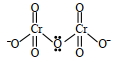
- 129. ડાયક્રોમેટ આયનની બેઈઝ સાથે પ્રક્રિયા કરવામાં આવે છે. તો બનતી નીપજમાં \(Cr\) નો ઓક્સિડેશન આંક ........... 2021 સરળ
- (A) \(3\)
- (B) \(4\)
- (C) \(5\)
- (D) \(6\)
જવાબ અને ઉકેલ જુઓ
સાચો જવાબ: (D)
\(Cr _{2} O _{7}^{2-}+ OH ^{-} \longrightarrow CrO _{4}^{2-}\)Oxidation state of \(Cr\) in \(CrO _{4}^{2-}\) is \(+6\)
-
- (A) \(X = SO _{2}, Y = Cr _{2} O _{3}\)
- (B) \(X = SO _{3}, Y = Cr _{2} O _{3}\)
- (C) \(X = SO _{2}, Y = Cr _{2}\left( SO _{4}\right)_{3}\)
- (D) \(X = SO _{3}, Y = Cr _{2}\left( SO _{4}\right)_{3}\)
જવાબ અને ઉકેલ જુઓ
સાચો જવાબ: (C)
\(SO _{2}+ dil H _{2} SO _{4} \longrightarrow SO _{3}( g )\)\(Cr _{2}\left( SO _{4}\right)_{3}\)
-
- (A) \(4 f^{7} 6 {~s}^{2}\)
- (B) \(4 f^{6}\)
- (C) \(4 f^{7}\)
- (D) \(4 f^{6} 6 {~s}^{2}\)
જવાબ અને ઉકેલ જુઓ
સાચો જવાબ: (C)
\({Eu} \rightarrow[{Xe}] 4 {f}^{7} 6 {~s}^{2}\)\({Eu}^{2+} \rightarrow[{Xe}] 4 {f}^{7}\)
- 132. \({Ga}^{+}\) આયનના વેલેન્સ ઇલેક્ટ્રોન માટે ચુંબકીય ક્વોન્ટમ આંક \( ..... \) છે (પરમાણ્વીય ક્રમાંક \({Ga}=31\) ) 2021 મધ્યમ
- (A) \(0\)
- (B) \(1\)
- (C) \(2\)
- (D) \(3\)
જવાબ અને ઉકેલ જુઓ
સાચો જવાબ: (A)
\({Ga}^{+}: {1s}^{2} \,2 {~s}^{2}\, 2 {P}^{6}\, 3 {~s}^{2} \,3 {p}^{6}\, 3 {~d}^{10} \,4 {~s}^{2}\)last orbital \(=\) \({s}\)
The azimuthal quantum number for the valenceelectrons \((4s-\)subshell) of \({Ga}+\) ion is zero\((0).\)
- 133. \({Gd}^{2+}\)ની ધરા અવસ્થાની ઇલેક્ટ્રોનિક રચનામાં \(4 f\) ઇલેક્ટ્રોનની સંખ્યા \(........\) છે. [પરમામાણ્વીય ક્રમાંક \({Gd}=64\) ] 2021 મધ્યમ
- (A) \(7\)
- (B) \(6\)
- (C) \(1\)
- (D) \(8\)
જવાબ અને ઉકેલ જુઓ
સાચો જવાબ: (A)
The electronic configuration of\({ }_{64} {Gd}:[{Xe}] 4 {f}^{7} 5 {~d}^{1} 6 {~s}^{2}\)
So the electronic configuration of
\({ }_{64} {Gd}^{2+}:[{Xe}] 4 {f}^{7} 5 {~d}^{1} 6 {~s}^{0}\)
\(i.e.\) the number of \(4 {f}\) electrons in the ground state electronic configuration of \({Gd}^{2+}\) is \(7\)
-
- (A) \(4\)
- (B) \(6\)
- (C) \(5\)
- (D) \(7\)
જવાબ અને ઉકેલ જુઓ
સાચો જવાબ: (D)
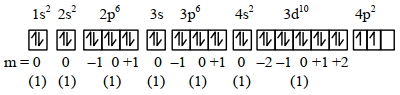
Completely filled orbital with \({m}_{\ell}=0\) are\(=1+1+1+1+1+1+1\)
\(=7\)
So Answer is \(7\)
-
- (A) \(1.73,3.87,0\)
- (B) \(0,3.87,1.73\)
- (C) \(3.87,1.73,0\)
- (D) \(1.73,0,3.87\)
જવાબ અને ઉકેલ જુઓ
સાચો જવાબ: (A)
\(\mu=\sqrt{n(n+2)} B M\)\(n=\) number of unpaired electrons
\(T_{i}^{i+3}=\text { Ar }] 3 d^{1} \quad \quad\quad n=1 \quad \quad \mu=1.73\, {BM}\)
\({V}^{+2}= \text { [Ar]3d }^{3} \quad \quad \quad {n}=3 \quad \quad \mu=3.87\, {BM}\)
\({Sc}^{+3}=[{Ar}] 3 {~d}^{0} 4 {~s}^{0} \quad \quad {n}=0 \quad \quad \mu=0\)
- 136. નીચે આપેલા લેન્થનોઈડસ પૈકી કયો એક \(MO _{2}\) બનાવશે નહીં ? \([M\) એ લેન્થેનોઈડ ધાતુ છે.] 2021 સરળ
- (A) \(\operatorname{Pr}\)
- (B) \(Dy\)
- (C) \(Nd\)
- (D) \(Yb\)
જવાબ અને ઉકેલ જુઓ
સાચો જવાબ: (D)
\(Y b\) is the only element that do not form \(MO _{2}\) type oxide -
- (A) \(Cr < Zn < Co < Cu < Fe\)
- (B) \(Zn < Cu < Co < Fe < Cr\)
- (C) \(Zn < Cr < Fe < Co < Cu\)
- (D) \(Cr < Fe < Co < Cu < Zn\)
જવાબ અને ઉકેલ જુઓ
સાચો જવાબ: (C)
\(Density /g cm^{-3}\)\(\begin{array}{*{20}{c}} {Zn}& < &{Cr}& < &{Fe}& < &{Co}& < &{Cu} \\ \downarrow &{}& \downarrow &{}& \downarrow &{}& \downarrow &{}& \downarrow \\ {7.1}&{}&{7.19}&{}&{7.8}&{}&{8.7}&{}&{8.9} \end{array}\)
-
- (A) \(Cr ^{+}\) અને \(Mn ^{2+}\)
- (B) \(Ni ^{2+}\) અને \(Cu ^{+}\)
- (C) \(Fe ^{2+}\) અને \(Co ^{+}\)
- (D) \(V ^{2+}\) અને \(Cr ^{+}\)
જવાબ અને ઉકેલ જુઓ
સાચો જવાબ: (A)
\(\begin{array}{ll}\text { Option }-1 & Mn ^{+2}[ Ar ] 3 d ^{5}, Cr ^{+}[ Ar ] 3 d ^{5} \\ \text { Option }-2 & Ni ^{+2}[ Ar ] 3 d ^{8}, Cu ^{+}[ Ar ] 3 d ^{10} \\ \text { Option }-3 & Fe ^{+2}[ Ar ] 3 d ^{6}, Co ^{+}[ Ar ] 3 d ^{7} 4 s ^{1} \\ \text { Option }-4 & V ^{+2}[ Ar ] 3 d ^{3}, Cr ^{+}[ Ar ] 3 d ^{5}\end{array}\) -
- (A) વિધાન \(I\) ખોટું છે પરંતુ વિધાન \(II\) સાચું છે.
- (B) વિધાન \(I\) સાચું છે પરંતુ વિધાન \(II\) ખોટું છે.
- (C) બન્ને, વિધાનો \(I\) અને વિધાન \(II\) સાચાં છે.
- (D) બન્ને, વિધાનો \(I\) અને વિધાન \(II\) ખોટાં છે.
જવાબ અને ઉકેલ જુઓ
સાચો જવાબ: (C)
The \(+3\) oxidation state of lanthanide is most stable and therefore lanthanide in \(+4\) oxidation state has strong tendence to gain \(e ^{-}\) and converted into \(+3\) and therefore act as strong oxidizing agent.\(eg Ce ^{+4}\) And there fore \(CeO _{2}\) is used to oxidized alcohol aldehyde and ketones.
Lanthanide in \(+2\) oxidation state has strong tendency to loss \(e ^{-}\) and converted into \(+3\) oxidation state therefore act as strong reducing agent.
\(\therefore EuSO _{4}\) act as strong reducing agent.
-
- (A) વિધાન \(I\) સાચું છે પણ વિધાન \(II\) ખોટું છે.
- (B) બંને વિધાન \(I\) અને વિધાન \(II\) સાચા છે.
- (C) વિધાન \(I\) ખોટું છે પણ વિધાન \(II\) સાચું છે.
- (D) બંને વિધાન \(I\) અને વિધાન \(II\) ખોટા છે.
જવાબ અને ઉકેલ જુઓ
સાચો જવાબ: (A)
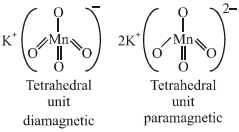
\(2 KMnO _{4} \stackrel{573 K }{\longrightarrow} K _{2} MnO _{4}+ MnO _{2}+ O _{2}\)Potassium Potassium
permanganate \(\quad\) manganate
Statement\(-I\) is correct.
Statement\(-II\) is incorrect
-
- (A) બંને વિધાન \(I\) અને વિધાન \(II\) સાચા છે.
- (B) વિધાન \(I\) ખોટું છે પણ વિધાન \(II\) સાચું છે.
- (C) બંને વિધાન \(I\) અને વિધાન \(II\) ખોટા છે.
- (D) વિધાન \(I\) સાચું છે પણ વિધાન \(II\) ખોટું છે.
જવાબ અને ઉકેલ જુઓ
સાચો જવાબ: (D)
The \(E ^{\circ}\) value for \(Ce ^{4+} / Ce ^{3+}\) is \(+1.74 V\) because the most stable oxidation state of lanthanide series elements is \(+3\) .It means \(Ce ^{3+}\) is more stable than \(Ce ^{4+}\)
-
- (A) \(Fe\)
- (B) \({Mn}\)
- (C) \({Cr}\)
- (D) \(Co\)
જવાબ અને ઉકેલ જુઓ
સાચો જવાબ: (C)
Elements of group \(7,8,9\) do not form hydrides thus \({Cr}\) will only form hydride among the given elements \((Fe, {Mn}, {Co})\) -
- (A) \({ClO}_{2}^{-}, {F}_{2}, {MnO}_{4}^{-}\) અને \({Cr}_{2} {O}_{7}^{2-}\)
- (B) \({Cr}_{2} {O}_{7}^{2-}, {MnO}_{4}^{-}, {ClO}_{2}^{-}\) અને \({Cl}_{2}\)
- (C) \({MnO}_{4}^{-}, {ClO}_{2}^{-}, {Cl}_{2}\) અને \({Mn}^{3+}\)
- (D) \({ClO}_{4}^{-}, {MnO}_{4}^{-}, {ClO}_{2}^{-}\) અને \({F}_{2}\)
જવાબ અને ઉકેલ જુઓ
સાચો જવાબ: (C)
No option contains all species that show disproportionation reaction.\({MnO}_{4}^{-}\)
\(Mn\) is in \(+7\) oxidation state (highest) hence cannot be simultaneously oxidized or reduced
-
- (A) \({Nd}\)
- (B) \({Yb}\)
- (C) \({La}\)
- (D) \({Ce}\)
જવાબ અને ઉકેલ જુઓ
સાચો જવાબ: (B)
Ytterbium shows \(+2\) oxidation state with diamagnetic nature -
- (A) \({CuCl}_{2}\)
- (B) \({AgCl}\)
- (C) \({ZnCl}_{2}\)
- (D) \({Cu}_{2} {Cl}_{2}\)
જવાબ અને ઉકેલ જુઓ
સાચો જવાબ: (A)
\((A)\) \({CuCl}_{2}+{nH}_{2} {O} \rightarrow {Cu}_{\left({aq}_{.}\right)}^{+2}\)\(\quad\quad\quad\quad\quad\quad\quad\quad\)blue colour
\((B)\) \({AgCl}+{nH}_{2} {O} \rightarrow\) Insoluble
\((C)\) \({ZnCl}_{2}+{nH}_{2} {O} \rightarrow {Zn}_{\left({aq}_{.}\right)}^{+2}\)
\(\quad\quad\quad\quad\quad\quad\quad\quad\)Colourless
\((D)\) \({Cu}_{2} {Cl}_{2}+{nH}_{2} {O} \rightarrow\) Insoluble
- 146. \({Np}({Z}=93)\)ની ઇલેક્ટ્રોનિક રચના ધરા અવસ્થામાં \(f\) ઇલેક્ટ્રોનની સંખ્યા \(.......\) છે. 2021 સરળ
- (A) \(2\)
- (B) \(5\)
- (C) \(4\)
- (D) \(6\)
જવાબ અને ઉકેલ જુઓ
સાચો જવાબ: (C)
\({Np}=1 {~s}^{2} 2 {~s}^{2} 2 {p}^{6} 3 {~s}^{2} 3 {p}^{6} 4 {~s}^{2} 3 {~d}^{10} 4 {p}^{6} 5 {~s}^{2} 4 {~d}^{10} 5 {p}^{6} 6 {~s}^{2}\)\(4 {f}^{14} 5 {~d}^{10} 6 {p}^{6} 7 {~s}^{2}-5 {f}^{4} 6 {~d}^{1}\)
Total no. of \('f'\) electron \(=14 {e}^{-}+4 {e}^{-}=18\)
-
- (A) \({Sc}^{3+}, {V}^{5+}, {Ti}^{4+}\)
- (B) \({Cu}^{2+}, {Cr}^{3+}, {Sc}^{+}\)
- (C) \({Ni}^{2+}, {Mn}^{7+}, {Hg}^{2+}\)
- (D) \({Cu}^{+}, {Zn}^{2+}, {Mn}^{4+}\)
જવાબ અને ઉકેલ જુઓ
સાચો જવાબ: (B)
\({Cu}^{2+}:[{Ar}] 3 {~d}^{9} 4 {~s}^{0}\)\({Cr}^{3+}:[{Ar}] 3 {~d}^{3} 4 {~s}^{0}\)
\({Sc}^{+}:[{Ar}] 3 {~d}^{1} 4 {~s}^{1}\)
All are coloured and paramagnetic due to presence of unpaired \({e}^{-}\)
-
- (A) \((a)>(d)>(c)>(b)>(e)\)
- (B) \(({d})>({a})>({b})>({c})>({e})\)
- (C) \((a)>(c)>(d)>(b)>(e)\)
- (D) \((c)>(a)>(d)>(e)>(b)\)
જવાબ અને ઉકેલ જુઓ
સાચો જવાબ: (A)
\((a)\) \(\stackrel{+6}{{C}} {rO}_{3}\)\((b)\) \(\stackrel{+3} {Fe}_{2} {O}_{3}\)
\((c)\) \(\stackrel{+4} {MnO}_{2}\)
\((d)\) \(\stackrel{+5} {V}_{2} {O}_{5}\)
\((e)\) \(\stackrel{+1} {Cu}_{2} {O}\)
So order of oxidation state \(a>d>c>b>e\)
- 149. \({V}_{2} {O}_{3}\) અને \({CrO}\) ઓક્સાઇડનો સ્વભાવ પ્રકાર અનુક્રમે \({X}\) અને \({Y}\) તરીકે અનુક્રમિત છે. \({X}\) અને \({Y}\)નો સાચો સમૂહ છે: 2021 મધ્યમ
- (A) \({X}=\) બેઝિક \(\quad {Y}=\) ઊભયગુણી
- (B) \({X}=\) ઊભયગુણી \(\quad {Y}=\) બેઝિક
- (C) \({X}=\) એસિડિક \(\quad {Y}=\) એસિડિક
- (D) \({X}=\) બેઝિક \(\quad {Y}=\) બેઝિક
જવાબ અને ઉકેલ જુઓ
સાચો જવાબ: (D)
\({V}_{2} {O}_{3}-\) basic\(CrO-\) basic
-
- (A) \(24\)
- (B) \(66\)
- (C) \(89\)
- (D) \(12\)
જવાબ અને ઉકેલ જુઓ
સાચો જવાબ: (D)
\({ }_{23} V: 1 s^{2} 2 s^{2} 2 p^{6} 3 s^{2} 3 p^{6} 3 d^{3} 4 s^{2}\)Number of electrons in p-orbitals is equal to \(12.00\)
આ પેજ પર આ ફિલ્ટર મુજબ કોઈ પ્રશ્ન નથી.