


JEE Mains 2021 Chemistry ના બધા પ્રશ્નો
26 પ્રકરણ420 માંથી 51–100 પ્રશ્નો
- 51. કયો પ્રક્રિયક \(1-\) એસિટિક એસિડમાં નેફ્થાઇલએમાઇન અને સલ્ફેનિલિક એસિડની શોધ માટે વપરાય છે? 2021 મધ્યમ
- (A) \(N _{2} O\)
- (B) \(NO _{3}^{-}\)
- (C) \(NO\)
- (D) \(NO _{2}^{-}\)
જવાબ અને ઉકેલ જુઓ
સાચો જવાબ: (D)
For detection of \(NO _{2}^{-}\), the following test is used.\(NO _{2}^{-}+ CH _{3} COOH \rightarrow HNO _{2}+ CH _{3} COO ^{-}\)

- 52. નાઈટ્રોબેન્ઝિનમાંથી \(m-\)ડાયબ્રોમોબેન્ઝિનમાં રૂપાંતર કરવા માટે કઈ પ્રક્રિયકો ની શ્રેણીનો ઉપયોગ કરવામાં આવે છે ?
 2021 સરળ
- (A) \(\stackrel{ NaNO _{2}}{\longrightarrow} / \stackrel{ HCl}{\longrightarrow} / \stackrel{ KBr}{\longrightarrow} /\stackrel{ H^+}{\longrightarrow}\)
- (B) \(\stackrel{ Br_2/Fe}{\longrightarrow} / \stackrel{Sn/ HCl}{\longrightarrow} / \stackrel{ NaNO_2/ HCl}{\longrightarrow} /\stackrel{ CuBR/Hbr}{\longrightarrow}\)
- (C) \(\stackrel{ Sn/ HCl}{\longrightarrow} / \stackrel{KBr}{\longrightarrow} / \stackrel{ Br_2}{\longrightarrow} /\stackrel{ H^+}{\longrightarrow}\)
- (D) \(\stackrel{ Sn/ HCl}{\longrightarrow} / \stackrel{Br_2}{\longrightarrow} / \stackrel{ NaNO_2}{\longrightarrow} /\stackrel{ NaBR}{\longrightarrow}\)
જવાબ અને ઉકેલ જુઓ
સાચો જવાબ: (B)
Correct sequence of reagents for the following conversion.
-
- (A) નીચું તાપમાન
- (B) \(- NH _{2}\) સમૂહ અતિ (highly) મેટા-નિર્દેશક છે.
- (C) એનિલિનીયમ આયનનું બનવું (સર્જન)
- (D) \(- NO _{2}\) વિસ્થાપન હંમેશા મેટા સ્થાનમાં જ થાય છે.
જવાબ અને ઉકેલ જુઓ
સાચો જવાબ: (C)
Aniline on protonation gives anilinium ion which is meta directing. So considerable amount of meta product is formed.
-
- (A) \(\left( CH _{3} CO \right) \ddot{ N } HC _{2} H _{5}\)
- (B) \(\left( C _{2} H _{5}\right)_{3} \ddot{ N }\)
- (C) \(\left( CH _{3} CO \right)_{2} \ddot{ N}H\)
- (D) \(\left( C _{2} H _{5}\right)_{2} \ddot{ N }H\)
જવાબ અને ઉકેલ જુઓ
સાચો જવાબ: (C)
For the given compounds:
-
- (A) \(3\)
- (B) \(4\)
- (C) \(6\)
- (D) \(5\)
જવાબ અને ઉકેલ જુઓ
સાચો જવાબ: (D)
\((i)\) \({Sn}+{HCl}\)\((ii)\) \({Fe}+{HCl}\)
\((iii)\) \({Zn}+{HCl}\)
\((iv)\) \({H}_{2}-{Pd}\)
\((v)\) \({H}_{2}\) (Raney Ni)

-
- (A) \(CH _{3} CH _{2} CH _{3}\)
- (B) \(CH _{3} CH _{2} CH _{2} OH\)
- (C) \(\left( CH _{3} CH _{2} CO \right)_{2} O\)
- (D) \(CH _{3} CH _{2} CHO\)
જવાબ અને ઉકેલ જુઓ
સાચો જવાબ: (D)
Final product of reaction is propanaldehyde.
-
- (A) \( (A) \) સાચું છે પણ \( (R) \) ખોટું છે.
- (B) \( (A) \) ખોટું છે પણ \( (R) \) સાચું છે.
- (C) \( (A) \) અને \( (R) \) બંને સાચા છે પરંતુ \( (R) \) એ \((A)\)નું યોગ્ય સમજૂતી નથી.
- (D) \( (A) \) અને \( (R) \) બંને સાચા છે પરંતુ \( (R) \) એ \((A)\)નું યોગ્ય સમજૂતી છે.
જવાબ અને ઉકેલ જુઓ
સાચો જવાબ: (D)
Gabriel pthalamide synthesis:Aromatic halide does not gives \({SN}_{2}\) reaction

-
- (A) વિધાન \( I \) અને વિધાન \( II \) બંને સાચા છે.
- (B) વિધાન \( I \) અને વિધાન \( II \) બંને ખોટા છે.
- (C) વિધાન \( I \) સાચું છે પરંતુ વિધાન \( II \) ખોટું છે.
- (D) વિધાન \( I \) ખોટું છે પરંતુ વિધાન \( II \) સાચું છે.
જવાબ અને ઉકેલ જુઓ
સાચો જવાબ: (D)
Explanation :- aniline is more basic than acetamide because in acetamide, lone pair of nitrogen is delocalized to more electronegative element oxygen.In Aniline lone pair of nitrogen delocalised over benzene ring.
- 59. નીચેના આપેલમાંથી કઈ પ્રક્રિયા/પ્રક્રિયાઓ \(p-\) એમિનોએઝોબેન્ઝીન આપશે નહી ? \({image}\)
 2021 મધ્યમ
- (A) ફક્ત \(A\)
- (B) ફક્ત \(B\)
- (C) ફક્ત \(C\)
- (D) \(A\) અને \(B\)
જવાબ અને ઉકેલ જુઓ
સાચો જવાબ: (B)
In basic or neutral medium \(N-N\) coupling favourable while in slightly acidic medium \(C-N\) coupling favourable.
- 60. નીચેનામાંથી કયા સંયોજનને જ્યારે \({NaHCO}_{3}\) સાથે પ્રક્રિયા કરવામાં આવશે ત્યારે \({CO}_{2}\)ને મુક્ત કરશે? 2021 મધ્યમ
- (A) \(\left({CH}_{3}\right)_{4} \stackrel{\oplus}{N} \stackrel{\ominus} {O} {H}\)
- (B) \(\left({CH}_{3}\right)_{3} \stackrel{\oplus}{{N}} HC\stackrel{\ominus}{l}\)
- (C) \({CH}_{3} {NH}_{2}\)
- (D) \(\begin{array}{*{20}{c}} O\\ {||}\\ {{\rm{C}}{{\rm{H}}_3} - {\rm{C}} - {\rm{N}}{{\rm{H}}_2}} \end{array}\)
જવાબ અને ઉકેલ જુઓ
સાચો જવાબ: (B)
\(\left({CH}_{3}\right)_{3} \stackrel{\oplus}{{N}} HC\stackrel{\ominus}{l}\) \(+ \stackrel{\oplus}{Na} \stackrel{\ominus}{HCO_3} {\longrightarrow} {H}_{2} {CO}_{3}+\left({CH}_{3}\right)_{3} {~N}+{NaCl} \longrightarrow CO_2 + H_2O\) -
- (A) \(C _{6} H _{5} COCl + C _{6} H _{5} NH _{2} \longrightarrow C _{6} H _{5} CONHC _{6} H _{5}\)
- (B) \(C _{6} H _{5} CH _{2} CN \stackrel{\text { [H] }}{\longrightarrow} C _{6} H _{5} CH _{2} CH _{2} NH _{2}\)
- (C) \(C _{6} H _{5} NH _{2} \stackrel{ HCl }{\longrightarrow} C _{6} H _{5} NH _{3} Cl ^{-}\)
- (D) \(C _{6} H _{5} CH _{2} Cl + NH _{3} \longrightarrow C _{6} H _{5} CH _{2} NH _{2}\)
જવાબ અને ઉકેલ જુઓ
સાચો જવાબ: (D)
The process of cleavage of the \(C - X\) bond by Ammonia molecule is known as ammonolysis.\(Ex : R - CH _{2}- Cl +\ddot{ N } H _{3} \longrightarrow R - CH _{2}- NH _{2}\)
-
- (A) પેરા-ટોલ્યુઇન સલ્ફોનીલ ક્લોરાઇડ
- (B) ક્લોરોફોર્મ અને \(KOH\)
- (C) બેન્ઝિન સલ્ફોનિક એસિડ
- (D) એસિટિલ એમાઇડ
જવાબ અને ઉકેલ જુઓ
સાચો જવાબ: (A)
Primary amines react with Para Toluene sulfonyl chloride to form a precipitate that is soluble in \(NaOH\).Secondary amines reacts with para toluene sulfonyl chloride to give a precipitate that is insoluble in \(NaOH\).
Tertiary amines do not react with para toluen.
-
- (A) આલ્કોહોલ, ફિનોલ
- (B) એમાઈન, આલ્કોહોલ
- (C) આલ્કોહોલ , એમાઈન
- (D) એમાઈન, ફિનોલ
જવાબ અને ઉકેલ જુઓ
સાચો જવાબ: (C)
Ceric ammonium nitrate for alcohol and \(CHCl _{3}\) / \(KOH\) is carbyl amine test for primary amines -
- (A) \(-\ddot{ N } H _{2}\) સમૂહ એ ઓર્થો અને પેરા નિર્દેશક છે, તેથી નીપજ \((B)\) શક્ય નથી.
- (B) પ્રક્રિયા શક્ય છે અને સંયોજન \((B)\) એ મુખ્ય નીપજ બની રહેશે.
- (C) પ્રક્રિયા નાઈટ્રેશનની જગ્યાએ સલ્ફોનેટેડ નીપજ બનાવશે.
- (D) પ્રક્રિયા શક્ય છે અને સંયોજન \((A)\) એ મુખ્ય નીપજ બની રહેશે.
જવાબ અને ઉકેલ જુઓ
સાચો જવાબ: (D)
Due to formation of anilinium ion by acid base reaction \(m-\)product is form as considerable amount.
-
- (A) \(74\)
- (B) \(75\)
- (C) \(77\)
- (D) \(78\)
જવાબ અને ઉકેલ જુઓ
સાચો જવાબ: (C)
\(\begin{array}{lll}1 \text { mole } & 1 \text { mole } & 1 \text { mole } \\ =140.5 gm & =169 gm & =273 gm \end{array}\)\(\therefore 0.140\, gm \frac{169}{140.5} \times 0.140\)
\(\text { L.R. } = 0.168\, gm < 0.388 \,gm\)
excess
\(\therefore\) Theoretical amount of given product formed
\(=\frac{273}{140.5} \times 0.140=0.272\, gm\)
But its actual amount formed is \(0.210\, gm\).
Hence, the percentage yield of product.
\(=\frac{0.210}{0.272} \times 100=77.20 \approx 77\)
\(OR\)
Mole of \(Ph - CoCl =\frac{0.140}{140}=10^{-3}\, mol\)
Mole of \(\begin{array}{*{20}{c}} {O\,\,\,\,\,\,\,\,\,\,} \\ {||\,\,\,\,\,\,\,\,\,\,\,} \\ {Ph - C = N{{(Ph)}_2}} \end{array}\) that should be obtained
by mol-mol analysis \(=10^{-3} \,mol\).
Theoritical mass of product \(=10^{-3} \times 273=\) \(273 \times 10^{-3} \,g\)
Observed mass of product \(=210 \times 10^{-3} \,g\)
\(=\frac{210 \times 10^{-3}}{273 \times 10^{-3}} \times 100=76.9\, \%=77\)

-
- (A) બંને વિધાન \(I\) અને વિધાન \(II\) ખોટા છે.
- (B) વિધાન \(I\) સાચું છે પણ વિધાન \(II\) ખોટું છે.
- (C) વિધાન \(I\) ખોટું છે પણ વિધાન \(II\) સાચું છે.
- (D) બંને વિધાન \(I\) અને વિધાન \(II\) સાચાં છે.
જવાબ અને ઉકેલ જુઓ
સાચો જવાબ: (C)
\((1)\) \(NaH\) (sodium Hydride) is used as a reducing reagent.\((2)\) \([image]\) In pyridine, due to free electron on \(N\) atom, it is basic in nature.
Hence statement \(I\) is false And \(II\) is true.

-
- (A) \(1\)
- (B) \(0\)
- (C) \(2\)
- (D) \(4\)
જવાબ અને ઉકેલ જુઓ
સાચો જવાબ: (C)
\(\rightarrow\) \(COOH\) group present in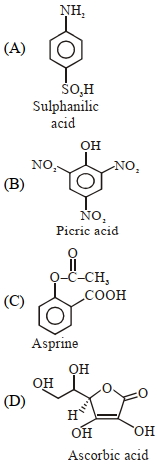
-
- (A) આલ્કોહોલ અને એસિડ સાથે સિસ\(-\)બ્યુટ\(-2-\)ઇનડાયોઈક ઍસિડની પ્રક્રિયા
- (B) સિસ\(-\)બ્યુટ\(-2-\)ઇનડાયોઈક ઍસિડને ગરમ કરતાં
- (C) આલ્કોહોલ અને એસિડ સાથે ટ્રાન્સ\(-\)બ્યુટ\(-2-\)ઇનડાયોઈક ઍસિડની પ્રક્રિયા
- (D) ટ્રાન્સ\(-\)બ્યુટ\(-2-\)ઇનડાયોઈક ઍસિડને ગરમ કરતાં
જવાબ અને ઉકેલ જુઓ
સાચો જવાબ: (B)
Cis but \(2 -\)enoic acid
-
- (A) \(III > II > I > IV\)
- (B) \(IV > III > II > I\)
- (C) \(I > II > III > TV\)
- (D) \(II > III > IV > I\)
જવાબ અને ઉકેલ જુઓ
સાચો જવાબ: (D)
\(2 > 3 > 4 > 1\)
-
- (A) \(CH _{3} CH _{2} OH\) \(\xrightarrow[{573\,\,K}]{{Cu}}\)
- (B) \(CH _{3} CN \frac{( i ) DBAL - H }{( i ) H _{2} O }\) \(\xrightarrow[{(ii)\,{H_2}o}]{{{\text{(i) DIBAL - H}}}}\)
- (C) \(CH _{2}= CH _{2}+ O _{2}\) \(\xrightarrow[{{H_2}O}]{{Pd(II)/Cu(II)}}\)
- (D) \(CH _{3} CH _{2} OH\) \(\xrightarrow{{Cr{O_3} - {H_2}S{O_4}}}\)
જવાબ અને ઉકેલ જુઓ
સાચો જવાબ: (D)
\(C{H_3} - C{H_2} - OH\xrightarrow[{{\text{Strong oxidising agent}}}]{{Cr{O_3} \cdot {H_2}S{O_4}}}\begin{array}{*{20}{c}} O \\ {||} \\ {C{H_3} - C - OH} \\ {{\text{(Carboxylic acid is formed by complete oxidation )}}} \end{array}\) -
- (A) \({CH}_{3} {CH}_{2} {COCH}_{3}+{OI}^{-} / {H}_{3} {O}^{+}\)
- (B) \(\mathrm{CH}_{3} \mathrm{CH}_{2} \mathrm{CH}_{3}+\mathrm{KMnO}_{4}(\mathrm{Heat}), \mathrm{OH} / \mathrm{H}_{3} \mathrm{O}^{+}\)
- (C) \({CH}_{3} {CH}_{2} {CCl}_{3}+{OH}^{-} / {H}_{3} {O}^{+}\)
- (D) \({CH}_{3} {CH}_{2} {CH}_{2} {Br}+{Mg}, {CO}_{2}\) શુષ્ક ઈથર \(/ {H}_{3} {O}^{+}\)
જવાબ અને ઉકેલ જુઓ
સાચો જવાબ: (D)
All gives propanoic acid as product but option \(4\) gives butanoic as product
-
- (A) \((a)-(ii), (b)-(i), (c)-(iv), (d)-(iii)\)
- (B) \((a)-(iii), (b)-(iv), (c)-(i), (d)-(ii)\)
- (C) \((a)-(ii), (b)-(iv), (c)-(i), (d)-(iii)\)
- (D) \((a)-(iii), (b)-(i), (c)-(iv), (d)-(ii)\)
જવાબ અને ઉકેલ જુઓ
સાચો જવાબ: (C)
Match list\(-I\) And list\(-II\)\((a)\) \(\begin{array}{*{20}{c}} O \\ {||} \\ {R - C - Cl} \end{array}\xrightarrow[{Pd - BaS{O_4}}]{{{H_2}}}\begin{array}{*{20}{c}} {\,\,\,\,\,\,\,O} \\ {\,\,\,\,\,\,\,\,||} \\ {R{\text{ }} - {\text{ }}CH} \end{array}\) \((a)-(ii)\)
Rosenmund Reduction
\((b)\) \(R - CH _{2}- COOH\) \(\xrightarrow[{{H_2}O}]{{C{l_2}/P}}\) \(\begin{array}{*{20}{c}} {R - CH - COOH} \\ {|\,\,\,\,\,\,\,\,\,\,\,\,\,\,\,} \\ {Cl\,\,\,\,\,\,\,\,\,\,\,\,} \end{array}\)
\(HVZ\) reaction \((b)-(iv)\)
\((c)\) \(\begin{array}{*{20}{c}} {O\,\,\,\,\,} \\ {||\,\,\,\,\,\,} \\ {R - C - N{H_2}} \end{array}\) \(\xrightarrow[{NaOH}]{{B{r_2}}}\) \(R - NH _{2}\)
Hoffmann Bromamide reaction \((c) - (i)\)
\((d)\) \(\begin{array}{*{20}{c}} {O\,\,\,\,\,\,} \\ {||\,\,\,\,\,\,} \\ {R - C - C{H_3}} \end{array}\xrightarrow[{conc.{\kern 1pt} HCl}]{{Zn(Hg)}}{\mkern 1mu} R - C{H_2} - C{H_3}\)
Clemmenson reduction \((d) - (iii)\)
-
- (A) સંયોજન \('A'\) ડાયકાર્બોક્સિલિક એસિડ છે અને સંયોજન \('B'\) ડાયોલ છે.
- (B) સંયોજન \('A'\) ડાયોલ છે અને સંયોજન \('B'\) ડાયકાર્બોક્સિલિક એસિડ છે.
- (C) બંને સંયોજન \('A'\) અને સંયોજન \('B'\) ડાયોલ્સ છે.
- (D) સંયોજન \('A'\) અને સંયોજન \('B'\) બંને ડાયકાર્બોક્સિલિક એસિડ છે.
જવાબ અને ઉકેલ જુઓ
સાચો જવાબ: (A)
\({KMnO}_{4} / {H}_{2} {SO}_{4} / \Delta\) act as a strong oxidising agent where as \({KMnO}_{4} / {H}_{2} {O} / 273\, {~K}\) is a mild oxidising agent.
-
- (A) માત્ર \((a)\) અને \((c)\)
- (B) માત્ર \((b), (c)\) અને \((d)\)
- (C) માત્ર \((a), (b)\) અને \((d)\)
- (D) માત્ર \((b)\) અને \((d)\)
જવાબ અને ઉકેલ જુઓ
સાચો જવાબ: (B)
Bromine water gives tribromo products, other gives monbromo products in which para is major product. - 75. કયા ક્રિયાશીલ સમૂહ કે જે અનુક્રમે ધનાયન અને ઋણાયન આદાનપ્રદાન રેઝિનની આયન-વિનિમય સંપત્તિ માટે જવાબદાર છે: 2021 મધ્યમ
- (A) \(- SO _{3} H\) અને \(- NH _{2}\)
- (B) \(- SO _{3} H\) અને \(- COOH\)
- (C) \(- NH _{2}\) અને \(- COOH\)
- (D) \(- NH _{2}\) અને \(- SO _{3} H\)
જવાબ અને ઉકેલ જુઓ
સાચો જવાબ: (A)
Cation exchanger contains \(- SO _{3} H\) or \(- COOH\) groups while anion exchanger contains basic groups like \(- NH _{2}\) -
- (A) બંને વિધાન \(I\) અને \(II\) ખોટા છે.
- (B) વિધાન \(I\) ખોટું છે પરંતુ વિધાન \(II\) સાચું છે.
- (C) વિધાન \(I\) સાચું છે પરંતુ વિધાન \(II\) ખોટું છે.
- (D) બંને વિધાન \(I\) અને \(II\) સાચા છે.
જવાબ અને ઉકેલ જુઓ
સાચો જવાબ: (C)
Statement \(1\) is trueBut it consume \(3\) moles of \(G\) \(R\)
So statement \(2\) is false.

-
- (A) બંને વિધાન \(I\) અને \(II\) સાચા છે
- (B) બંને વિધાન \(I\) અને \(II\) ખોટા છે
- (C) વિધાન \(I\) એ સાચું પરંતુ વિધાન \(II\) એ ખોટું છે
- (D) વિધાન \(I\) એ ખોટું પણ વિધાન \(II\) એ સાચું છે
જવાબ અને ઉકેલ જુઓ
સાચો જવાબ: (C)
Alkane are very less reactive, tertiary hydrogen can oxidise to alcohal with \(KMnO _{4}\).
-
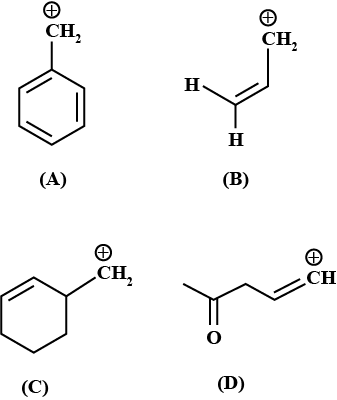
- (A) ધનાયન \(B\) વધુ સ્થિર છે અને ઝડપી દરે પ્રમાણમાં રચના કરે છે
- (B) ધનાયન \(A\) વધુ સ્થિર છે અને ધીમા દરે પ્રમાણમાં રચના કરે છે
- (C) ધનાયન \(B\) વધુ સ્થિર છે અને ધીમા દરે પ્રમાણમાં રચના કરે છે
- (D) ધનાયન \(A\) વધુ સ્થિર છે અને ઝડપી દરે પ્રમાણમાં રચના કરે છે
જવાબ અને ઉકેલ જુઓ
સાચો જવાબ: (A)
This is more stable due to secondary cation formation and formed with faster rate due to low activation energy.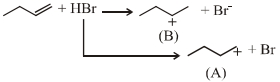
-
- (A) \(573\, K ,\, Cu , 300\, atm\)
- (B) \(623\, K ,\, Cu , 300\, atm\)
- (C) \(573\, K , 300\, atm\)
- (D) \(623\, K , 300\, atm\)
જવાબ અને ઉકેલ જુઓ
સાચો જવાબ: (D)
Temperature \(=623 K\)Pressure \(=300 atm\)
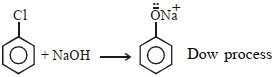
- 80. \({H}_{4} {P}_{2} {O}_{7}, {H}_{4} {P}_{2} {O}_{5}\) અને \({H}_{4} {P}_{2} {O}_{6}\)માં \('P'\)ની ઓક્સિડેશન અવસ્થા અનુક્રમે છે? 2021 અઘરું
- (A) \(5,3\) અને \(4\)
- (B) \(6,4\) અને \(5\)
- (C) \(5,4\) અને \(3\)
- (D) \(7,5\) અને \(6\)
જવાબ અને ઉકેલ જુઓ
સાચો જવાબ: (A)
Oxidation state of \({P}\) in \({H}_{4} {P}_{2} {O}_{7}, {H}_{4} {P}_{2} {O}_{5}\) and \({H}_{4} {P}_{2} {O}_{6}\) is \(5,3 \& 4\) respectively\({H}_{4} {P}_{2} {O}_{7}\)
\(2 {x}+4(+1)+7(-2)=0\)
\({x}=+5\)
\({H}_{4} {P}_{2} {O}_{5}\)
\(2 {x}+4(+1)+5(-2)=0\)
\({x}=+3\)
\({H}_{4} {P}_{2} {O}_{6}\)
\(2 {x}+4(+1)+6(-2)=0\)
\({x}=+4\)
-
- (A) \({HOCl}\)
- (B) પ્રવાહી \(NH_{3}\)
- (C) મંદ \(HNO_{2}\)
- (D) સાંદ્ર. \({HIO}_{3}\)
જવાબ અને ઉકેલ જુઓ
સાચો જવાબ: (D)
lodination of alkane is reversible reaction.It can be irreversible in the presence of strong oxidising agent like conc. \({HNO}_{3}\) or conc. \({HIO}_{3}\)
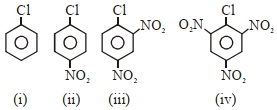
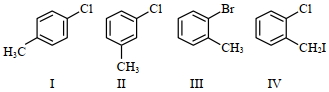
- 82. નીચે આપેલા સંયોજનોનો કેન્દ્રાનુરાગી વિસ્થાપન પ્રક્રિયા તરફના ચઢતા વલણ દર્શાવતાનો સાચો ક્રમ શોધો.
 2021 સરળ
- (A) \(( iv ) < ( iii ) < ( ii ) < ( i )\)
- (B) \(( iv ) < ( i ) < ( ii ) < ( iii )\)
- (C) \(( iv ) < ( i ) < ( iii ) < ( ii )\)
- (D) \(( i ) < ( ii ) < ( iii ) < ( iv )\)
જવાબ અને ઉકેલ જુઓ
સાચો જવાબ: (D)
For nucleophile substitution in aromatic halidesCorrect order is :
\(( i ) < ( ii ) < ( iii ) < ( iv )\)
More No. of \(NO _{2}\) substituted aromatic halide, increase the rate of nucleophile substitution reaction in aromatic halides.
-
- (A) \(II\)
- (B) \(IV\)
- (C) \(I\)
- (D) \(III\)
જવાબ અને ઉકેલ જુઓ
સાચો જવાબ: (B)
Other compounds halide can't be removed because corresponding \({C}^{+}\) is highly unstable.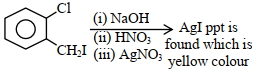
-
- (A) \({H}_{2} {O}_{2}\)
- (B) \({Cl}_{2} {C}={CCl}_{2}\)
- (C) \({CCl}_{4}\)
- (D) પ્રવાહી \({CO}_{2}\)
જવાબ અને ઉકેલ જુઓ
સાચો જવાબ: (C)
\({CO}_{2}, {CCl}_{4}\) and \({Cl}_{2} {C}={CCl}_{2}\) are used as dry cleaning agents for clothes.\({H}_{2} {O}_{2}\) is used as bleaching agent in laundry.
-
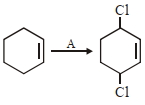
- (A) \(A = HCl ;\) નિર્જળ \(AlCl _{3}\)
- (B) \(A = HCl , ZnCl _{2}\)
- (C) \(A = Cl _{2} ; UV\) પ્રકાશ
- (D) \(A = Cl _{2}\); અંધારું, નિર્જળ \(AlCl _{3}\)
જવાબ અને ઉકેલ જુઓ
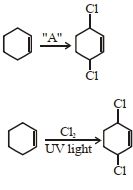
સાચો જવાબ: (C)
For substitution at allylic position in the given compound, the reagent used is \(Cl _{2} / uv\) light.The reaction is free radical halogenation.
-
- (A) \(a - ii , b - i , c - iv , d - iii\)
- (B) \(a-i i i, b-i v, c-i i, d-i\)
- (C) \(a-iii, b-i, c-i v, d-i i\)
- (D) \(a - ii , b - iv , c - i , d - iii\)
જવાબ અને ઉકેલ જુઓ
સાચો જવાબ: (B)
\((a)\) Alcoholic potassium hydroxide \(\rightarrow\) used for \(\beta-\) elimination\((b)\) \(Pd / BaSO _{4} \rightarrow\) Lindlar's catalyst
\((c)\) \(BHC\) (Benzene hexachloride) \(\rightarrow\) Obtained by addition reactions
\((d)\) Polyacetylene \(\rightarrow\) Electrodes in batteries
-
- (A) માત્ર \((B)\) અને \((C)\)
- (B) માત્ર \((A)\)
- (C) માત્ર \((A)\) અને \((C)\)
- (D) માત્ર \((B)\)
જવાબ અને ઉકેલ જુઓ
સાચો જવાબ: (C)
Ambident nucleophile\((A)\) \(KCN\) And \(AgCN\)
\((C)\) \(AgNO _{2}\) And \(KNO _{2}\)
-
- (A) માત્ર \((C)\) અને \((D)\)
- (B) માત્ર \((A), (B)\) અને \((C)\)
- (C) માત્ર \((A), (B)\) અને \((D)\)
- (D) માત્ર \((A)\) અને \((B)\)
જવાબ અને ઉકેલ જુઓ
સાચો જવાબ: (D)
\((A)\) and \((B)\) only in Resonance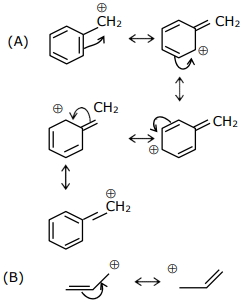
-
- (A) \(3\)
- (B) \(4\)
- (C) \(2\)
- (D) \(1\)
જવાબ અને ઉકેલ જુઓ
સાચો જવાબ: (C)
\({MCl}_{3} .2 {~L}\) octahedral\({MCl}_{3} \cdot 2 {~L} \stackrel{{Ex} . {AgNO}_{3}}{\longrightarrow} 1 {~mole} \text { of } {AgCl}\)
Its means that one \({Cl}^{-}\)ion present in ionization sphere.
\(\therefore \text { formula }=\left[{MCl}_{2} {~L}_{2}\right] {Cl}\)
For octahedral complex coordination no. is \(6\)
\(\therefore {L}\) act as bidentate ligand
-
- (A) પીળો, નારંગી
- (B) પીળો, લીલો
- (C) લીલો, નારંગી
- (D) લીલો, પીળો
જવાબ અને ઉકેલ જુઓ
સાચો જવાબ: (D)
Colour of \({Fe}^{2+}\) is observed green and \({Fe}^{3+}\) is yellow -
- (A) \(1\)
- (B) \(3\)
- (C) \(2\)
- (D) \(5\)
જવાબ અને ઉકેલ જુઓ
સાચો જવાબ: (C)
\(\left[{Ag}\left({NH}_{3}\right)_{2}\right]\left[{Ag}({CN})_{2}\right]\)\(\downarrow\quad\quad\quad\,\,\,\,\,\,\,\,\,\,\downarrow\)
\(+1\quad\quad\,\,\,\,\,\,\,\,\,\,+1\)
-
- (A) \(1\)
- (B) \(0\)
- (C) \(2\)
- (D) \(3\)
જવાબ અને ઉકેલ જુઓ
સાચો જવાબ: (B)
Mole of \({AgCl}\) precipitated is equal the mole of \({Cl}^{-}\)present in ionization sphere.\(\left[{Cr}\left({H}_{2} {O}\right)_{3}\left({NH}_{3}\right)_{3}\right] {Cl}_{3} \rightarrow\left[{Cr}\left({H}_{2} {O}\right)_{3}\left({NH}_{3}\right)_{3}\right]^{3+}+3 {Cl}^{-} \overset{AgNO_3}{\rightarrow} AgCl\)
\(1\, mole\) \(\quad\quad\quad\quad\quad\quad\quad\quad\quad\quad1\, mole\) \(\quad\quad\quad\quad3\, mole \quad\quad\quad3\, mole\)
Since none of \({Cl}^{-}\)is present in the co-ordination sphere. Therefore answer is zero.
-
- (A) \(1\)
- (B) \(2\)
- (C) \(3\)
- (D) \(5\)
જવાબ અને ઉકેલ જુઓ
સાચો જવાબ: (B)
\({\left[{CO}({CN})_{6}\right]^{4-}}\)\({x}+6 \times(-1)=-4\)
\({x}=+2\)
\({Co}^{2+}:[{Ar}] 3 {~d}^{7}\)
and \({CN}^{-}\)is a strong field ligand which can pair electron of central atom.
It has one unpaired electron ( \(n\) ) in \(4d-\)subshell.So spin only magnetic moment \((\mu)=\sqrt{n(n+2)}\, B . M\)
where \({n}=\) number of unpaired electrons.
\(\mu=\sqrt{3} \,{~B} . {M} \quad \mu=1.73\, {BM}\)

-
- (A) \(6\)
- (B) \(5\)
- (C) \(4\)
- (D) \(3\)
જવાબ અને ઉકેલ જુઓ
સાચો જવાબ: (A)
\(3\left[{Co}({en})_{2} {Cl}_{2}\right] {Cl}+\underset{\text { (excess) }}{{AgNO}_{3}} \rightarrow \underset{\text { (white ppt) }}{3 {AgCl}}\)Secondary valency of \({Co}=6\)
\((C.N.)\)
- 95. \(\left[ Co ( ox )_{2}( Br )\left( NH _{3}\right)\right]^{2-}\) માટે શક્ય અવકાશીય સમઘટકોની સંખ્યા ...... છે. \([ ox =\) ઓક્ઝલેટ \(]\) 2021 મધ્યમ
- (A) \(5\)
- (B) \(8\)
- (C) \(14\)
- (D) \(3\)
જવાબ અને ઉકેલ જુઓ
સાચો જવાબ: (D)
Total number of stereoisomers in\(\left[ Co ( ox )_{2} Br \left( NH _{3}\right)\right]^{2 -}\) i.e. \(\simeq\left[ M ( AA )_{2} ab \right]^{2-}\)
\(\rightarrow\) cis is optically active isomers and trans is optically inactive isomer
\(\rightarrow\) Hence total isomers is \(=3\)

-
- (A) \(1\)
- (B) \(5\)
- (C) \(2\)
- (D) \(6\)
જવાબ અને ઉકેલ જુઓ
સાચો જવાબ: (C)
trans \(- CoCl _{3} \cdot 4 NH _{3}\)or
\(\operatorname{trans}-\left[ Co \left( NH _{3}\right)_{4} Cl _{2}\right] C \ell\)
As we know that ethylene diamine is a bidentate ligand and ammonia is a mono dentate ligand.
It means overall two ethylene diamine is required to replace the all neutral ligands (four ammonia) from the coordination sphere of this complex.

- 97. \(\left[{Cr}\left({C}_{2} {O}_{4}\right)_{3}\right]^{3-}\) માટે પ્રકાશીય સમઘટકની સંખ્યા \(.....\) શક્ય છે. 2021 મધ્યમ
- (A) \(2\)
- (B) \(1\)
- (C) \(4\)
- (D) \(3\)
જવાબ અને ઉકેલ જુઓ
સાચો જવાબ: (A)
The number of optical isomers for \(\left[{Cr}\left({C}_{2} {O}_{4}\right)_{3}\right]^{3-}\) is two.
- 98. દ્વિસંયોજક ધાતુ આયન અણુ સંખ્યા \(25\) સાથેનું સ્પિન-ફક્ત ચુંબકીય ચાકમાત્રા મૂલ્ય\((BM)\) શું છે, તે જલીય દ્રાવણમાં છે? 2021 અઘરું
- (A) \(5.92\)
- (B) \(5.0\)
- (C) \(0\)
- (D) \(5.26\)
જવાબ અને ઉકેલ જુઓ
સાચો જવાબ: (A)
Electronic configuration of divalent metal ion having atomic number \(25\) isTotal number of unpaired electrons \(=5\)
\(\mu\) (Magnetic moment) \(=\sqrt{ n ( n +2)} BM\)
where \(n =\) number of unpaired \(e ^{-}\)
\(\therefore \mu=\sqrt{5(5+2)}=\sqrt{35} BM =5.92 BM\)

- 99. \(\left[{Fe}({CO})_{4}\left({C}_{2} {O}_{4}\right)\right]^{+}\)ની માત્ર ફક્ત સ્પિન ચુંબકીય ચાકમાત્રા \(BM\)માં ગણો. 2021 સરળ
- (A) \(5.92\)
- (B) \(0\)
- (C) \(1\)
- (D) \(1.73\)
જવાબ અને ઉકેલ જુઓ
સાચો જવાબ: (D)
\(\left[{Fe}({CO})_{4}\left({C}_{2} {O}_{4}\right)\right]^{+}\)One unpaired electron
Spin only magnetic moment
\(=\sqrt{3} \,{~B} . {M}=1.73\, {BM}\)

- 100. હાઇડ્રોક્સિએપેટાઇટનું રૂપાંતર પાણીમાં \({F}^{-}\) આયનોની હાજરીને કારણે થાય છે. હાઇડ્રોક્સિએપેટાઇટનું સાચુ સૂત્ર કયુ છે? 2021 અઘરું
- (A) \(\left[3 {Ca}_{3}\left({PO}_{4}\right)_{2} \cdot {Ca}({OH})_{2}\right]\)
- (B) \(\left[3 {Ca}({OH})_{2} \cdot {CaF}_{2}\right]\)
- (C) \(\left[{Ca}_{3}\left({PO}_{4}\right)_{2} \cdot {CaF}_{2}\right]\)
- (D) \(\left[3 {Ca}_{3}\left({PO}_{4}\right)_{2} \cdot {CaF}_{2}\right]\)
જવાબ અને ઉકેલ જુઓ
સાચો જવાબ: (A)
The \({F}^{\Theta}\) ions make the enamel on teeth much harder by converting hydroxyapatite, \(\left[3\left({Ca}_{3}({PO})_{2}\right] \cdot {Ca}({OH})_{2}\right]\) the enamel on the surface of the teeth into much harder fluroappatite. \(\left[3 {Ca}_{3}\left({PO}_{4}\right)_{2} \cdot {CaF}_{2}\right]\)


આ પેજ પર આ ફિલ્ટર મુજબ કોઈ પ્રશ્ન નથી.