


2015 માં પૂછાયેલાં પ્રકરણ
26 પ્રકરણ- 5પ્રશ્નો STD 11 એકમ, પરિમાણ અને માપન સૌથી વધુ પૂછાયેલ
- 3પ્રશ્નો STD 12 સેમિકન્ડક્ટર ઇલેક્ટ્રોનિક્સ : દ્રવ્યો, રચનાઓ અને સાદા પરિપથો
- 1પ્રશ્નો STD 12 ન્યુક્લિયસ
- 3પ્રશ્નો STD 12 પરમાણુઓ
- 3પ્રશ્નો STD 12 વિદ્યુતચુંબકીય તરંગો
- 4પ્રશ્નો STD 12 તરંગ પ્રકાશશાસ્ત્ર સૌથી વધુ પૂછાયેલ
- 4પ્રશ્નો STD 12 કિરણ પ્રકાશશાસ્ત્ર અને પ્રકાશીય ઉપકરણો
- 2પ્રશ્નો STD 12 પ્રત્યાવર્તી પ્રવાહ
- 10પ્રશ્નો STD 11 6.કણોનાં તંત્રો અને ચાકગતિ સૌથી વધુ પૂછાયેલ
- 4પ્રશ્નો STD 12 ગતિમાન વિધુતભારો અને ચુંબકત્વ
- 2પ્રશ્નો STD 12 વિદ્યુતચુંબકીય પ્રેરણ
- 2પ્રશ્નો STD 12 ચુંબકત્વ અને દ્રવ્ય
- 3પ્રશ્નો STD 12 પ્રવાહ વિદ્યુત
- 2પ્રશ્નો STD 12 સ્થિત વિદ્યુતસ્થિતિમાન અને કેપેસિટન્સ
- 3પ્રશ્નો STD 12 વિધુતભારો અને ક્ષેત્રો
- 3પ્રશ્નો STD 11 તરંગો
- 4પ્રશ્નો STD 11 દોલનો
- 3પ્રશ્નો STD 11 ગતિવાદ
- 2પ્રશ્નો STD 11 થર્મોડાયનેમિક્સ
- 1પ્રશ્નો STD 11 10.1, થર્મોનેટ્રી, થર્મલ વિસ્તરણ અને કેલરીમેટ્રી
- 1પ્રશ્નો STD 11 પૃષ્ઠતાણ
- 1પ્રશ્નો STD 11 તરલના યાંત્રિક ગુણધર્મો
- 1પ્રશ્નો STD 11 ગતિના નિયમો
- 2પ્રશ્નો STD 11 ગુરુત્વાકર્ષણ
- 3પ્રશ્નો STD 11 કાર્ય, ઊર્જા અને પાવર
- 1પ્રશ્નો STD 11 સદિશ
JEE Mains 2015 Physics ના બધા પ્રશ્નો
26 પ્રકરણ73 માંથી 1–50 પ્રશ્નો
-
- (A) \(\,\eta \cdot \left( {\frac{{S\Delta \theta }}{h}} \right)\left( {\frac{1}{{\rho g}}} \right)\)
- (B) \(\,\left( {\frac{{S\Delta \theta }}{{\eta h}}} \right)\left( {\frac{1}{{\rho g}}} \right)\)
- (C) \(\,\frac{{S\Delta \theta }}{{\eta h}}\)
- (D) \(\eta \,\frac{{S\Delta \theta }}{h}\)
જવાબ અને ઉકેલ જુઓ
સાચો જવાબ: (D)
\(\begin{array}{l}
Let\,\frac{Q}{A} = {\eta ^a}{\left( {\frac{{S\Delta \theta }}{h}} \right)^b}{\left( {\frac{1}{{\rho g}}} \right)^c}\\
{\rm{Using}}\,{\rm{dimensional}}\,method\\
M{T^{ - 3}} = {\left[ {M{L^{ - 1}}{T^{ - 1}}} \right]^a}{\left[ {L{T^{ - 2}}} \right]^b}{\left[ {{M^{ - 1}}{L^2}{T^2}} \right]^c}\\
or,\,M{T^{ - 3}} = \left[ {{M^{a - c}}{L^{ - a + b + 2c}}{T^{ - a - 2b + 2c}}} \right]\\
Equating\,powers\,and\,solving\\
we\,get,a = 1,b = 1,c = 0\\
\therefore \frac{Q}{A} = \eta \frac{{S\Delta \theta }}{h}
\end{array}\) -
- (A) \(u\, = \,\frac{{{e^2}h}}{{{a_0}}}\)
- (B) \(u\, = \,\frac{{hc}}{{{e^2}{a_0}}}\)
- (C) \(u\, = \,\frac{{{e^2}c}}{{h{a_0}}}\)
- (D) \(u\, = \,\frac{{{e^2}{a_0}}}{{hc}}\)
જવાબ અને ઉકેલ જુઓ
સાચો જવાબ: (D)
The unit of capacitance is \(\frac {Coulomb}{V} = \frac {Coulomb}{\text{work done per unit charge}}\)=\(\frac{\text { Coulomb }}{\frac{ W }{\text { Coulomb }}}=\frac{\text { Coulomb }^{2}}{ kgm ^{2} s ^{-2}}= C ^{2} kg ^{-1} m ^{-2} s ^{2}\)Checking units of each option:
\(\mu=\frac{ e ^{2} c }{\text { ha }} \Rightarrow=\frac{\text { Coulomb }^{2} ms ^{-1}}{ kgm ^{2} s ^{-1} m }= C ^{2} kg ^{-1} m ^{-2} s ^{0}\)
\(\mu=\frac{ e ^{2} h }{ ca _{\circ}} \Rightarrow=\frac{\text { Coulomb }^{2} kgm ^{2} s ^{-1}}{ ms ^{-1} m }= C ^{2} kg ^{1} m ^{0} s ^{0}\)
\(\mu=\frac{\text { hc }}{ e ^{2} a _{\circ}} \Rightarrow=\frac{ kgm ^{2} s ^{-1} ms ^{-1}}{\text { Coulomb }^{2} m }= C ^{-2} kg ^{1} m ^{1} s ^{-2}\)
\(\mu=\frac{ e ^{2} a _{\circ}}{ hc } \Rightarrow=\frac{\text { Coulomb }^{2} m }{ kgm ^{2} s ^{-1} ms ^{-1}}= C ^{2} kg ^{-1} m ^{-2} s ^{-2}\)
-
- (A) \(\left( {\frac{h}{{m{e^2}}}} \right)\)
- (B) \(\left( {\frac{{hc}}{{m{e^2}}}} \right)\)
- (C) \(\left( {\frac{h}{{c{e^2}}}} \right)\)
- (D) \(\left( {\frac{{m{c^2}}}{{h{e^2}}}} \right)\)
જવાબ અને ઉકેલ જુઓ
સાચો જવાબ: (C)
Let \(\mu_{0}\) related with \(e, m, c\) and \(h\) as follows.\(\mu_{0}=k e^{a} m^{b} c^{c} h^{d}\)
\({\left[M L T^{-2} A^{-2}\right]=[A T]^{a}[M]^{b}\left[L T^{-1}\right]^{c}\left[M L^{2} T^{-1}\right]^{d}}\)
\(=\left[M^{b+d} L^{c+2 d} T^{a-c-d} A^{a}\right]\)
On comparingboth sides we get
\(a=-2 \quad \ldots(i)\)
\(b+d=1 \ldots(i i)\)
\(c+2 d=1 \ldots(i i i)\)
\(a-c-d=-2 \ldots(i v)\)
By equations \((i),(i i),(i i i)\) and \((i v)\) we get,
\(a=-2, b=0, c=-1, d=1\)
\(\left[\mu_{0}\right]=\left[\frac{h}{c e^{2}}\right]\)
-
- (A) \(0.52\)
- (B) \(0.59\)
- (C) \(0.56\)
- (D) \(0.53\)
જવાબ અને ઉકેલ જુઓ
સાચો જવાબ: (B)
\(\begin{array}{l}
Lets\,count\, = \frac{{0.1}}{{10}} = 0.01\,\,cm\\
{d_1} = 0.5 + 8 \times 0.01 + 0.03 = 0.61\,cm\\
{d_2} = 0.5 + 4 \times 0.01 + 0.03 = 0.57\,cm\\
{d_3} = 0.5 + 6 \times 0.01 + 0.03 = 0.59\,cm\\
Mean\,diameter\, = \frac{{0.61 + 0.57 + 0.59}}{3}\\
\,\,\,\,\,\,\,\,\,\,\,\,\,\,\,\,\,\,\,\,\,\,\,\,\,\,\,\,\,\,\,\,\, = 0.59\,cm
\end{array}\) -
- (A) \(3 \)
- (B) \(1\)
- (C) \(5\)
- (D) \(2 \)
જવાબ અને ઉકેલ જુઓ
સાચો જવાબ: (A)
AS, \(g = 4\,{\pi ^2}\frac{l}{{{T^2}}}\)
So, \(\frac{{\Delta g}}{g} \times 100 = \frac{{\Delta l}}{L} \times 100 + 2\frac{{\Delta T}}{T} \times 100\)
\( = \frac{{0.1}}{{20}} \times 100 + 2 \times \frac{1}{{90}} \times 100 = 2.72 \simeq 3\% \) -
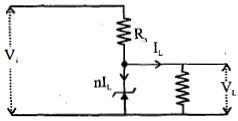
- (A) \(\frac{{\left( {{V_i} - {V_L}} \right)}}{{\left( {n + 1} \right){I_L}}}\)
- (B) \(\frac{{\left( {{V_i} + {V_L}} \right)}}{{\left( {n + 1} \right){I_L}}}\)
- (C) \(\frac{{\left( {{V_i} - {V_L}} \right)}}{{n{I_L}}}\)
- (D) \(\frac{{\left( {{V_i} + {V_L}} \right)}}{{n{I_L}}}\)
જવાબ અને ઉકેલ જુઓ
સાચો જવાબ: (A)
Voltage on resistor \(R_s\,=\,V_i\,-\,V_L\)or, \(({{I}_{L}}\,+\,n{{I}_{L}}){{R}_{s}}\,=\,{{V}_{i}}\,-\,{{V}_{L}}\)
\(\therefore \,\,{{R}_{s}}\,=\,\frac{\,{{V}_{i}}\,-\,{{V}_{L}}}{(n+\,1){{I}_{L}}}\)
- 7. અનબાયસ \(n-p\) જંકશનમાં ઇલેક્ટ્રોનનું \(n-\) વિભાગથી \(p-\) વિભાગમાં પ્રસરણ થાય છે કારણ કે... 2015 સરળ
- (A) \(p-\) વિભાગમાં રહેલ હૉલ તેને આકર્ષે છે
- (B) વિદ્યુતસ્થિતિમાનના તફાવતના કારણે ઇલેક્ટ્રોન જંકશનની પાર ગતિ કરે છે
- (C) ઇલેક્ટ્રોન માત્ર \(n\) થી \(p\) તરફ ગતિ કરે તેનું ઊલટું ના થાય
- (D) \(n-\) વિભાગમાં ઇલેક્ટ્રોનની સંખ્યા ઘનતા \(p-\) વિભાગમાં રહેલા ઇલેક્ટ્રોનની સંખ્યા ઘનતા કરતાં વધારે હોય.
જવાબ અને ઉકેલ જુઓ
સાચો જવાબ: (D)
Electrons in an unbiased \(p-n\) junction, diffuse from \(n -\) region \(i.e.\) higher electron concentration to \(p-\) region \(i.e.\) low electron concentration region. -
- (A) \(0.4\, A\) અને \(0.2\, A\)
- (B) \(0.2\, A\) અને \(0.4\, A\)
- (C) \(0.1\, A\) અને \(0.2\, A\)
- (D) \(0.2\, A\) અને \(0.1\, A\)
જવાબ અને ઉકેલ જુઓ
સાચો જવાબ: (A)
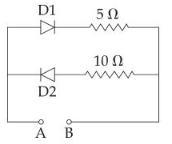
When positive terminal connected to \(A\) then diode \(D_1\) is forward biased, current \(I \, = \frac{2}{5} \, = 0.4\, A\) When positive terminal connected to \(B\) then diode \(D_2\) is forward biased, current, \(I\, = \frac{2}{10}\, = 0.2\,A\) -
- (A) \(6.2\times10^{21}\)
- (B) \(7.5\times10^{21}\)
- (C) \(1.25\times10^{22}\)
- (D) \(1.75\times10^{22}\)
જવાબ અને ઉકેલ જુઓ
સાચો જવાબ: (B)
We know that \(N_{\beta}=N_{0}\left(1-e^{-\lambda t}\right)\)\(N_{\beta}=\frac{6.023 \times 10^{23}}{24} \cdot\left[1-e^{\left(-\frac{\ln ^{2} }{15} \times 75\right)}\right]\)
on solving we get, \(\mathrm{N}_{\beta}=7.4 \times 10^{21}\)
-
- (A) \(n\left( {\frac{{hqB}}{{2\pi m}}} \right)\)
- (B) \(n\left( {\frac{{hqB}}{{8\pi m}}} \right)\)
- (C) \(n\left( {\frac{{hqB}}{{4\pi m}}} \right)\)
- (D) \(n\left( {\frac{{hqB}}{{\pi m}}} \right)\)
જવાબ અને ઉકેલ જુઓ
સાચો જવાબ: (C)
\(q V B=\frac{m v^{2}}{r}\) ..... \((i)\)\(\frac{n h}{2 \pi}=m v r\) ..... \((ii)\)
Multiplying equation \((i)\) and \((ii)\),
\(\frac{q B n h}{2 \pi}=m^{2} v^{2}\)
Now multiplying both sides by \(\frac{1}{2 m}\)
\(n \frac{q B h}{4 \pi m}=\frac{1}{2} m v^{2}\)
i.e. \(\quad \mathrm{KE}=n\left[\frac{q B h}{4 \pi m}\right]\)
- 11. જયારે હાઇડ્રોજેનિક પરમાણુ / આયનમાં ઇલેકટ્રોન ઉત્તેજિત અવસ્થામાંથી ધરાસ્થિતિમાં સંક્રાંતિ કરે છે. 2015 મધ્યમ
- (A) ગતિઊર્જા,સ્થિતિઊર્જા અને કુલઊર્જા ઘટે છે.
- (B) ગતિઊર્જા ઘટે છે, સ્થિતિઊર્જા વધે છે પણ કુલ ઊર્જા અચળ રહે છે.
- (C) ગતિઊર્જા અને કુલઊર્જા ઘટે છે,પણ સ્થિતિઊર્જા વધે છે.
- (D) તેની ગતિઊર્જા વધે છે,પણ સ્થિતિઊર્જા અને કુલઊર્જા ઘટે છે.
જવાબ અને ઉકેલ જુઓ
સાચો જવાબ: (D)
\({\text{U}} = - {\text{K}}\frac{{{\text{z}}{{\text{e}}^2}}}{{\text{r}}}\) ; \({\text{T}} \cdot {\text{E}} = - \frac{{\text{k}}}{2}\frac{{{\text{z}}{{\text{e}}^2}}}{{\text{r}}}\)\(\mathrm{K.E}=\frac{\mathrm{k}}{2} \frac{\mathrm{ze}^{2}}{\mathrm{r}} .\) Here \(r\) decreases
-
- (A) ધરા અવસ્થામાં રહેલા ઇલેક્ટ્રોનની દ'બ્રોગલી તરંગલંબાઈ કરતાં \(\frac{1}{4}\) ગણી હોય
- (B) ધરા અવસ્થામાં રહેલા ઇલેક્ટ્રોનની દ'બ્રોગલી તરંગલંબાઈ કરતાં ચાર ગણી હોય
- (C) ધરા અવસ્થામાં રહેલા ઇલેક્ટ્રોનની દ'બ્રોગલી તરંગલંબાઈ કરતાં બમણી હોય
- (D) ધરા અવસ્થામાં રહેલા ઇલેક્ટ્રોનની દ'બ્રોગલી તરંગલંબાઈ કરતાં અડધી હોય
જવાબ અને ઉકેલ જુઓ
સાચો જવાબ: (B)
De-Broglie wavelength of electron\(\lambda=\frac{h}{m V}\)
As we know, \(V \propto \frac{1}{n}\)
\(\mathrm{So}, \lambda \propto n\)
\(\lambda_{4}=4 \lambda_{1}\)
\(\lambda_{1}\) is the de-Broglie wavelength of the electron in the ground state.
-
- (A) \(2.45\)
- (B) \(5.48 \)
- (C) \(7.75\)
- (D) \(9.73 \)
જવાબ અને ઉકેલ જુઓ
સાચો જવાબ: (A)
Using \(\mathrm{U}_{\mathrm{av}}=\frac{1}{2} \varepsilon_{0} \mathrm{E}^{2}\)But \(U_{a v}=\frac{P}{4 \pi r^{2} \times c}\)
\(\frac{P}{4 \pi r^{2}}=\frac{1}{2} \varepsilon_{0} E^{2} \times c\)
\(\mathrm{E}_{0}^{2}=\frac{2 \mathrm{P}}{4 \pi \mathrm{r}^{2} \varepsilon_{0} \mathrm{c}}=\frac{2 \times 0.1 \times 9 \times 10^{9}}{1 \times 3 \times 10^{8}}\)
\(\mathrm{E}_{0}=\sqrt{6}=2.45 \,\mathrm{V} / \mathrm{m}\)
-
- (A) \(\vec B\,(x\,,\,t) = (3 \times {10^{ - 8}}\,T)\,\hat j \;\sin \,[2\pi \,(1.5 \times {10^{ - 8}}\,x\, - \,2 \times {10^{14}}\,t)]\)
- (B) \(\vec B\,(x\,,\,t) = (9 \times {10^{ - 8}}\,T)\,\hat i\; \sin \,[2\pi \,(1.5 \times {10^{ - 8}}\,x\, - \,2 \times {10^{14}}\,t)]\)
- (C) \(\vec B\,(x\,,\,t) = (9 \times {10^{ - 8}}\,T)\,\hat j\;\sin \,[(1.5 \times {10^{ - 6}}\,x\, - \,2 \times {10^{14}}\,t)]\)
- (D) \(\vec B\,(x\,,\,t) = (9 \times {10^{ - 8}}\,T)\,\hat k \;\sin \,[2\pi \,(1.5 \times {10^{ - 6}}\,x\, - \,2 \times {10^{14}}\,t)]\)
જવાબ અને ઉકેલ જુઓ
સાચો જવાબ: (D)
As we know,\(B_{0}=\frac{E_{0}}{C}=\frac{27}{3 \times 10^{8}}=9 \times 10^{-8}\) \(tesla\)
Oscillation of \(B\) can be only along \(\hat{\jmath}\) or \(\hat{k}\) direction.
\(\omega=2 \pi f=2 \pi \times 2 \times 10^{14} \,\mathrm{Hz}\)
\(\therefore \bar{B}(x, t)=\left(9 \times 10^{-8} T\right) \hat{k} \sin [2 \pi(1)\left.1.5 \times 10^{-6} \times-2 \times 10^{4} t\right)\)
- 15. \(z-\) દિશામાં પ્રસરતા સમતલીય વિદ્યુતચુંબકીય તરંગ માટે નીચે પૈકી કઈ \(\vec E\) અને \(\vec B\) ની જોડ શક્ય બને? 2015 મધ્યમ
- (A) \(\left( {2\hat i + 3\hat j} \right)\) અને \(\left( {\hat i + 2\hat j} \right)\)
- (B) \(\left( {-2\hat i - 3\hat j} \right)\) અને \(\left( {3\hat i - 2\hat j} \right)\)
- (C) \(\left( {3\hat i + 4\hat j} \right)\) અને \(\left( {4\hat i - 3\hat j} \right)\)
- (D) \(\left( {\hat i + 2\hat j} \right)\) અને \(\left( {2\hat i - \hat j} \right)\)
જવાબ અને ઉકેલ જુઓ
સાચો જવાબ: (B)
As we know, \(\vec E \cdot \vec B = 0\) \(\because [\vec E \bot \vec B]\) and \(\vec{E} \times \vec{B}\) should be along \(Z\) directionAs \((-2 \hat{i}-3 \hat{j}) \times(3 \hat{i}-2 \hat{j})=13 \hat{k}\)
Hence option \((b)\) is the correct answer.
-
- (A) \(\left| {{P_y}} \right|d > h\)
- (B) \(\left| {{P_y}} \right|d < h\)
- (C) \(\left| {{P_y}} \right|d \simeq h\)
- (D) \(\left| {{P_y}} \right|d > > h\)
જવાબ અને ઉકેલ જુઓ
સાચો જવાબ: (A)
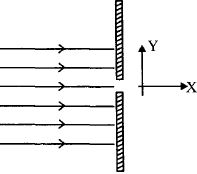
From Bragg's equation\(d \sin \theta=\lambda\)
\(\sin \theta=\frac{\lambda}{d}<1\)
\(\therefore \lambda < d\)
\(\frac{h}{{\left| {{p_y}} \right|}} < d\) \(\left[ {\because \lambda = \frac{h}{{\left| {{p_y}} \right|}}} \right]\)
\(\therefore \quad h<\left|p_{y}\right| d\)
- 17. \(I_0\) તીવ્રતા ધરાવતો અધ્રુવીભૂત પ્રકાશ એક કાચની સપાટી પર બ્રુસ્ટર ખૂણે આપત થાય છે. આ કિસ્સા માટે નીચે પૈકી કયું વિધાન સાચું પડે? 2015 મધ્યમ
- (A) પરાવર્તિત પ્રકાશ સંપૂર્ણ ધ્રુવીભૂત હશે જેની તીવ્રતા \(\frac{I_0}{2}\) કરતાં ઓછી હશે
- (B) ટ્રાન્સમીટેડ પ્રકાશ સંપૂર્ણ ધ્રુવીભૂત હશે જેની તીવ્રતા \(\frac{I_0}{2}\) કરતાં ઓછી હશે
- (C) ટ્રાન્સમીટેડ પ્રકાશ પાશ્વિક ધ્રુવીભૂત હશે જેની તીવ્રતા \(\frac{I_0}{2}\) હશે
- (D) પરાવર્તિત પ્રકાશ પાશ્વિક ધ્રુવીભૂત હશે જેની તીવ્રતા \(\frac{I_0}{2}\) હશે
જવાબ અને ઉકેલ જુઓ
સાચો જવાબ: (A)
When unpolarised light is incident at Brewster 's angle then reflected light is completely polarized and the intensity of the reflected light is less than half of the incident light. -
- (A) \(30\)
- (B) \(100\)
- (C) \(300\)
- (D) \(1\)
જવાબ અને ઉકેલ જુઓ
સાચો જવાબ: (A)
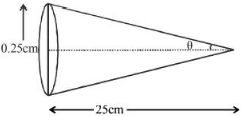
\(\sin \,\theta \, = \,\frac{{0.25}}{{25}}\, = \,\frac{1}{{100}}\)Resolving power \( = \,\frac{{1.22\,\lambda }}{{2\,\mu \,\sin \,\theta }}\, = \,30\,\mu m\)
-
- (A) \(\frac{\beta }{6}\)
- (B) \(\frac{\beta }{3}\)
- (C) \(\frac{\beta }{4}\)
- (D) \(\frac{\beta }{2}\)
જવાબ અને ઉકેલ જુઓ
સાચો જવાબ: (C)
\(2 I_{0}=4 I_{0} \cos ^{2}\left(\frac{\Delta \phi}{2}\right) \quad\) here, \(\Delta \phi=\frac{\pi}{2}\)But, \(\Delta \phi=\frac{2 \pi}{\lambda} \Delta x\)
so, \(\Delta x=\frac{\lambda}{4}\)
\(\frac{d y}{D}=\frac{\lambda}{4}\) ..... \((i)\)
\({\frac{{\lambda D}}{d} = \beta }\) ..... \((ii)\)
Multiplying equation \((i)\) and \((ii)\) we get,
\(y=\frac{\beta}{4}\)
-
- (A) \(\theta < Si{n^{ - 1}}\left[ {\mu sin\left( {A - si{n^{ - 1}}\left( {\frac{1}{\mu }} \right)} \right)} \right]\)
- (B) \(\;\theta > co{s^{ - 1}}\left[ {\mu sin\left( {A + si{n^{ - 1}}\left( {\frac{1}{\mu }} \right)} \right)} \right]\)
- (C) \(\;\theta < co{s^{ - 1}}\left[ {\mu sin\left( {A + si{n^{ - 1}}\left( {\frac{1}{\mu }} \right)} \right)} \right]\)
- (D) \(\theta > Si{n^{ - 1}}\left[ {\mu sin\left( {A - si{n^{ - 1}}\left( {\frac{1}{\mu }} \right)} \right)} \right]\)
જવાબ અને ઉકેલ જુઓ
સાચો જવાબ: (D)
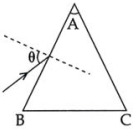
When \({{\text{r}}_2} = {\text{C}},\) \(\angle {{\text{N}}_2}{\text{Rc}} = {90^o}\)Where \(C=\) critical angle
As \(\sin C=\frac{1}{v}=\sin r_{2}\)
Applying snell's law at \('R'\)
\(\mu \,\,\sin {r_2} = 1\,\,\sin {90^o}\) ..... \((i)\)
Applying snell's law at \('Q'\)
\(1 \times \sin \theta=\mu \sin r_{1}\) ...... \((ii)\)
But \(r_{1}=A-r_{2}\)
So, \(\sin \theta=\mu \sin \left(A-r_{2}\right)\)
\(\sin \theta=\mu \sin A \cos r_{2}-\cos A\) ...... \((iii)\) [using \((i)\) ]
From \(( 1 )\)
\(\cos r_{2}=\sqrt{1-\sin ^{2} r_{2}}=\sqrt{1-\frac{1}{\mu^{2}}}\) ..... \((iv)\)
By eq. \((iii)\) and \((iv)\)
\(\sin \theta=\mu \sin A \sqrt{1-\frac{1}{\mu^{2}}}-\cos A\)
on further solving we can show for raynot to transmitted through face \(AC\)
\(\theta=\sin ^{-1}\left[u \sin \left(A-\sin ^{-1}\left(\frac{1}{\mu}\right)\right]\right.\)
So, for transmission through face \(\mathrm{AC}\)
\(\theta > {\sin ^{ - 1}}\) \(\left[ {u\sin \left( {A - {{\sin }^{ - 1}}\left( {\frac{1}{\mu }} \right)} \right]} \right.\)
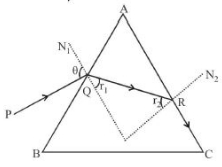
-
- (A) \(60\)
- (B) \(-24\)
- (C) \(-60\)
- (D) \(24\)
જવાબ અને ઉકેલ જુઓ
સાચો જવાબ: (C)
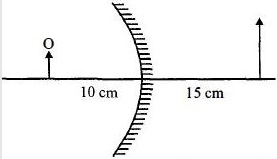
convex mirror is used as a shaving mirror.From question \(: v=15\, \mathrm{cm}, u=-10\,\mathrm{cm}\)
Radius of curvature, \(R=2\,\,f=?\)
Using mirror formula, \(\frac{1}{v}+\frac{1}{u}=\frac{1}{f}\)
\(\frac{1}{15}+\frac{1}{(-10)}=\frac{1}{f} \Rightarrow f=-30\, \mathrm{cm}\)
Therefore radius of curvature,
\(R=2\, \,f=-\,60\, \mathrm{cm}\)
-
- (A) \(3f\)
- (B) \(\frac{3}{2}f\)
- (C) \(f\)
- (D) \(2f\)
જવાબ અને ઉકેલ જુઓ
સાચો જવાબ: (D)
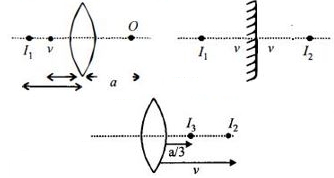
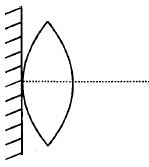
When object is keept at a distance \('a'\) from thin covex lensBy lens formula: \(\frac{1}{v}-\frac{1}{u}=\frac{1}{f}\)
\(\frac{1}{V}-\frac{1}{(-a)}=\frac{1}{f}\)
or, \(\frac{1}{v}=\frac{1}{f}-\frac{1}{a}\) ...... \((i)\)
Mirror forms image at equal distance from mirror
Now, again from lens formula
\(\frac{3}{a}-\frac{1}{V}=\frac{1}{f}\)
\({\frac{3}{a} - \frac{1}{f} + \frac{1}{a} = \frac{1}{f}}\) [From eqn. \((i)\)]
Hence, \(a=2f\)
-
- (A) \(30\)
- (B) \(15\)
- (C) \(60\)
- (D) \(1\)
જવાબ અને ઉકેલ જુઓ
સાચો જવાબ: (A)
Magnifying power of telescope,\(M P=\frac{\tan \beta( \text { angle subtended by image at eye piece) } }{\tan \alpha \text { (angle subtended by object on objective) }}\)
Also, \(M P =\frac{f_{o}}{f_{e}}=\frac{150}{5}=30\)
\(\tan \alpha =\frac{50}{1000}=\frac{1}{20}\, \mathrm{rad}\)
\(\therefore \quad \tan \beta=\theta=M P \times \tan \alpha\)
\(=30 \times \frac{1}{20}=\frac{3}{2}=1.5\)
or, closest value of \(\beta \approx 60^o\)
-
- (A) ગરમ વોલ્ટમીટરના તાર વડે
- (B) ફરતા ગુચળાવાળા ગેલ્વેનોમીટર વડે
- (C) સ્થિતમાન ધરાવતા ગુચળાવાળા ગેલ્વેનોમીટર વડે
- (D) ફરતા ચુંબકવાળા ગેલ્વેનોમીટર વડે
જવાબ અને ઉકેલ જુઓ
સાચો જવાબ: (B)
To measure \(AC\) voltage across a resistance a moving coil galvanometer is used -
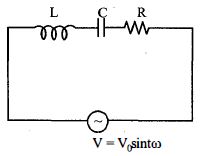
- (A) \(C\) સાથે શ્રેણીમાં અને તેનું મૂલ્ય \(\frac{C}{{\left( {{\omega ^2}LC - 1} \right)}}\) જેટલું હશે
- (B) \(C\) સાથે શ્રેણીમાં અને તેનું મૂલ્ય \(\,\frac{{\left( {1 - {\omega ^2}LC} \right)}}{{{\omega ^2}L}}\) જેટલું હશે
- (C) \(C\) સાથે સમાંતરમાં અને તેનું મૂલ્ય \(\,\frac{{\left( {1 - {\omega ^2}LC} \right)}}{{{\omega ^2}L}}\) જેટલું હશે
- (D) \(C\) સાથે સમાંતરમાં અને તેનું મૂલ્ય \(\frac{C}{{\left( {{\omega ^2}LC - 1} \right)}}\) જેટલું હશે
જવાબ અને ઉકેલ જુઓ
સાચો જવાબ: (C)
Power factor\(\cos \phi=\frac{R}{\sqrt{R^{2}+\left[\omega L-\frac{1}{\omega\left(C+C^{\prime}\right)}\right]^{2}}}=1\)
On solving we get,
\(\omega L=\frac{1}{\omega\left(C+C^{\prime}\right)}\)
\(C' = \frac{{1 - {\omega ^2}LC}}{{{\omega ^2}L}}\)
Hence option \((c)\) is the correct answer.
-
- (A) \(14.4\)
- (B) \(8.64\)
- (C) \(20.16\)
- (D) \(11.52\)
જવાબ અને ઉકેલ જુઓ
સાચો જવાબ: (A)
Angular momentum,\(\begin{array}{l}
{L_0} = mvr\sin {90^ \circ }\\
= 2 \times 0.6 \times 12 \times 1 \times 1\\
\left[ {AS\,\,V = r\omega ,\,\sin \,{{90}^ \circ } = 1} \right]\\
So,\,{L_0} = 14.4\,kg{m^2}/s
\end{array}\)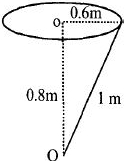
-
- (A) \(14.4\)
- (B) \(8.64\)
- (C) \(20.16\)
- (D) \(11.52\)
જવાબ અને ઉકેલ જુઓ
સાચો જવાબ: (A)
Angular momentum,\(\begin{array}{l}
{L_0} = mvr\sin {90^ \circ }\\
= 2 \times 0.6 \times 12 \times 1 \times 1\\
\left[ {AS\,\,V = r\omega ,\,\sin \,{{90}^ \circ } = 1} \right]\\
So,\,{L_0} = 14.4\,kg{m^2}/s
\end{array}\) -
- (A) \(ma\)
- (B) \(\frac {5}{3}\,ma\)
- (C) \(\frac {3}{2}\,ma\)
- (D) \(2\,ma\)
જવાબ અને ઉકેલ જુઓ
સાચો જવાબ: (C)
From figure,\(ma = F - f \) ...(i)
And, torque \(\tau = I\alpha \)
\(\begin{array}{l}
\frac{{m{R^2}}}{2}\alpha = fR\,\\
\,\frac{{m{R^2}}}{2} - \frac{a}{R} = fR\,\,\left[ {\alpha = \frac{a}{R}} \right]\\
\frac{{ma}}{2} = f\,\,\,\,\,\,\,\,\,\,\,\,\,\,\,\,...\left( {ii} \right)
\end{array}\)Put this value in equation \((i),\)
\(ma = F - \frac{{ma}}{2}\,\,or\,\,F = \frac{{3ma}}{2}\)
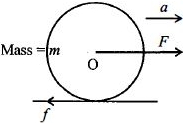
-
- (A) \(ma\)
- (B) \(\frac {5}{3}\,ma\)
- (C) \(\frac {3}{2}\,ma\)
- (D) \(2\,ma\)
જવાબ અને ઉકેલ જુઓ
સાચો જવાબ: (C)
From figure,\(ma = F - f \) ...(i)
And, torque \(\tau = I\alpha \)
\(\begin{array}{l}
\frac{{m{R^2}}}{2}\alpha = fR\,\\
\,\frac{{m{R^2}}}{2} - \frac{a}{R} = fR\,\,\left[ {\alpha = \frac{a}{R}} \right]\\
\frac{{ma}}{2} = f\,\,\,\,\,\,\,\,\,\,\,\,\,\,\,\,...\left( {ii} \right)
\end{array}\)Put this value in equation \((i),\)
\(ma = F - \frac{{ma}}{2}\,\,or\,\,F = \frac{{3ma}}{2}\)
-
- (A) \(\frac{{3h}}{4}\)
- (B) \(\;\frac{{5h}}{8}\)
- (C) \(\;\frac{{3{h^2}}}{{8R}}\)
- (D) \(\;\frac{{{h^2}}}{{4R}}\)
જવાબ અને ઉકેલ જુઓ
સાચો જવાબ: (A)
\(\begin{array}{l}
{y_{cm}} = \frac{{\int {ydm} }}{{\int {dm} }}\\
\,\,\,\,\,\,\,\, = \frac{{\int\limits_0^h {\pi {r^2}dy\rho \times y} }}{{\frac{1}{3}\pi {R^2}h\rho }} = \frac{{3h}}{4}
\end{array}\)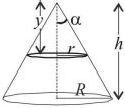
-
- (A) \(\frac{{3h}}{4}\)
- (B) \(\;\frac{{5h}}{8}\)
- (C) \(\;\frac{{3{h^2}}}{{8R}}\)
- (D) \(\;\frac{{{h^2}}}{{4R}}\)
જવાબ અને ઉકેલ જુઓ
સાચો જવાબ: (A)
\(\begin{array}{l}
{y_{cm}} = \frac{{\int {ydm} }}{{\int {dm} }}\\
\,\,\,\,\,\,\,\, = \frac{{\int\limits_0^h {\pi {r^2}dy\rho \times y} }}{{\frac{1}{3}\pi {R^2}h\rho }} = \frac{{3h}}{4}
\end{array}\) -
- (A) \(a\, = 2b\)
- (B) \(2a\, = b\)
- (C) \(a\, = b\)
- (D) \(3a \,= 2b\)
જવાબ અને ઉકેલ જુઓ
સાચો જવાબ: (B)
Centre of mass of the rod is given by:\(\begin{array}{l}
{x_{cm}} = \frac{{\int\limits_0^L {(ax + \frac{{b{x^2}}}{L})dx} }}{{\int\limits_0^L {\left( {a + \frac{{bx}}{L}} \right)dx} }}\\
\,\,\,\,\,\,\,\,\, = \frac{{\frac{{a{L^2}}}{2} + \frac{{b{L^2}}}{3}}}{{aL + \frac{{bL}}{2}}} = \frac{{L\left( {\frac{a}{2} + \frac{b}{3}} \right)}}{{a + \frac{b}{2}}}\\
Now\,\frac{7}{{12}} = \frac{{\frac{a}{2} + \frac{b}{3}}}{{a + \frac{b}{2}}}
\end{array}\)On solving we get, \(b = 2a\)
-
- (A) \(\frac{{M{R^2}}}{{16\sqrt 2 \pi }}\;\)
- (B) \(\frac{{4M{R^2}}}{{9\sqrt 3 \pi }}\)
- (C) \(\;\frac{{4M{R^2}}}{{3\sqrt 3 \pi }}\)
- (D) \(\;\frac{{M{R^2}}}{{32\sqrt 2 \pi }}\)
જવાબ અને ઉકેલ જુઓ
સાચો જવાબ: (B)
\(\begin{array}{l}
Here\,a = \frac{2}{{\sqrt 3 }}R\\
Now,\frac{M}{{M'}} = \frac{{\frac{4}{3}\pi {R^3}}}{{{a^3}}}\\
= \frac{{\frac{4}{3}\pi {R^3}}}{{{{\left( {\frac{2}{{\sqrt 3 }}R} \right)}^3}}} = \frac{{\sqrt 3 }}{2}\pi .\,M' = \frac{{2M}}{{\sqrt 3 \pi }}
\end{array}\)Moment of inertia of the cube about the given axis,
\(I = \frac{{M'{a^2}}}{6} = \frac{{\frac{{2M}}{{\sqrt 3 \pi }} \times {{\left( {\frac{2}{{\sqrt R }}R} \right)}^2}}}{6} = \frac{{4M{R^2}}}{{9\sqrt 3 \pi }}\)
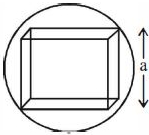
-
- (A) \(\frac{{M{R^2}}}{{16\sqrt 2 \pi }}\;\)
- (B) \(\frac{{4M{R^2}}}{{9\sqrt 3 \pi }}\)
- (C) \(\;\frac{{4M{R^2}}}{{3\sqrt 3 \pi }}\)
- (D) \(\;\frac{{M{R^2}}}{{32\sqrt 2 \pi }}\)
જવાબ અને ઉકેલ જુઓ
સાચો જવાબ: (B)
\(\begin{array}{l}
Here\,a = \frac{2}{{\sqrt 3 }}R\\
Now,\frac{M}{{M'}} = \frac{{\frac{4}{3}\pi {R^3}}}{{{a^3}}}\\
= \frac{{\frac{4}{3}\pi {R^3}}}{{{{\left( {\frac{2}{{\sqrt 3 }}R} \right)}^3}}} = \frac{{\sqrt 3 }}{2}\pi .\,M' = \frac{{2M}}{{\sqrt 3 \pi }}
\end{array}\)Moment of inertia of the cube about the given axis,
\(I = \frac{{M'{a^2}}}{6} = \frac{{\frac{{2M}}{{\sqrt 3 \pi }} \times {{\left( {\frac{2}{{\sqrt R }}R} \right)}^2}}}{6} = \frac{{4M{R^2}}}{{9\sqrt 3 \pi }}\)
-
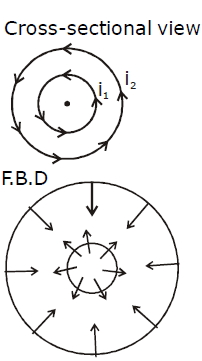
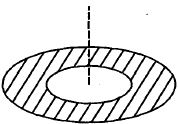
- (A) \(\;\overrightarrow {{F_1}} \) એ ત્રિજયાવર્તી દિશામાં અંદરની તરફ અને \(\overrightarrow {{F_2}} \) એત્રિજયાવર્તી દિશામાં બહારની તરફ હશે.
- (B) \(\;\overrightarrow {{F_1}} \) એ ત્રિજયાવર્તી દિશામાં અંદરની તરફ અને \(\overrightarrow {\;{F_2}} \)\(=0\)
- (C) \(\overrightarrow {{F_1}} \) એ ત્રિજયાવર્તી દિશામાં બહારની તરફ અને \(\overrightarrow {\;{F_2}} \) શૂન્ય
- (D) \(\overrightarrow {{F_1}} =\overrightarrow {\;{F_2}} =0\)
જવાબ અને ઉકેલ જુઓ
સાચો જવાબ: (D)
(Both solenoids are taken to be ideal in nature.)Both wires will attract each other, but net force on each wire will be zero.
Concept: Two current carrying elements attract each other if direction of current is same.
\(\overrightarrow {{F_1}} =\overrightarrow {\;{F_2}} =0\)
-
- (A) \(\frac{{IBR}}{{2\,\sin \,{\theta _0}}}\)
- (B) \(\frac{{IBR{\theta _0}}}{{\sin \,{\theta _0}}}\)
- (C) \(IBR\)
- (D) \(\frac{{IBR}}{{\,\sin \,{\theta _0}}}\)
જવાબ અને ઉકેલ જુઓ
સાચો જવાબ: (C)
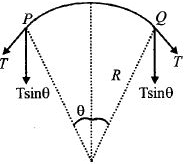
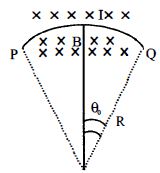
For small are length\(2 T \sin \theta=\operatorname{BIR} 2 \theta\)
\(\text { (As }\mathrm{F}=\mathrm{BIL} \text { and } L=\mathrm{RZ} \theta)\)
\(T=\mathrm{BIR}\)
-
- (A) \(2\)\(sin\)\(\theta \sqrt {\frac{{\pi \lambda gL}}{{{\mu _0}cos\theta }}} \;\;\;\;\;\;\;\;\)
- (B) \(2\)\(\sqrt {\frac{{\pi gL}}{{{\mu _0}}}tan\theta } \)
- (C) \(\;\sqrt {\frac{{\pi \lambda gL}}{{{\mu _0}}}tan\theta } \)
- (D) \(sin\)\(\theta \sqrt {\frac{{\pi \lambda gL}}{{{\mu _0}cos\theta }}} \)
જવાબ અને ઉકેલ જુઓ
સાચો જવાબ: (A)
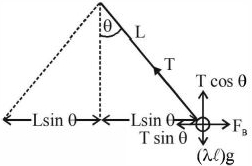
Let us consider \('l'\) length of current carrying wire.At equilibrium
\(\mathrm{T} \cos \theta=\lambda \mathrm{g} \ell\)
and \(T \sin \theta=\frac{\mu_{0}}{2 \pi} \frac{I \times I l}{2 L \sin \theta}\left[\because \frac{F_{B}}{\ell}=\frac{\mu_{0}}{4 \pi} \frac{2 I \times I}{2 \ell \sin \theta}\right]\)
Therefore, \(I=2 \sin \theta \sqrt{\frac{\pi \lambda g L}{u_{0} \cos \theta}}\)
-
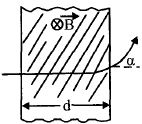
- (A) \(qV\,\sqrt {\frac{{Bd}}{{2m}}} \)
- (B) \(\frac{B}{2}\sqrt {\frac{{qd}}{{mV}}} \)
- (C) \(\frac{B}{d}\sqrt {\frac{{q}}{{2mV}}} \)
- (D) \(Bd\sqrt {\frac{q}{{2mV}}} \)
જવાબ અને ઉકેલ જુઓ
સાચો જવાબ: (D)
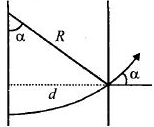
From figure, \(sin\,\alpha =dlR\)And we know, \(\frac{m v^{2}}{R}=q v B\)
\(\Rightarrow \quad R=\frac{m v}{q B}\)
\(\because \sin \alpha=\frac{d q B}{m v}\)
\(\sin \alpha=B d \sqrt{\frac{q}{2 m V}}\left[\because q V=\frac{1}{2} m v^{2}\right]\)
-
- (A) \(6\)
- (B) \(0.67\)
- (C) \(3\)
- (D) \(1.67\)
જવાબ અને ઉકેલ જુઓ
સાચો જવાબ: (D)
According to Faraday's law of electromagnetic induction,Induced \(emf\), \(e=\frac{L d i}{d t}\)
\(50 = L\left( {\frac{{5 - 2}}{{0.1\,{\text{sec}}}}} \right)\)
\(\Rightarrow L=\frac{50 \times 0.1}{3}=\frac{5}{3}=1.67\, \mathrm{H}\)
-
- (A) \(67\)
- (B) \(6.7\)
- (C) \(0.67\)
- (D) \(100\)
જવાબ અને ઉકેલ જુઓ
સાચો જવાબ: (C)
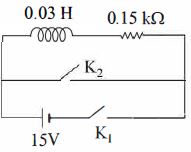
According to given conditions:\(\mathrm{i}_{0}=\frac{\mathrm{V}}{\mathrm{R}}\)
\(=\frac{15}{0.15 \times 10^{3}}\)
\(=0.1 \,A\)
\(i=i_{0} e^{-\frac{R t}{L}}\)
\(=0.1 \times e^{-\frac{0.15 \times 10^{3} \times 10^{-3}}{0.03}}\)
\(=0.1 \times \mathrm{e}^{-5}=\frac{0.1}{150}=0.67\, \mathrm{mA}\)
-
- (A) \(30000\pi \,A{m^{ - 1}}\)
- (B) \(3\pi \,A{m^{ - 1}}\)
- (C) \(30000 \,A{m^{ - 1}}\)
- (D) \(300 \,A{m^{ - 1}}\)
જવાબ અને ઉકેલ જુઓ
સાચો જવાબ: (C)
\(\bar{M}\) (mag. moment/volume) \(=\frac{N i A}{A \ell}\)\(=\frac{N i}{\ell}=\frac{(500) 15}{25 \times 10^{-2}}=30000\, \mathrm{Am}^{-1}\)
-
- (A) \(14.6\)
- (B) \(19.4\)
- (C) \(9.7\)
- (D) \(4.9\)
જવાબ અને ઉકેલ જુઓ
સાચો જવાબ: (C)
Here, \(r=30\, \mathrm{cm}=0.3 \,\mathrm{cm}\)we know \(\frac{\mu_{0} M}{4 \pi r^{3}}=B_{H}=3.6 \times 10^{-5}\)
\(M = \frac{{3.6 \times {{10}^{ - 5}}}}{{{{10}^{ - 7}}}} \times {(0.3)^3}\)
Hence, \(M=9.7\, \mathrm{Am}^{2}\)
-
- (A) \(12.5\)
- (B) \(24.5\)
- (C) \(13.1\)
- (D) \(11.9\)
જવાબ અને ઉકેલ જુઓ
સાચો જવાબ: (C)
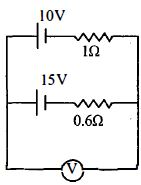
As the two cells oppose each other hence, the effective emf in closed circuit is \(15-10=5 \,\mathrm{V}\) and net resistance is \(1+\) \(0.6=1.6\, \Omega\) (because in the closed circuit the internal resistance of two cells are in series.Current in the circuit,
\(I=\frac{\text { effective emf }}{\text { total resistance }}=\frac{5}{1.6} \,A\)
The potential difference across voltmeter will be same as the terminal voltage of either cell.
Since the current is drawn from the cell of \(15\, \mathrm{V}\)
\(\therefore \quad V_{1}=E_{1}-I r_{1}\)
\(=15-\frac{5}{1.6} \times 0.6=13.1 \,\mathrm{V}\)
-
- (A) \(6\)
- (B) \(3\)
- (C) \(5\)
- (D) \(4\)
જવાબ અને ઉકેલ જુઓ
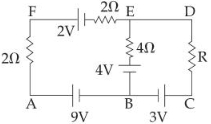
સાચો જવાબ: (C)
As no current flows through arm \(E B\) then\(\mathrm{V}_{\mathrm{D}}=0\, \mathrm{V}\)
\(\mathrm{V}_{\mathrm{E}}=0\, \mathrm{V}\)
\(\mathrm{v}_{\mathrm{B}}=-4 \,\mathrm{V}\)
\(\mathrm{V}_{\mathrm{A}}=5 \,\mathrm{V}\)
So, potential difference between the points
\(A\) and \(D\)
\(V_{A}-V_{D}=5\, \mathrm{V}\)
-
- (A) \(1.6 \times 10^{-7} \) \(Ω m\)
- (B) \(1.6 \times 10^{-5} \) \(Ω m\)
- (C) \(1.6 \times 10^{-3} \) \(Ωm\)
- (D) \(1.6 \times 10^{-8} \) \(Ωm\)
જવાબ અને ઉકેલ જુઓ
સાચો જવાબ: (B)
\(V=I R=\left(n e A v_{d}\right) \rho \frac{\ell}{A}\)\(\therefore \quad \rho=\frac{\mathrm{V}}{\mathrm{V}_{\mathrm{d}} \mathrm{lne}}\)
Here \(\mathrm{V}=\) potential difference
\(\mathrm{I}=\) length of wire
\(\mathrm{n}=\mathrm{no} .\) of electrons per unit volume of conductor.
\(\mathrm{e}=\mathrm{no.}\) of electrons
Placing the value of above parameters we get resistivity
\(\rho=\frac{5}{8 \times 10^{28} \times 1.6 \times 10^{-19} \times 2.5 \times 10^{-4} \times 0.1}\)
\(=1.6 \times 10^{-5}\, \Omega m\)
-
- (A) \(-110\)
- (B) \(-140\)
- (C) \(-120\)
- (D) \(-130\)
જવાબ અને ઉકેલ જુઓ
સાચો જવાબ: (A)
As we know, \(\mathrm{E}=-\frac{d v}{d x}\)Potential at the point \(x=2 \,m, y=2 \,m\) is given by :
\(\int_{0}^{V} d V=-\int_{0}^{2,2}(25 d x+30 d y)\)
on solving we get,
\(V=-110\,volt\)
-
- (A) \(R_1\)\( \ne 0\) અને \((R_2-R_1) > (R_4-R_3)\)
- (B) \(R_1\) \( = 0\) અને \(R_2 < (R_4-R_3)\)
- (C) \(2R < R_4\)
- (D) \(R_1\) \( = 0\) અને \( R_2 > (R_4-R_3)\)
જવાબ અને ઉકેલ જુઓ
સાચો જવાબ: (C)
We know, \(\mathrm{V}_{0}=\frac{\mathrm{Kq}}{\mathrm{R}}=\mathrm{V\,surface}\)Now, \(\mathrm{V}_{\mathrm{i}}=\frac{\mathrm{Kq}}{2 \mathrm{R}^{3}}\left(3 \mathrm{R}^{2}-\mathrm{r}^{2}\right) \quad[\mathrm{For}\, \mathrm{r}<\mathrm{R}]\)
At the centre of sphare \(r=0 .\)
Here \(\mathrm{V}=\frac{3}{2} \mathrm{V}_{0}\)
Now, \(\frac{5}{4} \frac{\mathrm{Kq}}{\mathrm{R}}=\frac{\mathrm{Kq}}{2 \mathrm{R}^{3}}\left(3 \mathrm{R}^{2}-\mathrm{r}^{2}\right)\)
\(\mathrm{R}_{2}=\frac{\mathrm{R}}{\sqrt{2}}\)
\(\frac{3}{4} \frac{\mathrm{Kq}}{\mathrm{R}}=\frac{\mathrm{Kq}}{\mathrm{R}^{3}}\)
\(\frac{1}{4} \frac{\mathrm{Kq}}{\mathrm{R}}=\frac{\mathrm{Kq}}{\mathrm{R}_{4}}\)
\(\mathrm{R}_{4}=4 \mathrm{R}\)
Also, \(\mathrm{R}_{1}=0\) and \(\mathrm{R}_{2}<\left(\mathrm{R}_{4}-\mathrm{R}_{3}\right)\)
-
- (A) \(\frac{\sigma }{{4a{ \in _0}}}\)
- (B) \(\frac{\sigma }{{8a{ \in _0}}}\)
- (C) \(\frac{\sigma }{{a{ \in _0}}}\)
- (D) \(\frac{\sigma }{{2a{ \in _0}}}\)
જવાબ અને ઉકેલ જુઓ
સાચો જવાબ: (A)
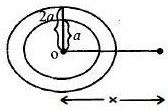
Eleatric field due to complete disc \((R=2 a)\) at a distance \(x\) and on its axis\(E_{1}=\frac{\sigma}{2 \varepsilon_{0}}\left[1-\frac{x}{\sqrt{R^{2}+x^{2}}}\right]\)
\(E_{1}=\frac{\sigma}{2 \varepsilon_{0}}\left[1-\frac{h}{\sqrt{4 a^{2}+h^{2}}}\right]\)
\( = \frac{\sigma }{{2{\varepsilon _0}}}\left[ {1 - \frac{h}{{2a}}} \right]\)
\(\left[ \begin{gathered}
{\text{ here }}x = h{\text{ }} \hfill \\
{\text{and }},R = 2a \hfill \\
\end{gathered} \right]\)Similarly, electric field due to disc \((R=a)\)
\(E_{2}=\frac{\sigma}{2 \varepsilon_{0}}\left(1-\frac{h}{a}\right)\)
Electric field due to given disc \(E=E_{1}-E_{2}\)
\(\frac{\sigma}{2 \varepsilon_{0}}\left[1-\frac{h}{2 a}\right]-\frac{\sigma}{2 \varepsilon_{0}}\left[1-\frac{h}{a}\right]-\frac{\sigma h}{4 \varepsilon_{0} a}\)
Hence, \(c=\frac{\sigma}{4 a \varepsilon_{0}}\)
-
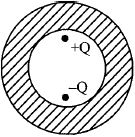
- (A) \(\begin{array}{l} {\sigma _1}\, \ne \,0,\,\,{Q_1}\, = \,0\\ {\sigma _2}\, = \,0,\,\,{Q_2}\, = \,0 \end{array}\)
- (B) \(\begin{array}{l} {\sigma _1}\, \ne \,0,\,\,{Q_1}\, = \,0\\ {\sigma _2}\, \ne \,0,\,\,{Q_2}\, = \,0 \end{array}\)
- (C) \(\begin{array}{l} {\sigma _1}\, = \,0,\,\,{Q_1}\, = \,0\\ {\sigma _2}\, = \,0,\,\,{Q_2}\, = \,0 \end{array}\)
- (D) \(\begin{array}{l} {\sigma _1}\, \ne \,0,\,\,{Q_1}\, \ne \,0\\ {\sigma _2}\, \ne \,0,\,\,{Q_2}\, \ne \,0 \end{array}\)
જવાબ અને ઉકેલ જુઓ
સાચો જવાબ: (C)
Inside the cavity net charge is zero.\(\therefore \quad Q_{1}=0\) and \(\sigma_{1}=0\)
There is no effect of point charges \(+Q\)
\(Q\) and induced charge on inner surface on the outer surface.
\(\therefore \quad Q_{2}=0\) and \(\sigma_{2}=0\)
આ પેજ પર આ ફિલ્ટર મુજબ કોઈ પ્રશ્ન નથી.
અન્ય વર્ષ
વારંવાર પૂછાતા પ્રશ્નો
ExamBro પર JEE Mains 2015 Physics ના કેટલા પ્રશ્નો છે?
73 પ્રશ્નો, દરેક સાચા જવાબ અને પૂરા ઉકેલ સાથે.
JEE Mains 2015 Physics નું કયું પ્રકરણ સૌથી વધુ પૂછાય છે?
કણોનાં તંત્રો અને ચાકગતિ, 10 પ્રશ્નો સાથે; ત્યાર બાદ એકમ, પરિમાણ અને માપન, 5 પ્રશ્નો સાથે.
JEE Mains 2015 Physics ના પ્રશ્નો કેટલા અઘરા હોય છે?
5% સરળ, 42% મધ્યમ અને 52% અઘરા.