


2014 માં પૂછાયેલાં પ્રકરણ
29 પ્રકરણ- 4પ્રશ્નો STD 11 એકમ, પરિમાણ અને માપન
- 5પ્રશ્નો STD 12 સેમિકન્ડક્ટર ઇલેક્ટ્રોનિક્સ : દ્રવ્યો, રચનાઓ અને સાદા પરિપથો
- 4પ્રશ્નો STD 12 ન્યુક્લિયસ
- 4પ્રશ્નો STD 12 પરમાણુઓ
- 6પ્રશ્નો STD 12 વિદ્યુતચુંબકીય તરંગો
- 9પ્રશ્નો STD 12 તરંગ પ્રકાશશાસ્ત્ર સૌથી વધુ પૂછાયેલ
- 6પ્રશ્નો STD 12 કિરણ પ્રકાશશાસ્ત્ર અને પ્રકાશીય ઉપકરણો
- 2પ્રશ્નો STD 12 પ્રત્યાવર્તી પ્રવાહ
- 12પ્રશ્નો STD 11 6.કણોનાં તંત્રો અને ચાકગતિ સૌથી વધુ પૂછાયેલ
- 5પ્રશ્નો STD 12 ગતિમાન વિધુતભારો અને ચુંબકત્વ
- 3પ્રશ્નો STD 12 વિદ્યુતચુંબકીય પ્રેરણ
- 5પ્રશ્નો STD 12 ચુંબકત્વ અને દ્રવ્ય
- 6પ્રશ્નો STD 12 પ્રવાહ વિદ્યુત
- 5પ્રશ્નો STD 12 સ્થિત વિદ્યુતસ્થિતિમાન અને કેપેસિટન્સ
- 4પ્રશ્નો STD 12 વિધુતભારો અને ક્ષેત્રો
- 4પ્રશ્નો STD 11 તરંગો
- 6પ્રશ્નો STD 11 દોલનો
- 4પ્રશ્નો STD 11 ગતિવાદ
- 5પ્રશ્નો STD 11 થર્મોડાયનેમિક્સ
- 1પ્રશ્નો STD 11 10.1, થર્મોનેટ્રી, થર્મલ વિસ્તરણ અને કેલરીમેટ્રી
- 3પ્રશ્નો STD 11 ઘન પદાર્થોના યાંત્રિક ગુણધર્મો
- 4પ્રશ્નો STD 11 પૃષ્ઠતાણ
- 7પ્રશ્નો STD 11 તરલના યાંત્રિક ગુણધર્મો સૌથી વધુ પૂછાયેલ
- 2પ્રશ્નો STD 11 ગતિના નિયમો
- 5પ્રશ્નો STD 11 ગુરુત્વાકર્ષણ
- 4પ્રશ્નો STD 11 કાર્ય, ઊર્જા અને પાવર
- 4પ્રશ્નો STD 11 સમતલમાં ગતિ
- 1પ્રશ્નો STD 11 સુરેખપથ પર ગતિ
- 4પ્રશ્નો STD 11 ઉષ્માનું પરિવહન
JEE Mains 2014 Physics ના બધા પ્રશ્નો
29 પ્રકરણ134 માંથી 1–50 પ્રશ્નો
-
- (A) \(\left[ {R{T^{ - 2}}} \right]\)
- (B) \(\left[ {{R^2}{T^{ - 1}}} \right]\)
- (C) \(\left[ {{R^2}} \right]\)
- (D) \(\left[ {{R^2}{T^2}} \right]\)
જવાબ અને ઉકેલ જુઓ
સાચો જવાબ: (C)
\(\begin{array}{l}
{\rm{dimensions of}}\,\mu = \left[ {ML{T^{ - 2}}{A^{ - 2}}} \right]\\
{\rm{dimensions of}}\, \in \, = \,\left[ {{M^{ - 1}}{L^{ - 3}}{T^4}{A^2}} \right]\\
{\rm{dimensions of}}\,R\, = \left[ {M{L^2}{T^{ - 3}}{A^{ - 2}}} \right]\\
\therefore \frac{{{\rm{dimensions of}}\,\mu }}{{{\rm{dimensions of}}\, \in }} = \left[ {\frac{{ML{T^{ - 2}}{A^{ - 2}}}}{{{M^{ - 1}}{L^{ - 3}}{T^4}{A^2}}}} \right]\\
= \left[ {{M^2}{L^4}{T^{-6}}{A^{ - 4}}} \right] = \left[ {{R^2}} \right]
\end{array}\) -
- (A) \(\frac{{ch}}{{2\pi \varepsilon _0^2}}\)
- (B) \(\frac{{{e^2}}}{{2\pi {\varepsilon _0}Gm_e^2}}\)
- (C) \(\frac{{{\mu _0}{\varepsilon _0}G}}{{{c^2}h{e^2}}}\)
- (D) \(\frac{{2\pi \sqrt {{\mu _0}{\varepsilon _0}} h}}{{c{e^2}G}}\)
જવાબ અને ઉકેલ જુઓ
સાચો જવાબ: (B)
\(\begin{array}{l}
The\,{\rm{Dimensional}}\,{\rm{formulae}}\,{\rm{of}}\\
{\rm{e}}\,{\rm{ = }}\left[ {{M^0}{L^0}{T^1}{A^1}} \right]\\
{\varepsilon _0} = \left[ {{M^{ - 1}}{L^3}{T^4}{A^2}} \right]\\
G = \left[ {{M^{ - 1}}{L^{-3}}{T^{ - 2}}} \right]\\
and\,{m_e} = \left[ {{M^1}{L^0}{T^0}} \right]\\
Now,\frac{{{e^2}}}{{2\pi {\varepsilon _0}Gm_e^2}}
\end{array}\)\(\begin{array}{l}
= \frac{{{{\left[ {{M^0}{L^0}{T^1}{A^1}} \right]}^2}}}{{2\pi \left[ {{M^{ - 1}}{L^{ - 3}}{T^4}{A^2}} \right]\left[ {{M^{ - 1}}{L^3}{T^{ - 2}}} \right]{{\left[ {{M^1}{L^0}{T^o}} \right]}^2}}}\\
= \frac{{\left[ {{T^2}{A^2}} \right]}}{{2\pi \left[ {{M^{ - 1 - 1 + 2}}{L^{ - 3 + 3}}{T^{4 - 2}}{A^2}} \right]}}\\
= \frac{{\left[ {{T^2}{A^2}} \right]}}{{2\pi \left[ {{M^0}{L^0}{T^2}{A^2}} \right]}} = \frac{1}{{2\pi }}
\end{array}\)\(\begin{array}{l}
\frac{1}{{2\pi }}\,is\,{\rm{Dimensionl}}ess\,thus\,the\,combination\\
\frac{{{e^2}}}{{2\pi {\varepsilon _0}Gm_e^2}}\end{array}\)would d have the same value in diffierent systems of units
-
- (A) \(1.7\)
- (B) \(2.7\)
- (C) \(4.4\)
- (D) \(2.27\)
જવાબ અને ઉકેલ જુઓ
સાચો જવાબ: (B)
Here, \(T=2 \pi \sqrt{\frac{L}{g}}\) or \(T^{2}=4 \pi^{2}(L / g)\)So, \(g=\frac{4 \pi^{2} L}{T^{2}}\)
Thus, \(\frac{\Delta g}{g}=\frac{\Delta L}{L}+2 \frac{\Delta T}{T}\)
% error in \(g=\frac{\Delta g}{g} \times 100\)
\(=\left(\frac{\Delta L}{L}+2 \frac{\Delta T}{T}\right) \times 100\)
\(=\left(\frac{(1 / 10)}{20}+2 \times \frac{1}{90}\right) \times 100=2.72 \%\)
- 4. વિદ્યાર્થી એક સળિયાની લંબાઇ માપે છે અને લંબાઇ \(3.50\;cm\) લખે છે. કયા સાધનનો લંબાઇ માપવા માટે ઉપયોગ કરે છે? 2014 મધ્યમ
- (A) વર્નિયર કેલિપર્સ કે જેમાં વર્નિયર સ્કેલનો \(10\) મો કાંપો મુખ્ય સ્કેલના \(9\) મા કાંપા સાથે મળે છે અને મુખ્ય સ્કેલના \(1\;cm\) માં \(10\) કાપા આવેલા છે.
- (B) સ્કૂગેજ કે જેના વર્તુળાકાર સ્કેલમાં \(100\) કાંપા છે અને પેચ \(1\;mm \) છે.
- (C) માઇક્રોમીટર કે જેના વર્તુળાકાર સ્કેલમાં \(50\) કાંપા છે અને પેચ \(1\;mm\) છે.
- (D) એક મીટર સ્કેલ
જવાબ અને ઉકેલ જુઓ
સાચો જવાબ: (A)
If student measures \(3.50 \mathrm{cm},\) it means that there is an uncertainly of order \(0.01 \mathrm{cm} .\)For vernier scale with \(1 \mathrm{MSD}=\frac{1}{10} \mathrm{cm}\) and \(9 \mathrm{MSD}=10 \mathrm{VSD}\)
\(LC\) of vernier calliper \(=1 \mathrm{MSD}-1 \mathrm{VSD}\)
\(=\frac{1}{10}\left(1-\frac{9}{10}\right)=\frac{1}{100} \mathrm{cm}=0.01 \mathrm{cm}\)
-
- (A) \(AND\, (A = 1, B = 1, Y = 1)\)
- (B) \(OR\,(A = 1 , B = 1, Y = 0)\)
- (C) \(NOT\, (A = 1, B= 1 , Y = 1)\)
- (D) \(XOR\, (A= 0, B = 0, Y = 0)\)
જવાબ અને ઉકેલ જુઓ
સાચો જવાબ: (A)
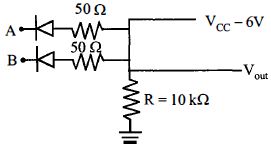
\(Y\,=\,\overline{AB}.\overline{AB}=\,\overline{\overline{AB}}\,+\,\overline{\overline{AB}\,}=\,AB\,+\,AB\,=\,AB\)In this case output \(Y\) is equivalent to \(AND\) gate.

-
- (A) \(0.02\)
- (B) \(0.5\)
- (C) \(0.05\)
- (D) \(0.2\)
જવાબ અને ઉકેલ જુઓ
સાચો જવાબ: (D)
The current voltage relation of diode is\(I=\left(e^{1000 V / T}-1\right) \mathrm{mA}(\text { given })\)
When, \(I=5 m A, e^{1000 V / T}=6 m A\)
Also, \(d I=\left(e^{1000\, v / T}\right) \times \frac{1000}{T}\)
(By exponential function)
\(=(6\, m A) \times \frac{1000}{300} \times(0.01)\)
\(=0.2\, \mathrm{mA}\)
-
- (A) એમીટર, બેઝ અને કલેક્ટર
- (B) બેઝ, એમીટર અને કલેક્ટર
- (C) બેઝ, કલેક્ટર અને એમીટર
- (D) કલેક્ટર, એમીટર અને બેઝ
જવાબ અને ઉકેલ જુઓ
સાચો જવાબ: (C)
In the given question, \(A\), \(B\) and \(C\) refer base, collector and emitter respectively -
- (A) \(AND\) ગેટ
- (B) \(OR\) ગેટ
- (C) \(XOR\) ગેટ
- (D) \(NOR\) ગેટ
જવાબ અને ઉકેલ જુઓ
સાચો જવાબ: (A)
\(AND\) ગેટ - 9. પરિપથમાં દર્શાવ્યા પ્રમાણે ઝેનર ડાયોડને બેટરી અને અવરોધ સાથે જોડેલ છે તો પ્રવાહ \(I, I_Z\) અને \(I_L\) અનુક્રમે કેટલા હશે?
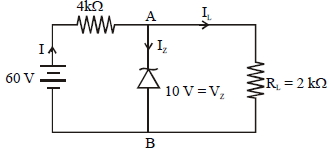 2014 અઘરું
- (A) \(15\,mA, 5\,mA, 10\, mA\)
- (B) \(15\,mA, 7.5\,mA, 7.5\, mA\)
- (C) \(12.5\,mA, 5\,mA, 7.5\, mA\)
- (D) \(12.5\,mA, 7.5\,mA, 5\, mA\)
જવાબ અને ઉકેલ જુઓ
સાચો જવાબ: (D)
Here, \(R=4 \mathrm{k} \Omega=4 \times 10^{3} \Omega\)\(V_{i}=60 \mathrm{V}\)
Zener voltage \(V_{z}=10 \mathrm{V}\) \(R_{L}=2 \mathrm{k} \Omega=2 \times 10^{3} \Omega\)
Load current, \(I_{\mathrm{L}}=\frac{V_{Z}}{R_{L}}=\frac{10}{2 \times 10^{3}}=5 \mathrm{\,mA}\)
Current through \(R, I=\frac{V_{i}-V_{Z}}{R}\)
\(=\frac{60-10}{4 \times 10^{3}}=\frac{50}{4 \times 10^{3}}=12.5 \mathrm{\,mA}\)
Fom circuit diagram,
\(I=I_{z}+I_{L}\)
\(\Rightarrow 12.5=I_{z}+5\)
\(\Rightarrow I_Z\,=\,12.5-5\,=\,7.5\,mA\)
-
- (A) \(1\,s\)
- (B) \(2\ln \left( {\frac{4}{3}} \right)s\)
- (C) \(ln\, 2\, s\)
- (D) \(\ln \left( {\frac{4}{3}} \right)s\)
જવાબ અને ઉકેલ જુઓ
સાચો જવાબ: (B)
Let \(N\) be the number of nucleiat any time \(t\) then,\(\frac{d N}{d t}=100-\lambda N\)
or \(\int_0^N {\frac{{dN}}{{(100 - \lambda N)}}} = \int_0^t d t\)
\(-\frac{1}{\lambda}[\log (100-\lambda N)]_{0}^{N}=t\)
\(\log (100-\lambda N)-\log 100=-\lambda t\)
\(\log \frac{100-\lambda N}{100}=-\lambda t\)
\(\frac{100-\lambda N}{100}=e^{-\lambda t}\)
\(1 - \frac{{\lambda N}}{{100}} = {e^{ - \lambda t}}\)
\(N=\frac{100}{\lambda}\left(1-e^{-\lambda} t\right)\)
As, \(N=50\) and \(\lambda=0.5\,/sec\)
\(\therefore 50=\frac{100}{0.5}\left(1-e^{-0.5}\right)\)
Solving we get,
\(t=2 \ln \left(\frac{4}{3}\right) \sec\)
-
- (A) \(1672\)
- (B) \(2391\)
- (C) \(3291\)
- (D) \(4453\)
જવાબ અને ઉકેલ જુઓ
સાચો જવાબ: (B)
Given, for \(^{14} \mathrm{C}\)\(A_{0}=16\) dis \(\min ^{-1} g^{-1}\)
\(A=12\) dis \(\min ^{-1} g^{-1}\)
\(\mathrm{t}_{1 / 2}=5760\) years
Now, \(\lambda = \frac{{0.693}}{{{t_{1/2}}}}\)
\(\lambda=\frac{0.693}{5760}\) per year
Then, from, \(t=\frac{2.303}{\lambda} \log _{10} \frac{\mathrm{A}_{0}}{\mathrm{A}}\)
\(=\frac{2.303 \times 5760}{0.693} \log _{10} \frac{16}{12}\)
\( = \frac{{2.303 \times 5760}}{{0.693}}{\log _{10}}1.333\)
\( = \frac{{2.303 \times 5760 \times 0.1249}}{{0.693}}\)
\(=2390.81 \approx 2391\) years
-
- (A) \((1)-(iv), (2)-(iii), (3)-(ii), ( 4)-(i)\)
- (B) \((1)-(iii), (2)-(iv), (3)-(i), (4)-(ii)\)
- (C) \((1)-(ii), (2)-(ii i), (3)-(iv), (4)-(i)\)
- (D) \((1)-(i), (2)-(ii), (3)-(iii), (4)-(iv)\)
જવાબ અને ઉકેલ જુઓ
સાચો જવાબ: (D)
Vibration of atoms and molecules \(700\, nm\) to \(1\,nm\) Radioactive decay of the nucleus \(< 10^{-3}\, nm\) Magnetron valve \(1\, nm\) to \(0.1\, m\) -
- (A) \(10439\)
- (B) \(13094\)
- (C) \(19039\)
- (D) \(39049\)
જવાબ અને ઉકેલ જુઓ
સાચો જવાબ: (C)
Given: \(\frac{\mathrm{d} \mathrm{N}_{0}}{\mathrm{dt}}=20\) decays \(/ \mathrm{mir}\)\(\frac{\mathrm{d} \mathrm{N}}{\mathrm{dt}}=2\) decays/min
\(\mathrm{T}_{1 / 2}=5730 \mathrm{years}\)
As we know,
\(\mathrm{N}=\mathrm{N}_{0} \mathrm{e}^{-\lambda t}\)
\(\log \frac{N_{0}}{N}=\lambda t\)
\(\therefore \mathrm{t}=\frac{1}{\lambda} \log \frac{\mathrm{N}_{0}}{\mathrm{N}}\)
\( = \frac{{2.303 \times {{\text{T}}_{1/2}}}}{{0.693}} \times {\text{Lo}}{{\text{g}}_{10}}\frac{{{{\text{N}}_0}}}{{\text{N}}}\)
But \(\frac{\frac{d N_{0}}{d t}}{\frac{d N}{d t}}=\frac{N_{0}}{N}=\frac{20}{2}=10\)
\(\therefore \,\,t = \frac{{2.303 \times 5730}}{{0.693}} \times 1\)
\(=19039\) years
-
- (A) \(λ_1 =2λ_2 =2λ_3 =λ_4\)
- (B) \(λ_1 =λ_2 =4λ_3 =9λ_4\)
- (C) \(λ_1 =2λ_2 =3λ_3 =4λ_4\)
- (D) \(4λ_1 =2λ_2 =2λ_3 =λ_4\)
જવાબ અને ઉકેલ જુઓ
સાચો જવાબ: (B)
Wave number \(\frac{1}{\lambda}=R Z^{2}\left[\frac{1}{n_{1}^{2}}-\frac{1}{n^{2}}\right]\)\(\Rightarrow \quad \lambda \propto \frac{1}{Z^{2}}\)
By question \(n=1\) and \(n_{1}=2\)
Then, \(\lambda_{1}=\lambda_{2}=4 \lambda_{3}=9 \lambda_{4}\)
-
- (A) \(1.1\)
- (B) \(0.8\)
- (C) \(1.6 \)
- (D) \(1.8\)
જવાબ અને ઉકેલ જુઓ
સાચો જવાબ: (A)
Radius of circular path followed by electron is given by,\(r=\frac{m v}{q B}=\frac{\sqrt{2 m e V}}{e B}=\frac{1}{B} \sqrt{\frac{2 m}{e} V}\)
\(\Rightarrow \quad V=\frac{B^{2} r^{2} e}{2 m}=0.8 \mathrm{V}\)
For transition between \(3\) to \(2\) .
\(E=13.6\left(\frac{1}{4}-\frac{1}{9}\right)=\frac{13.6 \times 5}{36}=1.88 \,eV\)
Work function \(=1.88 \mathrm{eV}-0.8 \mathrm{eV} \)
\(=1.08 \mathrm{eV} \approx 1.1 \mathrm{eV}\)
- 16. \(LED's\) દ્વારા વિદ્યુતચુંબકીય વર્ણપટ્ટમાં રહેલ દૃશય વિભાગનો પ્રકાશ મેળવવો હોય તો તેની ઉર્જા કેટલા વિભાગની હોવી જોઈએ? 2014 મધ્યમ
- (A) \(0.1\, eV\) થી \(0.4\,eV\)
- (B) \(0.5\, eV\) થી \(0.8\,eV\)
- (C) \(0.9\, eV\) થી \(1.6\,eV\)
- (D) \(1.7\, eV\) થી \(3.0\,eV\)
જવાબ અને ઉકેલ જુઓ
સાચો જવાબ: (D)
Energy band gap range is given by,\(E_{g}=\frac{h c}{\lambda}\)
For visible region
\(\lambda=\left(4 \times 10^{-7}-7 \times 10^{-7}\right) \mathrm{m}\)
\({{E_g} = \frac{{6.6 \times {{10}^{ - 34}} \times 3 \times {{10}^8}}}{{7 \times {{10}^{ - 7}}}}}\)
\(=\frac{19.8 \times 10^{-26}}{7 \times 10^{-7}}\)
\(=\frac{2.8 \times 10^{-19}}{1.6 \times 10^{-19}}\)
\(E_{g}=1.75 \mathrm{eV}\)
-
- (A) \((1 )-(i), (2)-(ii), (3)-(iii), (4)-(iv)\)
- (B) \((1 )-(i), (2)-(ii), (3)-(iv), ( 4)-(iii)\)
- (C) \((1)-(iii), (2)-(iv), (3)-(i), (4)-(ii)\)
- (D) \((1 )-(iv), (2-(iii), (3)-(ii), (4 )-(i)\)
જવાબ અને ઉકેલ જુઓ
સાચો જવાબ: (B)
\((1)\) Davisson and Gemner experiment-wave nature of electrons. \((2)\) Millikan's oil drop experiment - charge of an electron. \((3)\) Rutherford experiment - Existance of nucleus. \((4)\) Frank-Hertz experiment - Quantisation of energy levels. -
- (A) \(1.34\)
- (B) \(2.68\)
- (C) \(4.02\)
- (D) \(5.36\)
જવાબ અને ઉકેલ જુઓ
સાચો જવાબ: (B)
Wavelength of monochromatic green light \(=5.5 \times 10^{-5} \mathrm{cm}\)Intensity \(I\,=\,\frac{\text { Power }}{\text { Area }}\)
\( = \frac{{100 \times (3/100)}}{{4\pi {{(5)}^2}}}\)
\(=\frac{3}{100 \pi} \mathrm{Wm}^{-2}\)
Now, half of this intensity ( \(\mathrm{I}\) ) belongs to electric field and half of that to magnetic field, therefore,
\(\frac{1}{2}=\frac{1}{4} \varepsilon_{0} E_{0}^{2} C\)
or \(\mathrm{E}_{0}=\sqrt{\frac{2 \mathrm{I}}{\varepsilon_{0} \mathrm{C}}}\)
\( = \sqrt {\frac{{2 \times \left( {\frac{3}{{100}}\pi } \right)}}{{\left( {\frac{1}{{4\pi \times 9 \times {{10}^9}}}} \right) \times \left( {3 \times {{10}^8}} \right)}}} \)
\(=\sqrt{\frac{6}{25} \times 30}=\sqrt{7.2}\)
\(\therefore \mathrm{E}_{0}=2.68 \mathrm{V} / \mathrm{m}\)
-
- (A) \(R, M, I, V, U, X\) અને \(G\)
- (B) \(M, R, V, X, U, G\) અને \(I\)
- (C) \(G, X, U, V, I, M\) અને \(R\)
- (D) \(I, M, R, U, V, X\) અને \(G\)
જવાબ અને ઉકેલ જુઓ
સાચો જવાબ: (C)
Gamma rays \(< X-\) rays \(<\) Ultra violet \(<\) Visible rays \(<\) Infrared rays \(<\) Microwaves \(<\) Radio waves -
- (A) \((I)-(A), (II)-(B), (III)-(B), (IV)-(C)\)
- (B) \((I)-(A), (II)-(B), (III)-(C ), (IV)-(C)\)
- (C) \((I)-(B), (II)-(A), (III)-(D), (IV)-(A)\)
- (D) \((I)-(D), (II)-(C), (III)-(A), (IV)-(B)\)
જવાબ અને ઉકેલ જુઓ
સાચો જવાબ: (B)
The sodium spectrum is dominated by the bright doublet, which are known as the sodium \(D\) lines. The wavelength of these lines are around the range \(588.9\; n m\) and \(589.5 \;n m\). Now the wavelength of these sodium \(D\) lines falls under the wavelength range of the X rays in the spectrum. So we can say that the doublet of sodium belongs to the X rays.Most of the hydrogen gas in the interstellar medium is in cold atomic form or in the molecular form. They emit a wavelength due to a slight energy change in the hydrogen atoms. This wavelength is \(21.1 cm\) and so it is called the \(21\;cm\) line radiation. This wavelength lies in the spectrum of the visible light. Hence the wavelength emitted by atomic hydrogen in interstellar space belongs to the visible light spectrum.
The difference in the energy of two close energy levels in a hydrogen atom is called lamb shift. The wavelength
corresponding to this difference in energy is around \(30 \;cm\). This is in the range of the microwaves.
-
- (A) \(i\) \(ii\) \(iv\) \(iii\)
- (B) \(iii\) \(ii\) \(i\) \(iv\)
- (C) \(i\) \(ii\) \(iii\) \(iv\)
- (D) \(iv\) \(iii\) \(ii\) \(i\)
જવાબ અને ઉકેલ જુઓ
સાચો જવાબ: (C)
\((1)\) Infrared rays are used to treat muscular strain because these are heat rays.\((2)\) Radio waves are used for broadcasting because these waves have very long wavelength ranging from few centimeters to few hundred kilometers
\((3)\) \(X-\) rays are used to detect fracture of bones because they have high penetrating power but they can't penetrate through denser medium like bones.
\((4)\) Ultraviolet rays are absorbed by ozone of the atmosphere.
-
- (A) વિદ્યુતઊર્જા ઘનતા ચુંબકીય ઊર્જા ઘનતા કરતા અડધી હોય છે.
- (B) વિદ્યુતઊર્જા ઘનતા ચુંબકીય ઊર્જા ઘનતા જેટલી હોય છે.
- (C) બંને વિદ્યુત અને ચુંબકીય ઊર્જા ઘનતાઓ શૂન્ય હોય છે.
- (D) વિદ્યુતઊર્જા ઘનતા ચુંબકીય ઊર્જા ઘનતા કરતા બમણી હોય છે.
જવાબ અને ઉકેલ જુઓ
સાચો જવાબ: (B)
\(E_{0}=\mathrm{CB}_{0}\) and \(C=\frac{1}{\sqrt{\mu_{0} \varepsilon_{0}}}\)Electric energy density \(=\frac{1}{2} \varepsilon_{0} E_{0}^{2}=\mu_{E}\)
Magnetic energy density \(=\frac{1}{2} \frac{B o^{2}}{\mu_{0}}=\mu_{B}\)
Thus, \(\mu_{\mathrm{E}}=\mu_{B}\)
Energy is equally divided between electric and magnetic field
-
- (A) \(35 .2\times10^{-10}\, J/m^3\)
- (B) \(35 .2\times10^{-11}\, J/m^3\)
- (C) \(35 .2\times10^{-12}\, J/m^3\)
- (D) \(35 .2\times10^{-13}\, J/m^3\)
જવાબ અને ઉકેલ જુઓ
સાચો જવાબ: (C)
Given: Amplitude of electric field,\(E_{0}=4\,\mathrm{v} / \mathrm{m}\)
Absolute per mitivity,
\(\varepsilon_{0}=8.8 \times 10^{-12}\, \mathrm{c}^{2}\, / \mathrm{N}-\mathrm{m}^{2}\)
Average energy density \(u_{E}=?\)
Applying formula,
Average energy density \(u_{E}=\frac{1}{4} \varepsilon_{0} E^{2}\)
\(\Rightarrow u_{E}=\frac{1}{4} \times 8.8 \times 10^{-12} \times(4)^{2}\)
\(=35.2 \times 10^{-12} \,\mathrm{J} / \mathrm{m}^{3}\)
-
- (A) \(\frac{16}{9}\)
- (B) \(\frac{4}{3}\)
- (C) \(\frac{7}{1}\)
- (D) \(\frac{49}{1}\)
જવાબ અને ઉકેલ જુઓ
સાચો જવાબ: (D)
Intensity \(\propto\) (amplitude) \(^{2}\)\(\frac{I_{1}}{I_{2}}=\frac{16}{9}=\frac{a_{1}^{2}}{a_{2}^{2}}\)
\(\Rightarrow a_{1}=4 ; a_{2}=3\)
Therefore the ratio of intensities of bright and dark parts
\(\frac{{{I_{{\text{Bright }}}}}}{{{I_{{\text{Dark }}}}}} = \frac{{{{\left( {{a_1} + {a_2}} \right)}^2}}}{{{{\left( {{a_1} - {a_2}} \right)}^2}}}\) \( = \frac{{{{(4 + 3)}^2}}}{{{{(4 - 3)}^2}}} = \frac{{49}}{1}\)
-
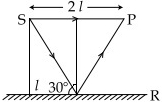
- (A) \(I\, = \,\frac{{2n\lambda }}{{\sqrt 3 - 1}}\)
- (B) \(I\, = \,\frac{{(2n - 1)\lambda }}{{2(\sqrt 3 - 1)}}\)
- (C) \(I\, = \,\frac{{(2n - 1\,\lambda )\sqrt 3 }}{{4(2 - \sqrt 3 )}}\)
- (D) \(I\, = \,\frac{{(2n - 1)\lambda }}{{\sqrt 3 - 1}}\)
જવાબ અને ઉકેલ જુઓ
સાચો જવાબ: (C)
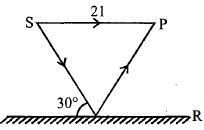
From the figure straight path \(\mathrm{SP}=2 l\)Reflected path \(\mathrm{SP}=2 l\) sec \(30^{\circ}\)
So path difference is \(2 l\left(\sec 30^{\circ}-1\right)\)
Also the ray, when reflected by the mirror, suffers a phase change of \(\pi\)
So the total difference in phase is \(2 l\left(\sec 30^{\circ}-1\right) \times \frac{2 \pi}{\lambda}+\pi\)
For constructive interference
\(2 l\left(\sec 30^{\circ}-1\right) \times \frac{2 \pi}{\lambda}+\pi=2 n \pi\)
Solving this, we get \(l=\frac{(2 n-1) \lambda \sqrt{3}}{4(2-\sqrt{3})}\)
-
- (A) \(0.2\)
- (B) \(0.4\)
- (C) \(0.8\)
- (D) \(0.9\)
જવાબ અને ઉકેલ જુઓ
સાચો જવાબ: (C)
Here, \(\sin \theta_{i c} / \sin \theta_{i B}=1.28\)As we know,
\(\mu=\frac{\sin \theta_{\mathrm{iB}}}{\sin \left(\frac{\pi}{2}-\theta_{\mathrm{iB}}\right)}\)
where, \(\theta_{\mathrm{iB}}\) is Brewster's angle of incidence,
And, \(\mu=\frac{1}{\sin \theta_{\text {ic }}}\)
Onsolving we get, relative refractive index of the two media.
-
- (A) \(( 1 )-(i), (2)-(ii), (3)-(iii), ( 4 )-(iv)\)
- (B) \((1 )-(ii), (2)-(i), (3)-(iv), ( 4)-(iii)\)
- (C) \((1)-(i), (2)-(ii), (3)-(iv), (4)-(iii)\)
- (D) \((1 )-(ii), (2)-(i), (3)-(iii), (4)-(iv)\)
જવાબ અને ઉકેલ જુઓ
સાચો જવાબ: (A)
Rotation period of earth is about \(24\) hrs \(=\) \(10^{5} \mathrm{s}\)Revolution period of earth is about \(365\) days \(=10^{7} \mathrm{s}\)
Speed of light wave \(\mathrm{C}=3 \times 10^{8} \mathrm{m} / \mathrm{s}\)
Wavelength of visible light of spectrum \(\lambda\) \( = 4000 - 7800\,\,\mathop {\text{A}}\limits^o \)
\(\mathrm{C}=\mathrm{f} \lambda\left(\text { and } \mathrm{T}=\frac{1}{\mathrm{f}}\right)\)
Therefore period of light wave is \(10^{-15} \,\mathrm{s}\) (approx)
-
- (A) \(n\) ના ઘટતા મૂલ્ય સાથે વધે
- (B) \(\beta \) ના ઘટતા મૂલ્ય સાથે વધે
- (C) \(n\, sin\, 2\beta \) ના વધતા મૂલ્ય સાથે વધે
- (D) \(\frac{1}{{n\,\sin \,2\beta }}\) ના વધતા મૂલ્ય સાથે વધે
જવાબ અને ઉકેલ જુઓ
સાચો જવાબ: (C)
Resolving power of microscope,\(\mathrm{R.P.}=\frac{2 \mathrm{n} \sin \theta}{\lambda}\)
\(\lambda=\) Wavelength of light used to illuminate the object
\(\mathrm{n}=\) Refractiveindex of the medium between object and objective
\(\theta=\) Angle
-
- (A) \(\;\frac{3}{2}\)
- (B) \(1\)
- (C) \(\;\frac{1}{3}\)
- (D) \(3\)
જવાબ અને ઉકેલ જુઓ
સાચો જવાબ: (C)
According to malus law, intensity of emerging beam is given by,\(I=I_{0} \cos ^{2} \theta\)
Now, \(I_{A^{\prime}}=I_{A} \cos ^{2} 30^o\)
\(I_{B^{\prime}}=I_{B} \cos ^{2} 60^o\)
As \(I_{A^{\prime}}=I_{B^{\prime}}\)
\(\Rightarrow \quad I_{A} \times \frac{3}{4}=I_{B} \times \frac{1}{4}\) \(\therefore \quad \frac{I_{A}}{I_{B}}=\frac{1}{3}\)
-
- (A) \(3300\)
- (B) \(4400\)
- (C) \(5500\)
- (D) \(6600\)
જવાબ અને ઉકેલ જુઓ
સાચો જવાબ: (B)
In a single slit experiment, For diffraction maxima,\(a\sin \theta = \left( {2n + 1\frac{\lambda }{2}} \right)\)
and for diffraction minima,
\(a \sin \theta=n \lambda\)
According to question,
\(\left(2 \times 1+1 \frac{\lambda}{2}\right)=1 \times 6600\)
\(\left( {\because {\lambda _{\text{R}}} = 6600\,\,\mathop {\text{A}}\limits^o } \right)\)
\({\lambda = \frac{{6600 \times 2}}{3}}\)
\(\,\lambda = 4400\,\mathop {\text{A}}\limits^o \)
-
- (A) \(3\)
- (B) \(6\)
- (C) \(12\)
- (D) \(24\)
જવાબ અને ઉકેલ જુઓ
સાચો જવાબ: (C)
In diffraction, angular width of central maxima is \(\frac{2 \lambda}{b}\)where \(b\) is slit width.
In Young's double slit experiment, angular width of each fringe is \(\frac{\lambda}{d}\)
where \(d\) is the distance between the two slits.
Given: \(d=6.1 b\) So, number of maximas observed in central maxima of diffraction pattern \(n=\frac{2 \lambda}{\frac{b}{\lambda}}\)
\(\therefore n=\frac{2 d}{b}=2 \times 6.1=12.2\)
Thus 12 maximas are observed.
-
- (A) \(520\)
- (B) \(540\)
- (C) \(560\)
- (D) \(580\)
જવાબ અને ઉકેલ જુઓ
સાચો જવાબ: (B)
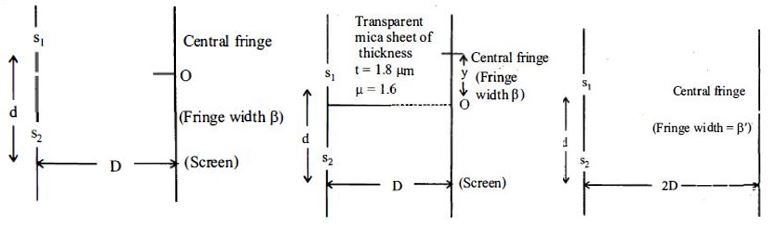
Given \(t=1.8 \times 10^{-6} \mathrm{m}\)\(\mu=1.6\)
\(\mathrm{n}=2(\text { from figure })\)
Applying formula \((\mu-1) \mathrm{t}=\mathrm{n} \lambda\)
\((1.6-1) \times 1.8 \times 10^{-6}=2 \lambda\)
or, \({\lambda = \frac{{1.8 \times {{10}^{ - 6}} \times 0.6}}{2}}\)
\(=\,540 \,\mathrm{nm}\)
-
- (A) \(124.5\)
- (B) \(144.5\)
- (C) \(65\)
- (D) \(99\)
જવાબ અને ઉકેલ જુઓ
સાચો જવાબ: (D)
Given: Separation of lens for two of its position, \(d=10 \mathrm{cm}\)Ratio of size of the images in two positions
\(\frac{I_{1}}{I_{2}}=\frac{3}{2}\)
Distance of object from the screen, \(D=?\)
Applying formula,
\({\frac{{{I_1}}}{{{I_2}}} = \frac{{{{(D + d)}^2}}}{{{{(D - d)}^2}}}}\)
\({ \Rightarrow \,\,\frac{3}{2} = \frac{{{{(D + 10)}^2}}}{{{{(D - 10)}^2}}}}\)
\({ \Rightarrow \quad \frac{3}{2} = \frac{{{D^2} + 100 + 20D}}{{{D^2} + 100 - 20D}}}\)
\(\Rightarrow 3 D^{2}+300-60 D=2 D^{2}+200+40 D\)
\(\Rightarrow \quad D^{2}-100 D+100=0\)
On solving, we get \(D=99\, \mathrm{cm}\)
Hence the distance between the screen and the object is \(99\, \mathrm{cm} .\)
-
- (A) \(15 \times 3 \times \sqrt 5 \,cm\)
- (B) \(15 \times 3\sqrt 7 \,cm\)
- (C) \(\frac{{15 \times \sqrt 7 }}{3}\,\,cm\)
- (D) \(\frac{{15 \times 3}}{{\sqrt 7 }}\,\,cm\)
જવાબ અને ઉકેલ જુઓ
સાચો જવાબ: (D)
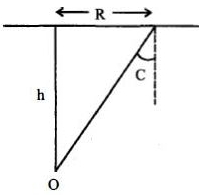
Given, \(\mu \, = \,\frac{4}{3}\)\(h\,=\,15\,cm\)
\(R\,=\,?\)
\(\frac{\sin 90^o}{\sin C}=\mu\)
\(\Rightarrow \quad \sin C=\frac{1}{\mu}=\frac{R}{\sqrt{R^{2}+h^{2}}}=\frac{3}{4}\)
\(\Rightarrow \quad 16 R^{2}=9 R^{2}+9 h^{2}\)
or, \({7{R^2} = 9{h^2}}\)
or, \({R = \frac{3}{{\sqrt 7 }}h = \frac{3}{{\sqrt 7 }} \times 15\,\,{\text{cm}}}\)
-
- (A) \(f_1 > f \) અને \(f_2\) ઋણ બની જાય છે.
- (B) \(f_2 > f\) અને \( f_1\) ઋણ બની જાય છે.
- (C) \(f_1\) અને \(f_2\) બંને ઋણ બની જાય છે.
- (D) \(f_1=f_2 < f\)
જવાબ અને ઉકેલ જુઓ
સાચો જવાબ: (A)
By Lens maker's formula for convex lens\(\frac{1}{f}=\left(\frac{\mu}{\mu_{L}}-1\right)\left(\frac{2}{R}\right)\)
for, \(\mu_{L_{1}}=\frac{4}{3}, f_{1}=4 R\)
for \(\mu_{L_{2}}=\frac{5}{3}, f_{2}=-5 R\)
\(\Rightarrow f_{2}=(-) \mathrm{ve}\)
-
- (A) \(+11.2\)
- (B) \(-11.2\)
- (C) \(-8.8\)
- (D) \(+8.8\)
જવાબ અને ઉકેલ જુઓ
સાચો જવાબ: (D)
Given, Focal length of objective, \(f_{0}=30\, \mathrm{cm}\)focal length of eye lens, \(f_{e}=3.0 \,\mathrm{cm}\)
Magnifying power, \(M=?\)
Magnifying power of the Galilean telescope,
\(M_{D}=\frac{f_{0}}{f_{e}}\left(1-\frac{f_{e}}{D}\right)\)
\( = \frac{{30}}{3}\left( {1 - \frac{3}{{25}}} \right)\) \([\because D = 25\,{\text{cm}}]\)
\(=10 \times \frac{22}{25}=8.8\, \mathrm{cm}\)
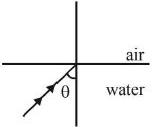
- 37. પાણીમાંથી લીલો પ્રકાશ હવા-પાણી આંતરપૃષ્ઠ પર ક્રાંતિકોણ \(\theta \) એ આપાત થાય છે.સાચું વિધાન પસંદ કરો. 2014 સરળ
- (A) લીલા પ્રકાશની આવૃત્તિ કરતાં ઓછી આવૃત્તિ ધરાવતો ધ્શ્ય પ્રકાશનો વર્ણપટ હવામાં નિર્ગમન પામે છે.
- (B) લીલા પ્રકાશની આવૃત્તિ કરતાં વધારે આવૃત્તિ ધરાવતો ધ્શ્ય પ્રકાશનો વર્ણપટ હવામાં નિર્ગમન પામે છે.
- (C) લંબથી જુદા જુદા ખૂણે સમગ્ર ધ્શ્ય પ્રકાશ માટેનું વર્ણપટ પાણીમાંથી બહાર નિર્ગમન પામે છે.
- (D) લંબથી \(90 °C\) ના ખૂણે સમગ્ર ધ્શ્ય પ્રકાશ માટેનું વર્ણપટ પાણીમાંથી બહાર નિર્ગમન પામે છે.
જવાબ અને ઉકેલ જુઓ
સાચો જવાબ: (A)
For critical angle \(\theta_{\mathrm{c}}\) ,\(\sin \theta_{c}=\frac{1}{\mu}\)
For greater wavelength or lesser frequency \(\mu\) is less.
So, critical angle would be more. So, they will not suffer reflection and come out at angles less then \(90^o\).
-
- (A) \(200\)
- (B) \(100\)
- (C) \(400\)
- (D) \(150\)
જવાબ અને ઉકેલ જુઓ
સાચો જવાબ: (A)
Given \(: f_{0}=1.2\, \mathrm{cm} ; f_{\mathrm{e}}=3.0 \,\mathrm{cm}\)\(u_{0}=1.25\, \mathrm{cm} ; M_{\infty}=?\)
From \(\frac{1}{f_{0}}=\frac{1}{v_{0}}-\frac{1}{u_{0}}\)
\(\Rightarrow \frac{1}{1.2}=\frac{1}{v_{0}}-\frac{1}{(-1.25)}\)
\(\Rightarrow \quad \frac{1}{v_{0}}=\frac{1}{1.2}-\frac{1}{1.25}\)
\(\Rightarrow \) \(v_{0}=30\, \mathrm{cm}\)
Magnification at infinity,
\(M_{\infty}=-\frac{v_{0}}{u_{0}} \times \frac{D}{f_{e}}\)
\(=\frac{30}{1.25} \times \frac{25}{3}\) ( \(\because D=25\, \mathrm{cm}\) least distance of distinct vision)
\(=200\)
Hence the magnifying power of the compound microscope is \(200\)
-
- (A) \(50\)
- (B) \(70\)
- (C) \(90\)
- (D) \(100\)
જવાબ અને ઉકેલ જુઓ
સાચો જવાબ: (C)
Given, \(V_{L}: V_{C}: V_{R}=1: 2: 3\)\(\mathrm{V}=100 \,\mathrm{V}\)
\(\mathrm{V}_{\mathrm{R}}=?\)
As we know,
\(V=\sqrt{V_{R}^{2}+\left(V_{L}-V_{C}\right)^{2}}\)
Solving we get, \(\mathrm{V}_{\mathrm{R}}=90\, \mathrm{V}\)
-
- (A) \(10\,cos\,(500t)\)
- (B) \(-10\,cos\,(500t)\)
- (C) \(10\,sin\,(500t)\)
- (D) \(-10\,sin\,(500t)\)
જવાબ અને ઉકેલ જુઓ
સાચો જવાબ: (B)
In a pure inductive circuit current alwayslags behind the emf by \(\frac{\pi}{2}\)
If \(v(t)=v_{0} \sin \omega t\)
then \(\mathrm{I}=\mathrm{I}_{0} \sin \left(\omega \mathrm{t}-\frac{\pi}{2}\right)\)
Now, given \(v(t)=100 \sin (500\, t)\)
and \(\mathrm{I}_{0}=\frac{\mathrm{E}_{0}}{\omega \mathrm{L}}=\frac{100}{500 \times 0.02}[\because \mathrm{L}=0.02 \,\mathrm{H}]\)
\(\mathrm{I}_{0}=10 \sin \left(500 \mathrm{t}-\frac{\pi}{2}\right)\)
\(\mathrm{I}_{0}=-10 \cos (500 \mathrm{t})\)
-
- (A) \(va\,\, ( 1 + cos\,2\theta )\)
- (B) \(va\,\, ( 1 + cos\,\theta )\)
- (C) \(va\,\,cos\,2\theta \)
- (D) \(va\)
જવાબ અને ઉકેલ જુઓ
સાચો જવાબ: (A)
\((v \cos \theta) \times 2\) turns\(2 \cos v a-1=\cos 2 w\)
\(2 \mathrm{rv} \cos ^{2} \mathrm{v}\)
va \((1+\cos 2 \theta)\)
-
- (A) \(va\,\, ( 1 + cos\,2\theta )\)
- (B) \(va\,\, ( 1 + cos\,\theta )\)
- (C) \(va\,\,cos\,2\theta \)
- (D) \(va\)
જવાબ અને ઉકેલ જુઓ
સાચો જવાબ: (A)
\((v \cos \theta) \times 2\) turns\(2 \cos v a-1=\cos 2 w\)
\(2 \mathrm{rv} \cos ^{2} \mathrm{v}\)
va \((1+\cos 2 \theta)\)
-
- (A) \(\sqrt {\frac{8}{7}} \)
- (B) \(\sqrt {\frac{15}{14}} \)
- (C) \(\frac{8}{7}\)
- (D) \(\frac{15}{14}\)
જવાબ અને ઉકેલ જુઓ
સાચો જવાબ: (D)
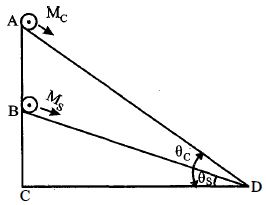
As we know,Acceleration, \(a = \frac{{mg\sin \theta }}{{m + \frac{I}{{{r^2}}}}}\)
\(\begin{array}{l}
\,For\,cylinder,\,{a_c} = \frac{{{M_c}g.\sin {\theta _c}}}{{{M_c} + \frac{1}{2}\frac{{{M_c}{R^2}}}{{{R^2}}}}}\\
\,\,\,\,\,\,\,\,\,\,\,\,\,\,\,\,\,\,\,\,\,\,\,\,\,\,\,\,\,\,\,\,\,\,\,\,\,\,\,\,\,\,\, = \frac{{{M_c}g.\sin {\theta _c}}}{{{M_c} + \frac{{{M_c}{R^2}}}{{2{R^2}}}}}
\end{array}\)\(\begin{array}{l}
or,\,\,\,{a_c} = \frac{2}{3}g\sin \,{\theta _c}\\
\,\,\,\,\,\,\,\,For\,sphere,\\
\,\,\,\,\,{a_s} = \frac{{{M_s}g\sin {\theta _s}}}{{{M_s} + \frac{{{I_s}}}{{{r^2}}}}}\\
\,\,\,\,\,\,\,\,\,\,\, = \frac{{{M_s}g\sin {\theta _s}}}{{{M_s} + \frac{2}{5}\frac{{M{R^2}}}{{{R^2}}}}}
\end{array}\)\(\begin{array}{l}
or,\,\,\,\,\,\,\,{a_s} = \frac{5}{7}g\sin {\theta _s}\\
\,\,\,\,\,\,\,\,\,\,\,\,\,given,\,{a_c} = {a_s}\\
i.e.,\,\,\frac{2}{3}g\sin {\theta _c} = \frac{5}{7}g\sin {\theta _s}\\
\therefore \,\,\frac{{\sin {\theta _c}}}{{\sin {\theta _s}}} = \frac{{\frac{5}{7}g}}{{\frac{2}{3}g}} = \frac{{15}}{{14}}
\end{array}\) -
- (A) \(Mg\)
- (B) \(Ma\)
- (C) \(\frac{Ma}{2}\)
- (D) \(\frac{Ma}{3}\)
જવાબ અને ઉકેલ જુઓ
સાચો જવાબ: (D)
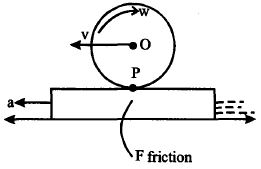
For pure, rolling,\(\begin{array}{l}
{a_{og}} = {a_{op}} + {a_{pg}}\\
\,\,\,\,\,\,\,\, = - {a_{po}} + {a_{pg}}\\
\,\,\,\,\,\,\,\, = - \alpha r + a\\
\Rightarrow \frac{F}{M} = - \frac{{F \times r}}{{\frac{{M{r^2}}}{2}}} + a\\
\Rightarrow \frac{{3F}}{M} = a \Rightarrow F = \frac{{Ma}}{3}
\end{array}\) -
- (A) \(\frac{L}{2} - \frac{{{\lambda _0}{L^2}}}{{4M}}\)
- (B) \(\frac{L}{3} + \frac{{{\lambda _0}{L^2}}}{{8M}}\)
- (C) \(\frac{L}{3} + \frac{{{\lambda _0}{L^2}}}{{4M}}\)
- (D) \(\frac{{2L}}{3} - \frac{{{\lambda _0}{L^2}}}{{6M}}\)
જવાબ અને ઉકેલ જુઓ
સાચો જવાબ: (C)
Mass per unit lengh \(=\lambda_{0}+\mathrm{kx}\)\(\mathrm{M}=\int_{0}^{\mathrm{L}}\left(\lambda_{0}+\mathrm{kx}\right) \mathrm{dx}\)
\(M=\lambda_{0} L+\frac{K \times L^{2}}{2}\)
\(\frac{2 \mathrm{M}-\lambda_{0} \mathrm{L}}{\mathrm{L}^{2}}=\mathrm{K}\)
\(\frac{2 \mathrm{M}}{\mathrm{L}^{2}}-\frac{\lambda_{0}}{\mathrm{L}}=\mathrm{K}\)
\(\frac{\int \mathrm{d} \mathrm{m}(\mathrm{r})}{\int \mathrm{d} \mathrm{m}}=\frac{\int(\lambda \mathrm{d} n) \mathrm{x}}{\mathrm{M}}=\frac{\int_{0}^{\mathrm{L}}\left(\lambda_{0} \mathrm{x}+\mathrm{k} \mathrm{x}^{2}\right) \mathrm{d} \mathrm{x}}{\mathrm{M}}\)
\(r_{c m}=\frac{\lambda_{0} L+\frac{k L^{2}}{2}}{M}\)
substitute \('k"\)
\(r_{c m}=\frac{2 L}{3}-\frac{\lambda_{0} \ell^{2}}{6 M}\)
-
- (A) કોણીય વેગમાનના મૂલ્યમાં ફેરફાર પણ દિશામાં નહિ.
- (B) કોણીય વેગમાની દિશામાં ફેરફાર પણ મૂલ્યમાં નહિ.
- (C) કોણીય વેગમાનની દિશા અને મૂલ્ય બંનેમાં ફેરફાર
- (D) કોણીય વેગમાન અચળ છે.
જવાબ અને ઉકેલ જુઓ
સાચો જવાબ: (B)
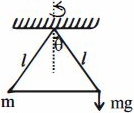
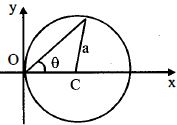
Torque working on the bob of mass \(m\) is,\(\tau = mg \times \ell \sin \theta .\,\). (Direction parallel to plane of rotation of particle)
As \(\tau \) is perpendicular to \(\overrightarrow L \), direction of \(L\) changes but magnitude remains same.
-
- (A) કોણીય વેગમાનના મૂલ્યમાં ફેરફાર પણ દિશામાં નહિ.
- (B) કોણીય વેગમાની દિશામાં ફેરફાર પણ મૂલ્યમાં નહિ.
- (C) કોણીય વેગમાનની દિશા અને મૂલ્ય બંનેમાં ફેરફાર
- (D) કોણીય વેગમાન અચળ છે.
જવાબ અને ઉકેલ જુઓ
સાચો જવાબ: (B)
Torque working on the bob of mass \(m\) is,\(\tau = mg \times \ell \sin \theta .\,\). (Direction parallel to plane of rotation of particle)
As \(\tau \) is perpendicular to \(\overrightarrow L \), direction of \(L\) changes but magnitude remains same.

આ પેજ પર આ ફિલ્ટર મુજબ કોઈ પ્રશ્ન નથી.
અન્ય વર્ષ
વારંવાર પૂછાતા પ્રશ્નો
ExamBro પર JEE Mains 2014 Physics ના કેટલા પ્રશ્નો છે?
134 પ્રશ્નો, દરેક સાચા જવાબ અને પૂરા ઉકેલ સાથે.
JEE Mains 2014 Physics નું કયું પ્રકરણ સૌથી વધુ પૂછાય છે?
કણોનાં તંત્રો અને ચાકગતિ, 12 પ્રશ્નો સાથે; ત્યાર બાદ તરંગ પ્રકાશશાસ્ત્ર, 9 પ્રશ્નો સાથે.
JEE Mains 2014 Physics ના પ્રશ્નો કેટલા અઘરા હોય છે?
5% સરળ, 43% મધ્યમ અને 52% અઘરા.