


Chapters asked in 2015
27 chapters- 5Qs STD 11 Units, dimensions and measurement Most asked
- 3Qs STD 12 Semicondutor electronics
- 1Qs STD 12 Nuclei
- 3Qs STD 12 Atoms
- 2Qs STD 12 Dual nature of radiation and matter
- 3Qs STD 12 Electromagnetic waves
- 4Qs STD 12 Wave optics Most asked
- 4Qs STD 12 Ray optics and optical instruments
- 2Qs STD 12 Alternating current
- 10Qs STD 11 System of particles and rotational motion Most asked
- 4Qs STD 12 Moving charges and magnetism
- 2Qs STD 12 Electromagnetic induction
- 2Qs STD 12 Magnetism and matter
- 3Qs STD 12 Current electricity
- 2Qs STD 12 Electric potential and capacitance
- 3Qs STD 12 Electric charges and fields
- 3Qs STD 11 Waves and sound
- 4Qs STD 11 Oscillations
- 3Qs STD 11 Kinetic theory of gases
- 2Qs STD 11 Thermodynamics
- 1Qs STD 11 10.1, thermonetry, thermal expansion and calorimetry
- 1Qs STD 11 Surface tension
- 1Qs STD 11 Fluid mechanics
- 1Qs STD 11 Newtons laws of motion
- 2Qs STD 11 Gravitation
- 3Qs STD 11 Work, energy, power and collision
- 1Qs STD 11 Vectors
All JEE Mains 2015 Physics questions
27 chaptersShowing 1–50 of 75 questions
-
- (A) \(\,\eta \cdot \left( {\frac{{S\Delta \theta }}{h}} \right)\left( {\frac{1}{{\rho g}}} \right)\)
- (B) \(\,\left( {\frac{{S\Delta \theta }}{{\eta h}}} \right)\left( {\frac{1}{{\rho g}}} \right)\)
- (C) \(\,\frac{{S\Delta \theta }}{{\eta h}}\)
- (D) \(\eta \,\frac{{S\Delta \theta }}{h}\)
Show answer and solution
Correct Answer: (D)
\(\begin{array}{l}
Let\,\frac{Q}{A} = {\eta ^a}{\left( {\frac{{S\Delta \theta }}{h}} \right)^b}{\left( {\frac{1}{{\rho g}}} \right)^c}\\
{\rm{Using}}\,{\rm{dimensional}}\,method\\
M{T^{ - 3}} = {\left[ {M{L^{ - 1}}{T^{ - 1}}} \right]^a}{\left[ {L{T^{ - 2}}} \right]^b}{\left[ {{M^{ - 1}}{L^2}{T^2}} \right]^c}\\
or,\,M{T^{ - 3}} = \left[ {{M^{a - c}}{L^{ - a + b + 2c}}{T^{ - a - 2b + 2c}}} \right]\\
Equating\,powers\,and\,solving\\
we\,get,a = 1,b = 1,c = 0\\
\therefore \frac{Q}{A} = \eta \frac{{S\Delta \theta }}{h}
\end{array}\) -
- (A) \(0.52\)
- (B) \(0.59\)
- (C) \(0.56\)
- (D) \(0.53\)
Show answer and solution
Correct Answer: (B)
\(\begin{array}{l}
Lets\,count\, = \frac{{0.1}}{{10}} = 0.01\,\,cm\\
{d_1} = 0.5 + 8 \times 0.01 + 0.03 = 0.61\,cm\\
{d_2} = 0.5 + 4 \times 0.01 + 0.03 = 0.57\,cm\\
{d_3} = 0.5 + 6 \times 0.01 + 0.03 = 0.59\,cm\\
Mean\,diameter\, = \frac{{0.61 + 0.57 + 0.59}}{3}\\
\,\,\,\,\,\,\,\,\,\,\,\,\,\,\,\,\,\,\,\,\,\,\,\,\,\,\,\,\,\,\,\,\, = 0.59\,cm
\end{array}\) -
- (A) \(\left( {\frac{h}{{m{e^2}}}} \right)\)
- (B) \(\left( {\frac{{hc}}{{m{e^2}}}} \right)\)
- (C) \(\left( {\frac{h}{{c{e^2}}}} \right)\)
- (D) \(\left( {\frac{{m{c^2}}}{{h{e^2}}}} \right)\)
Show answer and solution
Correct Answer: (C)
Let \(\mu_{0}\) related with \(e, m, c\) and \(h\) as follows.\(\mu_{0}=k e^{a} m^{b} c^{c} h^{d}\)
\({\left[M L T^{-2} A^{-2}\right]=[A T]^{a}[M]^{b}\left[L T^{-1}\right]^{c}\left[M L^{2} T^{-1}\right]^{d}}\)
\(=\left[M^{b+d} L^{c+2 d} T^{a-c-d} A^{a}\right]\)
On comparingboth sides we get
\(a=-2 \quad \ldots(i)\)
\(b+d=1 \ldots(i i)\)
\(c+2 d=1 \ldots(i i i)\)
\(a-c-d=-2 \ldots(i v)\)
By equations \((i),(i i),(i i i)\) and \((i v)\) we get,
\(a=-2, b=0, c=-1, d=1\)
\(\left[\mu_{0}\right]=\left[\frac{h}{c e^{2}}\right]\)
-
- (A) \(u\, = \,\frac{{{e^2}h}}{{{a_0}}}\)
- (B) \(u\, = \,\frac{{hc}}{{{e^2}{a_0}}}\)
- (C) \(u\, = \,\frac{{{e^2}c}}{{h{a_0}}}\)
- (D) \(u\, = \,\frac{{{e^2}{a_0}}}{{hc}}\)
Show answer and solution
Correct Answer: (D)
The unit of capacitance is \(\frac {Coulomb}{V} = \frac {Coulomb}{\text{work done per unit charge}}\)=\(\frac{\text { Coulomb }}{\frac{ W }{\text { Coulomb }}}=\frac{\text { Coulomb }^{2}}{ kgm ^{2} s ^{-2}}= C ^{2} kg ^{-1} m ^{-2} s ^{2}\)Checking units of each option:
\(\mu=\frac{ e ^{2} c }{\text { ha }} \Rightarrow=\frac{\text { Coulomb }^{2} ms ^{-1}}{ kgm ^{2} s ^{-1} m }= C ^{2} kg ^{-1} m ^{-2} s ^{0}\)
\(\mu=\frac{ e ^{2} h }{ ca _{\circ}} \Rightarrow=\frac{\text { Coulomb }^{2} kgm ^{2} s ^{-1}}{ ms ^{-1} m }= C ^{2} kg ^{1} m ^{0} s ^{0}\)
\(\mu=\frac{\text { hc }}{ e ^{2} a _{\circ}} \Rightarrow=\frac{ kgm ^{2} s ^{-1} ms ^{-1}}{\text { Coulomb }^{2} m }= C ^{-2} kg ^{1} m ^{1} s ^{-2}\)
\(\mu=\frac{ e ^{2} a _{\circ}}{ hc } \Rightarrow=\frac{\text { Coulomb }^{2} m }{ kgm ^{2} s ^{-1} ms ^{-1}}= C ^{2} kg ^{-1} m ^{-2} s ^{-2}\)
-
- (A) \(3\)
- (B) \(1 \)
- (C) \(5\)
- (D) \(2 \)
Show answer and solution
Correct Answer: (A)
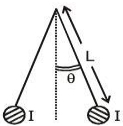
AS, \(g = 4\,{\pi ^2}\frac{l}{{{T^2}}}\)
So, \(\frac{{\Delta g}}{g} \times 100 = \frac{{\Delta l}}{L} \times 100 + 2\frac{{\Delta T}}{T} \times 100\)
\( = \frac{{0.1}}{{20}} \times 100 + 2 \times \frac{1}{{90}} \times 100 = 2.72 \simeq 3\% \) -
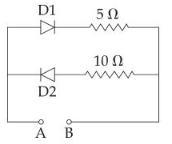
- (A) \(0.4\, A\) and \(0.2\, A\)
- (B) \(0.2\, A\) and \(0.4\, A\)
- (C) \(0.1\, A\) and \(0.2\, A\)
- (D) \(0.2\, A\) and \(0.1\, A\)
Show answer and solution
Correct Answer: (A)
When positive terminal connected to \(A\) then diode \(D_1\) is forward biased, current \(I \, = \frac{2}{5} \, = 0.4\, A\)When positive terminal connected to \(B\) then diode \(D_2\) is forward biased, current, \(I\, = \frac{2}{10}\, = 0.2\,A\)
- 7. In an unbiased \(n-p\) junction electrons diffuse from \(n-\) region to \(p-\) region because 2015 Easy
- (A) holes in \(p-\) region attract them
- (B) electrons travel across the junction due to potential difference
- (C) only electrons move from \(n\) to \(p\) region and not the vice-versa
- (D) electron concentration in \(n-\) region is more compared to that in \(p-\) region
Show answer and solution
Correct Answer: (D)
Electrons in an unbiased \(p-n\) junction, diffuse from \(n -\) region \(i.e.\) higher electron concentration to \(p-\) region \(i.e.\) low electron concentration region. - 8. The value of the resistor, \(R_S\), needed in the \(dc\) voltage regulator circuit shown here, equals
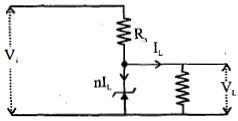 2015 Medium
- (A) \(\frac{{\left( {{V_i} - {V_L}} \right)}}{{\left( {n + 1} \right){I_L}}}\)
- (B) \(\frac{{\left( {{V_i} + {V_L}} \right)}}{{\left( {n + 1} \right){I_L}}}\)
- (C) \(\frac{{\left( {{V_i} - {V_L}} \right)}}{{n{I_L}}}\)
- (D) \(\frac{{\left( {{V_i} + {V_L}} \right)}}{{n{I_L}}}\)
Show answer and solution
Correct Answer: (A)
Voltage on resistor \(R_s\,=\,V_i\,-\,V_L\)or, \(({{I}_{L}}\,+\,n{{I}_{L}}){{R}_{s}}\,=\,{{V}_{i}}\,-\,{{V}_{L}}\)
\(\therefore \,\,{{R}_{s}}\,=\,\frac{\,{{V}_{i}}\,-\,{{V}_{L}}}{(n+\,1){{I}_{L}}}\)
-
- (A) \(6.2\times10^{21}\)
- (B) \(7.5\times10^{21}\)
- (C) \(1.25\times10^{22}\)
- (D) \(1.75\times10^{22}\)
Show answer and solution
Correct Answer: (B)
We know that \(N_{\beta}=N_{0}\left(1-e^{-\lambda t}\right)\)\(N_{\beta}=\frac{6.023 \times 10^{23}}{24} \cdot\left[1-e^{\left(-\frac{\ln ^{2} }{15} \times 75\right)}\right]\)
on solving we get, \(\mathrm{N}_{\beta}=7.4 \times 10^{21}\)
- 10. As an electron makes a transition from an excited state to the ground state of a hydrogen - like atom/ion: 2015 Medium
- (A) kinetic energy, potential energy and total energy decrease
- (B) kinetic energy decreases, potential energy increases but total energy remains same
- (C) kinetic energy and total energy decrease but potential energy mcreases
- (D) its kinetic energy increases but potential energy and total energy decrease
Show answer and solution
Correct Answer: (D)
\({\text{U}} = - {\text{K}}\frac{{{\text{z}}{{\text{e}}^2}}}{{\text{r}}}\) ; \({\text{T}} \cdot {\text{E}} = - \frac{{\text{k}}}{2}\frac{{{\text{z}}{{\text{e}}^2}}}{{\text{r}}}\)\(\mathrm{K.E}=\frac{\mathrm{k}}{2} \frac{\mathrm{ze}^{2}}{\mathrm{r}} .\) Here \(r\) decreases
-
- (A) \(n\left( {\frac{{hqB}}{{2\pi m}}} \right)\)
- (B) \(n\left( {\frac{{hqB}}{{8\pi m}}} \right)\)
- (C) \(n\left( {\frac{{hqB}}{{4\pi m}}} \right)\)
- (D) \(n\left( {\frac{{hqB}}{{\pi m}}} \right)\)
Show answer and solution
Correct Answer: (C)
\(q V B=\frac{m v^{2}}{r}\) ..... \((i)\)\(\frac{n h}{2 \pi}=m v r\) ..... \((ii)\)
Multiplying equation \((i)\) and \((ii)\),
\(\frac{q B n h}{2 \pi}=m^{2} v^{2}\)
Now multiplying both sides by \(\frac{1}{2 m}\)
\(n \frac{q B h}{4 \pi m}=\frac{1}{2} m v^{2}\)
i.e. \(\quad \mathrm{KE}=n\left[\frac{q B h}{4 \pi m}\right]\)
-
- (A) \(\frac{1}{4}\,^{th}\) of the de- Broglie wavelength of the electron in the ground state
- (B) four times the de-Broglie wavelength of the electron in the ground state
- (C) two times the de-Broglie wavelength of the electron in the ground state
- (D) half of the de-Broglie wavelength of the electron in the ground state
Show answer and solution
Correct Answer: (B)
De-Broglie wavelength of electron\(\lambda=\frac{h}{m V}\)
As we know, \(V \propto \frac{1}{n}\)
\(\mathrm{So}, \lambda \propto n\)
\(\lambda_{4}=4 \lambda_{1}\)
\(\lambda_{1}\) is the de-Broglie wavelength of the electron in the ground state.
-
- (A) \(2.4\)
- (B) \(0.5\)
- (C) \(1.7\)
- (D) \(1.2\)
Show answer and solution
Correct Answer: (C)
de-Broglie wavelength,\(\lambda=\frac{h}{P}=\frac{h}{m v}=\frac{h}{\sqrt{2 m q V}}\)
or, \(\quad \lambda=\frac{6.6 \times 10^{-34}}{\sqrt{2 \times 9.1 \times 10^{-31} \times 1.6 \times 10^{-19} \times 50}}\)
\( = \,1.7\,\,\mathop A\limits^o \)
-
- (A) \((a)-(ii)\) , \((b)- (iv)\) , \((c)-(iii)\)
- (B) \((a)-(ii)\) , \((b)-(i)\) , \((c)-(iii)\)
- (C) \((a)-(iv) \) , \((b)-(iii)\) , \((c)-(ii)\)
- (D) \((a)-(i) \) , \((b)-(iv) \) , \((c)-(iii)\)
Show answer and solution
Correct Answer: (B)
Frank - Hertz experiment - Discrete energy levels of atom photoelectric effect- particle nature of lightDavison - Germer experiment - wave nature of electron.
-
- (A) \(2.45\)
- (B) \(5.48 \)
- (C) \(7.75\)
- (D) \(9.73 \)
Show answer and solution
Correct Answer: (A)
Using \(\mathrm{U}_{\mathrm{av}}=\frac{1}{2} \varepsilon_{0} \mathrm{E}^{2}\)But \(U_{a v}=\frac{P}{4 \pi r^{2} \times c}\)
\(\frac{P}{4 \pi r^{2}}=\frac{1}{2} \varepsilon_{0} E^{2} \times c\)
\(\mathrm{E}_{0}^{2}=\frac{2 \mathrm{P}}{4 \pi \mathrm{r}^{2} \varepsilon_{0} \mathrm{c}}=\frac{2 \times 0.1 \times 9 \times 10^{9}}{1 \times 3 \times 10^{8}}\)
\(\mathrm{E}_{0}=\sqrt{6}=2.45 \,\mathrm{V} / \mathrm{m}\)
-
- (A) \(\vec B\,(x\,,\,t) = (3 \times {10^{ - 8}}\,T)\,\hat j \;\sin \,[2\pi \,(1.5 \times {10^{ - 8}}\,x\, - \,2 \times {10^{14}}\,t)]\)
- (B) \(\vec B\,(x\,,\,t) = (9 \times {10^{ - 8}}\,T)\,\hat i\; \sin \,[2\pi \,(1.5 \times {10^{ - 8}}\,x\, - \,2 \times {10^{14}}\,t)]\)
- (C) \(\vec B\,(x\,,\,t) = (9 \times {10^{ - 8}}\,T)\,\hat j\;\sin \,[(1.5 \times {10^{ - 6}}\,x\, - \,2 \times {10^{14}}\,t)]\)
- (D) \(\vec B\,(x\,,\,t) = (9 \times {10^{ - 8}}\,T)\,\hat k \;\sin \,[2\pi \,(1.5 \times {10^{ - 6}}\,x\, - \,2 \times {10^{14}}\,t)]\)
Show answer and solution
Correct Answer: (D)
As we know,\(B_{0}=\frac{E_{0}}{C}=\frac{27}{3 \times 10^{8}}=9 \times 10^{-8}\) \(tesla\)
Oscillation of \(B\) can be only along \(\hat{\jmath}\) or \(\hat{k}\) direction.
\(\omega=2 \pi f=2 \pi \times 2 \times 10^{14} \,\mathrm{Hz}\)
\(\therefore \bar{B}(x, t)=\left(9 \times 10^{-8} T\right) \hat{k} \sin [2 \pi(1)\left.1.5 \times 10^{-6} \times-2 \times 10^{4} t\right)\)
-
- (A) \(\left( {2\hat i + 3\hat j} \right)\) and \(\left( {\hat i + 2\hat j} \right)\)
- (B) \(\left( {-2\hat i - 3\hat j} \right)\) and \(\left( {3\hat i - 2\hat j} \right)\)
- (C) \(\left( {3\hat i + 4\hat j} \right)\) and \(\left( {4\hat i - 3\hat j} \right)\)
- (D) \(\left( {\hat i + 2\hat j} \right)\) and \(\left( {2\hat i - \hat j} \right)\)
Show answer and solution
Correct Answer: (B)
As we know, \(\vec E \cdot \vec B = 0\) \(\because [\vec E \bot \vec B]\) and \(\vec{E} \times \vec{B}\) should be along \(Z\) directionAs \((-2 \hat{i}-3 \hat{j}) \times(3 \hat{i}-2 \hat{j})=13 \hat{k}\)
Hence option \((b)\) is the correct answer.
-
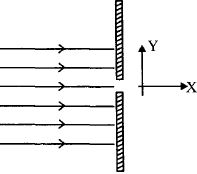
- (A) \(\left| {{P_y}} \right|d > h\)
- (B) \(\left| {{P_y}} \right|d < h\)
- (C) \(\left| {{P_y}} \right|d \simeq h\)
- (D) \(\left| {{P_y}} \right|d > > h\)
Show answer and solution
Correct Answer: (A)
From Bragg's equation\(d \sin \theta=\lambda\)
\(\sin \theta=\frac{\lambda}{d}<1\)
\(\therefore \lambda < d\)
\(\frac{h}{{\left| {{p_y}} \right|}} < d\) \(\left[ {\because \lambda = \frac{h}{{\left| {{p_y}} \right|}}} \right]\)
\(\therefore \quad h<\left|p_{y}\right| d\)
-
- (A) \(30\)
- (B) \(100\)
- (C) \(300\)
- (D) \(1\)
Show answer and solution
Correct Answer: (A)
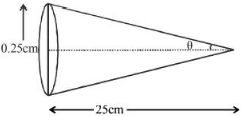
\(\sin \,\theta \, = \,\frac{{0.25}}{{25}}\, = \,\frac{1}{{100}}\)Resolving power \( = \,\frac{{1.22\,\lambda }}{{2\,\mu \,\sin \,\theta }}\, = \,30\,\mu m\)
-
- (A) \(\frac{\beta }{6}\)
- (B) \(\frac{\beta }{3}\)
- (C) \(\frac{\beta }{4}\)
- (D) \(\frac{\beta }{2}\)
Show answer and solution
Correct Answer: (C)
\(2 I_{0}=4 I_{0} \cos ^{2}\left(\frac{\Delta \phi}{2}\right) \quad\) here, \(\Delta \phi=\frac{\pi}{2}\)But, \(\Delta \phi=\frac{2 \pi}{\lambda} \Delta x\)
so, \(\Delta x=\frac{\lambda}{4}\)
\(\frac{d y}{D}=\frac{\lambda}{4}\) ..... \((i)\)
\({\frac{{\lambda D}}{d} = \beta }\) ..... \((ii)\)
Multiplying equation \((i)\) and \((ii)\) we get,
\(y=\frac{\beta}{4}\)
-
- (A) reflected light is completely polarized witih intensity less than \(\frac{I_0}{2}\)
- (B) transmitted light is completely polarized with intensity less than \(\frac{I_0}{2}\)
- (C) transmitted light is partially polarized with intensity \(\frac{I_0}{2}\)
- (D) reflected light is partially polarized with intensity \(\frac{I_0}{2}\)
Show answer and solution
Correct Answer: (A)
When unpolarised light is incident at Brewster 's angle then reflected light is completely polarized and the intensity of the reflected light is less than half of the incident light. -
- (A) \(30\)
- (B) \(15\)
- (C) \(60\)
- (D) \(1\)
Show answer and solution
Correct Answer: (A)
Magnifying power of telescope,\(M P=\frac{\tan \beta( \text { angle subtended by image at eye piece) } }{\tan \alpha \text { (angle subtended by object on objective) }}\)
Also, \(M P =\frac{f_{o}}{f_{e}}=\frac{150}{5}=30\)
\(\tan \alpha =\frac{50}{1000}=\frac{1}{20}\, \mathrm{rad}\)
\(\therefore \quad \tan \beta=\theta=M P \times \tan \alpha\)
\(=30 \times \frac{1}{20}=\frac{3}{2}=1.5\)
or, closest value of \(\beta \approx 60^o\)
-
- (A) \(3f\)
- (B) \(\frac{3}{2}f\)
- (C) \(f\)
- (D) \(2f\)
Show answer and solution
Correct Answer: (D)
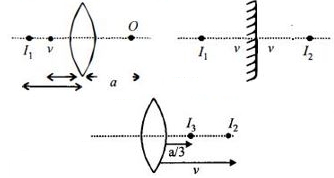
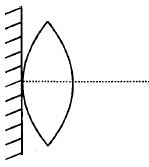
When object is keept at a distance \('a'\) from thin covex lensBy lens formula: \(\frac{1}{v}-\frac{1}{u}=\frac{1}{f}\)
\(\frac{1}{V}-\frac{1}{(-a)}=\frac{1}{f}\)
or, \(\frac{1}{v}=\frac{1}{f}-\frac{1}{a}\) ...... \((i)\)
Mirror forms image at equal distance from mirror
Now, again from lens formula
\(\frac{3}{a}-\frac{1}{V}=\frac{1}{f}\)
\({\frac{3}{a} - \frac{1}{f} + \frac{1}{a} = \frac{1}{f}}\) [From eqn. \((i)\)]
Hence, \(a=2f\)
-
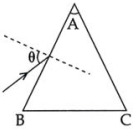
- (A) \(\theta < Si{n^{ - 1}}\left[ {\mu sin\left( {A - si{n^{ - 1}}\left( {\frac{1}{\mu }} \right)} \right)} \right]\)
- (B) \(\;\theta > co{s^{ - 1}}\left[ {\mu sin\left( {A + si{n^{ - 1}}\left( {\frac{1}{\mu }} \right)} \right)} \right]\)
- (C) \(\;\theta < co{s^{ - 1}}\left[ {\mu sin\left( {A + si{n^{ - 1}}\left( {\frac{1}{\mu }} \right)} \right)} \right]\)
- (D) \(\theta > Si{n^{ - 1}}\left[ {\mu sin\left( {A - si{n^{ - 1}}\left( {\frac{1}{\mu }} \right)} \right)} \right]\)
Show answer and solution
Correct Answer: (D)
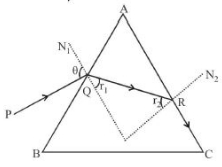
When \({{\text{r}}_2} = {\text{C}},\) \(\angle {{\text{N}}_2}{\text{Rc}} = {90^o}\)Where \(C=\) critical angle
As \(\sin C=\frac{1}{v}=\sin r_{2}\)
Applying snell's law at \('R'\)
\(\mu \,\,\sin {r_2} = 1\,\,\sin {90^o}\) ..... \((i)\)
Applying snell's law at \('Q'\)
\(1 \times \sin \theta=\mu \sin r_{1}\) ...... \((ii)\)
But \(r_{1}=A-r_{2}\)
So, \(\sin \theta=\mu \sin \left(A-r_{2}\right)\)
\(\sin \theta=\mu \sin A \cos r_{2}-\cos A\) ...... \((iii)\) [using \((i)\) ]
From \(( 1 )\)
\(\cos r_{2}=\sqrt{1-\sin ^{2} r_{2}}=\sqrt{1-\frac{1}{\mu^{2}}}\) ..... \((iv)\)
By eq. \((iii)\) and \((iv)\)
\(\sin \theta=\mu \sin A \sqrt{1-\frac{1}{\mu^{2}}}-\cos A\)
on further solving we can show for raynot to transmitted through face \(AC\)
\(\theta=\sin ^{-1}\left[u \sin \left(A-\sin ^{-1}\left(\frac{1}{\mu}\right)\right]\right.\)
So, for transmission through face \(\mathrm{AC}\)
\(\theta > {\sin ^{ - 1}}\) \(\left[ {u\sin \left( {A - {{\sin }^{ - 1}}\left( {\frac{1}{\mu }} \right)} \right]} \right.\)
-
- (A) \(60\)
- (B) \(-24\)
- (C) \(-60\)
- (D) \(24\)
Show answer and solution
Correct Answer: (C)
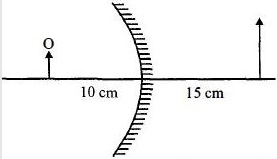
convex mirror is used as a shaving mirror.From question \(: v=15\, \mathrm{cm}, u=-10\,\mathrm{cm}\)
Radius of curvature, \(R=2\,\,f=?\)
Using mirror formula, \(\frac{1}{v}+\frac{1}{u}=\frac{1}{f}\)
\(\frac{1}{15}+\frac{1}{(-10)}=\frac{1}{f} \Rightarrow f=-30\, \mathrm{cm}\)
Therefore radius of curvature,
\(R=2\, \,f=-\,60\, \mathrm{cm}\)
-
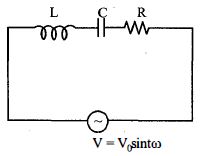
- (A) series with \(C\) and has a magnitude \(\frac{C}{{\left( {{\omega ^2}LC - 1} \right)}}\)
- (B) series with \(C\) and has a magnitude \(\,\frac{{\left( {1 - {\omega ^2}LC} \right)}}{{{\omega ^2}L}}\)
- (C) parallel with \(C\) and has a magnitude \(\,\frac{{\left( {1 - {\omega ^2}LC} \right)}}{{{\omega ^2}L}}\)
- (D) parallel with \(C\) and has a magnitude \(\frac{C}{{\left( {{\omega ^2}LC - 1} \right)}}\)
Show answer and solution
Correct Answer: (C)
Power factor\(\cos \phi=\frac{R}{\sqrt{R^{2}+\left[\omega L-\frac{1}{\omega\left(C+C^{\prime}\right)}\right]^{2}}}=1\)
On solving we get,
\(\omega L=\frac{1}{\omega\left(C+C^{\prime}\right)}\)
\(C' = \frac{{1 - {\omega ^2}LC}}{{{\omega ^2}L}}\)
Hence option \((c)\) is the correct answer.
-
- (A) hot wire voltmeter
- (B) moving coil galvanometer
- (C) potential coil galvanometer
- (D) moving magnet galvanometer
Show answer and solution
Correct Answer: (B)
To measure \(AC\) voltage across a resistance a moving coil galvanometer is used -
- (A) \(14.4\)
- (B) \(8.64\)
- (C) \(20.16\)
- (D) \(11.52\)
Show answer and solution
Correct Answer: (A)
Angular momentum,\(\begin{array}{l}
{L_0} = mvr\sin {90^ \circ }\\
= 2 \times 0.6 \times 12 \times 1 \times 1\\
\left[ {AS\,\,V = r\omega ,\,\sin \,{{90}^ \circ } = 1} \right]\\
So,\,{L_0} = 14.4\,kg{m^2}/s
\end{array}\)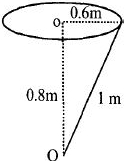
-
- (A) \(14.4\)
- (B) \(8.64\)
- (C) \(20.16\)
- (D) \(11.52\)
Show answer and solution
Correct Answer: (A)
Angular momentum,\(\begin{array}{l}
{L_0} = mvr\sin {90^ \circ }\\
= 2 \times 0.6 \times 12 \times 1 \times 1\\
\left[ {AS\,\,V = r\omega ,\,\sin \,{{90}^ \circ } = 1} \right]\\
So,\,{L_0} = 14.4\,kg{m^2}/s
\end{array}\) -
- (A) \(ma\)
- (B) \(\frac {5}{3}\,ma\)
- (C) \(\frac {3}{2}\,ma\)
- (D) \(2\,ma\)
Show answer and solution
Correct Answer: (C)
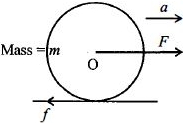
From figure,\(ma = F - f \) ...(i)
And, torque \(\tau = I\alpha \)
\(\begin{array}{l}
\frac{{m{R^2}}}{2}\alpha = fR\,\\
\,\frac{{m{R^2}}}{2} - \frac{a}{R} = fR\,\,\left[ {\alpha = \frac{a}{R}} \right]\\
\frac{{ma}}{2} = f\,\,\,\,\,\,\,\,\,\,\,\,\,\,\,\,...\left( {ii} \right)
\end{array}\)Put this value in equation \((i),\)
\(ma = F - \frac{{ma}}{2}\,\,or\,\,F = \frac{{3ma}}{2}\)
-
- (A) \(ma\)
- (B) \(\frac {5}{3}\,ma\)
- (C) \(\frac {3}{2}\,ma\)
- (D) \(2\,ma\)
Show answer and solution
Correct Answer: (C)
From figure,\(ma = F - f \) ...(i)
And, torque \(\tau = I\alpha \)
\(\begin{array}{l}
\frac{{m{R^2}}}{2}\alpha = fR\,\\
\,\frac{{m{R^2}}}{2} - \frac{a}{R} = fR\,\,\left[ {\alpha = \frac{a}{R}} \right]\\
\frac{{ma}}{2} = f\,\,\,\,\,\,\,\,\,\,\,\,\,\,\,\,...\left( {ii} \right)
\end{array}\)Put this value in equation \((i),\)
\(ma = F - \frac{{ma}}{2}\,\,or\,\,F = \frac{{3ma}}{2}\)
-
- (A) \(a\, = 2b\)
- (B) \(2a\, = b\)
- (C) \(a\, = b\)
- (D) \(3a \,= 2b\)
Show answer and solution
Correct Answer: (B)
Centre of mass of the rod is given by:\(\begin{array}{l}
{x_{cm}} = \frac{{\int\limits_0^L {(ax + \frac{{b{x^2}}}{L})dx} }}{{\int\limits_0^L {\left( {a + \frac{{bx}}{L}} \right)dx} }}\\
\,\,\,\,\,\,\,\,\, = \frac{{\frac{{a{L^2}}}{2} + \frac{{b{L^2}}}{3}}}{{aL + \frac{{bL}}{2}}} = \frac{{L\left( {\frac{a}{2} + \frac{b}{3}} \right)}}{{a + \frac{b}{2}}}\\
Now\,\frac{7}{{12}} = \frac{{\frac{a}{2} + \frac{b}{3}}}{{a + \frac{b}{2}}}
\end{array}\)On solving we get, \(b = 2a\)
-
- (A) \(\frac{{3h}}{4}\)
- (B) \(\;\frac{{5h}}{8}\)
- (C) \(\;\frac{{3{h^2}}}{{8R}}\)
- (D) \(\;\frac{{{h^2}}}{{4R}}\)
Show answer and solution
Correct Answer: (A)
\(\begin{array}{l}
{y_{cm}} = \frac{{\int {ydm} }}{{\int {dm} }}\\
\,\,\,\,\,\,\,\, = \frac{{\int\limits_0^h {\pi {r^2}dy\rho \times y} }}{{\frac{1}{3}\pi {R^2}h\rho }} = \frac{{3h}}{4}
\end{array}\)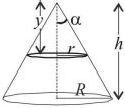
-
- (A) \(\frac{{3h}}{4}\)
- (B) \(\;\frac{{5h}}{8}\)
- (C) \(\;\frac{{3{h^2}}}{{8R}}\)
- (D) \(\;\frac{{{h^2}}}{{4R}}\)
Show answer and solution
Correct Answer: (A)
\(\begin{array}{l}
{y_{cm}} = \frac{{\int {ydm} }}{{\int {dm} }}\\
\,\,\,\,\,\,\,\, = \frac{{\int\limits_0^h {\pi {r^2}dy\rho \times y} }}{{\frac{1}{3}\pi {R^2}h\rho }} = \frac{{3h}}{4}
\end{array}\) -
- (A) \(\frac{{M{R^2}}}{{16\sqrt 2 \pi }}\)
- (B) \(\frac{{4M{R^2}}}{{9\sqrt 3 \pi }}\)
- (C) \(\;\frac{{4M{R^2}}}{{3\sqrt 3 \pi }}\)
- (D) \(\;\frac{{M{R^2}}}{{32\sqrt 2 \pi }}\)
Show answer and solution
Correct Answer: (B)
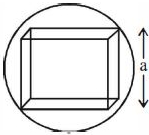
\(\begin{array}{l}
Here\,a = \frac{2}{{\sqrt 3 }}R\\
Now,\frac{M}{{M'}} = \frac{{\frac{4}{3}\pi {R^3}}}{{{a^3}}}\\
= \frac{{\frac{4}{3}\pi {R^3}}}{{{{\left( {\frac{2}{{\sqrt 3 }}R} \right)}^3}}} = \frac{{\sqrt 3 }}{2}\pi .\,M' = \frac{{2M}}{{\sqrt 3 \pi }}
\end{array}\)Moment of inertia of the cube about the given axis,
\(I = \frac{{M'{a^2}}}{6} = \frac{{\frac{{2M}}{{\sqrt 3 \pi }} \times {{\left( {\frac{2}{{\sqrt R }}R} \right)}^2}}}{6} = \frac{{4M{R^2}}}{{9\sqrt 3 \pi }}\)
-
- (A) \(\frac{{M{R^2}}}{{16\sqrt 2 \pi }}\)
- (B) \(\frac{{4M{R^2}}}{{9\sqrt 3 \pi }}\)
- (C) \(\;\frac{{4M{R^2}}}{{3\sqrt 3 \pi }}\)
- (D) \(\;\frac{{M{R^2}}}{{32\sqrt 2 \pi }}\)
Show answer and solution
Correct Answer: (B)
\(\begin{array}{l}
Here\,a = \frac{2}{{\sqrt 3 }}R\\
Now,\frac{M}{{M'}} = \frac{{\frac{4}{3}\pi {R^3}}}{{{a^3}}}\\
= \frac{{\frac{4}{3}\pi {R^3}}}{{{{\left( {\frac{2}{{\sqrt 3 }}R} \right)}^3}}} = \frac{{\sqrt 3 }}{2}\pi .\,M' = \frac{{2M}}{{\sqrt 3 \pi }}
\end{array}\)Moment of inertia of the cube about the given axis,
\(I = \frac{{M'{a^2}}}{6} = \frac{{\frac{{2M}}{{\sqrt 3 \pi }} \times {{\left( {\frac{2}{{\sqrt R }}R} \right)}^2}}}{6} = \frac{{4M{R^2}}}{{9\sqrt 3 \pi }}\)
-
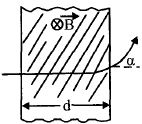
- (A) \(qV\,\sqrt {\frac{{Bd}}{{2m}}} \)
- (B) \(\frac{B}{2}\sqrt {\frac{{qd}}{{mV}}} \)
- (C) \(\frac{B}{d}\sqrt {\frac{{q}}{{2mV}}} \)
- (D) \(Bd\sqrt {\frac{q}{{2mV}}} \)
Show answer and solution
Correct Answer: (D)
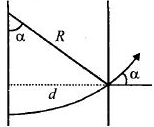
From figure, \(sin\,\alpha =dlR\)And we know, \(\frac{m v^{2}}{R}=q v B\)
\(\Rightarrow \quad R=\frac{m v}{q B}\)
\(\because \sin \alpha=\frac{d q B}{m v}\)
\(\sin \alpha=B d \sqrt{\frac{q}{2 m V}}\left[\because q V=\frac{1}{2} m v^{2}\right]\)
-
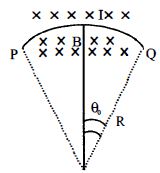
- (A) \(\frac{{IBR}}{{2\,\sin \,{\theta _0}}}\)
- (B) \(\frac{{IBR{\theta _0}}}{{\sin \,{\theta _0}}}\)
- (C) \(IBR\)
- (D) \(\frac{{IBR}}{{\,\sin \,{\theta _0}}}\)
Show answer and solution
Correct Answer: (C)
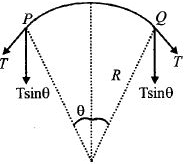
For small are length\(2 T \sin \theta=\operatorname{BIR} 2 \theta\)
\(\text { (As }\mathrm{F}=\mathrm{BIL} \text { and } L=\mathrm{RZ} \theta)\)
\(T=\mathrm{BIR}\)
-
- (A) \(\;\overrightarrow {{F_1}} \) is radially inwards and \(\overrightarrow {{F_2}} \) is radially outwards
- (B) \(\;\overrightarrow {{F_1}} \) is radially inwards and \(\overrightarrow {\;{F_2}} \)\(=0\)
- (C) \(\overrightarrow {{F_1}} \) is radially outwards and \(\overrightarrow {\;{F_2}} =0\)
- (D) \(\overrightarrow {{F_1}} =\overrightarrow {\;{F_2}} =0\)
Show answer and solution
Correct Answer: (D)
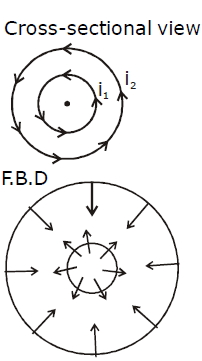
(Both solenoids are taken to be ideal in nature.)Both wires will attract each other, but net force on each wire will be zero.
Concept: Two current carrying elements attract each other if direction of current is same.
\(\overrightarrow {{F_1}} =\overrightarrow {\;{F_2}} =0\)
-
- (A) \(2\)\(sin\)\(\theta \sqrt {\frac{{\pi \lambda gL}}{{{\mu _0}cos\theta }}} \;\;\;\;\;\;\;\;\)
- (B) \(2\)\(\sqrt {\frac{{\pi gL}}{{{\mu _0}}}tan\theta } \)
- (C) \(\;\sqrt {\frac{{\pi \lambda gL}}{{{\mu _0}}}tan\theta } \)
- (D) \(sin\)\(\theta \sqrt {\frac{{\pi \lambda gL}}{{{\mu _0}cos\theta }}} \)
Show answer and solution
Correct Answer: (A)
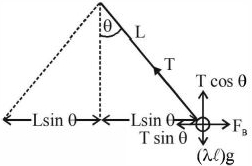
Let us consider \('l'\) length of current carrying wire.At equilibrium
\(\mathrm{T} \cos \theta=\lambda \mathrm{g} \ell\)
and \(T \sin \theta=\frac{\mu_{0}}{2 \pi} \frac{I \times I l}{2 L \sin \theta}\left[\because \frac{F_{B}}{\ell}=\frac{\mu_{0}}{4 \pi} \frac{2 I \times I}{2 \ell \sin \theta}\right]\)
Therefore, \(I=2 \sin \theta \sqrt{\frac{\pi \lambda g L}{u_{0} \cos \theta}}\)
-
- (A) \(67\)
- (B) \(6.7\)
- (C) \(0.67\)
- (D) \(100\)
Show answer and solution
Correct Answer: (C)
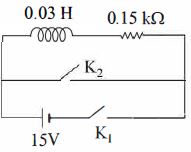
According to given conditions:\(\mathrm{i}_{0}=\frac{\mathrm{V}}{\mathrm{R}}\)
\(=\frac{15}{0.15 \times 10^{3}}\)
\(=0.1 \,A\)
\(i=i_{0} e^{-\frac{R t}{L}}\)
\(=0.1 \times e^{-\frac{0.15 \times 10^{3} \times 10^{-3}}{0.03}}\)
\(=0.1 \times \mathrm{e}^{-5}=\frac{0.1}{150}=0.67\, \mathrm{mA}\)
-
- (A) \(6\)
- (B) \(0.67\)
- (C) \(3\)
- (D) \(1.67\)
Show answer and solution
Correct Answer: (D)
According to Faraday's law of electromagnetic induction,Induced \(emf\), \(e=\frac{L d i}{d t}\)
\(50 = L\left( {\frac{{5 - 2}}{{0.1\,{\text{sec}}}}} \right)\)
\(\Rightarrow L=\frac{50 \times 0.1}{3}=\frac{5}{3}=1.67\, \mathrm{H}\)
-
- (A) \(30000\pi \,A{m^{ - 1}}\)
- (B) \(3\pi \,A{m^{ - 1}}\)
- (C) \(30000 \,A{m^{ - 1}}\)
- (D) \(300 \,A{m^{ - 1}}\)
Show answer and solution
Correct Answer: (C)
\(\bar{M}\) (mag. moment/volume) \(=\frac{N i A}{A \ell}\)\(=\frac{N i}{\ell}=\frac{(500) 15}{25 \times 10^{-2}}=30000\, \mathrm{Am}^{-1}\)
-
- (A) \(14.6\)
- (B) \(19.4\)
- (C) \(9.7\)
- (D) \(4.9\)
Show answer and solution
Correct Answer: (C)
Here, \(r=30\, \mathrm{cm}=0.3 \,\mathrm{cm}\)we know \(\frac{\mu_{0} M}{4 \pi r^{3}}=B_{H}=3.6 \times 10^{-5}\)
\(M = \frac{{3.6 \times {{10}^{ - 5}}}}{{{{10}^{ - 7}}}} \times {(0.3)^3}\)
Hence, \(M=9.7\, \mathrm{Am}^{2}\)
-
- (A) \(12.5\)
- (B) \(24.5\)
- (C) \(13.1\)
- (D) \(11.9\)
Show answer and solution
Correct Answer: (C)
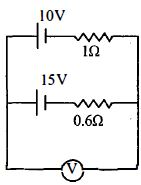
As the two cells oppose each other hence, the effective emf in closed circuit is \(15-10=5 \,\mathrm{V}\) and net resistance is \(1+\) \(0.6=1.6 \,\Omega\) (because in the closed circuit the internal resistance of two cells are in series.Current in the circuit,
\(I=\frac{\text { effective emf }}{\text { total resistance }}=\frac{5}{1.6} \,A\)
The potential difference across voltmeter will be same as the terminal voltage of either cell.
Since the current is drawn from the cell of \(15 \,\mathrm{V}\)
\(\therefore \quad V_{1}=E_{1}-I r_{1}\)
\(=15-\frac{5}{1.6} \times 0.6=13.1 \,\mathrm{V}\)
-
- (A) \(6\)
- (B) \(3\)
- (C) \(5\)
- (D) \(4\)
Show answer and solution
Correct Answer: (C)
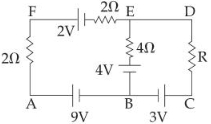
As no current flows through arm \(E B\) then\(\mathrm{V}_{\mathrm{D}}=0\, \mathrm{V}\)
\(\mathrm{V}_{\mathrm{E}}=0\, \mathrm{V}\)
\(\mathrm{v}_{\mathrm{B}}=-4 \,\mathrm{V}\)
\(\mathrm{V}_{\mathrm{A}}=5 \,\mathrm{V}\)
So, potential difference between the points
\(A\) and \(D\)
\(V_{A}-V_{D}=5\, \mathrm{V}\)
-
- (A) \(1.6 \times 10^{-7} \) \(Ω m\)
- (B) \(1.6 \times 10^{-5} \) \(Ω m\)
- (C) \(1.6 \times 10^{-3} \) \(Ωm\)
- (D) \(1.6 \times 10^{-8} \) \(Ωm\)
Show answer and solution
Correct Answer: (B)
\(V=I R=\left(n e A v_{d}\right) \rho \frac{\ell}{A}\)\(\therefore \quad \rho=\frac{\mathrm{V}}{\mathrm{V}_{\mathrm{d}} \mathrm{lne}}\)
Here \(\mathrm{V}=\) potential difference
\(\mathrm{I}=\) length of wire
\(\mathrm{n}=\mathrm{no} .\) of electrons per unit volume of conductor.
\(\mathrm{e}=\mathrm{no.}\) of electrons
Placing the value of above parameters we get resistivity
\(\rho=\frac{5}{8 \times 10^{28} \times 1.6 \times 10^{-19} \times 2.5 \times 10^{-4} \times 0.1}\)
\(=1.6 \times 10^{-5} \,\Omega m\)
-
- (A) \(R_1\)\( \ne 0\) and \((R_2-R_1) > (R_4-R_3)\)
- (B) \(R_1\) \( = 0\) and \(R_2 < (R_4-R_3)\)
- (C) \(2R < R_4\)
- (D) \(R_1\) \( = 0\) and \( R_2 > (R_4-R_3)\)
Show answer and solution
Correct Answer: (C)
We know, \(\mathrm{V}_{0}=\frac{\mathrm{Kq}}{\mathrm{R}}=\mathrm{V\,surface}\)Now, \(\mathrm{V}_{\mathrm{i}}=\frac{\mathrm{Kq}}{2 \mathrm{R}^{3}}\left(3 \mathrm{R}^{2}-\mathrm{r}^{2}\right) \quad[\mathrm{For}\, \mathrm{r}<\mathrm{R}]\)
At the centre of sphare \(r=0 .\)
Here \(\mathrm{V}=\frac{3}{2} \mathrm{V}_{0}\)
Now, \(\frac{5}{4} \frac{\mathrm{Kq}}{\mathrm{R}}=\frac{\mathrm{Kq}}{2 \mathrm{R}^{3}}\left(3 \mathrm{R}^{2}-\mathrm{r}^{2}\right)\)
\(\mathrm{R}_{2}=\frac{\mathrm{R}}{\sqrt{2}}\)
\(\frac{3}{4} \frac{\mathrm{Kq}}{\mathrm{R}}=\frac{\mathrm{Kq}}{\mathrm{R}^{3}}\)
\(\frac{1}{4} \frac{\mathrm{Kq}}{\mathrm{R}}=\frac{\mathrm{Kq}}{\mathrm{R}_{4}}\)
\(\mathrm{R}_{4}=4 \mathrm{R}\)
Also, \(\mathrm{R}_{1}=0\) and \(\mathrm{R}_{2}<\left(\mathrm{R}_{4}-\mathrm{R}_{3}\right)\)
-
- (A) \(-110\)
- (B) \(-140\)
- (C) \(-120\)
- (D) \(-130\)
Show answer and solution
Correct Answer: (A)
As we know, \(\mathrm{E}=-\frac{d v}{d x}\)Potential at the point \(x=2 \,m, y=2 \,m\) is given by :
\(\int_{0}^{V} d V=-\int_{0}^{2,2}(25 d x+30 d y)\)
on solving we get,
\(V=-110\,volt\)
No questions on this page match these filters.
Other years
Frequently asked
How many JEE Mains 2015 Physics questions are on ExamBro?
75 questions, each with the correct answer and a full solution.
Which JEE Mains 2015 Physics chapter is asked the most?
System of particles and rotational motion, with 10 questions, followed by Units, dimensions and measurement with 5.
How difficult are JEE Mains 2015 Physics questions?
5% are easy, 44% medium and 51% hard.