


2018 માં પૂછાયેલાં પ્રકરણ
28 પ્રકરણ- 5પ્રશ્નો STD 11 એકમ, પરિમાણ અને માપન
- 4પ્રશ્નો STD 12 સેમિકન્ડક્ટર ઇલેક્ટ્રોનિક્સ : દ્રવ્યો, રચનાઓ અને સાદા પરિપથો
- 3પ્રશ્નો STD 12 ન્યુક્લિયસ
- 3પ્રશ્નો STD 12 પરમાણુઓ
- 4પ્રશ્નો STD 12 વિદ્યુતચુંબકીય તરંગો
- 5પ્રશ્નો STD 12 તરંગ પ્રકાશશાસ્ત્ર
- 4પ્રશ્નો STD 12 કિરણ પ્રકાશશાસ્ત્ર અને પ્રકાશીય ઉપકરણો
- 2પ્રશ્નો STD 12 પ્રત્યાવર્તી પ્રવાહ
- 12પ્રશ્નો STD 11 6.કણોનાં તંત્રો અને ચાકગતિ સૌથી વધુ પૂછાયેલ
- 7પ્રશ્નો STD 12 ગતિમાન વિધુતભારો અને ચુંબકત્વ સૌથી વધુ પૂછાયેલ
- 4પ્રશ્નો STD 12 વિદ્યુતચુંબકીય પ્રેરણ
- 1પ્રશ્નો STD 12 ચુંબકત્વ અને દ્રવ્ય
- 8પ્રશ્નો STD 12 પ્રવાહ વિદ્યુત સૌથી વધુ પૂછાયેલ
- 5પ્રશ્નો STD 12 સ્થિત વિદ્યુતસ્થિતિમાન અને કેપેસિટન્સ
- 4પ્રશ્નો STD 12 વિધુતભારો અને ક્ષેત્રો
- 5પ્રશ્નો STD 11 તરંગો
- 4પ્રશ્નો STD 11 દોલનો
- 2પ્રશ્નો STD 11 ગતિવાદ
- 5પ્રશ્નો STD 11 થર્મોડાયનેમિક્સ
- 2પ્રશ્નો STD 11 ઘન પદાર્થોના યાંત્રિક ગુણધર્મો
- 2પ્રશ્નો STD 11 પૃષ્ઠતાણ
- 1પ્રશ્નો STD 11 તરલના યાંત્રિક ગુણધર્મો
- 1પ્રશ્નો STD 11 ગતિના નિયમો
- 4પ્રશ્નો STD 11 ગુરુત્વાકર્ષણ
- 6પ્રશ્નો STD 11 કાર્ય, ઊર્જા અને પાવર
- 3પ્રશ્નો STD 11 સુરેખપથ પર ગતિ
- 1પ્રશ્નો STD 11 ઉષ્માનું પરિવહન
- 1પ્રશ્નો STD 11 સદિશ
JEE Mains 2018 Physics ના બધા પ્રશ્નો
28 પ્રકરણ108 માંથી 1–50 પ્રશ્નો
-
- (A) \(8.5\)
- (B) \(6.0\)
- (C) \(7.5\)
- (D) \(6.5\)
જવાબ અને ઉકેલ જુઓ
સાચો જવાબ: (D)
\(\begin{array}{l}
Maximum\,percentage\,error\,in\,A\\
= 3\left( {\% \,error\,in\,p} \right) + 2\left( {\% \,error\,in\,Q} \right)\\
\,\,\,\,\,\,\,\,\,\,\,\,\,\,\, + \frac{1}{2}\left( {\% \,error\,in\,R} \right) + 1\left( {\% \,error\,in\,S} \right)\\
= 3 \times 0.5 + 2 \times 1 = \frac{1}{2} \times 3 + 1 \times 1.5\\
= 1.5 + 2 + 1.5 + 1.5 = 6.5\%
\end{array}\) -
- (A) \(3.5\)
- (B) \(4.5\)
- (C) \(6\)
- (D) \(2.5 \)
જવાબ અને ઉકેલ જુઓ
સાચો જવાબ: (B)
\(\begin{array}{l}
Density\left( d \right) = \frac{{mass\left( M \right)}}{{volume\left( V \right)}} = \frac{M}{{{L^3}}}\\
\therefore Error\,in\,density,\,\frac{{\Delta d}}{d} = \frac{{\Delta M}}{M} + \frac{{3\Delta L}}{L}\\
= 1.5\% + 3\left( {1\% } \right) = 4.5\%
\end{array}\) - 3. ગોળાના પૃષ્ઠના ક્ષેત્રફળના માપનમાં મળેલી સાપેક્ષ ત્રુટિ \(\alpha \) છે. તો તેના કદના માપનમાં મળતી સાપેક્ષ ત્રુટિ કેટલી હશે? 2018 અઘરું
- (A) \(\frac{2}{3}\alpha \)
- (B) \(\frac{5}{2}\alpha \)
- (C) \(\frac{3}{2}\alpha \)
- (D) \(\alpha \)
જવાબ અને ઉકેલ જુઓ
સાચો જવાબ: (C)
\(\begin{array}{l}
{\mathop{\rm Re}\nolimits} lative\,\,eroor\,\,in\,\,surface\,\,area,\\
\frac{{\Delta s}}{s} = 2 \times \frac{{\Delta r}}{r} = \alpha \,and\,relative\,error\,in\\
volume,\,\frac{{\Delta v}}{v} = 3 \times \frac{{\Delta r}}{r}\\
\therefore \,{\mathop{\rm Re}\nolimits} lative\,\,error\,in\,volume\,w.r.t\,relative\,error\,in\,area,\\
\frac{{\Delta v}}{v} = \frac{3}{2}\alpha
\end{array}\) -
- (A) \(0.0430\,cm\)
- (B) \(0.3150\,cm\)
- (C) \(0.43 00\,cm\)
- (D) \(0.2150\, cm\)
જવાબ અને ઉકેલ જુઓ
સાચો જવાબ: (D)
In one rotation scale moves \(\frac{0.25}{5}=0.05 cm\)Least count \(=0.05 \times 10^{-2} cm\)
For 4 main scale division \(=4 \times 0.05=0.2 cm\)
For circular scale divosion \(=30 \times 0.05 \times 10^{-2}=1.5 \times 10^{-2} cm\)
Thickness of wire \(=0.2+0.015=0.2150 cm\)
-
- (A) \(G^2hc\)
- (B) \({\left( {\frac{{Gh}}{{{c^3}}}} \right)^{\frac{1}{2}}}\)
- (C) \({G^{\frac{1}{2}}}{h^2}c\)
- (D) \(Gh^2c^3\)
જવાબ અને ઉકેલ જુઓ
સાચો જવાબ: (B)
Plank length is a unit of length \(I_p\,= 1.616229\times10^{-35}\,m\) \({l_p} = \sqrt {\frac{{hG}}{{{c^3}}}} \) -
- (A)
\(x\) \(y\) \(z\) \(0\) \(0\) \(1\) \(0\) \(1\) \(1\) \(1\) \(0\) \(1\) \(1\) \(1\) \(0\) - (B)
\(x\) \(y\) \(z\) \(0\) \(0\) \(0\) \(0\) \(1\) \(0\) \(1\) \(0\) \(0\) \(1\) \(1\) \(1\) - (C)
\(x\) \(y\) \(z\) \(0\) \(0\) \(1\) \(0\) \(1\) \(1\) \(1\) \(0\) \(1\) \(1\) \(1\) \(1\) - (D)
\(x\) \(y\) \(z\) \(0\) \(0\) \(0\) \(0\) \(1\) \(1\) \(1\) \(0\) \(1\) \(1\) \(1\) \(1\)
જવાબ અને ઉકેલ જુઓ
સાચો જવાબ: (C)
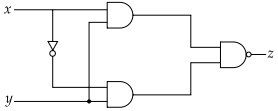
Truth table of the circuit is as follows\(x\) \(y\) \(\bar x\) \(a= x.y\) \(b=\bar x.y\) \(z=\bar {a.b}\) \(0\) \(0\) \(1\) \(0\) \(0\) \(1\) \(0\) \(1\) \(1\) \(0\) \(1\) \(1\) \(1\) \(0\) \(0\) \(0\) \(0\) \(1\) \(1\) \(1\) \(0\) \(1\) \(0\) \(1\) - (A)
-
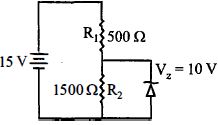
- (A) \(2.5\)
- (B) \(3.3\)
- (C) \(5.5\)
- (D) \(6.7\)
જવાબ અને ઉકેલ જુઓ
સાચો જવાબ: (B)
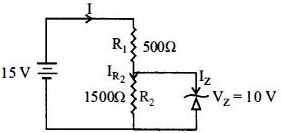
The voltage drop across \(\mathrm{R}_{2}\) is \(\mathrm{V}_{\mathrm{R}_{2}}\) \(=\mathrm{V}_{\mathrm{Z}}=10 \mathrm{V}\)The current through \(\mathrm{R}_{2}\) is
\(\mathrm{I}_{\mathrm{R}_{2}}=\) \(\frac{\mathrm{V}_{\mathrm{R}_{2}}}{\mathrm{R}_{2}}\) \(=\frac{10 \mathrm{V}}{1500 \Omega}\) \(=0.667 \times 10^{-2} \mathrm{A}\)
\(=6.67 \times 10^{-3} \mathrm{A}=6.67 \mathrm{mA}\)
The voltage drop across \(R_{1}\) is
\(\mathrm{V}_{\mathrm{R}_{1}}=15 \mathrm{V}-\mathrm{V}_{\mathrm{R}_{2}}\) \(=15 \mathrm{V}-10 \mathrm{V}=5 \mathrm{V}\)
The current through \(\mathrm{R}_{1}\) is
\(\mathrm{I}_{\mathrm{R}_{1}}=\frac{\mathrm{V}_{\mathrm{R}_{1}}}{\mathrm{R}_{1}}=\frac{5 \mathrm{V}}{500 \Omega}=10^{-2} \mathrm{A}=10 \times 10^{-3} \mathrm{A}=10 \mathrm{mA}\)
The current through the zener diode is
\(\mathrm{I}_{\mathrm{Z}}=\mathrm{I}_{\mathrm{R}_{1}}-\mathrm{I}_{\mathrm{R}_{2}}\) \(=(10-6.67) \mathrm{mA}=3.3 \mathrm{mA}\)
-
- (A) \(15\)
- (B) \(13.5 \)
- (C) \(11.5\)
- (D) \(0\)
જવાબ અને ઉકેલ જુઓ
સાચો જવાબ: (C)
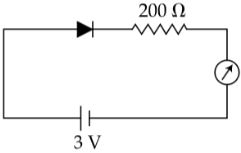
Clearly from fig. given in question, Silicon diode is in forward bias.\(\therefore\) Potential barrier across diode
\(\Delta \mathrm{V}=0.7 \mathrm{volts}\)
Current, \(I=\frac{V-\Delta V}{R}=\frac{3-0.7}{200}\) \(=\frac{2.3}{200}=11.5 \mathrm{mA}\)
-
- (A) \(\beta \frac{{{R_L}}}{{{R_{BE}}}},\frac{{\Delta {I_E}}}{{\Delta {I_B}}},{\beta ^2}\frac{{{R_L}}}{{{R_{BE}}}}\)
- (B) \({\beta ^2}\frac{{{R_L}}}{{{R_{BE}}}},\frac{{\Delta {I_C}}}{{\Delta {I_B}}},\beta \frac{{{R_L}}}{{{R_{BE}}}}\)
- (C) \({\beta ^2}\frac{{{R_L}}}{{{R_{BE}}}},\frac{{\Delta {I_C}}}{{\Delta {I_E}}},{\beta ^2}\frac{{{R_L}}}{{{R_{BE}}}}\)
- (D) \(\beta \frac{{{R_L}}}{{{R_{BE}}}},\frac{{\Delta {I_C}}}{{\Delta {I_B}}},{\beta ^2}\frac{{{R_L}}}{{{R_{BE}}}}\)
જવાબ અને ઉકેલ જુઓ
સાચો જવાબ: (D)
Curent gain \(\beta=\frac{\Delta I_{C}}{I_{B}}\)Voltage gain \(\mathrm{A}_{\mathrm{v}}=\) Current gain \(\times\) Resistance
\(\operatorname{gain}=\beta \frac{R_{L}}{R_{B E}}\)
Power gain \(A_{p}=(\text { Current gain })^{2} \times\) Resistance gain
\(=\beta^{2} \frac{R_{L}}{R_{B E}}\)
-
- (A) \(6\)
- (B) \(7\)
- (C) \(4\)
- (D) \(5\)
જવાબ અને ઉકેલ જુઓ
સાચો જવાબ: (D)
Let initial activity \(=\mathrm{N}_{0}=0.8\, \mu \mathrm{ci}\)\(0.8 \times 3.7 \times 10^{4}\, \mathrm{dps}\)
Activity in \(1\, \mathrm{cm}^{3}\) of blood at \(\mathrm{t}=10\, \mathrm{hr}\)
\(\mathrm{n}=\frac{300}{60} \mathrm{dps}=5 \,\mathrm{dps}\)
\(\mathrm{N}=\) Activity of whole blood at timet \(=10 \,\mathrm{hr}\) Total volume of the blood in the person, \(V\)
\(=\frac{N}{n}\)
\( = \frac{{{N_0}e - \lambda t}}{n} = \) \( \frac{{0.8 \times 3.7 \times {{10}^4} \times 0.7927}}{5} \cong 5\,\,{\mkern 1mu} litre\)
-
- (A) \(10\) વર્ષ અને \(20\) વર્ષ
- (B) \(5\) વર્ષ અને \(20\) વર્ષ
- (C) \(20\) વર્ષ અને \(10\) વર્ષ
- (D) \(20\) વર્ષ અને \(5\) વર્ષ
જવાબ અને ઉકેલ જુઓ
સાચો જવાબ: (B)
Given \(: \mathrm{N}_{1}=2 \mathrm{N}_{2}\)Activity of radioactive substance \(=\lambda \mathrm{N}\)
Half life period \(\mathrm{t}=\frac{\ln 2}{\lambda}\) or, \(\lambda=\frac{\ln 2}{\mathrm{t}}\)
\(\lambda_{1} \mathrm{N}_{1}=\frac{\ln 2}{\mathrm{t}_{1}} \times \mathrm{N}_{1}=5 \mu \mathrm{C}_{\mathrm{i}}\) ...... \((i)\)
\(\lambda_{2} \mathrm{N}_{2}=\frac{\ln 2}{\mathrm{t}_{2}} \times \mathrm{N}_{2}=10 \mu \mathrm{C}_{\mathrm{i}}\) ...... \((ii)\)
Dividing equation \((ii)\) by \((i)\)
\(\frac{t_{2}}{t_{1}} \times \frac{N_{1}}{N_{2}}=\frac{1}{2}\)
\(\frac{t_{2}}{t_{1}}=\frac{1}{4} \Rightarrow t_{1}=4 t_{2}\)
i.e., Half life of \(S_{1}\) is four times of sample \(S_{2}\) Hence \(5\) years and \(20\) years.
- 12. સ્થિર પડેલ અસ્થાયી ન્યુક્લિયસ બે ન્યુક્લિયસમાં વિભાજિત થાય છે જેમના વેગનો ગુણોત્તર \(8:27\) છે, તો તેમની ત્રિજ્યાનો ગુણોત્તર કેટલો હશે? 2018 અઘરું
- (A) \(8 : 27\)
- (B) \(2 : 3\)
- (C) \(3 : 2\)
- (D) \(4:9\)
જવાબ અને ઉકેલ જુઓ
સાચો જવાબ: (C)
Let heavy nucleus breaks into two nuclei of mass \(m_{1}\) and \(m_{2}\) and move away with velocities \({V}_{1}^1\) and \(V_{2}^2\) respectively.According to question, \(\frac{V_{1}}{V_{2}}=\frac{8}{27}\) \(m_{1} V_{1}=m_{2} V_{2}\) (Law of momentum conservation)
\(\Rightarrow\) \(\frac{{{m_1}}}{{{m_2}}} = \frac{{{V_2}}}{{{V_1}}} = \frac{{27}}{8}\)
\(\rho \times \frac{4}{3}\pi R_1^3\) \(\left( {\because {\text{ density }}\rho = \frac{{{\text{ mass }}}}{{{\text{ volume }}}}} \right)\)
\(\rho \times \frac{4}{3}\pi R_2^3\)
\( \Rightarrow \left( {\frac{{{R_1}}}{{{R_2}}}} \right) = \) \({\left( {\frac{{27}}{8}} \right)^{\frac{1}{3}}} = {\left( {\frac{3}{2}} \right)^{3 \times \frac{1}{3}}}\)
\(\therefore \frac{R_{1}}{R_{2}}=\frac{3}{2}\)
-
- (A) \(20\)
- (B) \(79\)
- (C) \(109\)
- (D) \(34\)
જવાબ અને ઉકેલ જુઓ
સાચો જવાબ: (B)
Energy required to remove e - from singlyionized helium atom \({ = \frac{{(13.6){Z^2}}}{{{1^2}}} = 54.4\,{\text{eV}}}\)
\((\because Z=2)\)
Energy required to remove \(e^-\) from helium atom \(=x\,eV\)
According to question, \(54.4 \mathrm{eV}=2.2 \mathrm{x} \Rightarrow \mathrm{x}\)
\(=24.73 \mathrm{eV}\)
Therefore, energy required to ionize helium atom \(=(54.4+24.73)eV\) \(=79.12 \mathrm{eV}\)
-
- (A) \({\lambda _B}\, = \,{\lambda _{G}}/3\)
- (B) \({\lambda _B}\, = \,{\lambda _{G}}/2\)
- (C) \({\lambda _B}\, = \,{2\lambda _{G}}\)
- (D) \({\lambda _B}\, = \,{3\lambda _{G}}\)
જવાબ અને ઉકેલ જુઓ
સાચો જવાબ: (D)
de-Broglie wavelength, \(\lambda=\frac{h}{P}\)\(\frac{\lambda_{\mathrm{B}}}{\lambda_{\mathrm{G}}}=\frac{\mathrm{P}_{\mathrm{G}}}{\mathrm{P}_{\mathrm{B}}}=\frac{\mathrm{mv}_{\mathrm{G}}}{\mathrm{mv}_{\mathrm{B}}}\)
Speed of electron \(v \propto \frac{z}{n}\)
so \(\frac{\lambda_{B}}{\lambda_{G}}=\frac{n_{B}}{n_{G}}=\frac{3}{1} \Rightarrow \lambda_{B}=3 \lambda_{G}\)
-
- (A) \(16\) \( v_L\)
- (B) \(\frac{{{v_L}}}{{16}}\)
- (C) \(\;\frac{{{v_L}}}{{25}}\)
- (D) \(25\) \( v_L\)
જવાબ અને ઉકેલ જુઓ
સાચો જવાબ: (C)
\(\mathrm{hv}_{\mathrm{L}}=\mathrm{E}_{\infty}-\mathrm{E}_{1}\) ..... \((i)\)\(\mathrm{hv}_{\mathrm{f}}=\mathrm{E}_{\infty}-\mathrm{E}_{5}\) ..... \((ii)\)
\({\text{E}} \propto \frac{{{{\text{z}}^2}}}{{{{\text{n}}^2}}} \Rightarrow \) \(\frac{{{{\text{E}}_5}}}{{{{\text{E}}_1}}} = {\left( {\frac{1}{5}} \right)^2} = \frac{1}{{25}}\)
\(\operatorname{Eqn}(\mathrm{i}) /(\mathrm{ii}) \Rightarrow \frac{\mathrm{h} v_{\mathrm{L}}}{\mathrm{h} v_{\mathrm{f}}}=\frac{\mathrm{E}_{1}}{\mathrm{E}_{5}}\)
\(\Rightarrow \frac{v_{\mathrm{L}}}{v_{\mathrm{f}}}=\frac{25}{1} \Rightarrow v_{\mathrm{f}}=\frac{v_{\mathrm{L}}}{25}\)
-
- (A) \(\frac{{{_{{\epsilon r_1}}}}}{{{_{{\epsilon r_2}}}}} = 2\)
- (B) \(\frac{{{_{{\epsilon r_1}}}}}{{{_{{\epsilon r_2}}}}} = \frac{1}{4}\)
- (C) \(\frac{{{_{{\epsilon r_1}}}}}{{{_{{\epsilon r_2}}}}} = \frac{1}{2}\)
- (D) \(\frac{{{_{{\epsilon r_1}}}}}{{{_{{\epsilon r_2}}}}} = 4\)
જવાબ અને ઉકેલ જુઓ
સાચો જવાબ: (B)
Velocity of \(EM\) wave is given by \(\mathrm{v}=\frac{1}{\sqrt{\mu \epsilon}}\)Velocity in air \(=\frac{\omega}{\mathrm{k}}=\mathrm{C}\)
Velocity in medium \(=\frac{\mathrm{C}}{2}\)
Here, \(\mu_{1}=\mu_{2}=1\) as medium is non-magnetic
\(\therefore \frac{\sqrt{\epsilon_{\eta}}}{\frac{1}{\sqrt{\epsilon_{\mathrm{r}_{2}}}}}=\frac{\mathrm{C}}{\left(\frac{\mathrm{C}}{2}\right)}=2 \quad \Rightarrow \quad \frac{\epsilon_{\mathrm{r}_{1}}}{\epsilon_{\mathrm{r}_{2}}}=\frac{1}{4}\)
-
- (A) \(\frac{{{E_0}}}{C}\left( {\frac{{\hat i - \hat j}}{{\sqrt 2 }}} \right)\cos \left[ {{{10}^4}\left( {\frac{{\hat i - \hat j}}{{\sqrt 2 }}} \right)\cdot \vec r - \left( {3 \times {{10}^{12}}} \right)t} \right]\)
- (B) \(\frac{{{E_0}}}{C}\left( {\frac{{\hat i - \hat j}}{{\sqrt 2 }}} \right)\cos \left[ {{{10}^4}\left( {\frac{{\hat i + \hat j}}{{\sqrt 2 }}} \right)\cdot \vec r - \left( {3 \times {{10}^{12}}} \right)t} \right]\)
- (C) \(\frac{{{E_0}}}{C}\hat k\cos \left[ {{{10}^4}\left( {\frac{{\hat i + \hat j}}{{\sqrt 2 }}} \right)\cdot \vec r + \left( {3 \times {{10}^{12}}} \right)t} \right]\)
- (D) \(\frac{{{E_0}}}{C}\frac{{\left( {\hat i + \hat j + \hat k} \right)}}{{\sqrt 3 }}\cos \left[ {{{10}^4}\left( {\frac{{\hat i + \hat j}}{{\sqrt 2 }}} \right)\cdot \vec r + \left( {3 \times {{10}^{12}}} \right)t} \right]\)
જવાબ અને ઉકેલ જુઓ
સાચો જવાબ: (A)
Poynting Vector -\(\vec{s}=\frac{\vec{E} \times \vec{B}}{\mu_{o}}\)
-wherein
It is total energy flowing perpendicularly per second per unit area into the surface in free space.
\(\vec{E} \times \vec{B}\) should give a direction of wave propagation
\(\Rightarrow \vec{E} \times \vec{B} \| \frac{\hat{i}+\hat{j}}{\sqrt{2}}\)
option \((1) \hat{k} \times\left(\frac{\hat{i}+\hat{j}}{\sqrt{2}}\right)=\frac{\hat{j}-\hat{i}}{\sqrt{2}} \| \frac{\hat{i}-\hat{j}}{\sqrt{2}}\)
option \(( 2)\) and \(( 4)\) does not satisfy this wave propagation vector should be
\(\operatorname{along} \frac{\hat{i}+\hat{j}}{\sqrt{2}}\)
-
- (A) \(\vec E\, = \,\sqrt {\frac{I}{{{\varepsilon _0}C}}} \cos \left[ {\frac{{2\pi }}{\lambda }(y - ct)} \right]\,\hat i\,;\,\vec B\, = \,\frac{1}{c}E\hat k\)
- (B) \(\vec E\, = \,\sqrt {\frac{I}{{{\varepsilon _0}C}}} \cos \left[ {\frac{{2\pi }}{\lambda }(y - ct)} \right]\,\hat k\,;\,\vec B\, = - \,\frac{1}{c}E\hat i\)
- (C) \(\vec E\, = \,\sqrt {\frac{{2I}}{{{\varepsilon _0}C}}} \cos \left[ {\frac{{2\pi }}{\lambda }(y - ct)} \right]\,\hat k\,;\,\vec B\, = + \frac{1}{c}E\hat i\)
- (D) \(\vec E\, = \,\sqrt {\frac{{2I}}{{{\varepsilon _0}C}}} \cos \left[ {\frac{{2\pi }}{\lambda }(y + ct)} \right]\,\hat k\,;\,\vec B\, = \frac{1}{c}E\hat i\)
જવાબ અને ઉકેલ જુઓ
સાચો જવાબ: (C)
If \(E_0\) is magnitude of electric field then \(\frac{1}{2}\,{\varepsilon _0}{E_0}^2\, \times \,C\, = \,I\, \Rightarrow {\kern 1pt} {E_0}\, = \sqrt {\frac{{2I}}{{C{\varepsilon _0}}}} \) \({B_0} = {\kern 1pt} \frac{{{E_0}}}{C}\,\) Direction of \(\vec E \times \vec B\) will be along \( + \hat j.\) -
- (A) \(\frac{{3 \times {{10}^8}}}{{\left| {{z_2} - {z_1}} \right|}}\)
- (B) \(\frac{{6 \times {{10}^8}}}{{\left| {{z_2} - {z_1}} \right|}}\)
- (C) \(\frac{{1.5 \times {{10}^8}}}{{\left| {{z_2} - {z_1}} \right|}}\)
- (D) \(\frac{1}{{{t_1} + \frac{{\left| {{z_{2 - }}{z_1}} \right|}}{{3 \times {{10}^8}}}}}\)
જવાબ અને ઉકેલ જુઓ
સાચો જવાબ: (A)
Using \(E=E_{0}-e^{j(k z-\omega t)}\)Given, at \(t=t_{1}, z=z_{1}, E=0\)
the next zero that occurs in it's neighborhood is at \(z_{2},\) the frequency of the electromagnetic wave at \(t_{2}\)
\(e^{i\left(k z_{1}-\omega t_{1}\right)}=e^{i\left(k z_{2}-\omega x_{2}\right)}\)
\(k z_{1}-\omega t_{1}=k z_{2}-\omega t_{2}\)
\(\left(t_{2}-t_{1}\right) \omega=k\left(z-z_{1}\right)\)
where \(k=\frac{2 \pi}{\lambda}=2 \pi v\)
\(\left(t_{2}-t_{1}\right)=\frac{2 \pi}{\lambda \times 2 \pi v}\left(z_{2}-z_{1}\right)\)
\(=\frac{1}{x \times v}\left(z_{2}-z_{1}\right)\)
\(\Rightarrow \lambda \times v=\frac{\left(z_{2}-z_{1}\right)}{\left(t_{2}-t_{1}\right)}=C\)
\(\left(t_{2}-t_{1}\right)=\frac{\left(z_{2}-z_{1}\right)}{C}\)
Frequency is \(f \propto \frac{1}{t}\) then \(\frac{1}{\left(t_{2}-t_{1}\right)}=\frac{C}{\left(z_{2}-z_{1}\right)}\)
\(\therefore \text { Frequency, } f=\frac{3 \times 10^{8}}{\left(z_{2}-z_{1}\right)}\)
-
- (A) \(\frac{\pi }{8}\)
- (B) \(\frac{\pi }{12}\)
- (C) \(\frac{\pi }{4}\)
- (D) \(\frac{\pi }{6}\)
જવાબ અને ઉકેલ જુઓ
સાચો જવાબ: (A)
If angular position of \(2^{nd}\) maxima from central maxima is \(\theta\) then\(\sin \theta = \frac{{(2n - 1)\lambda }}{{2a}}\) \( = \frac{{3\lambda }}{{2a}}\) \( = \frac{{3 \times 550 \times {{10}^{ - 9}}}}{{2 \times 22 \times {{10}^{ - 7}}}}\)
\(\therefore \,\,\theta = \frac{\pi }{8}\,\,{\text{rad}}\)
-
- (A) \(203\)
- (B) \(45\)
- (C) \(98\)
- (D) \(128\)
જવાબ અને ઉકેલ જુઓ
સાચો જવાબ: (A)
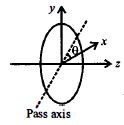
Let the angle between polarization direction and \(x\) -axis be \(\theta^{\prime}\)So angle between polarisation direction and pass axis of polariser is \(\left(\theta^{\prime}-\theta\right)\)
Given \(\theta = {8^o},{88^o},\,{188^o},\,\,{218^o}\)
\(\therefore I=I_{o} \cos ^{2}\,\left(\theta^{\prime}-\theta\right)\)
For \(\theta^{\prime}=203^o\) intensities are same
-
- (A) \(50\)
- (B) \(75 \)
- (C) \(100\)
- (D) \(25\)
જવાબ અને ઉકેલ જુઓ
સાચો જવાબ: (D)
Angular width of central maxima \(=\frac{2 \lambda}{\mathrm{d}}\)or, \(\lambda=\frac{\mathrm{d}}{2} ;\) Fringe width, \(\beta=\frac{\lambda \times \mathrm{D}}{\mathrm{d}^{\prime}}\)
\(10^{-2}=\frac{d}{2} \times \frac{50 \times 10^{-2}}{d^{\prime}}=\frac{10^{-6} \times 50 \times 10^{-2}}{2 \times d^{\prime}}\)
Therefore, slit separation distance, \(\mathrm{d}^{\prime}=25 \,\mu \mathrm{m}\)
-
- (A) \(\cos \,\,\theta \, = \,{\left( {\frac{2}{3}} \right)^{1/4}}\)
- (B) \(\cos \,\,\theta \, = \,{\left( {\frac{1}{3}} \right)^{1/4}}\)
- (C) \(\cos \,\,\theta \, = \,{\left( {\frac{1}{3}} \right)^{1/2}}\)
- (D) \(\cos \,\,\theta \, = \,{\left( {\frac{2}{3}} \right)^{1/2}}\)
જવાબ અને ઉકેલ જુઓ
સાચો જવાબ: (A)
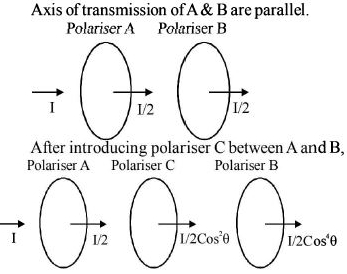
Polariser \(A\) and \(B\) have same alignment of transmission axis. Lets assume polariser \(C\) is introduced at \(\theta \) angle \(\frac{1}{2}{\cos ^2}\,\theta \, \times {\cos ^2}\,\theta \, = \,\frac{1}{3}\) or, \({\cos ^4}\,\theta \,\, = \,\frac{2}{3}\, \Rightarrow \,\cos \,\theta \, = {\left( {\frac{2}{3}} \right)^{1/4}}\) -
- (A) \(30\)
- (B) \(45\)
- (C) \(60\)
- (D) \(0\)
જવાબ અને ઉકેલ જુઓ
સાચો જવાબ: (B)
\(\frac{I}{2} \cos ^{4} \theta=\frac{I}{8} \Rightarrow \cos ^{4} \theta=\frac{1}{4}\)\(\Rightarrow \cos \theta=\frac{1}{\sqrt{2}}\) or, \(\theta=45^{\circ}\)
-
- (A) \(30\)
- (B) \(0\)
- (C) \(90\)
- (D) \(45\)
જવાબ અને ઉકેલ જુઓ
સાચો જવાબ: (C)
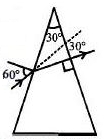
Augle of prism, \(A=30^o,\,\, i=60^o,\)angle of deviation, \(\delta=30^o\)
Using formula, \(\delta=i+e-A\)
\(\Rightarrow e=\delta+A-i\)
\(=30^o+30^o-60^o=0^o\)
Emergent ray will be perpendicular to the face
So it will make angle \(90^o\) with the force through which it emerges.
-
- (A) \(1.50\)
- (B) \(1.55\)
- (C) \(1.75\)
- (D) \(1.51\)
જવાબ અને ઉકેલ જુઓ
સાચો જવાબ: (B)
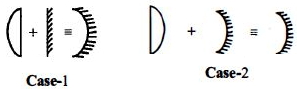
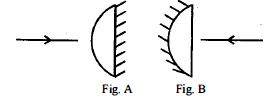
Effective focal length of the combination, \(\frac{1}{F}=\frac{2}{f}+\frac{1}{f_{m}}\)\(f_{m} \Longrightarrow \infty\)
This gives, \(f=56\)
\(f_{m}=\frac{R}{2}\)
Hence,
\(\frac{1}{F}=\frac{2}{f}+\frac{2}{R}\)
This gives, \(R=31.11\)
\(\frac{1}{f}=(\mu-1)\left(\frac{1}{R}\right)\)
\(\mu=1.55\)
-
- (A) \(18\,cm, 20\,cm\)
- (B) \(10\,cm, 12\,cm\)
- (C) \(12\,cm, 14\,cm\)
- (D) \(16\,cm, 18\,cm\)
જવાબ અને ઉકેલ જુઓ
સાચો જવાબ: (A)
For minimum spherical aberration separation\(d \,= f_1-f_2\, = 2\,cm\)
Resultant focal lenght \(=F\,= 10\,cm\)
Using \(\frac{1}{F} = \frac{1}{{{f_1}}} + \frac{1}{{{f_2}}} - \frac{d}{{{f_1}{f_2}}}\) and solving we get \(f_1\), \(f_2\) \(18\,cm\) and \(20\,cm\) respectively
-
- (A) \((B), (D)\)
- (B) \((B), (C)\)
- (C) \((A), (C), (D)\)
- (D) \((A), (D)\)
જવાબ અને ઉકેલ જુઓ
સાચો જવાબ: (C)
When object is at \(8\,\mathrm{cm}\)Image \(V_{1}=\frac{f \times u}{u-f}=\frac{5 \times 8}{8-5}=-\frac{40}{3}\, \mathrm{cm}\)
When object is at \(12\,\mathrm{cm}\)
Image \(V_{2}=\frac{f \times u}{u-f}=\frac{5 \times 12}{12-5}=-\frac{60}{7}\, \mathrm{cm}\)
Separation \(=\left|\mathrm{V}_{1}-\mathrm{V}_{2}\right|=\frac{40}{3}-\frac{60}{7}=\frac{100}{21} \mathrm{cm}\)
So \(A,\,C\) and \(D\) are correct statements.
-
- (A) \(\frac{{1000}}{{\sqrt 2 }},10\)
- (B) \(\;\frac{{50}}{{\sqrt 2 }},0\)
- (C) \(50,0\)
- (D) \(50,10\)
જવાબ અને ઉકેલ જુઓ
સાચો જવાબ: (A)
As we know, average power \(P_{\text {avg }}=V_{\text {ms }} I_{\text {ms }} \cos \theta\)\(=\left(\frac{V_{0}}{\sqrt{2}}\right)\left(\frac{I_{0}}{\sqrt{2}}\right) \cos \theta=\left(\frac{100}{\sqrt{2}}\right)\left(\frac{20}{\sqrt{2}}\right) \cos 45^{\circ}\left(\because \theta=45^{\circ}\right)\)
\(P_{\text {avg }}=\frac{1000}{\sqrt{2}} \text { watt }\)
Wattless current \(\mathrm{I}=\mathrm{I}_{\mathrm{rms}} \sin \theta\)
\(=\frac{\mathrm{I}_{0}}{\sqrt{2}} \sin \theta=\frac{20}{\sqrt{2}} \sin 45^{\circ}=10\, \mathrm{A}\)
-
- (A) \(\frac{{{\omega _0}R}}{L}\)
- (B) \(\frac{R}{{\left( {{\omega _0}C} \right)}}\)
- (C) \(\;\frac{{CR}}{{{\omega _0}}}\)
- (D) \(\frac{{{\omega _0}L}}{R}\)
જવાબ અને ઉકેલ જુઓ
સાચો જવાબ: (D)
Quality factor \(Q=\frac{\omega_{0}}{2 \Delta \omega}=\frac{\omega_{0} L}{R}\) -
- (A) \(m,\frac{1}{x}\)
- (B) \(m,\frac{1}{x^2}\)
- (C) \(m,x\)
- (D) \(m,x^2\)
જવાબ અને ઉકેલ જુઓ
સાચો જવાબ: (A)
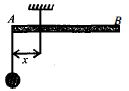
Balancing torque w.r.t point of suspension\(\begin{array}{l}
mg\,x\, = Mg\left( {\frac{{.\ell }}{2} - x} \right)\\
\Rightarrow mx = M\frac{\ell }{2} - Mx\\
m = \left( {M\frac{\ell }{2}} \right)\frac{1}{x} - M\\
y = \alpha \frac{1}{x} - C,\,\,\,\,\,\,\,\,\, straight\,\, line\,\, equation.
\end{array}\)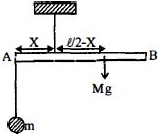
-
- (A) \(m,\frac{1}{x}\)
- (B) \(m,\frac{1}{x^2}\)
- (C) \(m,x\)
- (D) \(m,x^2\)
જવાબ અને ઉકેલ જુઓ
સાચો જવાબ: (A)
Balancing torque w.r.t point of suspension\(\begin{array}{l}
mg\,x\, = Mg\left( {\frac{{.\ell }}{2} - x} \right)\\
\Rightarrow mx = M\frac{\ell }{2} - Mx\\
m = \left( {M\frac{\ell }{2}} \right)\frac{1}{x} - M\\
y = \alpha \frac{1}{x} - C,\,\,\,\,\,\,\,\,\, straight\,\, line\,\, equation.
\end{array}\) -
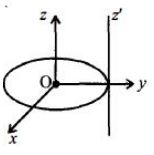
- (A) \(\tan \theta = \frac{1}{4}\)
- (B) \(\tan \theta = 2\)
- (C) \(\tan \theta = \frac{1}{2}\)
- (D) \(\tan \theta = 4\)
જવાબ અને ઉકેલ જુઓ
સાચો જવાબ: (C)
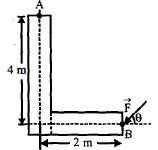
To produce maximum moment of force line of action of force must be perpendicular to line \(AB\).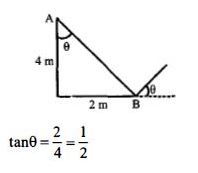
-
- (A) \(\tan \theta = \frac{1}{4}\)
- (B) \(\tan \theta = 2\)
- (C) \(\tan \theta = \frac{1}{2}\)
- (D) \(\tan \theta = 4\)
જવાબ અને ઉકેલ જુઓ
સાચો જવાબ: (C)
To produce maximum moment of force line of action of force must be perpendicular to line \(AB\). -
- (A) \(\frac{{55}}{2}M{R^2}\)
- (B) \(\frac{{73}}{2}M{R^2}\)
- (C) \(\frac{{181}}{2}M{R^2}\)
- (D) \(\;\frac{{19}}{2}M{R^2}\)
જવાબ અને ઉકેલ જુઓ
સાચો જવાબ: (C)
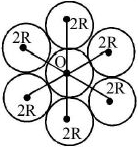
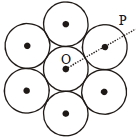
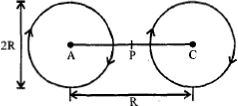
Using parallel axes theorem, moment of inertia about \('O'\)\(\begin{array}{l}
{I_0} = {I_{cm}} + m{d^2}\\
\,\,\,\,\,\,\,\,\,\,\,\,\,\,\,\, = \frac{{7M{R^2}}}{2} + 6\left( {M \times {{\left( {2R} \right)}^2}} \right) = \frac{{55M{R^2}}}{2}
\end{array}\)Again, moment of inertia about point P,\({I_P} = {I_0} + m{d^2}\)
\( = \frac{{55M{R^2}}}{2} + 7M{\left( {3R} \right)^2} = \frac{{181}}{2}M{R^2}\)
-
- (A) \(\frac{{55}}{2}M{R^2}\)
- (B) \(\frac{{73}}{2}M{R^2}\)
- (C) \(\frac{{181}}{2}M{R^2}\)
- (D) \(\;\frac{{19}}{2}M{R^2}\)
જવાબ અને ઉકેલ જુઓ
સાચો જવાબ: (C)
Using parallel axes theorem, moment of inertia about \('O'\)\(\begin{array}{l}
{I_0} = {I_{cm}} + m{d^2}\\
\,\,\,\,\,\,\,\,\,\,\,\,\,\,\,\, = \frac{{7M{R^2}}}{2} + 6\left( {M \times {{\left( {2R} \right)}^2}} \right) = \frac{{55M{R^2}}}{2}
\end{array}\)Again, moment of inertia about point P,\({I_P} = {I_0} + m{d^2}\)
\( = \frac{{55M{R^2}}}{2} + 7M{\left( {3R} \right)^2} = \frac{{181}}{2}M{R^2}\)
-
- (A) \(1:2\)
- (B) \(1:4\)
- (C) \(1:3\)
- (D) \(1:5\)
જવાબ અને ઉકેલ જુઓ
સાચો જવાબ: (C)
As we know, moment of inertia of a disc about an axis passing through \(C.G.\) and perpendicular to its plane, \({I_z}\, = \frac{{m{R^2}}}{2}\) Moment of inertia of a disc about a tangential axis perpendicular to its own plane, \({I_z}'\, = \frac{3}{{20}}m{R^2}\) \({I_z}/{I_z}'\, = \frac{{m{R^2}}}{2}/\frac{{3m{R^2}}}{2}\, = 1/3\)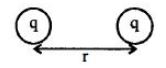
-
- (A) \(1:2\)
- (B) \(1:4\)
- (C) \(1:3\)
- (D) \(1:5\)
જવાબ અને ઉકેલ જુઓ
સાચો જવાબ: (C)
As we know, moment of inertia of a disc about an axis passing through \(C.G.\) and perpendicular to its plane, \({I_z}\, = \frac{{m{R^2}}}{2}\) Moment of inertia of a disc about a tangential axis perpendicular to its own plane, \({I_z}'\, = \frac{3}{{20}}m{R^2}\) \({I_z}/{I_z}'\, = \frac{{m{R^2}}}{2}/\frac{{3m{R^2}}}{2}\, = 1/3\) -
- (A) \(\sqrt {\cos \alpha } \)
- (B) \(\cos \alpha \)
- (C) \(\sin \alpha \)
- (D) \(\sqrt {\sin \alpha } \)
જવાબ અને ઉકેલ જુઓ
સાચો જવાબ: (A)
When the rod makes an angle \(\alpha \)Displacement of center of mass \( = \frac{1}{2}\cos \,\alpha \)
\(mg\frac{1}{2}\cos \alpha = \frac{l}{2}I{\omega ^2}\,\)
\(mg\frac{1}{2}\cos \alpha = \frac{{m{l^2}}}{6}{\omega ^2}\) (M.I. of thin uniform rod about an axis passing through its center of mass and perpendicular to the rod \(I = \frac{{m{l^2}}}{{12}}\))
\( \Rightarrow \omega = \sqrt {\frac{{3g\cos \alpha }}{l}} \)
speed of end \( = \omega \times l = \sqrt {3g\cos \alpha l} \)
i.e., Speed of end, \(\omega \, \propto \,\sqrt {\cos \alpha } \)
-
- (A) \(\frac{v}{{6L}}\)
- (B) \(\frac{6v}{{5L}}\)
- (C) \(\frac{3v}{{5L}}\)
- (D) \(\frac{v}{{5L}}\)
જવાબ અને ઉકેલ જુઓ
સાચો જવાબ: (A)
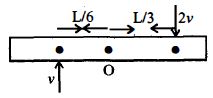
Linear momentum is conserved\(2 m v-2 m v=(2 m+m+M) V_{c m}\)
\(\Rightarrow V_{c m}=0\)
Angular momentum is conserve
\(2 m v \frac{L}{6}+2 m v \times \frac{L}{3}+0=I w\) \(...(i)\)
\(I=\mathrm{M.I.}\) of rod \(+\mathrm{M.I.}\) of mass \(2 \mathrm{m}+\mathrm{M.I}\) of mass \(\mathrm{m}\)
\(=\frac{8 m L^{2}}{12}+2 m\left(\frac{L}{6}\right)^{2}+m\left(\frac{L}{3}\right)^{2}\)
\(=m L^{2}\left(\frac{2}{3}+\frac{1}{18}+\frac{1}{9}\right)=\frac{5}{6} m L^{2}\)
eqn \((1)\) becomes
\(\left(\frac{m v L}{3}+\frac{2}{3} m v L\right)=\frac{5}{6} m L^{2} w\)
\(\frac{m L}{3}(V+2 v)=\frac{5}{6} m L^{2} w\)
\(\frac{6 V}{5 L}=w\)
-
- (A) \(2.5 \times {10^{ - 2}}\,\Omega \)
- (B) \(1.25 \times {10^{ - 3}}\,\Omega \)
- (C) \(2.5 \times {10^{ - 3}}\,\Omega \)
- (D) \(1.25 \times {10^{ - 2}}\,\Omega \)
જવાબ અને ઉકેલ જુઓ
સાચો જવાબ: (D)
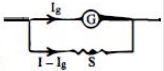
A ccording to question, current through galvanometer, \(\mathrm{I}_{\mathrm{g}}=1\, \mathrm{mA}\)Current through shunt \(\left(I-I_{g}\right)=2 \,A\)
Galvanometer resistance \(\mathrm{R}_{\mathrm{g}}=25 \,\Omega\)
Resistance of shunt, \(\mathrm{S}=?\)
\(\mathrm{I}_{\mathrm{g}} \mathrm{R}_{\mathrm{g}}=\left(\mathrm{I}-\mathrm{I}_{\mathrm{g}}\right) \mathrm{S}\)
\( \Rightarrow S = \frac{{{{10}^{ - 3}} \times 25}}{2}\)
\(S \simeq 1.25 \times {10^{ - 2}}\,\Omega \)
-
- (A) \(4\times10^{-5}\,Wb/m^2\)
- (B) Zero
- (C) \(2\times10^{-5}\,Wb/m^2\)
- (D) \(8\times10^{-5}\,Wb/m^2\)
જવાબ અને ઉકેલ જુઓ
સાચો જવાબ: (A)
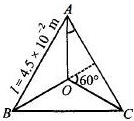
Here, side of the triangle, \(l=4.5 \times 10^{-2} \,\mathrm{m}\) current, \(I =1 \,\mathrm{A}\)magnetic field at the centre of the triangle \('O'B = ?\)
From figure, \(\tan 60^{\circ}=\sqrt{3}=\frac{1}{2 d}\)
\(\Rightarrow d=\frac{l}{2 \sqrt{3}}=\left(\frac{4.5 \times 10^{-2}}{2 \sqrt{3}}\right)\, \mathrm{m}\)
Magnetic field, \(B=\frac{\mu_{0} i}{4 \pi d}\left(\cos \theta_{1}+\cos \theta_{2}\right)\)
Putting value of \(\mu=4 \pi \times 10^{-7}\) and \(\theta_{1}\) and \(\theta_{2}\)
we will get net magenetic field
\(=3 \times B=4 \times 10^{-5} \,\mathrm{Wb} / \mathrm{m}^{2}\)
-
- (A) \(55\)
- (B) \(110\)
- (C) \(220\)
- (D) \(550\)
જવાબ અને ઉકેલ જુઓ
સાચો જવાબ: (B)
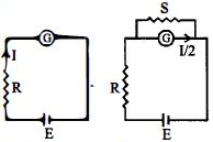
Figure of merit of a galvanometer is the current required to produce a deflection of one division in the galvancmeter i.e., figure of merit \(=\frac{\mathrm{I}}{\theta}\)\(\mathrm{I}=\frac{\varepsilon}{\mathrm{R}+\mathrm{G}} \quad \mathrm{G}=\frac{1}{9} \,\mathrm{K} \,\Omega\)
\(\frac{1}{2}=\frac{\varepsilon}{R+\frac{G S}{G+\bar{S}}} \times \frac{S}{S+G} \Rightarrow \frac{1}{2}=\frac{\varepsilon S}{R(S+G)+G S}\)
\(S=\frac{R G \times \frac{1}{2}}{\varepsilon-\frac{(R+G) I}{2}}\)
\(S=\frac{11 \times 10^{3} \times \frac{1}{2} \times 10^{2} \times 270 \times 10^{-6}}{6-\left(\frac{6}{2}\right)}=110\, \Omega\)
-
- (A) \(r_e < r_p\) \(=\) \(\;{r_\alpha }\)
- (B) \(r_e < r_p\) \( <\) \(\;{r_\alpha }\)
- (C) \(r_e < \) \(\;{r_\alpha }\) \(< r_p\)
- (D) \(r_e > r_p\) \(=\) \(\;{r_\alpha }\)
જવાબ અને ઉકેલ જુઓ
સાચો જવાબ: (A)
As we know, radius of circular path in magnetic field \(\mathrm{r}=\frac{\sqrt{2 \mathrm{Km}}}{\mathrm{qB}}\)For electron, \(\mathrm{r}_{\mathrm{e}}=\frac{\sqrt{2 \mathrm{Km}_{\mathrm{e}}}}{\mathrm{eB}}.........(i)\)
For proton, \(\mathrm{r}_{\mathrm{p}}=\frac{\sqrt{2 \mathrm{Km}_{\mathrm{p}}}}{\mathrm{eB}}.........(ii)\)
For \(\alpha\) particle,
\(\mathrm{r}_{\alpha}=\frac{\sqrt{2 \mathrm{Km}_{\mathrm{a}}}}{\mathrm{q}_{\alpha} \mathrm{B}}=\frac{\sqrt{2 \mathrm{K} 4 \mathrm{m}_{\mathrm{p}}}}{2 \mathrm{eB}}=\frac{\sqrt{2 \mathrm{Km}_{\mathrm{p}}}}{\mathrm{eB}} .........(iii)\)
\(\mathrm{r}_{\mathrm{e}}<\mathrm{r}_{\mathrm{p}}=\mathrm{r}_{\alpha} \quad\left(\because \mathrm{m}_{\mathrm{e}}<\mathrm{m}_{\mathrm{p}}\right)\)
-
- (A) \(\sqrt 3 \)
- (B) \(\sqrt 2 \)
- (C) \(\frac{1}{{\sqrt 2 }}\)
- (D) \(2\)
જવાબ અને ઉકેલ જુઓ
સાચો જવાબ: (B)
Magnetic field at the centre of \(\operatorname{loop}, B_{1}=\frac{\mu_{0} I}{2 R}\)Dipole moment of circular loop is \(m=I A\)
\(\mathrm{m}_{1}=\mathrm{I} \cdot \mathrm{A}=\mathrm{I} \pi \mathrm{R}^{2} \quad\{\mathrm{R}=\text { Radius of the loop }\}\)
If moment is doubled (keeping current constant) \(R\) becomes \(\sqrt{2 \mathrm{R}}\)
\({{\text{m}}_2} = {\text{L}}\pi {(\sqrt 2 {\text{R}})^2} = 2.{\text{I}}\pi {{\text{R}}^2} = 2{{\text{m}}_1}\)
\(B_{2}=\frac{\mu_{0} I}{2(\sqrt{2} R)}\)
-
- (A) \(\frac{{4N{\mu _0}I}}{{{5^{3/2}}R}}\)
- (B) \(\frac{{8N{\mu _0}I}}{{{5^{3/2}}R}}\)
- (C) \(\frac{{4N{\mu _0}I}}{{{5^{1/2}}R}}\)
- (D) \(\frac{{8N{\mu _0}I}}{{{5^{1/2}}R}}\)
જવાબ અને ઉકેલ જુઓ
સાચો જવાબ: (B)
Point \(P\) is situated at the mid-point of the line joining the centres of the circular wires which have same radii \((R)\). The magnetic fields \((\vec{B})\) at \(P\) due to the currents in the wires are in same direction.Magnitude of magnetic fieldat point, \(P\)
\(B = 2\left\{ {\frac{{{\mu _0}NI{R^2}}}{{2{{\left( {{R^2} + \frac{{{R^2}}}{4}} \right)}^{3/2}}}}} \right\}\)
\(=\frac{\mu_{0} N I R^{2}}{\frac{5^{3 / 2}}{8}}=\frac{8 \mu_{0} N I}{5^{3 / 2} R}\)
-
- (A) \(\frac{1}{2}\,\,q\omega {r^2}\)
- (B) \(\frac{4}{3}\,\,q\omega {r^2}\)
- (C) \(\frac{3}{2}\,\,q\omega {r^2}\)
- (D) \(q\omega {r^2}\)
જવાબ અને ઉકેલ જુઓ
સાચો જવાબ: (A)
Magnetic moment, \(\mu \, = \,IA\, = \,\frac{{qv}}{{2\pi r}}(\pi {r^2})\) or, \(\mu \,\, = \,\,\frac{{qr\omega }}{{2\pi r}}(\pi {r^2})\, = \,\frac{1}{2}\,q{r^2}\omega \) -
- (A) \(0.17\)
- (B) \(0.15\)
- (C) \(0.34\)
- (D) \(0.25\)
જવાબ અને ઉકેલ જુઓ
સાચો જવાબ: (A)
Given: Capacitance, \(C=0.2\, \mu \mathrm{F}=0.2 \times 10^{-6}\,F\)Inductance \(\mathrm{L}=0.5\, \mathrm{mH}=0.5 \times 10^{-3}\, \mathrm{H}\)
Current \(I=?\)
Using energy conservation
\(\frac{1}{2} C V^{2}=\frac{1}{2} C V_{1}^{2}+\frac{1}{2} L I^{2}\)
\(\frac{1}{2} \times 0.2 \times 10^{-6} \times 10^{2}+0\)
\(=\frac{1}{2} \times 0.2 \times 10^{-6} \times 5^{2}+\frac{1}{2} \times 0.5 \times 10^{-3} I^{2}\)
\(\therefore \quad I=\sqrt{3} \times 10^{-1}\, \mathrm{A}=0.17\, \mathrm{A}\)

આ પેજ પર આ ફિલ્ટર મુજબ કોઈ પ્રશ્ન નથી.
અન્ય વર્ષ
વારંવાર પૂછાતા પ્રશ્નો
ExamBro પર JEE Mains 2018 Physics ના કેટલા પ્રશ્નો છે?
108 પ્રશ્નો, દરેક સાચા જવાબ અને પૂરા ઉકેલ સાથે.
JEE Mains 2018 Physics નું કયું પ્રકરણ સૌથી વધુ પૂછાય છે?
કણોનાં તંત્રો અને ચાકગતિ, 12 પ્રશ્નો સાથે; ત્યાર બાદ પ્રવાહ વિદ્યુત, 8 પ્રશ્નો સાથે.
JEE Mains 2018 Physics ના પ્રશ્નો કેટલા અઘરા હોય છે?
5% સરળ, 32% મધ્યમ અને 63% અઘરા.