


2017 માં પૂછાયેલાં પ્રકરણ
26 પ્રકરણ- 3પ્રશ્નો STD 11 એકમ, પરિમાણ અને માપન
- 4પ્રશ્નો STD 12 સેમિકન્ડક્ટર ઇલેક્ટ્રોનિક્સ : દ્રવ્યો, રચનાઓ અને સાદા પરિપથો
- 2પ્રશ્નો STD 12 ન્યુક્લિયસ
- 3પ્રશ્નો STD 12 પરમાણુઓ
- 2પ્રશ્નો STD 12 વિદ્યુતચુંબકીય તરંગો
- 4પ્રશ્નો STD 12 તરંગ પ્રકાશશાસ્ત્ર
- 3પ્રશ્નો STD 12 કિરણ પ્રકાશશાસ્ત્ર અને પ્રકાશીય ઉપકરણો
- 1પ્રશ્નો STD 12 પ્રત્યાવર્તી પ્રવાહ
- 9પ્રશ્નો STD 11 6.કણોનાં તંત્રો અને ચાકગતિ સૌથી વધુ પૂછાયેલ
- 3પ્રશ્નો STD 12 ગતિમાન વિધુતભારો અને ચુંબકત્વ
- 2પ્રશ્નો STD 12 વિદ્યુતચુંબકીય પ્રેરણ
- 2પ્રશ્નો STD 12 ચુંબકત્વ અને દ્રવ્ય
- 8પ્રશ્નો STD 12 પ્રવાહ વિદ્યુત સૌથી વધુ પૂછાયેલ
- 4પ્રશ્નો STD 12 સ્થિત વિદ્યુતસ્થિતિમાન અને કેપેસિટન્સ
- 2પ્રશ્નો STD 12 વિધુતભારો અને ક્ષેત્રો
- 2પ્રશ્નો STD 11 તરંગો
- 4પ્રશ્નો STD 11 દોલનો
- 4પ્રશ્નો STD 11 ગતિવાદ
- 1પ્રશ્નો STD 11 થર્મોડાયનેમિક્સ
- 4પ્રશ્નો STD 11 10.1, થર્મોનેટ્રી, થર્મલ વિસ્તરણ અને કેલરીમેટ્રી
- 2પ્રશ્નો STD 11 ઘન પદાર્થોના યાંત્રિક ગુણધર્મો
- 1પ્રશ્નો STD 11 તરલના યાંત્રિક ગુણધર્મો
- 1પ્રશ્નો STD 11 ગુરુત્વાકર્ષણ
- 5પ્રશ્નો STD 11 કાર્ય, ઊર્જા અને પાવર સૌથી વધુ પૂછાયેલ
- 1પ્રશ્નો STD 11 સમતલમાં ગતિ
- 1પ્રશ્નો STD 11 સુરેખપથ પર ગતિ
JEE Mains 2017 Physics ના બધા પ્રશ્નો
26 પ્રકરણ78 માંથી 1–50 પ્રશ્નો
-
- (A) \(\left[ M \right] = \left[ {{T^{ - 1}}\,{C^{ - 2}}\,h} \right]\)
- (B) \(\left[ M \right] = \left[ {{T^{ - 1}}\,{C^2}\,h} \right]\)
- (C) \(\left[ M \right] = \left[ {{T^{ - 1}}\,{C^{ - 2}}\,{h^{ - 1}}} \right]\)
- (D) \(\left[ M \right] = \left[ {T\,{C^{ - 2}}\,h} \right]\)
જવાબ અને ઉકેલ જુઓ
સાચો જવાબ: (A)
Let mass related as \(M \propto \,{T^x}{C^y}{h^z}\)
\({M^1}{L^0}{T^0} = {\left( T \right)^x}{\left( {{L^1}{T^{ - 1}}} \right)^y}{\left( {{M^1}{L^2}{T^{ - 1}}} \right)^z}\)
\({M^1}{L^0}{T^0} = {M^z}{L^{y + 2z}} + {T^{x - y - z}}\)
\(z = 1\)
\(y + 2z = 0\) \(x - y - z = 0\)
\(y = - 2\) \(x + 2 - 1 = 0\)
\(M = \left[ {{T^{ - 1}}{C^{ - 2}}{h^1}} \right]\) -
- (A) \(8\)
- (B) \(12\)
- (C) \(32\)
- (D) \(25\)
જવાબ અને ઉકેલ જુઓ
સાચો જવાબ: (C)
\(\begin{array}{l}
Give,\,p = {a^{1/2}}{b^2}{c^3}{d^{ - 4}},\\
Maximum\,relative\,error,\\
\frac{{\Delta p}}{p} = \frac{1}{2}\frac{{\Delta a}}{a} + 2\frac{{\Delta b}}{b} + 3\frac{{\Delta c}}{c} + 4\frac{{\Delta d}}{d}\\
= \frac{1}{2} \times 2 + 2 \times 1 + 3 \times 3 + 4 \times 5\\
= 32\%
\end{array}\) -
- (A) \(0.15\)
- (B) \(1.5\)
- (C) \(2.4\)
- (D) \(10\)
જવાબ અને ઉકેલ જુઓ
સાચો જવાબ: (B)
\(\mathrm{T}=\frac{\mathrm{rhg}}{2} \times 10^{3} \mathrm{N} / \mathrm{m}\)\(\frac{\Delta \mathrm{T}}{\mathrm{T}}=\left|\frac{\Delta \mathrm{r}}{\mathrm{r}}\right|+\left|\frac{\Delta \mathrm{h}}{\mathrm{h}}\right|=\frac{0.01}{1.25}+\frac{0.01}{1.45}\)
\(\%\) error \(=\frac{\Delta \mathrm{T}}{\mathrm{T}} \times 100=\frac{1}{1.25}+\frac{1}{1.45}=0.8+0.69=1.5 \%\)
-
- (A) \(1.68\)
- (B) \(1.83\)
- (C) \(0.59\)
- (D) \(1.20\)
જવાબ અને ઉકેલ જુઓ
સાચો જવાબ: (A)
The conductivity of semiconductor\( \sigma =\mathrm{e}\left(\mathrm{n}_{\mathrm{e}} \mu_{\mathrm{e}}+\mathrm{n}_{\mathrm{h}} \mu_{\mathrm{h}}\right)\)
\(=1.6 \times 10^{-19}\left(5 \times 10^{18} \times 2+5 \times 10^{19} \times 0.01\right) \)
\(=1.6 \times 1.05=1.68(\Omega-\mathrm{m})^{-1}\)
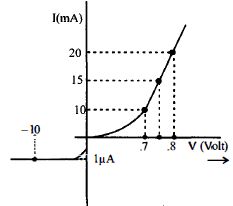
- 5. ડાયોડ માટે \(V-I\) લાક્ષણિકતા નીચે દર્શાવેલ છે. તો ફોરવર્ડ અને રિવર્સ બાયસના અવરોધનો ગુણોત્તર કેટલો થાય?
 2017 અઘરું
- (A) \(10\)
- (B) \(10^{-6}\)
- (C) \(10^6\)
- (D) \(100\)
જવાબ અને ઉકેલ જુઓ
સાચો જવાબ: (B)
Forward bias resistance\(=\frac{\Delta V}{\Delta I}=\frac{0.1}{10 \times 10^{-3}}=10 \Omega\)
Reverse bias resistance \(=\frac{10}{10^{-6}}=10^{7} \Omega\)
Ratio of resistances
\(=\,\frac {Forward \,\,bias\,\, resistance }{Reverse\,\, bias \,\,resistance}\)
\(=10^{-6}\)
- 6. કોમન એમીટર અમ્પ્લિફાયરનો પ્રવાહ ગેઇન \(69\) છે. જો એમીટર પ્રવાહ \(7.0\,mA\) હોય તો કલેક્ટર પ્રવાહ કેટલા \(mA\) મળે? 2017 મધ્યમ
- (A) \(9.6\)
- (B) \(6.9\)
- (C) \(0.69\)
- (D) \(69\)
જવાબ અને ઉકેલ જુઓ
સાચો જવાબ: (B)
Given, current gain of \(CE\) amplifier \(\beta=69, \mathrm{I}_{\mathrm{E}}\) \(=7 \mathrm{mA}\)or \(\quad \frac{\mathrm{I}_{\mathrm{C}}}{\mathrm{I}_{\mathrm{B}}}=69\)
We know that, \(\alpha=\frac{\beta}{1+\beta}=\frac{69}{70} \cdot \frac{\mathrm{I_C}}{\mathrm{I}_{\mathrm{E}}}\)
\(\mathrm{I}_{\mathrm{C}}=\mathrm{I}_{\mathrm{E}} \times \frac{69}{70}=\frac{\mathrm{69}}{70} \times 7\)
Collector current, \(I_{C}=6.9\, \mathrm{mA}\)
-
- (A) \(45\)
- (B) \(90\)
- (C) \(135\)
- (D) \(180\)
જવાબ અને ઉકેલ જુઓ
સાચો જવાબ: (D)
Explanation: In CE amplifier cirucit the input and output voltage are out of phase. When the input voltage is increased then \(Rb\) is increased. Ic also increases so the voltage drop across Rc is increased. However increase in voltage across Rc is in opposite sense. So, phase angle between them is \(180^{\circ}\). -
- (A) \(0.96\, gm\)
- (B) \(0.8\,gm\)
- (C) \(4\times10^{-2} \,gm\)
- (D) \(6.6\times10^{-5} \,gm\)
જવાબ અને ઉકેલ જુઓ
સાચો જવાબ: (C)
Power level of reactor, \(P=\frac{E}{\Delta t}=\frac{\Delta m c^{2}}{\Delta t}\)mass of the fuel consumed per hour in the reactor,
\(\frac{\Delta m}{\Delta t}=\frac{P}{c^{2}}=\frac{10^{9}}{\left(3 \times 10^{8}\right)^{2}}=4 \times 10^{-2} \mathrm{gm}\)
-
- (A) \(t \) = \(\frac{T}{2}\;\frac{{\log 2}}{{\log 1.3}}\)
- (B) \(t = T\;\frac{{\log 1.3}}{{\log 2}}\)
- (C) \(t=T log(1.3)\)
- (D) \(t = \frac{T}{{{\rm{log}}\left( {1.3} \right)}}\;\)
જવાબ અને ઉકેલ જુઓ
સાચો જવાબ: (B)
Let initially there are total \(\mathrm{N}_{0}\) number of nucleiAt time \(\mathrm{t} \frac{N_{B}}{N_{A}}=0.3(\text { given })\)
\(\Rightarrow \quad N_{B}=0.3 N_{A}\)
\(\mathrm{N}_{0}=N_{A}+N_{B}=N_{A}+0.3 N_{A}\)
\(\therefore \quad N_{A}=\frac{\mathrm{N}_{0}}{1.3}\)
As we know \(N_{t}=N_{0} e^{-\lambda t}\)
or, \(\frac{\mathrm{N}_{0}}{1.3}=N_{0} e^{-\lambda t}\)
\(\frac{1}{1.3}=e^{-\lambda t} \Rightarrow \ln (1.3)=\lambda t\)
or, \(t=\frac{\ln (1.3)}{\lambda} \Rightarrow t=\frac{\ln (1.3)}{\frac{\ln (2)}{T}}=\frac{\ln (1.3)}{\ln (2)} T\)
-
- (A) \(n^{-4}\)
- (B) \(n^{-5}\)
- (C) \(n^{-3}\)
- (D) \(n^{-2}\)
જવાબ અને ઉકેલ જુઓ
સાચો જવાબ: (D)
Magnetic field at the centre of nucleus of \(\mathrm{H}\) -atom,\(\mathrm{B}=\frac{\mu_{0} \mathrm{I}}{2 \mathrm{r}}\) ..... \((i)\)
According to Bohr's model, radius of orbit \(r\, \propto \,{n^2}\) from eq. \((i)\) we can also write as \(B \propto n^{-2}\)
-
- (A) \(r = \frac{4}{3}\)
- (B) \(\;r = \frac{2}{3}\)
- (C) \(\;r = \frac{3}{4}\)
- (D) \(\;r = \frac{1}{3}\)
જવાબ અને ઉકેલ જુઓ
સાચો જવાબ: (D)
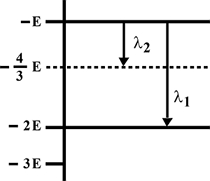
From energy level diagram, using \(\Delta E=\frac{h c}{\lambda}\)For wavelength \(\lambda_{1} \Delta E=-E-(-2 E)=\frac{h c}{\lambda_{1}}\)
\(\therefore \quad \lambda_{1}=\frac{h c}{E}\)
For wavelength \(\lambda_{2} \Delta E=-E-\left(-\frac{4 E}{3}\right)=\frac{h c}{\lambda_{2}}\)
\(\therefore \quad {\lambda _2} = \frac{{hc}}{{\left( {\frac{E}{3}} \right)}}\) \(\therefore r = \frac{{{\lambda _1}}}{{{\lambda _2}}} = \frac{1}{3}\)
-
- (A) \(\frac{{{h^2}}}{{{\pi ^2}{m^2}{r^3}}}\)
- (B) \(\frac{{{h^2}}}{{8{\pi ^2}{m^2}{r^3}}}\)
- (C) \(\frac{{{h^2}}}{{4{\pi ^2}{m^2}{r^3}}}\)
- (D) \(\frac{{{h^2}}}{{4\pi {m^2}{r^3}}}\)
જવાબ અને ઉકેલ જુઓ
સાચો જવાબ: (C)
Speed of electron in first orbit \((\mathrm{n}=1)\) of hydrogen atom \((z=1)\),\(v = \frac{{{e^2}}}{{2{\varepsilon _0}h}}\)
radius of Bohr's first orbit,
\(r=\frac{h^{2} \varepsilon_{0}}{\pi m e^{2}} \Rightarrow \varepsilon_{0}=\frac{r \pi m \mathrm{e}^{2}}{h^{2}}\) ..... \((i)\)
Acceleration of electron,
\(\frac{v^{2}}{r}=\frac{e^{4}}{4 \varepsilon_{0}^{2} h^{2}} \times \frac{\pi m e^{2}}{h^{2} \varepsilon_{0}}\)
\({ = \frac{{{{\text{e}}^4} \times \pi {\text{m}}{{\text{e}}^2}}}{{4{{\text{h}}^4}\varepsilon _0^3}}}\) ..... \((ii)\)
eliminating \(\varepsilon_{0}\) from eq \((ii)\)
\(=\frac{e^{4} \pi m e^{2} h^{6}}{4 h^{4} r^{3} \pi^{3} m^{3} e^{6}}\) from \(eq^n\) \((i)\)
\(=\frac{h^{2}}{4 \pi^{2} m^{2} r^{3}}\)
-
- (A) \(\frac{{2{E_0}}}{c}\hat j\,\sin\, kz\,\cos\, \omega t\)
- (B) \(-\frac{{2{E_0}}}{c}\hat j\,\sin\, kz\,\sin\, \omega t\)
- (C) \(\frac{{2{E_0}}}{c}\hat j\,\sin\, kz\,\sin\, \omega t\)
- (D) \(\frac{{2{E_0}}}{c}\hat j\,\cos\, kz\,\cos\, \omega t\)
જવાબ અને ઉકેલ જુઓ
સાચો જવાબ: (C)
Given, Electric field component of monochromatic radiation,\((\overrightarrow{\mathrm{E}})=2 \mathrm{E}_{0} \hat{\mathrm{i}} \cos \mathrm{kz} \cos \omega \mathrm{t}\)
We know that, \(\frac{d E}{d z}=-\frac{d B}{d t}\)
\(\frac{\mathrm{dE}}{\mathrm{dz}}=-2 \mathrm{E}_{0} \mathrm{k} \sin \mathrm{kz} \cos \omega \mathrm{t}=-\frac{\mathrm{dB}}{\mathrm{dt}}\)
\(\mathrm{dB}=+2 \mathrm{E}_{0} \mathrm{k} \,\sin \mathrm{kz} \cos\, \omega \mathrm{td}\, \mathrm{t}\) .... \((i)\)
Integrating \(eq^n\). \((i)\), we have
\(B=+2 E_{0} k \sin k z \int \cos \omega t d t\)
Magnetic field is given by,
\(=+2 \mathrm{E}_{0} \frac{\mathrm{k}}{\omega} \sin \mathrm{kz} \sin \,\omega \mathrm{t}\)
We also know that,
\(\frac{E_{0}}{B_{0}}=\frac{\omega}{k}=c\)
Magnetic field vector,
\(\overrightarrow{\mathrm{B}}=\frac{2 \mathrm{E}_{0}}{\mathrm{c}} \hat{\mathrm{j}} \sin \mathrm{kz} \sin \omega \mathrm{t}\)
-
- (A) \(\vec E = {B_0}\,c\sin \,\left( {kx + \omega t} \right)\hat k\,V/m\)
- (B) \(\vec E = \frac{{{B_0}}}{c}\,\sin \,\left( {kx + \omega t} \right)\hat k\,V/m\)
- (C) \(\vec E = - {B_0}\,c\sin \,\left( {kx + \omega t} \right)\hat k\,V/m\)
- (D) \(\vec E = {B_0}\,c\sin \,\left( {kx - \omega t} \right)\hat k\,V/m\)
જવાબ અને ઉકેલ જુઓ
સાચો જવાબ: (A)
Speed of \(EM\) wave in force space \(\left( c \right) = \frac{{{E_0}}}{{{B_0}}}\,\) or \(\vec E = c{B_0}{\mkern 1mu} \sin {\mkern 1mu} \left( {kx + \omega t} \right)\hat k\) -
- (A) \(3\)
- (B) \(9\)
- (C) \(4.5\)
- (D) \(1.5\)
જવાબ અને ઉકેલ જુઓ
સાચો જવાબ: (B)
\(\mathrm{a}=0.1\, \mathrm{mm}=10^{-4}\, \mathrm{cm}\)\(\lambda=6000 \times 10^{-10}\, \mathrm{cm}=6 \times 10^{-7} \,\mathrm{cm}, \mathrm{D}=0.5\, \mathrm{m}\)
for \(3^{\text {rd }}\) dark band, \(a\,\sin \theta=3 \lambda\)
or \(\sin \theta=\frac{3 \lambda}{a}=\frac{x}{D}\)
The distance of the third dark band from the central bright band
\(x = \frac{{3\lambda D}}{a}\) \( = \frac{{3 \times 6 \times {{10}^{ - 7}} \times 0.5}}{{{{10}^{ - 4}}}}\) \(=\,9\,mm\)
-
- (A) \(10.1 \)
- (B) \(12.1 \)
- (C) \(17.3\)
- (D) \(15.3\)
જવાબ અને ઉકેલ જુઓ
સાચો જવાબ: (C)
Use relativistic doppler's effect as velocity of observer is not small as compared to light\(f=f_{0} \sqrt{\frac{c+v}{c+v}}\) ; \(V=\) relative speed of approach
\(f_{0}=10\, \mathrm{GHz}\)
\(\therefore f=10 \sqrt{\frac{c+\frac{c}{2}}{c-\frac{c}{2}}}=10 \sqrt{3}=17.3\, \mathrm{GHz}\)
-
- (A) \(1.5\)
- (B) \(3\)
- (C) \(4.5\)
- (D) \(6\)
જવાબ અને ઉકેલ જુઓ
સાચો જવાબ: (B)
For secondary minima,\(b \sin \theta=n \lambda \Rightarrow \sin \theta=\frac{n \lambda}{b}\)
Distance of \(\mathrm{n}^{\text {th }}\) secondary minima \(\mathrm{x}=\mathrm{D} \sin\, \theta\)
or \(\sin \theta_{1}=\frac{x_{1}}{D}\)
\(\sin \theta_{1}=\frac{2 \lambda}{b}\)
\(n=4\)
\(\sin \theta_{2}=\frac{4 \lambda}{b}=\frac{x_{2}}{D}\)
\(x_{2}-x_{1}=\frac{4 \lambda}{b}-\frac{2 \lambda}{b}=\frac{2 \lambda}{b}\)
\(3=\frac{2 \lambda}{b} \Rightarrow b=\frac{2 \lambda}{3}\) ...... \((i)\)
Width of central maxima \(=\frac{2 \lambda}{b}\)
\(=\frac{2 \lambda}{\frac{2 \lambda}{3}}=3 \mathrm{cm}\) ... from eq. \((i)\)
-
- (A) \(1.56\)
- (B) \(7.8\)
- (C) \(9.75\)
- (D) \(15.6\)
જવાબ અને ઉકેલ જુઓ
સાચો જવાબ: (B)
For common maxima, \(n_{1} \lambda_{1}=n_{2} \lambda_{2}\)\(\Rightarrow \quad \frac{n_{1}}{n_{2}}=\frac{\lambda_{2}}{\lambda_{1}}=\frac{520 \times 10^{-9}}{650 \times 10^{-9}}=\frac{4}{5}\)
For \(\lambda_{1}\)
\(y=\frac{n_{1} \lambda_{1} D}{d}, \lambda_{1}=650\, \mathrm{nm}\)
\(y=\frac{4 \times 650 \times 10^{-9} \times 1.5}{0.5 \times 10^{-3}} \quad\) or, \(y=7.8\,\mathrm{mn}\)
-
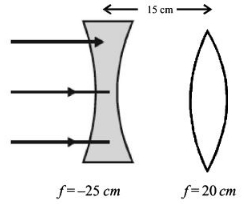
- (A) સાચું અને અભિસારી કાચથી \(40\) \( cm\) દૂર
- (B) સાચું અને અપસારી કાચથી \(40\) \(cm\) દૂર
- (C) આભાસી અને અપસારી કાચથી \(40\) \(cm\) દૂર
- (D) સાચું અને અભિસારી કાચથી \(6 \) \(cm\) દૂર
જવાબ અને ઉકેલ જુઓ
સાચો જવાબ: (B)
As parallel beam incident on diverging lens will form image at focus.\(\therefore \quad v=-25\, \mathrm{cm}\)
The image formed by diverging lens is used as an object for converging lens,
So for converging lens \(u=-25-15=-40 \,\mathrm{cm}, \quad f=20\, \mathrm{cm}\)
\(\therefore \quad\) Final image formed by converging lens
\(\frac{1}{V}-\frac{1}{-40}=\frac{1}{20}\)
or, \(\quad V=40\, \mathrm{cm}\) from converging lens real and inverted.
-
- (A) \(27.5\)
- (B) \(20\)
- (C) \(25\)
- (D) \(30.5\)
જવાબ અને ઉકેલ જુઓ
સાચો જવાબ: (A)
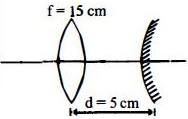
Given, focal kngth of lens \((\mathrm{f})=15 \,\mathrm{cm}\)object is placed at a distance \((u)=-20\, \mathrm{cm}\)
By lens formula,
\(\frac{1}{f} = \frac{1}{v} - \frac{1}{u}\)
\(\frac{1}{v} = \frac{1}{f} + \frac{1}{u}\)
\( = \frac{1}{{15}} - \frac{1}{{20}}\)
\(\frac{1}{v}=\frac{4-3}{60}\)
\({v}=60\, \mathrm{cm}\)
The image \(I\) gets formed at \(60\,\mathrm{cm}\) to the right of the lens and it wil be inverted.
The rays from the image \((I)\) formed further falls on the convex mirror forms another image This image should formed in such a way that it coincide with object at the same point due to reflection takes place by convex mirror.
Distance between lens and mirror will be \(\mathrm{d}\,=\) imagedistance \((\mathrm{v})\,-\) radius of curvature of convex mirror.
\(5=60-2 f\)
\(2 f=60-5\)
\(\mathrm{f}=\frac{55}{2}=27.5\, \mathrm{cm}\) (convex mirror)
-
- (A) \(\frac{1}{{{{\cos }^{ - 1}}\,\left( {\sin {\mkern 1mu} {\theta _C}} \right)}}\)
- (B) \(\frac{1}{{{{\tan }^{ - 1}}\,\left( {\sin {\mkern 1mu} {\theta _C}} \right)}}\)
- (C) \({{{\cos }^{ - 1}}\left( {\sin \,{\theta _C}} \right)}\)
- (D) \({{{\tan }^{ - 1}}\left( {\sin \,{\theta _C}} \right)}\)
જવાબ અને ઉકેલ જુઓ
સાચો જવાબ: (D)
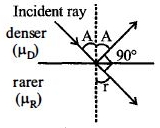
From Snell's law, \(\frac{\mu_{\mathrm{R}}}{\mu_{\mathrm{D}}}=\frac{\sin \mathrm{i}}{\sin \mathrm{r}}\) ..... \((i)\)\(\because \,\angle {\text{i}} = {\text{A}}\) and \(\angle {\text{r}} = \left( {{{90}^o} - {\text{A}}} \right)\)
We also know that, \(\sin \theta_{C}=\frac{\mu_{R}}{\mu_{D}}\)
From \(eq^{n}\,\,(i)\), \(\sin {\theta _C} = \frac{{\sin A}}{{\sin \left( {{{90}^o} - A} \right)}}\)
\(\sin {\theta _{\text{C}}} = \frac{{\sin {\text{A}}}}{{\cos {\text{A}}}}\)
\(\sin {\theta _{\text{C}}} = \tan {\text{A}}\)
\({\text{A}} = {\tan ^{ - 1}}\left( {\sin {\theta _{\text{C}}}} \right)\)
-
- (A) \(10\,\Omega \) અને \({\tan ^{ - 1}}\left( {\frac{5}{3}} \right)\)
- (B) \(7\,\Omega \) અને \(45^o\)
- (C) \(10\,\Omega \) અને \({\tan ^{ - 1}}\left( {\frac{8}{3}} \right)\)
- (D) \(7\,\Omega \) અને \({\tan ^{ - 1}}\left( {\frac{5}{3}} \right)\)
જવાબ અને ઉકેલ જુઓ
સાચો જવાબ: (B)
Given,\(\mathrm{V}_{0}=283 \,\mathrm{volt}, \omega=320,\, \mathrm{R}=5 \,\Omega, \mathrm{L}=25 \,\mathrm{mH}, \mathrm{C} =1000 \,\mu \mathrm{F}\)
\(x_{L}=\omega L=320 \times 25 \times 10^{-3}=8\, \Omega\)
\(x_{C}=\frac{1}{\omega C}=\frac{1}{320 \times 1000 \times 10^{-6}}=3.1 \,\Omega\)
Total impedance of the circuit:
\(z=\sqrt{\mathrm{R}^{2}+\left(\mathrm{X}_{\mathrm{L}}-\mathrm{X}_{\mathrm{C}}\right)^{2}}=\sqrt{25+(4.9)^{2}}=7\, \Omega\)
Phase difference between the voltage and current
\(\tan \phi=\frac{\mathrm{X}_{\mathrm{L}}-\mathrm{X}_{\mathrm{C}}}{\mathrm{R}}\)
\(\tan \phi=\frac{4.9}{5} \approx 1 \Rightarrow \phi=45 \%\)
-
- (A) \(\frac{{219\,M{R^2}}}{{256}}\)
- (B) \(\frac{{237\,M{R^2}}}{{512}}\)
- (C) \(\frac{{19\,M{R^2}}}{{512}}\)
- (D) \(\frac{{197\,M{R^2}}}{{256}}\)
જવાબ અને ઉકેલ જુઓ
સાચો જવાબ: (B)
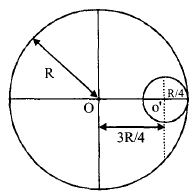
Moment of Inertia of complete disc about\('O'\) point \({I_{total}} = \frac{{M{R^2}}}{2}\)
Radius of removed disc \(= R/4\)
Mass of removed disc \(= M/16\) [As \(M\) \( \propto \) \({{R^2}}\)]
\(M.I.\) of removed disc about its own axis \((O')\)
\( = \frac{1}{2}\frac{M}{{16}}{\left( {\frac{R}{4}} \right)^2} = \frac{{M{R^2}}}{{512}}\)
\(M.I\) of removed disc about \(O\)
\(\begin{array}{l}
{I_{remo\,ved\,disc\,}} = {I_{cm}} + m{x^2}\\
= \frac{{M{R^2}}}{{512}} + \frac{M}{{16}}{\left( {\frac{{3R}}{4}} \right)^2} = \frac{{19\,M{R^2}}}{{512}}
\end{array}\)\(M.I.\) of remaining disc
\({I_{remaining}} = \frac{{M{R^2}}}{2} - \frac{{19}}{{512}}M{R^2} = \frac{{237}}{{512}}M{R^2}\)
-
- (A) દાંડીનો ડાબો ભાગ જમણા ભાગ કરતાં લાંબો છે.
- (B) દાંડીના બંને બાજુ ના ભાગ સમાન છે
- (C) દાંડીનો ડાબો ભાગ જમણા ભાગ કરતાં ટૂંકો છે.
- (D) આ ત્રાજવા દ્વારા વજન કરતાં દરેક વસ્તુ તેના વાસ્તવિક વજન કરતાં હલકી જણાય છે.
જવાબ અને ઉકેલ જુઓ
સાચો જવાબ: (C)
According to principle of moments when a system is stable or balance, the anticlockwise moment is equal to clockwise moment. i.e., load \( \times \) load arm \(=\) effort \( \times \) effort arm When \(5\, mg\) weight is placed, load arm shifts to left side, hence left arm becomes shorter than right arm -
- (A) \(\sqrt {\frac{3}{2}} \;\;\;\;\;\;\;\;\;\;\)
- (B) \(\frac{{\sqrt 3 }}{2}\)
- (C) \(1\)
- (D) \(\frac{3}{{\sqrt 2 }}\)
જવાબ અને ઉકેલ જુઓ
સાચો જવાબ: (A)
As we known, moment of inertia of a solid cylinder about an axis which is perpendicular bisector\(\begin{array}{l}
I = \frac{{m{R^2}}}{4} + \frac{{m{l^2}}}{{12}}\\
I = \frac{m}{4}\left[ {{R^2} + \frac{{{l^2}}}{3}} \right]\\
Let\,V\, = Volume\,of\,cylinder\, = \,\pi {R^2}l\\
\,\, = \frac{m}{4}\left[ {\frac{V}{{\pi l}} + \frac{{{l^2}}}{3}} \right] \Rightarrow \frac{{dI}}{{dl}} = \frac{m}{4}\left[ {\frac{{ - V}}{{\pi {l^2}}} + \frac{{2l}}{3}} \right] = 0
\end{array}\)\(\begin{array}{l}
\frac{V}{{\pi {l^2}}} = \frac{{2l}}{3} \Rightarrow V = \frac{{2\pi {l^3}}}{3}\\
\pi {R^2}l = \frac{{2\pi {l^3}}}{3} \Rightarrow \frac{{{l^2}}}{{{R^2}}} = \frac{3}{2}\,or,\,\frac{l}{R} = \sqrt {\frac{3}{2}}
\end{array}\)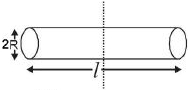
-
- (A) \(\sqrt {\frac{3}{2}} \;\;\;\;\;\;\;\;\;\;\)
- (B) \(\frac{{\sqrt 3 }}{2}\)
- (C) \(1\)
- (D) \(\frac{3}{{\sqrt 2 }}\)
જવાબ અને ઉકેલ જુઓ
સાચો જવાબ: (A)
As we known, moment of inertia of a solid cylinder about an axis which is perpendicular bisector\(\begin{array}{l}
I = \frac{{m{R^2}}}{4} + \frac{{m{l^2}}}{{12}}\\
I = \frac{m}{4}\left[ {{R^2} + \frac{{{l^2}}}{3}} \right]\\
Let\,V\, = Volume\,of\,cylinder\, = \,\pi {R^2}l\\
\,\, = \frac{m}{4}\left[ {\frac{V}{{\pi l}} + \frac{{{l^2}}}{3}} \right] \Rightarrow \frac{{dI}}{{dl}} = \frac{m}{4}\left[ {\frac{{ - V}}{{\pi {l^2}}} + \frac{{2l}}{3}} \right] = 0
\end{array}\)\(\begin{array}{l}
\frac{V}{{\pi {l^2}}} = \frac{{2l}}{3} \Rightarrow V = \frac{{2\pi {l^3}}}{3}\\
\pi {R^2}l = \frac{{2\pi {l^3}}}{3} \Rightarrow \frac{{{l^2}}}{{{R^2}}} = \frac{3}{2}\,or,\,\frac{l}{R} = \sqrt {\frac{3}{2}}
\end{array}\) -
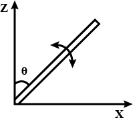
- (A) \(\frac{3 g}{2 l} \sin \theta\)
- (B) \(\frac{2 g}{3 l} \sin \theta\)
- (C) \(\frac{3 g}{2 l} \cos \theta\)
- (D) \(\frac{2 g}{2 l} \sin \theta\)
જવાબ અને ઉકેલ જુઓ
સાચો જવાબ: (A)
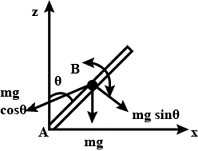
Torque at angle \(\theta\)\(\tau=M g \sin \theta\)
\(\tau=l \alpha\)
\(l \alpha=M g \sin \theta \frac{l}{2}\)
\(l=\frac{M l^{2}}{3}\)
\(\frac{M l^{2}}{3} . \alpha=M g \sin \theta \frac{l}{2}\)
\(\frac{l \alpha}{3}=g \frac{\sin \theta}{2}\)
\(\alpha=\frac{3 g \sin \theta}{2 l}\)
-
- (A) \(\frac{{2mg}}{{2m + M}}\)
- (B) \(\frac{{2Mg}}{{2m + M}}\)
- (C) \(\frac{{2mg}}{{2M + m}}\)
- (D) \(\frac{{2Mg}}{{2M + m}}\)
જવાબ અને ઉકેલ જુઓ
સાચો જવાબ: (A)
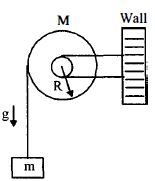
From the codition of equilibrium\(mg - T = ma \) \(....(i)\)
\(RT =\) \(I\alpha \)
\(\begin{array}{l}
\overline a = \overline \alpha \times R\,and\,I = \frac{{M{R^2}}}{2}\\
\,\,\,\,\,\,\,\,\,\,\,RT = \frac{{M{R^2}}}{2}.\frac{a}{R}
\end{array}\)Tension in string,
\(T = \frac{{Ma}}{2}\) From equation \((i)\)
\(mg - \frac{{Ma}}{2} = ma\)
\( \Rightarrow mg = a\left( {\frac{M}{2} + m} \right) \Rightarrow mg = a\left( {\frac{{M + 2m}}{2}} \right)\)
Hence, acceleration of the body,
\(a = \frac{{2mg}}{{M + 2m}}\)
-
- (A) \(1.985 \times 10^3\) \(Ω\)
- (B) \(2.045 \times 10^3 \) \( Ω\)
- (C) \(2.535 \times 10^3 \) \(Ω\)
- (D) \(4.005 \times10^3\) \( Ω\)
જવાબ અને ઉકેલ જુઓ
સાચો જવાબ: (A)
Given : Current through the galvanometer, \(i_{g}=5 \times 10^{-3} \,A\)Galvanometer resistance, \(G=15\, \Omega\)
Let resistance \(R\) to be put in series with the galvanometer to convert it into a voltmeter.
\(V=i_{g}(R+G)\)
\(10= 5 \times 10^{-3}(R+15) \)
\( \therefore \quad R=2000-15=1985 \)
\(=1.985 \times 10^{3} \,\Omega \)
-
- (A) \(\vec E = - {v_0}{B_0}\left( {3\hat i - 2\hat j - 4\hat k} \right)\)
- (B) \(\vec E = - {v_0}{B_0}\left( {\hat i + \hat j + 7\hat k} \right)\)
- (C) \(\vec E = {v_0}{B_0}\left( {14\hat j + 7\hat k} \right)\)
- (D) \(\vec E = - {v_0}{B_0}\left( {14\hat j + 7\hat k} \right)\)
જવાબ અને ઉકેલ જુઓ
સાચો જવાબ: (D)
According to question, as the test charge experiences no net force in that region i.e., sum of electric force \(\left( {{{\text{F}}_{\text{e}}} = {\text{q}}\overrightarrow {\text{E}} } \right)\,\) and magnetic forces \([{{\text{F}}_{\text{m}}} = {\text{q}}(\overline {\text{v}} \times \overline {\text{B}} ]\) will be zero.Hence, \(F_{e}+F_{m}=0\)
\(\mathrm{F}_{\mathrm{e}}=-\mathrm{q}(\overline{\mathrm{v}} \times \overline{\mathrm{B}})\)
\(=-\mathrm{B}_{0} \mathrm{v}_{0}[(3 \hat{\mathrm{i}}-\hat{\mathrm{j}}+2 \hat{\mathrm{k}}) \times(\mathrm{i}+2 \hat{\mathrm{j}}-4 \hat{\mathrm{k}})]\)
\(=-B_{0} v_{0}(14 \hat{j}+7 \hat{k})\)
-
- (A) તારથી દૂર
- (B) તાર તરફ
- (C) તારને સમાંતર અને પ્રવાહની દિશામાં
- (D) તારને સમાંતર અને પ્રવાહની વિરુધ્ધ દિશામાં
જવાબ અને ઉકેલ જુઓ
સાચો જવાબ: (B)
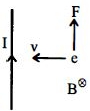
The force is parallel to the direction of current in magnetic field,hence \(\mathrm{F}=\mathrm{q}(\mathrm{v} \times \overrightarrow{\mathrm{B}})\)
According to Fleming's left hand rule,
we have, the direction of motion of charge is towards the wire.
-
- (A) \(\frac{{\pi {\mu _0}{I_0}}}{2}.\frac{{{a^2}}}{b}\omega \,\sin \,\left( {\omega t} \right)\)
- (B) \(\frac{{\pi {\mu _0}{I_0}}}{2}.\frac{{{a^2}}}{b}\omega \,\cos \,\left( {\omega t} \right)\)
- (C) \(\pi {\mu _0}{I_0}\,\frac{{{a^2}}}{b}\omega \,\sin \,\left( {\omega t} \right)\)
- (D) \(\frac{{\pi {\mu _0}{I_0}{b^2}}}{a}\,\omega \,\cos \,\left( {\omega t} \right)\)
જવાબ અને ઉકેલ જુઓ
સાચો જવાબ: (A)
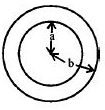
For two concentric circular coil,Mutual Inductance \(M=\frac{\mu_{0} \pi \mathrm{N}_{1} \mathrm{N}_{2} \mathrm{a}^{2}}{2 \mathrm{b}}\)
here, \(\mathrm{N}_{1}=\mathrm{N}_{2}=1\)
Hence, \(M=\frac{\mu_{0} \pi a^{2}}{2 b}.........(i)\)
and given \(I=I_{0} \cos \omega t.........(ii)\)
Now according to Faraday's second law induced \(emf\)
\(\mathrm{e}=-\mathrm{M} \frac{\mathrm{d} \mathrm{I}}{\mathrm{dt}}\)
Fromeq. \((ii)\)
\(\mathrm{e}=\frac{-\mu_{0} \pi \mathrm{a}^{2}}{2 \mathrm{b}} \frac{\mathrm{d}}{\mathrm{dt}}\left(\mathrm{I}_{0} \cos \omega \mathrm{t}\right)\)
\(\mathrm{e}=\frac{\mu_{0} \pi \mathrm{a}^{2}}{2 \mathrm{b}} \mathrm{I}_{0} \sin \omega \mathrm{t}(\omega)\)
\(\mathrm{e}=\frac{\pi \mu_{0} \mathrm{I}_{0}}{2} \cdot \frac{\mathrm{a}^{2}}{\mathrm{b}} \omega \sin \omega \mathrm{t}\)
-
- (A) \(200 \)
- (B) \(225\)
- (C) \(250\)
- (D) \(275\)
જવાબ અને ઉકેલ જુઓ
સાચો જવાબ: (C)
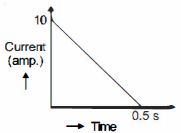
According to Faraday's law of electromagnetic induction, \(\quad \varepsilon=\frac{d \phi}{d t}\)Also, \(\varepsilon=\mathrm{i} \mathrm{R}\)
\(\therefore \quad i R=\frac{d \phi}{d t} \quad \Rightarrow \int d \phi=R \int i d t\)
Magnitude of change in flux \((\mathrm{d} \phi)=R \times\) area under current vs time graph
or, \(\quad d \phi=100 \times \frac{1}{2} \times \frac{1}{2} \times 10=250\, \mathrm{Wb}\)
-
- (A) \(6.65\)
- (B) \(8.89 \)
- (C) \(6.98\)
- (D) \(8.76 \)
જવાબ અને ઉકેલ જુઓ
સાચો જવાબ: (A)
Given : Magnetic moment, \(M=6.7 \times 10^{-2}\, \mathrm{Am}^{2}\)Magnetic field, \(\mathrm{B}=0.01\, \mathrm{T}\)
Moment of inertia, \(I=7.5 \times 10^{-6}\, \mathrm{Kgm}^{2}\)
\(\text { Using, } T =2 \pi \sqrt{\frac{I}{M B}} \)
\(=2 \pi \sqrt{\frac{7.5 \times 10^{-6}}{6.7 \times 10^{-2} \times 0.01}}=\frac{2 \pi}{10} \times 1.06\, s\)
Time taken for \(10\) complete oscillations
\(t=10\, T=2 \pi \times 1.06 \)
\(=6.6568 \approx 6.65\, \mathrm{s}\)
-
- (A) જ્યારે ટોર્ક મહત્તમ હોય ત્યારે સ્થિતિઉર્જા મહત્તમ હોય
- (B) જ્યારે ટોર્ક ન્યૂનતમ હોય ત્યારે સ્થિતિઉર્જા શૂન્ય હોય
- (C) જ્યારે ટોર્ક મહત્તમ હોય ત્યારે સ્થિતિઉર્જા શૂન્ય હોય
- (D) જ્યારે ટોર્ક મહત્તમ હોય ત્યારે સ્થિતિઉર્જા ન્યૂનતમ હોય
જવાબ અને ઉકેલ જુઓ
સાચો જવાબ: (C)
Potential energy of dipole,\(U = - pE\,\cos \,\theta \)
Torque experienced by dipole
\(\tau = pE\,\sin \,\theta \)
Torque will be maximum \(({\tau _{\max }})\) when \(\theta = {90^o}\)
then potential energy \(U = 0\)
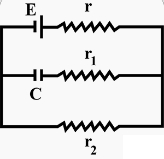
- 39. આકૃતિમાં બતાવેલ પરિપથ માટે પ્રવાહ જયારે સ્થાયી અવસ્થામાં પહોંચે ત્યારે કેપેસિટન્સ \(C\) ના કેપેસિટર પરનો વિદ્યુતભાર હશે :
 2017 મધ્યમ
- (A) \(CE\)
- (B) \(CE\)\(\;\frac{{\;{r_1}}}{{\left( {{r_2} + r} \right)}}\)
- (C) \(CE\)\(\;\frac{{\;{r_2}}}{{\left( {r + {r_2}} \right)}}\)
- (D) \(CE\)\(\;\frac{{\;{r_1}}}{{\left( {{r_1} + r} \right)}}\)
જવાબ અને ઉકેલ જુઓ
સાચો જવાબ: (C)
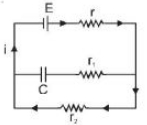
In steady state, flow of current through capacitor will be zero.Current through the circuit,
\(i=\frac{E}{r+r_{2}}\)
Potential difference through capacitor
\(V_{c}=\frac{Q}{C}=E-i r=E-\left(\frac{E}{r+r_{2}}\right) r\)
\(\therefore \quad Q=C E \frac{r_{2}}{r+r_{2}}\)
-
- (A) \(A_1\) નું અવલોકન \(2\,A\) મળે
- (B) \(A_1\) નું અવલોકન \(18\, A\) મળે
- (C) \(V\) નું અવલોકન \(9\, V\) મળે
- (D) \(V\) નું અવલોકન \(7\, V\) મળે
જવાબ અને ઉકેલ જુઓ
સાચો જવાબ: (A)
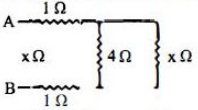
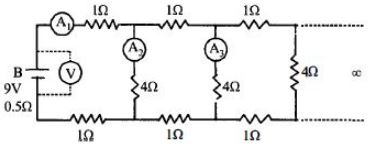
The given circuit can be redrawn as,as \(4\, \Omega\) and \(x\, \Omega\) are parallel
\(x^{\prime}=\frac{1}{4}+\frac{1}{x}=\frac{(4+x)}{4 x} \quad x^{\prime}=\frac{4 x}{4+x}\)
and \( 1 \,\Omega\) and \(1\, \Omega\) are also in series \(x^{\prime \prime}=2 \,\Omega\) Now equivalent resistance of circuit
\(x=\frac{4 x}{4+x}+2=\frac{8+6 x}{4+x}\)
\(4 x+x^{2}=8+6 x\)
\(x^{2}-2 x-8=0\)
\(x=\frac{2 \pm \sqrt{4-4(1)(-8)}}{2}=\frac{2 \pm \sqrt{36}}{2}\)
\(=\frac{2 \pm 6}{2}=4\, \Omega\)
Reading of Ammeter \(A_{1}=\frac{V}{(R+r)}\)
\(A_{1}=\frac{9}{4+0.5}=2\) \(Ampere\)
-
- (A) \(\frac{{{l_1}}}{{{l_1} + {l_2}}}\)
- (B) \(\frac{{{l_2}}}{{{l_2} - {l_1}}}\)
- (C) \(\frac{{{l_1}}}{{{l_1} - {l_2}}}\)
- (D) \(\frac{{{l_1}}}{{{l_2} - {l_1}}}\)
જવાબ અને ઉકેલ જુઓ
સાચો જવાબ: (D)
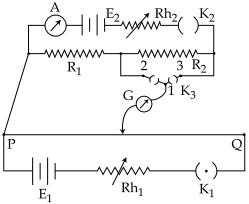
When key is at point \(( 1)\)\(\mathrm{V}_{1}=\mathrm{i} \mathrm{R}_{1}=\mathrm{x} l_{1}\)
When key is at \(( 3)\)
\({{\rm{v}}_2} = {\rm{i}}\left( {{{\rm{R}}_1} + {{\rm{R}}_2}} \right) = {\rm{x}}{l_2}\)
\(\frac{\mathrm{R}_{1}}{\mathrm{R}_{1}+\mathrm{R}_{2}}=\frac{l_{1}}{l_{2}} \Rightarrow \frac{\mathrm{R}_{1}}{\mathrm{R}_{2}}=\frac{l_{1}}{l_{2}-l_{1}}\)
-
- (A) \(P_1 > P_2 > P_3\)
- (B) \(P_1 > P_3 > P_2\)
- (C) \(P_2 > P_1 > P_3\)
- (D) \(P_3 > P_2 > P_1\)
જવાબ અને ઉકેલ જુઓ
સાચો જવાબ: (C)
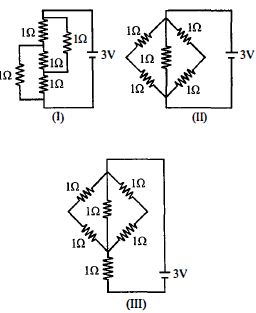
From the given circuit, net resistances \({{\rm{R}}_I} = 1\,\Omega ,{{\rm{R}}_{{\rm{II}}}} = 1/2\,\Omega ,{{\rm{R}}_{{\rm{III}}}} = 3/2\,\Omega \)It is clear that \(\mathrm{R}_{3}>\mathrm{R}_{1}>\mathrm{R}_{2}\)
Hence, \({P_3} < {P_1} < {P_2}\)
As Power \((P)\) \(=\frac{\mathrm{V}^{2}}{\mathrm{R}} \Rightarrow \mathrm{P} \propto \frac{1}{\mathrm{R}}\)
-
- (A) \(1600\)
- (B) \(400\)
- (C) \(200\)
- (D) \(100\)
જવાબ અને ઉકેલ જુઓ
સાચો જવાબ: (A)
Given, \({R_1} = 100\,\Omega ,{r^\prime } = r/2,{R_2} = ?\)Resistivity of wire, \(\mathrm{R}=\frac{\rho l}{\mathrm{A}}\)
\(\because\) Area \(\times\) length \(=\) volume
Hence, \(R=\frac{\rho V}{A^{2}}\)
since, \(\rho \rightarrow\) constant, \(V \rightarrow\) constant
\(\mathrm{R} \propto \frac{1}{\mathrm{A}^{2}}\)
or \(\quad \mathrm{R} \propto \frac{1}{\mathrm{r}^{4}} \quad \because \quad \mathrm{A}=\pi \mathrm{r}^{2}\)
\(\frac{\mathrm{R}_{2}}{\mathrm{R}_{1}}=16 \Rightarrow \mathrm{R}_{2}=16 \times 100=1600\, \Omega,\)
Resistance of new wire.
-
- (A) \(\frac{33}{5}\, \Omega \)
- (B) \( 6\,\Omega \)
- (C) \( 7\,\Omega \)
- (D) \(\frac{20}{3}\, \Omega \)
જવાબ અને ઉકેલ જુઓ
સાચો જવાબ: (D)
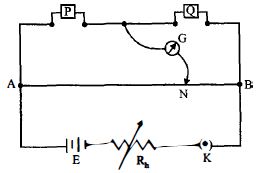
In balance position of bridge, \(\frac{P}{Q}=\frac{l}{(100-l)}\)Initially neutral position is \(60\, \mathrm{cm} .\) from \(\mathrm{A}\),
so
\(\frac{4}{60}=\frac{Q}{40} \Rightarrow Q=\frac{16}{6}=\frac{8}{3}\, \Omega\)
Now, when unknown resistance \(\mathrm{R}\) is connected in series to \(P\), neutral point is \(80\, cm\) from Athen,
\(\frac{4+R}{80}=\frac{Q}{20}\)
\(\frac{4+R}{80}=\frac{8}{60}\)
\(R=\frac{64}{6}-4=\frac{64-24}{6}=\frac{40}{6} \,\Omega\)
Hence, the value of unknown resistance \(\mathrm{R}\)
is \(=\frac{20}{3}\, \Omega\)
-
- (A) \(1\) \(A\)
- (B) \(0.25\) \( A\)
- (C) \(0.5\) \( A\)
- (D) \(0\) \( A\)
જવાબ અને ઉકેલ જુઓ
સાચો જવાબ: (D)
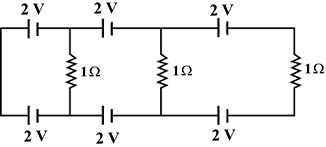
The potential difference in each loop is zero.\(\therefore \) No current will flow or current in each resistance is Zero.
-
- (A) વ્હીસ્ટન- બ્રીજ અતિ સંવેદનશીલ સ્થિતિમાં હોય જયારે તેના ચારેય અવરોધો પરિમાણનાં સરખા ક્રમના હોય.
- (B) સમતુલ્ય વ્હીસ્ટન- બ્રીજમાં જો સેલ અને ગેલ્વેનોમીટરના સ્થાન પરસ્પર બદલવામાં આવે તો નલ- પોઇન્ટ વિક્ષોભીત થાય છે.
- (C) રિહ્યોસ્ટેટનો ઉપયોગ પોટેન્શીયલ ડીવાઇડર તરીકે થઇ શકે છે.
- (D) કિરર્ચોફનો બીજો નિયમ ઊર્જા સંરક્ષણ દર્શાવે છે.
જવાબ અને ઉકેલ જુઓ
સાચો જવાબ: (B)
There is no change in null point, if the cell and the galvanometer are exchanged in a balanced wheatstone birdge.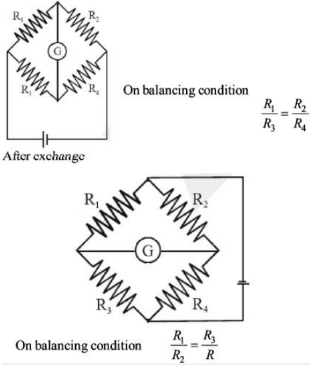
-
- (A) \(3\)
- (B) \(4\)
- (C) \(5\)
- (D) \(6\)
જવાબ અને ઉકેલ જુઓ
સાચો જવાબ: (C)
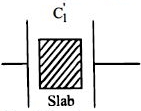
Before introducing a slab capacitance of plates\(C_{1}=\frac{\varepsilon_{0} A}{3}\)
If a slab of dielectric constant \(K\) is introduced between plates then
\(C=\frac{K \varepsilon_{0} A}{d}\) then \(C'_1 = \frac{{{\varepsilon _0}A}}{{2.4}}\)
\(\mathrm{C}_{1}\) and \({C'}_{1}\) are in series hence,
\(\frac{{{\varepsilon _0}A}}{3} = \frac{{{\text{k}}\frac{{{\varepsilon _0}A}}{3} \cdot \frac{{{\varepsilon _0}A}}{{2.4}}}}{{{\text{k}}\frac{{{\varepsilon _0}A}}{3} + \frac{{{\varepsilon _0}{\text{A}}}}{{2.4}}}}\)
\(3\, k=2.4 \,k+3\)
\(0.6\, \mathrm{k}=3\)
Hence, the dielectric constant of slap is given by,
\(k=\frac{30}{6}=5\)
-
- (A) \(20\)
- (B) \(32\)
- (C) \(28\)
- (D) \(16\)
જવાબ અને ઉકેલ જુઓ
સાચો જવાબ: (D)
Energy of sphere \(=\frac{Q^{2}}{2 C}\)\(4.5=\frac{16 \times 10^{-12}}{2 C}\)
\(C=\frac{16 \times 10^{-12}}{9}=4 \pi \varepsilon_{0} R\)
(capacity of spherical conductor)
\(\mathrm{R}=\frac{16 \times 10^{-12}}{9} \times \frac{1}{4 \pi \varepsilon_{0}}\)
\(\because \frac{1}{4 \pi \varepsilon_{0}}=9 \times 10^{9}\)
\(=9 \times 10^{9} \times \frac{16}{9} \times 10^{-12}=16\, \mathrm{mm}\)
-
- (A) \(589.5\)
- (B) \(589.2\)
- (C) \(589.4\)
- (D) \(589.6\)
જવાબ અને ઉકેલ જુઓ
સાચો જવાબ: (C)
Potential gradient is given by,\(\Delta \mathrm{V}=\mathrm{E} . \mathrm{d}\)
\(0.8=\mathrm{Ed}(\mathrm{max})\)
\(\Delta V=E d \cos \theta=0.8 \times \cos 60=0.4\)
Hence, maximum potential at a point on the sphere
\(=589.4\, \mathrm{V}\)
-
- (A) \(1\)
- (B) \(16\)
- (C) \(24\)
- (D) \(32\)
જવાબ અને ઉકેલ જુઓ
સાચો જવાબ: (D)
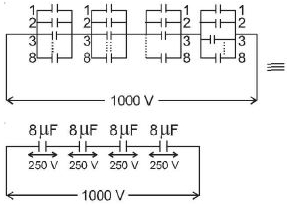
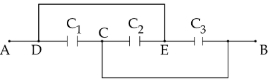
To get a capacitance of \(2\, \mu \mathrm{F}\) arrangement of capacitors of capacitance \(1\, \mu \mathrm{F}\) as shown in figure \(8\) capacitors of \(1\, \mu \mathrm{F}\) in parallel with four such branches in series i.e., \(32\) such capacitors are required.\(\frac{1}{C_{e q}}=\frac{1}{8}+\frac{1}{8}+\frac{1}{8}+\frac{1}{8} \quad \therefore C_{e q}=2\, \mu F\)
આ પેજ પર આ ફિલ્ટર મુજબ કોઈ પ્રશ્ન નથી.
અન્ય વર્ષ
વારંવાર પૂછાતા પ્રશ્નો
ExamBro પર JEE Mains 2017 Physics ના કેટલા પ્રશ્નો છે?
78 પ્રશ્નો, દરેક સાચા જવાબ અને પૂરા ઉકેલ સાથે.
JEE Mains 2017 Physics નું કયું પ્રકરણ સૌથી વધુ પૂછાય છે?
કણોનાં તંત્રો અને ચાકગતિ, 9 પ્રશ્નો સાથે; ત્યાર બાદ પ્રવાહ વિદ્યુત, 8 પ્રશ્નો સાથે.
JEE Mains 2017 Physics ના પ્રશ્નો કેટલા અઘરા હોય છે?
5% સરળ, 41% મધ્યમ અને 54% અઘરા.