


JEE Mains 2022 Chemistry ના બધા પ્રશ્નો
26 પ્રકરણ351 માંથી 251–300 પ્રશ્નો
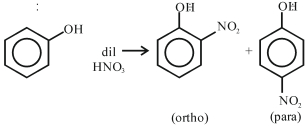
- 251. ફિનોલ ની મંદનાઈટ્રિક એસિડ સાથેની પ્રક્રિયા બે નીપજો આપે છે. મોટા પાયા પર અલગીકરણ માટે કઈ પધ્ધતિ સૌથી વધુ સક્ષમ છે? 2022 મધ્યમ
- (A) વર્ણાનુલેખી
- (B) વિભાગીય સ્ફટિકિકરણ
- (C) વરાળ નિસ્યંદન
- (D) ઊર્ધ્વપાતન
જવાબ અને ઉકેલ જુઓ
સાચો જવાબ: (C)
Para product has higher boiling point than ortho as intermolecular \(H\)-bond is possible in former, where as intramolecular \(H\)-bond is possible in ortho product.Steam distillation can separate them as ortho product is steam volatile.
-
- (A) \(\left[ Fe \left( H _{2} O \right)_{6}\right]_{2}\left[ Fe ( CN )_{6}\right]\)
- (B) \(Fe _{2}\left[ Fe ( CN )_{6}\right]_{2}\)
- (C) \(Fe _{3}\left[ Fe ( OH )_{2}( CN )_{4}\right]_{2}\)
- (D) \(Fe _{4}\left[ Fe ( CN )_{6}\right]_{3}\)
જવાબ અને ઉકેલ જુઓ
સાચો જવાબ: (D)
\(4 Fe ^{3+}+3\left[ Fe ( CN )_{6}\right]^{-4} \underset{\text { Prussian Blue }}{\longrightarrow} Fe _{4}\left[ Fe ( CN )_{6}\right]_{3}\) -
- (A) \((A)-(IV), (B)-(III), (C)-(I), (D)-(II)\)
- (B) \((A)-(III), (B)-(I), (C)-(IV), (D)-(II)\)
- (C) \((A)-(III), (B)-(IV), (C)-(II), (D)-(I)\)
- (D) \((A)-(III), (B)-(IV), (C)-(I), (D)-(II)\)
જવાબ અને ઉકેલ જુઓ
સાચો જવાબ: (D)
\((A)\) Chloroform + Aniline \(\rightarrow\) \((III)\) Distillation\((B)\) Benzoic acid + Napthalene \(\rightarrow\) \((IV)\) Crystallisation
\((C)\) Water + Aniline \(\rightarrow\) \((I)\) Steam distillation
\((D)\) Napthalene + Sodium chloride \(\rightarrow\) \((II)\) Sublimation
-
- (A) બંને વિધાન \(I\) અને વિધાન \(II\) સાચા છે.
- (B) બંને વિધાન \(I\) અને વિધાન \(II\) ખોટા છે.
- (C) વિધાન \(I\) સાચું છે, પરંતુ વિધાન \(II\) ખોટું છે.
- (D) વિધાન \(I\) ખોટું છે, પરંતુ વિધાન \(II\) સાચું છે.
જવાબ અને ઉકેલ જુઓ
સાચો જવાબ: (A)
Both statement \(I\) and statement \(II\) are correct. -
- (A) \(PCC\) ઓક્સિડેશન
- (B) ઓઝોનોલિસીસ
- (C) \(BH _{3}, H _{2} O _{2} /{ }^{-} OH\) બાદ \(PCC\)
- (D) \(HBr\), જળવિભાજન અને ત્યારબાદ \(K _{2} Cr _{2} O _{7}\). વડે ઓકસીડેશન
જવાબ અને ઉકેલ જુઓ
સાચો જવાબ: (C)
\(BH _{3}, H _{2} O _{2} / OH\) followed by \(PCC\) oxidation.
-
- (A) \(41\)
- (B) \(43\)
- (C) \(44\)
- (D) \(42\)
જવાબ અને ઉકેલ જુઓ
સાચો જવાબ: (D)
\(\%\) optical purity \(=\frac{\text { observed rotation of mixture } \times 100}{\text { rotation of pure enantiomer }}\)\(=\frac{+12.6^{\circ}}{+30^{\circ}} \times 100=42\)
-
- (A) \(4\)
- (B) \(1\)
- (C) \(2\)
- (D) \(3\)
જવાબ અને ઉકેલ જુઓ
સાચો જવાબ: (C)
Diamagnetic species are: \(N _{2}, O _{2}{ }^{2-}\) - 258. આયનો/અણુઓને ધ્યાનમાં લો. \(O _{2}^{+}, O _{2}, O _{2}^{-}, O _{2}^{2-}\) ચઢતા બંધક્રમાંકનો સાચો વિકલ્પ શોધો. 2022 સરળ
- (A) \(O _{2}^{2-}< O _{2}^{-}< O _{2}< O _{2}^{+}\)
- (B) \(O _{2}^{-}< O _{2}^{2-}< O _{2}< O _{2}^{+}\)
- (C) \(O _{2}^{-}< O _{2}^{2-}< O _{2}^{+}< O _{2}\)
- (D) \(O _{2}^{-}< O _{2}^{+}< O _{2}^{2-}< O _{2}\)
જવાબ અને ઉકેલ જુઓ
સાચો જવાબ: (A)
ion/molecule Number of \(e^{-}\) BMO Number of \(e^{-}\) in ABMO Bond order \(O _{2}{ }^{+}\) \(10\) \(5\) \(2.5\) \(O _{2}{ }\) \(10\) \(6\) \(2\) \(O _{2}{ }^{-}\) \(10\) \(7\) \(1.5\) \(O _{2}{ }^{-2}\) \(10\) \(8\) \(1\) Bond order \(O _{2}{ }^{2-}< O _{2}{ }^{-}< O _{2}< O _{2}{ }^{+}\)
-
- (A) \(3\)
- (B) \(2\)
- (C) \(1\)
- (D) \(4\)
જવાબ અને ઉકેલ જુઓ
સાચો જવાબ: (A)
\(BeF _{2}, BF _{3}\) and \(CCl _{4} \Rightarrow \mu_{\text {net }}=0\)\(H _{2} O , NH _{3}\) and \(HCl \Rightarrow \mu_{\text {net }} \neq 0\)
- 260. \(BrF_{3}\) અણુમાં મધ્યવર્તી પરમાણુમાં અસંબંધકારક યુગ્મ(મો)ની સંખ્યા અને આકાર,...... . 2022 મધ્યમ
- (A) \(0 ,\) ત્રિકોણીય સમતલીય
- (B) \(1,\) પિરામીડલ
- (C) \(2,\) વળેલ \(T-\)આકાર
- (D) \(1,\) વળેલ \(T-\)આકાર
જવાબ અને ઉકેલ જુઓ
સાચો જવાબ: (C)
Steric no. \(=5\left( sp ^{3} d \right)\), lone pair \(=2\)Bent \(T\) shape.

-
- (A) \(C _{2}^{2-}< N _{2}^{2-}< O _{2}^{2-}\)
- (B) \(O _{2}^{2-}< N _{2}^{2-}< C _{2}^{2-}\)
- (C) \(C _{2}^{2-}< O _{2}^{2-}< N _{2}^{2-}\)
- (D) \(N _{2}^{2-}< C _{2}^{2-}< O _{2}^{2-}\)
જવાબ અને ઉકેલ જુઓ
સાચો જવાબ: (B)
Species \(\quad\) Bond order\(C _{2}^{2-} \quad\quad\quad\quad 3\)
\(N _{2}^{2-} \quad\quad\quad\quad 2\)
\(O _{2}^{2-} \quad\quad\quad\quad 1\)
-
- (A) \(HCN < H _{2} O < NH _{3}\)
- (B) \(HCN < CH _{4}< NH _{3}\)
- (C) \(CH _{4}< HCN < NH _{3}\)
- (D) \(CH _{4}< NH _{3}< HCN\)
જવાબ અને ઉકેલ જુઓ
સાચો જવાબ: (C)
Order of \(H\)-Bonding\(CH _{4}\,<\, HCN \,<\, NH _{3}\)
\(NCH \ldots NCH\)
\(H _{2} NH \ldots NH _{3}\)
- 263. \(CH _{4}, NH _{4}+\) અને \(BH _{4}^{-}\)ને ધ્યાનમાં લઈ નીચેનામાંથી સાચો વિકલ્પ શોધો. 2022 મધ્યમ
- (A) તેઓ સમઈલેક્ટ્રોનિય અને ફક્ત બે સમચતુષ્ફલકીય બંધારણો ધરાવે છે.
- (B) તેઓ સમઈલેકટ્રોનિય અને બધા સમચતુષ્ફલકીય બંધારણો ધરાવે છે.
- (C) ફક્ત બેમાં સમ ઈલેકટ્રોનિય બંધારણ અને બધા સમચતુષ્ફલકીય બંધારણો ધરાવે છે.
- (D) ફક્ત બે સમઈલેકટ્રોનિય અને ફક્ત બેમાં સમચતુષ્ફલકીય બંધારણો ધરાવે છે.
જવાબ અને ઉકેલ જુઓ
સાચો જવાબ: (B)
All are tetrahedral and each have \(10\) electrons.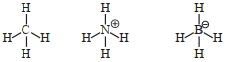
-
- (A) \(0\) અથવા \(1\)
- (B) \(2\)
- (C) \(3\)
- (D) \(4\)
જવાબ અને ઉકેલ જુઓ
સાચો જવાબ: (A)
\(DU =4+1-\left(\frac{5-1}{2}\right)=3\)\(CH _{2}= C = CH = CH = NH\)
Zero \(sp ^{3}\) carbon
-
- (A) \(2\)
- (B) \(3\)
- (C) \(4\)
- (D) \(5\)
જવાબ અને ઉકેલ જુઓ
સાચો જવાબ: (B)
\(CN ^{-}, NO ^{+}, O _{2}^{2+}\) have bond order \(=3\) -
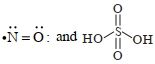
- (A) \(BCl _{3}\) અને \(SF _{6}\)
- (B) \(NO\) અને \(H _{2} SO _{4}\)
- (C) \(SF _{6}\) અને \(H _{2} SO _{4}\)
- (D) \(BCl _{3}\) અને \(NO\)
જવાબ અને ઉકેલ જુઓ
સાચો જવાબ: (B)
(A) \(BCl _{3} \rightarrow\) Even Electron molecule\(SF _{6} \rightarrow\) Expanded octet molecule
(B) \(NO \rightarrow\) Odd Electron molecule
\(H _{2} SO _{4} \rightarrow\) Expanded octet.
(C) \(SF _{6} \rightarrow\) Even Electron molecule
\(H _{2} SO _{4} \rightarrow\) Expanded octet.
(D) \(BCl _{3} \rightarrow\) Even Electron molecule
\(NO \rightarrow\) Odd Electron molecule
\(S \rightarrow 12e^{-}\) in outer orbit.
- 267. નીચે આપેલ પૈકી ઈલેકટ્રોનની ઊણપ ધરાવતા અણુઓની સંખ્યા શોધો. \(PH _{3}, B _{2} H _{6}, CCl _{4}, NH _{3}, LiH\) અને \(BCl _{3}\). 2022 સરળ
- (A) \(0\)
- (B) \(1\)
- (C) \(2\)
- (D) \(3\)
જવાબ અને ઉકેલ જુઓ
સાચો જવાબ: (C)
Electron deficient species have less than \(8\) electrons (or two electrons for \(H\) ) in their valence (incomplete octet)\(B _{2} H _{6}, BCl _{3}\) have incomplete octet.
-
- (A) \(1\)
- (B) \(2\)
- (C) \(3\)
- (D) \(4\)
જવાબ અને ઉકેલ જુઓ
સાચો જવાબ: (D)
Paramagnetic \(B _{2}, C _{2}^{-}, O _{2}^{+}, He _{2}^{+}\) -
- (A) \(2\)
- (B) \(10\)
- (C) \(3\)
- (D) \(4\)
જવાબ અને ઉકેલ જુઓ
સાચો જવાબ: (A)
The species with 2 lone pairs are XeF 4 and H 2 O . Therefore, the number of species with two lone pairs of electrons is \(2 .\)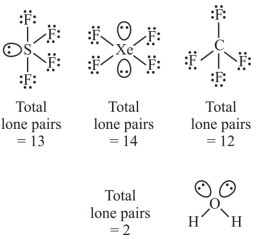
- 270. નીચે આપેલાને તેની સહસંયોજક લાક્ષણિકતાના (પ્રકૃતિ) ચઢતા ક્રમમાં ગોઠવો. \(CaF _{2}\),\(CaCl _{2}\),\(CaBr _{2}\),\(CaI _{2}\) 2022 મધ્યમ
- (A) \(B < A < C < D\)
- (B) \(A < B < C < D\)
- (C) \(A < B < D < C\)
- (D) \(A < C < B < D\)
જવાબ અને ઉકેલ જુઓ
સાચો જવાબ: (B)
According to Fajan's rule,Covalent character \(\propto\) size of Anion - 271. \(PF _{5}\) માં \(P\) વડે પ્રદર્શિત સંકરણ એ \(sp ^{x} d ^{y}\) તો \(y\) નું મૂલ્ય \(\dots\dots\) છે. 2022 સરળ
- (A) \(1\)
- (B) \(10\)
- (C) \(100\)
- (D) \(0.1\)
જવાબ અને ઉકેલ જુઓ
સાચો જવાબ: (A)
\(PF _{5} \Rightarrow sp ^{3} d\) hybridisation(\(5\) sigma bonds, zero lone pair on central atom)
Value of \(y=1\)
-
- (A) વિષુવવૃત્તીય સ્થાન અને \(90^{\circ}\) પર તેમાં બે અબંધકારક યુગ્મ - બંધકારક યુગ્મ અપાકર્ષણો છે.
- (B) વિષુવવૃત્તીય સ્થાન અને \(90^{\circ}\) પર તેમાં ત્રણ અબંધકારક યુગ્મ - બંધકારક યુગ્મ અપાકર્ષણો છે.
- (C) અક્ષીય સ્થાન અને \(90^{\circ}\) પર તેમાં ત્રણ અબંધકારક યુગ્મ - બંધકારક યુગ્મ અપાકર્ષણ છે.
- (D) અક્ષીય સ્થાન અને \(90^{\circ}\) પર બે અબંધકારક યુગ્મ - બંધકારક યુગ્મ અપાકર્ષણ છે.
જવાબ અને ઉકેલ જુઓ
સાચો જવાબ: (A)
\(sp ^{3} d\), See-Saw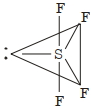
-
- (A) \((A)-(II), (B)-(I), (C)-(IV), (D)-(III)\)
- (B) \((A)-(III), (B)-(IV), (C)-(I), (D)-(II)\)
- (C) \((A)-(III), (B)-(I), (C)-(IV), (D)-(II)\)
- (D) \((A)-(III), (B)-(IV), (C)-(II), (D)-(I)\)
જવાબ અને ઉકેલ જુઓ
સાચો જવાબ: (C)
\((A)\) \(\psi_{M O}=\psi_{A}-\psi_{B}\) \((III)\,ABMO\)\((B)\) \(\mu= Q \times r\) \((I)\) Dipole moment
\((C)\) \(\frac{ N _{b}- N _{2}}{2}\) \((IV)\) Bond order
\((D)\) \(\psi_{M O}=\psi_{A}+\psi_{B}\) \((II)\) \(BMO\)
-
- (A) \((A) < (B) < (C) < (D)\)
- (B) \((B) < (A) < (D) < (C)\)
- (C) \(( B )<( D )<( A )<( C )\)
- (D) \(( B ) < ( A ) < ( C ) < (D)\)
જવાબ અને ઉકેલ જુઓ
સાચો જવાબ: (B)
\(3 s ^{2} \rightarrow Mg\)\(3 s ^{2} 3 p ^{1} \rightarrow Al\)
\(3 s ^{2} 3 p ^{3} \rightarrow P\)
\(3 s ^{2} 3 p ^{4} \rightarrow S\)
\(C > D > A > B\)
-
- (A) \(Mg ^{2+}< Na ^{+}< F ^{-}< O ^{2-}< N ^{3-}\)
- (B) \(N ^{3-}< O ^{2-}< F ^{-}< Na ^{+}< Mg ^{2+}\)
- (C) \(F ^{-}< Na ^{+}< O ^{2-}< Mg ^{2+}< N ^{3-}\)
- (D) \(Na ^{+}< F ^{-}< Mg ^{2+}< O ^{2-}< N ^{3-}\)
જવાબ અને ઉકેલ જુઓ
સાચો જવાબ: (A)
\(N ^{-3}> O ^{-2}> F ^{-}> Na ^{+}> Mg ^{+2}(\) Radii \()\)(Isoelectronic species)
-
- (A) \(O \,<\, N\, <\, B \,< \,Be\)
- (B) \(Be\, < \,B \,<\, N\, <\, O\)
- (C) \(B\, <\, Be\, < \,N \,<\, O\)
- (D) \(B \,< \,Be \,< \,O \,<\, N\)
જવાબ અને ઉકેલ જુઓ
સાચો જવાબ: (D)
\(1^{st}\,\,I.E.\) \(\underset{\left(2 p ^{3}\right)}{ N }>\underset{\left(2 p ^{4}\right)}{ O }>\underset{\left(2 s^{2}\right)}{ Be }>\underset{\left(2 p ^{1}\right)}{ B }\) -
- (A) \(F < Cl < Te < Po\)
- (B) \(Cl < F < Te < Po\)
- (C) \(Te < Po < Cl < F\)
- (D) \(Po < Te < F < Cl\)
જવાબ અને ઉકેલ જુઓ
સાચો જવાબ: (D)
As \(Cl\) has maximum electron affinity among all elements.Element \(\quad \Delta _{ eg } H ( k J / m o l )\)
\(F \quad\quad\quad\quad -328\)
\(Cl \quad\quad\quad\quad -349\)
\(Te \quad\quad\quad\quad -190\)
\(Po \quad\quad\quad\quad -174\)
-
- (A) \(Na > Mg > Be > Si > P\)
- (B) \(P > Si > Be > Mg > Na\)
- (C) \(Si > P > Be > Na > Mg\)
- (D) \(Be > Na > Mg > Si > P\)
જવાબ અને ઉકેલ જુઓ
સાચો જવાબ: (A)
Across a period metallic character decreases - 279. ધાતુ કે જેનું ગલનબિંદુ એકદમ નીચું છે અને તેનું આવર્ત સ્થાન અર્ધ ધાતુની નજીક છે તે \(.....\) 2022 સરળ
- (A) \(Al\)
- (B) \(Ga\)
- (C) \(Se\)
- (D) \(In\)
જવાબ અને ઉકેલ જુઓ
સાચો જવાબ: (B)
\(\begin{array}{ll} Al \rightarrow & 933\,K \\ Ga \rightarrow & 303\,K \\ In \rightarrow & 430\,K \\ Se \rightarrow & 490\,K \end{array}\) - 280. એક તત્વ જેનું બાહ્ય ઈલેકટ્રોનીય સંરચના \([Rn] \,5 f ^{14} 6 d ^1 7 s ^2\) છે. તો \(IUPAC\) નામકરણ મુજબ તે \(....\) 2022 મધ્યમ
- (A) \(Unnilbium\)
- (B) \(Unnilunium\)
- (C) \(Unnilquadium\)
- (D) \(Unniltrium\)
જવાબ અને ઉકેલ જુઓ
સાચો જવાબ: (D)
Atomic Number \(103\) -
- (A) \(Be > Mg > Ca > Sr\)
- (B) \(Sr > Ca > Mg > Be\)
- (C) \(Sr > Be > Mg > Ca\)
- (D) \(Be > Sr > Mg > Ca\)
જવાબ અને ઉકેલ જુઓ
સાચો જવાબ: (C)
In \(II'A'\) group density decreases down the group till \(Ca\) and after that it increases.Correct order of density is \(Sr > Be > Mg > Ca\) -
- (A) \(K\) ની પ્રથમ આયનીકરણ એન્થાલ્પી \(Na\) અને \(Li\) કરતા ઓછી છે.
- (B) તેના સમૂહમાં \(Xe\) તેની સૌથી ઓછી પ્રથમ આયનિકરણ એન્થાલ્પી ધરાવતો નથી.
- (C) \(37\) પરમાણુ ક્રમાંક ધરાવતા તત્વની પ્રથમ આયનીકરણ એન્થાલ્પી \(38\) પરમાણુ ક્રમાંક ધરાવતા તત્વ કરતા ઓછી છે.
- (D) \(Ga\) ની પ્રથમ આયનીકરણ એન્થાલ્ધી, \(d\)-વિભાગના પરમાણુ ક્રમાંક \(30\) ધરાવતા તત્વ કરતા વધુ છે.
જવાબ અને ઉકેલ જુઓ
સાચો જવાબ: (D)
Ionization enthalpy order :\(Li > Na > K\)
\(He > Ne > Ar > Kr > Xe > Rn\)
\(Sr > Rb\)
\(Zn > Ga\)
-
- (A) \(Mg^{2+} > Na^+ > F^- > O^{2-} < N^{3-}\)
- (B) \(N^{3-} < F^- > O^{2-} > Na^+ > Mg^{2+}\)
- (C) \(Mg^{2+} < Na^+ < F^- < O^{2-} < N^{3-}\)
- (D) \(N^{3-} > O^{2-} > F^- > Na^+ < Mg^{2+}\)
જવાબ અને ઉકેલ જુઓ
સાચો જવાબ: (C)
Ionic size increases with the addition of electrons and ionic size decreases with the loss of electrons. The nitride ion, has \(10\) electrons in contrast to only \(7\) protons. It has high inter electronic repulsions due to which it has the maximum size. The increasing order of ionic size is \(Mg ^{2+}\,<\, Na ^{+}\,<\,F ^{-}\,< \,O ^{2-}\)They are isoelectronic species with same number of electrons. Higher is the atomic number, higher will be the effective nuclear charge, lower will be the size.
-
- (A) \(487\)
- (B) \(768\)
- (C) \(577\)
- (D) \(856\)
જવાબ અને ઉકેલ જુઓ
સાચો જવાબ: (C)
\(I. E\; : \;Na < Al < Mg < Si\)\(\therefore \quad 496<\operatorname{IE}( Al )<737\)
Option \((C)\), matches the condition.
i.e \(\operatorname{IE}( Al )=577 \;kJmol ^{-1}\)
-
- (A) ફક્ત \((A)\) અને \((B)\)
- (B) ફક્ત \((B)\) અને \((C)\)
- (C) ફક્ત \((A)\) અને \((C)\)
- (D) ફક્ત \((C)\) અને \((D)\)
જવાબ અને ઉકેલ જુઓ
સાચો જવાબ: (C)
\(Rb\) and \(Cs\) have nearly same electron gain enthalpy electron gain enthalpy \(=-46\,kj / ml\)\(Ar\) and \(Kr\) have same \(\Delta H _{ eq }\). Value is \(+96\,kj / ml\)
-
- (A) \(SO _{3}\)
- (B) \(SiO _{2}\)
- (C) \(CaO\)
- (D) \(Al _{2} O _{3}\)
જવાબ અને ઉકેલ જુઓ
સાચો જવાબ: (C)
\(SO _{3}, SiO _{2}=\) Acidic\(CaO =\) Basic
\(Al _{2} O _{3}=\) Amphoteric
-
- (A) બંને \((A)\) અને \((R)\) સાચાં છે, અને \((R)\) એ \((A)\) નું યોગ્ય સ્પષ્ટીકરણ છે.
- (B) બંને \((A)\) અને \((R)\) સાચાં છે, અને \((R)\) એ \((A)\) નું યોગ્ય સ્પષ્ટીકરણ નથી.
- (C) \((A)\) સાચું છે પણ પરંતુ \((R)\) ખોંટુ છે.
- (D) \((A)\) ખોટુ છે પણ પરંતુ \((R)\) સાચું છે.
જવાબ અને ઉકેલ જુઓ
સાચો જવાબ: (D)
Ionic radius of \(O ^{2-}\) is more than that of \(Mg ^{2+}\)Both \(O ^{2-}\) and \(Mg ^{2+}\) are isoelectronic with \(10\) electrons
-
- (A) બંને \(A\) અને \(R\) સાચા છે અને \(R\) એ \(A\) ની સચોટ સમજુતી છે.
- (B) બંને \(A\) અને \(R\) સાચા છે અને \(R\) એ \(A\) ની સાચી સમજૂતી નથી.
- (C) \(A\) સાચું છે, પરંતુ \(R\) ખોટું છે.
- (D) \(A\) ખોટું છે, પરંતુ \(R\) સાચું છે.
જવાબ અને ઉકેલ જુઓ
સાચો જવાબ: (A)
Ionisation energy \(= N > O\).In oxygen atom, \(2\) of the \(42 p\) electrons must occupy the same \(2 p\) orbital resulting in an increased electron electron-repulsion.
-
- (A) \(0\)
- (B) \(1\)
- (C) \(2\)
- (D) \(3\)
જવાબ અને ઉકેલ જુઓ
સાચો જવાબ: (B)
\(Na _{2} O =\) Basic\(N _{2} O =\) Neutral
\(Cl _{2} O _{7}=\) Acidic
\(As _{2} O _{3}=\) Amphoteric
\(NO =\) Neutral
-
- (A) \(( A )-( IV ),( B )-( III ),( C )-( I ),( D )\)\(-( II )\)
- (B) \(( A )-( IV ),( B )-( II ),( C )-( I ),( D )\)\(-( III )\)
- (C) \(( A )-( II ),( B )-( IV ),( C )-( III ),( D )\)\(-( I )\)
- (D) \(( A )-( I ),( B )-( II ),( C )-( III ),( D )\)\(-( IV )\)
જવાબ અને ઉકેલ જુઓ
સાચો જવાબ: (B)
\(Cl _{2} O _{7} \quad\) Acidic\(Na _{2} O \quad\) Basic
\(Al _{2} O _{3} \quad\) Amphoteric
\(N _{2} O \quad\) Neutral
-
- (A) \(3 s ^{2} \cdot 3 p ^{4}\)
- (B) \(3 d ^{10} \cdot 4 s ^{2}, 4 p ^{4}\)
- (C) \(4 d ^{10} \cdot 5 s ^{2}, 5 p ^{4}\)
- (D) \(2 s ^{2}, p 4\)
જવાબ અને ઉકેલ જુઓ
સાચો જવાબ: (A)
\(E \Rightarrow[ Ar ] 3 d ^{10} 4 s ^{2} 4 p ^{4}\)Element above \(E \Rightarrow[ Ne ] 3 s ^{2} 3 p ^{4}\)
-
- (A) \(150\)
- (B) \(125\)
- (C) \(175\)
- (D) \(25\)
જવાબ અને ઉકેલ જુઓ
સાચો જવાબ: (B)
\(\,\quad\quad\quad\quad 2 NOCl ( g ) \rightleftharpoons 2 NO ( g )+ Cl _{2}( g )\)\(t =0 \quad\quad 2 M \quad\quad\quad\quad\quad -\quad\quad\quad\quad -\)
\(t = t _{ eq }\quad(2- x ) M\quad\quad\quad\quad xM \quad\quad \frac{ x }{2} M\)
\(\because x =0.4 \,M\)
\(\therefore[ NOCl ]_{ eq }=1.6\, M\)
\({[ NO ]_{ eq }=0.4 \,M }\)
\({\left[ Cl _{2}\right]_{ eq }=0.2 \,M }\)
\(\Rightarrow K _{ c }=\frac{[ NO ]^{2}\left[ Cl _{2}\right]}{[ NOCl ]^{2}}=\frac{[0.4]^{2}[0.2]}{[1.6]^{2}}\)
\(K _{ c }=\frac{32}{2.56} \times 10^{-3}\)
\(K _{ c }=12.5 \times 10^{-3}\)
\(K _{ c }=125 \times 10^{-4}\)
-
- (A) \(102\)
- (B) \(243\)
- (C) \(747\)
- (D) \(545\)
જવાબ અને ઉકેલ જુઓ
સાચો જવાબ: (C)
\(2 O _{3} \rightleftharpoons 3 O _{2}( g )\)\(\frac{2}{5} \quad\quad\quad \frac{3}{5}\)
\(k _{ p }=\frac{ P _{ O _{2}}^{3}}{ P _{ O _{3}}^{2}}\)
\(k_{p}=1.35\)
\(\Delta G ^{\circ}=- RT \ln k _{ p }\)
\(=-8.3 \times 300 \times \ln 1.35\)
\(=-747 \,J / mol\)
-
- (A) \(520\)
- (B) \(430\)
- (C) \(931\)
- (D) \(710\)
જવાબ અને ઉકેલ જુઓ
સાચો જવાબ: (D)
\(\quad \quad\quad \quad N _{2} O _{4} \quad \rightleftharpoons \quad\quad2 NO _{2}\)\(t =0 \quad\quad1 \,mol\)
\(t = t\quad \quad(1-0.5) \,mol \quad \quad 0.5 \times 2\,mol\)
\(\quad\quad\quad\quad=0.5 \,mol \quad\quad\quad 1\, mol\)
\(k _{ p }=\frac{\left(\frac{1}{1.5} \times 1\right)^{2}}{\left(\frac{0.5}{1.5} \times 1\right)}=\frac{1}{0.75}=\frac{100}{75}\)
\(=1.33\)
\(\Delta G ^{0}=- RT \ell nk _{ P }\)
\(=-8.31 \times 300 \times \ell n (1.33)=-710.45\, J / mol\)
\(=-710 \,J / mol\).
-
- (A) \(3\)
- (B) \(0\)
- (C) \(1\)
- (D) \(2\)
જવાબ અને ઉકેલ જુઓ
સાચો જવાબ: (D)
\(K_{e q}^{\prime}=\frac{1}{\sqrt{K_{e q}}}=\frac{1}{\sqrt{2 \times 10^{15}}}=x \times 10^{-8}\)\(\frac{1}{\sqrt{20}} \times \frac{1}{10^{7}}= x \times 10^{-8}\)
\(\frac{1}{\sqrt{20}} \times 10^{-7}= x \times 10^{-8}\)
\(\frac{10}{\sqrt{20}}= x\)
\(x=\frac{\sqrt{10}}{\sqrt{2}}=\sqrt{5}=2.236\)
\(\simeq 2.24\)
-
- (A) \(8945\)
- (B) \(945\)
- (C) \(1400\)
- (D) \(2735\)
જવાબ અને ઉકેલ જુઓ
સાચો જવાબ: (D)
\(\quad\quad HI \quad\quad\quad\rightleftharpoons \frac{1}{2} H _{2}+\frac{1}{2} I _{2}\)\(t _{ i } \,\quad\quad 1\)
\(\text { teq } \quad 1-0.4 \quad\quad \frac{0.4}{2} \quad\quad\quad \frac{0.4}{2}\)
\(K _{ p }= \frac{(0.2)^{\frac{1}{2}}(0.2)^{\frac{1}{2}}}{1-0.4}=\frac{0.2}{0.6}=\frac{1}{3}\)
\(\Delta G =\Delta G ^{\circ}+ RT \ln K =0\)
\(\Delta G ^{\circ} =- RT \ln K \Rightarrow-8.31 \times 300 \times 2.3 \times \log \left(\frac{1}{3}\right)\)
\(=2735\, J / mol\)
-
- (A) \(2.25\)
- (B) \(6.24\)
- (C) \(12.13\)
- (D) \(15.24\)
જવાબ અને ઉકેલ જુઓ
સાચો જવાબ: (A)
\(PCl _{5}=5\) \(mole\)\(Ar =4\) \(mole\)
\(P _{\text {Total }}=\frac{9 \times 0.82 \times 610}{100}=4.5 \,atm\)
\(P _{ PCI _{5}}=\frac{5 \times 4.5}{9}=2.5 ; P _{ Ar }=\frac{4 \times 4.5}{9}=2\)
\(PCl _{5} \rightleftharpoons PCl _{3}+ Cl _{2}\)
\(2.5- P \quad P \quad P\)
\(P_{\text {total }}=2.5-P+P+P+P_{A r}=6\)
\(P =1.5\)
\(K_{p}=\frac{1.5 \times 1.5}{1}=2.25\)
-
- (A) \(2312\)
- (B) \(954\)
- (C) \(1107\)
- (D) \(1451\)
જવાબ અને ઉકેલ જુઓ
સાચો જવાબ: (C)
Given : \(2\, mole\) of \(N _{2}\) gas was present as inert gas.Equilibrium pressure \(=2.46\, atm\)
\(PCl _{5}( g ) \rightleftharpoons PCl _{3}( g )+ C \ell_{2}( g )\)
\(t =0 \quad\quad\quad 5 \quad\quad\quad\quad 0\quad\quad 0\)
\(t = Eq ^{ m }\quad\quad 5- x\quad\,\,\,\, x \quad\quad x\)
from ideal gas equation
\(PV = nRT\)
\(2.46 \times 200=(5-x+x+x+2) \times 0.082 \times 600\) \(x =3\)
\(K _{ P }=\frac{ n _{ PCl _{3}} \times n _{ Cl _{2}}}{ n _{ PCl _{5}}} \times\left[\frac{ P _{\text {totall }}}{ n _{\text {total }}}\right]\)
\(\frac{3 \times 3}{2} \times \frac{2.46}{10}=1.107=1107 \times 10^{-3}\)
-
- (A) \(455\)
- (B) \(45\)
- (C) \(95\)
- (D) \(195\)
જવાબ અને ઉકેલ જુઓ
સાચો જવાબ: (D)
\(N _{2} O\) moles \(=\frac{2.2}{44}=\frac{1}{20}\)\(\Delta H = nC _{ p } \Delta T =\frac{1}{20} \times 100(-40)=-200\, J\)
\(\Delta U = q _{ p }+ w\)
\(w =- P _{\text {ext. }} \Delta\, V\)
\(W =-1 \frac{(167.75-217.1)}{1000} \times 101.3 \,J\)
\(W =+5 \,J\)
\(\Delta U =-200+5=-195\, J\)
-
- (A) \(+\,324\)
- (B) \(+\,632\)
- (C) \(-\,632\)
- (D) \(-\,324\)
જવાબ અને ઉકેલ જુઓ
સાચો જવાબ: (C)
\(\Delta H =\sum \Delta H _{\text {Combustion }}\) (Reactant) \(-\sum \Delta H _{\text {Combustion }}\) (Product)\(=3 \times(-1300)\,-\,[-3268]\)
\(=-632\, kJ\, mol ^{-1}\)

આ પેજ પર આ ફિલ્ટર મુજબ કોઈ પ્રશ્ન નથી.