


All JEE Mains 2022 Chemistry questions
26 chaptersShowing 251–300 of 351 questions
-
- (A) \(t-\)Butyl ethyl ether
- (B) \(2,2-\)Dimethyl butane
- (C) \(2-\)Methyl pent\(-1-\)ene
- (D) \(2-\)Methyl prop\(-1-\)ene
Show answer and solution
Correct Answer: (D)
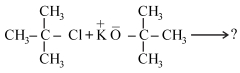
We have been given a bulky base, hence elimination will take place \(\&\) not substitution.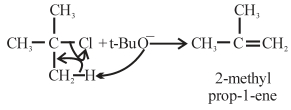
-
- (A) \(1\)
- (B) \(2\)
- (C) \(3\)
- (D) \(4\)
Show answer and solution
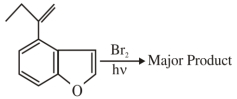
Correct Answer: (A)
No. of Br atoms \(=1\)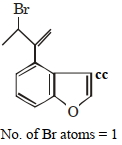
-
- (A) \(A, B, C\) and \(D\)
- (B) Only \(A\) and \(B\)
- (C) Only \(A\) and \(C\)
- (D) Only \(B, C\) and \(D\)
Show answer and solution
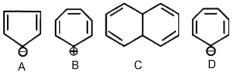
Correct Answer: (B)
\(A , B\) aromatic\(C , D\) is nonaromatic
- 254. The correct decreasing order of priority of functional groups in naming an organic compound as per \(IUPAC\) system of nomenclature is. 2022 Easy
- (A) \(- COOH >- CONH _{2}>- COCl >- CHO\)
- (B) \(- SO _{3} H >- COCl >- CONH _{2}>- CN\)
- (C) \(- COOR >- COCl >- NH _{2}> C = O\)
- (D) \(- COOH >- COOR >- CONH _{2}>- COCl\)
Show answer and solution
Correct Answer: (B)
\(- SO _{3} H >- COCl >- CONH { }_{2}>- CN\) -
- (A) \(4-\)methyl\(-2-\)nitro\(-5-\)oxohept\(-3-\)enal
- (B) \(4-\)methyl\(-5-\)oxo\(-2-\)nitrohept\(-3-\)enal
- (C) \(4-\)methyl\(-6-\)nitro\(-3-\)oxohept\(-4-\)enal
- (D) \(6-\)formyl\(-4-\)methyl\(-2-\)nitrohex\(-3-\)enal
Show answer and solution
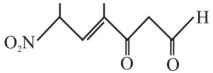
Correct Answer: (C)
\(4-\)methyl\(-6-\)nitro\(-3-\)oxohept\(-4-\)enal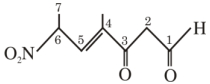
-
- (A) \(1-\)Chloroethene
- (B) \(1-\)Chloroethyne
- (C) \(1,2-\)Dichloroethane
- (D) \(1,1-\)Dichloroethane
Show answer and solution
Correct Answer: (D)
"\(1,1-\)Dichloroethane is Ethylidene chloride"
-
- (A) \(2\)
- (B) \(3\)
- (C) \(4\)
- (D) \(5\)
Show answer and solution
Correct Answer: (B)
\(CN ^{-}, NO ^{+}, O _{2}^{2+}\) have bond order \(=3\) -
- (A) \(4\)
- (B) \(1\)
- (C) \(2\)
- (D) \(3\)
Show answer and solution
Correct Answer: (C)
Diamagnetic species are: \(N _{2}, O _{2}{ }^{2-}\) -
- (A) \(3\)
- (B) \(2\)
- (C) \(1\)
- (D) \(4\)
Show answer and solution
Correct Answer: (A)
\(BeF _{2}, BF _{3}\) and \(CCl _{4} \Rightarrow \mu_{\text {net }}=0\)\(H _{2} O , NH _{3}\) and \(HCl \Rightarrow \mu_{\text {net }} \neq 0\)
- 260. Amongst \(SF _{4}, XeF _{4}, CF _{4}\) and \(H _{2} O\), the number of species with two lone pairs of electrons ..... . 2022 Easy
- (A) \(2\)
- (B) \(10\)
- (C) \(3\)
- (D) \(4\)
Show answer and solution
Correct Answer: (A)
The species with 2 lone pairs are XeF 4 and H 2 O . Therefore, the number of species with two lone pairs of electrons is \(2 .\)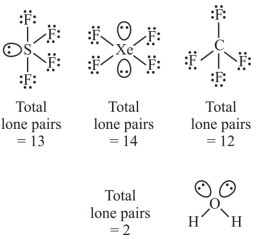
-
- (A) \(B < A < C < D\)
- (B) \(A < B < C < D\)
- (C) \(A < B < D < C\)
- (D) \(A < C < B < D\)
Show answer and solution
Correct Answer: (B)
According to Fajan's rule,Covalent character \(\propto\) size of Anion - 262. Consider the ions/molecule \(O _{2}^{+}, O _{2}, O _{2}^{-}, O _{2}^{2-}\) For increasing bond order the correct option is ..... . 2022 Easy
- (A) \(O _{2}^{2-}< O _{2}^{-}< O _{2}< O _{2}^{+}\)
- (B) \(O _{2}^{-}< O _{2}^{2-}< O _{2}< O _{2}^{+}\)
- (C) \(O _{2}^{-}< O _{2}^{2-}< O _{2}^{+}< O _{2}\)
- (D) \(O _{2}^{-}< O _{2}^{+}< O _{2}^{2-}< O _{2}\)
Show answer and solution
Correct Answer: (A)
Bond order \(O _{2}{ }^{2-}< O _{2}{ }^{-}< O _{2}< O _{2}{ }^{+}\)ion/molecule Number of \(e^{-}\) BMO Number of \(e^{-}\) in ABMO Bond order \(O _{2}{ }^{+}\) \(10\) \(5\) \(2.5\) \(O _{2}{ }\) \(10\) \(6\) \(2\) \(O _{2}{ }^{-}\) \(10\) \(7\) \(1.5\) \(O _{2}{ }^{-2}\) \(10\) \(8\) \(1\) - 263. Consider the species \(CH _{4}, NH _{4}^{+}\)and \(BH _{4}^{-}\). Choose the correct option with respect to the there species .... . 2022 Medium
- (A) They are isoelectronic and only two have tetrahedral structures
- (B) They are isoelectronic and all have tetrahedral structures
- (C) Only two are isoelectronic and all have tetrahedral structures
- (D) Only two are isoelectronic and only two have tetrahedral structures
Show answer and solution
Correct Answer: (B)
All are tetrahedral and each have \(10\) electrons.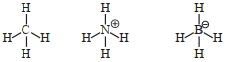
-
- (A) equatorial position and there are two lone pairbond pair repulsions at \(90^{\circ}\)
- (B) equatorial position and there are three lone pair-bond pair repulsions at \(90^{\circ}\)
- (C) axial position and there are three lone pair bond pair repulsion at \(90^{\circ}\).
- (D) axial position and there are two lone pair bond pair repulsion at \(90^{\circ}\).
Show answer and solution
Correct Answer: (A)
\(sp ^{3} d\), See-Saw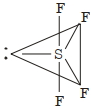
-
- (A) \((A)-(II), (B)-(I), (C)-(IV), (D)-(III)\)
- (B) \((A)-(III), (B)-(IV), (C)-(I), (D)-(II)\)
- (C) \((A)-(III), (B)-(I), (C)-(IV), (D)-(II)\)
- (D) \((A)-(III), (B)-(IV), (C)-(II), (D)-(I)\)
Show answer and solution
Correct Answer: (C)
\((A)\) \(\psi_{M O}=\psi_{A}-\psi_{B}\) \((III)\,ABMO\)\((B)\) \(\mu= Q \times r\) \((I)\) Dipole moment
\((C)\) \(\frac{ N _{b}- N _{2}}{2}\) \((IV)\) Bond order
\((D)\) \(\psi_{M O}=\psi_{A}+\psi_{B}\) \((II)\) \(BMO\)
-
- (A) \(0\)
- (B) \(1\)
- (C) \(2\)
- (D) \(3\)
Show answer and solution
Correct Answer: (C)
Electron deficient species have less than \(8\) electrons (or two electrons for \(H\) ) in their valence (incomplete octet)\(B _{2} H _{6}, BCl _{3}\) have incomplete octet.
- 267. Number of lone pair (s) of electrons on central atom and the shape of \(BrF _{3}\) molecule respectively, are ..... . 2022 Medium
- (A) \(0 ,\) triangular planar
- (B) \(1,\) pyramidal.
- (C) \(2,\) bent \(T-\)shape.
- (D) \(1,\) bent \(T-\)shape
Show answer and solution
Correct Answer: (C)
Steric no. \(=5\left( sp ^{3} d \right)\), lone pair \(=2\)Bent \(T\) shape.

- 268. The correct order of bound orders of \(C _{2}^{2-}, N _{2}^{2-}\) and \(O _{2}^{2-}\) is, respectively. 2022 Medium
- (A) \(C _{2}^{2-}< N _{2}^{2-}< O _{2}^{2-}\)
- (B) \(O _{2}^{2-}< N _{2}^{2-}< C _{2}^{2-}\)
- (C) \(C _{2}^{2-}< O _{2}^{2-}< N _{2}^{2-}\)
- (D) \(N _{2}^{2-}< C _{2}^{2-}< O _{2}^{2-}\)
Show answer and solution
Correct Answer: (B)
Species \(\quad\) Bond order\(C _{2}^{2-} \quad\quad\quad\quad 3\)
\(N _{2}^{2-} \quad\quad\quad\quad 2\)
\(O _{2}^{2-} \quad\quad\quad\quad 1\)
-
- (A) \(HCN < H _{2} O < NH _{3}\)
- (B) \(HCN < CH _{4}< NH _{3}\)
- (C) \(CH _{4}< HCN < NH _{3}\)
- (D) \(CH _{4}< NH _{3}< HCN\)
Show answer and solution
Correct Answer: (C)
Order of \(H\)-Bonding\(CH _{4}\,<\, HCN \,<\, NH _{3}\)
\(NCH \ldots NCH\)
\(H _{2} NH \ldots NH _{3}\)
- 270. The hybridization of \(P\) exhibited in \(P F_{5}\) is \(s p^{x} d^{y}\). The value of \(y\) is \(...\) 2022 Easy
- (A) \(1\)
- (B) \(10\)
- (C) \(100\)
- (D) \(0.1\)
Show answer and solution
Correct Answer: (A)
\(PF _{5} \Rightarrow sp ^{3} d\) hybridisation(\(5\) sigma bonds, zero lone pair on central atom)
Value of \(y=1\)
-
- (A) \(1\)
- (B) \(2\)
- (C) \(3\)
- (D) \(4\)
Show answer and solution
Correct Answer: (D)
Paramagnetic \(B _{2}, C _{2}^{-}, O _{2}^{+}, He _{2}^{+}\) - 272. The number of \(sp ^{3}\) hybridised carbons in an acyclic neutral compound with molecular formula \(C _{4} H _{5} N\) is. 2022 Medium
- (A) \(0\) or \(1\)
- (B) \(2\)
- (C) \(3\)
- (D) \(4\)
Show answer and solution
Correct Answer: (A)
\(DU =4+1-\left(\frac{5-1}{2}\right)=3\)\(CH _{2}= C = CH = CH = NH\)
Zero \(sp ^{3}\) carbon
- 273. Which of the following pair of molecules contain odd electron molecule and an expanded octet molecule? 2022 Medium
- (A) \(BCl _{3}\) and \(SF _{6}\)
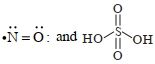
- (B) \(NO\) and \(H _{2} SO _{4}\)
- (C) \(SF _{6}\) and \(H _{2} SO _{4}\)
- (D) \(BCl _{3}\) and \(NO\)
Show answer and solution
Correct Answer: (B)
(A) \(BCl _{3} \rightarrow\) Even Electron molecule\(SF _{6} \rightarrow\) Expanded octet molecule
(B) \(NO \rightarrow\) Odd Electron molecule
\(H _{2} SO _{4} \rightarrow\) Expanded octet.
(C) \(SF _{6} \rightarrow\) Even Electron molecule
\(H _{2} SO _{4} \rightarrow\) Expanded octet.
(D) \(BCl _{3} \rightarrow\) Even Electron molecule
\(NO \rightarrow\) Odd Electron molecule
\(S \rightarrow 12e^{-}\) in outer orbit.
-
- (A) \(SO _{3}\)
- (B) \(SiO _{2}\)
- (C) \(CaO\)
- (D) \(Al _{2} O _{3}\)
Show answer and solution
Correct Answer: (C)
\(SO _{3}, SiO _{2}=\) Acidic\(CaO =\) Basic
\(Al _{2} O _{3}=\) Amphoteric
-
- (A) \(3 s ^{2} \cdot 3 p ^{4}\)
- (B) \(3 d ^{10} \cdot 4 s ^{2}, 4 p ^{4}\)
- (C) \(4 d ^{10} \cdot 5 s ^{2}, 5 p ^{4}\)
- (D) \(2 s ^{2}, p 4\)
Show answer and solution
Correct Answer: (A)
\(E \Rightarrow[ Ar ] 3 d ^{10} 4 s ^{2} 4 p ^{4}\)Element above \(E \Rightarrow[ Ne ] 3 s ^{2} 3 p ^{4}\)
- 276. Given below are the oxides: \(Na _{2} O , As _{2} O _{3}, N _{2} O , NO\) and \(Cl _{2} O _{7}\) Number of amphoteric oxides is ..... . 2022 Easy
- (A) \(0\)
- (B) \(1\)
- (C) \(2\)
- (D) \(3\)
Show answer and solution
Correct Answer: (B)
\(Na _{2} O =\) Basic\(N _{2} O =\) Neutral
\(Cl _{2} O _{7}=\) Acidic
\(As _{2} O _{3}=\) Amphoteric
\(NO =\) Neutral
-
- (A) Both \((A)\) and \((R)\) are true and \((R)\) is the correct explanation of \(( A )\)
- (B) Both \((A)\) and \((R)\) are true but \((R)\) is not the correct explanation of \((A)\)
- (C) \((A)\) is true but \((R)\) is false
- (D) \((A)\) is false but \((R)\) is true
Show answer and solution
Correct Answer: (D)
Ionic radius of \(O ^{2-}\) is more than that of \(Mg ^{2+}\)Both \(O ^{2-}\) and \(Mg ^{2+}\) are isoelectronic with \(10\) electrons
-
- (A) Both \(A\) and \(R\) are correct and \(R\) is the correct explanation of \(A\).
- (B) Both \(A\) and \(R\) are correct but \(R\) is NOT the correct explanation of \(A\).
- (C) \(A\) is correct but \(R\) is not correct.
- (D) \(A\) is not correct but \(R\) is correct
Show answer and solution
Correct Answer: (A)
Ionisation energy \(= N > O\).In oxygen atom, \(2\) of the \(42 p\) electrons must occupy the same \(2 p\) orbital resulting in an increased electron electron-repulsion.
-
- (A) \((A)\) and \((B)\) only
- (B) \((B)\) and \((C)\) only
- (C) \((A)\) and \((C)\) only
- (D) \((C)\) and \((D)\) only
Show answer and solution
Correct Answer: (C)
\(Rb\) and \(Cs\) have nearly same electron gain enthalpy electron gain enthalpy \(=-46\,kj / ml\)\(Ar\) and \(Kr\) have same \(\Delta H _{ eq }\). Value is \(+96\,kj / ml\)
-
- (A) \(( A )-( IV ),( B )-( III ),( C )-( I ),( D )\)\(-( II )\)
- (B) \(( A )-( IV ),( B )-( II ),( C )-( I ),( D )\)\(-( III )\)
- (C) \(( A )-( II ),( B )-( IV ),( C )-( III ),( D )\)\(-( I )\)
- (D) \(( A )-( I ),( B )-( II ),( C )-( III ),( D )\)\(-( IV )\)
Show answer and solution
Correct Answer: (B)
\(Cl _{2} O _{7} \quad\) Acidic\(Na _{2} O \quad\) Basic
\(Al _{2} O _{3} \quad\) Amphoteric
\(N _{2} O \quad\) Neutral
-
- (A) \((A) < (B) < (C) < (D)\)
- (B) \((B) < (A) < (D) < (C)\)
- (C) \(( B )<( D )<( A )<( C )\)
- (D) \(( B ) < ( A ) < ( C ) < (D)\)
Show answer and solution
Correct Answer: (B)
\(3 s ^{2} \rightarrow Mg\)\(3 s ^{2} 3 p ^{1} \rightarrow Al\)
\(3 s ^{2} 3 p ^{3} \rightarrow P\)
\(3 s ^{2} 3 p ^{4} \rightarrow S\)
\(C > D > A > B\)
-
- (A) \(Na > Mg > Be > Si > P\)
- (B) \(P > Si > Be > Mg > Na\)
- (C) \(Si > P > Be > Na > Mg\)
- (D) \(Be > Na > Mg > Si > P\)
Show answer and solution
Correct Answer: (A)
Across a period metallic character decreases -
- (A) \(Be > Mg > Ca > Sr\)
- (B) \(Sr > Ca > Mg > Be\)
- (C) \(Sr > Be > Mg > Ca\)
- (D) \(Be > Sr > Mg > Ca\)
Show answer and solution
Correct Answer: (C)
In \(II'A'\) group density decreases down the group till \(Ca\) and after that it increases.Correct order of density is \(Sr > Be > Mg > Ca\) - 284. The correct order of electron gain enthalpies of \(Cl\), \(F , Te\) and \(Po\) is ..... 2022 Easy
- (A) \(F < Cl < Te < Po\)
- (B) \(Cl < F < Te < Po\)
- (C) \(Te < Po < Cl < F\)
- (D) \(Po < Te < F < Cl\)
Show answer and solution
Correct Answer: (D)
As \(Cl\) has maximum electron affinity among all elements.Element \(\quad \Delta _{ eg } H ( k J / m o l )\)
\(F \quad\quad\quad\quad -328\)
\(Cl \quad\quad\quad\quad -349\)
\(Te \quad\quad\quad\quad -190\)
\(Po \quad\quad\quad\quad -174\)
-
- (A) \(Mg ^{2+}< Na ^{+}< F ^{-}< O ^{2-}< N ^{3-}\)
- (B) \(N ^{3-}< O ^{2-}< F ^{-}< Na ^{+}< Mg ^{2+}\)
- (C) \(F ^{-}< Na ^{+}< O ^{2-}< Mg ^{2+}< N ^{3-}\)
- (D) \(Na ^{+}< F ^{-}< Mg ^{2+}< O ^{2-}< N ^{3-}\)
Show answer and solution
Correct Answer: (A)
\(N ^{-3}> O ^{-2}> F ^{-}> Na ^{+}> Mg ^{+2}(\) Radii \()\)(Isoelectronic species)
- 286. The correct order of ionic size of \(N^{3-} , Na^+ ,F^- , Mg^{2+}\) and \(O^{2-}\) is 2022 Hard
- (A) \(Mg^{2+} > Na^+ > F^- > O^{2-} < N^{3-}\)
- (B) \(N^{3-} < F^- > O^{2-} > Na^+ > Mg^{2+}\)
- (C) \(Mg^{2+} < Na^+ < F^- < O^{2-} < N^{3-}\)
- (D) \(N^{3-} > O^{2-} > F^- > Na^+ < Mg^{2+}\)
Show answer and solution
Correct Answer: (C)
Ionic size increases with the addition of electrons and ionic size decreases with the loss of electrons. The nitride ion, has \(10\) electrons in contrast to only \(7\) protons. It has high inter electronic repulsions due to which it has the maximum size. The increasing order of ionic size is \(Mg ^{2+}\,<\, Na ^{+}\,<\,F ^{-}\,< \,O ^{2-}\)They are isoelectronic species with same number of electrons. Higher is the atomic number, higher will be the effective nuclear charge, lower will be the size.
- 287. The first ionization enthalpies of \(Be , B , N\) and \(O\) follow the order\(....\) 2022 Medium
- (A) \(O < N < B < Be\)
- (B) \(Be < B < N < O\)
- (C) \(B < Be < N < O\)
- (D) \(B < Be < O < N\)
Show answer and solution
Correct Answer: (D)
\(1^{st}\,\,I.E.\) \(\underset{\left(2 p ^{3}\right)}{ N }>\underset{\left(2 p ^{4}\right)}{ O }>\underset{\left(2 s^{2}\right)}{ Be }>\underset{\left(2 p ^{1}\right)}{ B }\) -
- (A) \(487\)
- (B) \(768\)
- (C) \(577\)
- (D) \(856\)
Show answer and solution
Correct Answer: (C)
\(I. E\; : \;Na < Al < Mg < Si\)\(\therefore \quad 496<\operatorname{IE}( Al )<737\)
Option \((C)\), matches the condition.
i.e \(\operatorname{IE}( Al )=577 \;kJmol ^{-1}\)
-
- (A) The first ionization enthalpy of \(K\) is less than that of \(Na\) and \(Li\)
- (B) \(Xe\) does not have the lowest first ionization enthalpy in its group
- (C) The first ionization enthalpy of element with atomic number \(37\) is lower than that of the element with atomic number \(38\) .
- (D) The first ionization enthalpy of \(Ga\) is higher than that of the \(d-\)block element with atomic number \(30\).
Show answer and solution
Correct Answer: (D)
Ionization enthalpy order :\(Li > Na > K\)
\(He > Ne > Ar > Kr > Xe > Rn\)
\(Sr > Rb\)
\(Zn > Ga\)
- 290. The \(IUPAC\) nomenclature of an element with electronic configuration \([ Rn ] 5 f ^{14} 6 d ^{1} 7 s ^{2}\) is. 2022 Medium
- (A) \(Unnilbium\)
- (B) \(Unnilunium\)
- (C) \(Unnilquadium\)
- (D) \(Unniltrium\)
Show answer and solution
Correct Answer: (D)
Atomic Number \(103\) - 291. The metal that has very low melting point and its periodic position is closer to a metalloid is. 2022 Easy
- (A) \(Al\)
- (B) \(Ga\)
- (C) \(Se\)
- (D) \(In\)
Show answer and solution
Correct Answer: (B)
\(\begin{array}{ll} Al \rightarrow & 933\,K \\ Ga \rightarrow & 303\,K \\ In \rightarrow & 430\,K \\ Se \rightarrow & 490\,K \end{array}\) -
- (A) \(150\)
- (B) \(125\)
- (C) \(175\)
- (D) \(25\)
Show answer and solution
Correct Answer: (B)
\(\,\quad\quad\quad\quad 2 NOCl ( g ) \rightleftharpoons 2 NO ( g )+ Cl _{2}( g )\)\(t =0 \quad\quad 2 M \quad\quad\quad\quad\quad -\quad\quad\quad\quad -\)
\(t = t _{ eq }\quad(2- x ) M\quad\quad\quad\quad xM \quad\quad \frac{ x }{2} M\)
\(\because x =0.4 \,M\)
\(\therefore[ NOCl ]_{ eq }=1.6\, M\)
\({[ NO ]_{ eq }=0.4 \,M }\)
\({\left[ Cl _{2}\right]_{ eq }=0.2 \,M }\)
\(\Rightarrow K _{ c }=\frac{[ NO ]^{2}\left[ Cl _{2}\right]}{[ NOCl ]^{2}}=\frac{[0.4]^{2}[0.2]}{[1.6]^{2}}\)
\(K _{ c }=\frac{32}{2.56} \times 10^{-3}\)
\(K _{ c }=12.5 \times 10^{-3}\)
\(K _{ c }=125 \times 10^{-4}\)
-
- (A) \(102\)
- (B) \(243\)
- (C) \(747\)
- (D) \(545\)
Show answer and solution
Correct Answer: (C)
\(2 O _{3} \rightleftharpoons 3 O _{2}( g )\)\(\frac{2}{5} \quad\quad\quad \frac{3}{5}\)
\(k _{ p }=\frac{ P _{ O _{2}}^{3}}{ P _{ O _{3}}^{2}}\)
\(k_{p}=1.35\)
\(\Delta G ^{\circ}=- RT \ln k _{ p }\)
\(=-8.3 \times 300 \times \ln 1.35\)
\(=-747 \,J / mol\)
-
- (A) \(2.25\)
- (B) \(6.24\)
- (C) \(12.13\)
- (D) \(15.24\)
Show answer and solution
Correct Answer: (A)
\(PCl _{5}=5\) \(mole\)\(Ar =4\) \(mole\)
\(P _{\text {Total }}=\frac{9 \times 0.82 \times 610}{100}=4.5 \,atm\)
\(P _{ PCI _{5}}=\frac{5 \times 4.5}{9}=2.5 ; P _{ Ar }=\frac{4 \times 4.5}{9}=2\)
\(PCl _{5} \rightleftharpoons PCl _{3}+ Cl _{2}\)
\(2.5- P \quad P \quad P\)
\(P_{\text {total }}=2.5-P+P+P+P_{A r}=6\)
\(P =1.5\)
\(K_{p}=\frac{1.5 \times 1.5}{1}=2.25\)
-
- (A) \(8945\)
- (B) \(945\)
- (C) \(1400\)
- (D) \(2735\)
Show answer and solution
Correct Answer: (D)
\(\quad\quad HI \quad\quad\quad\rightleftharpoons \frac{1}{2} H _{2}+\frac{1}{2} I _{2}\)\(t _{ i } \,\quad\quad 1\)
\(\text { teq } \quad 1-0.4 \quad\quad \frac{0.4}{2} \quad\quad\quad \frac{0.4}{2}\)
\(K _{ p }= \frac{(0.2)^{\frac{1}{2}}(0.2)^{\frac{1}{2}}}{1-0.4}=\frac{0.2}{0.6}=\frac{1}{3}\)
\(\Delta G =\Delta G ^{\circ}+ RT \ln K =0\)
\(\Delta G ^{\circ} =- RT \ln K \Rightarrow-8.31 \times 300 \times 2.3 \times \log \left(\frac{1}{3}\right)\)
\(=2735\, J / mol\)
-
- (A) \(3\)
- (B) \(0\)
- (C) \(1\)
- (D) \(2\)
Show answer and solution
Correct Answer: (D)
\(K_{e q}^{\prime}=\frac{1}{\sqrt{K_{e q}}}=\frac{1}{\sqrt{2 \times 10^{15}}}=x \times 10^{-8}\)\(\frac{1}{\sqrt{20}} \times \frac{1}{10^{7}}= x \times 10^{-8}\)
\(\frac{1}{\sqrt{20}} \times 10^{-7}= x \times 10^{-8}\)
\(\frac{10}{\sqrt{20}}= x\)
\(x=\frac{\sqrt{10}}{\sqrt{2}}=\sqrt{5}=2.236\)
\(\simeq 2.24\)
-
- (A) \(2312\)
- (B) \(954\)
- (C) \(1107\)
- (D) \(1451\)
Show answer and solution
Correct Answer: (C)
Given : \(2\, mole\) of \(N _{2}\) gas was present as inert gas.Equilibrium pressure \(=2.46\, atm\)
\(PCl _{5}( g ) \rightleftharpoons PCl _{3}( g )+ C \ell_{2}( g )\)
\(t =0 \quad\quad\quad 5 \quad\quad\quad\quad 0\quad\quad 0\)
\(t = Eq ^{ m }\quad\quad 5- x\quad\,\,\,\, x \quad\quad x\)
from ideal gas equation
\(PV = nRT\)
\(2.46 \times 200=(5-x+x+x+2) \times 0.082 \times 600\) \(x =3\)
\(K _{ P }=\frac{ n _{ PCl _{3}} \times n _{ Cl _{2}}}{ n _{ PCl _{5}}} \times\left[\frac{ P _{\text {totall }}}{ n _{\text {total }}}\right]\)
\(\frac{3 \times 3}{2} \times \frac{2.46}{10}=1.107=1107 \times 10^{-3}\)
-
- (A) \(520\)
- (B) \(430\)
- (C) \(931\)
- (D) \(710\)
Show answer and solution
Correct Answer: (D)
\(\quad \quad\quad \quad N _{2} O _{4} \quad \rightleftharpoons \quad\quad2 NO _{2}\)\(t =0 \quad\quad1 \,mol\)
\(t = t\quad \quad(1-0.5) \,mol \quad \quad 0.5 \times 2\,mol\)
\(\quad\quad\quad\quad=0.5 \,mol \quad\quad\quad 1\, mol\)
\(k _{ p }=\frac{\left(\frac{1}{1.5} \times 1\right)^{2}}{\left(\frac{0.5}{1.5} \times 1\right)}=\frac{1}{0.75}=\frac{100}{75}\)
\(=1.33\)
\(\Delta G ^{0}=- RT \ell nk _{ P }\)
\(=-8.31 \times 300 \times \ell n (1.33)=-710.45\, J / mol\)
\(=-710 \,J / mol\).
-
- (A) \(81\)
- (B) \(117\)
- (C) \(453\)
- (D) \(751\)
Show answer and solution
Correct Answer: (B)
Given data is for \(1 \,moles\) and asked for \(5\, moles\) so value is \(23.4 \times 5=117\, kJ\) -
- (A) \(455\)
- (B) \(45\)
- (C) \(95\)
- (D) \(195\)
Show answer and solution
Correct Answer: (D)
\(N _{2} O\) moles \(=\frac{2.2}{44}=\frac{1}{20}\)\(\Delta H = nC _{ p } \Delta T =\frac{1}{20} \times 100(-40)=-200\, J\)
\(\Delta U = q _{ p }+ w\)
\(w =- P _{\text {ext. }} \Delta\, V\)
\(W =-1 \frac{(167.75-217.1)}{1000} \times 101.3 \,J\)
\(W =+5 \,J\)
\(\Delta U =-200+5=-195\, J\)
No questions on this page match these filters.