


પ્રશ્નો
8 પ્રશ્નો8 માંથી 1–8 પ્રશ્નો
- 1. આ ઘટકો માં \(NO , NO ^{+}, NO ^{2+}, NO ^{-},\) લઘુત્તમ બંધની પ્રબળતા ધરાવતું એક કયું છે: 2020 અઘરું
- (A) \(NO ^{2+}\)
- (B) \(NO ^{+}\)
- (C) \(NO\)
- (D) \(NO ^{-}\)
જવાબ અને ઉકેલ જુઓ
સાચો જવાબ: (D)
Bond order of \(NO ^{2+}=2.5\)Bond order of \(NO ^{+}=3\)
Bond order of \(NO =2.5\)
Bond order of \(NO ^{-}=2\)
Bond order \(\alpha\) bond strength.
-
- (A) આયન-દ્વિધ્રુવીય > આયન-આયન > દ્વિધ્રુવીય-દ્વિધ્રુવીય
- (B) દ્વિધ્રુવીય-દ્વિધ્રુવીય > આયન-દ્વિધ્રુવીય > આયન-આયન
- (C) આયન-દ્વિધ્રુવીય > દ્વિધ્રુવીય-દ્વિધ્રુવીય > આયન-આયન
- (D) આયન-આયન > આયન-દ્વિધ્રુવીય > દ્વિધ્રુવીય-દ્વિધ્રુવીય
જવાબ અને ઉકેલ જુઓ
સાચો જવાબ: (D)
Interionic\(/\) Intermolecular forces \(\propto\) charge on the speciesIons are charged species whereas dipoles are partially charged.
\(\therefore\) Ion-Ion \(\,>\,\) Ion-dipole \(\,>\,\) dipole-dipole
Hence, option \(d\) is correct.
-
- (A) હાઈડ્રોજન બંધન અને લંડન વિક્ષેપન
- (B) દ્વિધ્રુવીય-દ્વિધ્રુવીય અને હાઈડ્રોજન બંધન
- (C) લંડન વિક્ષેપન અને દ્વિધ્રુવીય-દ્વિધ્રુવીય
- (D) લંડન વિક્ષેપન , દ્વિધ્રુવીય-દ્વિધ્રુવીય અને હાઈડ્રોજન બંધન
જવાબ અને ઉકેલ જુઓ
સાચો જવાબ: (C)
Ethyl acetate is polar molecule. Hence there will be dipole-dipole
attraction and london dispersion forces are present. -
- (A) સમચોરસ પિરામિડલ
- (B) ચતુષ્ફલકીય
- (C) સમચોરસ સમતલીય
- (D) લંબચોરસ સમતલીય
જવાબ અને ઉકેલ જુઓ
સાચો જવાબ: (A)
\((1)\) If \(AB _{4}\) molecule is a square pyramidal then it has one lone pair and their structure should be and it should be polar because dipole moment of lone pair of \('A'\) never be cancelled by others.\((2)\) If \(AB _{4}\) molecule is a tetrahedral then it has no lone pair and their structure should be and it should be non polar due to perfect symmetry.
\((3)\) If \(AB _{4}\), molecule is a square planar then it should be non polar because vector sum of dipole moment is zero.
\((4)\) If \(AB _{4}\) molecule is a rectangular planar then it should be non polar because vector sum of dipole moment is zero.
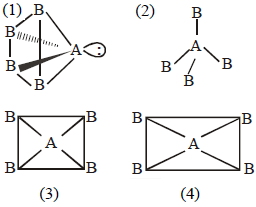
-
- (A) \(\mathrm{O}_{2}^{-}\) અથવા \(\mathrm{O}_{2}^{+}\)
- (B) \(\mathrm{O}_{2}\) અથવા \(\mathrm{O}_{2}^{+}\)
- (C) \(\mathrm{O}_{2}\) અથવા \(\mathrm{O}_{2}^{-}\)
- (D) \(\mathrm{O}_{2}, \mathrm{O}_{2}^{-}\) અથવા \(\mathrm{O}_{2}^{+}\)
જવાબ અને ઉકેલ જુઓ
સાચો જવાબ: (A)
\(\begin{array}{|c|c|c|} \hline & \text { unpaired electron } & \text { magnetic moment } \\ \hline O _{2}^{\oplus} & 1 & 1.73 B . M \\ \hline O _{2}^{\ominus} & 1 & 1.73 B . M \\ \hline O _{2} & 2 & 2.83 B.M \\ \hline \end{array}\) -
- (A) \(\underline{N}{H }_{3} \stackrel{ H ^{+}}{\longrightarrow}\)
- (B) \(\underline {Xe}F _{4}+ SbF _{5} \rightarrow\)
- (C) \(H _{2} \underline SO _{4}+ NaCl \xrightarrow{{420\,\,K}}\)
- (D) \(H _{3} \underline PO _{2} \xrightarrow{{ Disproportionation }}\)
જવાબ અને ઉકેલ જુઓ
સાચો જવાબ: (B)
\(XeF _{4}+ SbF _{5} \rightarrow\left[ XeF _{3}\right]^{+}\left[ SbF _{6}\right]^{-}\)\(sp ^{3} d ^{2}\,\,\,\,\, sp ^{3} d\,\,\, \quad sp ^{3} d\,\,\,\,\, \quad sp ^{3} d ^{2}\)
-
- (A) \(\left[ Ni ( CN )_{4}\right]^{2-}\)
- (B) \(\left[ CrF _{6}\right]^{3-}\)
- (C) \(BrF _{5}\)
- (D) \(XeF _{4}\)
જવાબ અને ઉકેલ જુઓ
સાચો જવાબ: (A)
\(\left[ Ni ( CN )_{4}\right]^{2-}\)\(dsp\)\(^{2}\) hybridisation.
-
- (A) સમત્રિકોણીય દ્વિપિરામિડલ
- (B) ચોરસ સમતલીય
- (C) ચતુષ્ફલકીય
- (D) પિરામિડલ
જવાબ અને ઉકેલ જુઓ
સાચો જવાબ: (A)
\(4 \sigma\) bonds \(+1\) lone pairShape (including lone pair of electrons) is Trigonal bipyramidal

આ પેજ પર આ ફિલ્ટર મુજબ કોઈ પ્રશ્ન નથી.