


JEE Mains 2020 Chemistry ના બધા પ્રશ્નો
25 પ્રકરણ193 માંથી 101–150 પ્રશ્નો
-
- (A) \(2.15\)
- (B) \(3.33\)
- (C) \(1.67\)
- (D) \(4.33\)
જવાબ અને ઉકેલ જુઓ
સાચો જવાબ: (A)
Cell reaction is\(\mathrm{Sn}(\mathrm{s})+\mathrm{Pb}^{+2}(\mathrm{aq}) \rightarrow \mathrm{Sn}^{+2}(\mathrm{aq})+\mathrm{Pb}(\mathrm{s})\dots (1)\)
Apply Nernst equation:
\(\mathrm{E}_{\text {cell}}=\mathrm{E}_{\text {cel }}^{0}-\frac{0.06}{2} \log \frac{\left[\mathrm{Sn}^{+2}\right]}{\left[\mathrm{Pb}^{+2}\right]}\)
\(\mathrm{E}_{\mathrm{cell}}^{0}=-0.13+0.14=0.01 \mathrm{V}\)
At equilibrium : \(E_{\text {cell}}=0\)
Substituting in \(( 1)\)
\(0=0.01-\frac{0.06}{2} \log \frac{\left[\mathrm{Sn}^{+2}\right]}{\left[\mathrm{Pb}^{+2}\right]}\)
\(\Rightarrow \quad \frac{1}{3}=\log \frac{\left[\mathrm{Sn}^{+2}\right]}{\left[\mathrm{Pb}^{+2}\right]}\)
\(\Rightarrow\; \frac{\left[\mathrm{Sn}^{+2}\right]}{\left\lceil\mathrm{Pb}^{+2}\right\rceil}=2.15\)
-
- (A) \(0.64,-5.71\) અને \(-14.29\)
- (B) \(28.4,-7.14\) અને \(-5.71\)
- (C) \(28.4,-5.71\) અને \(-14.29\)
- (D) \(0.64,-7.14\) અને \(-5.71\)
જવાબ અને ઉકેલ જુઓ
સાચો જવાબ: (C)
\(\operatorname{In}\left[\frac{ k _{2}}{ k _{1}}\right]=\frac{\Delta H ^{\circ}}{ R }\left\{\frac{1}{ T _{1}}-\frac{1}{ T _{2}}\right\}\)\(\ln (10)=\frac{\Delta H ^{\circ}}{ R }\left\{\frac{1}{298}-\frac{1}{373}\right\}\)
\(373 \times 298 \times R \times 2.303=\Delta H ^{\circ}=28.37 kJ mol ^{-1}\)
\(\Delta G _{ T _{1}}^{\circ}=- RT _{1} \ln \left( K _{1}\right)=-298 R \ln (10)=-5.71 k mol ^{-1}\)
\(\Delta G _{ T _{2}}^{\circ}=- RT _{2} \ln \left( K _{2}\right)=-373 R \ln (100)\)
\(=-14.283 kJ / mol\)
-
- (A) \(\left(\Lambda_{\mathrm{m}}^{0}\right)_{\mathrm{NaBr}}-\left(\Lambda_{\mathrm{m}}^{0}\right)_{\mathrm{NaI}}=\left(\Lambda_{\mathrm{m}}^{0}\right)_{\mathrm{KBr}}-\left(\Lambda_{\mathrm{m}}^{0}\right)_{\mathrm{NaBr}}\)
- (B) \(\left(\Lambda_{\mathrm{m}}^{0}\right)_{\mathrm{H}_{2} \mathrm{O}}=\left(\Lambda_{\mathrm{m}}^{0}\right)_{\mathrm{HCl}}+\left(\Lambda_{\mathrm{m}}^{0}\right)_{\mathrm{NaOH}}-\left(\Lambda_{\mathrm{m}}^{0}\right)_{\mathrm{NaCl}}\)
- (C) \(\left(\Lambda_{\mathrm{m}}^{0}\right)_{\mathrm{KCl}}-\left(\Lambda_{\mathrm{m}}^{0}\right)_{\mathrm{NaCl}}=\left(\Lambda_{\mathrm{m}}^{0}\right)_{\mathrm{KBr}}-\left(\Lambda_{\mathrm{m}}^{0}\right)_{\mathrm{NaBr}}\)
- (D) \(\left(\Lambda_{\mathrm{m}}^{0}\right)_{\mathrm{NaBr}}-\left(\Lambda_{\mathrm{m}}^{0}\right)_{\mathrm{NaCl}}=\left(\Lambda_{\mathrm{m}}^{0}\right)_{\mathrm{KBr}}-\left(\Lambda_{\mathrm{m}}^{0}\right)_{\mathrm{KCl}}\)
જવાબ અને ઉકેલ જુઓ
સાચો જવાબ: (A)
According to Kohlrausch's law correct expression \(\overline{15}\)\(\left(\Lambda_{\mathrm{m}}^{0}\right)_{\mathrm{KBr}}-\left(\Lambda_{\mathrm{m}}^{0}\right)_{\mathrm{NaI}}=\left(\Lambda_{\mathrm{m}}^{0}\right)_{\mathrm{KBr}}-\left(\Lambda_{\mathrm{m}}^{0}\right)_{\mathrm{KI}}\)
The other statements are correct.
-
- (A) \(10\)
- (B) \(5\)
- (C) \(12\)
- (D) \(15\)
જવાબ અને ઉકેલ જુઓ
સાચો જવાબ: (B)
\(\Delta T_{b}=i \times K_{b} \times m\)\(i \times 0.1 \times K_{b}=3 \times 0.05 \times K_{b} \times 2\)
\(i=3\)
\(\left[C r\left(N H_{3}\right)_{5} \cdot C l\right] C l_{2} \rightarrow\left[C r\left(N H_{3}\right)_{5} C l\right]^{+2}+2 C l^{-}\)
\(x=5\)
-
- (A) \(13\)
- (B) \(10\)
- (C) \(8\)
- (D) \(6\)
જવાબ અને ઉકેલ જુઓ
સાચો જવાબ: (B)
\(\mathrm{ppm}=\frac{10.3 \times 10^{-3}}{1030} \times 10^{6}=10\) -
- (A) \(10\)
- (B) \(5\)
- (C) \(8\)
- (D) \(12\)
જવાબ અને ઉકેલ જુઓ
સાચો જવાબ: (A)
Molar mass of \(Na _{2} CO _{3} \cdot xH _{2} O\)\(\Rightarrow 23 \times 2+12+48+18 x\)
\(\Rightarrow 46+12+48+18 x\)
\(\Rightarrow(106+18 x )\)
\(Eqwt =\frac{ M }{2}=(53+9 x )\)
As \(n _{\text {factor }}\) in dissolution will be determined from net cationic or anionic charge; which is \(2\) so
\(Eqwt =\frac{ M }{2}=53+9 x\)
Gmeq \(=\frac{ wt }{ Eqwt }=\frac{1.43}{53+9 x }\)
Normality \(=\frac{ Gmeq }{ V _{\text {litre }}}\)
Normality \(=0.1=\frac{1.43}{\frac{53+9 x }{0.1}}\)
As volume \(=100 ml\)
\(=0.1 Litre\)
So \(\quad 10^{-2}=\frac{1.43}{53+9 x }\)
\(53+9 x =143\)
\(9 x =90\)
\(x =10.00\)
-
- (A) \(172\)
- (B) \(175\)
- (C) \(180\)
- (D) \(177\)
જવાબ અને ઉકેલ જુઓ
સાચો જવાબ: (D)
Let molar mass of protein \(A=x\) \(g/mol\)Let molar mass of protein \(B = y g / mol\)
\(\pi_{ A }=\) osmotic pressure of protein \(A =\frac{\left(\frac{0.73}{ x }\right)}{0.25} RT\)
\(\pi_{ B }=\) osmotic pressure of protein \(B =\frac{\left(\frac{1.65}{ y }\right)}{1} RT\)
\(\pi_{ A }=\pi_{ B }\)
\(\Rightarrow\left(\frac{0.73}{ x \times 0.25}\right) RT =\left(\frac{1.65}{ y }\right) RT\)
\(\Rightarrow\left(\frac{ x }{ y }\right)=\frac{0.73}{0.25 \times 1.65}=1.769 \cong 1.77\)
-
- (A) \(600\)
- (B) \(620\)
- (C) \(590\)
- (D) \(628\)
જવાબ અને ઉકેલ જુઓ
સાચો જવાબ: (A)
\(550= P _{ A }^{\circ} \times \frac{1}{4}+ P _{ B }^{\circ} \times \frac{3}{4}\)\(2200= P _{ A }^{\circ}+3 P _{ B }^{\circ}\)\(....(i)\)
\(2800= P _{ A }^{\circ}+4 P _{ B }^{\circ}\)\(....(ii)\)
\(560= P _{ A }^{\circ} \times \frac{1}{5}+ P _{ B }^{\circ} \times \frac{4}{5}\)
\(P _{ B }^{\circ}=600, P _{ A }^{\circ}=400\)
-
- (A) \(35^oC\) પર દ્રાવણ બનાવવા ઉષ્મા શોષાવી જોઇએ
- (B) આ પ્રણાલીમાં રાઉલ્ટના નિયમનું પાલન થતુ નથી
- (C) \(100\; mL\; CS_2\) અને \(100\; mL\) એસિટોનના મિશ્રણનું કદ \(< 200 \;mL\) થશે
- (D) તેઓ પોતે સ્વતંત્ર રીતે હોય તેના કરતા \(CS_2\) અને એસિટોન ઓછા જોડાયેલા છે
જવાબ અને ઉકેલ જુઓ
સાચો જવાબ: (C)
The vapour pressure of mixture \((=600\; \mathrm{mm} \;\mathrm{Hg}\) ) is greater than the individual vapour pressure of its constituents (Vapour pressure of \(\mathrm{CS}_{2}=512\; \mathrm{mm}\; Hg\), acetone \(=344 \;\mathrm{mm}\; Hg\) ). Hence, the solution formed shows positive deviationfrom Raoult's law.
\(\Rightarrow(1) \Delta_{\mathrm{sol}} \mathrm{H}>0\)
\((2)\) Raoult's law is not obeyed
(3) \(\Delta_{\text {sol. }}\) Volume \(>0\)
(4) \(\mathrm{CS}_{2}\) and Acetone are less attracted to each ether than to themselves.
-
- (A) \(0.37\)
- (B) \(0.67\)
- (C) \(0.87\)
- (D) \(0.63\)
જવાબ અને ઉકેલ જુઓ
સાચો જવાબ: (A)
\(1\; L\) solution requires \(30 \mathrm{m\;mol} \;\mathrm{HCl}\)\(250 \;\mathrm{ml}\) sol. will require \(7.5 \mathrm{m}\; \mathrm{mol} \;\mathrm{HCl}\)
\({\text { or } 3.75 \mathrm{m\;mol}\; \mathrm{H}_{2} \mathrm{SO}_{4}}\)
\({\Rightarrow \frac{3.75 \times 98}{1000} \mathrm{gm} \;\mathrm{H}_{2} \mathrm{SO}_{4}}\)
\({=0.3675 \;\mathrm{gm} \;\mathrm{H}_{2} \mathrm{SO}_{4}}\)
-
- (A) દ્રાવણનું કદ બદલાતુ અને દ્રાવકનું કદ ઘટે છે
- (B) દ્રાવણનુ કદ ઘટે છે અને દ્રાવકનું કદ ઘટે છે
- (C) દ્રાવણનુ કદ ઘટે છે અને દ્રાવકનું કદ વધે છે
- (D) દ્રાવણ અને દ્રાવકની કટ બદલાતા નથી
જવાબ અને ઉકેલ જુઓ
સાચો જવાબ: (C)
The pure solvent solution will try to maintain higher vapour pressure in the sealed container and in return the solvent vapour molecules will condense in the solution of non-volatile solute as it maintains an equilibrium with lower vapour pressure. (Lowering of vapour pressure is observed when a non volatile solute is mixed in a volatile solvent)This will eventually lead to increase in the volume of solution and decrease in the volume of solvent.
-
- (A) \(8.33\)
- (B) \(5.67\)
- (C) \(6.33\)
- (D) \(4.67\)
જવાબ અને ઉકેલ જુઓ
સાચો જવાબ: (B)
gm eq. of \(\mathrm{Ag}=\frac{108}{108}=1\)\(\mathrm{gm}\) eq. of \(\mathrm{O}_{2}(\mathrm{g})=1\)
Volume of \(\mathrm{O}_{2}(\mathrm{g})=22.7 \times \frac{1}{4}=5.675\) litre
-
- (A) \(A>B>C\)
- (B) \(A>C>B\)
- (C) \(C>B>A\)
- (D) \(B > C > A\)
જવાબ અને ઉકેલ જુઓ
સાચો જવાબ: (A)
Relative lowering of \(V . P. =\frac{\Delta P }{ P ^{0}}= x _{\text {solute }}\)\(\left(\frac{\Delta P }{ P ^{0}}\right)_{ A }=\frac{\frac{10}{100}}{\frac{10}{100}+\frac{180}{18}}:\left(\frac{\Delta P }{ P ^{0}}\right)_{ B }=\frac{\frac{10}{200}}{\frac{10}{200}+\frac{180}{18}}\)
\(\left(\frac{\Delta P }{ P ^{0}}\right)_{ C }=\frac{\frac{10}{10,000}}{\frac{10}{10,000}+\frac{180}{18}}:\left(\frac{\Delta P }{ P ^{0}}\right)_{ A }>\left(\frac{\Delta P }{ P ^{0}}\right)_{ B }>\left(\frac{\Delta P }{ P ^{0}}\right)_{ C }\)
-
- (A) \(14\)
- (B) \(22\)
- (C) \(6\)
- (D) \(38\)
જવાબ અને ઉકેલ જુઓ
સાચો જવાબ: (C)
According to Dalton's law of partial pressure\(p _{ i }= x _{ i } \times P _{ T }\)
\(P _{ i }=\) partial pressure of the \(i ^{\text {th }}\) component
\(x _{ i }=\) mole fraction of the \(i ^{\text {th }}\) component
\(p _{ T }=\) total pressure of mixture
\(\Rightarrow 2 atm =\left(\frac{ n _{ H _{2}}}{ n _{ H _{2}}+ n _{ H _{ e }}+ n _{ O _{2}}}\right) \times p _{ T }\)
\(\Rightarrow p _{ T }=2 atm \times \frac{3}{1}=6 atm\)
-
- (A) \(37\)
- (B) \(35\)
- (C) \(40\)
- (D) \(32\)
જવાબ અને ઉકેલ જુઓ
સાચો જવાબ: (A)
\(P _{ CO _{2}}= K _{ H } \times CO _{2}\)\(\frac{3}{30}=\frac{ K _{ H } \cdot n _{ CO _{2}}}{ K _{ H } 1} \Rightarrow n _{ CO _{2}-0.1} mol\)
\(pH =\frac{1}{2}\left( pka _{1}-\log c \right)=\frac{1}{2}(6.4 \times 1)=3.7\)
\(pH =37 \times 10^{-1}\)
-
- (A) \(150\)
- (B) \(167\)
- (C) \(160\)
- (D) \(159\)
જવાબ અને ઉકેલ જુઓ
સાચો જવાબ: (B)
Osmotic pressure \(=\pi= i \times C \times RT\)For \(NaCl i =2\) so
\(\pi_{ NaCl }= i \times C _{ NaCl } \times RT \quad C _{ NaCl }=\) conc. of \(NaCl\)
\(0.1=2 \times C _{ NaCl } \times RT\)
\(C_{ NaCl }=\frac{0.05}{ RT } \quad C_{\text {glucose }}=\) conc. of glucose
For glucose \(i=1\) so
\(\pi_{\text {Glucose }}= i \times C _{\text {glucose }} \times RT\)
\(0.2=1 \times C _{\text {glucose }} \times RT\)
\(C _{\text {Glucose }}=\frac{0.2}{ RT } \quad \eta_{ NaCl }=\) No. of moles \(NaCl\)
\(\eta_{ NaCl }\) in \(1 L = C _{ NaCl } \times V _{\text {Litre }}\)
\(=\frac{0.05}{ RT } \quad \eta_{ glucose }=\) No. of moles glucose
\(\eta_{\text {glucose }}\) in \(2 L = C _{\text {glucose }} \times V _{\text {Litre }}\)
\(=\frac{0.4}{ RT }\)
\(V _{\text {Total }}=1+2=3 L\)
so Final conc. \(NaCl =\frac{0.05}{3 RT }\)
Final conc. glucose \(=\frac{0.4}{3 RT }\)
\(\pi_{\text {Total }}=\pi_{ NaCl }+\pi_{\text {glucose }}\)
\(=\left[i \times C_{ NaCl }+C_{\text {glucose }}\right] \times RT\)
\(=\left(\frac{2 \times 0.05}{3 RT }+\frac{0.4}{3 RT }\right) \times RT\)
\(=\frac{0.5}{3} atm\)
\(=0.1666 atm\)
\(=166.6 \times 10^{-3} atm\)
\(\Rightarrow 167.00 \times 10^{-3} atm\)
so \(x=167.00\)
-
- (A) \(2.25\)
- (B) \(2\)
- (C) \(1.75\)
- (D) \(1.5\)
જવાબ અને ઉકેલ જુઓ
સાચો જવાબ: (C)
\(\Delta \mathrm{T}_{\mathrm{f}}=\mathrm{i} \times \mathrm{m} \times \mathrm{K}_{\mathrm{f}}\)\(0.2=2 \times 2 \times \frac{\mathrm{w} / 58.5}{600 / 1000}\)
\(\mathrm{w}=1.755 \mathrm{gm}\)
-
- (A) \(4.97\)
- (B) \(6.63\)
- (C) \(3.52\)
- (D) \(9.47\)
જવાબ અને ઉકેલ જુઓ
સાચો જવાબ: (A)
\(\mathrm{FeSO}_{4} \cdot 7 \mathrm{H}_{2} \mathrm{O}(\mathrm{M}=277.85)\)\(\mathrm{ppm}=\frac{\text { wt. of Fe }}{\text { wt. of wheat }} \times 10^{6}\)
let the wt. of salt be \(=\mathrm{w} \mathrm{gm}\)
moles \(=\frac{\mathrm{w}}{277.85}\)
wt. of \(\mathrm{Fe}=\left(\frac{\mathrm{W}}{277.85} \times 55.85\right) \mathrm{gm}\)
\(10=\frac{\frac{\mathrm{W}}{277.85} \times 55.85}{10^{5}} \times 10^{6}\)
\(W=\frac{277.85}{55.85}=4.97\)
-
- (A) \((A)\)
- (B) \((C)\)
- (C) \((B)\)
- (D) \((A)\) અને \((C)\)
જવાબ અને ઉકેલ જુઓ
સાચો જવાબ: (C)
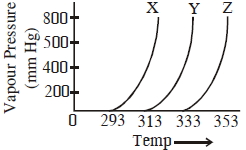
Order of B.P. is : \(Z>Y>X\)Order of vapour pressure \(: Z < Y < X\)
order of intermolecular interaction \(: Z>Y>X\)
- 120. \(0.1\, N\) \(NaOH\) ના ફોસ્ફિનિક એસિડની તટસ્થતા માટે જરૂરી \(0.1\, N\)નું \(10\, mL\) કદ (\( ml \) માં) ........ 2020 અઘરું
- (A) \(15\)
- (B) \(18\)
- (C) \(10\)
- (D) \(5\)
જવાબ અને ઉકેલ જુઓ
સાચો જવાબ: (C)
\(H _{3} PO _{2}+ NaOH \rightarrow NaH _{2} PO _{2}+ H _{2} O\)\(\frac{ n _{ H_3 PO _{2}} \text { reacted }}{1}=\frac{ n _{ NaOH } \text { reacted }}{1}\)
\(\Rightarrow \frac{0.1 \times 10}{1}=0.1 \times V _{ NaOH }\)
\(\Rightarrow V _{ NaOH }=10 ml\)
-
- (A) \(C _{2}=\frac{1000 x _{2}}{ M _{1}+ x _{2}\left( M _{2}- M _{1}\right)}\)
- (B) \(C _{2}=\frac{ d x _{2}}{ M _{2}+ x _{2}\left( M _{2}- M _{1}\right)}\)
- (C) \(C _{2}=\frac{ d x _{1}}{ M _{2}+ x _{2}\left( M _{2}- M _{1}\right)}\)
- (D) \(C _{2}=\frac{1000 dx _{2}}{ M _{1}+ x _{2}\left( M _{2}- M _{1}\right)}\)
જવાબ અને ઉકેલ જુઓ
સાચો જવાબ: (D)
\(C_{2}=\frac{x_{2}}{\left[x_{2} M_{2}+\left(1-x_{2}\right) M_{2}\right] / C l} \times 1000\)\(C_{2}=\frac{1000 d x_{2}}{M_{1}+\left(M_{2}-M_{1}\right) x_{2}}\)
-
- (A) \(90\)
- (B) \(95\)
- (C) \(85\)
- (D) \(80\)
જવાબ અને ઉકેલ જુઓ
સાચો જવાબ: (C)
\(Eq\) of \(H _{2} O _{2}= Eq\) of \(KMnO _{4}\)\(x \times 2=\frac{0.316}{158} \times 5\)
\(x=5 \times 10^{-3} mol\)
\(m _{ H _{2} O _{2}}=5 \times 10^{-3} \times 34=0.17 gm\)
\(\% H _{2} O _{2}=\frac{0.17}{0.2} \times 100=85\)
-
- (A) \(8\)
- (B) \(10\)
- (C) \(12\)
- (D) \(5\)
જવાબ અને ઉકેલ જુઓ
સાચો જવાબ: (D)
\(C : H =4: 1\)\(C: O=3: 4\)
Mass ratio
\(C : H : O =12: 3: 16\)
Mole ratio
\(C : H : O =1: 3: 1\)
Empirical formula \(= CH _{3} O\)
Molecular formula \(= C _{2} H _{6} O _{2}\)
(saturated acyclic organic compound)
\(C _{2} H _{6} O _{2}+\frac{5}{2} O _{2} \longrightarrow 2 CO _{2}+3 H _{2} O\)
\(2\, mole\) \(5 \,mol\)
Moles of \(O _{2}\) required \(=5\) moles
-
- (A) \(20\)
- (B) \(25\)
- (C) \(22\)
- (D) \(18\)
જવાબ અને ઉકેલ જુઓ
સાચો જવાબ: (B)
moles \(=\frac{\text { number of molecules }}{6 \times 10^{23}}=\frac{\text { given mass }}{\text { molar mass }}\)\(\Rightarrow\) molar mas \(=\frac{10 \times 6.023 \times 10^{23}}{6.023 \times 10^{22}}=100 g / mol\)
\(\Rightarrow\) molarity \(=\frac{\text { moles of solute }}{\text { volume of } \operatorname{sol}^{n}(\ell)}=\frac{(5 / 100)}{2}\)
\(=0.025\)
-
- (A) \(32.06\)
- (B) \(38.25\)
- (C) \(26.92\)
- (D) \(24.34\)
જવાબ અને ઉકેલ જુઓ
સાચો જવાબ: (C)
Number of moles of \(\mathrm{Cl}^{-}\) precipitated in \(\left[\mathrm{Co}\left(\mathrm{NH}_{3}\right)_{6}\right] \mathrm{Cl}_{3}\) is equal to number of moles of \(\mathrm{AgNO}_{3}\) used.\(\frac{0.3}{267.46} \times 3=\frac{0.125 \times \mathrm{V}}{1000}\)
where \(\left.\mathrm{V} \text { is volume of } \mathrm{AgNO}_{3} \text { (in } \mathrm{mL}\right)\) \(\mathrm{V}=26.92 \mathrm{mL}\)
-
- (A) \(1\) અને \(0.5\)
- (B) \(2\) અને \(0.5\)
- (C) \(1\) અને \(1\)
- (D) \(1\) અને \(2\)
જવાબ અને ઉકેલ જુઓ
સાચો જવાબ: (A)
IE values indicate, that the metal belongs to Ist group since second IE is very high ( only one valence electron) Metal hydroxide will be of type, \(MOH\). \(\mathrm{MOH}+\mathrm{HCl} \rightarrow \mathrm{MCl}+\mathrm{H}_{2} \mathrm{O}\)\((1mol)\) \((1 \mathrm{mol})\)
\(\mathrm{MOH}+\frac{1}{2} \mathrm{H}_{2} \mathrm{SO}_{4} \rightarrow \frac{1}{2} \mathrm{M}_{2} \mathrm{SO}_{4}+\mathrm{H}_{2} \mathrm{O}\)
\((1mol) \)\(\left(\frac{1}{2} \mathrm{mol}\right)\)
So one mole of HCl required to react with one mole \(MOH.\)
So \(\frac{1}{2}\) mole of \(\mathrm{H}_{2} \mathrm{SO}_{4}\) required to react with one mole \(MOH.\)
-
- (A) \(37.84\)
- (B) \(42.67\)
- (C) \(33.33\)
- (D) \(62.16\)
જવાબ અને ઉકેલ જુઓ
સાચો જવાબ: (A)
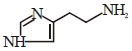
M.F. of Histamine is \(\mathrm{C}_{5} \mathrm{H}_{9} \mathrm{N}_{3}\)Molecular mass of Histamine is 111
Now, mass \(\%\) of nitrogen \(=\left(\frac{42}{111}\right) \times 100\)
\(=37.84 \%\)
-
- (A) \(22\)
- (B) \(19\)
- (C) \(17\)
- (D) \(14\)
જવાબ અને ઉકેલ જુઓ
સાચો જવાબ: (D)
\(100\, \mathrm{gm}\) soln \(\rightarrow 63 \,\mathrm{gm} \mathrm{HNO}_{3}\)\(\frac{100}{1.4} \mathrm{mL} \rightarrow 1\) mole \(\mathrm{HNO}_{3}\)
Molarity \(=\frac{1}{\frac{100}{1.4} \times \frac{1}{1000}}=14 \;\mathrm{M}\)
- 129. જ્યારે \(2.8\, kg\) ડાયનાઇટ્રોજનની માત્રા \(1\, kg\) ડાયહાઇડ્રોજન સાથે પ્રક્રિયા આપે છે ત્યારે ઉત્પન્ન થતું એમોનિયાનું દળ............ 2020 મધ્યમ
- (A) \(3400\)
- (B) \(3425\)
- (C) \(3390\)
- (D) \(3000\)
જવાબ અને ઉકેલ જુઓ
સાચો જવાબ: (A)
\(N _{2} \quad+\) \(3 H _{2} \rightarrow\) \(2 NH _{3}\) \(\frac{2.8}{28} K mol\) \(\frac{1}{2} K mol\) \(=0.1 K mol\) \(0.5 K mol\) \(-\) \(0\) \(0.2 K mol\) \(0.2 K mol\) mass \(\left( NH _{3}\right)=0.2 \times 17 Kg\)
\(=3.4 Kg\)
\(=3400 gm\)
-
- (A) \(4:1\)
- (B) \(1:1\)
- (C) \(2:1\)
- (D) \(3:1\)
જવાબ અને ઉકેલ જુઓ
સાચો જવાબ: (D)
\(\quad \quad{ }^{35} Cl \quad{ }^{37} Cl \quad\) Av. molarlet \(\quad x \quad: \quad 1 \quad\) mass \(=35.5\)
mole ratio
Av. molar mass \(=\frac{ n _{1} M _{1}+ n _{2} M _{2}}{\left( n _{1}+ n _{2}\right)}\)
\(35.5=\frac{x \times 35+1 \times 37}{x+1}\)
\(x=3\)
-
- (A) \(13\)
- (B) \(15\)
- (C) \(11\)
- (D) \(9\)
જવાબ અને ઉકેલ જુઓ
સાચો જવાબ: (A)
Total \(13\) atom are present in same plane (\(7\) carbon and \(6\) hydrogen atoms.)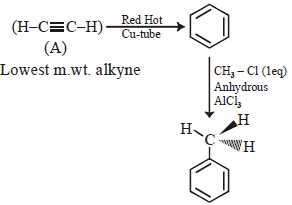
-
- (A) \(4-\)બ્રોમો\(-2-\)મિથાઇલસાયકલોપેન્ટેન કાર્બોક્સિલિક એસિડ
- (B) \(5-\)બ્રોમો\(-3-\) મિથાઇલસાયકલોપેન્ટેનોઇક એસિડ
- (C) \(3-\)બ્રોમો\(-5-\)મિથાઇલસાયકલોપેન્ટેન કાર્બોક્સિલિક એસિડ
- (D) \(3-\)બ્રોમો\(-5-\)મિથાઇલસાયકલોપેન્ટેનોઇક એસિડ
જવાબ અને ઉકેલ જુઓ
સાચો જવાબ: (A)
\(4-\)bromo\(-2-\)methyl cyclopentane carboxylic Acid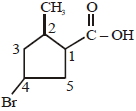
-
- (A) \(Cl-CH=CH-OCH_3\)
- (B) \(Cl-CH=CH-CH_3\)
- (C) \(Cl-CH=CH_2\)
- (D) \(Cl-CH=CH-NO_2\)
જવાબ અને ઉકેલ જુઓ
સાચો જવાબ: (D)
સ્પષ્ટીકરણ:
કાર્બનિક રસાયણવિજ્ઞાનમાં ઇલેક્ટ્રોનીય અસરોના સિદ્ધાંતોના આધારે આપેલા વિનાઇલ ક્લોરાઇડના વ્યુત્પન્નોની બંધલંબાઈનું સ્ટેપ-બાય-સ્ટેપ વિશ્લેષણ નીચે મુજબ છે:
1. વિનાઇલિક હેલાઇડ્સમાં સંસ્પંદન (Resonance):
આપેલા તમામ વિકલ્પોમાં, ક્લોરિન પરમાણુ સીધો જ કાર્બન-કાર્બન દ્વિ-બંધ (\(C=C\)) ધરાવતા \(sp^2\) સંકૃત કાર્બન પરમાણુ સાથે જોડાયેલો છે। ક્લોરિન પરમાણુ પર રહેલા અબંધકારક ઇલેક્ટ્રોન યુગ્મો (lone pairs) મેસોમેરિક અસર (સંસ્પંદન) દ્વારા નજીકના પાઇ-બંધ સાથે વિસ્થાનિકૃત થઈ શકે છે। આ સંસ્પંદનને કારણે \(C-Cl\) બંધમાં આંશિક દ્વિ-બંધની લાક્ષણિકતા (partial double bond character) ઉત્પન્ન થાય છે, જેના લીધે તે સામાન્ય એકલ બંધ કરતાં ટૂંકો અને મજબૂત બને છે।
2. વિસ્થાપિત સમૂહની અસર:
આ આંશિક દ્વિ-બંધ લાક્ષણિકતાનું પ્રમાણ આ પ્રણાલીના બીજા છેડે જોડાયેલા સમૂહની પ્રકૃતિ પર આધાર રાખે છે.
વિકલ્પ D માં અસર:
નાઇટ્રો સમૂહ (\(-NO_2\)) એ સંસ્પંદન (\(-M\)) અસર દ્વારા ખૂબ જ પ્રબળ ઇલેક્ટ્રોન આકર્ષક (electron-withdrawing) સમૂહ છે। તે દ્વિ-બંધમાંથી ઇલેક્ટ્રોન ઘનતાને પોતાની તરફ ખેંચે છે, જેને કારણે ક્લોરિનના ઇલેક્ટ્રોન યુગ્મનું સંસ્પંદન ખૂબ જ સરળ બને છે।
વિસ્થાનિકરણની અસર:
આ વ્યાપક વિસ્થાનિકરણને લીધે \(C=Cl^+\) દ્વિ-બંધ ધરાવતા સંસ્પંદન બંધારણનો ફાળો ઘણો વધી જાય છે।
3. સરખામણી:
નાઇટ્રો સમૂહની \(-M\) અસર \(C-Cl\) બંધમાં દ્વિ-બંધની લાક્ષણિકતા મહત્તમ કરે છે, જેના પરિણામે બંધલંબાઈ સૌથી વધુ ઘટે છે (સૌથી ટૂંકી બને છે). તેનાથી વિપરીત, \(-OCH_3\) (વિકલ્પ A) અને \(-CH_3\) (વિકલ્પ B) જેવા સમૂહો ઇલેક્ટ્રોન દાતા હોવાથી આ અસરનો વિરોધ કરે છે.
તેથી, \(Cl-CH=CH-NO_2\) માં \(C-Cl\) બંધલંબાઈ સૌથી ઓછી હોય છે.
આથી, સાચો ઉત્તર વિકલ્પ D છે.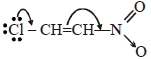
-
- (A) સાદૂ નિસ્યંદન, \(3-\)મિથાઇલ પેન્ટેન
- (B) સાદૂ નિસ્યંદન, આઇસો હેકઝેન
- (C) વિભાગીય નિસ્યંદન, આઇસોહેકઝેન
- (D) વિભાગીય નિસ્યંદન, \(3-\)મિથાઇલ પેન્ટેન
જવાબ અને ઉકેલ જુઓ
સાચો જવાબ: (C)
Liquid which have less difference in boiling point can be isolated by fractional distillation and liquid with less boiling point will be isolated first. -
- (A) વરાળ નિસ્યંદન
- (B) વિભેદી નિષ્કર્ષણ
- (C) ઘટાડો દબાણ હેઠળ નિસ્યંદન
- (D) વિભાગીય નિસ્યંદન
જવાબ અને ઉકેલ જુઓ
સાચો જવાબ: (C)
Glycerol is separated by reduced pressure distillation in soap industries. -
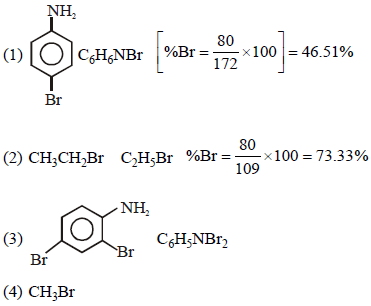
- (B) \(H _{3} C - CH _{2}- Br\)
- (D) \(H _{3} C - Br\)
જવાબ અને ઉકેલ જુઓ
સાચો જવાબ: (A)
In Carius methodmass of organic compound \(=0.172 gm\) mass of Bromine \(=0.08 gm\)
Hence \(\%\) of Bromine \(=\frac{0.08}{0.172} \times 100\)
\(=46.51 \%\)
-
- (A) \(50\)
- (B) \(55\)
- (C) \(45\)
- (D) \(40\)
જવાબ અને ઉકેલ જુઓ
સાચો જવાબ: (A)
Carius method\(\%\) of \(Br =\frac{\text { wt of } AgBr }{\text { wt. of organic compound }} \times 100 \times \frac{\text { molar mass of Br }}{\text { AgBr }}\)
\(=\frac{1.88}{1.6} \times \frac{80}{188} \times 100=\frac{15040}{300.8}=50 \%\)
- 138. નીચેની કઈ પ્રક્રિયા નિપજો માટે નાઇટ્રોજનના અનુમાપન ની જેલ્ડાહલ પદ્ધતિ નિષ્ફળ થાય છે?
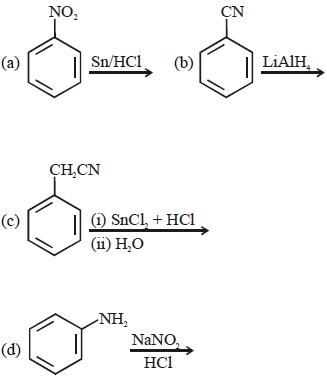 2020 મધ્યમ
- (A) \(a\) અને \(d\)
- (B) \(c\) અને \(d\)
- (C) \(a, c\) અને \(d\)
- (D) \(b\) અને \(c\)
જવાબ અને ઉકેલ જુઓ
સાચો જવાબ: (B)
Kjeldahl method is used for \(N\) estimation But not given by 'Diazo' compounds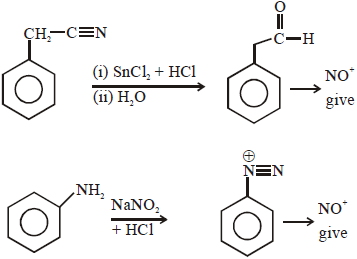
-
- (A) \((\mathrm{B}),(\mathrm{C})\) અને \((\mathrm{A})\)
- (B) \((\mathrm{C}),(\mathrm{A})\) અને \((\mathrm{B})\)
- (C) \((\mathrm{A}),(\mathrm{B})\) અને \((\mathrm{C})\)
- (D) \((\mathrm{B}),(\mathrm{A})\) અને \((\mathrm{C})\)
જવાબ અને ઉકેલ જુઓ
સાચો જવાબ: (B)
Benzanilide \(\rightarrow\) Ph-NH-CO-Ph \((\mu=2.71 \mathrm{D})\)Aniline \(\rightarrow \mathrm{Ph}-\mathrm{NH}_{2}\), \((\mu=1.59 \mathrm{D})\)
Acetophenone \(\rightarrow\) Ph-O-CH \(_{3}\) ( \(\mu=3.05 \mathrm{D}\) )
Dipole moment : \({C}>{A}>{B}\)
Hence the sequence of obtained compounds is \((\mathrm{C})\;,(\mathrm{A})\) and \((\mathrm{B})\)
-
- (A) \(N _{2} O _{5}\)
- (B) \(NO _{2}\)
- (C) \(N _{2} O\)
- (D) \(N _{2} O _{3}\)
જવાબ અને ઉકેલ જુઓ
સાચો જવાબ: (D)
\(2 NO + N _{2} O _{4} \stackrel{250 K }{\longrightarrow} 2 N _{2} O _{3}\)blue solid
- 141. કેંદ્રાનુરાગી યોગશીલ પ્રકિયામાં નીચેના સંયોજનની પ્રતિક્રિયાશીલતાનો વધતો ક્રમ કયો છે પ્રોપેનાલ , બેંઝાલ્ડીહાઈડ , પ્રોપેનોન , બ્યુટેનોન 2020 મધ્યમ
- (A) બ્યુટેનોન \(<\) પ્રોપેનોન \(<\) બેંઝાલ્ડીહાઈડ \(<\) પ્રોપેનાલ ,
- (B) બેંઝાલ્ડીહાઈડ \(<\) બ્યુટેનોન \(<\) પ્રોપેનોન \(<\) પ્રોપેનાલ
- (C) પ્રોપેનાલ\(<\) પ્રોપેનોન \(<\) બ્યુટેનોન \(<\) બેંઝાલ્ડીહાઈડ
- (D) બેંઝાલ્ડીહાઈડ \(<\) પ્રોપેનાલ \(<\) પ્રોપેનોન \(<\) બ્યુટેનોન
જવાબ અને ઉકેલ જુઓ
સાચો જવાબ: (A)
Reactivity order of various carbonyl compounds \(\rightarrow\) Aldehydes \(>\) Ketones
-
- (A) \(12\)
- (B) \(9\)
- (C) \(5\)
- (D) \(10\)
જવાબ અને ઉકેલ જુઓ
સાચો જવાબ: (C)
No. of chiral centres
-
- (A) \((iii)\) \( < ( iv ) < ( ii ) < ( i )\)
- (B) \((iii)\) \( < ( iv ) < ( i ) < ( ii )\)
- (C) \((iii)\) \( < (1) < (i v) < (i i)\)
- (D) \((i)\) \( < (\) iii) \( < ( iv ) < ( ii )\)
જવાબ અને ઉકેલ જુઓ
સાચો જવાબ: (C)
Increasing order of reactivity towards \(HCN\) addition Greater the electrophilicity on \(\begin{array}{*{20}{c}} O \\ {||} \\ { - C - } \end{array}\) group greater the reactivity in nucleophilic addition.\((iii)\) \(< (1) < ( iv ) < ( ii )\)

-
- (A) \(72.72\)
- (B) \(37.62\)
- (C) \(33.33\)
- (D) \(66.67\)
જવાબ અને ઉકેલ જુઓ
સાચો જવાબ: (D)
\(A\xrightarrow[(ii)\;H_3O^+]{(i)\;CH_3MgBr}B\xrightarrow[573\;K]{Cu}2-\)methyl \(2-\)butene\(\begin{array}{*{20}{c}}
{C{H_3} - C - C{H_2} - C{H_3}} \\
{||\,\,\,\,\,\,\,\,\,\,\,\,\,\,\,\,\,\,} \\
{O\,\,\,\,\,\,\,\,\,\,\,\,\,\,\,\,\,\,\,}
\end{array}\xrightarrow[{{H_3}{O^ + }}]{{C{H_3}MgBr}}\)\(\begin{array}{*{20}{c}}
{C{H_3}\,\,\,\,\,\,\,\,\,\,\,} \\
{|\,\,\,\,\,\,\,\,\,\,\,\,\,\,\,\,\,} \\
{C{H_3} - C - C{H_2} - C{H_3}} \\
{|\,\,\,\,\,\,\,\,\,\,\,\,\,\,\,\,\,} \\
{OH\,\,\,\,\,\,\,\,\,\,\,\,\,\,\,}
\end{array}\xrightarrow[{573\,K}]{{Cu}}\)\(\begin{array}{*{20}{c}}
{C{H_3}\,\,\,\,\,\,\,\,\,\,\,\,\,\,} \\
{|\,\,\,\,\,\,\,\,\,\,\,\,\,\,\,\,\,\,\,} \\
{C{H_3} - C = CH - C{H_3}}
\end{array}\)\(\mathrm{C} \Rightarrow 12 \times 4=48\)
\(\mathrm{H} \Rightarrow 8 \times 1=8\)
\(\mathrm{O} \Rightarrow 16 \times 1=16\)
Total \(= 72\)
\(\%\) of \(\mathrm{C}=\frac{48}{72} \times 100=66.66 \%\)
- 145. આ ઘટકો માં \(NO , NO ^{+}, NO ^{2+}, NO ^{-},\) લઘુત્તમ બંધની પ્રબળતા ધરાવતું એક કયું છે: 2020 અઘરું
- (A) \(NO ^{2+}\)
- (B) \(NO ^{+}\)
- (C) \(NO\)
- (D) \(NO ^{-}\)
જવાબ અને ઉકેલ જુઓ
સાચો જવાબ: (D)
Bond order of \(NO ^{2+}=2.5\)Bond order of \(NO ^{+}=3\)
Bond order of \(NO =2.5\)
Bond order of \(NO ^{-}=2\)
Bond order \(\alpha\) bond strength.
-
- (A) આયન-દ્વિધ્રુવીય > આયન-આયન > દ્વિધ્રુવીય-દ્વિધ્રુવીય
- (B) દ્વિધ્રુવીય-દ્વિધ્રુવીય > આયન-દ્વિધ્રુવીય > આયન-આયન
- (C) આયન-દ્વિધ્રુવીય > દ્વિધ્રુવીય-દ્વિધ્રુવીય > આયન-આયન
- (D) આયન-આયન > આયન-દ્વિધ્રુવીય > દ્વિધ્રુવીય-દ્વિધ્રુવીય
જવાબ અને ઉકેલ જુઓ
સાચો જવાબ: (D)
Interionic\(/\) Intermolecular forces \(\propto\) charge on the speciesIons are charged species whereas dipoles are partially charged.
\(\therefore\) Ion-Ion \(\,>\,\) Ion-dipole \(\,>\,\) dipole-dipole
Hence, option \(d\) is correct.
-
- (A) હાઈડ્રોજન બંધન અને લંડન વિક્ષેપન
- (B) દ્વિધ્રુવીય-દ્વિધ્રુવીય અને હાઈડ્રોજન બંધન
- (C) લંડન વિક્ષેપન અને દ્વિધ્રુવીય-દ્વિધ્રુવીય
- (D) લંડન વિક્ષેપન , દ્વિધ્રુવીય-દ્વિધ્રુવીય અને હાઈડ્રોજન બંધન
જવાબ અને ઉકેલ જુઓ
સાચો જવાબ: (C)
Ethyl acetate is polar molecule. Hence there will be dipole-dipole
attraction and london dispersion forces are present. -
- (A) સમચોરસ પિરામિડલ
- (B) ચતુષ્ફલકીય
- (C) સમચોરસ સમતલીય
- (D) લંબચોરસ સમતલીય
જવાબ અને ઉકેલ જુઓ
સાચો જવાબ: (A)
\((1)\) If \(AB _{4}\) molecule is a square pyramidal then it has one lone pair and their structure should be and it should be polar because dipole moment of lone pair of \('A'\) never be cancelled by others.\((2)\) If \(AB _{4}\) molecule is a tetrahedral then it has no lone pair and their structure should be and it should be non polar due to perfect symmetry.
\((3)\) If \(AB _{4}\), molecule is a square planar then it should be non polar because vector sum of dipole moment is zero.
\((4)\) If \(AB _{4}\) molecule is a rectangular planar then it should be non polar because vector sum of dipole moment is zero.
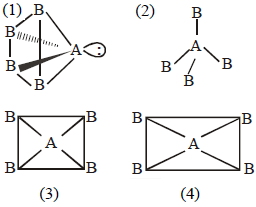
-
- (A) \(\mathrm{O}_{2}^{-}\) અથવા \(\mathrm{O}_{2}^{+}\)
- (B) \(\mathrm{O}_{2}\) અથવા \(\mathrm{O}_{2}^{+}\)
- (C) \(\mathrm{O}_{2}\) અથવા \(\mathrm{O}_{2}^{-}\)
- (D) \(\mathrm{O}_{2}, \mathrm{O}_{2}^{-}\) અથવા \(\mathrm{O}_{2}^{+}\)
જવાબ અને ઉકેલ જુઓ
સાચો જવાબ: (A)
\(\begin{array}{|c|c|c|} \hline & \text { unpaired electron } & \text { magnetic moment } \\ \hline O _{2}^{\oplus} & 1 & 1.73 B . M \\ \hline O _{2}^{\ominus} & 1 & 1.73 B . M \\ \hline O _{2} & 2 & 2.83 B.M \\ \hline \end{array}\) -
- (A) \(\underline{N}{H }_{3} \stackrel{ H ^{+}}{\longrightarrow}\)
- (B) \(\underline {Xe}F _{4}+ SbF _{5} \rightarrow\)
- (C) \(H _{2} \underline SO _{4}+ NaCl \xrightarrow{{420\,\,K}}\)
- (D) \(H _{3} \underline PO _{2} \xrightarrow{{ Disproportionation }}\)
જવાબ અને ઉકેલ જુઓ
સાચો જવાબ: (B)
\(XeF _{4}+ SbF _{5} \rightarrow\left[ XeF _{3}\right]^{+}\left[ SbF _{6}\right]^{-}\)\(sp ^{3} d ^{2}\,\,\,\,\, sp ^{3} d\,\,\, \quad sp ^{3} d\,\,\,\,\, \quad sp ^{3} d ^{2}\)


આ પેજ પર આ ફિલ્ટર મુજબ કોઈ પ્રશ્ન નથી.