


Chapters asked in 2020
25 chapters- 6Qs STD 11 Organic chemistry purification and characterization
- 8Qs STD 12 D and f- block elements
- 6Qs STD 11 Redox reactions
- 7Qs STD 12 Biomolecules
- 8Qs STD 11 Equilibrium - II (icon Equilibrium)
- 13Qs STD 12 Chemical kinetics
- 3Qs STD 11 Organic chemistry reaction mechanism
- 2Qs STD 12 Amines
- 3Qs STD 12 Carboxylic acids and their derivative
- 5Qs STD 12 Aldehydes and ketones
- 3Qs STD 12 Alcohol, phenol and ethers
- 4Qs STD 12 Haloalkanes and Haloarenes
- 27Qs STD 12 Co-ordination chemistry Most asked
- 11Qs STD 12 P -Block elements - ll
- 14Qs STD 12 Electrochemistry Most asked
- 16Qs STD 12 Solution and colligative properties Most asked
- 11Qs STD 11 Some basic concept of chemistry
- 1Qs STD 11 Hydricarbon
- 3Qs STD 11 Organic chemistry Nomenclature of organic compounds
- 9Qs STD 11 Chemical bonding and molecular structure
- 13Qs STD 11 Classification of elements and periodicity in properties
- 6Qs STD 11 Equilibrium - 1 (chemical Equilibrium)
- 14Qs STD 11 Thermodynamics and thermochemistry
- 2Qs STD 11 P-Block elements - I
- 9Qs STD 11 Structure of atom
All JEE Mains 2020 Chemistry questions
25 chaptersShowing 1–50 of 204 questions
-
- (A) \((\mathrm{B}),(\mathrm{C})\) and \((\mathrm{A})\)
- (B) \((\mathrm{C}),(\mathrm{A})\) and \((\mathrm{B})\)
- (C) \((\mathrm{A}),(\mathrm{B})\) and \((\mathrm{C})\)
- (D) \((\mathrm{B}),(\mathrm{A})\) and \((\mathrm{C})\)
Show answer and solution
Correct Answer: (B)
Benzanilide \(\rightarrow\) Ph-NH-CO-Ph \((\mu=2.71 \mathrm{D})\)Aniline \(\rightarrow \mathrm{Ph}-\mathrm{NH}_{2}\), \((\mu=1.59 \mathrm{D})\)
Acetophenone \(\rightarrow\) Ph-O-CH \(_{3}\) ( \(\mu=3.05 \mathrm{D}\) )
Dipole moment : \({C}>{A}>{B}\)
Hence the sequence of obtained compounds is \((\mathrm{C})\;,(\mathrm{A})\) and \((\mathrm{B})\)
-
- (A) simple distillation, \(3-\)methylpentane
- (B) simple distillation, isohexane
- (C) fractional distillation, isohexane
- (D) fractional distillation, \(3-\)methylpentane
Show answer and solution
Correct Answer: (C)
Liquid which have less difference in boiling point can be isolated by fractional distillation and liquid with less boiling point will be isolated first. -
- (A) Steam distillation
- (B) Differential extraction
- (C) Distillation under reduced pressure
- (D) Fractional distillation
Show answer and solution
Correct Answer: (C)
Glycerol is separated by reduced pressure distillation in soap industries. -
- (A) \(50\)
- (B) \(55\)
- (C) \(45\)
- (D) \(40\)
Show answer and solution
Correct Answer: (A)
Carius method\(\%\) of \(Br =\frac{\text { wt of } AgBr }{\text { wt. of organic compound }} \times 100 \times \frac{\text { molar mass of Br }}{\text { AgBr }}\)
\(=\frac{1.88}{1.6} \times \frac{80}{188} \times 100=\frac{15040}{300.8}=50 \%\)
-
- (B) \(H _{3} C - CH _{2}- Br\)
- (D) \(H _{3} C - Br\)
Show answer and solution
Correct Answer: (A)
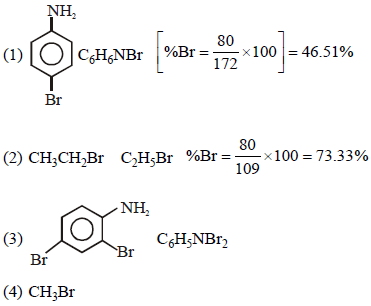
In Carius methodmass of organic compound \(=0.172 gm\) mass of Bromine \(=0.08 gm\)
Hence \(\%\) of Bromine \(=\frac{0.08}{0.172} \times 100\)
\(=46.51 \%\)
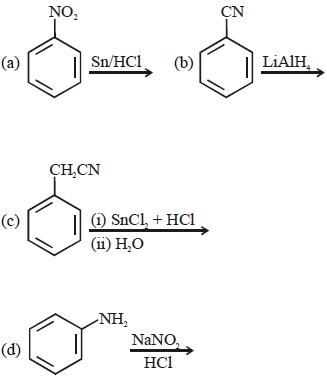
- 6. The Kjeldahl method of Nitrogen estimation fails for which of the following reaction products \(?\)
 2020 Medium
- (A) \(a\) and \(d\)
- (B) \(c\) and \(d\)
- (C) \(a, c\) and \(d\)
- (D) \(b\) and \(c\)
Show answer and solution
Correct Answer: (B)
Kjeldahl method is used for \(N\) estimation But not given by 'Diazo' compounds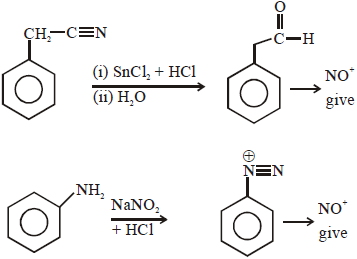
-
- (A) lanthanoid metals
- (B) actinoid metals
- (C) actinoid and transition metals
- (D) lanthanoid and actinoid metals
Show answer and solution
Correct Answer: (A)
Alloys of lanthanides with Fe are called Misch metal, which consists of a lanthanoid metal \((\sim 95 \%)\) and iron \((\sim 5 \%)\) and traces of \(S , C , Ca\) and \(Al\). -
- (A) \(Cu\)
- (B) \(Hg\)
- (C) \(Au\)
- (D) \(Ni\)
Show answer and solution
Correct Answer: (C)
Atomic radius of \(Ag\) and \(Au\) is nearly same due to lanthanide contraction. - 9. The correct electronic configuration and spin only magnetic moment (BM) of \(Gd ^{3+}( Z =64)\), respectively, are 2020 Medium
- (A) \([ Xe ] 5 f ^{7}\) and \(8.9\)
- (B) \([ Xe ] 4 f ^{7}\) and \(7.9\)
- (C) \([ Xe ] 5 f ^{7}\) and \(7.9\)
- (D) \([ X e ] 4 f ^{7}\) and \(8.9\)
Show answer and solution
Correct Answer: (B)
Electronic configuration of \(Gd ^{3+}\) is\(64 Gd ^{3+}=[ Xe ] 4 f ^{7}\)
\(Gd ^{3+}\) having \(7\) unpaired electrons.
Magnetic moment \((\mu)=\sqrt{n(n+2)}\) \(B.M.\)
\(\mu=\sqrt{7(7+2)} B \cdot M\)
\(=7.9 B . M\)
\(n \Rightarrow\) Number of unpaired electrons.

-
- (A) \([\mathrm{Xe}] 4 \mathrm{f}^{4}\) and \([\mathrm{Xe}] 4 \mathrm{f}^{9}\)
- (B) \([\mathrm{Xe}] 4 \mathrm{f}^{7}\) and \([\mathrm{Xe}] 4 \mathrm{f}^{1}\)
- (C) \([\mathrm{Xe}] 4 \mathrm{f}^{7} 6 \mathrm{s}^{2}\) and \([\mathrm{Xe}] 4 \mathrm{f}^{2} 6 \mathrm{s}^{2}\)
- (D) \([\mathrm{Xe}] 4 \mathrm{f}^{2}\) and \([\mathrm{Xe}] 4 \mathrm{f}^{7}\)
Show answer and solution
Correct Answer: (B)
\(\mathrm{Eu}_{63} \Rightarrow[\mathrm{Xe}] 4 \mathrm{f}^{7} 5 \mathrm{d}^{\circ} 6 \mathrm{s}^{2}\)\(\mathrm{Eu}^{2+} \Rightarrow[\mathrm{Xe}] 4 \mathrm{f}^{7}\)
\(\mathrm{Ce}_{58} \Rightarrow[\mathrm{Xe}] 4 \mathrm{f}^{1} 5 \mathrm{d}^{1} 6 \mathrm{s}^{2}\)
\(\mathrm{Ce}^{3+} \Rightarrow[\mathrm{Xe}] 4 \mathrm{f}^{1}\)
-
- (A) Group \(11\) and Group \(4\)
- (B) Actinoids and Group \(4\)
- (C) Actinoids and Group \(6\)
- (D) Group \(6\) and Actinoids
Show answer and solution
Correct Answer: (B)
Element with atomic no. \(101\) is an Actinoid element. -
- (A) In manganate and permanganate ions, the \(\pi\) \(-\)bonding takes place by overlap of \(p-\)orbitals of oxygen and \(d-\)orbitals of manganese
- (B) Manganate ion is green in colour and permanganate ion in purple in colour
- (C) Manganate and permanganate ions are paramagnetic
- (D) Manganate and permanganate ions are tetrahedral
Show answer and solution
Correct Answer: (C)
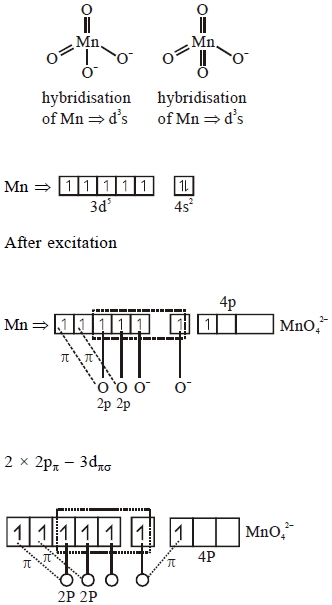
Option \(1)\) Manganate \(\Rightarrow MnO _{4}^{2-}\)Permanganate \(\Rightarrow MnO _{4}^{-}\)
\(2 \times 2 P _{\pi}-3 d _{\pi}\)
\(1 \times 2 P _{\pi}-4 P _{\pi}\)
\((2)\) \(MnO _{4}^{2-} \Rightarrow\) green
\(MnO _{\stackrel -4} \Rightarrow\) purple/violet
\((3)\) Manganate contains \(1\) unpaired electron hence it is paramagnetic
where as permanganetic contains no unpaired electrons hence it is diamagnetic.
\((4)\) Both have d's hybridisation hence both have tetrahedral geometry.
-
- (A) Dy
- (B) Eu
- (C) Ce
- (D) Tb
Show answer and solution
Correct Answer: (B)
Fact -
- (A) \(21,32,53,64\)
- (B) \(21,25,42,72\)
- (C) \(9,17,34,38\)
- (D) \(37,42,50,64\)
Show answer and solution
Correct Answer: (B)
Tranition elements \(=21\) to \(30\)\(37\) to \(48\)
\(57\) \(\&\) \(72\) to \(80\)
Ans. \(21,25,42\, \& 72\)
-
- (A) \(14\)
- (B) \(16\)
- (C) \(18\)
- (D) \(20\)
Show answer and solution
Correct Answer: (C)
\(4 \mathrm{NaCl}+\mathrm{K}_{2} \mathrm{Cr}_{2} \mathrm{O}_{7}+6 \mathrm{H}_{2} \mathrm{SO}_{4}\)\(\quad \quad \quad \quad \quad \downarrow\)
\(2 \mathrm{CrO}_{2} \mathrm{Cl}_{2}+4 \mathrm{NaHSO}_{4}+2 \mathrm{KHSO}_{4}+3 \mathrm{H}_{2} \mathrm{O}\)
\((\mathrm{A})\)
\(\mathrm{CrO}_{2} \mathrm{Cl}_{2}+4 \mathrm{NaOH} \longrightarrow \mathrm{Na}_{2} \mathrm{CrO}_{4}+2 \mathrm{NaCl}+2 \mathrm{H}_{2} \mathrm{O}\)
\(\quad \quad \quad \quad \quad \quad \quad \quad \quad \quad \quad (B)\)
\(\mathrm{Na}_{2} \mathrm{CrO}_{4}+2 \mathrm{H}_{2} \mathrm{SO}_{4}+2 \mathrm{H}_{2} \mathrm{O}_{2}\)
\(\mathrm{CrO}_{5}+2 \mathrm{NaHSO}_{4}+3 \mathrm{H}_{2} \mathrm{O}\)
\((\mathrm{C})\)
\(A=C r O_{2} C l_{2}\)
\({B}=\mathrm{Na}_{2} \mathrm{CrO}_{4}\)
\({C}={C r O}_{5}\)
Total number of atom in \(\mathrm{A}+\mathrm{B}+\mathrm{C}=18\)
-
- (A) \(0\)
- (B) \(5\)
- (C) \(2\)
- (D) \(19\)
Show answer and solution
Correct Answer: (D)
\(\left[ Fe ^{2+} \rightarrow Fe ^{3+}+ e ^{-}\right] \times 2\)\(\frac{ H _{2} O _{2}+2 e ^{-} \rightarrow 2 HO ^{\ominus}}{2 Fe ^{2+}+ H _{2} O _{2} \rightarrow 2 Fe ^{3+}+2 HO _{(q\omega)}^{\ominus}}\)
\(x =2 \quad y =2\)
\(\left[8 H ^{+}+ MnO _{4}^{-}+5 e ^{-} \rightarrow Mn ^{2+}+4 H _{2} O \right] \times 2\)
\(\left[ H _{2} O _{2} \rightarrow O _{2( g )}+2 H ^{+}+2 e ^{-}\right] \times 5\)
\(\Rightarrow 16 H ^{+}+2 MnO _{4}^{-}+5 H _{2} O _{2}\)
\(\rightarrow 2 Mn ^{2+}+8 H _{2} O +5 O _{2(g)}+10 H ^{+}\)
\(\Rightarrow 6 H ^{+}+2 MnO _{4}^{-}+5 H _{2} O _{2}\)
\(\rightarrow 2 Mn ^{2+}+8 H _{2} O +5 O _{2( g )}\)
So \(\quad x^{\prime}=2 \quad y^{\prime}=8 \quad z^{\prime}=5\)
so \(\quad x+y+x^{\prime}+y^{\prime}+z^{\prime}\)
\(\Rightarrow 2+2+2+8+5\)
\(\Rightarrow 19\)
-
- (A) \(12\)
- (B) \(25\)
- (C) \(19\)
- (D) \(22\)
Show answer and solution
Correct Answer: (C)
\(K _{2} Cr _{2} O _{7}\)\(2(+1)+2 x+7(-2)=0\)
\(x=+6\)
In \(K _{2} Cr _{2} O _{7},\) Transition metal \(( Cr )\) present in +6
oxidation state.
\(KMnO _{4}\)
\((+1)+y+4(-2)=0\)
\(x=+7\)
In \(KMnO _{4}\), transition metal (Mn) present in \(+7\) oxidation state
\(K _{2} FeO _{4}\)
\(2(+1)+z+4(-2)=0\)
\(x=+6\)
In \(K _{2} FeO _{4},\) transition metal (Fe) present in \(+6\) oxidation state
So \(x=+6\)
\(y=+7\)
\(z=+6\)
____________
\(x+y+z=19\)
-
- (A) Combination of dinitrogen with dioxygen at \(2000 \;K\)
- (B) Formation of ozone from atmosphereic oxygen in the presence of sunlight
- (C) Reaction of \(\mathrm{H}_{2} \mathrm{SO}_{4}\) with \(\mathrm{NaOH}\)
- (D) Reaction of \(\left[\mathrm{Co}\left(\mathrm{H}_{2} \mathrm{O}\right)_{6}\right] \mathrm{Cl}_{3}\) with \(\mathrm{AgNO}_{3}\)
Show answer and solution
Correct Answer: (A)
\(\mathrm{N}_{2}+\mathrm{O}_{2} \stackrel{2000 \mathrm{K}}{\longrightarrow} 2 \mathrm{NO} \quad\) (Redox reaction)during the reaction, oxidation of nitrogen take place from \(0\) to \(2\) and reduction of oxygen take place from \(0\) to \(-2 .\) It means this reaction is redox reaction.
\(3 \mathrm{O}_{2} \stackrel{\mathrm{hv}}{\longrightarrow} 2 \mathrm{O}_{3} \quad\) (Non - redox reaction)
\(\mathrm{H}_{2} \mathrm{SO}_{4}+2 \mathrm{NaOH} \rightarrow \mathrm{Na}_{2} \mathrm{SO}_{4}+2 \mathrm{H}_{2} \mathrm{O}\) (neutralization reaction)
\(\left[\mathrm{Co}\left(\mathrm{H}_{2} \mathrm{O}\right)_{6}\right] \mathrm{Cl}_{3}+3 \mathrm{AgNO}_{3}\)
\(\rightarrow 3 \mathrm{AgCl} \downarrow+\left[\mathrm{Co}\left(\mathrm{H}_{2} \mathrm{O}\right)_{6}\right]\left(\mathrm{NO}_{3}\right)_{3}\)
(White ppt.)
- 19. The sum of the total number of bonds between chromium and oxygen atoms in chromate and dichromate ions is 2020 Hard
- (A) \(12\)
- (B) \(13\)
- (C) \(14\)
- (D) \(15\)
Show answer and solution
Correct Answer: (A)
Total number of bonds between chromium and oxygen in both structures are \(18\)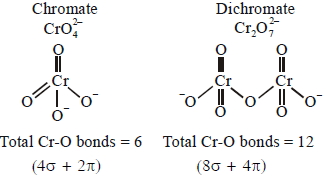
-
- (A) \(55\)
- (B) \(52\)
- (C) \(60\)
- (D) \(50\)
Show answer and solution
Correct Answer: (D)
\(K _{2} Cr _{2} O _{7}+ FeC _{2} O _{4} \longrightarrow Cr ^{+3}+ Fe ^{+3}+ CO _{2}\)\(n=6 \quad \quad n=3\)
\(\frac{0.02 \times 6 \times V ( mL )}{1000}=\frac{0.288}{144} \times 3\)
\(\Rightarrow \quad V =50 mL\)
-
- (A) \(A =\) Glucose, \(B =\) Fructose, \(C =\) Albumin
- (B) \(A =\) Lactose, \(B =\) Fructose, \(C =\) Alanine
- (C) \(A =\) Lactose, \(B =\) Glucose, \(C =\) Alanine
- (D) \(A =\) Lactose, \(B =\) Glucose, \(C =\) Albumin
Show answer and solution
Correct Answer: (D)
Alanine does not show Biuret test because Biuret test is used for deduction of peptide linkage & alanine is amino acid.Albumine is protein so have paptide linkage so it gives positive Biuret test.
Positive Barfoed test is shown by monosaccharide but not disaccharide. Positive Molisch's test is shown by glucose.
-
- (A) \(A \): Aspartame ; \(B \): Saccharin ; \(C \): Sucralose ;\( D \); Alitame
- (B) \(A\) : Alitame ; \(B \): Saccharin ; \(C\) : Aspartame ; \(D\) ; Sucralose
- (C) \(A\) : Saccharin ; \(B\) : Alitame ; \(C\) : Sucralose ; \(D\) ; Aspartame
- (D) \(A\) : Aspartame ; \(B\) : Alitame ; \(C\) : Saccharin ;\( D\) ; Sucralose
Show answer and solution
Correct Answer: (A)
(i) Blue voilet color with Ninhydrine \(\rightarrow\) amino acid derivative. So it cannot be saccharide or sucralose.(ii) Lassaigne extract give + ve test with \(\mathrm{AgNO}_{3} .\) So \(\mathrm{Cl}\) is present, -ve test with \(\mathrm{Fe}_{4}\left[\mathrm{Fe}(\mathrm{CN})_{6}\right]_{3}\) means \(\mathrm{N}\) is absent. So it can't be Aspartame or Saccharine or Alitame, so \(\mathrm{C}\) is sucralose.
(iii) Lassaigne solution of \(B\) and \(D\) given \(+ve\) sodium nitroprusside test, so it is having \(S\), so it is Saccharine and Alitame.

-
- (A) \(5,6, \& 5\)
- (B) \(4,5 \& 5\)
- (C) \(5,4 \& 5\)
- (D) \(4,6 \& 5\)
Show answer and solution
Correct Answer: (D)
\((i)\) Glucose \(+\) dry \(HCl\) \(\xrightarrow{{ROH}}\) Acetal \(\xrightarrow[{{{\left( {C{H_3}CO} \right)}_2}O}]{{x\,\,Eq}}\) acetyl derivative\((ii)\) Glucose \(\xrightarrow{{Ni/{H_2}}}A\xrightarrow[{{{\left( {C{H_3}CO} \right)}_2}O}]{{y\,Eq}}\) Acetyl derivative
\((iii)\) Glucose \(\xrightarrow[{{{\left( {C{H_3}CO} \right)}_2}O}]{{z\,Eq}}\) Acetyl derivative due to presence of \(- OH\) group in Glucose the reaction is
\((ii)\)\(\begin{array}{*{20}{c}} {CH = O\,\,\,\,\,\,\,\,\,\,\,\,\,} \\ {|\,\,\,\,\,\,\,\,\,\,\,\,\,\,\,\,\,\,\,\,\,\,\,\,\,\,\,\,\,\,\,\,\,} \\ {{{\left( {CH - OH} \right)}_4}} \\ {|\,\,\,\,\,\,\,\,\,\,\,\,\,\,\,\,\,\,\,\,\,\,\,\,\,\,\,\,\,\,} \\ {C{H_2} - OH\,\,\,\,\,\,} \end{array}\)\(\xrightarrow[{{H_2}}]{{Ni}}\begin{array}{*{20}{c}} {C{H_2} - OH\,\,\,\,\,\,\,\,\,\,} \\ {|\,\,\,\,\,\,\,\,\,\,\,\,\,\,\,\,\,\,\,\,\,\,\,\,\,\,\,\,\,\,\,\,\,\,\,\,\,\,} \\ {{{\left( {CH - OH} \right)}_4}\,\xrightarrow[{A{c_2}O}]{{6\,Eq.}}} \\ {|\,\,\,\,\,\,\,\,\,\,\,\,\,\,\,\,\,\,\,\,\,\,\,\,\,\,\,\,\,\,\,\,\,\,\,\,\,\,\,\,} \\ {C{H_2} - OH\,\,\,\,\,\,\,\,\,\,\,\,\,} \end{array}\)
\(\begin{array}{*{20}{c}} {C{H_2} - OAc\,\,\,\,\,\,\,} \\ {|\,\,\,\,\,\,\,\,\,\,\,\,\,\,\,\,\,\,\,\,\,\,\,\,\,\,\,\,\,\,\,\,\,\,} \\ {\left( {C{H_2} - OAc} \right)} \\ {|\,\,\,\,\,\,\,\,\,\,\,\,\,\,\,\,\,\,\,\,\,\,\,\,\,\,\,\,\,\,\,\,\,} \\ {C{H_2} - OAc\,\,\,\,\,\,} \end{array}\)

-
- (A) Formation of blue colour
- (B) Formation of violet colour
- (C) Formation of red colour
- (D) Gives no colour
Show answer and solution
Correct Answer: (C)
Seliwanoff's test is used to distinguish between aldose and ketone sugars; when added to a solution containing ketose, red colour is formed rapidlySucrose.\(\xrightarrow{{{\text{Hydrolysis}}}}\)\(\begin{array}{*{20}{c}} {{\text{Glucose}}} \\ + \\ {{\text{Fructose}}} \end{array}\)\(\xrightarrow[{{\text{reagent}}}]{{{\text{Seliwanoff's}}}}\,\)Red colour
-
- (A) \(\alpha-D-\) glucose and \(\beta-\mathrm{D}-\) glucose
- (B) \(\alpha-D-\) glucose and \(\alpha -D-\)Fructose
- (C) \(\alpha-D-\) glucose and \(\alpha -D-\)glucose
- (D) \(\alpha-D-\) glucose and \(\alpha -D-\)galactose
Show answer and solution
Correct Answer: (C)
Two monomers in maltose are \(\alpha\) -D-glucose and \(\alpha\) -D-glucose -
- (A) Valine
- (B) Leucine
- (C) Lysine
- (D) Tyrosine
Show answer and solution
Correct Answer: (D)
Tyrosine is not an essential amino acid. -
- (A) The pentaacetate of glucose does not react with hydroxylamine to give oxime
- (B) Glucose gives Schiff's test for aldehyde
- (C) Glucose exists in two crystalline forms \(\alpha\) and \(\beta\)
- (D) Glucose reacts with hydroxylamine to form oxime
Show answer and solution
Correct Answer: (B)
Glucose gives negative test with Schiff reagent -
- (A) \(7.2\)
- (B) \(6.43\)
- (C) \(3.22\)
- (D) \(5.23\)
Show answer and solution
Correct Answer: (D)
Sol. 3 gm Acetic Acid \(+250 \mathrm{ml}\; 0.1 \mathrm{M} \;\mathrm{HCl}+\) Water\(\longrightarrow\) made to 500 ml solution.
\(\Rightarrow 500 \mathrm{ml}\) solution has \(25 \mathrm{meq}\) of \(\mathrm{HCl}\)
\(50 \mathrm{meq}\) of \(\mathrm{CH}_{3} \mathrm{COOH}\)
\(\therefore 20 \mathrm{ml}\) solution has \(1 meq.\) of \(\mathrm{HCl}\) \(2 \mathrm{meq}\) of \(\mathrm{CH}_{3} \mathrm{COOH}\)
We have added 2.5 meq. of \(\mathrm{NaOH}\left(5 \mathrm{M}, \frac{1}{2} \mathrm{ml}\right)\)
Finally, \(NaOH \;and\; HCl\) are completely consumed and we are left with 0.5 meq of \(\mathrm{CH}_{3} \mathrm{COOH}\) and 1.5 meq of \(\mathrm{CH}_{3} \mathrm{COONa}\)
\(\mathrm{pH}=\mathrm{pKa}+\log \frac{1.5}{0.5}\)
\(=4.75+ \log 3=4.75+0.4771\)
\(=5.2271\)
-
- (A) \((B)>(C)>(D)>(A)\)
- (B) \(( A )>( C )>( D )>( B )\)
- (C) \((B)>(D)>(C)>(A)\)
- (D) \(( A )>( D )>( C )>( B )\)
Show answer and solution
Correct Answer: (D)
\((i)\) \(10^{-2} M HCl \Rightarrow\left[ H ^{+}\right]=10^{-2} M \rightarrow pH =2\)\((ii)\) \(10^{-2} M NaOH \Rightarrow\left[ OH ^{-}\right]=10^{-2} M \rightarrow PoH =2\)
\((iii)\) \(10^{-2} M CH _{3} COO ^{- Na ^{+}} \Rightarrow\left[ OH ^{+}\right]>10^{-7} \Rightarrow poH <7\)
\((iv)\) \(10^{-2} M NaCl \Rightarrow\) Neutral pot \(=7\)
\((i)>(i v)>(i i i)>(i i)\)
-
- (A) Both assertion and reason are true, but the reason is not the correct explanation for the assertion.
- (B) Both assertion and reason are false.
- (C) Assertion is not true, but reason is true.
- (D) Both assertion and reason are true, and the reason is the correct explanation for the assertion.
Show answer and solution
Correct Answer: (B)
\(\mathrm{H}_{2} \mathrm{O}(\ell) \rightleftharpoons \mathrm{H}_{(\mathrm{aq})}^{+}+\mathrm{OH}_{(\mathrm{aq})}^{-}\)For ionization of \(\mathrm{H}_{2} \mathrm{O}: \Delta \mathrm{H}>\mathrm{O}\) \(\Rightarrow\) Endothermic
On temperature increase reaction shifts forward
\(\Rightarrow\) both \(\left[\mathrm{H}^{+}\right]\) and \(\left[\mathrm{OH}^{-}\right]\) increase
\(\Rightarrow \mathrm{pH} \;and\; \mathrm{pOH}\) decreases.
-
- (A) Both \(( A )\) and \(( R )\) are true and \(( R )\) is the explanation for \((A)\)
- (B) Both \((A)\) and \((R)\) are false
- (C) \((A)\) is false and \(( R )\) is true
- (D) Both \(( A )\) and \(( R )\) are true but \(( R )\) is not the explanation for \((A)\)
Show answer and solution
Correct Answer: (D)
Slow or fast process is kinetic parameter but extent less or more is hermodynamic parameter. -
- (A) \(8\)
- (B) \(4\)
- (C) \(2\)
- (D) \(10\)
Show answer and solution
Correct Answer: (C)
\(\begin{array}{*{20}{c}} {A{B_2}\left( S \right) \rightleftharpoons A_{\left( {aq.} \right)}^{ + 2} + 2B_{\left( {aq.} \right)}^ - \,:\,{K_{sp}}} \\ {\,\,\,\,\,\,\,\,\,\,S\,\,\,\,\,\,\,\,\,\,\,\,2s} \end{array}\)\(K _{ SP }= S ^{1} \times(2 s )^{2}=4 s ^{3}\)
\(3.2 \times 10^{-11}=4 \times S ^{3}\)
\(S =2 \times 10^{-4} M / L\)
-
- (A) \(\left(18 \times 10^{-31}\right)^{1 / 4}\)
- (B) \(\left(2.22 \times 10^{-31}\right)^{1 / 4}\)
- (C) \(\left(4.86 \times 10^{-29}\right)^{1 / 4}\)
- (D) \(\left(18 \times 10^{-31}\right)^{1 / 2}\)
Show answer and solution
Correct Answer: (A)
\(\mathrm{Cr}(\mathrm{OH})_{3}(\mathrm{s}) \rightleftharpoons \mathrm{Cr}^{3+}(\mathrm{aq} .)+3 \mathrm{OH}^{-}(\mathrm{aq} .)\)\(\mathrm{k}_{\mathrm{sp}}=27(\mathrm{s})^{4}=6 \times 10^{-31}\)
\(\Rightarrow[3(\mathrm{s})]^{4}=18 \times 10^{-31}\)
\(\left[\mathrm{OH}^{-}\right]=3(\mathrm{s})=\left[18 \times 10^{-31}\right]^{1 / 4}\)
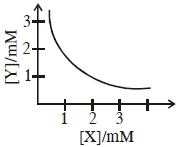
- 34. The stoichiometry and solubility product of a salt with the solubility curve given below is, respectively
 2020 Hard
- (A) \(\mathrm{X}_{2} \mathrm{Y}, 2 \times 10^{-9} \;\mathrm{M}^{3}\)
- (B) \(\mathrm{XY}_{2}, 1 \times 10^{-9} \;\mathrm{M}^{3}\)
- (C) \(\mathrm{XY}_{2}, 4 \times 10^{-9}\; \mathrm{M}^{3}\)
- (D) \(\mathrm{XY}, 2 \times 10^{-6} \;\mathrm{M}^{3}\)
Show answer and solution
Correct Answer: (C)
From the graph and dimensions salt is : \(\mathrm{XY}_{2}\)\([\mathrm{X}]=1 \times 10^{-3} \mathrm{M}\)
\([\mathrm{Y}]=2 \times 10^{-3} \mathrm{M}\)
\(\mathrm{XY}_{2}(\mathrm{s}) \rightleftharpoons \mathrm{X}_{(\mathrm{aq}, )}^{2+}+2 \mathrm{Y}_{(\mathrm{aq})}^{-}\)
\(\mathrm{K_{sp}}=\left[\mathrm{X}^{2+}\right][\mathrm{Y}^-]^{2}\)
\(=\left(10^{-3}\right)\left(2 \times 10^{-3}\right)^{2}\)
\(=4 \times 10^{-9} \mathrm{M}^{3}\)
-
- (A) \(7.3\)
- (B) \(8.7\)
- (C) \(9.6\)
- (D) \(10.6\)
Show answer and solution
Correct Answer: (D)
\(4 \mathrm{gm}\) of \(\mathrm{NaOH}\) in \(100 \mathrm{L}\) sol. \(\Rightarrow 10^{-3} \mathrm{M}\) sol.\(9.8 \mathrm{gm}\) of \(\mathrm{H}_{2} \mathrm{SO}_{4}\) in \(100 \mathrm{L}\) sol. \(\Rightarrow 10^{-3} \mathrm{M}\) sol.
Mixture : \(40 L\) of \(10^{-3} \mathrm{M} \mathrm{NaOH}\) and \(10 \mathrm{L}\) of
\(10^{-3} \mathrm{M} \mathrm{H}_{2} \mathrm{SO}_{4}\) sol.
Final Conc. of \(OH^-=\frac{10^{-3}(40 \times 1-10 \times 1 \times 2)}{40+10}=6 \times 10^{-4} \mathrm{M}\)
\(\mathrm{pOH}=-\log \left(6 \times 10^{-4}\right)\)
\(=4-\log 6=4-0.60=3.40\)
\(\mathrm{pH}=14-3.40=10.60\)
-
- (A) \(180\)
- (B) \(120\)
- (C) \(300\)
- (D) \(900\)
Show answer and solution
Correct Answer: (D)
\([ A ]_{ t }=4[ B ]_{ t }\)\([ A ]_{0} e ^{-\left( in ^{2} / 300\right)^{t}}=4[ B ]_{0} e ^{(-\ln 2 / 180) t }\)
\(e^{\left(\frac{in^{2}}{180}-\frac{in^{2}}{300}\right)}=4\)
\(\left(\frac{\ln ^{2}}{180}-\frac{\ln ^{2}}{300}\right) t =\ln 4\)
\(\left(\frac{1}{180}-\frac{1}{300}\right) t=2 \Rightarrow t=\frac{2 \times 180 \times 300}{120}=900 sec\)
-
- (A) \(2.88\)
- (B) \(2.52\)
- (C) \(1.96\)
- (D) \(3.98\)
Show answer and solution
Correct Answer: (D)
\(\ln \left(\frac{t_{1}}{t_{2}}\right)=\frac{-\operatorname{Ea}}{R}\left[\frac{1}{T_{2}}-\frac{1}{T_{1}}\right]\)\(\ln \left(\frac{60}{40}\right)=\frac{-\operatorname{Ea}}{8.3}\left[\frac{1}{400}-\frac{1}{300}\right]\)
\(\mathrm{E}=0.4 \times 1200 \times 8.3\)
\(=3.984\; \mathrm{kJ} / \mathrm{mole}\)
-
- (A) \(E_{\mathrm{b}}>E_{\mathrm{d}}>E_{\mathrm{c}}>E_{\mathrm{a}}\)
- (B) \(E_{\mathrm{a}}>E_{\mathrm{c}}>E_{\mathrm{d}}>E_{\mathrm{b}}\)
- (C) \(E_{\mathrm{c}}>E_{\mathrm{a}}>E_{\mathrm{d}}>E_{\mathrm{b}}\)
- (D) \(E_{\mathrm{b}}>E_{\mathrm{a}}>E_{\mathrm{d}}>E_{\mathrm{c}}\)
Show answer and solution
Correct Answer: (C)
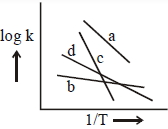
\(\log \mathrm{K}=\frac{-\mathrm{Ea}}{2.303 \mathrm{RT}}+\log \mathrm{A}\)Acrroding to Arrhenius equation plot of \(\operatorname{log } \mathrm { K }\) Vs. \(\frac{1}{\mathrm{T}}\) is linear with.
slope \(=\frac{-\mathrm{Ea}}{2.303 \mathrm{R}}\)
From plot we conclude:
\(|\) slope \(| \quad: c>a>d>b\)
\(\therefore \mathrm{E}_{\mathrm{c}}>\mathrm{E}_{\mathrm{a}}>\mathrm{E}_{\mathrm{d}}>\mathrm{E}_{\mathrm{b}}\)
-
- (A) \(27.01\)
- (B) \(25.07\)
- (C) \(23.03\)
- (D) \(21.06\)
Show answer and solution
Correct Answer: (C)
All nuclear decays follow first order kinetics\(\mathrm{t}=\frac{1}{\mathrm{k}} \ln \frac{\left[\mathrm{A}_{0}\right]}{[\mathrm{A}]}\)
\(=\frac{\left(t_{1 / 2}\right)}{0.693} \times 2.303 \quad \log _{10} 10=10 \times 2.303 \times 1\)
\(=23.03\) years
-
- (A) \(135\)
- (B) \(105\)
- (C) \(198\)
- (D) \(75\)
Show answer and solution
Correct Answer: (D)
\(\mathrm{K}_{1}=\mathrm{Ae}^{-\frac{\mathrm{Ea}}{\mathrm{R} \times 700}}\)\(\mathrm{K}_{2}=\mathrm{A} \times \mathrm{e}^{-\frac{(\mathrm{Ea}-30)}{\mathrm{R} \times 500}}\)
For same rate
\(\mathrm{K}_{1}=\mathrm{K}_{2}\)
\(e^{-\frac{\mathrm{Ea}}{700 \mathrm{R}}}=e^{-\frac{(\mathrm{Ea}-30)}{\mathrm{R} \times 500}}\)
\(\frac{\mathrm{Ea}}{700 \mathrm{R}}=\frac{\mathrm{Ea}-30}{\mathrm{R} \times 500}\)
\(5 \mathrm{Ea}=7 \mathrm{Ea}-210\)
\(210=2 \mathrm{Ea}\)
\(\mathrm{E}_{\mathrm{a}}=105 \mathrm{kJ} / \mathrm{mole}\)
\(\mathrm{E}_{\mathrm{a}}-30=75\)
-
- (A) \(\mathrm{k}_{\mathrm{b}}\left[\mathrm{N}_{2}\right]\left[\mathrm{H}_{2} \mathrm{O}\right]^{2} /[\mathrm{NO}]\)
- (B) \(\mathrm{k}_{\mathrm{b}}\left[\mathrm{N}_{2}\right]\left[\mathrm{H}_{2} \mathrm{O}\right]\)
- (C) \(\mathrm{k}_{\mathrm{b}}\left[\mathrm{N}_{2}\right]\left[\mathrm{H}_{2} \mathrm{O}\right]^{2}\)
- (D) \(\mathrm{k}_{\mathrm{b}}\left[\mathrm{N}_{2}\right]\left[\mathrm{H}_{2} \mathrm{O}\right]^{2} /\left[\mathrm{H}_{2}\right]\)
Show answer and solution
Correct Answer: (D)
\(\mathrm{K}_{\mathrm{eq}}=\frac{\mathrm{k}_{\mathrm{f}}}{\mathrm{k}_{\mathrm{b}}}=\frac{\left[\mathrm{N}_{2}\right]\left[\mathrm{H}_{2} \mathrm{O}\right]^{2}}{\left[\mathrm{H}_{2}\right]^{2}[\mathrm{NO}]^{2}}\)At equilibrium \(\mathrm{r}_{\mathrm{f}}=\mathrm{r}_{\mathrm{b}}\)
\(\mathrm{k}_{\mathrm{f}}\left[\mathrm{H}_{2}\right][\mathrm{NO}]^{2}=\mathrm{k}_{\mathrm{b}} \frac{\left[\mathrm{N}_{2}\right]\left[\mathrm{H}_{2} \mathrm{O}\right]^{2}}{\left[\mathrm{H}_{2}\right]}\)
Hence, rate expression for reverse reaction.
\(=\mathrm{k}_{\mathrm{b}} \frac{\left[\mathrm{N}_{2}\right]\left[\mathrm{H}_{2} \mathrm{O}\right]^{2}}{\left[\mathrm{H}_{2}\right]}\)
-
- (A) \(65\)
- (B) \(75\)
- (C) \(70\)
- (D) \(60\)
Show answer and solution
Correct Answer: (D)
\(t _{0.75}=2 \times \frac{\ln 2}{ k }=90\)\(k =\frac{\ln 2}{45} min ^{-1}\)
\(kt =\ln \frac{1}{1-0.6}=\ln 2.5\)
\(\frac{\ln 2}{45} \times t=\ln 2.5\)
\(t=45 \times \frac{\log 2.5}{\log 2}=45 \times \frac{0.4}{0.3}=60 min\)
-
- (A) A zero order reaction is a single step reaction
- (B) A second order reaction is always a multistep reaction
- (C) A first order reaction is always a single step reaction
- (D) A zero order reaction is a multistep reaction
Show answer and solution
Correct Answer: (D)
Zero order reaction is multiple step reaction. -
- (A) \(84297.5\)
- (B) \(84280\)
- (C) \(84294.7\)
- (D) \(84285.6\)
Show answer and solution
Correct Answer: (A)
\(T _{1}=300 K \quad T _{2}=315 K\)As per question \(K _{ T _{2}}=5 K _{ T _{1}}\) as molecules activated are increased five times so k will increases \(5\) times
Now
\(\ln \left(\frac{ K _{ T _{2}}}{ K _{ T _{1}}}\right)=\frac{ Ea }{ R }\left(\frac{1}{ T _{1}}-\frac{1}{ T _{2}}\right)\)
\(\ln 5=\frac{ Ea }{ R }\left(\frac{15}{300 \times 315}\right)\)
So \(\quad Ea =\frac{1.6094 \times 8.314 \times 300 \times 315}{15}\)
\(Ea =84297.47\) Joules/mole
-
- (A) \(2\, R\)
- (B) \(R\)
- (C) \(1 / R\)
- (D) \(2 / R\)
Show answer and solution
Correct Answer: (A)
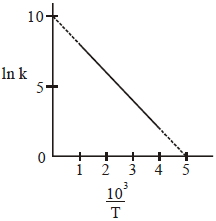
Slope \(=-\frac{E_{a}}{R}\)\(-\frac{10}{5}=-\frac{E_{a}}{R}\)
\(E_{a}=2 R\)
-
- (A) \(-6 \mathrm{RT}\)
- (B) \(+6 \mathrm{RT}\)
- (C) \(+6(2.303) \mathrm{RT}\)
- (D) \(-6(2.303) \mathrm{RT}\)
Show answer and solution
Correct Answer: (D)
\(\mathrm{K}=\mathrm{A} \mathrm{e}^{\frac{-\mathrm{E}_{\mathrm{a}}}{\mathrm{RT}}}\)\(\mathrm{K}^{\prime}=\mathrm{Ae}^{\frac{-\mathrm{E}_{\mathrm{a}}}{\mathrm{RT}}}=10^{6} \mathrm{K}\)
Ae \(\frac{-\mathrm{E}}{\mathrm{RT}}=10^{6} \times \mathrm{Ae}^{\frac{-\mathrm{E}_{\mathrm{a}}}{\mathrm{RT}}}\)
\(\frac{-\mathrm{E}_{\mathrm{a}}}{\mathrm{RT}}=\frac{-\mathrm{E}_{\mathrm{a}}}{\mathrm{RT}}+\ln 10^{6}\)
\(\mathrm{E}_{\mathrm{a}}^{\prime}=\mathrm{E}_{\mathrm{a}}-\mathrm{RT} \ln 10^{6}\)
\(\mathrm{E'}_{\mathrm{a}}-\mathrm{E}_{\mathrm{a}}=-\mathrm{RT} \ln 10^{6}\)
\(=-6 \mathrm{RT} \times 2.303\)
-
- (A) \(85\)
- (B) \(94\)
- (C) \(110\)
- (D) \(100\)
Show answer and solution
Correct Answer: (D)
\(\ell n \left(\frac{ K _{ T _{2}}}{ K _{ T _{1}}}\right)=\frac{ E _{ a }}{ R }\left[\frac{1}{ T _{1}}-\frac{1}{ T _{2}}\right]\)\(T _{1}=303 K ; T _{2}=313 K\)
\(\frac{ K _{ T _{2}}}{ K _{ T _{1}}}=3.555\)
\(\ell E (3.555)=\frac{ E _{ a }}{8.314}\left[\frac{1}{303}-\frac{1}{313}\right]\)
\(E_a=99980.715\)
\(E _{ a }=99.98 \frac{ kJ }{ mole }\)
-
- (A) \(0.3,0.4\)
- (B) \(0.4,0.3\)
- (C) \(0.4,0.4\)
- (D) \(0.3,0.3\)
Show answer and solution
Correct Answer: (A)
From rate law\(= K [ A ]^{ x }[ B ]^{ y }\)
\(6 \times 10^{-3}= K (0.1)^{ x }(0.1)^{ y }\)\(.....(1)\)
\(2.4 \times 10^{-2}= K (0.1)^{ x }(0.2)^{ y } \ldots \ldots(2)\)
\(1.2 \times 10^{-2}= K (0.2)^{ x }(0.1)^{ y }\)\(......(3)\)
\((3) \div(1) \Rightarrow x=1\)
\((2) \div(3) \Rightarrow x=2\)
So, other with respect to \(A=1\)
Order with respect to \(B =2\)
\((4)\) \(\div(3)\)
\(\left(\frac{ x }{0.2}\right) \times\left(\frac{0.2}{0.1}\right)^{2}=\frac{7.2 \times 10^{-2}}{1.2 \times 10^{-2}}\)
\(x =\frac{6 \times 0.2}{4}\)
\(x=0.3 M\)
(5) \(\div(4)\)
\(\left(\frac{y}{0.2}\right)^{2}=\frac{2.88 \times 10^{-1}}{7.2 \times 10^{-2}}\)
\(y^{2}=4 \times 0.2^{2}\)
\(y=0.4 M\)
-
- (A) \((a) < (b) < (c)\)
- (B) \((b) < (c) < (a)\)
- (C) \((c) < (b) < (a)\)
- (D) \((a) < (c) < (b)\)
Show answer and solution
Correct Answer: (A)
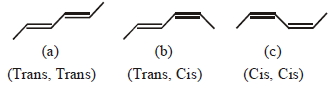
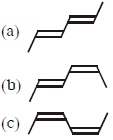
Generally trans is more stable then cis formHeat of combustion (HOC) \(\propto \frac{1}{\text { Stability }}\)
Stability : \(a>b>c\)
\(\mathrm{HOC}: \mathrm{c}>\mathrm{b}>\mathrm{a}\)
-
- (A) \((v) < (i) < (iv) < (ii) < (iii)\)
- (B) \((iii) < (i) < (ii) < (iv) < (v)\)
- (C) \((v) < (iii) < (ii) < (iv) < (i)\)
- (D) \((iii) < (iv) < (ii) < (i) < (v)\)
Show answer and solution
Correct Answer: (C)
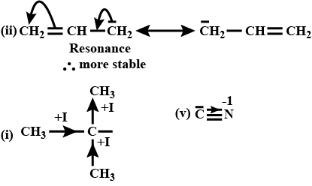
Basicity \(\propto \frac{1}{\text { Stability }}\)\((v)\) In figure \(5 , sp\) hybridised carbon is more electronegative. -ve charge on more electronegative atom makes it more stable. [ref. image]
Also, there is \(-I\) effect.
\(\therefore\) It is most stable.
\((iii)\) \(H - C \equiv \overline{ C }\)
sp hybridized carbon carry -ve charge.
\(\therefore\) Hence, it is also more stable
\((ii)\) In figure \(2\), resonance is taking place. [ref. image]
\(\therefore\) It is more stable.
\((iv)\) \(\overline{ C } H _3\)
-ve charge is carried by \(sp ^3\) hybridised carbon.
\(\therefore\) It is less stable.
\((i)\) In figure \(1\) , the central \(C\) is surrounded by \(CH _3\) and hence it shows \(+ I\) effect from \(3\) sides. [ref. image]
\(\therefore\) Hence, it is least stable.
\(\therefore \text { (v) }\,<\,\text { (iii) }\,<\,\text { (ii) }\,<\,\text { (iv) }\,<\,\text { (i) }\)
No questions on this page match these filters.
Other years
Frequently asked
How many JEE Mains 2020 Chemistry questions are on ExamBro?
204 questions, each with the correct answer and a full solution.
Which JEE Mains 2020 Chemistry chapter is asked the most?
Co-ordination chemistry, with 27 questions, followed by Solution and colligative properties with 16.
How difficult are JEE Mains 2020 Chemistry questions?
3% are easy, 51% medium and 45% hard.