


પ્રશ્નો
13 પ્રશ્નો13 માંથી 1–13 પ્રશ્નો
- 1. \(1\) બાર અને \(298\, K\) પર આદર્શ વાયુના પાંચ મોલને કદ બમણા કરવા માટે વેક્યૂમમાં વિસ્તૃત કર્યા છે. થયેલ કાર્ય: 2020 મધ્યમ
- (A) \(C _{ V }\left( T _{2}- T _{1}\right)\)
- (B) \(- RT \ln V _{2} / V _{1}\)
- (C) \(- RT \left( V _{2}- V _{1}\right)\)
- (D) શૂન્ય
જવાબ અને ઉકેલ જુઓ
સાચો જવાબ: (D)
As the expansion is done in vaccum that is in absence of \(p _{\text {ext }}\) so\(W=\) zero
-
- (A) \(6\)
- (B) \(8\)
- (C) \(10\)
- (D) \(12\)
જવાબ અને ઉકેલ જુઓ
સાચો જવાબ: (A)
\(\Delta G ^{\circ}=- AFE ^{\circ}=-3 \times 96500 \times E ^{\circ}\)\(\Rightarrow E ^{\circ}=-6 \times 10^{-2} V\)
-
- (A) \(-1.3\)
- (B) \(-2.7\)
- (C) \(-3.7\)
- (D) \(-4.2\)
જવાબ અને ઉકેલ જુઓ
સાચો જવાબ: (B)
\(\mathrm{A}(\ell) \longrightarrow 2 \mathrm{B}(\mathrm{g})\)\(\Delta \mathrm{U}=2.1 \mathrm{Kcal}, \Delta \mathrm{S}=20 \mathrm{cal} \mathrm{K}^{-1}\) at \(300 \mathrm{K}\)
\(\Delta \mathrm{H}=\Delta \mathrm{U}+\Delta \mathrm{n}_{\mathrm{g}} \mathrm{RT}\)
\(\Delta \mathrm{G}=\Delta \mathrm{H}-\mathrm{T} \Delta \mathrm{S}\)
\(\Delta \mathrm{G}=\Delta \mathrm{U}+\Delta \mathrm{n}_{\mathrm{g}} \mathrm{RT}-\mathrm{T} \Delta \mathrm{S}\)
\(=2.1+\frac{2 \times 2 \times 300}{1000}-\frac{300 \times 20}{1000}\)
\(\left(\mathrm{R}=2 \mathrm{cal} \mathrm{K}^{-1} \mathrm{mol}^{-1}\right)\)
\(=2.1+1.2-6=-2.70 \mathrm{Kcal} / \mathrm{mol}\)
-
- (A) \(7.25\)
- (B) \(6.75\)
- (C) \(7\)
- (D) \(6.25\)
જવાબ અને ઉકેલ જુઓ
સાચો જવાબ: (D)
For ideal gas:\(\Delta \mathrm{U}=\mathrm{nC}_{\mathrm{V}}\left[\mathrm{T}_{2}-\mathrm{T}_{1}\right]\)
\(\Rightarrow \quad 5000=4 \times \mathrm{C}_{\mathrm{V}}[500-300]\)
\(\Rightarrow \quad \mathrm{C}_{\mathrm{v}}=\frac{5000}{800}=6.25 \mathrm{J}\) \(mole\) \(^{-1} \mathrm{K}^{-1}\)
-
- (A) \(326400\)
- (B) \(312400\)
- (C) \(322425\)
- (D) \(322500\)
જવાબ અને ઉકેલ જુઓ
સાચો જવાબ: (A)
\(C _{2} H _{5} OH _{(\ell)}+3 O _{2( g )} \longrightarrow 2 CO _{2( g )}+3 H _{2} O _{(\ell)}\)\(\Delta n _{ g }=2-3=-1\)
\(\Delta_{ C } H =\Delta_{ c } U +\left(\Delta n _{ g }\right) RT\)
\(\Delta_{ c } H =\Delta_{ c } U - RT\)
\(\Delta_{ c } U =\Delta_{ c } H + RT\)
\(=-327 \times 10^{3}+2 \times 300\)
\(=-326400 cal\)
: Heat evolved
\(=326400 cal\)
-
- (A) \(13536.6\)
- (B) \(-13537.6\)
- (C) \(-13535.5\)
- (D) \(13530.2\)
જવાબ અને ઉકેલ જુઓ
સાચો જવાબ: (B)
\(\Delta G^{\circ}=\Delta H^{\circ}-T \Delta S^{\circ}\)\(=\left(\Delta U^{\circ}+\Delta n_{g} R T\right)-T \Delta S^{\circ}\)
\(\left.=\left[\{-20+(-1)) \frac{8.314}{1000} \times 298\right\}-\frac{298}{1000} \times(-30)\right] k J\)
\(=-13.537572 kJ\)
\(=-13537.57\) Joule
-
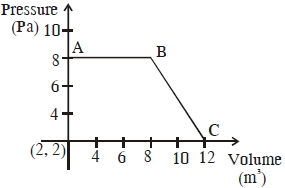
- (A) \(40\)
- (B) \(48\)
- (C) \(45\)
- (D) \(96\)
જવાબ અને ઉકેલ જુઓ
સાચો જવાબ: (B)
Area enclosed under\(P V\) curve \(= 48\)
\(= 48\; Joule\)
-
- (A) is \(x = y\)
- (B) is \(x < y\)
- (C) કોઈ સંબંધ નહીં
- (D) is \(x > y\)
જવાબ અને ઉકેલ જુઓ
સાચો જવાબ: (D)
Enthalpy of atomisation of \(\mathrm{Br}_{2}(l)\)\(\mathrm{Br}_{2}(l) \stackrel{\Delta \mathrm{H}_{\mathrm{vap}}}{\longrightarrow} \mathrm{Br}_{2}(\mathrm{g}) \stackrel{\Delta \mathrm{H}_{\mathrm{BE}}}{\longrightarrow} 2 \mathrm{Br}(\underline{\mathrm{g}})\)
\(\Delta \mathrm{H}_{\mathrm{atom}}=\Delta \mathrm{H}_{\mathrm{vap}}+\Delta \mathrm{H}_{\mathrm{BE}}\)
\(\mathrm{x}=\Delta \mathrm{H}_{\mathrm{vap}}+\mathrm{y}\)
So, \(x>y\)
-
- (A) \(189494\)
- (B) \(189480\)
- (C) \(189989\)
- (D) \(189950\)
જવાબ અને ઉકેલ જુઓ
સાચો જવાબ: (A)
\(H _{2} O (\ell) \rightleftharpoons H _{2} O ( g ) \quad 90 gm\) of \(H _{2} O\)\(\Delta H =\Delta U +\Delta n _{ g } RT \quad \Rightarrow 5\) moles of \(H _{2} O\)
\(5 \times 41000 J =\Delta U +1 \times 8.314 \times 373 \times 5\)
\(\Delta U =189494.39\) Joule
-
- (A) \(Ar _{( g )}+ e ^{-} \rightarrow Ar _{( g )}^{-}\)
- (B) \(H _{( g )}+ e ^{-} \rightarrow H _{( g )}^{-}\)
- (C) \(Na _{( g )} \rightarrow Na _{( g )}^{+}+ e ^{-}\)
- (D) \(O _{( g )}^{-}+ e ^{-} \rightarrow O _{( g )}^{2-}\)
જવાબ અને ઉકેલ જુઓ
સાચો જવાબ: (B)
\(H _{( g )}+ e ^{-} \rightarrow H ^{-} \quad\) is exothermic rest of all endothermic process. -
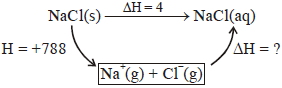
- (A) \(-780\)
- (B) \(-784\)
- (C) \(780\)
- (D) \(784\)
જવાબ અને ઉકેલ જુઓ
સાચો જવાબ: (B)
\(4=788+\Delta H\)\(\Delta H =-784 kJ\)
-
- (A) આપેલ તત્વના બધા પરમાણુઓ સમાન દળ સહિતના સમાન ગુણધર્મો ધરાવે છે. જુદા તત્ત્વોના પરમાણુઓના દળ જુદા હોય છે
- (B) રાસાયણિક પ્રક્રિયા દરમિયાન પરમાણુઓની પુનઃગોઠવણી થાય છે. રાસાયણિક પ્રક્રિયામાં તેઓનું સર્જન કે વિનાશ થતો નથી
- (C) બધા વાયુઓ સમાન \(T\) અને \(P\) એ હોય તો જ્યારે તેઓ સંયોજાય કે ઉત્પન્ન થાય ત્યારે કદથી એક સાદા ગુણોતરમાં હોય છે.
- (D) દ્રવ્ય સ્વતંત્ર અસ્તિત્વ ધરાવતા પરમાણુઓનું બનેલું છે
જવાબ અને ઉકેલ જુઓ
સાચો જવાબ: (C)
according to Gaylussac's law of volume combination when gases combine or reproduced in a chemical reaction they do so in a simple ratio by volume provided all gases are at the same \(T\) and \(P.\) -
- (A) \(\Delta S\) અને \(S\) બંને તાપમાનના વિધેયો છે.
- (B) \(S\) એ તાપમાનનું વિધેય નથી પરંતુ \(\Delta \mathrm{S}\) તાપમાનનું વિધેય છે.
- (C) બંને \(\mathrm{S}\) અને \(\Delta \mathrm{S}\) તાપમાનના વિધેયો નથી.
- (D) \(S\) એ તાપમાનનું વિધેય છે પરંતુ \(\Delta \mathrm{S}\) તાપમાનનું વિધેય નથી.
જવાબ અને ઉકેલ જુઓ
સાચો જવાબ: (A)
\(\mathrm{ds}=\int \frac{\mathrm{q}_{\mathrm{rev}}}{\mathrm{T}}\)
આ પેજ પર આ ફિલ્ટર મુજબ કોઈ પ્રશ્ન નથી.