


પ્રશ્નો
16 પ્રશ્નો16 માંથી 1–16 પ્રશ્નો
-
- (A) \(10\)
- (B) \(5\)
- (C) \(12\)
- (D) \(15\)
જવાબ અને ઉકેલ જુઓ
સાચો જવાબ: (B)
\(\Delta T_{b}=i \times K_{b} \times m\)\(i \times 0.1 \times K_{b}=3 \times 0.05 \times K_{b} \times 2\)
\(i=3\)
\(\left[C r\left(N H_{3}\right)_{5} \cdot C l\right] C l_{2} \rightarrow\left[C r\left(N H_{3}\right)_{5} C l\right]^{+2}+2 C l^{-}\)
\(x=5\)
-
- (A) \(13\)
- (B) \(10\)
- (C) \(8\)
- (D) \(6\)
જવાબ અને ઉકેલ જુઓ
સાચો જવાબ: (B)
\(\mathrm{ppm}=\frac{10.3 \times 10^{-3}}{1030} \times 10^{6}=10\) -
- (A) \(10\)
- (B) \(5\)
- (C) \(8\)
- (D) \(12\)
જવાબ અને ઉકેલ જુઓ
સાચો જવાબ: (A)
Molar mass of \(Na _{2} CO _{3} \cdot xH _{2} O\)\(\Rightarrow 23 \times 2+12+48+18 x\)
\(\Rightarrow 46+12+48+18 x\)
\(\Rightarrow(106+18 x )\)
\(Eqwt =\frac{ M }{2}=(53+9 x )\)
As \(n _{\text {factor }}\) in dissolution will be determined from net cationic or anionic charge; which is \(2\) so
\(Eqwt =\frac{ M }{2}=53+9 x\)
Gmeq \(=\frac{ wt }{ Eqwt }=\frac{1.43}{53+9 x }\)
Normality \(=\frac{ Gmeq }{ V _{\text {litre }}}\)
Normality \(=0.1=\frac{1.43}{\frac{53+9 x }{0.1}}\)
As volume \(=100 ml\)
\(=0.1 Litre\)
So \(\quad 10^{-2}=\frac{1.43}{53+9 x }\)
\(53+9 x =143\)
\(9 x =90\)
\(x =10.00\)
-
- (A) \(172\)
- (B) \(175\)
- (C) \(180\)
- (D) \(177\)
જવાબ અને ઉકેલ જુઓ
સાચો જવાબ: (D)
Let molar mass of protein \(A=x\) \(g/mol\)Let molar mass of protein \(B = y g / mol\)
\(\pi_{ A }=\) osmotic pressure of protein \(A =\frac{\left(\frac{0.73}{ x }\right)}{0.25} RT\)
\(\pi_{ B }=\) osmotic pressure of protein \(B =\frac{\left(\frac{1.65}{ y }\right)}{1} RT\)
\(\pi_{ A }=\pi_{ B }\)
\(\Rightarrow\left(\frac{0.73}{ x \times 0.25}\right) RT =\left(\frac{1.65}{ y }\right) RT\)
\(\Rightarrow\left(\frac{ x }{ y }\right)=\frac{0.73}{0.25 \times 1.65}=1.769 \cong 1.77\)
-
- (A) \(600\)
- (B) \(620\)
- (C) \(590\)
- (D) \(628\)
જવાબ અને ઉકેલ જુઓ
સાચો જવાબ: (A)
\(550= P _{ A }^{\circ} \times \frac{1}{4}+ P _{ B }^{\circ} \times \frac{3}{4}\)\(2200= P _{ A }^{\circ}+3 P _{ B }^{\circ}\)\(....(i)\)
\(2800= P _{ A }^{\circ}+4 P _{ B }^{\circ}\)\(....(ii)\)
\(560= P _{ A }^{\circ} \times \frac{1}{5}+ P _{ B }^{\circ} \times \frac{4}{5}\)
\(P _{ B }^{\circ}=600, P _{ A }^{\circ}=400\)
-
- (A) \(35^oC\) પર દ્રાવણ બનાવવા ઉષ્મા શોષાવી જોઇએ
- (B) આ પ્રણાલીમાં રાઉલ્ટના નિયમનું પાલન થતુ નથી
- (C) \(100\; mL\; CS_2\) અને \(100\; mL\) એસિટોનના મિશ્રણનું કદ \(< 200 \;mL\) થશે
- (D) તેઓ પોતે સ્વતંત્ર રીતે હોય તેના કરતા \(CS_2\) અને એસિટોન ઓછા જોડાયેલા છે
જવાબ અને ઉકેલ જુઓ
સાચો જવાબ: (C)
The vapour pressure of mixture \((=600\; \mathrm{mm} \;\mathrm{Hg}\) ) is greater than the individual vapour pressure of its constituents (Vapour pressure of \(\mathrm{CS}_{2}=512\; \mathrm{mm}\; Hg\), acetone \(=344 \;\mathrm{mm}\; Hg\) ). Hence, the solution formed shows positive deviationfrom Raoult's law.
\(\Rightarrow(1) \Delta_{\mathrm{sol}} \mathrm{H}>0\)
\((2)\) Raoult's law is not obeyed
(3) \(\Delta_{\text {sol. }}\) Volume \(>0\)
(4) \(\mathrm{CS}_{2}\) and Acetone are less attracted to each ether than to themselves.
-
- (A) \(0.37\)
- (B) \(0.67\)
- (C) \(0.87\)
- (D) \(0.63\)
જવાબ અને ઉકેલ જુઓ
સાચો જવાબ: (A)
\(1\; L\) solution requires \(30 \mathrm{m\;mol} \;\mathrm{HCl}\)\(250 \;\mathrm{ml}\) sol. will require \(7.5 \mathrm{m}\; \mathrm{mol} \;\mathrm{HCl}\)
\({\text { or } 3.75 \mathrm{m\;mol}\; \mathrm{H}_{2} \mathrm{SO}_{4}}\)
\({\Rightarrow \frac{3.75 \times 98}{1000} \mathrm{gm} \;\mathrm{H}_{2} \mathrm{SO}_{4}}\)
\({=0.3675 \;\mathrm{gm} \;\mathrm{H}_{2} \mathrm{SO}_{4}}\)
-
- (A) દ્રાવણનું કદ બદલાતુ અને દ્રાવકનું કદ ઘટે છે
- (B) દ્રાવણનુ કદ ઘટે છે અને દ્રાવકનું કદ ઘટે છે
- (C) દ્રાવણનુ કદ ઘટે છે અને દ્રાવકનું કદ વધે છે
- (D) દ્રાવણ અને દ્રાવકની કટ બદલાતા નથી
જવાબ અને ઉકેલ જુઓ
સાચો જવાબ: (C)
The pure solvent solution will try to maintain higher vapour pressure in the sealed container and in return the solvent vapour molecules will condense in the solution of non-volatile solute as it maintains an equilibrium with lower vapour pressure. (Lowering of vapour pressure is observed when a non volatile solute is mixed in a volatile solvent)This will eventually lead to increase in the volume of solution and decrease in the volume of solvent.
-
- (A) \(8.33\)
- (B) \(5.67\)
- (C) \(6.33\)
- (D) \(4.67\)
જવાબ અને ઉકેલ જુઓ
સાચો જવાબ: (B)
gm eq. of \(\mathrm{Ag}=\frac{108}{108}=1\)\(\mathrm{gm}\) eq. of \(\mathrm{O}_{2}(\mathrm{g})=1\)
Volume of \(\mathrm{O}_{2}(\mathrm{g})=22.7 \times \frac{1}{4}=5.675\) litre
-
- (A) \(A>B>C\)
- (B) \(A>C>B\)
- (C) \(C>B>A\)
- (D) \(B > C > A\)
જવાબ અને ઉકેલ જુઓ
સાચો જવાબ: (A)
Relative lowering of \(V . P. =\frac{\Delta P }{ P ^{0}}= x _{\text {solute }}\)\(\left(\frac{\Delta P }{ P ^{0}}\right)_{ A }=\frac{\frac{10}{100}}{\frac{10}{100}+\frac{180}{18}}:\left(\frac{\Delta P }{ P ^{0}}\right)_{ B }=\frac{\frac{10}{200}}{\frac{10}{200}+\frac{180}{18}}\)
\(\left(\frac{\Delta P }{ P ^{0}}\right)_{ C }=\frac{\frac{10}{10,000}}{\frac{10}{10,000}+\frac{180}{18}}:\left(\frac{\Delta P }{ P ^{0}}\right)_{ A }>\left(\frac{\Delta P }{ P ^{0}}\right)_{ B }>\left(\frac{\Delta P }{ P ^{0}}\right)_{ C }\)
-
- (A) \(14\)
- (B) \(22\)
- (C) \(6\)
- (D) \(38\)
જવાબ અને ઉકેલ જુઓ
સાચો જવાબ: (C)
According to Dalton's law of partial pressure\(p _{ i }= x _{ i } \times P _{ T }\)
\(P _{ i }=\) partial pressure of the \(i ^{\text {th }}\) component
\(x _{ i }=\) mole fraction of the \(i ^{\text {th }}\) component
\(p _{ T }=\) total pressure of mixture
\(\Rightarrow 2 atm =\left(\frac{ n _{ H _{2}}}{ n _{ H _{2}}+ n _{ H _{ e }}+ n _{ O _{2}}}\right) \times p _{ T }\)
\(\Rightarrow p _{ T }=2 atm \times \frac{3}{1}=6 atm\)
-
- (A) \(37\)
- (B) \(35\)
- (C) \(40\)
- (D) \(32\)
જવાબ અને ઉકેલ જુઓ
સાચો જવાબ: (A)
\(P _{ CO _{2}}= K _{ H } \times CO _{2}\)\(\frac{3}{30}=\frac{ K _{ H } \cdot n _{ CO _{2}}}{ K _{ H } 1} \Rightarrow n _{ CO _{2}-0.1} mol\)
\(pH =\frac{1}{2}\left( pka _{1}-\log c \right)=\frac{1}{2}(6.4 \times 1)=3.7\)
\(pH =37 \times 10^{-1}\)
-
- (A) \(150\)
- (B) \(167\)
- (C) \(160\)
- (D) \(159\)
જવાબ અને ઉકેલ જુઓ
સાચો જવાબ: (B)
Osmotic pressure \(=\pi= i \times C \times RT\)For \(NaCl i =2\) so
\(\pi_{ NaCl }= i \times C _{ NaCl } \times RT \quad C _{ NaCl }=\) conc. of \(NaCl\)
\(0.1=2 \times C _{ NaCl } \times RT\)
\(C_{ NaCl }=\frac{0.05}{ RT } \quad C_{\text {glucose }}=\) conc. of glucose
For glucose \(i=1\) so
\(\pi_{\text {Glucose }}= i \times C _{\text {glucose }} \times RT\)
\(0.2=1 \times C _{\text {glucose }} \times RT\)
\(C _{\text {Glucose }}=\frac{0.2}{ RT } \quad \eta_{ NaCl }=\) No. of moles \(NaCl\)
\(\eta_{ NaCl }\) in \(1 L = C _{ NaCl } \times V _{\text {Litre }}\)
\(=\frac{0.05}{ RT } \quad \eta_{ glucose }=\) No. of moles glucose
\(\eta_{\text {glucose }}\) in \(2 L = C _{\text {glucose }} \times V _{\text {Litre }}\)
\(=\frac{0.4}{ RT }\)
\(V _{\text {Total }}=1+2=3 L\)
so Final conc. \(NaCl =\frac{0.05}{3 RT }\)
Final conc. glucose \(=\frac{0.4}{3 RT }\)
\(\pi_{\text {Total }}=\pi_{ NaCl }+\pi_{\text {glucose }}\)
\(=\left[i \times C_{ NaCl }+C_{\text {glucose }}\right] \times RT\)
\(=\left(\frac{2 \times 0.05}{3 RT }+\frac{0.4}{3 RT }\right) \times RT\)
\(=\frac{0.5}{3} atm\)
\(=0.1666 atm\)
\(=166.6 \times 10^{-3} atm\)
\(\Rightarrow 167.00 \times 10^{-3} atm\)
so \(x=167.00\)
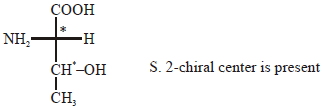
-
- (A) \(2.25\)
- (B) \(2\)
- (C) \(1.75\)
- (D) \(1.5\)
જવાબ અને ઉકેલ જુઓ
સાચો જવાબ: (C)
\(\Delta \mathrm{T}_{\mathrm{f}}=\mathrm{i} \times \mathrm{m} \times \mathrm{K}_{\mathrm{f}}\)\(0.2=2 \times 2 \times \frac{\mathrm{w} / 58.5}{600 / 1000}\)
\(\mathrm{w}=1.755 \mathrm{gm}\)
-
- (A) \(4.97\)
- (B) \(6.63\)
- (C) \(3.52\)
- (D) \(9.47\)
જવાબ અને ઉકેલ જુઓ
સાચો જવાબ: (A)
\(\mathrm{FeSO}_{4} \cdot 7 \mathrm{H}_{2} \mathrm{O}(\mathrm{M}=277.85)\)\(\mathrm{ppm}=\frac{\text { wt. of Fe }}{\text { wt. of wheat }} \times 10^{6}\)
let the wt. of salt be \(=\mathrm{w} \mathrm{gm}\)
moles \(=\frac{\mathrm{w}}{277.85}\)
wt. of \(\mathrm{Fe}=\left(\frac{\mathrm{W}}{277.85} \times 55.85\right) \mathrm{gm}\)
\(10=\frac{\frac{\mathrm{W}}{277.85} \times 55.85}{10^{5}} \times 10^{6}\)
\(W=\frac{277.85}{55.85}=4.97\)
-
- (A) \((A)\)
- (B) \((C)\)
- (C) \((B)\)
- (D) \((A)\) અને \((C)\)
જવાબ અને ઉકેલ જુઓ
સાચો જવાબ: (C)
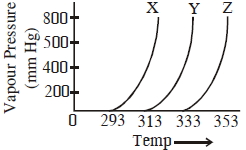
Order of B.P. is : \(Z>Y>X\)Order of vapour pressure \(: Z < Y < X\)
order of intermolecular interaction \(: Z>Y>X\)
આ પેજ પર આ ફિલ્ટર મુજબ કોઈ પ્રશ્ન નથી.