


2013 में पूछे गए अध्याय
15 अध्याय- 1प्रश्न STD 11 साम्यावस्था - 2
- 1प्रश्न STD 12 जैव-अणु
- 3प्रश्न STD 12 ऐमीन सबसे ज़्यादा पूछा गया
- 1प्रश्न STD 12 हैलोऐल्केन तथा हैलोऐरीन
- 2प्रश्न STD 11 कार्बनिक रसायन प्रतिक्रिया तंत्र सबसे ज़्यादा पूछा गया
- 1प्रश्न STD 12 उपसहसंयोजन यौगिक
- 1प्रश्न STD 12 D- एवं f-ब्लॉक के तत्व
- 1प्रश्न STD 12 रासायनिक बलगतिकी
- 1प्रश्न STD 12 वैद्युत रसायन
- 1प्रश्न STD 12 Solution and colligative properties
- 1प्रश्न STD 11 रसायन विज्ञान की कुछ मूल अवधारणाएँ
- 4प्रश्न STD 11 रासायनिक आबंधन तथा आण्विक संरचना सबसे ज़्यादा पूछा गया
- 2प्रश्न STD 11 तत्त्वों का वर्गीकरण एवं गुणधर्मों में आवर्तिता
- 1प्रश्न STD 11 ऊष्मागतिकी
- 1प्रश्न STD 11 परमाणु की संरचना
JEE Mains 2013 Chemistry के सभी प्रश्न
15 अध्याय22 में से 1–22 प्रश्न
-
- (A) \(0.1\)
- (B) \(0.9\)
- (C) \(2\)
- (D) \(9\)
उत्तर और हल देखें
सही उत्तर: (D)
As \(p H=1 ; H^{+}=10^{-1}=0.1 \,M\)\(p H=2 ; H^{+}=10^{-2}=0.01\, M\)
\(\therefore M_{1}=0.1 ; V_{1}=1\)
\(M_{2}=0.01; V_{2}=?\)
From
\(M_{1} V_{1}=M_{2} V_{2} ; 0.1 \times 1=0.01 \times V_{2}\)
\(V_{2}=10\) litre
volume of water added \(=10-1=9\) litre.
- 2. प्रकाश संश्लेषण की प्रक्रिया में ग्लूकोज़ के एक अणु के उत्पादन में कितने \(ATP\) अणुओं का उत्पाद्न होगा ? 2013 मध्यम
- (A) \(18\)
- (B) \(10\)
- (C) \(8\)
- (D) \(6\)
उत्तर और हल देखें
सही उत्तर: (A)
\(18\) ATPs are involved in the formation of \(1\) glucose molecule as shown in the reaction below:\(6 \mathrm{CO}_{2}+12 \mathrm{N} A D P H+18 \mathrm{ATP} \rightarrow \mathrm{C}_{6} \mathrm{H}_{12} \mathrm{O}_{6}+12 \mathrm{NADP}+18 \mathrm{ADP}\)
- 3. भोपाल गैस त्रासदी में यूनियन कार्बाइड प्लान्ट के संग्रह टैंक से कौन-सी गैस का रिसाव हुआ था 2013 मध्यम
- (A) मिथाइल आइसोसाइनेट
- (B) मिथाइलएमीन
- (C) अमोनिया
- (D) फॉस्जीन
उत्तर और हल देखें
सही उत्तर: (A)
Methyl isocyanate \(\mathrm{CH}_{3^{-}} \mathrm{N}=\mathrm{C}=\mathrm{O}(\mathrm{MlC})\) gas was leaked
from the storage tank of the union carbide plant in Bhopal gas tragedy -
- (A) \(CH_3COOH\)
- (B) \(CH_3CH_2CH_2COOH\)
- (C) \(\begin{array}{*{20}{c}}
{C{H_3} - CH - COOH} \\
{|\,\,\,\,\,\,\,\,\,\,\,\,\,} \\
{C{H_3}\,\,\,\,\,\,}
\end{array}\) - (D) \(CH_3CH_2COOH\)
उत्तर और हल देखें
सही उत्तर: (D)
\(\underset{(A)}{\mathop{\begin{matrix}
\,\,\,\,\,\,\,\,\,\,\,\,\,\,\,\,O \\
\,\,\,\,\,\,\,\,\,\,\,\,\,\,\,\,|| \\
C{{H}_{3}}C{{H}_{2}}-C-OH \\
\end{matrix}}}\,\) \(\xrightarrow{N{{H}_{3}}}\,\underset{(B)}{\mathop{C{{H}_{3}}C{{H}_{2}}COON{{H}_{4}}}}\,\xrightarrow{\Delta }\)\(\underset{(C)}{\mathop{\begin{matrix}
\,\,\,\,\,\,\,\,\,\,\,\,\,\,\,\,\,\,\,\,O \\
\,\,\,\,\,\,\,\,\,\,\,\,\,\,\,\,\,\,\,\,|| \\
C{{H}_{3}}-C{{H}_{2}}-C-N{{H}_{2}} \\
\end{matrix}}}\,\) \(\xrightarrow[\begin{smallmatrix}
Hofmann's\,\,broamide \\
reaction
\end{smallmatrix}]{B{{r}_{2}}\,,\,KOH}\) \(C{{H}_{3}}-C{{H}_{2}}-N{{H}_{2}}\) -
- (A) \(2\)
- (B) \(5\)
- (C) \(4\)
- (D) \(6\)
उत्तर और हल देखें
सही उत्तर: (B)
During acetylation, one \(H\) atom with atomic mass \(1\,amu\) of \(- NH_2\) group is replaced by an acetyl group \(\mathrm{CH}_{3} \mathrm{CO}[\text { molecular mass }=434 \,\mu ]\). Thus\(-\mathrm{NH}_{2}+\mathrm{CH}_{3} \mathrm{COCl} \longrightarrow-\mathrm{NHCOCH}_{3}+\mathrm{HCl}\)
The above equation suggests that, the acylation of each \(-\mathrm{NH}_{2}\) group increases the mass by \(42 \,\mu\) \([43-1] .\) If the molecular mass of the organic compound is \(180 \,\mu\) while that of the acylated product is \(390 \,\mu\), then the increase in the mass due to acylation is given by
\(390-180=210 \,\mu\)
Hence, the number of \(-\mathrm{NH}_{2}\) groups \(=\frac{210\, \mu}{42\, \mu}=5\)
-
- (A) सेकेण्डरी ऐल्कोहॉल \({S_{{N^1}}}\) द्वारारा
- (B) टर्शियरी ऐल्कोहॉल \({S_{{N^1}}}\) द्वारा
- (C) सेकेण्डरी ऐल्कोहॉल \({S_{{N^2}}}\) द्वारा
- (D) टर्शियरी ऐल्कोहॉल \(S _{ N } 2\) द्वारा
उत्तर और हल देखें
सही उत्तर: (B)
The reaction of alcohol with Lucas reagent is mostly an \({S_{{N^1}}}\) reaction and the rate of reaction is directly proportional to the stability of carbocation formed in the reaction. Since \(3^{o} R-O H\) forms \(3^{o}\) carbocation (most stable), hence it will react fastest. -
- (A) कार्बोॠणायन
- (B) कार्बिन
- (C) कार्बोधनायन
- (D) मुक्त मूलक
उत्तर और हल देखें
सही उत्तर: (C)
\(\begin{matrix}
Cl-CH-C{{H}_{3}} \\
|\,\,\,\,\,\,\,\,\, \\
\underset{(-)\,\,\,\,\,\,\,\,\,\,\,\,\,\,}{\mathop{Ph\,\,\,\,\,\,\,}}\, \\
\end{matrix}\xrightarrow[Toluene]{SbC{{l}_{5}}}\underset{\begin{smallmatrix}
(Carbocation) \\
(planar)
\end{smallmatrix}}{\mathop{Ph-\overset{\oplus }{\mathop{C}}\,H-C{{H}_{3}}}}\,+SbCl_{6}^{-}\) \(\to \underset{\begin{smallmatrix}
(d\,and\,l)\,mixture \\
+SbC{{l}_{5}}
\end{smallmatrix}}{\mathop{\begin{matrix}
Ph-CH-C{{H}_{3}} \\
\,|\,\,\,\,\,\,\,\,\, \\
Cl\,\,\,\,\,\,\,\,\, \\
\end{matrix}}}\,\) -
- (A) \(III > II > I\)
- (B) \(I > II > III\)
- (C) \(II > III > I\)
- (D) \(III > I > II\)
उत्तर और हल देखें
सही उत्तर: (D)
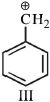
Stability due to resonance - More the no of resonating structure more is the stability.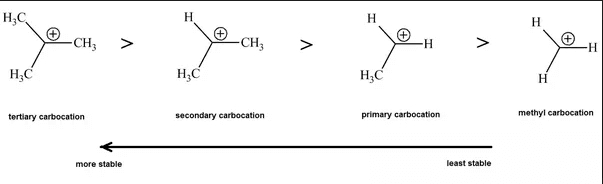
-
- (A) \([Co(en)_3]^{3+}\)
- (B) \([Co(en)_2Cl_2]^{+}\)
- (C) \([Co(NH_3)_3Cl_3]\)
- (D) \([Co(en) (NH_3)_2 Cl_2]^+\)
उत्तर और हल देखें
सही उत्तर: (C)
Optical isomerism is exhibited by only those complexes which lacks elements of symmetry. \(\left[\mathrm{Co}\left(\mathrm{NH}_{3}\right)_{3} \mathrm{Cl}_{3}\right]\) shows facial as well as meridional isomerism. But both the forms contain plane of symmetry. Thus, this complex does not exhibit optical isomerism. -
- (A) \(Cr\,(Z=24)\)
- (B) \(Mn\,(Z = 25)\)
- (C) \(Fe\,(Z=26)\)
- (D) \(Co\,(Z = 27)\)
उत्तर और हल देखें
सही उत्तर: (D)
\(E^{0}_{C r^{3+} / C r^{2+}}=\,-\,0.41\, V \)\(\mathrm{E}^{0}_{\mathrm{Fe}^{3+} / \mathrm{Fe}^{2+}}=+0.77 \,\mathrm{V}\)
\(\mathrm{E}^{0}_{\mathrm{Co}^{3+} / \mathrm{Co}^{2+}}=+1.97\, \mathrm{V}\)
\(E^{0}_{\mathrm{Mn}^{3+} / \mathrm{Mn}^{2+}}=+1.57\, \mathrm{V}\)
-
- (A) \(53.6\)
- (B) \(48.6\)
- (C) \(58.5\)
- (D) \(60.5\)
उत्तर और हल देखें
सही उत्तर: (A)
Activation energy can be calculated from the equation \(\frac{\log \,k_{2}}{\log k_{1}}=\frac{E_{a}}{2.303 R}\left(\frac{1}{T_{1}}-\frac{1}{T_{2}}\right)\)given \(\frac{k_{2}}{k_{1}}=2 T_{2}=310\, K T_{1}=300 K\)
\(=\log \,2=\frac{-E_{a}}{2.303 \times 8.314}\left(\frac{1}{310}-\frac{1}{300}\right)\)
\(E_{a}=53598.6 \,J / \mathrm{mol}\)
\(=53.6\, \mathrm{kJ} / \mathrm{mol} .\)
-
- (A) \(Cl\)
- (B) \(Cr^{3+}\)
- (C) \(Mn^{2+}\)
- (D) \(MnO_4^-\)
उत्तर और हल देखें
सही उत्तर: (D)
Higher the value of standard reduction potential stronger will be the oxidising agent, hence \(M n O_{4}^-\) is the strongest oxidising agent. - 13. \(0.5( M ) HCl\) के \(750\, mL\) को \(2( M ) HCl\) के \(250\, mL\) के साथ मिलाने से प्राप्त विलयन की मोलरता .......... \(M\) होगी 2013 मध्यम
- (A) \(0.87\)
- (B) \(1.00\)
- (C) \(1.75\)
- (D) \(0.97\)
उत्तर और हल देखें
सही उत्तर: (A)
From Molarity equation:\(M_{1} V_{1}+M_{2} V_{2}=M \times V\)
\(M=\frac{M_{1} V_{1}+M_{2} V_{2}}{V}\)
where \(V=\) total volume
\(=\frac{750 \times 0.5+250 \times 2}{1000}=0.875\, M\)
- 14. एक गैसीय हाइ्ड्रोकार्बन दहन पर \(0.72\, g\). जल और \(3.08\, g . CO _{2}\) देता है। हाइड्रोकार्बन का आनुभविक सूत्र है 2013 कठिन
- (A) \(C_2H_4\)
- (B) \(C_3H_4\)
- (C) \(C_6H_5\)
- (D) \(C_7H_8\)
उत्तर और हल देखें
सही उत्तर: (D)
\(18 \mathrm{g} \mathrm{H}_{2} \mathrm{O}\) contain \(2 \mathrm{g} \mathrm{H}\)\(\therefore 0.72 \mathrm{g} \mathrm{H}_{2} \mathrm{O}\) contain \(0.08 \mathrm{g} \mathrm{H}\)
\(44 \mathrm{g} \mathrm{CO}_{2}\) contain \(12 \mathrm{g} \mathrm{C}\)
\(\therefore 3.08 \mathrm{g} \mathrm{CO}_{2}\) contain \(0.84 \mathrm{g} \mathrm{C}\)
\(C: H=\frac{0.84}{12}: \frac{0.08}{1}=0.07: 0.08=7: 8\)
\(\therefore\) Empirical formula \(=\mathrm{C}_{7} \mathrm{H}_{8}\)
- 15. अणु/आयनों के निम्न युग्मों में से किसमें दोनों स्पीशीज़ के होने की संभावना नहीं हैं ? 2013 मध्यम
- (A) \(H_{2}^+, He_2^{2-}\)
- (B) \(H_{2}^-, He_2^{2-}\)
- (C) \(H_{2}^{+2}, He_2\)
- (D) \(H_{2}^-, He_2^{2+}\)
उत्तर और हल देखें
सही उत्तर: (C)
Species having zero or negative bond order do not exist.\(\mathrm{H}_{2}^{2+}(1+1-2=0)=\sigma 1 \mathrm{s}^{0}\)
Bond order \(=0\)
\(\mathrm{He}_{2}(2+2=4)=\sigma 1 \mathrm{s}^{2},{ }^{\star} \mathrm{fs}^{2}\)
Bond order \(=\frac{N_{0}-N_{a}}{2}=\frac{2-2}{2}=0\)
\(\mathrm{So}, \mathrm{both} \mathrm{H}_{2}^{2+}\) and \(\mathrm{He}_{2}\) do not exist.
-
- (A) \(C_2\)
- (B) \(F_2\)
- (C) \(O_2\)
- (D) \(S_2\)
उत्तर और हल देखें
सही उत्तर: (A)
वे अणु जिनसे प्रतिचुंबकीय व्यवहार प्रदर्शित करने की अपेक्षा की जाती है, वे हैं
A) \(C_2\) और B) \(F_2\)।
एक अणु प्रतिचुंबकीय होता है यदि उसके सभी इलेक्ट्रॉन युग्मित हों और अनुचुंबकीय होता है यदि इसमें एक या अधिक अयुग्मित इलेक्ट्रॉन हों। आणविक कक्षक (MO) सिद्धांत के आधार पर:
A) \(C_2\) (12 इलेक्ट्रॉन): इलेक्ट्रॉनिक विन्यास है \((\sigma 1 s)^2( \left.\sigma^* 1 s\right)^2(\sigma 2 s)^2\left(\sigma^* 2 s\right)^2\left(\pi 2 p_x\right)^2\left(\pi 2 p_y\right)^2\)। सभी इलेक्ट्रॉन युग्मित हैं। (प्रतिचुंबकीय)
B) \(F_2\) (18 इलेक्ट्रॉन): इलेक्ट्रॉनिक विन्यास है \(\sigma 1 s^2 \sigma^* 1 s^2 \sigma 2 s^2 \sigma^* 2 s^2 \sigma 2 p_z^2 \pi 2 p_x^2 \pi 2 p_y^2 \pi^* 2 p_x^2 \pi^* 2 p_y^2\)। सभी इलेक्ट्रॉन युग्मित हैं। (प्रतिचुंबकीय)
C) \(O _{ 2 }\) (16 इलेक्ट्रॉन): इसमें \(\pi^* 2 p_x\) और \(\pi^* 2 p_y\) कक्षकों में दो अयुग्मित इलेक्ट्रॉन होते हैं। (अनुचुंबकीय)
D) \(S_2\) (32 इलेक्ट्रॉन): \(O_2\) की तरह, इसमें अपने उच्चतम अधिकृत आणविक कक्षकों ( \(\pi^* 3 p\) ) में दो अयुग्मित इलेक्ट्रॉन होते हैं। (अनुचुंबकीय) -
- (A) \(ONCl\) तथा \(ONO^-\) समइलेक्टॉनिक नहीं है
- (B) \(O_3\) अणु टेढा है।
- (C) ओजोन ठोस अवस्था में बैंगनी-काला होता है।
- (D) ओजोन प्रतिचुम्बकीय गैस है।
उत्तर और हल देखें
सही उत्तर: (A)
(a) Number of electrons in\(\begin{array}{l}\mathrm{ONCl}=3.2 \mathrm{e}^{-} \\\mathrm{ONO}^{-}=24 \mathrm{e}^{-}\end{array}\)
Thus, ONCl and ONO- are not isoelectronic.
(b) \(\mathrm{O}_{3}\) has bent shape structure. Central atom O is \(s p^{2}\) hybridised with 1 lone pair of electrons.
(c) Ozone is violet-black in solid state.
(d) \(O_{3}\) has no unpaired electrons, thus it is diamagnetic.
-
- (A) \(Li_2 < Li_2^+ < Li_2^-\)
- (B) \(Li_2^- < Li_2^+ < Li_2\)
- (C) \(Li_2 < Li_2^- < Li_2^+\)
- (D) \(Li_2^- < Li_2 < Li_2^+\)
उत्तर और हल देखें
सही उत्तर: (B)
Correct option(b) \(\mathrm{Li}_{2}-<\mathrm{Li}_{2}^{+}<\mathrm{Li}_{2}\)
Explanation:
\(\mathrm{Li}_{2}(3+3=6)=\sigma 1 \mathrm{s}^{2}, \quad \hat{\sigma} 1 \mathrm{s}^{2}, \sigma 2 \mathrm{s}^{2}\)
Bond order \(=\frac{N_{b}-N_{a}}{2}=\frac{4-2}{2}=1\)
\(\mathrm{Li}_{2}^{+}(3+3-1=5)=\sigma 1 \mathrm{s}^{2}, \dot{\sigma}^{2} 1 s^{2}, \cdot \sigma 2 s^{1}\)
Bond order \(=\frac{3-2}{2}=\frac{1}{2}=0.5\)
Bond order \(=\frac{4-3}{2}=\frac{1}{2}=0.5\)
Stability order is \(\mathrm{Li}_{2}>\mathrm{Li}_{2}^{+}>\mathrm{Li}_{2}^{-}\) (because Li \(_{2}^{-}\) have more number of electrons in antibonding orbitals which destabilises the species).
- 19. \(Ca , Ba , S , Sc\) और \(Ar\) के लिये निम्न में से कौन प्रथम आयनन एन्थैल्पी के बढ़ते क्रम को सही क्रम में प्रस्तुत करता हैं ? 2013 कठिन
- (A) \(Ca < S < Ba < Se < Ar\)
- (B) \(S < Se < Ca < Ba < Ar\)
- (C) \(Ba < Ca < Se < S < Ar\)
- (D) \(Ca < Ba < S < Se < Ar\)
उत्तर और हल देखें
सही उत्तर: (C)
\(B \)enthalpy increases along the period but decreases down the group.
The IE of an element increases as one moves across a period in the periodic table because the
electrons are held tighter by the higher effective nuclear charge.
The ionization energy of the elements decreases as one moves down the group because the electrons are held in lower-energy orbitals, away from the nucleus and therefore, are less tightly bound.
\(A r\) has higher IE because it is a noble gas and \(B a\) has the lowest IE as it is in 6 periods and more
metallic.
Hence, the correct option is \(\mathrm{C}\)
- 20. \(Na\) का प्रथम आयनन विभव \(5.1\, eV\) है। \(Na ^{+}\) की इलेक्ट्रॉन प्राप्ति एन्थैल्पी निम्न होगी \((.......eV)\) 2013 कठिन
- (A) \(-2.55\)
- (B) \(-5.1\)
- (C) \(-10.2\)
- (D) \(+2.55\)
उत्तर और हल देखें
सही उत्तर: (B)
\(\mathrm{Na} \rightarrow \mathrm{Na}^{+}+\mathrm{e}^{-} \quad \mathrm{IE}=5.1 \mathrm{eV} \ldots \ldots\)\(\mathrm{Na}^{+}+\mathrm{e}^{-} \rightarrow \mathrm{Na}\)
Second reaction is inverse of first reaction,
therefore electron goes enthalapy of \(N a^{+}\)
is reverse of ionization energy
\(\therefore \Delta H_{e g}=-5.1 \mathrm{eV}\)
-
- (A) \(q = +208\,J, \,w =-208\,J\)
- (B) \(q =-208\,J, w =-208\,J\)
- (C) \(q =-208\,J, w = +208\,J\)
- (D) \(q = +208\,J, w = +208\,J\)
उत्तर और हल देखें
सही उत्तर: (A)
Solution:-As the heat is absorbed.
\(\therefore q =+208 J\)
Now for reversible isothermal process,
\(q =- W\)
\(\therefore W =- q =-208 J\)
Hence the values of \(q\) and \(W\) for the process will be \(+208 J\) and \(-208 J\) respectively.
-
- (A) \(1.214 \times 10^{-7} \,m\)
- (B) \(2.816 \times 10^{-7}\, m\)
- (C) \(6.500 \times 10^{-7}\, m\)
- (D) \(8.500 \times 10^{-7}\, m\)
उत्तर और हल देखें
सही उत्तर: (A)
Let \(\lambda\) is the wavelength of that photon then\(h c / \lambda=E_{2}-E_{1}\)
and using value of given E, \(E=\frac{h c}{\lambda}=2.178 \times 10^{-18} \times z^{2}\left[\frac{1}{1^{2}}-\frac{1}{2^{2}}\right](z=1)\)
\(\therefore \lambda=\frac{6.62 \times 10^{-34} \times 3 \times 10^{8}}{2.178 \times 10^{-18}} \times \frac{4}{3}=1.214 \times 10^{-7} \mathrm{m}\)
इस पेज पर इन फ़िल्टर से कोई प्रश्न नहीं मिला।
अन्य वर्ष
अक्सर पूछे जाने वाले प्रश्न
ExamBro पर JEE Mains 2013 Chemistry के कितने प्रश्न हैं?
22 प्रश्न, हर एक सही उत्तर और पूरे हल के साथ।
JEE Mains 2013 Chemistry का कौन-सा अध्याय सबसे ज़्यादा पूछा जाता है?
रासायनिक आबंधन तथा आण्विक संरचना, 4 प्रश्नों के साथ; उसके बाद ऐमीन, 3 प्रश्नों के साथ।
JEE Mains 2013 Chemistry के प्रश्न कितने कठिन होते हैं?
0% आसान, 50% मध्यम और 50% कठिन।