


Chapters asked in 2013
24 chapters- 3Qs STD 11 Organic chemistry purification and characterization
- 4Qs STD 12 D and f- block elements
- 2Qs STD 11 Redox reactions
- 6Qs STD 12 Biomolecules Most asked
- 8Qs STD 11 Equilibrium - II (icon Equilibrium) Most asked
- 3Qs STD 12 Chemical kinetics
- 4Qs STD 11 Organic chemistry reaction mechanism
- 4Qs STD 12 Amines
- 1Qs STD 12 Carboxylic acids and their derivative
- 3Qs STD 12 Aldehydes and ketones
- 4Qs STD 12 Alcohol, phenol and ethers
- 6Qs STD 12 Haloalkanes and Haloarenes
- 4Qs STD 12 Co-ordination chemistry
- 2Qs STD 12 P -Block elements - ll
- 5Qs STD 12 Electrochemistry
- 6Qs STD 12 Solution and colligative properties
- 4Qs STD 11 Some basic concept of chemistry
- 1Qs STD 11 Hydricarbon
- 11Qs STD 11 Chemical bonding and molecular structure Most asked
- 5Qs STD 11 Classification of elements and periodicity in properties
- 2Qs STD 11 Equilibrium - 1 (chemical Equilibrium)
- 6Qs STD 11 Thermodynamics and thermochemistry
- 1Qs STD 11 P-Block elements - I
- 5Qs STD 11 Structure of atom
All JEE Mains 2013 Chemistry questions
24 chaptersShowing 1–50 of 100 questions
- 1. For which of the following compounds Kjeldahl method can be used to determine the percentage of Nitrogen ? 2013 Medium
- (A) Nitrobenzene
- (B) Pyridine
- (C) Alanine
- (D) Diazomethane
Show answer and solution
Correct Answer: (C)
Kjeldahl's method is not applicable for cpmpounds containing nitrogen in nitro and azo groups and nitrogen present in the ring. Because nitrogen of these compounds does not change to ammonium sulphate under these conditions.Hence only Alanine can be used to determine percentage of nitrogen.
\(\underset{Alanine}{\mathop{\begin{matrix}
{{H}_{2}}N-CH-COOH \\
|\,\,\,\,\,\,\,\,\, \\
\,\,\,\,\,\,\,\,\,CH{{(C{{H}_{3}})}_{2}} \\
\end{matrix}}}\,\) - 2. Which of the following compounds is not expected to show Lassaignes' test for nitrogen ? 2013 Hard
- (A) Propanenitrile
- (B) Hydroxylamine hydrochloride
- (C) Nitromethane
- (D) Ethanamine
Show answer and solution
Correct Answer: (B)
Lassaigne's test is used for the detection of nitrogen and given by all nitrogenous compound except diazo \(\rlap{-} (\,\,N = N\rlap{-} )\) compounds.
This test is shown only by the compounds containing \(C\) and \(N\) both hence hydroxyl amine hydrochloride \((H_2NOH .HCl)\) will not perform this test -
- (A) \(Fe^{3+}\) ion also gives blood red colour with \(SCN^-\) ion.
- (B) \(Fe^{2+}\) ion also gives blood red colour with \(SCN^-\) ion.
- (C) On passing \(H_2S\) into \(Na_2ZnO_2\) solution a white ppt of \(ZnS\) is formed.
- (D) Cupric ion reacts with excess of ammonia solution to give deep blue colour of \([Cu(NH_3)_4]^{2+}\) ion
Show answer and solution
Correct Answer: (A)
Only \(Fe^{3+}\) ion gives blood red colouration with \(SCN^-\) ion.\(F{e^{3 + }} + SC{N^ - }\, \to \,\mathop {{{[Fe(SCN)]}^{2 + }}}\limits_{{\text{(dark red)}}} \)
-
- (A) \(Cr\,(Z=24)\)
- (B) \(Mn\,(Z = 25)\)
- (C) \(Fe\,(Z=26)\)
- (D) \(Co\,(Z = 27)\)
Show answer and solution
Correct Answer: (D)
\(E^{0}_{C r^{3+} / C r^{2+}}=\,-\,0.41\, V \)\(\mathrm{E}^{0}_{\mathrm{Fe}^{3+} / \mathrm{Fe}^{2+}}=+0.77 \,\mathrm{V}\)
\(\mathrm{E}^{0}_{\mathrm{Co}^{3+} / \mathrm{Co}^{2+}}=+1.97\, \mathrm{V}\)
\(E^{0}_{\mathrm{Mn}^{3+} / \mathrm{Mn}^{2+}}=+1.57\, \mathrm{V}\)
-
- (A) \(Cu_2O\) is colourless
- (B) Copper \((I)\) compounds are colourless except when colour results from charge transfer
- (C) Copper \((I)\) compounds are diamagnetic.
- (D) \(Cu_2S\) is black.
Show answer and solution
Correct Answer: (A)
\(Cu_2O\) is red in colour. - 6. Potassium dichromate when heated with concentrated sulphuric acid and a soluble chloride, gives brown-red vapours of: 2013 Hard
- (A) \(CrO3\)
- (B) \(CrCl_3\)
- (C) \(CrO_2Cl_2\)
- (D) \(Cr_2O_3\)
Show answer and solution
Correct Answer: (C)
Solid potassium dichromate when heated with concentrated sulphuric acid and a soluble chloride gives orange red vapours of a volatile oily liquid \(Cr{O_2}C{l_2}\)\(K_2Cr_2O_7 + 4NaCl + 6H_2SO_4\) \(\longrightarrow\)
\(\begin{array}{l}
2KHS{O_4} + 4NaHS{O_4} + 2Cr{O_2}C{l_2}\\
\,\,\,\,\,\,\,\,\,\,\,\,\,\,\,\,\,\,\,\,\,\,\,\,\,\,\,\,\,\,\,\,\,\,\,\,\,\,\,\,\,\,\,\,\,\,\,{\rm{chromyl \,chloride}}
\end{array}\) -
- (A) \(MnSO_4\)
- (B) \(Mn_2O_7\)
- (C) \(MnO_2\)
- (D) \(Mn_2O_3\)
Show answer and solution
Correct Answer: (B)
\(KMnO_4\) reacts with \(H_2SO_4\) to form \(Mn_2O_7\) which is highly explosive substance\(2KMn{O_4} + {H_2}S{O_4} \to {K_2}S{O_4} + M{n_2}{O_7} + {H_2}O\)
-
- (A) \(2,1,2\)
- (B) \(2,1,3\)
- (C) \(3, 1,6\)
- (D) \(3, 1, 4\)
Show answer and solution
Correct Answer: (C)
On balancing the given reaction, we find\(3Na_2HAsO_3 + NaBrO_3 + 6HCl \longrightarrow\)
\(6NaCl + 3H_3AsO_4 + NaBr\)
-
- (A) \(I^-\)
- (B) \(S(s)\)
- (C) \(NO_3^ - \left( {aq} \right)\)
- (D) \(Cr_2O_7^{2 - }\)
Show answer and solution
Correct Answer: (A)
If an electronegative element is in its lowest possible oxidation state in a compound or in free state. It can function as a powerful reducing agent.
e.g. \(I^-\) - 10. Among the following vitamins the one whose deficiency causes rickets (bone deficiency) is 2013 Easy
- (A) Vitamin \(A\)
- (B) Vitamin \(B\)
- (C) Vitamin \(D\)
- (D) Vitamin \(C\)
Show answer and solution
Correct Answer: (C)
Deficiency of vitamin \(D\) causes rickets -
- (A) Carbonyl bond
- (B) Ether bond
- (C) Ester bond
- (D) Amide bond
Show answer and solution
Correct Answer: (B)
Glycosidic linkage is actually an ether bond as the linkage forming the rings in an oligosaccharide or polysaccharide is not just one bond, but the two bonds sharing an oxygen atom e.g. sucrose
-
- (A) \(- OH\) on the second carbon is on the right side in Fischer projection
- (B) \(- OH\) on the sixth carbon is on the right side in Fischer projection
- (C) \(- OH\) on the fifth carbon is on the right side in Fischer projection
- (D) It is dextrorotatory
Show answer and solution
Correct Answer: (C)
Fisher gave the prefix \('D''\) to compounds whosebottom chiral hasits \(OH\) to the right. So natural glucoseis called \(D\,-\) glucose is called \(D\,-\) glucose or dextrose.Structure of \(D\,-\) glucose :

-
- (A) \(18\) molecules of \(ATP\)
- (B) \(10\) molecules of \(ATP\)
- (C) \(8\) molecules of \(ATP\)
- (D) \(6\) molecules of \(ATP\)
Show answer and solution
Correct Answer: (A)
\(18\) ATPs are involved in the formation of \(1\) glucose molecule as shown in the reaction below:\(6 \mathrm{CO}_{2}+12 \mathrm{N} A D P H+18 \mathrm{ATP} \rightarrow \mathrm{C}_{6} \mathrm{H}_{12} \mathrm{O}_{6}+12 \mathrm{NADP}+18 \mathrm{ADP}\)
-
- (A) Diastase
- (B) Maltase
- (C) Zymase
- (D) Invertase
Show answer and solution
Correct Answer: (A)
Maltose is obtained by partial hydrolysis of starch by the enzyme diastase present in Malt\(2{\left( {{C_6}{H_{10}}{O_5}} \right)_n} + n{H_2}O\xrightarrow[{^n{C_6}{H_{12}}{O_6}\,\,{\text{(Maltose)}}\,}]{{Diastase}}\)
-
- (A) Amylopectin is a branched polymer of \(\alpha - \) glucose
- (B) Cellulose is a linear polymer of \(\beta - \) glucose
- (C) Glycogen is the food reserve of plants
- (D) All proteins are polymers of \(\alpha - \) amino acids
Show answer and solution
Correct Answer: (C)
Glycogen is called animal starch and is found in all animal cells. It constitutes the reserve food material -
- (A) \(0.1\)
- (B) \(0.9\)
- (C) \(2\)
- (D) \(9\)
Show answer and solution
Correct Answer: (D)
As \(p H=1 ; H^{+}=10^{-1}=0.1 \,M\)\(p H=2 ; H^{+}=10^{-2}=0.01\, M\)
\(\therefore M_{1}=0.1 ; V_{1}=1\)
\(M_{2}=0.01; V_{2}=?\)
From
\(M_{1} V_{1}=M_{2} V_{2} ; 0.1 \times 1=0.01 \times V_{2}\)
\(V_{2}=10\) litre
volume of water added \(=10-1=9\) litre.
- 17. \(NaOH\) is a strong base. What will be \(pH\) of \(5.0 \times 10^{-2}\,M\) \(NaOH\) solution \((log\,2 = 0.3)\) 2013 Medium
- (A) \(14\)
- (B) \(13.70\)
- (C) \(13\)
- (D) \(12.70\)
Show answer and solution
Correct Answer: (D)
Given \([O{H^ - }] = 5 \times {10^{ - 2}}\)\(\therefore \,pOH = - \log \,5 \times {10^{ - 2}}\)
\( = - \log \,5 + 2\log \,10 = 1.30\)
\(\because \,pH + pOH = 14\)
\(\because \,pH = 14 - pOH\)
\( = 14 - 1.30 = 12.70\)
-
- (A) \(5.1 \times {10^{ - 5}}\,M\)
- (B) \(7.1 \times {10^{ - 8}}\,M\)
- (C) \(4.1 \times {10^{ - 5}}\,M\)
- (D) \(8.1 \times {10^{ - 7}}\,M\)
Show answer and solution
Correct Answer: (A)
Given \(N{a_2}C{O_3} = 1.0 \times {10^{ - 4}}\,M\)\(\therefore \,[CO_3^ - ] = 1.0 \times {10^{ - 4}}\,M\)
\(i.e.\,\,\,s = 1.0 \times {10^{ - 4}}\,M\)
At equilibrium
\([B{a^{ + + }}][CO_3^ - ] = {K_{sp}}\,of\,BaC{O_3}\)
\([B{a^{ + + }}] = \frac{{{K_{sp}}}}{{[CO_3^ - ]}} = \frac{{5.1 \times {{10}^{ - 9}}}}{{1.0 \times {{10}^{ - 4}}}}\)
\( = 5.1 \times {10^{ - 5}}\,M\)
-
- (A) \(F^- < CN^- < NO_2^-\)
- (B) \(NO_2^- < CN^- < F^-\)
- (C) \(F^- < NO_2^- < CN^-\)
- (D) \(NO_2^- < F^- < CN^-\)
Show answer and solution
Correct Answer: (C)
Higher the value of \(K_a\) lower will be the value of \(pK_a\) \(i.e.\) higher will be the acidic nature. Further since \(CN^-, F^-\) and \(NO_2^-\) are conjugate base of the acids \(HCN, HF\) and \(HNO_2\) respectively hence the correct order of base strength will be \(F^- < NO_2^- < CN^-\) ( \(\because \) stronger the acid weaker will be its conjugate base) - 20. What is the \(pH\) of a \(10^{-4}\, M\,OH^-\) solution at \(330\,K\), if \(K_w\) at \(330\,K\) is \(10^{-13.6}\) ? 2013 Medium
- (A) \(4\)
- (B) \(9\)
- (C) \(10\)
- (D) \(9.6\)
Show answer and solution
Correct Answer: (D)
Given at \(330\,K\)\({K_w} = {10^{ - 13.6}}\)
i.e. \(p{K_w} = pH + pOH\)
\(\because \,pOH = - \log [O{H^ - }]\)
\(13.6 = pH + pOH\)
\(pOH = - \log \,{10^{ - 4}}\)
\(13.6 = pH + 4\)
\(\therefore \,pH = 13.6 - 4\)
\( = 9.6\)
-
- (A) \(pH=4.70\)
- (B) \(pH < 4.70\)
- (C) \(pH\) of solution will be equal to \(pH\) of acetic acid
- (D) \(4.76 < pH < 5.0\)
Show answer and solution
Correct Answer: (D)
\(pH = p{K_a} + \log \,\frac{{[salt]}}{{[acid]}}\)\( = 4.76 + \log \,\frac{{\frac{{7.5}}{{500}}}}{{\frac{5}{{500}}}} = 4.7 + \log \,1.5 = 4.87\)
Hence correct answer is \(4.76 < pH < 5.0\)
-
- (A) \(BaSO_4 > Hg_2Cl_2 > Cr_2(SO_4)_3 > CrCl_3\)
- (B) \(BaSO_4 > Hg_2Cl_2 > CrCl_3 > Cr_2 (SO_4)_3\)
- (C) \(BaSO_4 > CrCl_3 > Hg_2Cl_2 > Cr_2(SO_4)_3\)
- (D) \(Hg_2Cl_2 > BaSO_4 > CrCl_3 > Cr_2(SO_4)_3\)
Show answer and solution
Correct Answer: (B)
\(C{r_2}{(S{O_4})_3} \rightleftharpoons \mathop {2C{r^{ + 3 }}}\limits_{2s} + \mathop {3S{O_4}^{ - - }}\limits_{3s} \)\({K_{sp}} = {(2s)^2}{(3s)^2} = 4{s^2} \times 27{s^3} = 108{s^5}\)
\(s = {\left( {\frac{{{K_{sp}}}}{{108}}} \right)^{1/5}}\)
\(H{g_2}C{l_2} \rightleftharpoons \mathop {2H{g^{2 + }}}\limits_{2s} + \mathop {2C{l^ - }}\limits_{2s} \)
\({K_{sp}} = {(2s)^2} \times {(2s)^2} = 16{x^4}\)
\(s = {\left( {\frac{{{K_{sp}}}}{{16}}} \right)^{1/4}}\)
\(BaS{O_4} \rightleftharpoons \mathop {B{a^{ + 2}}}\limits_s + \mathop {S{O_4}^{ - - }}\limits_s \)
\({K_{sp}} = {s^2}\)
\(s = \sqrt {{K_{sp}}} \)
\(CrC{l_3} \rightleftharpoons \mathop {C{r^{3 + }}}\limits_s + \mathop {3C{l^ - }}\limits_{3s} \)
\({K_{sp}} = s \times {(3s)^3} = 27\,{s^4}\)
\(s = {\left( {\frac{{{K_{sp}}}}{{27}}} \right)^{1/4}}\)
Hence the correct order of solubilities of salts is
\(\sqrt {{K_{sp}}} > {\left( {\frac{{{K_{sp}}}}{{16}}} \right)^{1/4}} > {\left( {\frac{{{K_{sp}}}}{{27}}} \right)^{1/4}} > {\left( {\frac{{{K_{sp}}}}{{108}}} \right)^{1/5}}\)
- 23. Which one of the following arrangements represents the correct order of the proton affinity of the given species 2013 Hard
- (A) \({I^ - } < {F^ - } < H{S^ - } < N{H_2}^ - \)
- (B) \(H{S^ - } < N{H_2}^ - < {F^ - } < {I^ - }\)
- (C) \({F^ - } < {I^ - } < N{H_2}^ - < H{S^ - }\)
- (D) \(N{H_2}^ - < H{S^ - } < {I^ - } < {F^ - }\)
Show answer and solution
Correct Answer: (A)
The species with the greatest proton affinity will be the strongest base, and its conjugate acid will be the weakest acid. The weakest acid will have the smallest value of \(K_a\). Since \(HI\) is a stronger acid than \(HF\) which is a stronger acid than \(H_2S\), a partial order of proton affinity is\({I^ - } < {F^ - } < H{S^ - }\)
Since \(NH_3\) is a very weak acid, \(NH_2^ -\) must be a very strong base. Therefore the correct order of proton affinity is \(I^- < F^- < HS^- < NH_2^-\)
-
- (A) \(0.0456\)
- (B) \(1.14\)
- (C) \(0.114\)
- (D) \(0.57\)
Show answer and solution
Correct Answer: (B)
Given \( - \,\frac{{dMnO_4^ - }}{{dt}}\, = \,4.56\, \times {10^{ - 3}}\,M{s^{ - 1}}\)From the reaction given,
\( - \frac{1}{2}\,\frac{{dMnO_4^ - }}{{dt}}\, = \,\frac{{4.56 \times {{10}^{ - 3}}}}{2}\,M{s^{ - 1}}\)
\( - \frac{1}{2}\,\frac{{dMnO_4^ - }}{{dt}}\, = \,\frac{1}{5}\,\frac{{d{I_2}}}{{dt}}\)
\(\therefore \,\, - \frac{5}{2}\,\frac{{dMnO_4^ - }}{{dt}}\,\, = \frac{{d{I_2}}}{{dt}}\)
On substituting the given value
\(\therefore \frac{{d{I_2}}}{{dt}}\, = \,\frac{{4.56\, \times {{10}^{ - 3}} \times 5}}{2}\, = \,1.14\, \times \,{10^{ - 2}}\,M/s\)
-
- (A) \(0.5\)
- (B) \(1.25\)
- (C) \(12.5\)
- (D) \(1.0\)
Show answer and solution
Correct Answer: (D)
For a zero order reactionRate constant \( = \,k\, = \,\frac{{a - x}}{t}\)
\(2\, \times \,{10^{ - 2}}\, = \,\frac{{a\, - \,0.5}}{{25}}\)
\(a\, - \,0.5\, = \,0.5\)
\(a\, = \,1.0\,M\)
-
- (A) \(53.6\)
- (B) \(48.6\)
- (C) \(58.5\)
- (D) \(60.5\)
Show answer and solution
Correct Answer: (A)
Activation energy can be calculated from the equation \(\frac{\log \,k_{2}}{\log k_{1}}=\frac{E_{a}}{2.303 R}\left(\frac{1}{T_{1}}-\frac{1}{T_{2}}\right)\)given \(\frac{k_{2}}{k_{1}}=2 T_{2}=310\, K T_{1}=300 K\)
\(=\log \,2=\frac{-E_{a}}{2.303 \times 8.314}\left(\frac{1}{310}-\frac{1}{300}\right)\)
\(E_{a}=53598.6 \,J / \mathrm{mol}\)
\(=53.6\, \mathrm{kJ} / \mathrm{mol} .\)
-
- (A) carbanion
- (B) carbene
- (C) carbocation
- (D) free radical
Show answer and solution
Correct Answer: (C)
\(\begin{matrix}
Cl-CH-C{{H}_{3}} \\
|\,\,\,\,\,\,\,\,\, \\
\underset{(-)\,\,\,\,\,\,\,\,\,\,\,\,\,\,}{\mathop{Ph\,\,\,\,\,\,\,}}\, \\
\end{matrix}\xrightarrow[Toluene]{SbC{{l}_{5}}}\underset{\begin{smallmatrix}
(Carbocation) \\
(planar)
\end{smallmatrix}}{\mathop{Ph-\overset{\oplus }{\mathop{C}}\,H-C{{H}_{3}}}}\,+SbCl_{6}^{-}\) \(\to \underset{\begin{smallmatrix}
(d\,and\,l)\,mixture \\
+SbC{{l}_{5}}
\end{smallmatrix}}{\mathop{\begin{matrix}
Ph-CH-C{{H}_{3}} \\
\,|\,\,\,\,\,\,\,\,\, \\
Cl\,\,\,\,\,\,\,\,\, \\
\end{matrix}}}\,\) - 28. Arrange in the correct order of stability (decreasing order) for the following molecules
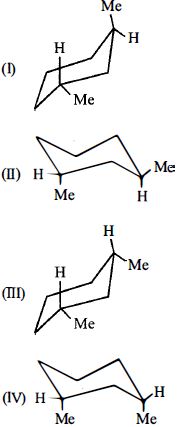 2013 Hard
- (A) \((I) > (II) > (III) >(IV)\)
- (B) \((IV) > (III) > (II) \approx (I)\)
- (C) \((I) > (II) \approx (III) > (IV)\)
- (D) \((III) > (I) \approx (II) > (IV)\)
Show answer and solution
Correct Answer: (C)
Disequatorial cis \(-1,\,3-\) Dimethylcyclohexane is more stable as both methyl groups are equatorial and are away from each other. (Refer to Image \(I\))It is followed by trans \(-1,\,3-\) Dimethylcyclohexane where one \(-C H_{3}\) group is equatorial and other is axial (Refer to Image \(II\))
Diaxial cis \(-1,\,3-\) Dimethylcyclohexane is less stable due to large amount of steric strain due to the interaction of axial - \(\mathrm{CH}_{3}\) groups. (Refer to Image \(III\) )
\((I) > (II) \approx (III) > (IV)\)
- 29. In the above compounds correct order of reactivity in electrophilic substitution reactions will be
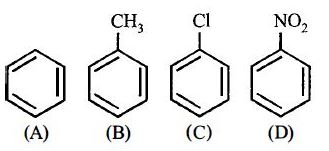 2013 Hard
- (A) \(B >A> C > D\)
- (B) \(D > C > B > A\)
- (C) \(A > B > C > D\)
- (D) \(B > C > A > D\)
Show answer and solution
Correct Answer: (A)
\(- Cl\) and \(-CH_3\) groups are \(o\) and \(p\) directing. They are electron releasing due to \(+ E\) and \(+ M\) effects. Further since such groups increase electron density in the nucleus, they facilitate further electrophilic substitution and hence known as activating group. The activating effect of these groups is in order of \(- CH_3 > -X\) but chlorine exceptionally deactive the ring due to strong \(- I\) effect. Hence, it is difticult to carry out substitution in chlorobenzene than in benzene . Further \(- NO_2\) is a deactivating group hence deactivates the benzene nucleus, i.e. hinder the further substitution. Thus nitrobenzene undergo electrophilic substitution with a great difficulty hence the correct order will be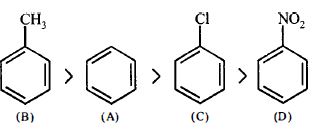
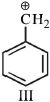
-
- (A) \(III > II > I\)
- (B) \(I > II > III\)
- (C) \(II > III > I\)
- (D) \(III > I > II\)
Show answer and solution
Correct Answer: (D)
Stability due to resonance - More the no of resonating structure more is the stability.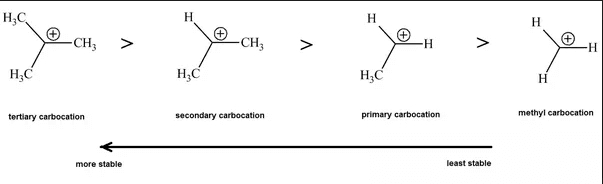
-
- (A) \(2\)
- (B) \(5\)
- (C) \(4\)
- (D) \(6\)
Show answer and solution
Correct Answer: (B)
During acetylation, one \(H\) atom with atomic mass \(1\,amu\) of \(- NH_2\) group is replaced by an acetyl group \(\mathrm{CH}_{3} \mathrm{CO}[\text { molecular mass }=434 \,\mu ]\). Thus\(-\mathrm{NH}_{2}+\mathrm{CH}_{3} \mathrm{COCl} \longrightarrow-\mathrm{NHCOCH}_{3}+\mathrm{HCl}\)
The above equation suggests that, the acylation of each \(-\mathrm{NH}_{2}\) group increases the mass by \(42 \,\mu\) \([43-1] .\) If the molecular mass of the organic compound is \(180 \,\mu\) while that of the acylated product is \(390 \,\mu\), then the increase in the mass due to acylation is given by
\(390-180=210 \,\mu\)
Hence, the number of \(-\mathrm{NH}_{2}\) groups \(=\frac{210\, \mu}{42\, \mu}=5\)
-
- (A) \(CH_3COOH\)
- (B) \(CH_3CH_2CH_2COOH\)
- (C) \(\begin{array}{*{20}{c}}
{C{H_3} - CH - COOH} \\
{|\,\,\,\,\,\,\,\,\,\,\,\,\,} \\
{C{H_3}\,\,\,\,\,\,}
\end{array}\) - (D) \(CH_3CH_2COOH\)
Show answer and solution
Correct Answer: (D)
\(\underset{(A)}{\mathop{\begin{matrix}
\,\,\,\,\,\,\,\,\,\,\,\,\,\,\,\,O \\
\,\,\,\,\,\,\,\,\,\,\,\,\,\,\,\,|| \\
C{{H}_{3}}C{{H}_{2}}-C-OH \\
\end{matrix}}}\,\) \(\xrightarrow{N{{H}_{3}}}\,\underset{(B)}{\mathop{C{{H}_{3}}C{{H}_{2}}COON{{H}_{4}}}}\,\xrightarrow{\Delta }\)\(\underset{(C)}{\mathop{\begin{matrix}
\,\,\,\,\,\,\,\,\,\,\,\,\,\,\,\,\,\,\,\,O \\
\,\,\,\,\,\,\,\,\,\,\,\,\,\,\,\,\,\,\,\,|| \\
C{{H}_{3}}-C{{H}_{2}}-C-N{{H}_{2}} \\
\end{matrix}}}\,\) \(\xrightarrow[\begin{smallmatrix}
Hofmann's\,\,broamide \\
reaction
\end{smallmatrix}]{B{{r}_{2}}\,,\,KOH}\) \(C{{H}_{3}}-C{{H}_{2}}-N{{H}_{2}}\) - 33. The gas leaked from a storage tank of the Union Carbide plant in Bhopal gas tragedy was : 2013 Medium
- (A) Methyl isocyanate
- (B) Methylamine
- (C) Ammonia
- (D) Phosgene
Show answer and solution
Correct Answer: (A)
Methyl isocyanate \(\mathrm{CH}_{3^{-}} \mathrm{N}=\mathrm{C}=\mathrm{O}(\mathrm{MlC})\) gas was leaked
from the storage tank of the union carbide plant in Bhopal gas tragedy -
- (A) \(1^o > 2^o > 3^o > NH_3\)
- (B) \(3^o > 2^o > NH_3 > 1^o\)
- (C) \(3^o > 2^o > 1^o > NH_3\)
- (D) \(NH_3 > 1^o > 2^o > 3^o\)
Show answer and solution
Correct Answer: (C)
The correct order of relative basicity of amines in the gas phase is \(3^o > 2^o > 1^o > NH_3\) The alkyl group releases electron and thus, tends to disperse the positive charge of the alkyl ammonium ion and therefore stabilises it. Since, \(NH_4^+\) (from \(NH_3\)) has no such alkyl group, it is not stabilised to such an extent as alkyl ammonium ion. -
- (A) Ethers
- (B) Amines
- (C) Esters
- (D) Alcohols
Show answer and solution
Correct Answer: (C)
Mono-carboxylic acids are functional isomers of esters. e.g.,\(\mathop {C{H_3}COOH}\limits_{{\text{Acetic acid}}} \,\) \(\mathop {HCOOC{H_3}}\limits_{{\text{Methyl formate}}} \,\)
-
- (C) \(CH_3CHO\)
- (D) \(HCHO\)
Show answer and solution
Correct Answer: (C)
Only those aldehydes which do not have \(\alpha - H\) atom undergo Cannizaro's reaction. Hence \(CH_3CHO\) will not undergo Cannizaro's reaction as it has \(3\,\alpha \) \(H\) atoms. -
- (A) \(LiAlH_4\)
- (B) \(Zn-Hg\) with \(HCl\)
- (C) Glycol with \(KOH\)
- (D) \(H_2\) with \(Pt\) as catalyst
Show answer and solution
Correct Answer: (B)
\(\underset{Ketone}{\mathop{>\,C=O\,}}\,\xrightarrow{Zn-Hg/HCl}>\,C{{H}_{2}}\) -
- (A) Schift's reagent
- (B) Tollen 's reagent
- (C) \(I_2\)/Alkali
- (D) Fehling's solution
Show answer and solution
Correct Answer: (C)
Only acetaldehyde and methyl ketones give iodoform test. - 39. Amongst the following alcohols which would react fastest with conc. \(HCl\) and \(ZnCl_2\) ? 2013 Hard
- (A) pentanol
- (B) \(2-\) methyl butanol
- (C) \(2-\) pentanol
- (D) \(2-\) methyl butan \(-2-\) ol
Show answer and solution
Correct Answer: (D)
\(ZnCl_2 +\) cone . \(HCl\) is Lucas reagent . Lucas reagent reacts fastest with tertiary alcohol. \(3^o\) alcohol \(+\) Lucas reagent \(=\) Immediate turbidity -
- (A) \(2-\) ethoxypropane
- (B) ethoxypropane
- (C) methoxybutane
- (D) \(2-\) methoxybutane
Show answer and solution
Correct Answer: (A)
\(\mathop {C{H_3}C{H_2}OCH{{(C{H_3})}_2}}\limits_{(A)} \xrightarrow{{Conc.\,HI}}\) \(\mathop {C{H_3}C{H_2}I}\limits_{(B)} \, + \,\,\mathop {{{(C{H_3})}_2}CHI}\limits_{(C)} \)\(\mathop {C{H_3}C{H_2}I}\limits_{(B)} \,\xrightarrow{{NaOH}}C{H_3}C{H_2}OH\,\) \(\xrightarrow{{[O]}}C{H_3}COOH\)
\(\,\mathop {{{(C{H_3})}_2}CHI}\limits_{(C)} \xrightarrow{{NaOH}}{(C{H_3})_2}CHOH\) \(\xrightarrow{{[O]}}{(C{H_3})_2}CO\)
hence the \(IUPAC\) name of compound is
\(\begin{array}{*{20}{c}}
{C{H_3} - C{H_2} - O - \mathop {CH}\limits^2 - \mathop {C{H_3}}\limits^1 } \\
{\,\,\,\,\,\,\,\,\,\,\,\,\,\,\,\,\,\,\,\,\,\,\,\,\,\,\,\,\,\,\,\,\,\,\,|\,\,\,\,\,\,\,} \\
{\,\,\,\,\,\,\,\,\,\,\,\,\,\,\,\,\,\,\,\,\,\,\,\,\,\,\,\,\,\,\,\,\,\,\,\,\,\,\,{}^3C{H_3}\,\,\,\,\,\,\,}
\end{array}\) -
- (A) \(2^o > 1^o >CH_3OH >3^o\)
- (B) \(3^o > 2^o > 1^o > CH_3OH\)
- (C) \(2^o> 3^o > 1^o > CH_3OH\)
- (D) \(CH_3OH > 1^o >2^o > 3^o\)
Show answer and solution
Correct Answer: (B)
The order of dehydration among three type of alcohols is \(3^o > 2^o > 1^o > CH_3OH\). This behaviour is related to the relative stabilities of carbocations \((3^o > 2^o > 1^o)\). -
- (A) Water \(<\) methyl alcohol \(<\) dimethyl ether \(<\) glycerol
- (B) methyl alcohol \(<\) glycerol \(<\) water \(<\) dimethyl ether
- (C) dimethyl ether \(<\) methyl alcohol \(<\) water \(<\) glycerol
- (D) glycerol \(<\) dimethyl ether \(<\) water \(<\) methyl alcohol
Show answer and solution
Correct Answer: (C)
The correct order of viscosity of the given liquids is dimethyl ether \(<\) methyl alcohol \(<\) water \(<\) glycerol -
- (A) secondary alcohol by \({S_{{N^1}}}\)
- (B) tertiary alcohol by \({S_{{N^1}}}\)
- (C) secondary alcohol by \({S_{{N^2}}}\)
- (D) tertiary alcohol by \({S_{{N^2}}}\)
Show answer and solution
Correct Answer: (B)
The reaction of alcohol with Lucas reagent is mostly an \({S_{{N^1}}}\) reaction and the rate of reaction is directly proportional to the stability of carbocation formed in the reaction. Since \(3^{o} R-O H\) forms \(3^{o}\) carbocation (most stable), hence it will react fastest. -
- (A) \(Br^- > I^->Cl^-\)
- (B) \({I^ - } > B{r^ - } > C{l^{^ - }}\)
- (C) \(C{l^{^ - }} > B{r^ - } > {I^ - }\)
- (D) \(C{l^{^ - }} > {I^ - } > B{r^ - }\)
Show answer and solution
Correct Answer: (B)
Since the leaving group breaks away as a base, it is easier to displace weaker bases as compared to stronger bases. Thus less basic the substituent. the more easily it is displaced. Since the basic strength of the given groups is in order.\({I^ - } < B{r^ - } < Cl^-\)
Thus the order of halogen leaving groups is
\({I^ - } > B{r^ - } > C{l^{^ - }}\)
- 45. In Williamson synthesis of mixed ether having a primary and a tertiary alkyl group if tertiary halide is used, then 2013 Hard
- (A) Rate of reaction will be slow due to slow cleavage of carbon-halogen bond.
- (B) Alkene will be the main product
- (C) Simple ether will form instead of mixed ether.
- (D) Expected mixed ether will be formed.
Show answer and solution
Correct Answer: (B)
The tertiary alkylhalide undergo elimination reaction to give alkenes\(\begin{array}{*{20}{c}}
{\,\,\,\,\,\begin{array}{*{20}{c}}
{\,\,\,\,C{H_3}\,\,} \\
{|\,\,\,\,}
\end{array}} \\
{C{H_3} - C - X + } \\
{\,\,\,\,\,|\,\,\,\,} \\
{\,\,\,\,\,\,\,\,\,C{H_3}\,\,\,}
\end{array}\) \(NaOC_2H_5\,\to \) \(\mathop {\begin{array}{*{20}{c}}
{\,\,\,\,\,C{H_3}} \\
{|\,} \\
{C{H_3} - C = C{H_2}}
\end{array}}\limits_{2\, - \,methyl\,propane} \) -
- (A) \(RI > RBr > RCl\)
- (B) \(RCl > RBr> RI\)
- (C) \(RBr >RCl >RI\)
- (D) \(RBr > RI > RCl\)
Show answer and solution
Correct Answer: (A)
For a given alkyl group, the order of reactivity is\(\mathop {\underline {R - I\, > \,R\, - \,Br\, > \,R\, - \,Cl\, > \,R\, - \,F} }\limits_{\;{\text{ }}increasing{\text{ }}bond{\text{ }}energy} \)
decreasing halogen reactivity.
This order depends on the carbon-halogen bond energy; the carbon-fluorine bond energy is maximum and thus fluorides are least reactive while carbon - iodide bond energy is maximum hence iodides are most reactive.
-
- (A) two molecules of aryl halides
- (B) one molecule of each of aryl- halide and alkyl-halide.
- (C) one molecule of each of aryl-halide and phenol.
- (D) two molecules of aralkyl-halides.
Show answer and solution
Correct Answer: (B)
Reaction between alkyl halide, aryl halide and sodium in presence of ether is known as Wurtz fitting reaction\({C_6}H_5Cl + 2Na + ClC{H_3} \to \mathop {{C_6}{H_5}C{H_3}}\limits_{{\text{Toluene}}} + 2NaCl\)
- 48. Which of the following would not give \(2-\) phenylbutane as the major product in a Friedel-Crafts alkylation reaction ? 2013 Hard
- (A) \(1-\) butene \(+ HF\)
- (B) \(2-\) butanol \(+ H_2SO_4\)
- (C) Butanoyl chloride \(+ AlCl_3\) then \(Zn, HCl\)
- (D) Butyl choloride \(+ AlCl_3\)
Show answer and solution
Correct Answer: (C)
The fridal - crafts alkylation reaction will give propyl phenyl ketone which further on clemmenson's reduction will give butyl benzene\({C_6}{H_6}\, + \,C{H_3}C{H_2}C{H_2}COCl\,\xrightarrow{{AlC{l_3}}}\) \({C_6}{H_5}COC{H_2}C{H_2}C{H_3}\,\xrightarrow{{Zn - Hg\,/\,HCl}}\) \(\mathop {{C_6}{H_5}C{H_2}C{H_2}C{H_2}C{H_3}}\limits_{Butyl\,\,benzene} \)
- 49. In which of the following octahedral complex species the magnitude of \({\Delta _0}\) will be maximum ? 2013 Hard
- (A) \([Co(H_2O)_ 6]^{2+}\)
- (B) \([Co(CN)_6 ]^{3-}\)
- (C) \([Co(C_2O_4)_3]^{3-}\)
- (D) \([Co(NH_3)_6]^{3+}\)
Show answer and solution
Correct Answer: (B)
Crystal field splitting depends upon the nature of ligand . The nature of ligand \(\Delta \) decreases as shown below
\(C_2O_4^- < H_2O < NH_3 < CN^-\)
hence the crystal field splitting will be maximum for \([Co(CN)_6]^{3-}\) - 50. Type of isomerism which exists between \([Pd(C_6H_5)_2(SCN)_2]\) and \([Pd(C_6H_5)_2(NCS)_2]\) is 2013 Hard
- (A) Linkage isomerism
- (B) Coordination isomerism
- (C) Ionisation isomerism
- (D) Solvate isomerism
Show answer and solution
Correct Answer: (A)
The compound shows linkage isomerism because the ligand in the compound is an ambidenate ligand that can bond at more than one atomic sitei.e., \(:NC{S^ - }\) and \(:SC{N^ - }\)
No questions on this page match these filters.
Other years
Frequently asked
How many JEE Mains 2013 Chemistry questions are on ExamBro?
100 questions, each with the correct answer and a full solution.
Which JEE Mains 2013 Chemistry chapter is asked the most?
Chemical bonding and molecular structure, with 11 questions, followed by Equilibrium - II (icon Equilibrium) with 8.
How difficult are JEE Mains 2013 Chemistry questions?
2% are easy, 37% medium and 61% hard.