


JEE Mains 2013 Chemistry ના બધા પ્રશ્નો
23 પ્રકરણ98 માંથી 51–98 પ્રશ્નો
-
- (A) \(Cl\)
- (B) \(Cr^{3+}\)
- (C) \(Mn^{2+}\)
- (D) \(MnO_4^-\)
જવાબ અને ઉકેલ જુઓ
સાચો જવાબ: (D)
Higher the value of standard reduction potential stronger will be the oxidising agent, hence \(M n O_{4}^-\) is the strongest oxidising agent. -
- (A) \(0.3892\)
- (B) \(0.2938\)
- (C) \(0.2398\)
- (D) \(0.3928\)
જવાબ અને ઉકેલ જુઓ
સાચો જવાબ: (B)
\(W=Zit\)where \(Z\,=\) Electrochemical equivalent
Eq. wt. of copper \(=\,\frac {63}{2}=31.5\)
\(Z\,=\,\frac {31.5}{96500}\)
\(W\, = \,Zit\, = \,\frac{{31.5}}{{96500}}\, \times \,1.5\, \times 10 \times 60\, = \,0.2938\,g\)
-
- (A) \(Cu^+\)
- (B) \(Fe^{3+}\)
- (C) \(Ag^+\)
- (D) \(I_2\)
જવાબ અને ઉકેલ જુઓ
સાચો જવાબ: (C)
Higher the value of reduction potential stronger will be the oxidising hence based on the given values \(Ag^+\) will be strongest oxidizing agent - 54. \(12\, g\) અબાષ્પશીલ દ્રાવ્યને \(108\, g\) પાણીમાં ઓગળતા બાષ્પદબાણનો સાપેક્ષ ધટાડો \(0.1\) થાય છે . તો દ્રાવ્યનુ આણ્વિય દળ જણાવો. 2013 મધ્યમ
- (A) \(80\)
- (B) \(60\)
- (C) \(20\)
- (D) \(40\)
જવાબ અને ઉકેલ જુઓ
સાચો જવાબ: (C)
\(\frac{{{P^o}\, - \,{P_s}}}{{{P^o}}}\, = \,\frac{n}{N}\, = \,\frac{w}{m}\, \times \,\frac{M}{W}\)\(0.1\, = \,\frac{{12}}{m}\, \times \,\frac{{18}}{{108}}\)
\(m\, = \,\frac{{12\, \times \,18}}{{0.1\, \times \,108}}\, = \,20\)
- 55. \(750\) મિલિ \(0.5\,M\,HCl\) ને \(250\) મિલિ \(2\, M\,HCl\) ના દ્રાવણ સાથે મિશ્ર કરતા બનતા દ્રાવણની મોલારિટી .........\(M\) થાય છે. 2013 મધ્યમ
- (A) \(0.87\)
- (B) \(1.00\)
- (C) \(1.75\)
- (D) \(0.97\)
જવાબ અને ઉકેલ જુઓ
સાચો જવાબ: (A)
From Molarity equation:\(M_{1} V_{1}+M_{2} V_{2}=M \times V\)
\(M=\frac{M_{1} V_{1}+M_{2} V_{2}}{V}\)
where \(V=\) total volume
\(=\frac{750 \times 0.5+250 \times 2}{1000}=0.875 \,M\)
-
- (A) \(3\)
- (B) \(5\)
- (C) \(2\)
- (D) \(4\)
જવાબ અને ઉકેલ જુઓ
સાચો જવાબ: (C)
van't Hoff factor \((i)\) and the degree of association are related as below :\(i\, = \,1\, - \,\alpha \,\left( {1 - \,\frac{1}{n}} \right)\)
\(0.9\, = \,1 - \,0.2\,\left( {1 - \frac{1}{n}} \right)\)
On solving,
\(\,\left( {1 - \frac{1}{n}} \right)\, = \,\frac{1}{2}\)
\(\frac{1}{n}\, = \,1\, - \frac{1}{2}\, = \frac{1}{2}\)
\(\therefore \,n = 2\)
-
- (A) \(880.07\)
- (B) \(899.04\)
- (C) \(886.02\)
- (D) \(868.06\)
જવાબ અને ઉકેલ જુઓ
સાચો જવાબ: (D)
\(\Delta {T_f}\, = \,{K_f}m\)where \(m\) \(=\) molality
\(273 - 268\, = \,1.86\, \times \,\frac{w}{{M\, \times \,V}}\)
\(5\, = \,1.86\, \times \,\frac{w}{{32\, \times 10}}\)
\(w\, = \,\frac{{5\, \times 32\, \times \,10}}{{1.86}}\)
\( = \,860.2\, \approx \,868.06\,g\)
-
- (A) \(0.137\)
- (B) \(0.237\)
- (C) \(0.435\)
- (D) \(0.205\)
જવાબ અને ઉકેલ જુઓ
સાચો જવાબ: (B)
\({P_A}\, = \,P_A^o\, \times \,{x_A}\, = \) total pressure \(\times y_A\)\({P_B}\, = \,P_B^o\, \times {x_B}\, = \) total pressure \(\times y_B\)
where \(x\) and \(y\) represents mole fraction in liquid and vapour phase repsectively.
\(\frac{{P_B^o{x_B}}}{{P_A^o{x_A}}}\, = \,\frac{{{y_B}}}{{{y_A}}};\)
\(\frac{{P_B^o(1 - \,{x_A})}}{{P_A^o\,{x_A}}}\, = \,\frac{{1 - \,{y_A}}}{{{y_A}}}\)
on putting values \(\frac{{119\,(1 - \,0.50)}}{{37\, \times \,0.50}}\, = \,\frac{{1 - \,{y_A}}}{{{y_A}}}\)
on solving \(y_A\,=\,0.237\)
-
- (A) \(260\)
- (B) \(2.18\)
- (C) \(2.79\)
- (D) \(3\)
જવાબ અને ઉકેલ જુઓ
સાચો જવાબ: (C)
The relation between molarity \((M)\) and molality \((m)\) is\(d\, = \,M\,\left( {\frac{1}{m}\, + \,\frac{{{M_2}}}{{1000}}} \right)\,,\,{M_2}\, = \) Mol. mass of solute
On putting value
\(1.252\, = \,3\left( {\frac{1}{m}\, + \,\frac{{58.5}}{{1000}}} \right)\)
on solving \(m\,=\,2.79\)The relation between molarity \((M)\) and molality \((m)\) is
\(d\, = \,M\,\left( {\frac{1}{m}\, + \,\frac{{{M_2}}}{{1000}}} \right)\,,\,{M_2}\, = \) Mol. mass of solute
On putting value
\(1.252\, = \,3\left( {\frac{1}{m}\, + \,\frac{{58.5}}{{1000}}} \right)\)
on solving \(m\,=\,2.79\)
-
- (A) \(0.57\)
- (B) \(5.7\)
- (C) \(11.4\)
- (D) \(1.14\)
જવાબ અને ઉકેલ જુઓ
સાચો જવાબ: (A)
From molarity equation\({M_1}{V_1} + {M_2}{V_2} = M{V_{(total)}}\)
\(2 \times \frac{{10}}{{1000}} + 0.5 \times \frac{{200}}{{1000}} = M \times \frac{{210}}{{1000}}\)
\(120 = M \times 210\)
\(M = \frac{{120}}{{210}} = 0.57\,M\)
- 61. અચળ તાપમાને અને દબાણે \(6\, litres\) આલ્કેનના સંપૂર્ણ દહન માટે \(27\, litres\) ઓક્સિજનની જરૂર છે.તો તે આલ્કેન...... 2013 અઘરું
- (A) ઈથીન
- (B) \(2-\) બ્યુટીન
- (C) \(1-\) બ્યુટીન
- (D) પ્રોપિન
જવાબ અને ઉકેલ જુઓ
સાચો જવાબ: (B)
\(2-\) બ્યુટીન -
- (A) \(4.0\, g\) હાઈડ્રોજન
- (B) \(71.0\, g\) ક્લોરીન
- (C) \(127.0\, g\) આયોડિન
- (D) \(48.0\, g\) મેગ્નેશિયમ
જવાબ અને ઉકેલ જુઓ
સાચો જવાબ: (A)
\(4\,g\) of hydrogen \(= 4\) mole of hydrogen\(= 4 \times 6.023 \times 10^{23}\) atoms
\(71.0\,gm\) of chlorine \( = \frac{{71.0}}{{71.0}} = 1\) moles of chlorine
\(= 6.023 \times 10^{23}\) atoms
\(127\,gm\) of iodine \( = \frac{1}{2}\) mole of \(I_2\)
\( = \frac{{127}}{{254}} = 6.023 \times {10^{23}} \times \frac{1}{2}\) atoms
\(48.0\,gm\) of magnesium
\( = \frac{{48.0}}{{24.0}} = 2 \times 6.023 \times {10^{23}}\) atoms
\(\therefore \) \(4.0\,gm\,H_2\) has largest number of atoms
-
- (A) \(C_2H_4\)
- (B) \(C_3H_4\)
- (C) \(C_6H_5\)
- (D) \(C_7H_8\)
જવાબ અને ઉકેલ જુઓ
સાચો જવાબ: (D)
\(18 \mathrm{g} \mathrm{H}_{2} \mathrm{O}\) contain \(2 \mathrm{g} \mathrm{H}\)\(\therefore 0.72 \mathrm{g} \mathrm{H}_{2} \mathrm{O}\) contain \(0.08 \mathrm{g} \mathrm{H}\)
\(44 \mathrm{g} \mathrm{CO}_{2}\) contain \(12 \mathrm{g} \mathrm{C}\)
\(\therefore 3.08 \mathrm{g} \mathrm{CO}_{2}\) contain \(0.84 \mathrm{g} \mathrm{C}\)
\(C: H=\frac{0.84}{12}: \frac{0.08}{1}=0.07: 0.08=7: 8\)
\(\therefore\) Empirical formula \(=\mathrm{C}_{7} \mathrm{H}_{8}\)
- 64. \(HI\) નો ઉમેરો પેરોક્સાઇડ ઉદીપકની હાજરીમાં પ્રતિ-માર્કોવનિકોવ નિયમનું પાલન કરતું નથી કારણ કે.... 2013 અઘરું
- (A) \(HI\) એ પ્રબળ રીડકક્ષનકર્તા છે
- (B) \(H-I\)બંધ સમવિભાજન દ્વારા તોડવા માટે વધારે પ્રબળ(મજબૂત) છે.
- (C) \(I\) પરમાણુ \(H\) પરમાણુ સાથે જોડાઈને \(HI\) આપે છે
- (D) આયોડિન અણુ દ્વિ બંધમાં ઉમેરવા માટે પૂરતી પ્રતિક્રિયાશીલ નથી
જવાબ અને ઉકેલ જુઓ
સાચો જવાબ: (D)
\(HI\) does not exhibit peroxide effect. \(HI\) bond although dissociates easily into iodine radicals, they being bigger in size are not much reactive but recombine together to form iodine molecule -
- (A) પ્રોપેનનાઇટ્રાઇલ
- (B) હાઈડ્રોક્સિએમાઇન હાઇડ્રોક્લોરાઈડ
- (C) નાઇટ્રોમિથેન
- (D) ઇથેનએમાઇન
જવાબ અને ઉકેલ જુઓ
સાચો જવાબ: (B)
Lassaigne's test is used for the detection of nitrogen and given by all nitrogenous compound except diazo \(\rlap{-} (\,\,N = N\rlap{-} )\) compounds. This test is shown only by the compounds containing \(C\) and \(N\) both hence hydroxyl amine hydrochloride \((H_2NOH .HCl)\) will not perform this test - 66. નીચેનામાંથી કયા સંયોજન માટે જેલ્ડાહલ પદ્ધતિનો ઉપયોગ નાઇટ્રોજનની ટકાવારી નક્કી કરવા માટે કરી શકાય છે. 2013 મધ્યમ
- (A) નાઇટ્રોબેંઝિન
- (B) પિરિડિન
- (C) એલેનાઇન
- (D) ડાઇએઝોમિથેન
જવાબ અને ઉકેલ જુઓ
સાચો જવાબ: (C)
Kjeldahl's method is not applicable for cpmpounds containing nitrogen in nitro and azo group and nitrogen present in the ring. Because nitrogen of these compounds does not change to ammonium sulphate under these conditions.Hence only Alanine can be used to determine percentage of nitrogen.
\(\underset{Alanine}{\mathop{\begin{matrix}
{{H}_{2}}N-CH-COOH \\
|\,\,\,\,\,\,\,\,\, \\
\,\,\,\,\,\,\,\,\,CH{{(C{{H}_{3}})}_{2}} \\
\end{matrix}}}\,\) -
- (A) \(Fe^{3+}\) આયન પણ \(SCN^-\) આયન સાથે રક્ત લાલ રંગ આપે છે.
- (B) \(Fe^{2+}\) આયન પણ \(SCN^-\) આયન સાથે રક્ત લાલ રંગ આપે છે.
- (C) \(Na_2ZnO_2\) દ્રાવણમાં \(H_2S\) પસાર થવા પર, \(ZnS\) ના સફેદ ppt રચાય છે.
- (D) \([Cu(NH_3)_4]^{2+}\) આયન નો ઠંડો બ્લૂ રંગ મેળવવા માટે ક્યુપરિક આયન એ વધુ પ્રમાણ માં ઍમોનિયા દ્રાવણ ની સાથે પ્રકિયા કરે છે
જવાબ અને ઉકેલ જુઓ
સાચો જવાબ: (A)
Only \(Fe^{3+}\) ion gives blood red colouration with \(SCN^-\) ion. \(F{e^{3 + }} + SC{N^ - }\, \to \,\mathop {{{[Fe(SCN)]}^{2 + }}}\limits_{{\text{(dark red)}}} \) -
- (C) \(CH_3CHO\)
- (D) \(HCHO\)
જવાબ અને ઉકેલ જુઓ
સાચો જવાબ: (C)
Only those aldebydes which do not have \(\alpha - H\) atom undergo Cannizaro 's reaction. Hence \(CH_3CHO\) will not undergo Cannizaro's reaction as it has \(3\,\alpha \) \(H\) atoms. -
- (A) \(LiAlH_4\)
- (B) \(Zn-Hg\) સાથે \(HCl\)
- (C) \(KOH\) ની સાથે ગ્લાયકોલ
- (D) \(H_2\) ની સાથે \(Pt\) ઉદીપક
જવાબ અને ઉકેલ જુઓ
સાચો જવાબ: (B)
\(\underset{Ketone}{\mathop{>\,C=O\,}}\,\xrightarrow{Zn-Hg/HCl}>\,C{{H}_{2}}\) -
- (A) સ્કીફ પ્રકીયક
- (B) ટોલેન્સ પ્રકીયક
- (C) \(I_2\)/આલ્કલી
- (D) ફેહલિંગ દ્રાવણ
જવાબ અને ઉકેલ જુઓ
સાચો જવાબ: (C)
Only acetaldehyde and methyl ketones give iodoform test. -
- (A) \(Li_2 < Li_2^+ < Li_2^-\)
- (B) \(Li_2^- < Li_2^+ < Li_2\)
- (C) \(Li_2 < Li_2^- < Li_2^+\)
- (D) \(Li_2^- < Li_2 < Li_2^+\)
જવાબ અને ઉકેલ જુઓ
સાચો જવાબ: (B)
Correct option(b) \(\mathrm{Li}_{2}-<\mathrm{Li}_{2}^{+}<\mathrm{Li}_{2}\)
Explanation:
\(\mathrm{Li}_{2}(3+3=6)=\sigma 1 \mathrm{s}^{2}, \quad \hat{\sigma} 1 \mathrm{s}^{2}, \sigma 2 \mathrm{s}^{2}\)
Bond order \(=\frac{N_{b}-N_{a}}{2}=\frac{4-2}{2}=1\)
\(\mathrm{Li}_{2}^{+}(3+3-1=5)=\sigma 1 \mathrm{s}^{2}, \dot{\sigma}^{2} 1 s^{2}, \cdot \sigma 2 s^{1}\)
Bond order \(=\frac{3-2}{2}=\frac{1}{2}=0.5\)
Bond order \(=\frac{4-3}{2}=\frac{1}{2}=0.5\)
Stability order is \(\mathrm{Li}_{2}>\mathrm{Li}_{2}^{+}>\mathrm{Li}_{2}^{-}\) (because Li \(_{2}^{-}\) have more number of electrons in antibonding orbitals which destabilises the species).
-
- (A) \(61\)
- (B) \(38\)
- (C) \(35.5\)
- (D) \(41.5\)
જવાબ અને ઉકેલ જુઓ
સાચો જવાબ: (D)
Given \(e = 1.60 \times 10^{-19}\,C\)\(d = 9.17 \times 10^{-11}\,m\)
From \(\mu = e \times d\)
\(\mu = 1.60 \times 10^{-19} \times 9.17 \times 10^{-11}\)
\(= 14.672 \times 10^{-30}\)
\(\%\) ionic character \( = \frac{{Observed\,dipole\,moment}}{{Dipole\,moment\,for\,100\% \,ionic\,bond}}\)
\( = \frac{{6.104 \times {{10}^{ - 30}}}}{{14.672 \times {{10}^{ - 30}}}} \times 100\)
\( = 41.5\% \)
-
- (A) \(H_{2}^+, He_2^{2-}\)
- (B) \(H_{2}^-, He_2^{2-}\)
- (C) \(H_{2}^{+2}, He_2\)
- (D) \(H_{2}^-, He_2^{2+}\)
જવાબ અને ઉકેલ જુઓ
સાચો જવાબ: (C)
Species having zero or negative bond order do not exist.\(\mathrm{H}_{2}^{2+}(1+1-2=0)=\sigma 1 \mathrm{s}^{0}\)
Bond order \(=0\)
\(\mathrm{He}_{2}(2+2=4)=\sigma 1 \mathrm{s}^{2},{ }^{\star} \mathrm{fs}^{2}\)
Bond order \(=\frac{N_{0}-N_{a}}{2}=\frac{2-2}{2}=0\)
\(\mathrm{So}, \mathrm{both} \mathrm{H}_{2}^{2+}\) and \(\mathrm{He}_{2}\) do not exist.
-
- (A) \(CO_2, NO_2, ClO_2, SiO_2\)
- (B) \(PCl_3,Al Cl_3, BCl_3, SbCl_3\)
- (C) \(BF_3, NF_3, PF_3,Al F_3\)
- (D) \(BF_4^- , CCl_4 , NH_4^+ , PCl_4^+\)
જવાબ અને ઉકેલ જુઓ
સાચો જવાબ: (D)
All have tetrahedral structure -
- (A) \(PdCl_4^{2 - }\)
- (B) \(FeCl_4^{2 - }\)
- (C) \(CoCl_4^{2 - }\)
- (D) \(NiCl_4^{2 - }\)
જવાબ અને ઉકેલ જુઓ
સાચો જવાબ: (A)
\([PdCl_4]^{2-}\) is \(dsp^2\) hybridized and square planar in shape. -
- (A) \(C_2\)
- (B) \(F_2\)
- (C) \(O_2\)
- (D) \(S_2\)
જવાબ અને ઉકેલ જુઓ
સાચો જવાબ: (A)
પ્રતિચુંબકીય વર્તણૂક દર્શાવતા અણુઓ છે
A) \(C_2\) અને B) \(F_2\).
એક અણુ પ્રતિચુંબકીય હોય છે જો તેના બધા ઇલેક્ટ્રોન યુગ્મિત હોય અને અનુચુંબકીય હોય છે જો તેમાં એક અથવા વધુ અયુગ્મિત ઇલેક્ટ્રોન હોય. આણ્વીય કક્ષક (MO) સિદ્ધાંત મુજબ:
A) \(C_2\) (12 ઇલેક્ટ્રોન): ઇલેક્ટ્રોન રચના છે \((\sigma 1 s)^2( \left.\sigma^* 1 s\right)^2(\sigma 2 s)^2\left(\sigma^* 2 s\right)^2\left(\pi 2 p_x\right)^2\left(\pi 2 p_y\right)^2\). બધા ઇલેક્ટ્રોન યુગ્મિત છે. (પ્રતિચુંબકીય)
B) \(F_2\) (18 ઇલેક્ટ્રોન): ઇલેક્ટ્રોન રચના છે \(\sigma 1 s^2 \sigma^* 1 s^2 \sigma 2 s^2 \sigma^* 2 s^2 \sigma 2 p_z^2 \pi 2 p_x^2 \pi 2 p_y^2 \pi^* 2 p_x^2 \pi^* 2 p_y^2\). બધા ઇલેક્ટ્રોન યુગ્મિત છે. (પ્રતિચુંબકીય)
C) \(O _{ 2 }\) (16 ઇલેક્ટ્રોન): \(\pi^* 2 p_x\) અને \(\pi^* 2 p_y\) કક્ષકોમાં બે અયુગ્મિત ઇલેક્ટ્રોન ધરાવે છે. (અનુચુંબકીય)
D) \(S_2\) (32 ઇલેક્ટ્રોન): \(O_2\) ની જેમ, તે તેની ઉચ્ચતમ અધિકૃત આણ્વીય કક્ષકોમાં ( \(\pi^* 3 p\) ) બે અયુગ્મિત ઇલેક્ટ્રોન ધરાવે છે. (અનુચુંબકીય) -
- (A) \(ONCl\) અને \(ONO^-\) સમઇલેક્ટ્રોનીય છે
- (B) \(O_3\) અણુ વળેલો છે.
- (C) ઘનઅવસ્થામાં ઓઝોન જાંબલી કાળો છે.
- (D) ઓઝોન પ્રતિચુંબકીય વાયુ છે
જવાબ અને ઉકેલ જુઓ
સાચો જવાબ: (A)
(a) Number of electrons in\(\begin{array}{l}\mathrm{ONCl}=3.2 \mathrm{e}^{-} \\\mathrm{ONO}^{-}=24 \mathrm{e}^{-}\end{array}\)
Thus, ONCl and ONO- are not isoelectronic.
(b) \(\mathrm{O}_{3}\) has bent shape structure. Central atom O is \(s p^{2}\) hybridised with 1 lone pair of electrons.
(c) Ozone is violet-black in solid state.
(d) \(O_{3}\) has no unpaired electrons, thus it is diamagnetic.
-
- (A) \(XeF_4\)
- (B) \(IF_5\)
- (C) \(SbF_5\)
- (D) \(CF_4\)
જવાબ અને ઉકેલ જુઓ
સાચો જવાબ: (B)
The geometry of \(IF_5\) is square pyramidal with an unsymmetric charge distribution therefore this molecule is polar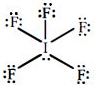
- 79. \(O_2^+ ; O_2 , O_2^-\) અને \(O_2^{2-}\) માટે \(O -O\) બંધમાં આંતરકેન્દ્રિય અંતર અનુક્રમે જણાવો. 2013 મધ્યમ
- (A) \(1.30\mathop {\,A}\limits^o ,1.49\,\mathop A\limits^o ,1.12\,\mathop A\limits^o ,1.21\,\mathop A\limits^o \)
- (B) \(1.49\mathop {\,A}\limits^o ,1.21\,\mathop A\limits^o ,1.12\,\mathop A\limits^o ,1.30\,\mathop A\limits^o \)
- (C) \(1.21\mathop {\,A}\limits^o ,1.12\,\mathop A\limits^o ,1.49\,\mathop A\limits^o ,1.30\,\mathop A\limits^o \)
- (D) \(1.12\mathop {\,A}\limits^o ,1.21\,\mathop A\limits^o ,1.30\,\mathop A\limits^o ,1.49\,\mathop A\limits^o \)
જવાબ અને ઉકેલ જુઓ
સાચો જવાબ: (D)
The bond length follows the order \(O_2^+ < O_2 < O_2^- < O_2^{2-}\) According to this the possible values are \(1.12\mathop {\,A}\limits^o ,1.21\,\mathop A\limits^o ,1.30\,\mathop A\limits^o ,1.49\,\mathop A\limits^o \) -
- (A) \({H_2} > {B_2} > L{i_2}\)
- (B) \(L{i_2} > {H_2} > {B_2}\)
- (C) \(L{i_2} > {B_2} > {H_2}\)
- (D) એકપણ નહીં
જવાબ અને ઉકેલ જુઓ
સાચો જવાબ: (D)
None of the given option is correct.The molecular orbital configuration of the given molecules is
\(H_2 = \sigma 1s^2\) (no electron anti-bonding)
\(L{i_2} = \sigma 1{s^2}\,{\sigma ^*}1{s^2}\,\sigma 2{s^2}\,\) (two anti - bonding electrons)
\({B_2} = \sigma 1{s^2}\,{\sigma ^*}1{s^2}\,\sigma 2{s^2}\,{\sigma ^*}2{s^2}\)
\(\left\{ {\pi 2p_y^1 = \pi 2p_z^1} \right\}\)
(\(4\) anti-bonding electrons)
Though the bond order of all the specie are same \((B.O=1)\) but stability is different.
This is due to difference in the presence of no. of anti-bonding electron.
Higher the no. of anti-bonding electron lower is the stability hence the correct order is
\(H_2 > Li_2 >B_2\)
- 81. \(Ca, Ba, S, Se\) અને \(Ar\) માટે નીચેના પૈકી ક્યો ક્રમ પ્રથમ આયનીકરણ એન્થાલ્પીનો સાચો ચઢતો ક્રમ દર્શાવે છે ? 2013 અઘરું
- (A) \(Ca < S < Ba < Se < Ar\)
- (B) \(S < Se < Ca < Ba < Ar\)
- (C) \(Ba < Ca < Se < S < Ar\)
- (D) \(Ca < Ba < S < Se < Ar\)
જવાબ અને ઉકેલ જુઓ
સાચો જવાબ: (C)
\(B \)enthalpy increases along the period but decreases down the group.
The IE of an element increases as one moves across a period in the periodic table because the
electrons are held tighter by the higher effective nuclear charge.
The ionization energy of the elements decreases as one moves down the group because the electrons are held in lower-energy orbitals, away from the nucleus and therefore, are less tightly bound.
\(A r\) has higher IE because it is a noble gas and \(B a\) has the lowest IE as it is in 6 periods and more
metallic.
Hence, the correct option is \(\mathrm{C}\)
-
- (A) \(-2.55\)
- (B) \(-5.1\)
- (C) \(-10.2\)
- (D) \(+2.55\)
જવાબ અને ઉકેલ જુઓ
સાચો જવાબ: (B)
\(\mathrm{Na} \rightarrow \mathrm{Na}^{+}+\mathrm{e}^{-} \quad \mathrm{IE}=5.1 \mathrm{eV} \ldots \ldots\)\(\mathrm{Na}^{+}+\mathrm{e}^{-} \rightarrow \mathrm{Na}\)
Second reaction is inverse of first reaction,
therefore electron goes enthalapy of \(N a^{+}\)
is reverse of ionization energy
\(\therefore \Delta H_{e g}=-5.1 \mathrm{eV}\)
-
- (A) \(O> N > F > C\)
- (B) \(O> F > N > C\)
- (C) \(F > O> N > C\)
- (D) \(C > N > O> F\)
જવાબ અને ઉકેલ જુઓ
સાચો જવાબ: (B)
The second ionization potential means removal of electron from cation\(C^+ = 1s^2\,2s^2\,2p^1,\,N^+ = 1s^2\,2s^2\,2p^2\)
\(O^+ = 1s^2\,2s^2\,2p^3,\,F^+ = 1s^2\,2s^2\,2p^4\)
Therefore \(O > F > N > C\)
- 84. નીચેના પૈકી ક્યુ ઇલેક્ટ્રોનીય બંધારણ ધરાવતું તત્વ તેની સંયોજનોમાં સૌથી વધુ ઓક્સિડેશન અવસ્થા દર્શાવે છે ? 2013 મધ્યમ
- (A) \(3d ^5\,4s^2\)
- (B) \(3d ^8\,4s^2\)
- (C) \(3d ^7\,4s^2\)
- (D) \(3d ^6\,4s^2\)
જવાબ અને ઉકેલ જુઓ
સાચો જવાબ: (A)
The element with outer electron configuration \(3d^5\, 4s^2\) is \(Mn\) which exhibits oxidation states from \(+ 2\) to \(+ 7\) - 85. ફ્લોરિનના ઋણ ચિન્હ સાથે ઇલેક્ટ્રોન પ્રાપ્તિ એન્થાલ્પી કલોરિનની તુલનામાં ઓછી છે કારણ..... 2013 મધ્યમ
- (A) ફ્લોરિનની ઊંચી આયનીકરણ એન્થાલ્પી
- (B) ક્લોરીન અણુનું નાનું કદ
- (C) ફ્લોરિન અણુનું નાનું કદ
- (D) ફ્લોરિનની \(2p\) કક્ષકનું મોટું કદ
જવાબ અને ઉકેલ જુઓ
સાચો જવાબ: (C)
The electron gain enthalpy order for halogens is \(Cl >F>Br>I\) Due to small size of fluorine the extra electron to be added feels more electron-electron repulsion. Therefore fluorine has less value for electron affinity than chlorine -
- (A) \(\frac{{{K_1}{K_2}}}{{{K_3}}}\)
- (B) \(\frac{{{K_1}{K_3^2}}}{{{K_2}}}\)
- (C) \({K_1}{K_2}{K_3}\)
- (D) \(\frac{{{K_2}{K_3^3}}}{{{K_1}}}\)
જવાબ અને ઉકેલ જુઓ
સાચો જવાબ: (D)
To calculate the value of \(K_4\) in the given equation we should apply eqn. \((2)\) + eqn. \((3)\times3 \) - eqn. \((1)\) hence \({K_4} = \frac{{{K_2}{K_3^3}}}{{{K_1}}}\) -
- (A) \(\frac{1}{{\sqrt {RT} }}\)
- (B) \({\left( {RT} \right)^{1/2}}\)
- (C) \({RT}\)
- (D) \(1\)
જવાબ અને ઉકેલ જુઓ
સાચો જવાબ: (A)
\({K_P} = {K_C}{(RT)^{\Delta {n_g}}}\)For the reaction
\(CO(g) + \frac{1}{2}{O_2}(g) \leftrightarrow C{O_2}(g)\)
\(\Delta {n_g} = 1 - \left( {1 + \frac{1}{2}} \right) = - \frac{1}{2}\)
\(\therefore \,{K_P} = \frac{{{K_C}}}{{\sqrt {RT} }};\,\frac{{{K_P}}}{{{K_C}}} = \frac{1}{{\sqrt {RT} }}\)
-
- (A) \(-88\)
- (B) \(-66\)
- (C) \(-62\)
- (D) \(-44\)
જવાબ અને ઉકેલ જુઓ
સાચો જવાબ: (A)
\({N_2}(g) + \frac{1}{2}{O_2} \to {N_2}O(g)\)\(N\equiv N(g)+\frac{1}{2}(O=O\to )\overset{-}{\mathop{\underset{\centerdot \,\centerdot }{\overset{\centerdot \,\centerdot }{\mathop{N}}}\,}}\,=\overset{+}{\mathop{N}}\,=\underset{\centerdot \,\centerdot }{\overset{\centerdot \,\centerdot }{\mathop{O}}}\,(g)\)
\(\Delta H_f^o = \) [Energy required for breaking of bonds] - [Energy released for forming of bonds]
\(=(\Delta {{H}_{N=N}}+\frac{1}{2}\Delta {{H}_{O=O}}-(\Delta {{H}_{N=N}}+\Delta {{H}_{N=O}})\)
\( = (946 + \frac{1}{2} \times 468) - (418 + 607) = 170\,kJ\,mo{l^{ - 1}}\)
Resonance energy \( = 170 - 82 = 88\,kJ\,mo{l^{ - 1}}\)
-
- (A) \(241.8\)
- (B) \(22\)
- (C) \(44.1\)
- (D) \(527.7\)
જવાબ અને ઉકેલ જુઓ
સાચો જવાબ: (C)
Given\({H_2}(g) + \frac{1}{2}{O_2}(g) \to {H_2}O(l);\)
\(\Delta {H^o} = - 285.9\,kJ\,mo{l^{ - 1}}........(1)\)
\({H_2}(g) + \frac{1}{2}{O_2}(g) \to {H_2}O(g);\)
\(\Delta {H^o}= - 241.8\,kJ\,mo{l^{ - 1}}........(2)\)
We have to calculate
\({H_2}O(l) \to {H_2}O(g);\,\Delta {H^o} = ?\)
On substracting eqn. \((2)\) from eqn. \((1)\) we get
\({H_2}O(l) \to {H_2}O(g);\)
\(\Delta {H^o} = - 241.8 - ( - 285.9)\)
\( = 44.1\,kJ\,mo{l^{ - 1}}\)
-
- (A) \(-300\)
- (B) \(-350\)
- (C) \(-328\)
- (D) \(-228\)
જવાબ અને ઉકેલ જુઓ
સાચો જવાબ: (C)
Applying Hess's Law\({\Delta _f}{H^o} = {\Delta _{sub}}H + \frac{1}{2}{\Delta _{diss}}H + I.E. + E.A + {\Delta _{lattice}}H\)
\({\Delta _f}{H^o} = {\Delta _{sub}}H + \frac{1}{2}{\Delta _{diss}}H + I.E. + E.A + {\Delta _{lattice}}H\)
\(E.A. = - 617 + 286 = - 328\,kJ\,mo{l^{ - 1}}\)
\(\therefore \) electron affinity of fluorine
\( = - 328\,kJ\,mo{l^{ - 1}}\)
-
- (A) \(280\)
- (B) \(285\)
- (C) \(270\)
- (D) \(15\)
જવાબ અને ઉકેલ જુઓ
સાચો જવાબ: (B)
\(X \to Y;\,\Delta H = - 135\,kJ/mol,\)\({E_a} = 150\,kJ/mol\)
For an exothermic reaction
\({{E}_{a(F.R.)}}=\Delta H+E_{a(B.R.)}'\)
\(150 = - 135 + E_{a(B.R.)}'\)
\(E_{a(B.R.)}' = 285\,kJ/mol\)
-
- (A) \(q = +208\,J, \,w =-208\,J\)
- (B) \(q =-208\,J, w =-208\,J\)
- (C) \(q =-208\,J, w = +208\,J\)
- (D) \(q = +208\,J, w = +208\,J\)
જવાબ અને ઉકેલ જુઓ
સાચો જવાબ: (A)
Solution:-As the heat is absorbed.
\(\therefore q =+208 J\)
Now for reversible isothermal process,
\(q =- W\)
\(\therefore W =- q =-208 J\)
Hence the values of \(q\) and \(W\) for the process will be \(+208 J\) and \(-208 J\) respectively.
-
- (A) \(\Delta U\, = 0\) (વાયુનું સમતાપી પ્રતિવર્તી વિસ્તરણ)
- (B) \(w = - nRT\,\ln \frac{{{V_2}}}{{{V_1}}}\) (આદર્શ વાયુનું સમતાપી પ્રતિવર્તી વિસ્તરણ)
- (C) \(w = nRT\,\ln \frac{{{V_2}}}{{{V_1}}}\) (આદર્શ વાયુ, સમતાપી પ્રતિવર્તી વિસ્તરણ)
- (D) અચળ કદની પ્રણાલી માટે, સંકળાયેલી ઉષ્મા સીધી જ આંતરિક ઊર્જાનો ફેરફાર કરે છે
જવાબ અને ઉકેલ જુઓ
સાચો જવાબ: (C)
For isothermal reversible expansion \(w = - nRT\,\ln \frac{{{V_2}}}{{{V_1}}}\) - 94. \(1000\, kg\) દળની અને \(36\, km/hr\) ના વેગની ગતિ કરતી કારની દ-બ્રોગ્લી તરંગ લંબાઈ જણાવો. 2013 મધ્યમ
- (A) \(6.626\times10^{-34}\, m\)
- (B) \(6.626\times10^{-38}\, m\)
- (C) \(6.626\times10^{-31}\, m\)
- (D) \(6.626\times10^{-30}\, m\)
જવાબ અને ઉકેલ જુઓ
સાચો જવાબ: (B)
\(\lambda = \frac{h}{{mv}}\)\(h = 6.6 \times {10^{ - 34}}\,J - s\)
\(m = 1000\,kg\)
\(v = 36\,km/hr = \frac{{36 \times {{10}^3}}}{{60 \times 60}}\,m/\sec = 10\,m/\sec \)
\(\lambda = \frac{{6.6 \times {{10}^{ - 34}}}}{{{{10}^3} \times 10}} = 6.6 \times {10^{ - 38}}\,m\)
-
- (A) \(25\) અને \(1\)
- (B) \(8\) અને \(1\)
- (C) \(2\) અને \(4\)
- (D) \(4\) અને \(1\)
જવાબ અને ઉકેલ જુઓ
સાચો જવાબ: (B)
\((i)\) \(n=5\) means \(l=0,1,2,3,4\)since \(m= +1\)
hence total no. of electrons will be \(= 0\) (from \(s\)) \(+ 2\) (from \(p\)) \(+ 2\) (fron \(d\)) \(+ 2\) (from \(f\)) \(+ 2\) (from \(g\))
\(=0+2+2+2+2=8\)
\((ii)\) \(n=2,\,l=1,\,m_l=-1,\,m_s=-1/2\) represent \(2p\) orbital with one electron
-
- (A) \(1.214 \times 10^{-7} \,m\)
- (B) \(2.816 \times 10^{-7}\, m\)
- (C) \(6.500 \times 10^{-7}\, m\)
- (D) \(8.500 \times 10^{-7}\, m\)
જવાબ અને ઉકેલ જુઓ
સાચો જવાબ: (A)
Let \(\lambda\) is the wavelength of that photon then\(h c / \lambda=E_{2}-E_{1}\)
and using value of given E, \(E=\frac{h c}{\lambda}=2.178 \times 10^{-18} \times z^{2}\left[\frac{1}{1^{2}}-\frac{1}{2^{2}}\right](z=1)\)
\(\therefore \lambda=\frac{6.62 \times 10^{-34} \times 3 \times 10^{8}}{2.178 \times 10^{-18}} \times \frac{4}{3}=1.214 \times 10^{-7} \mathrm{m}\)
- 97. હાઈડ્રોજન વર્ણપટની બામર શ્રેણીમા પ્રથમ ઉત્સર્જન રેખાનો તરંગ આંક જણાવો. \((\,R =\) રીડબર્ગ અચળાંક \()\) 2013 મધ્યમ
- (A) \(\frac {5}{36}\,\,R\)
- (B) \(\frac {9}{400}\,\,R\)
- (C) \(\frac {7}{6}\,\,R\)
- (D) \(\frac {3}{4}\,\,R\)
જવાબ અને ઉકેલ જુઓ
સાચો જવાબ: (A)
\(\bar v = R{Z^2}\left( {\frac{1}{{{2^2}}} - \frac{1}{{{3^2}}}} \right)\)\( = R\left( {\frac{1}{4} - \frac{1}{9}} \right)\)
\( = \frac{{5R}}{{36}}\)
- 98. કોઈ એક પરમાણુમા કેટલી કક્ષકો, ક્વોન્ટમ આંક \(n = 3, l = 2\) અને \(m_l = + 2\) ધરાવે છે ? 2013 મધ્યમ
- (A) \(5\)
- (B) \(3\)
- (C) \(1\)
- (D) \(7\)
જવાબ અને ઉકેલ જુઓ
સાચો જવાબ: (C)
\(n=3,\,l=2\) means \(3d\) orbitali.e. in an atom only one orbital can have the value \(m_l = +2\)
આ પેજ પર આ ફિલ્ટર મુજબ કોઈ પ્રશ્ન નથી.