


JEE Mains 2019 Chemistry ના બધા પ્રશ્નો
25 પ્રકરણ237 માંથી 151–200 પ્રશ્નો
-
- (A) \(490\)
- (B) \(445\)
- (C) \(495\)
- (D) \(890\)
જવાબ અને ઉકેલ જુઓ
સાચો જવાબ: (C)
\(2{C_{57}}{H_{110}}{O_6}(s) + 163{O_2}(g) \to \) \(114C{O_2}(g) + 110{H_2}O(l)\)\(\frac{{Moles\,of\,{C_{57}}{H_{110}}{O_6}}}{2} = \frac{{Moles\,of\,{H_2}O}}{{110}}\)
\(\frac{{\frac{{445}}{{890}}}}{2} = \frac{{\frac{{Mass\,of\,{H_2}O}}{{18}}}}{{110}}\)
Mass of \(H_2O = 495\,g\)
-
- (A) \(0.84\)
- (B) \(33.6\)
- (C) \(16.8\)
- (D) \(8.4\)
જવાબ અને ઉકેલ જુઓ
સાચો જવાબ: (A)
Let \(NaHCO_3 = x\,gm\)Then, \(H_2C_2O_4 = (10-x)\,gm\)
\(\therefore \,{n_{NaHC{O_3}}} = \frac{x}{{84}}\)
\(2NaHC{O_3} \to N{a_2}C{O_3} + {H_2}O + C{O_2}\)
\(\therefore {n_{C{O_2}}} = \frac{x}{{168}}\)
Total \(C{O_2} = \frac{x}{{168}} + \frac{{10 - x}}{{90}} = \frac{{0.25}}{{25}}\)
On solving \('x'\)
\(\% = \frac{x}{{10}} \times 100 = 10\,x\)
\({n_{{H_2}{C_2}{O_4}}} = \left( {\frac{{10 - x}}{{90}}} \right)\)
\({H_2}{C_2}{O_4} \to {H_2}O + C{O_2} + CO\)
\(\therefore {n_{C{O_2}}} = \left( {\frac{{10 - x}}{{90}}} \right)\)
-
- (A) \(40\)
- (B) \(10\)
- (C) \(20\)
- (D) None of these
જવાબ અને ઉકેલ જુઓ
સાચો જવાબ: (A)
Eq. of \((COOH)_2\) \(=\) Eq. of \(NaOH\)\(50 \times 0.5 \times 2 = 25 \times M \times 1\)
Mass of \(NaOH\) in \(50\, mL\) \( = \frac{{50 \times 2}}{{1000}} \times 40 = 4\,g\)
-
- (A) \(12\)
- (B) \(4\)
- (C) \(8\)
- (D) \(16\)
જવાબ અને ઉકેલ જુઓ
સાચો જવાબ: (C)
Molality of \(N{a^ + } = \left( {\frac{w}{M} \times \frac{{1000}}{w}} \right) \times 2\) (\(Na_2SO_4\) contains two \(Na^+\) ions) \( = \left[ {\left( {\frac{{92}}{{23}} \times \frac{{1000}}{{1000}}} \right)} \right] \times 2 = 8\) -
- (A) ફ્રીડલ ક્રાફ્ટ આલ્કાઈલેશન
- (B) રિમાર ટીમાન પ્રક્રિયા
- (C) એનીલીન નું સંશ્લેષણ
- (D) ફ્રીડલ ક્રાફ્ટ એસાઈલેશન
જવાબ અને ઉકેલ જુઓ
સાચો જવાબ: (A)
Polysubstitution is a major drawback of Friedal craft’s alkylation. It is so because activating behaviour of benzene ring increases with increase in number of alkyl group on benzene ring - 156. નીચેના પૈકી ક્યા આલ્કીનની જ્યારે \(HCI\) સાથે પ્રક્રિયા કરવામાં આવે ત્યારે મુખ્યત્વે પ્રતિમાર્કોવનિકોવ નીપજ આપે છે? 2019 અઘરું
- (A) \(H_2N -CH = CH_2\)
- (B) \(F_3C -CH = CH_2\)
- (C) \(CH_3 O -CH = CH_2\)
- (D) \(Cl -CH = CH_2\)
જવાબ અને ઉકેલ જુઓ
સાચો જવાબ: (B)
In this case antimarkonikov product will be formed as major product because carbocation formed at a double bonded carbon having lesser number of \(H\) atom will be unstable due to presence of an electron with drawing group \((CF_3)\) attached to it.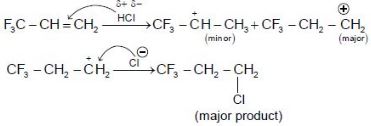
- 157. નીચેની પ્રક્રિયાની મુખ્ય નીપજ જણાવો. \(C{H_3}C \equiv CH\xrightarrow[{(ii)\,Dl}]{{(i)\,DCl\,\,(1\,equiv)}}\) 2019 અઘરું
- (A) \(CH_3CD(I)CHD(Cl)\)
- (B) \(CH_3C(I)(Cl)CHD_2\)
- (C) \(CH_3CD_2CH(Cl)(I)\)
- (D) \(CH_3CD(Cl)CHD(I)\)
જવાબ અને ઉકેલ જુઓ
સાચો જવાબ: (B)
\(C{{H}_{3}}C\equiv CH\xrightarrow{DCl}\begin{matrix}
Cl\,\,\, \\
|\,\,\, \\
C{{H}_{3}}-C=CHD \\
\end{matrix}\) \(\xrightarrow{DI}\begin{matrix}
Cl\,\, \\
|\,\,\, \\
C{{H}_{3}}-C-CH{{D}_{2}} \\
\,|\,\,\,\, \\
I\,\,\, \\
\end{matrix}\) -
- (A) \(\alpha - \) હાઈડ્રોજન
- (B) \(\gamma - \) હાઈડ્રોજન
- (C) \(\delta - \) હાઈડ્રોજન
- (D) \(\beta - \) હાઈડ્રોજન
જવાબ અને ઉકેલ જુઓ
સાચો જવાબ: (B)
Allylic radical will form in presence of sunlight -
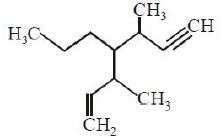
- (A) \(3, 5-\) ડાયમિથાઇલ \(-4-\) પ્રોપાઇલહેપ્ટ \(-1-\) ઇન \(-6-\) આઇન
- (B) \(3-\) મિથાઇલ\(-4-\) (\(1-\) મિથાઇલપ્રોપ \(-2-\) આઇનાઇલ) \(-1-\) હેપ્ટીન
- (C) \(3-\) મિથાઇલ\(-4-\) (\(3-\) મિથાઇલપ્રોપ \(-1-\) ઇનાઇલ) \(-1-\) હેપ્ટાઇન
- (D) \(3, 5-\) ડાયમિથાઇલ\(-4-\) પ્રોપાઇલહેપ્ટ \(-6-\) ઇન \(-1-\) આઇન
જવાબ અને ઉકેલ જુઓ
સાચો જવાબ: (A)
According to \(IUPAC\) rules, select the largest chain including functional group, if alkene and alkyne are present at equivalent position then priority is given to alkene. -
- (A) \(C_{12}H_8N\)
- (B) \(C_{12}H_8N_2\)
- (C) \(C_6H_8N_2\)
- (D) \(C_6H_8N\)
જવાબ અને ઉકેલ જુઓ
સાચો જવાબ: (C)
\(CO_2 = 6\,mole,\,N_1 = 1\,mole\) \(C_{atom}= 6,\,N_{atom} = 2\) Hence \(C_6H_8N_2\) -
- (A) \(a - d, b -r, c -p\)
- (B) \(a -q, b -r, c -s\)
- (C) \(a -r, b -p, c -s\)
- (D) \(a -q, b -r, c -p\)
જવાબ અને ઉકેલ જુઓ
સાચો જવાબ: (B)
(mixture) \(\quad\quad\quad\quad\) (seperation method)\(H _2 O : \text { Sugar } \Rightarrow \text { Recrystallization }\)
\(H _2 O : \text { Aniline } \Rightarrow \text { Steam distillation }\)
\(H _2 O \text { : Toluene } \Rightarrow \text { Differential extraction }\)
-
- (A) \(a\, \to \,q,\,\,b \to \,p,\,\,c \to r\)
- (B) \(a\, \to \,r,\,\,b \to \,q,\,\,c \to p\)
- (C) \(a\, \to \,q,\,\,b \to \,r,\,\,c \to p\)
- (D) \(a\, \to \,p,\,\,b \to \,r,\,\,c \to q\)
જવાબ અને ઉકેલ જુઓ
સાચો જવાબ: (B)
Acetonitrile is used as mobile phase for most of the reverse chromatography. Benzaldehyde is adsorbed on alumina. - 163. નીચે આપેલા આલ્ડિહાઇડો પૈકી ક્યા એક તુલ્ય જેટલા ગ્રીગનાર્ડ પ્રક્રીયક સાથે પ્રક્રિયા કરી ગ્રીગનાર્ડ પદાર્થ આપતા નથી તે/તેઓ કયા છે?
 2019 અઘરું
- (A) \((b),\,\,(d)\)
- (B) \((b),\,\,(c)\)
- (C) \((b)\,,\,(c)\,,\,(d)\)
- (D) \((c)\,\,(d)\)
જવાબ અને ઉકેલ જુઓ
સાચો જવાબ: (A)
Each of \((b)\) and \((d)\) will react two moles of Grignard reagent. -
- (A) \((b) < (a) < (c) < (d)\)
- (B) \((b) < (a) < (d) < (c)\)
- (C) \((a) < (b) < (d) < (c)\)
- (D) \((a) < (b) < (c) < (d)\)
જવાબ અને ઉકેલ જુઓ
સાચો જવાબ: (C)
The order is identical to nucleophilic substitution order: Acid chloride \(>\) Acid anhydride \(>\) Acid \(>\) Amide - 165. નીચેની પ્રક્રિયામાં આલ્ડીહાઇડ \(+\) આલ્કોહોલ \(\xrightarrow{{HCl}}\) એસિટાલ \(HCHO\) \(^tBuOH\)
\(CH_3CHO\) \(MeOH\) સૌથી યોગ્ય જોડી કઈ? 2019 મધ્યમ- (A) \(CH_3CHO\) અને \(^tBuOH\)
- (B) \(HCHO\) અને \(MeOH\)
- (C) \(CH_3CHO\) અને \(MeOH\)
- (D) \(HCHO\) અને \(^tBuOH\)
જવાબ અને ઉકેલ જુઓ
સાચો જવાબ: (B)
\(Rate \propto \frac{1}{{{\text{Steric Crowding}}}}\) - 166. નીચેની પ્રકિયામાં
કાર્બોનીલ સંયોજન \( + MeOH\overset {HCl} \longleftrightarrow {\text{acetal}}\) પ્રકિયા નો દર કોના માટે વધારે હશે ? 2019 અઘરું- (A) એસિટોન દ્રાવક તરીકે અને તત્વયોગમીતીય જથ્થામાં મિથેનોલ
- (B) પ્રોપેનાલ દ્રાવક તરીકે અને તત્વયોગમીતીય જથ્થામાં મિથેનોલ
- (C) એસિટોન દ્રાવક તરીકે અને મિથેનોલ વધારે જથ્થામાં
- (D) પ્રોપેનાલ દ્રાવક તરીકે અને મિથેનોલ વધારે જથ્થામાં
જવાબ અને ઉકેલ જુઓ
સાચો જવાબ: (D)
Ketones \(<\) Aldehyde \(\longrightarrow\) Rate of Nucleophilic addition reaction Only aldehydes are responsible for formation of acetals. Excess of \(MeOH\) is used to drive the reaction towards forward direction -
- (A) Torsional strain
- (B) કોણીય તણાવ
- (C) અવકાશીય આંતરક્રિયા
- (D) આંતરક્રિયાના વિધુતસ્થિતિકીય બળો
જવાબ અને ઉકેલ જુઓ
સાચો જવાબ: (B)
Angle strain govern stability in cyclic compound. -
- (A) \(58\)
- (B) \(120\)
- (C) \(149\)
- (D) \(151\)
જવાબ અને ઉકેલ જુઓ
સાચો જવાબ: (C)
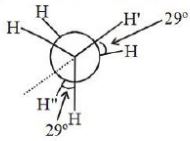
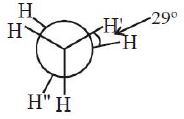
Dihedral angle is then angle between bond pairs present on adjacent atoms.\(H'-C-C-H''\)
Hence angle between
\(H' - C - C - H"\) is
\(({120^o} + {29^o}) = {149^o}\)
-
- (A) \(Li^+ > Na^+ > K^+ > Cs^+ > Rb^+\)
- (B) \(Na^+> Li^+ > K^+ > Rb^+ > Cs^+\)
- (C) \(Na^+ > Li^+ > K^+ > Cs^+ > Rb^+\)
- (D) \(Li^+ > Na^+ > K^+ > Rb^+ > Cs^+\)
જવાબ અને ઉકેલ જુઓ
સાચો જવાબ: (D)
Hydration enthalpy depends upon ionic potential (charge/size). As ionic potential increases hydration enthalpy increases \({\Delta _{hyd}}{H^o} \propto \frac{q}{r}\) - 170. આણ્વિય કક્ષક સિદ્ધાંત મુજબ \(Li_2^ + \) અને \(Li_2^ - \) ના સંદર્ભમાં નીચેના પૈકી ક્યુ સાચુ છે ? 2019 મધ્યમ
- (A) \(Li_2^ + \) અસ્થાયી છે અને \(Li_2^ - \) સ્થાયી છે
- (B) \(Li_2^ + \) સ્થાયી છે અને \(Li_2^ - \) અસ્થાયી છે
- (C) બંને સ્થાયી છે
- (D) બંને અસ્થાયી છે
જવાબ અને ઉકેલ જુઓ
સાચો જવાબ: (C)
\(Li_2^+\):
કુલ ઇલેક્ટ્રોન = \(3 \times 2 - 1 = 5\)
MO ગોઠવણી: \((\sigma 1s)^2 (\sigma^* 1s)^2 (\sigma 2s)^1\)
બંધ ક્રમ (\(BO\)) = \(\frac{1}{2}(3 - 2) = 0.5\)
\(Li_2^-\):
કુલ ઇલેક્ટ્રોન = \(3 \times 2 + 1 = 7\)
MO ગોઠવણી: \((\sigma 1s)^2 (\sigma^* 1s)^2 (\sigma 2s)^2 (\sigma^* 2s)^1\)
બંધ ક્રમ (\(BO\)) = \(\frac{1}{2}(4 - 3) = 0.5\)
બંનેનો બંધ ક્રમ \(0.5\) હોવાથી, બંને સ્થાયી છે.
-
- (A) સૌથી ઓછી વિયોજન એન્થાલ્પી
- (B) સૌથી પ્રબળ વાન ડર વાલ્સ આંતરક્રિયા
- (C) પ્રબળ હાઇડ્રોજન બંધ
- (D) સૌથી ઓછી આયનીય લાક્ષણિકતા
જવાબ અને ઉકેલ જુઓ
સાચો જવાબ: (C)
\(HF\) has strong hydrogen bond. \(\therefore \) It has highest boiling point among hydrogen halides. The strong hydrogen bond is due to more difference in electronegativity between \(F\) and \(H\) atoms -
- (A) ફકત \(I\) અને \(II\)
- (B) \(I\), \(II\) અને \(III\)
- (C) ફકત \(I\) અને \(III\)
- (D) ફકત \(II\) અને \(III\)
જવાબ અને ઉકેલ જુઓ
સાચો જવાબ: (C)
\((i)\) \(VBT\) does not explain colour exhibited by complex of transition metal because splitting of \(d-\) orbitals in explained by \(CFT\). \((ii)\) \(VBT\) does not distinguish between strong and weak field complex. \((iii)\) \(VBT\) does not give quantitative interpretation of magnetic properties. \(\therefore \) According to question statement \(I\) and \(III\) are correct -
- (A) \([IF_6]^ -\)
- (B) \([ICl_4]^ -\)
- (C) \([ICl_2]^ -\)
- (D) \([BrF_2]^ -\)
જવાબ અને ઉકેલ જુઓ
સાચો જવાબ: (B)
\({[IC{l_4}]^ - } \to s{p^3}{d^2}\)\({[I{F_6}]^ - } \to s{p^3}{d^3}\)
\({[IC{l_2}]^ - } \to s{p^3}d\)
\({[Br{F_2}]^ - } \to s{p^3}d\)
- 174. નીચેના અણુ/આયન પૈકી ક્યો એક પ્રતિચુંબકીય છે અને સૌથી ઓછી બંધલંબાઇ ધરાવે છે ? \(C_2^{2-} ,N_2^{2-} ,O_2^{2-},O_2\) 2019 અઘરું
- (A) \(O_2^{2-}\)
- (B) \(C_2^{2-}\)
- (C) \(O_2\)
- (D) \(N_2^{2-}\)
જવાબ અને ઉકેલ જુઓ
સાચો જવાબ: (B)
\(C_2^{2 - } - {\sigma _{1s}}2{\sigma ^*}_{1s}2{\sigma _{2s}}2{\sigma ^*}_{2{s^2}}[{\pi _{2p_x^2}} = {\pi _2}p_y^2]{\sigma _{2p_z^2}}\)\(B.O = \frac{{10 - 4}}{2} = 3\) (diamagnetic)
\(N_2^{2 - } - {\sigma _{1s}}2{\sigma ^*}_{1s}2{\sigma _{2s}}2{\sigma ^*}_{2{s^2}}[{\pi _{2p_x^2}} = {\pi _2}p_y^2]{\sigma _{2p_z^2}}[{\pi _{2p_x^1}} = {\pi ^*}_{2p_y^1}]\)
\(B.O = \frac{{10 - 6}}{2} = 2\) (paramagnetic)
\(O_2^{2 - } - {\sigma _{1s}}2{\sigma ^*}_{1s}2{\sigma _{2s}}2{\sigma ^*}_{2s}2{\sigma _{2p_z^2}}[{\pi _{2p_x^2}} = {\pi _2}p_y^2]\,[{\pi _{2p_x^2}} = {\pi ^*}_2p_y^2]\)
\(B.O = \frac{{10 - 8}}{2} = 1\) (diamagnetic)
\({O_2} - {\sigma _{1s}}2{\sigma ^*}_{1s}2{\sigma _{2s}}2{\sigma ^*}_{2s}2{\sigma _{2p_z^2}}\,[{\pi _{2p_x^2}} = {\pi _2}p_y^2]\,[{\pi _{2p_x^2}} = {\pi ^*}_2p_y^2]\)
\(B.O = \frac{{10 - 6}}{2} = 2\) (paramagnetic)
-
- (A) \(O_2\)
- (B) \(NO\)
- (C) \(B_2\)
- (D) \(CO\)
જવાબ અને ઉકેલ જુઓ
સાચો જવાબ: (D)
\(CO\) is diamagnetic in nature due to absence of any unpaired electron. - 176. નીચેના પૈકી ક્યો અણુ ઋણાયનના સર્જન દ્વારા સ્થાયી બનવાની અપેક્ષા રાખી શકાય ? \(C_2 , O_2 , NO , F_2\) 2019 અઘરું
- (A) \(F_2\)
- (B) \(C_2\)
- (C) \(O_2\)
- (D) \(NO\)
જવાબ અને ઉકેલ જુઓ
સાચો જવાબ: (B)
\(C_2\) configuration\(\sigma 1{s^2}{\sigma ^*}1{s^2}\sigma 2{s^2}{\sigma ^*}2{s^2}_{\pi 2{p_z}^2}^{\pi 2{p_y}^2}\sigma 2Px\)
\(C_2^-\) configuration
\(\sigma 1{s^2}{\sigma ^*}1{s^2}\sigma 2{s^2}{\sigma ^*}2{s^2}_{\pi 2{p_z}^2}^{\pi 2{p_y}^2}\sigma 2P_x^1\)
- 177. નીચેના પૈકી પ્રક્રિયામાં ક્રમમાં બંધક્રમાંક વધે છે અને અનુચુંબકીય લાક્ષણિકતા પ્રતિચુંબકીયમાં બદલાઈ જાય છે ? 2019 અઘરું
- (A) \(NO\,\to \,NO^+\)
- (B) \(N_2\,\to \,N_2^+\)
- (C) \(O_2\,\to \,O_2^+\)
- (D) \(O_2\,\to \,O_2^{2-}\)
જવાબ અને ઉકેલ જુઓ
સાચો જવાબ: (A)
\(B.O\) \(\mathop {\mathop {NO}\limits_{0.5} }\limits_{Para} \to \mathop {\mathop {N{O^ + }}\limits_3 }\limits_{Dia} \) \(B.O\) \(\mathop {\mathop {{N_2}}\limits_3 }\limits_{Dia} \to \mathop {\mathop {N_2^ + }\limits_{2.5} }\limits_{Para} \)\(B.O\) \(\mathop {\mathop {{O_2}}\limits_2 }\limits_{Para} \to \mathop {\mathop {O_2^ + }\limits_{2.5} }\limits_{Para} \) \(B.O\) \(\mathop {\mathop {{O_2}}\limits_2 }\limits_{Para} \to \mathop {\mathop {O_2^{2 - }}\limits_1 }\limits_{Dia} \)
-
- (A) \(O_2^ + \)
- (B) \(N_2\)
- (C) \(O_2\)
- (D) \(N_2^ + \)
જવાબ અને ઉકેલ જુઓ
સાચો જવાબ: (D)
\({N_{{2^ \oplus }}} \Rightarrow BO = 2.5 \Rightarrow [\pi = Bond = 2\,\& \sigma - Bond = \frac{1}{2}]\)\({N_2} \Rightarrow B.O. = 3.0 \Rightarrow [\pi - Bond = 2\,\& \sigma - Bond = 1]\)
\({O_{{2^ \oplus }}} = B.O. \Rightarrow 2.5 \Rightarrow [\pi - Bond = 1.5\,\& \sigma - Bond = 1]\)
\({O_2} \Rightarrow B.O. \Rightarrow 2 \Rightarrow [\pi - Bond \Rightarrow 1\,\& \sigma - Bond = 1]\)
-
- (A) \(Sn\)
- (B) \(C\)
- (C) \(Ge\)
- (D) \(Si\)
જવાબ અને ઉકેલ જુઓ
સાચો જવાબ: (B)
It is due to the smallest atomic size of carbon in the given options. - 180. \(71\) જેટલો પરમાણ્વિય ક્રમાંક ધરાવતા તત્વ \(X\) નો \(71\) મો ઇલેક્ટ્રોન કઈ કક્ષકમાં દાખલ થશે ? 2019 મધ્યમ
- (A) \(6p\)
- (B) \(4f\)
- (C) \(5d\)
- (D) \(6s\)
જવાબ અને ઉકેલ જુઓ
સાચો જવાબ: (C)
The electron configuration is \([Xe]4f^{14}\,5d^1\,6s^2\) -
- (A) ઓછો કેન્દ્રિય વીજભાર અને ઓછી પ્રથમ આયનીકરણ એન્થાલ્પી
- (B) વધુ કેન્દ્રિય વીજભાર અને વધુ પ્રથમ આયનીકરણ એન્થાલ્પી
- (C) વધુ કેન્દ્રિય વીજભાર અને ઓછી પ્રથમ આયનીકરણ એન્થાલ્પી
- (D) ઓછો કેન્દ્રિય વીજભાર અને વધુ પ્રથમ આયનીકરણ એન્થાલ્પી
જવાબ અને ઉકેલ જુઓ
સાચો જવાબ: (D)
Since boron has higher nuclear charge because it has greater atomic number and lower \(1^{st}\) \(I.E.\) then beryllium due to fully filled \(s-\) orbital. -
- (A) \(C < S < Al < Cs\)
- (B) \(S < C < Cs < Al\)
- (C) \(S < C < Al, Cs\)
- (D) \(C < S < Cs < Al\)
જવાબ અને ઉકેલ જુઓ
સાચો જવાબ: (A)
On moving down size increases. -
- (A) નિષ્ક્રિય જોડી અસર
- (B) વિકર્ણ સંબંધ
- (C) સ્ફટિક અસર
- (D) લેન્થેનાઇડ સંકોચન
જવાબ અને ઉકેલ જુઓ
સાચો જવાબ: (A)
The outermost electron configuration of \(Tl\) is \(6s^26p^1\). The \(6s\) electrons are strongly attracted towards the nucleus due to its more penetrating power and deshielding of \(d\) and \(f-\) electrons. Hence \(6s\) electrons do not participate in bonding - 184. જ્યારે ઓક્સિજનની પ્રથમ ઇલેક્ટ્રોન પ્રાપ્તિ એન્થાલ્પી \((\Delta _{eg}H) -141\,kJ/mol^{-1}\) હોય ત્યારે દ્વિતીય આયનીકરણ એન્થાલ્પી.......... છે . 2019 મધ્યમ
- (A) પ્રથમ ઇલેક્ટ્રોન પ્રાપ્તિ એન્થાલ્પીને લગભગ સમાન
- (B) ઋણ, પરંતુ પ્રથમ ઇલેક્ટ્રોન પ્રાપ્તિ એન્થાલ્પી કરતા ઓછી
- (C) ઋણ, પરંતુ પ્રથમ ઇલેક્ટ્રોન પ્રાપ્તિ એન્થાલ્પી કરતા વધુ ઋણ મૂલ્ય
- (D) એક ધનમૂલ્ય
જવાબ અને ઉકેલ જુઓ
સાચો જવાબ: (D)
\(2^{nd}\) electron gain enthalpy of oxygen is positive. -
- (A) \(Uun\)
- (B) \(Uue\)
- (C) \(Uuh\)
- (D) \(Uub\)
જવાબ અને ઉકેલ જુઓ
સાચો જવાબ: (B)
The \(IUPAC\) name of element having atomic number \(119\) is “Ununennium”. So its symbol is \(uue\) - 186. સામાન્ય રીતે, આવર્તકોષ્ટકમાં સમૂહમાં નીચે જતા અનુક્રમે ઘટતા અને વધતા ગુણધર્મો જણાવો . 2019 મધ્યમ
- (A) વિધુતઋણમયતા અને ઇલેક્ટ્રોનપ્રાપ્તિ એન્થાલ્પી
- (B) પરમાણ્વિય ત્રિજ્યા અને વિધુતઋણમયતા
- (C) વિધુતઋણમયતા અને પરમાણ્વિય ત્રિજ્યા
- (D) ઇલેક્ટ્રોનપ્રાપ્તિ એન્થાલ્પી અને વિધુતઋણમયતા
જવાબ અને ઉકેલ જુઓ
સાચો જવાબ: (C)
On moving down a group, electronegativity decreases and atomic radius increases for representative elements. -
- (A) \(Ti\) અને \(Hf\)
- (B) \(Mn\) અને \(Re\)
- (C) \(Sc\) અને \(Ni\)
- (D) \(Mo\) અને \(W\)
જવાબ અને ઉકેલ જુઓ
સાચો જવાબ: (D)
Due to lanthanoide contraction \(Mo\) and \(W\) have similar atomic radii. - 188. સમઇલેક્ટ્રોનીય ઘટકો \(Cl^-\) , \(Ar\) અને \(Ca^{2+}\) નું કદ કોના દ્વારા અસર પામે છે ? 2019 સરળ
- (A) સંયોજકતા કોશનો મુખ્ય ક્વોંન્ટમ આંક
- (B) સંયોજકતા કોશનો ગૌણ ક્વોંન્ટમ આંક
- (C) બહારની કક્ષકોમાં ઇલેક્ટ્રોન - ઇલેક્ટ્રોન આંતરક્રિયા
- (D) કેન્દ્રિય વીજભાર
જવાબ અને ઉકેલ જુઓ
સાચો જવાબ: (D)
For isoelectronic species the size is compared by nuclear charge. Size \( \propto \frac{1}{{{\rm{Z}}\,{\rm{ (Nuclear\, Charge)}}}}\) -
- (A) \(Te > Xe\)
- (B) \(Ga > Ge\)
- (C) \(Si > Al\)
- (D) \(P > S\)
જવાબ અને ઉકેલ જુઓ
સાચો જવાબ: (B)
Electronegativity increases from left to right in a period and decreases down the group -
- (A) આંતરસંક્રાતિ ધાતુઓ
- (B) આલ્કલાઇન અર્થ ધાતુ
- (C) આલ્કલી ધાતુ
- (D) સંક્રાતિ ધાતુઓ
જવાબ અને ઉકેલ જુઓ
સાચો જવાબ: (B)
\([Og_{118}]\, 8s^2\) is configuration for \(Z = 120\), where \(Og\) is oganesson As per the configuration it is in \(II^{nd}\) group. -
- (A) \(1, 24.62\, dm^3\, atm\, mol^{-1}\), \(606.0\, dm^6\, atm^2 \,mol\,^{-2}\)
- (B) \(1, 24.62\, dm^3\, atm\, mol^{-1}\), \(1.65 \times 10^{-3}\, dm^{-6}\, atm^{-2} \,mol\,^{2}\)
- (C) \(1,4.1 \times 10^{-2}\, dm^{-3}\, atm^{-1}\, mol\), \(606.0\, dm^6\, atm^2 \,mol\,^{-2}\)
- (D) \(24.62\, dm^3\, atm\, mol^{-1}\), \(606.0\, dm^6\, atm^2\,atm^2 \,mol\,^{-2}\) , \(1.65 \times 10^{-3}\,dm^{-6}\,atm^{-2}\,mol^2\)
જવાબ અને ઉકેલ જુઓ
સાચો જવાબ: (B)
\({K_p} = {K_{c\,}}{\left( {RT} \right)^{\Delta ng}}\) -
- (A) \(0.242\times10^{-4}\, atm^2\)
- (B) \(1\times10^{-4}\, atm^2\)
- (C) \(4.9\times10^{-3}\, atm^2\)
- (D) \(0.242\,atm^2\)
જવાબ અને ઉકેલ જુઓ
સાચો જવાબ: (D)
\(\mathop {\mathop {\mathop {N{H_4}HS(s)}\limits_{5.1\,g} }\limits_{0.1\,g\,mol\, - 0.03} }\limits_{V = 3L,\,T = 327{\,^o}C} \leftrightarrow \mathop {\mathop {\mathop {N{H_3}(g)}\limits_{} }\limits_{0.03\,mol} }\limits_{\frac{{0.98}}{2}} + \mathop {\mathop {\mathop {{H_2}S(g)}\limits_{} }\limits_{0.03\,mol} }\limits_{\frac{{0.98}}{2}} \)\({K_P} = {P_{N{H_3}}}{P_{{H_2}S}}\) \(PV = nRT\)
\({K_P} = \frac{{0.98}}{2} \times \frac{{0.98}}{2}\) \(P \times 3 = 0.06 \times 0.0821 \times 600\)
\(P = \frac{{0.06 \times 0.0821 \times 200}}{3}\)
\({K_P} = 0.243\) \(P = 0.98\,\)
-
- (A) \(\sqrt {x + y} \,atm\)
- (B) \(2\left( {\sqrt {x + y} } \right)\,atm\)
- (C) \((x + y)\, atm\)
- (D) \(x^2 + y^2\, atm\)
જવાબ અને ઉકેલ જુઓ
સાચો જવાબ: (B)
\(A(s) \leftrightarrow \mathop {B(g)}\limits_{{P_1}} + \mathop {C(g)}\limits_{{P_1} + {P_2}} \,{K_{{P_1}}} = x\,at{m^2}\)\(D(s) \leftrightarrow \mathop {C(g)}\limits_{{P_1} + {P_2}} + \mathop {E(g)}\limits_{{P_2}} \,{K_{{P_2}}} = y\,at{m^2}\)
\({K_{{P_1}}} = {P_1}({P_1} + {P_2})\)
\({K_{{P_2}}} = {P_2}({P_1} + {P_2})\)
\({K_{{P_1}}} + {K_{{P_2}}} = {({P_1} + {P_2})^2}\)
\(x + y{({P_1} + {P_2})^2}\)
\({P_1} + {P_2} = \sqrt {x + y} \)
\(2({P_1} + {P_2}) = \sqrt {x + y} \)
\({P_{Total}} = {P_B} + {P_C} + {P_E} = 2({P_1} + {P_2}) = 2\sqrt {x + y} \)
-
- (A) \({K_1}{K_2} = \frac{1}{3}\)
- (B) \({K_2} = K_1^3\)
- (C) \({K_2} = K_1^{-3}\)
- (D) \({K_1}{K_2} = 3\)
જવાબ અને ઉકેલ જુઓ
સાચો જવાબ: (C)
\({A_2}(g) + {B_2}(g)\overset {{K_1}} \longleftrightarrow 2AB(g).....(1)\)\(6AB(g)\overset {{K_2}} \longleftrightarrow 3{A_2}(g) + 3{B_2}(g).....(2)\)
Reaction \((2) = -3 \times \) reaction \((1)\)
\(\therefore \,{K_2} = {\left( {\frac{1}{{{K_1}}}} \right)^3} \Rightarrow {K_2} = K_1^{ - 3}\)
-
- (A) \(2NO\left( g \right) \rightleftharpoons {N_2}\left( g \right) + {O_2}\left( g \right)\)
- (B) \(2C\left( s \right) + {O_2}\left( g \right) \rightleftharpoons 2CO\left( g \right)\)
- (C) \(N{O_2}\left( g \right) + S{O_2}\left( g \right) \rightleftharpoons NO\left( g \right) + S{O_3}\left( g \right)\)
- (D) \(2HI\left( g \right) \rightleftharpoons {H_2}\left( g \right) + {I_2}\left( g \right)\)
જવાબ અને ઉકેલ જુઓ
સાચો જવાબ: (B)
If \(\Delta {n_g} = 0\)\({K_P} = {K_C}\)
If \(\Delta {n_g} \ne 0,\,{K_P} \ne {K_C}\)
Hence \((B)\) is correct answer.
-
- (A) \(\frac{{{3^{3/2}}K_p^{1/2}{P^2}}}{{16}}\)
- (B) \(\frac{{K_p^{1/2}{P^2}}}{16}\)
- (C) \(\frac{{K_p^{1/2}{P^2}}}{4}\)
- (D) \(\frac{{{3^{3/2}}K_p^{1/2}{P^2}}}{4}\)
જવાબ અને ઉકેલ જુઓ
સાચો જવાબ: (A)
\(\mathop {{N_2}}\limits_x + \mathop {3{H_2}}\limits_{3x} \leftrightarrow \mathop {2N{H_3}}\limits_{{P_1}} \)\({P_T} = 4x\,{K_P} = \frac{{P_1^2}}{{x \times 27 \times 3}}\)
\(x = \left( {\frac{P}{4}} \right)\)
\({P_1} = \sqrt {27{X^4}{K_P}} \)
\(\sqrt {27} \,{({K_P})^{1/2}}{\left( {\frac{{{P_T}}}{4}} \right)^2} = \frac{{{3^{3/2}}K_P^{1/2}{P^2}}}{{16}}\)
-
- (A) \(10^{77}\)
- (B) \(10^{25}\)
- (C) \(10^{181}\)
- (D) \(10^{154}\)
જવાબ અને ઉકેલ જુઓ
સાચો જવાબ: (B)
\(2S{O_2}(g) + {O_2}(g) \to 2S{O_3}(g)\)\({K_{eq}} = \frac{{{{[S{O_3}]}^2}}}{{[{O_2}]{{[S{O_2}]}^2}}}\)
\( = \frac{{{K_2}}}{{{K_1}}} = \frac{{{{10}^{129}}}}{{{{10}^{104}}}} = {10^{25}}\)
-
- (A) \(8\)
- (B) \(4\)
- (C) \(12\)
- (D) \(6\)
જવાબ અને ઉકેલ જુઓ
સાચો જવાબ: (B)
\(\mathop {\mathop A\limits_a }\limits_{(a - x)} + \mathop {\mathop {2B}\limits_{1.5a} }\limits_{(1.5a - 2x)} \leftrightarrow \mathop {\mathop {2C}\limits_0 }\limits_{2x} + \mathop {\mathop D\limits_0 }\limits_x \)Hence \({K_C} = \frac{{{{(2x)}^2} \times x}}{{(a - x){{(1.5a - 2x)}^2}}}\)
Given, at equilibrium
\(\therefore \,\,(a - x) = (1.5a - 2x)\)
\(\therefore \,\,a = 2x\)
On solving \({K_C} = 4\)
-
- (A) \(4\)
- (B) \(16\)
- (C) \(0.25\)
- (D) \(1\)
જવાબ અને ઉકેલ જુઓ
સાચો જવાબ: (A)
\(\begin{gathered} \quad \quad \quad \quad \quad \quad \quad \quad A\,\,\, + \,\,\,\,\,2B\,\,\,\,\, \rightleftharpoons \,\,\,\,2C\,\,\, + \,\,\,D \hfill \\ Initially\,\,conc.\,\,\,\,\,\,\,\,a\,\,\,\,\,\,\,\,1.5a\,\,\,\,\,\,\,\,\,\,\,\,\,\,\,\,\,\,\,\,\,\,\,\,\,\,\,\,\,\,\,\,\,\,\,\,\, \hfill \\ at\,\,equllibrium\,\,\,\,a - x\,\,1.5a - 2x\,\,\,\,\,2x\,\,\,\,\,\,\,\,\,\,x \hfill \\ \end{gathered} \)\(0.5a=x\)
\(a=2x\)
\({k_c} = \frac{{{{(2x)}^2}x}}{{(a - x){{(1.5a - 2x)}^2}}} = \frac{{4{x^2}.x}}{{(x){{(x)}^2}}} = 4\)
-
- (A) \(100\)
- (B) \(-80\)
- (C) \(80\)
- (D) \(-100\)
જવાબ અને ઉકેલ જુઓ
સાચો જવાબ: (C)
\(\Delta {G^o} = - 2.303RT\,\log \,{K_{eq}}\)\( = - 2.303 \times 8.314 \times 298\,\log \,{10^{ - 14}}\)
\( = - 2.303 \times 8.314 \times 298 \times - 14\)
\( = 79,881.87\)
\( \simeq 80\,KJ\,mo{l^{ - 1}}\)

આ પેજ પર આ ફિલ્ટર મુજબ કોઈ પ્રશ્ન નથી.