


All JEE Mains 2019 Chemistry questions
26 chaptersShowing 151–200 of 248 questions
-
- (A) Higher the value of \(K_H\) at a given pressure, higher is the solubility of the gas in the liquids
- (B) Different gases have different \(K_H\) (Henry’s law constant) values at the same temperature
- (C) The partial pressure of the gas in vapour phase is proportional to the mole fraction of the gas in the solution
- (D) The value of \(K_H\) increases with increase of temperature and \(K_H\) is function of the nature of the gas
Show answer and solution
Correct Answer: (A)
Gases having higher \(K_H\) value are less soluble -
- (A) \(2.0\,pm\)
- (B) \(2.0\,nm\)
- (C) \(1.0\,pm\)
- (D) \(0.1\,nm\)
Show answer and solution
Correct Answer: (A)
\(Moles = \frac{{MV\,ml}}{{1000}} = \frac{{{{10}^{ - 3}} \times 10}}{{1000}} = {10^{ - 5}}\,mole\)\(10^{-5}\) \(N_A\) molecules covering area \(= 0.24\,cm^2\)
\(1\) molecules covering area \( = \frac{{0.24}}{{{{10}^{ - 5}}\,{N_A}}}\)
\(\frac{{0.24}}{{{{10}^{ - 5}}\, \times 6 \times {{10}^{23}}}} = {a^2}\)
\(a^2 = 4 \times 10^{-20}\,cm^2\)
\(a = 2 \times 10^{-10}\,cm\)
\(a = 2 \times 10^{-12}\,cm\)
\(a = 2\,pm\)
-
- (A) \(25\)
- (B) \(75\)
- (C) \(50\)
- (D) \(12.5\)
Show answer and solution
Correct Answer: (A)
Apply law of equivalence :\(25 \times N = 30 \times 0.1 \times 2\)
\({N_{HCl}} = \frac{{30 \times 0.2}}{{25}} = \frac{6}{5} \times 0.2 = \frac{{1.2}}{5}\)
For the \(2^{nd}\) titration
\(\frac{{1.2}}{5} \times {V_{HCl}} = 30 \times 0.2\)
\({V_{HCl}} = \frac{{6 \times 5}}{{1.2}} = \frac{{30}}{{1.2}} = 25\,ml\)
-
- (A) \({M_A} = 50 \times {10^{ - 3}}\) and \({M_B} = 25 \times {10^{ - 3}}\)
- (B) \({M_A} = 10 \times {10^{ - 3}}\) and \({M_B} = 5 \times {10^{ - 3}}\)
- (C) \({M_A} = 5 \times {10^{ - 3}}\) and \({M_B} = 10 \times {10^{ - 3}}\)
- (D) \({M_A} = 25 \times {10^{ - 3}}\) and \({M_B} = 50 \times {10^{ - 3}}\)
Show answer and solution
Correct Answer: (C)
Mol. wt is of \(1\, mol\)
\(AB_2\) \(A + 2B = 25\)
\(A_2B_2\) \(2A + 2B = 30\) -
- (A) \(40\)
- (B) \(10\)
- (C) \(20\)
- (D) None of these
Show answer and solution
Correct Answer: (A)
Eq. of \((COOH)_2\) \(=\) Eq. of \(NaOH\)\(50 \times 0.5 \times 2 = 25 \times M \times 1\)
Mass of \(NaOH\) in \(50\, mL\) \( = \frac{{50 \times 2}}{{1000}} \times 40 = 4\,g\)
-
- (A) \(0.84\)
- (B) \(33.6\)
- (C) \(16.8\)
- (D) \(8.4\)
Show answer and solution
Correct Answer: (A)
Let \(NaHCO_3 = x\,gm\)Then, \(H_2C_2O_4 = (10-x)\,gm\)
\(\therefore \,{n_{NaHC{O_3}}} = \frac{x}{{84}}\)
\(2NaHC{O_3} \to N{a_2}C{O_3} + {H_2}O + C{O_2}\)
\(\therefore {n_{C{O_2}}} = \frac{x}{{168}}\)
Total \(C{O_2} = \frac{x}{{168}} + \frac{{10 - x}}{{90}} = \frac{{0.25}}{{25}}\)
On solving \('x'\)
\(\% = \frac{x}{{10}} \times 100 = 10\,x\)
\({n_{{H_2}{C_2}{O_4}}} = \left( {\frac{{10 - x}}{{90}}} \right)\)
\({H_2}{C_2}{O_4} \to {H_2}O + C{O_2} + CO\)
\(\therefore {n_{C{O_2}}} = \left( {\frac{{10 - x}}{{90}}} \right)\)
-
- (A) \(12\)
- (B) \(4\)
- (C) \(8\)
- (D) \(16\)
Show answer and solution
Correct Answer: (C)
Molality of \(N{a^ + } = \left( {\frac{w}{M} \times \frac{{1000}}{w}} \right) \times 2\) (\(Na_2SO_4\) contains two \(Na^+\) ions) \( = \left[ {\left( {\frac{{92}}{{23}} \times \frac{{1000}}{{1000}}} \right)} \right] \times 2 = 8\) -
- (A) \(C_4H_{10}\)
- (B) \(C_4H_6\)
- (C) \(C_4H_7Cl\)
- (D) \(C_4H_8\)
Show answer and solution
Correct Answer: (B)
\(\mathop {{C_x}{H_y}}\limits_{10} + \mathop {\left( {x + \frac{y}{4}} \right){O_2}}\limits_{10\left( {x + \frac{y}{4}} \right)} \to \mathop {xC{O_2}}\limits_{10x} + \frac{y}{2}{H_2}O\)By given data, \(10\left( {x + \frac{y}{4}} \right) = 55....(1)\)
\(10x = 40....(2)\)
\(\therefore x = 4,\,y = 6 \Rightarrow {C_4}{H_6}\)
-
- (A) \(490\)
- (B) \(445\)
- (C) \(495\)
- (D) \(890\)
Show answer and solution
Correct Answer: (C)
\(2{C_{57}}{H_{110}}{O_6}(s) + 163{O_2}(g) \to \) \(114C{O_2}(g) + 110{H_2}O(l)\)\(\frac{{Moles\,of\,{C_{57}}{H_{110}}{O_6}}}{2} = \frac{{Moles\,of\,{H_2}O}}{{110}}\)
\(\frac{{\frac{{445}}{{890}}}}{2} = \frac{{\frac{{Mass\,of\,{H_2}O}}{{18}}}}{{110}}\)
Mass of \(H_2O = 495\,g\)
-
- (A) \(136.8\)
- (B) \(17.1\)
- (C) \(68.4\)
- (D) \(34.2\)
Show answer and solution
Correct Answer: (C)
\(0.1 = \frac{{{n_{{C_{12}} + {H_{22}} + {O_{11}}}}}}{2}\)\({n_{{C_{12}} + {H_{22}} + {O_{11}}}} = 0.2\)
\(W{t_{{C_{12}} + {H_{22}} + {O_{11}}}} = 0.2 \times 342 = 68.4\)
-
- (A) \(C_3H_8(g) + 5O_2(g) \to 3CO_2(g) + 4H_2O(l)\)
- (B) \(P_4(s) + 5O_2(g) \to P_4O_{10}(s)\)
- (C) \(4Fe(s) + 3O_2(g) \to 2Fe_2O_3(s)\)
- (D) \(2Mg(s) + O_2(g) \to 2MgO(s)\)
Show answer and solution
Correct Answer: (C)
\(4\,mol\) of \(Fe\) require \(3 \times 32\,gram\)\(\frac {1}{56}\,mol\) of \(Fe\) require \(=\frac {3\times 32}{4}\,\times \frac {1}{56}\,=\,0.428\,g\)
-
- (A) \(80\)
- (B) \(20\)
- (C) \(75\)
- (D) \(25\)
Show answer and solution
Correct Answer: (B)
In \(CH_4\)Mole of carbon \(n_C = 1\)
Mole of hydrogen \(= n_H = 4\)
\(\%\) of \(n_C\) \( = \frac{{{n_C}}}{{{n_C} + {n_H}}} \times 100 = \frac{1}{5} \times 100 = 20\% \)
- 163. What would be the molality of \(20\%\) (mass/mass) aqueous solution of \(KI\) ? (molar mass of \(KI = 166\, g\, mol^{-1}\)) 2019 Hard
- (A) \(1.08\)
- (B) \(1.48\)
- (C) \(1.51\)
- (D) \(1.35\)
Show answer and solution
Correct Answer: (C)
\(20\%\,w/w\,KI\)Mass of solute \((KI) = 20\,g\)
Mass of solvent \(= 100-20 = 80\,g\)
Molar mass of \(KI = 38+128 = 166\)
Molality \( = \frac{{gm\,(solute)}}{{mw\, \times Kg\,(solvent)}} = \frac{{20 \times 1000}}{{166 \times 80}} = 1.506 = 1.51\)
-
- (A) Friedel Craft’s alkylation
- (B) Reimer Tiemann reaction
- (C) Acetylation of aniline
- (D) Friedel Craft’s acylation
Show answer and solution
Correct Answer: (A)
Polysubstitution is a major drawback of Friedal craft’s alkylation. It is so because activating behaviour of benzene ring increases with increase in number of alkyl group on benzene ring - 165. The major product of the following reaction is \(C{H_3}C \equiv CH\xrightarrow[{(ii)\,Dl}]{{(i)\,DCl\,\,(1\,equiv)}}\) 2019 Hard
- (A) \(CH_3CD(I)CHD(Cl)\)
- (B) \(CH_3C(I)(Cl)CHD_2\)
- (C) \(CH_3CD_2CH(Cl)(I)\)
- (D) \(CH_3CD(Cl)CHD(I)\)
Show answer and solution
Correct Answer: (B)
\(C{{H}_{3}}C\equiv CH\xrightarrow{DCl}\begin{matrix}
Cl\,\,\, \\
|\,\,\, \\
C{{H}_{3}}-C=CHD \\
\end{matrix}\) \(\xrightarrow{DI}\begin{matrix}
Cl\,\, \\
|\,\,\, \\
C{{H}_{3}}-C-CH{{D}_{2}} \\
\,|\,\,\,\, \\
I\,\,\, \\
\end{matrix}\) -
- (A) \(\alpha - \) hydrogen
- (B) \(\gamma - \) hydrogen
- (C) \(\delta - \) hydrogen
- (D) \(\beta - \) hydrogen
Show answer and solution
Correct Answer: (B)
Allylic radical will form in presence of sunlight - 167. Which one of the following alkenes when treated with \(HCl\) yields majorly an anti Markovnikov product? 2019 Hard
- (A) \(H_2N -CH = CH_2\)
- (B) \(F_3C -CH = CH_2\)
- (C) \(CH_3 O -CH = CH_2\)
- (D) \(Cl -CH = CH_2\)
Show answer and solution
Correct Answer: (B)
In this case antimarkonikov product will be formed as major product because carbocation formed at a double bonded carbon having lesser number of \(H\) atom will be unstable due to presence of an electron with drawing group \((CF_3)\) attached to it.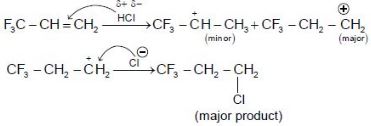
-
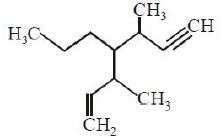
- (A) \(3, 5-\) dimethyl \(-4-\) propylhept \(-1-\) en \(-6-\) yne
- (B) \(3-\) methyl \(-4-\) (\(1-\) methylprop \(-2-\) ynyl) \(-1-\) heptene
- (C) \(3-\) methyl \(-4-\) (\(3-\) methylprop \(-1-\) enyl) \(-1-\) heptyne
- (D) \(3, 5-\) dimethyl \(-4-\) propylhept \(-6-\) en \(-1-\) yne
Show answer and solution
Correct Answer: (A)
According to \(IUPAC\) rules, select the largest chain including functional group, if alkene and alkyne are present at equivalent position then priority is given to alkene. - 169. According to molecular orbital theory, which of the following is true with respect to \(Li_2^ + \) and \(Li_2^ - \) ? 2019 Medium
- (A) \(Li_2^ + \) is unstable and \(Li_2^ - \) is stable
- (B) \(Li_2^ + \) is stable and \(Li_2^ - \) is unstable
- (C) Both are stable
- (D) Both are unstable
Show answer and solution
Correct Answer: (C)
\(Li_2^+\): Electrons = 5
MO Config: \((\sigma_{1s})^2 (\sigma_{1s}^*)^2 (\sigma_{2s})^1\)
Bond Order = \(\frac{1}{2} (N_b - N_a) = \frac{1}{2} (3 - 2) = 0.5\)
\(Li_2^-\): Electrons = 7
MO Config: \((\sigma_{1s})^2 (\sigma_{1s}^*)^2 (\sigma_{2s})^2 (\sigma_{2s}^*)^1\)
Bond Order = \(\frac{1}{2} (N_b - N_a) = \frac{1}{2} (4 - 3) = 0.5\)
Both are stable.
- 170. Among the following molecules / ions \(C_2^{2-} ,N_2^{2-} ,O_2^{2-},O_2\) which one is diamagnetic and has the shortest bond length ? 2019 Hard
- (A) \(O_2^{2-}\)
- (B) \(C_2^{2-}\)
- (C) \(O_2\)
- (D) \(N_2^{2-}\)
Show answer and solution
Correct Answer: (B)
\(C_2^{2 - } - {\sigma _{1s}}2{\sigma ^*}_{1s}2{\sigma _{2s}}2{\sigma ^*}_{2{s^2}}[{\pi _{2p_x^2}} = {\pi _2}p_y^2]{\sigma _{2p_z^2}}\)\(B.O = \frac{{10 - 4}}{2} = 3\) (diamagnetic)
\(N_2^{2 - } - {\sigma _{1s}}2{\sigma ^*}_{1s}2{\sigma _{2s}}2{\sigma ^*}_{2{s^2}}[{\pi _{2p_x^2}} = {\pi _2}p_y^2]{\sigma _{2p_z^2}}[{\pi _{2p_x^1}} = {\pi ^*}_{2p_y^1}]\)
\(B.O = \frac{{10 - 6}}{2} = 2\) (paramagnetic)
\(O_2^{2 - } - {\sigma _{1s}}2{\sigma ^*}_{1s}2{\sigma _{2s}}2{\sigma ^*}_{2s}2{\sigma _{2p_z^2}}[{\pi _{2p_x^2}} = {\pi _2}p_y^2]\,[{\pi _{2p_x^2}} = {\pi ^*}_2p_y^2]\)
\(B.O = \frac{{10 - 8}}{2} = 1\) (diamagnetic)
\({O_2} - {\sigma _{1s}}2{\sigma ^*}_{1s}2{\sigma _{2s}}2{\sigma ^*}_{2s}2{\sigma _{2p_z^2}}\,[{\pi _{2p_x^2}} = {\pi _2}p_y^2]\,[{\pi _{2p_x^2}} = {\pi ^*}_2p_y^2]\)
\(B.O = \frac{{10 - 6}}{2} = 2\) (paramagnetic)
-
- (A) \(O_2\)
- (B) \(NO\)
- (C) \(B_2\)
- (D) \(CO\)
Show answer and solution
Correct Answer: (D)
\(CO\) is diamagnetic in nature due to absence of any unpaired electron. -
- (A) \(F_2\)
- (B) \(C_2\)
- (C) \(O_2\)
- (D) \(NO\)
Show answer and solution
Correct Answer: (B)
\(C_2\) configuration\(\sigma 1{s^2}{\sigma ^*}1{s^2}\sigma 2{s^2}{\sigma ^*}2{s^2}_{\pi 2{p_z}^2}^{\pi 2{p_y}^2}\sigma 2Px\)
\(C_2^-\) configuration
\(\sigma 1{s^2}{\sigma ^*}1{s^2}\sigma 2{s^2}{\sigma ^*}2{s^2}_{\pi 2{p_z}^2}^{\pi 2{p_y}^2}\sigma 2P_x^1\)
-
- (A) lowest dissociation enthalpy
- (B) strongest van der Waals’ interactions
- (C) strongest hydrogen bonding
- (D) lowest ionic character
Show answer and solution
Correct Answer: (C)
\(HF\) has strong hydrogen bond. \(\therefore \) It has highest boiling point among hydrogen halides. The strong hydrogen bond is due to more difference in electronegativity between \(F\) and \(H\) atoms - 174. In which of the following processes, the bond order has increased and paramagnetic character has changed to diamagnetic? 2019 Hard
- (A) \(NO\,\to \,NO^+\)
- (B) \(N_2\,\to \,N_2^+\)
- (C) \(O_2\,\to \,O_2^+\)
- (D) \(O_2\,\to \,O_2^{2-}\)
Show answer and solution
Correct Answer: (A)
\(B.O\) \(\mathop {\mathop {NO}\limits_{0.5} }\limits_{Para} \to \mathop {\mathop {N{O^ + }}\limits_3 }\limits_{Dia} \) \(B.O\) \(\mathop {\mathop {{N_2}}\limits_3 }\limits_{Dia} \to \mathop {\mathop {N_2^ + }\limits_{2.5} }\limits_{Para} \)\(B.O\) \(\mathop {\mathop {{O_2}}\limits_2 }\limits_{Para} \to \mathop {\mathop {O_2^ + }\limits_{2.5} }\limits_{Para} \) \(B.O\) \(\mathop {\mathop {{O_2}}\limits_2 }\limits_{Para} \to \mathop {\mathop {O_2^{2 - }}\limits_1 }\limits_{Dia} \)
-
- (A) \(Li^+ > Na^+ > K^+ > Cs^+ > Rb^+\)
- (B) \(Na^+> Li^+ > K^+ > Rb^+ > Cs^+\)
- (C) \(Na^+ > Li^+ > K^+ > Cs^+ > Rb^+\)
- (D) \(Li^+ > Na^+ > K^+ > Rb^+ > Cs^+\)
Show answer and solution
Correct Answer: (D)
Hydration enthalpy depends upon ionic potential (charge/size). As ionic potential increases hydration enthalpy increases\({\Delta _{hyd}}{H^o} \propto \frac{q}{r}\)
-
- (A) \(I\) and \(II\) only
- (B) \(I\), \(II\) and \(III\)
- (C) \(I\) and \(III\) only
- (D) \(II\) and \(III\) only
Show answer and solution
Correct Answer: (C)
\((i)\) \(VBT\) does not explain colour exhibited by complex of transition metal because splitting of \(d-\) orbitals in explained by \(CFT\).
\((ii)\) \(VBT\) does not distinguish between strong and weak field complex.
\((iii)\) \(VBT\) does not give quantitative interpretation of magnetic properties.
\(\therefore \) According to question statement \(I\) and \(III\) are correct -
- (A) \(Sn\)
- (B) \(C\)
- (C) \(Ge\)
- (D) \(Si\)
Show answer and solution
Correct Answer: (B)
It is due to the smallest atomic size of carbon in the given options. -
- (A) \([IF_6]^ -\)
- (B) \([ICl_4]^ -\)
- (C) \([ICl_2]^ -\)
- (D) \([BrF_2]^ -\)
Show answer and solution
Correct Answer: (B)
\({[IC{l_4}]^ - } \to s{p^3}{d^2}\)\({[I{F_6}]^ - } \to s{p^3}{d^3}\)
\({[IC{l_2}]^ - } \to s{p^3}d\)
\({[Br{F_2}]^ - } \to s{p^3}d\)
-
- (A) \(O_2^ + \)
- (B) \(N_2\)
- (C) \(O_2\)
- (D) \(N_2^ + \)
Show answer and solution
Correct Answer: (D)
\({N_{{2^ \oplus }}} \Rightarrow BO = 2.5 \Rightarrow [\pi = Bond = 2\,\& \sigma - Bond = \frac{1}{2}]\)\({N_2} \Rightarrow B.O. = 3.0 \Rightarrow [\pi - Bond = 2\,\& \sigma - Bond = 1]\)
\({O_{{2^ \oplus }}} = B.O. \Rightarrow 2.5 \Rightarrow [\pi - Bond = 1.5\,\& \sigma - Bond = 1]\)
\({O_2} \Rightarrow B.O. \Rightarrow 2 \Rightarrow [\pi - Bond \Rightarrow 1\,\& \sigma - Bond = 1]\)
- 180. Aluminium is usually found in \(+3\) oxidation state. In contrast, thallium exists in \(+1\) and \(+3\) oxidation states. This is due to 2019 Medium
- (A) inert pair effect
- (B) diagonal relationship
- (C) lattice effect
- (D) lanthanoid contraction
Show answer and solution
Correct Answer: (A)
The outermost electron configuration of \(Tl\) is \(6s^26p^1\). The \(6s\) electrons are strongly attracted towards the nucleus due to its more penetrating power and deshielding of \(d\) and \(f-\) electrons. Hence \(6s\) electrons do not participate in bonding -
- (A) greater nuclear charge and greater first ionisation enthalpy
- (B) lesser nuclear charge and lesser first ionisation enthalpy
- (C) greater nuclear charge and lesser first ionisation enthalpy
- (D) lesser nuclear charge and greater first ionisation enthalpy
Show answer and solution
Correct Answer: (D)
Since boron has higher nuclear charge because it has greater atomic number and lower \(1^{st}\) \(I.E.\) then beryllium due to fully filled \(s-\) orbital. - 182. In general, the properties that decrease and increase down a group in the periodic table respectively are 2019 Medium
- (A) atomic radius and electronegativity
- (B) electron gain enthalpy and electronegativity
- (C) electronegativity and atomic radius
- (D) electronegativity and electron gain enthalpy
Show answer and solution
Correct Answer: (C)
On moving down a group, electronegativity decreases and atomic radius increases for representative elements. - 183. The \(71^{st}\) electron of an element \(X\) with an atomic number of \(71\) enters into the orbital: 2019 Medium
- (A) \(6p\)
- (B) \(4f\)
- (C) \(5d\)
- (D) \(6s\)
Show answer and solution
Correct Answer: (C)
The electron configuration is \([Xe]4f^{14}\,5d^1\,6s^2\) - 184. The correct option with respect to the Pauling electronegativity values of the elements is 2019 Medium
- (A) \(Te > Xe\)
- (B) \(Ga > Ge\)
- (C) \(Si > Al\)
- (D) \(P > S\)
Show answer and solution
Correct Answer: (B)
Electronegativity increases from left to right in a period and decreases down the group -
- (A) \(C < S < Al < Cs\)
- (B) \(S < C < Cs < Al\)
- (C) \(S < C < Al, Cs\)
- (D) \(C < S < Cs < Al\)
Show answer and solution
Correct Answer: (A)
On moving down size increases. -
- (A) Inner transition metal
- (B) Alkaline earth metal
- (C) Alkali metal
- (D) Transition metal
Show answer and solution
Correct Answer: (B)
\([Og_{118}]\, 8s^2\) is configuration for \(Z = 120\), where \(Og\) is oganesson
As per the configuration it is in \(II^{nd}\) group. -
- (A) \(Uun\)
- (B) \(Uue\)
- (C) \(Uuh\)
- (D) \(Uub\)
Show answer and solution
Correct Answer: (B)
The \(IUPAC\) name of element having atomic number \(119\) is “Ununennium”. So its symbol is \(uue\) -
- (A) \(Ti\) and \(Hf\)
- (B) \(Mn\) and \(Re\)
- (C) \(Sc\) and \(Ni\)
- (D) \(Mo\) and \(W\)
Show answer and solution
Correct Answer: (D)
Due to lanthanoide contraction \(Mo\) and \(W\) have similar atomic radii. - 189. The size of the iso-electronic species \(Cl^-\) , \(Ar\) and \(Ca^{2+}\) is affected by 2019 Easy
- (A) Principal quantum number of valence shell
- (B) Azimuthal quantum number of valence shell
- (C) electron -electron interaction in the outer orbitals
- (D) nuclear charge
Show answer and solution
Correct Answer: (D)
For isoelectronic species the size is compared by nuclear charge.Size \( \propto \frac{1}{{{\rm{Z}}\,{\rm{ (Nuclear\, Charge)}}}}\)
- 190. When the first electron gain enthalpy \((\Delta _{eg}H)\) of oxygen is \(-141\,kJ/mol,\) its second electron gain enthalpy is 2019 Medium
- (A) a more negative value than the first
- (B) almost the same as that of the first
- (C) negative, but less negative than the first
- (D) a positive value
Show answer and solution
Correct Answer: (D)
\(2^{nd}\) electron gain enthalpy of oxygen is positive. -
- (A) \(0.242\times10^{-4}\, atm^2\)
- (B) \(1\times10^{-4}\, atm^2\)
- (C) \(4.9\times10^{-3}\, atm^2\)
- (D) \(0.242\,atm^2\)
Show answer and solution
Correct Answer: (D)
\(\mathop {\mathop {\mathop {N{H_4}HS(s)}\limits_{5.1\,g} }\limits_{0.1\,g\,mol\, - 0.03} }\limits_{V = 3L,\,T = 327{\,^o}C} \leftrightarrow \mathop {\mathop {\mathop {N{H_3}(g)}\limits_{} }\limits_{0.03\,mol} }\limits_{\frac{{0.98}}{2}} + \mathop {\mathop {\mathop {{H_2}S(g)}\limits_{} }\limits_{0.03\,mol} }\limits_{\frac{{0.98}}{2}} \)\({K_P} = {P_{N{H_3}}}{P_{{H_2}S}}\) \(PV = nRT\)
\({K_P} = \frac{{0.98}}{2} \times \frac{{0.98}}{2}\) \(P \times 3 = 0.06 \times 0.0821 \times 600\)
\(P = \frac{{0.06 \times 0.0821 \times 200}}{3}\)
\({K_P} = 0.243\) \(P = 0.98\,\)
-
- (A) \({K_1}{K_2} = \frac{1}{3}\)
- (B) \({K_2} = K_1^3\)
- (C) \({K_2} = K_1^{-3}\)
- (D) \({K_1}{K_2} = 3\)
Show answer and solution
Correct Answer: (C)
\({A_2}(g) + {B_2}(g)\overset {{K_1}} \longleftrightarrow 2AB(g).....(1)\)\(6AB(g)\overset {{K_2}} \longleftrightarrow 3{A_2}(g) + 3{B_2}(g).....(2)\)
Reaction \((2) = -3 \times \) reaction \((1)\)
\(\therefore \,{K_2} = {\left( {\frac{1}{{{K_1}}}} \right)^3} \Rightarrow {K_2} = K_1^{ - 3}\)
-
- (A) \(\frac{{{3^{3/2}}K_p^{1/2}{P^2}}}{{16}}\)
- (B) \(\frac{{K_p^{1/2}{P^2}}}{16}\)
- (C) \(\frac{{K_p^{1/2}{P^2}}}{4}\)
- (D) \(\frac{{{3^{3/2}}K_p^{1/2}{P^2}}}{4}\)
Show answer and solution
Correct Answer: (A)
\(\mathop {{N_2}}\limits_x + \mathop {3{H_2}}\limits_{3x} \leftrightarrow \mathop {2N{H_3}}\limits_{{P_1}} \)\({P_T} = 4x\,{K_P} = \frac{{P_1^2}}{{x \times 27 \times 3}}\)
\(x = \left( {\frac{P}{4}} \right)\)
\({P_1} = \sqrt {27{X^4}{K_P}} \)
\(\sqrt {27} \,{({K_P})^{1/2}}{\left( {\frac{{{P_T}}}{4}} \right)^2} = \frac{{{3^{3/2}}K_P^{1/2}{P^2}}}{{16}}\)
-
- (A) \(100\)
- (B) \(-80\)
- (C) \(80\)
- (D) \(-100\)
Show answer and solution
Correct Answer: (C)
\(\Delta {G^o} = - 2.303RT\,\log \,{K_{eq}}\)\( = - 2.303 \times 8.314 \times 298\,\log \,{10^{ - 14}}\)
\( = - 2.303 \times 8.314 \times 298 \times - 14\)
\( = 79,881.87\)
\( \simeq 80\,KJ\,mo{l^{ - 1}}\)
-
- (A) \(10^{77}\)
- (B) \(10^{25}\)
- (C) \(10^{181}\)
- (D) \(10^{154}\)
Show answer and solution
Correct Answer: (B)
\(2S{O_2}(g) + {O_2}(g) \to 2S{O_3}(g)\)\({K_{eq}} = \frac{{{{[S{O_3}]}^2}}}{{[{O_2}]{{[S{O_2}]}^2}}}\)
\( = \frac{{{K_2}}}{{{K_1}}} = \frac{{{{10}^{129}}}}{{{{10}^{104}}}} = {10^{25}}\)
-
- (A) \(4\)
- (B) \(16\)
- (C) \(0.25\)
- (D) \(1\)
Show answer and solution
Correct Answer: (A)
\(\begin{gathered} \quad \quad \quad \quad \quad \quad \quad \quad A\,\,\, + \,\,\,\,\,2B\,\,\,\,\, \rightleftharpoons \,\,\,\,2C\,\,\, + \,\,\,D \hfill \\ Initially\,\,conc.\,\,\,\,\,\,\,\,a\,\,\,\,\,\,\,\,1.5a\,\,\,\,\,\,\,\,\,\,\,\,\,\,\,\,\,\,\,\,\,\,\,\,\,\,\,\,\,\,\,\,\,\,\,\,\, \hfill \\ at\,\,equllibrium\,\,\,\,a - x\,\,1.5a - 2x\,\,\,\,\,2x\,\,\,\,\,\,\,\,\,\,x \hfill \\ \end{gathered} \)\(0.5a=x\)
\(a=2x\)
\({k_c} = \frac{{{{(2x)}^2}x}}{{(a - x){{(1.5a - 2x)}^2}}} = \frac{{4{x^2}.x}}{{(x){{(x)}^2}}} = 4\)
-
- (A) \(8\)
- (B) \(4\)
- (C) \(12\)
- (D) \(6\)
Show answer and solution
Correct Answer: (B)
\(\mathop {\mathop A\limits_a }\limits_{(a - x)} + \mathop {\mathop {2B}\limits_{1.5a} }\limits_{(1.5a - 2x)} \leftrightarrow \mathop {\mathop {2C}\limits_0 }\limits_{2x} + \mathop {\mathop D\limits_0 }\limits_x \)Hence \({K_C} = \frac{{{{(2x)}^2} \times x}}{{(a - x){{(1.5a - 2x)}^2}}}\)
Given, at equilibrium
\(\therefore \,\,(a - x) = (1.5a - 2x)\)
\(\therefore \,\,a = 2x\)
On solving \({K_C} = 4\)
-
- (A) \(2NO\left( g \right) \rightleftharpoons {N_2}\left( g \right) + {O_2}\left( g \right)\)
- (B) \(2C\left( s \right) + {O_2}\left( g \right) \rightleftharpoons 2CO\left( g \right)\)
- (C) \(N{O_2}\left( g \right) + S{O_2}\left( g \right) \rightleftharpoons NO\left( g \right) + S{O_3}\left( g \right)\)
- (D) \(2HI\left( g \right) \rightleftharpoons {H_2}\left( g \right) + {I_2}\left( g \right)\)
Show answer and solution
Correct Answer: (B)
If \(\Delta {n_g} = 0\)\({K_P} = {K_C}\)
If \(\Delta {n_g} \ne 0,\,{K_P} \ne {K_C}\)
Hence \((B)\) is correct answer.
-
- (A) \(1, 24.62\, dm^3\, atm\, mol^{-1}\), \(606.0\, dm^6\, atm^2 \,mol\,^{-2}\)
- (B) \(1, 24.62\, dm^3\, atm\, mol^{-1}\), \(1.65 \times 10^{-3}\, dm^{-6}\, atm^{-2}\, mol\,^{2}\)
- (C) \(1,4.1 \times 10^{-2}\, dm^{-3}\, atm^{-1}\, mol\), \(606.0\, dm^6\, atm^2 \,mol\,^{-2}\)
- (D) \(24.62\, dm^3\, atm\, mol^{-1}\), \(606.0\, dm^6\, atm^2\,atm^2\, mol\,^{-2}\) , \(1.65 \times 10^{-3}\,dm^{-6}\,atm^{-2}\,mol^2\)
Show answer and solution
Correct Answer: (B)
\({K_p} = {K_{c\,}}{\left( {RT} \right)^{\Delta ng}}\) -
- (A) \(\sqrt {x + y} \,atm\)
- (B) \(2\left( {\sqrt {x + y} } \right)\,atm\)
- (C) \((x + y)\, atm\)
- (D) \(x^2 + y^2\, atm\)
Show answer and solution
Correct Answer: (B)
\(A(s) \leftrightarrow \mathop {B(g)}\limits_{{P_1}} + \mathop {C(g)}\limits_{{P_1} + {P_2}} \,{K_{{P_1}}} = x\,at{m^2}\)\(D(s) \leftrightarrow \mathop {C(g)}\limits_{{P_1} + {P_2}} + \mathop {E(g)}\limits_{{P_2}} \,{K_{{P_2}}} = y\,at{m^2}\)
\({K_{{P_1}}} = {P_1}({P_1} + {P_2})\)
\({K_{{P_2}}} = {P_2}({P_1} + {P_2})\)
\({K_{{P_1}}} + {K_{{P_2}}} = {({P_1} + {P_2})^2}\)
\(x + y{({P_1} + {P_2})^2}\)
\({P_1} + {P_2} = \sqrt {x + y} \)
\(2({P_1} + {P_2}) = \sqrt {x + y} \)
\({P_{Total}} = {P_B} + {P_C} + {P_E} = 2({P_1} + {P_2}) = 2\sqrt {x + y} \)
No questions on this page match these filters.