


Chapters asked in 2016
21 chapters- 1Qs STD 11 Organic chemistry purification and characterization
- 3Qs STD 12 D and f- block elements
- 2Qs STD 12 Biomolecules
- 3Qs STD 12 Chemical kinetics
- 3Qs STD 12 Amines
- 1Qs STD 12 Aldehydes and ketones
- 2Qs STD 12 Alcohol, phenol and ethers
- 1Qs STD 12 Haloalkanes and Haloarenes
- 4Qs STD 12 Co-ordination chemistry Most asked
- 5Qs STD 12 P -Block elements - ll Most asked
- 3Qs STD 12 Electrochemistry
- 3Qs STD 12 Solution and colligative properties
- 2Qs STD 11 Some basic concept of chemistry
- 3Qs STD 11 Hydricarbon
- 1Qs STD 11 Organic chemistry Nomenclature of organic compounds
- 2Qs STD 11 Chemical bonding and molecular structure
- 2Qs STD 11 Classification of elements and periodicity in properties
- 2Qs STD 11 Equilibrium - 1 (chemical Equilibrium)
- 5Qs STD 11 Thermodynamics and thermochemistry Most asked
- 3Qs STD 11 P-Block elements - I
- 2Qs STD 11 Structure of atom
All JEE Mains 2016 Chemistry questions
21 chaptersShowing 1–50 of 53 questions
- 1. The distillation technique most suited for separating glycerol from spent-lye in the soap industry is: 2016 Medium
- (A) Steam distillation.
- (B) Distillation under reduced pressure.
- (C) Simple distillation
- (D) Fractional distillation
Show answer and solution
Correct Answer: (B)
Spent-lye and glycerol are separated by distillation under reduced pressure.Under the reduced pressure the liquid boil at low temperature and the temperature of decomposition will not reach. e.g. glycerol boils at \(290^{\circ} \mathrm{C}\) with decomposition but at reduced pressure it boils at \(180^{\circ} \mathrm{C}\) without decomposition.
-
- (A) \(Co^{3+}\) and \(Cr^{3+}\)
- (B) \(Co^{3+}\) and \(Co^{3+}\)
- (C) \(Cr^{3+}\) and \(Cr^{3+}\)
- (D) \(Cr^{3+}\) and \(Co^{3+}\)
Show answer and solution
Correct Answer: (C)
A ruby is a crystal of alumina, aluminum oxide \((Al_2O_3)\) containing a trace of chromium \((III)\) ions replacing some of the aluminum ions. In ruby, each \(Al^{3+}\) ion and \(Cr^{3+}\) ion is surrounded by six oxide ions in an octahedral arrangement. The origin of the color of emeralds is similar to that of the color of rubies. However, the bulk of an emerald crystal is composed of beryl, beryllium aluminum silicate \((Be_3 Al_2(SiO_3)_6)\) instead of the alumina which forms rubies. The color is produced by chromium \((III)\) ions, which replace some of the aluminum ions in the crystal. In emeralds, the \(Cr^{3+}\) is surrounded by six silicate ions, rather than the six oxide ions in ruby. Therefore, the color (green) of emeralds is different from that of ruby -
- (A) \(VO_2\)
- (B) \(MnO_2\)
- (C) \(TiO_2\)
- (D) \(CrO_2\)
Show answer and solution
Correct Answer: (D)
Out of all the four given metallic oxides \(C r O_{2}\) is attacted by magnetic field very strongly. The effect persists even when the magnetic field is removed. Thus \(C r O_{2}\) is metallic and ferromagnetic in nature. -
- (A) \(Cr^{2+}\)
- (B) \(MnO_4^{2 - }\)
- (C) \(MnO_4^{3 - }\)
- (D) \(Cu^+\)
Show answer and solution
Correct Answer: (B)
In \(MnO_4^{-2}\) manganese is in \(+6\) oxidation state which is having highest stability.\(MnO_4^{2-}\) disproportionates in neutral or acidic solution.
\(3MnO_4^{2 - }\, + \,4{H^ + }\, \to \,2MnO_4^{2 - }\, + \,Mn{O_2}\, + \,2{H_2}O\)
- 5. Consider the following sequence for aspartic acid The \(pI\) (isoelectric point) of aspartic acid
 2016 Medium
- (A) \(3.65\)
- (B) \(2.77\)
- (C) \(5.74\)
- (D) \(1.88\)
Show answer and solution
Correct Answer: (B)
In the given reaction sequence\(pH\,=\,\frac{p{{K}_{1}}\,+\,p{{K}_{2}}}{2}\,=\,\frac{1.88\,+\,3.65}{2}\)
\(=\frac{5.53}{2}\,=\,2.675\,\approx \,2.77\)
At isoelectric point of aspartic acid both carboxylic as well as amino form co-exist.
-
- (A) Starch
- (B) Reducing sugar
- (C) Protein
- (D) Cupric ion
Show answer and solution
Correct Answer: (C)
Ninhdrin is often used to detect \(\alpha \) - amino acids and also free amino and carboxylic acid group on proteins and peptides. when about \(0.5\,ml\) of a \(0.1\%\) solution of ninhydin is boiled for one or two minutes with a few \(\,ml\) of dilute amino acid or protein solution, a blue colors decelops, ninhydrin degrades amino acids into aldehydes, ammonia, and \(CO_2\) through a series of reactions; the net result is ninhydrin in a partially reduced form hydrindantin;Ninhydrin then condenses with ammonia and hydrin dantin to produce an intensely blue or puple pigment, sometimes called Ruhemann's purple:

-
- (A) \(2.66\,L\,min^{-1}\,\) at \(STP\)
- (B) \(1.34 \times 10-^{-2} \,mol\, min^{-1}\)
- (C) \(6.96 \times 10-^{-2} \,mol\, min^{-1}\)
- (D) \(6.93 \times 10-^{-2} \,mol\, min^{-1}\)
Show answer and solution
Correct Answer: (D)
\(H_{2} O_{2}(a q) \rightarrow H_{2} O(a q)+\frac{1}{2} O_{2}(g)\)For a first order reaction
\(k=\frac{2.303}{t} \log \frac{a}{(a-x)}\)
Given \(a=0.5,(a-x)=0.125,\,t=50\,min\)
\(k=\frac{2.303}{50} \log \frac{0.5}{0.125}\)
\(=2.78 \times 10^{-2} \,\mathrm{min}^{-1}\)
\(r=k\left[H_{2} O_{2}\right]=2.78 \times 10^{-2} \times 0.05\)
\(=1.386 \times 10^{-3} \,\,\mathrm{mol} \,\mathrm{min}^{-1}\)
Now
\(-\frac{d\left|H_{d} O_{2}\right|}{d t}=\frac{d\left|H_{2} O\right|}{d t}=\frac{2 d\left|O_{2}\right|}{d t}\)
\(\frac{2 d\left[O_{2}\right]}{d t}-\frac{d\left[H_{2} O_{2}\right]}{d t}\)
\(\frac{d\left[O_{2}\right]}{d t}=\frac{1}{2} \times \frac{d\left[H_{2} O_{2}\right]}{d t}\)
\(=\frac{1.386 \times 10^{-3}}{2}=6.93 \times 10^{-4}\,\, \mathrm{mol}\, \mathrm{min}^{-1}\)
-
- (A) \(3k\)
- (B) \(9k\)
- (C) \(k/3\)
- (D) \(k\)
Show answer and solution
Correct Answer: (D)
Rate constant is independent of concentration -
- (A) \(1.4 \times {10^{20}}\)
- (B) \(3.1 \times {10^{10}}\)
- (C) \(5.2 \times {10^9}\)
- (D) \(2.6 \times {10^{10}}\)
Show answer and solution
Correct Answer: (A)
On adding eq. \((i)\) and eq. \((ii)\) we get\({{O}_{3}}(g)+O(g)\to 2{{O}_{2}}(g)\)
Hence overall rate constant \(=\,K_i\times K_{ii}\)
\( = \,5.2 \times \,{10^9}\, \times \,2.6\, \times \,{10^{10}}\, \approx \,\) \(1.4\, \times \,{10^{20}}\,mo{l^{ - 1}}\,L{s^{ - 1}}\)
\({{O}_{3}}(g)+C{{l}^{*}}(g)\to {{O}_{2}}(g)+Cl{{O}^{*}}(g),\,\,{{K}_{i}}\)
\(Cl{{O}^{*}}(g)+{{O}^{*}}(g)\to {{O}_{2}}(g)+C{{l}^{*}}(g),\,\,{{K}_{ii}}\)
\({{O}_{3}}(g)+{{O}^{*}}(g)\to 2{{O}_{2}}(g),\) \(K_{Rate}\,=\,K_i\times K_{ii}\)
- 10. In the Hoffmann bromamide degradation reaction, the number of moles of \(NaOH\) and \(Br_2\) used per mole of amine produced are : 2016 Medium
- (A) Two moles of \(NaOH\) and two moles of \(Br_2.\)
- (B) Four moles of \(NaOH\) and one mole of \(Br_2.\)
- (C) One mole of \(NaOH\) and one mole of \(Br_2.\)
- (D) Four moles of \(NaOH\) and two moles of \(Br_2.\)
Show answer and solution
Correct Answer: (B)
Hofmann-bromamide degradation reaction is given as\(\mathrm{RCONH}_{2}+4 \mathrm{NaOH}+\mathrm{Br}_{2} \rightarrow \)\(\mathrm{RNH}_{2}+\mathrm{Na}_{2} \mathrm{CO}_{3}+2 \mathrm{NaBr}+2 \mathrm{H}_{2} \mathrm{O}\)
Hence four moles of \(\mathrm{NaOH}\) and one mole of \(\mathrm{Br}_{2}\) are used.
-
- (A) \(N\,9\)
- (B) \(N\,3\)
- (C) \(N\,1\)
- (D) \(N\,7\)
Show answer and solution
Correct Answer: (A)
Lone pair of \(N\) is involved in aromaticity -
- (A) Sandmeyer's reaction
- (B) Carbylamine reaction
- (C) Mustard oil test
- (D) \(C_6H_5SO_2Cl\)
Show answer and solution
Correct Answer: (D)
Primary, secondary and tertiary amines are distinguished by Hinsberg reagent test. The Hinsberg reagent is benzene sulphonyl chloride \((C_6H_5SO_2Cl).\) - 13. The correct statement about the synthesis of erythritol \((C(CH_2OH)_4)\) used in the preparation of \(PETN\) is 2016 Hard
- (A) The synthesis requires three aldol condensations and one Cannizzaro reaction
- (B) Alpha hydrogens of ethanol and methanol are involved in this reaction.
- (C) The synthesis requires two aldol condensations and two Cannizzaro reactions
- (D) The synthesis requires four aldol condensations between methanol and ethanol
Show answer and solution
Correct Answer: (A)
The pentaerythritol is typically produced a base - catalyed reaction of acetaldehyde with excess formaldehyde. the aldol condenstion of three moles of formaldehyde with one mole of acetaldehyde is followed by a crossed cannizzaro reaction between pentaerythritol product and sodium formate as a byproduct. These reaction are shown below\(\mathop {C{H_3}CHO\, + \,3HCHO\, \to \,}\limits_{(three\,aldol\,condensation)} C{(C{H_2}OH)_3}CHO\)
\(C{(C{H_2}OH)_3}CHO\, + \,HCHO\, + \,NaOH\) \(\mathop { \to \,C{{(C{H_2}OH)}_4}\, + \,HCOONa}\limits_{(Cannizaro's\,\,reaction)} \)
-
- (A) \((3)\) only
- (B) \((1)\) and \((2)\)
- (C) All of these
- (D) \((1)\) and \((3)\)
Show answer and solution
Correct Answer: (A)
When ter - alky thalides are used in Willamson synination occurs rather than substitution resuting into formation af alkene. Here alkoxide jon abstract one of the \(\beta\) hydrogen atom along with acting as a nucleophile. -
- (A) Reduction of an acyl halide with \(H_2/Pd\)
- (B) Reduction of an anhydride with \(LiAlH_4\)
- (C) Reduction of an ester with \(Na/C_2H_5OH\)
- (D) Reduction of a carbonyl compound with \(Na/Hg\) and \(HCl\)
Show answer and solution
Correct Answer: (C)
The Bouveault reduction is a reaction in which an ester is reduced to primary alcohol using absolute ethanol and sodium.\(\begin{array}{*{20}{c}}
{\,O\,\,\,\,\,\,\,\,\,\,\,\,\,\,\,\,\,\,\,\,\,\,\,\,\,\,\,\,\,\,\,\,\,\,\,\,\,\,\,\,\,\,\,\,\,\,\,\,\,\,\,\,\,\,\,\,\,\,\,\,\,\,\,\,\,\,\,\,\,\,\,\,\,\,\,\,\,\,\,\,\,\,} \\
{||\,\,\,\,\,\,\,\,\,\,\,\,\,\,\,\,\,\,\,\,\,\,\,\,\,\,\,\,\,\,\,\,\,\,\,\,\,\,\,\,\,\,\,\,\,\,\,\,\,\,\,\,\,\,\,\,\,\,\,\,\,\,\,\,\,\,\,\,\,\,\,\,\,\,\,\,\,\,\,\,\,\,} \\
{R - C - OR\xrightarrow{{Na/{C_2}{H_5}OH}}RC{H_2}OH + ROH}
\end{array}\)Bouveault-Blanc reduction.
-
- (A) \(NaI\)
- (B) \(NaOEt/ EtOH\)
- (C) \(NaOH/H_2O\)
- (D) \(NaOH /H_2O-EtOH\)
Show answer and solution
Correct Answer: (A)
Alkyl chloride or bromide undergo substitution and get converted to an alkyl iodide on treatment with a solution of sodium iodide in acetone. e.g.\(CH_3CH_2CH_2Br + NaI\) \(\xrightarrow{{acetone}}\) \(CH_3CH_2CH_2I\) + \(NaBr\)
This reaction is also known as Finkelstein Reaction
- 17. Identify the correct trend given below (Atomic No. \(= Ti : 22,\) \(Cr : 24\) and \(Mo : 42\) ) 2016 Hard
- (A) \({\Delta _0}\) of \({{[Cr{{({{H}_{2}}O)}_{6}}]}^{2+}}>\,{{[Mo{{({{H}_{2}}O)}_{6}}]}^{2+}}\) and \({\Delta _0}\) of \({[Ti{({H_2}O)_6}]^{3 + }} > {[Ti{({H_2}O)_6}]^{2 + }}\)
- (B) \({\Delta _0}\) of \({[Cr{({H_2}O)_6}]^{2 + }} > {[Mo{({H_2}O)_6}]^{2 + }}\) and \({\Delta _0}\) of \({[Ti{({H_2}O)_6}]^{3 + }} < {[Ti{({H_2}O)_6}]^{2 + }}\)
- (C) \({\Delta _0}\) of \({[Cr{({H_2}O)_6}]^{2 + }} < {[Mo{({H_2}O)_6}]^{2 + }}\) and \({\Delta _0}\) of \({[Ti{({H_2}O)_6}]^{3 + }} > {[Ti{({H_2}O)_6}]^{2 + }}\)
- (D) \({\Delta _0}\) of \({[Cr{({H_2}O)_6}]^{2 + }} < {[Mo{({H_2}O)_6}]^{2 + }}\) and \({\Delta _0}\) of \({[Ti{({H_2}O)_6}]^{3 + }} < {[Ti{({H_2}O)_6}]^{2 + }}\)
Show answer and solution
Correct Answer: (C)
The splitting is affected by the oxidation state of the central metal ion. A higher oxidation state leads to larger spitting hence.\({\Delta _0}\) of \({{[Ti{{({{H}_{2}}O)}_{6}}]}^{3+}}>\) \({\Delta _0}\) of \({{[Ti{{({{H}_{2}}O)}_{6}}]}^{2+}}\) Further \({\Delta _0}\) also depends of \(Z_{eff.}\) and \(Z_{eff.}\) of \(4d\) series is more than \(3d\) series.
Hence
\({\Delta _0}\) of \({{[Cr{{({{H}_{2}}O)}_{6}}]}^{2+}}<\) \({\Delta _0}\) of \(\,{{[Mo{{({{H}_{2}}O)}_{6}}]}^{2+}}\)
- 18. The pair having the same magnetic moment is : [At. No.: \(Cr= 24,\,Mn= 25, \,Fe= 26, \,Co= 27\)] 2016 Hard
- (A) \([Mn(H_2O)_6]^{2+}\) and \([Cr(H_2O)_6]^{2+}\)
- (B) \([CoCl_4]^{2-}\) and \([Fe(H_2O)_6]^{2+}\)
- (C) \([Cr(H_2O)_6]^{2+}\) and \([CoCl_4]^{2-}\)
- (D) \([Cr(H_2O)_6]^{2+}\) and \([Fe(H_2O)_6]^{2+}\)
Show answer and solution
Correct Answer: (D)
magnetic moment \(\mu=\sqrt{n(n+2)}\) where \(n\) is the number of unpaired electrons.\(C r^{2+}\) and \(F e^{2+}\) has same number of unpaired electrons
\(C r^{2+} \Rightarrow 3 d^{4}\) four unpaired electrons
\(F e^{2+} \Rightarrow 3 d^{6}\) four unpaired electrons
-
- (A) \([Co(NH_3)_6]Cl_3\)
- (B) \([Pt(NH_3)_2Cl_2]\)
- (C) \([Co(NH_3)_4Cl_2]\)
- (D) \([Co(NH_3)_5Cl]Cl_2\)
Show answer and solution
Correct Answer: (A)
Complexes having only one type of ligands are examples of homoleptic complex - 20. Which one of the following complexes will consume more equivalents of aqueous solution of \(AgNO_3\) ? 2016 Hard
- (A) \(Na_2[CrCl_5(H_2O)]\)
- (B) \(N{a_3}[CrC{l_6}]\)
- (C) \([Cr{({H_2}O)_5}Cl]C{l_2}\)
- (D) \([Cr{({H_2}O)_6}]C{l_3}\)
Show answer and solution
Correct Answer: (D)
More equivalents of \(AgNO_3\) aqueous solution will be consumed if complex will furnish more \(Cl^-\) ions in solution. Hence complex \([Cr(H_2O)_6]Cl_3\) will consume more equivalents of aqueous solution of \(AgNO_3\). -
- (A) The \(S-S-S\) bond angles in the \(S_8\) and \(S_6\) rings are the same
- (B) Rhombic and monoclinic sulphur have \(S_8\) molecules
- (C) \(S_2\) is paramagnetic like oxygen
- (D) \(S_8\) ring has a crown shape
Show answer and solution
Correct Answer: (A)
The \(S_6\) molecule has a chair-form hexagon ring with the same bond length as that in \(S_8\), but with some what smaller bond angles i.e. bond lengths are same but bond angles are different
-
- (A) Chlorine
- (B) Iodine
- (C) Fluorine
- (D) Oxygen
Show answer and solution
Correct Answer: (C)
Fluorine is most electronegative element in periodic table and exhibits \(O.S.\) value of \(- 1\) only. -
- (A) Orthophosphorous and hypophosphoric acids
- (B) Pyrophosphorous and pyrophosphoric acids
- (C) Orthophosphorous and pyrophosphorous acids
- (D) Pyrophosphorous and hypophosphoric acids
Show answer and solution
Correct Answer: (C)
Phosphorous acids contain \(P\) in \(+ 3\) oxidation state.\(\begin{array}{l|c|c} \hline {\text { Pyrophosphorous acid }} & {\mathrm{H}_{4} \mathrm{P}_{2} \mathrm{O}_{5}} & {+3} \\\hline {\text { Pyrophophoric acid }} & {\mathrm{H}_{4} \mathrm{P}_{2} \mathrm{O}_{7}} & {+5} \\ \hline \text { Orthophosphorous acid } & {\mathrm{H}_{3} \mathrm{PO}_{3}} & {+3} \\ \hline \text { Hypophosphoric acid } & {\mathrm{H}_{4} \mathrm{P}_{2} \mathrm{O}_{6}} & {+4} \\ \hline\end{array}\)
- 24. The reaction of zinc with dilute and concentrated nitric acid, respectively, produces : 2016 Hard
- (A) \(NO\) and \(N_2O\)
- (B) \(NO\) and \(N_2O\)
- (C) \(N_2O\) and \(NO_2\)
- (D) \(NO_2\) and \(NO\)
Show answer and solution
Correct Answer: (C)
Reaction of \(Zn\) with dil. \(HNO_{3}\) \(4 \mathrm{Zn}+10 \mathrm{HNO}_{3}(\mathrm{dil}) \longrightarrow 4 \mathrm{Zn}\left(\mathrm{NO}_{3}\right)_{2}+5 \mathrm{H}_{2} \mathrm{O}+\mathrm{N}_{2} \mathrm{O}\)(\(Zn\) reacts differently with very dilute HNO \(_{3}\) )
Reaction of \(Zn\) with conc. \(HNO_{3}\) \(\mathrm{Zn}+4 \mathrm{HNO}_{3}(\mathrm{conc.}) \longrightarrow \mathrm{Zn}\left(\mathrm{NO}_{3}\right)_{2}+2 \mathrm{H}_{2} \mathrm{O}+2 \mathrm{NO}_{2}\)
-
- (A) Instantaneous dipole-induced dipole
- (B) Ion-dipole
- (C) Ionic
- (D) Dipole -dipole
Show answer and solution
Correct Answer: (A)
Instantaneous dipole-induced dipole forces are most responsible in allowing xenon gas to liquify. -
- (A) \(Cu\)
- (B) \(Zn\)
- (C) \(Pb\)
- (D) \(Cr\)
Show answer and solution
Correct Answer: (B)
Galvanization or galvanizing is the process of applying a protective zinc coating to steel or iron, to prevent rusting. The most common method is hot-dip galvanizing, in which the parts are submerged in a bath of molten zinc -
- (A) Corrosion of iron can be minimized by forming a contact with another metal with a higher reduction potential
- (B) Iron corrodes in oxygen free water
- (C) Corrosion of iron can be minimized by forming an impermeable barrier at its surface
- (D) Iron corrodes more rapidly in salt water because its electrochemical potential is higher
Show answer and solution
Correct Answer: (C)
Corrosion of iron can be minimized by forming an impermeable barrier at its surface - 28. What will occur if a block of copper metal is dropped into a beaker containing a solution of \(1\,M\,ZnSO_4\) ? 2016 Hard
- (A) The copper metal will dissolve with evolution of oxygen gas
- (B) The copper metal will dissolve with evolution of hydrogen gas
- (C) No reaction will occur
- (D) The copper metal will dissolve and zinc metal will be deposited
Show answer and solution
Correct Answer: (C)
No reaction will occur as the \(Zn\) is placed above \(Cu\) in electrochemical series. Hence there will be no displacement reaction. -
- (A) \(752.4\)
- (B) \(759.0\)
- (C) \(7.6\)
- (D) \(76.0\)
Show answer and solution
Correct Answer: (A)
According to Raoult's Law\(\frac{P^{\circ}-P_{s}}{P_{s}}=\frac{W_{B} \times M_{A}}{M_{B} \times W_{A}} \quad \ldots(i)\)
Here \(P^{\circ}=\) Vapour pressure of pure solvent,
\(P_{s}=\) Vapour pressure of solution
\(W_{B}=\) Mass of solute,
\(W_{A}=\) Mass of solvent
\(M_{B}=\) Molar mass of solute,
\(M_{A}=\) Molar Mass of solvent
Vapour pressure of pure water at \(100\,{\,^o}C\)
(by assumption \(=760\,torr\) )
By substituting values in equation \((i)\) we get,
\(\frac{760-P_{x}}{P_{x}}=\frac{18 \times 18}{180 \times 178.2} \quad \ldots(i i)\)
On solving \((i i)\) we get
\(P_{s}=752.4\,torr\)
-
- (A) \(0.50\)
- (B) \(0.33\)
- (C) \(0.67\)
- (D) \(0.80\)
Show answer and solution
Correct Answer: (A)
\((a)\) Van't Hoff factore \((i)\)\(=\,\frac {No.\, of\, particles\, after \,association\, or \,dissociation}{No.\, of\, particles\, before\, association\, or \,dissociation}\)
For \(M{X_2}\, \rightleftharpoons \,{M^{2 + }}\, + \,2{X^ - }\)
\(t\,=\,0\) \(1\) \(0\) \(0\)
at.eq. \(1-\alpha \) \(\alpha \) \(2\alpha \)
Total no. of particles
\(=\,1\,-\,\alpha + \alpha +2\alpha \,=\,1+2\alpha \)
\(\therefore \) \(i\,=\,\frac {1+2\alpha }{1}\) \(=\,2\)
\(\therefore \alpha \,=\,0.50\) or \(50\%\)
-
- (A) \(0.0075\)
- (B) \(0.005\)
- (C) \(0.02\)
- (D) \(0.015\)
Show answer and solution
Correct Answer: (D)
According to Henry law\(\frac {P_1}{P_2}\,=\,\frac {S_1}{S_2}\)
\(\frac {500}{750}\,=\,\frac {0.01}{S_2}\)
\(\therefore \) \(=\,\frac {750\times 0.01}{500}\) \(=\,0.015\,g/L\)
-
- (A) \(0.25\)
- (B) \(0.50\)
- (C) \(0.333\)
- (D) \(0.125\)
Show answer and solution
Correct Answer: (D)
\(\underset{1\,moles}{\mathop{\underset{2\,moles\,}{\mathop{2{{H}_{3}}As{{O}_{4}}}}\,}}\,+5{{H}_{2}}S\xrightarrow{Conc.HCl}\underset{1/2\,moles}{\mathop{\underset{1\,mole}{\mathop{A{{s}_{2}}{{S}_{5}}}}\,}}\,+8{{H}_{2}}O\)\(\therefore \) number of moles of \(H_3AsO_4\)
\(=\frac{35.5}{142}=0.25\)
\(\therefore \) number of moles of \(As_2S_5\)
\(=\frac{0.25}{2}=0.125\,mol.\)
-
- (A) \(400\)
- (B) \(600\)
- (C) \(200\)
- (D) \(800\)
Show answer and solution
Correct Answer: (A)
Applying law of equivalenceEquivalence of acid = Equivalence of base
\(0.1 \times v = 0.04 \times 1\)
\(v = 0.4\,L = 0.4 \times 1000 = 400\,ml\)
-
- (A) Isobutane
- (B) Ethane
- (C) Butane
- (D) Propane
Show answer and solution
Correct Answer: (D)
Since the compound undergoing combustion is an alkane. Hence the combustion reaction can be written as\(\underset{5L}{\mathop{{{C}_{n}}{{H}_{2n+2}}}}\,+\underset{25L}{\mathop{\left( \frac{3n+1}{2} \right){{O}_{2}}}}\,\to \) \(nC{{O}_{2}}+(n+1){{H}_{2}}O\)
since volumes are measured at constant \(T\) & \(P\). Hence according to Avogadro's law
Volume \(\propto \) mole
\(\therefore \,{{n}_{alkane}}=\left( \frac{2}{3n+1} \right)\times {{n}_{{{O}_{2}}}}\)
\(5 = \frac{2}{{3n + 1}} \times 25\)
\(\therefore \,n = 3\)
Hence alkane is propane \((C_3H_8)\)
-
- (A) \(C_4H_8\)
- (B) \(C_4H_{10}\)
- (C) \(C_3H_6\)
- (D) \(C_3H_8\)
Show answer and solution
Correct Answer: (D)
\(C_{x} H_{y(g)}+\left(\frac{4 x+y}{4}\right) O_{2(g)} \rightarrow x C O_{2(g)}+\frac{y}{2} H_{2} O(l)\)Volume of \(O_{2}\) used
\(=375 \times \frac{20}{100}=75 m l\)
From the reaction of combination
\(m l C_{x} H_{y}\) requires \(=\frac{4 x+y}{4} m l O_{2}\)
\(15\left(\frac{4 x+y}{4}\right)=75\)
So, \(4 x+y=20\)
\(x=3\)
\(y=8\)
\(\therefore C_{3} H_{8}\)
- 36. The reaction of propene with \(HOCl (Cl_2 + H_2O)\) proceeds through the intermediate : 2016 Hard
- (A) \(CH_3 -CH(OH)-CH_2^+\)
- (B) \(CH_3 -CHCl-CH_2^+\)
- (C) \(CH_3 -CH^+ -CH_2 -OH\)
- (D) \(CH_3 -CH^+ -CH_2 -Cl\)
Show answer and solution
Correct Answer: (D)
\(C{{H}_{3}}-CH=C{{H}_{2}}\xrightarrow[(electrophilic\,addition)]{\overset{\delta -}{\mathop{HO}}\,-\overset{\delta +}{\mathop{Cl}}\,}\) \(\underset{(\operatorname{int}ermediate)}{\mathop{C{{H}_{3}}-\overset{+}{\mathop{C}}\,H-C{{H}_{2}}-Cl}}\,\) \(\xrightarrow{O{{H}^{-}}}C{{H}_{3}}-CH(OH)-C{{H}_{2}}-Cl\) -
- (A) \(2, 2-\) dimethyl \(-4-\) pentene
- (B) \(4, 4- \) dimethyl pentene
- (C) Isopropyl \(-2- \) butene
- (D) \(2, 2-\) dimethyl \(-3-\) pentene
Show answer and solution
Correct Answer: (B)
\(\begin{array}{*{20}{c}}
{\begin{array}{*{20}{c}}
{\,\,\,\,\,\,C{H_3}\,}\\
|
\end{array}\,\,\,\,\,\,\,\,\,\,\,\,\,\,\,\,\,\,\,\,\,\,\,\,\,\,\,\,\,\,\,\,\,\,\,\,\,\,\,\,\,\,}\\
{{H_3}C - C - C{H_2} - CH = C{H_2}}\\
{\,|\,\,\,\,\,\,\,\,\,\,\,\,\,\,\,\,\,\,\,\,\,\,\,\,\,\,\,\,\,\,\,\,\,\,\,\,\,\,\,\,\,\,}\\
{\,C{H_3}\,\,\,\,\,\,\,\,\,\,\,\,\,\,\,\,\,\,\,\,\,\,\,\,\,\,\,\,\,\,\,\,\,\,\,\,\,\,\,}
\end{array}\) This is the hydrocabon with \(7\) carbon atoms containing a neopentyl and a vinyl group. -
- (A) \(PCl_5,\,IF_5,\, XeO_2F_2\)
- (B) \(BF_3,\,PCl_3,\,XeO_3\)
- (C) \(SF_4,\,XeF_4,\,CCl_4\)
- (D) \(ClF_3,\, XeOF_2,\, XeF_3^+\)
Show answer and solution
Correct Answer: (D)
\(Cl{I_3} \to \) Hybridisation \( = 3 + \frac{1}{2}[7 - 3] = 5\,(s{p^3}d)\)\(XeOF_2 \to \) Hybridisation \( = 3 + \frac{1}{2}[8 - 4] = 5\,(s{p^3}d)\)
\(XeF_3^+ \to \) Hybridisation \( = 3 + \frac{1}{2}[8 - 3 - 1] = 5\,(s{p^3}d)\)
All molecules have \(sp^3d\) hybridization and \(2\) lone pairs. Hence all have identical ( \(T-\) shape).
-
- (A) \(NO_3^-\)
- (B) \(NO_2\)
- (C) \(NO_2^+\)
- (D) \(NO_2^-\)
Show answer and solution
Correct Answer: (C)
The hybridization of \(\mathrm{NO}_{2}^{+}\) is sp.It is a linear molecule.
Rest does not have sp hybridization.
Therefore, the correct option is C.
- 40. Aqueous solution of which salt will not contain ions with the electronic configuration \(1s^2\,2s^2\,2p^6\,3s^2\,3p^6\) ? 2016 Medium
- (A) \(NaF\)
- (B) \(KBr\)
- (C) \(NaCl\)
- (D) \(CaI_2\)
Show answer and solution
Correct Answer: (A)
\(NaF\) is composed of \(Na^+\) and \(F^-\)\(N{a^ + } \to [He]\,2{s^2}\,2{p^6}\)
\({F^ - } \to [He]\,2{s^2}\,2{p^6}\)
Hence do not match with the configuration given in the question.
- 41. The following statements concern elements in the periodic table. Which of the following is true ? 2016 Medium
- (A) For Group \(15\) elements, the stability of \(+5\) oxidation state increases down the group
- (B) Elements of Group \(16\) have lower ionization enthalpy values compared to those of Group \(15\) in the corresponding periods
- (C) The Group \(13\) elements are all metals
- (D) All the elements in Group \(17\) are gases
Show answer and solution
Correct Answer: (B)
Due to extra stable half-filled \(p-\) orbital electronic configurations of Group \(15\) elements, larger amount of energy is required to remove electrons compared to Group \(16\) elements -
- (A) \(25\)
- (B) \(100\)
- (C) \(10\)
- (D) \(5\)
Show answer and solution
Correct Answer: (A)
\(XY(s) \leftrightarrow \mathop {X(g)}\limits_P + \mathop {Y(g)}\limits_P \)At eq.,
Total pressure \( = 2P = 10\,bar\)
\(\therefore \,p = 5;\,Now\,{K_p} = ({P_x})({P_y}) = {p^2} = 25\)
-
- (A) \(1.818\)
- (B) \(1.182\)
- (C) \(0.182\)
- (D) \(0.818\)
Show answer and solution
Correct Answer: (A)
\(A + B \rightleftharpoons C + D\)No. of moles Initialy \(1\) \(1\) \(1\) \(1\)
At equillibrium \(1-a\) \(1-a\) \(1+a\) \(1+a\)
\(\therefore K_{c}=\left(\frac{1+a}{1-a}\right)^{2}=100\)
\(\therefore \quad \frac{1+a}{1-a}=10\)
On solving
\(a=0.81\)
\([D]_{A t e q}=1+a=1+0.81=1.81\)
-
- (A) \(\Delta H\) is negative while \(\Delta S\) is positive
- (B) Both \(\Delta H\) and are \(\Delta S\) negative
- (C) \(\Delta H\) is positive while \(\Delta S\) is negative
- (D) Both \(\Delta H\) and \(\Delta S\) are positive
Show answer and solution
Correct Answer: (D)
\(\Delta G\, = \,\Delta H - T\Delta S\)For a spontaneous reaction \(\Delta G = -ve\) which is possible when both \(\Delta H\) and \(\Delta S\) are positive at high temperature and hence the reaction becomes spontaneous.
-
- (A) \(1.0 \times 10^{-10}\)
- (B) \(10\)
- (C) \(1\)
- (D) \(1.0 \times 10^{10}\)
Show answer and solution
Correct Answer: (C)
Given \(\Delta {H^o} = - 29.8\,kJ\,mo{l^{ - 1}}\)\(\Delta {S^o} = - 1.00\,kJ\,{K^{ - 1}}\)
From the equation
\(\Delta G = \Delta {H^o} - T\Delta {S^o} = - 29.8 - (298 \times - 0.100)\)
\( = - 29.8 + 29.8 = 0\)
Now, \(\Delta {G^o} = - 2.303\,RT\,\log \,{K_{eq}}\)
\(0 = - 2.303\,RT\,\log \,{K_{eq}}\)
\(\therefore {K_{eq}} = 1\)
-
- (A) \(124.50\)
- (B) \(249\)
- (C) \(498\)
- (D) \(62.25\)
Show answer and solution
Correct Answer: (A)
\(2{H_2}{O_2}(l) \leftrightarrow 2{H_2}O(l) + {O_2}(g)\)\(W = - {P_{ext}}(\Delta V) = - ({n_{{O_2}}})RT\)
\(\because \,100\) mole \({H_2}{O_2}\) on decomposition give \(50\) mol \({O_2}\)
\(\therefore \,W = - (50)(8.3)(300) = - 124500\,J\)
\( = - 124.5\,kJ\)
-
- (A) \(-676.5\)
- (B) \(-110\)
- (C) \(110.5\)
- (D) \(676.5\)
Show answer and solution
Correct Answer: (B)
Many enthalpy changes are difficult to measure directly under standard conditions. Hess law states that the total enthalpy change of a reaction is independent of the route taken. To find\(H _{ f }, C _{( s )}+\frac{1}{2} O _{2}( g ) \rightarrow CO ( g )\)
Given:- combustion of carbon
\(C + O _{2} \rightarrow CO _{2}: \Delta H _{1}=-393.5 KJmol\)
combination of carbon monoxide
\(CO +\frac{1}{2} O _{2} \rightarrow CO _{2}: \Delta H _{2}=-283.5 kJ mol ^{-1}\)
Formation of carbon monoxide:
\(\triangle H =\triangle H _{1}-\Delta H _{2}=-393.5-(-283.5)\)
\(=39.3 .5+283.5=-110 kJ / mol\)
-
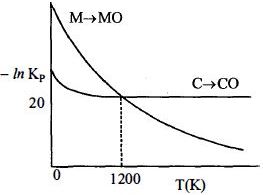
- (A) At \(T < 1200\,K,\) oxidation of carbon is unfavourable
- (B) Oxidation of carbon is favourable at all temperatures.
- (C) At \(T< 1200\,K,\) the reaction \(MO(s) +C(s) \to M(s) + CO(g)\) is spontaneous.
- (D) At \(T > 1200\,K,\) carbon will reduce \(MO(s)\) to \(M(s)\)
Show answer and solution
Correct Answer: (C)
At \(< 1200\,K\), carbon will reduce \(MO(s)\) to \(M(s)\) hence, chemical reaction\(MO(s) + C(s) \to M(s) + CO(g)\) is spontaneous
-
- (A) Reaction of lithium hydride with \(B_2H_6\)
- (B) Electrolysis of acidified water using \(Pt\) electrodes
- (C) Reaction of zinc with aqueous alkali
- (D) Allowing a solution of sodium in liquid ammonia to stand
Show answer and solution
Correct Answer: (A)
Lithium hydride react with diborane to produce lithiumborohydride\(2LiH + B_2H_6 \longrightarrow 2Li[BH_4]\)
-
- (A) \((A) - (iii), (B) - (i), (C) - (iv), (D) - (ii)\)
- (B) \((A) - (iv), (B) - (i), (C) - (ii), (D) - (iii)\)
- (C) \((A) - (ii), (B) - (i), (C) - (iv), (D) - (iii)\)
- (D) \((A) - (ii), (B) - (iv), (C) - (i), (D) - (iii)\)
Show answer and solution
Correct Answer: (A)
\(A - \) Silica gel packets are used to absorb moisture and keep things dry \(i.e.\) as drying agent.
\(B -\) Silicon is a semiconductor and is used in transistors.
\(C -\) Silicone is used as sealant.
\(D -\) Silicates are widely used in ion-exchange beds in domestic and commercial water purification, softening, and other applications


No questions on this page match these filters.
Other years
Frequently asked
How many JEE Mains 2016 Chemistry questions are on ExamBro?
53 questions, each with the correct answer and a full solution.
Which JEE Mains 2016 Chemistry chapter is asked the most?
P -Block elements - ll, with 5 questions, followed by Thermodynamics and thermochemistry with 5.
How difficult are JEE Mains 2016 Chemistry questions?
4% are easy, 30% medium and 66% hard.