


પરમાણુનું બંધારણ ના બધા પ્રશ્નો
નવા પહેલા178 માંથી 51–100 પ્રશ્નો
-
- (A) \(34\)
- (B) \(40\)
- (C) \(45\)
- (D) \(50\)
જવાબ અને ઉકેલ જુઓ
સાચો જવાબ: (A)
\(34\) -
- (A) \(600\)
- (B) \(657\)
- (C) \(661\)
- (D) \(668\)
જવાબ અને ઉકેલ જુઓ
સાચો જવાબ: (C)
\(\lambda=\frac{\mathrm{h}}{\mathrm{mv}}\)\(\lambda=\frac{\mathrm{hv}}{\mathrm{mv}^2}\)
\(\frac{\mathrm{mv}^2}{\mathrm{~h}}=\frac{\mathrm{v}}{\lambda}=\mathrm{v}\) (આવૃત્તિ)
આપેલ છે \(\frac{1}{2} \mathrm{mv}^2=2.18 \times 10^{-18} \mathrm{~J}\)
\(\mathrm{~h}=6.6 \times 10^{-34}\)
\(\mathrm{v}=\frac{4.36 \times 10^{-18}}{6.6 \times 10^{-34}}=660.60 \times 10^{13} \mathrm{~Hz}\)
\(\approx 661 \times 10^{13} \mathrm{~Hz}\)
-
- (A) \(12\)
- (B) \(65\)
- (C) \(58\)
- (D) \(20\)
જવાબ અને ઉકેલ જુઓ
સાચો જવાબ: (C)
\( \mathrm{m} \Delta \mathrm{V} \cdot \Delta \mathrm{x}=\frac{\mathrm{h}}{4 \pi} \)\(\Delta \mathrm{V} \)\( =\frac{6.626 \times 10^{-34}}{9.1 \times 10^{-31} \times 10^{-15} \times 4 \times 3.14} \)
\( =57.97 \times 10^{+9} \mathrm{~m} / \mathrm{sec}\)
-
- (A) \(11\)
- (B) \(10\)
- (C) \(12\)
- (D) \(13\)
જવાબ અને ઉકેલ જુઓ
સાચો જવાબ: (B)
\(5^{\text {th }}\) ઉત્તેજિત અવસ્થા \(\Rightarrow n_1=6\)\(1^{\text {st }}\) ઉત્તેજિત અવસ્થા \(\Rightarrow n_2=2\)
\(\Delta n=n_1-n_2=6-2=4\)
વર્ણપટ રેખાઓની મહત્તમ સંખ્યા
\(=\frac{\Delta \mathrm{n}(\Delta \mathrm{n}+1)}{2}=\frac{4(4+1)}{2}=10\)
-
- (A) \(540\) અને \(\frac{1}{683}\)
- (B) \(540\) અને \(683\)
- (C) \(450\) અને \(\frac{1}{683}\)
- (D) \(450\) અને \(683\)
જવાબ અને ઉકેલ જુઓ
સાચો જવાબ: (B)
કેન્ડેલા એ એક સ્ત્રોતની પ્રકાશીય તીવ્રતા છે જે \(540 \times 10^{12} \mathrm{~Hz}\) આવૃત્તિનું એકરંગી વિકિરણ ઉત્સર્જિત કરે છે અને તેની પ્રદીપ્તિ તીવ્રતા તે દિશામાં \(\frac{1}{683} \mathrm{w} / \mathrm{sr}\) છે. તે કેન્ડેલાનો એકમ છે. -
- (A) \(14\)
- (B) \(35\)
- (C) \(18\)
- (D) \(16\)
જવાબ અને ઉકેલ જુઓ
સાચો જવાબ: (D)
\(n=4\) can have,
So, Ans.\(16\)\(4\text s\) \(4\text q\) \(4\text d\) \(4\text f\) Total \(\text e^{-}\) \(2\) \(6\) \(10\) \(14\) Total \(\text e ^{-}\)with \(\text S =+\frac{1}{2}\) \(1\) \(3\) \(5\) \(7\) -
- (A) વિધાન \(I\) સાચું છે પણ વિધાન \(II\) ખોટું છે.
- (B) બંને વિધાન \(I\) અને વિધાન \(II\) સાચા છે
- (C) બંને વિધાન \(I\) અને વિધાન \(II\) ખોટા છે.
- (D) વિધાન \(I\) ખોટું છે પણુ વિધાન \(II\) સાચું છે.
જવાબ અને ઉકેલ જુઓ
સાચો જવાબ: (A)
હાઇડ્રોજન જેવા એક જ ઇલેક્ટ્રોન ધરાવતા ઘટકો માટે, કક્ષકની ઊર્જા ફક્ત મુખ્ય ક્વોન્ટમ આંક \(n\) પર આધાર રાખે છે. તેથી, વિધાન - \(II\) ખોટું છે.
વિધાન - \(I\) એ અપભ્રષ્ટ કક્ષકોની સાચી વ્યાખ્યા છે. - 58. પોટેશિયમ (પરમાણુ ક્રમાંક \(19\)) ના સૌથી બહારની કક્ષામાં રહેલા ઇલેક્ટ્રોન માટેના ચાર ક્વોન્ટમ આંક _______ છે. 2024 અઘરું
- (A) \(\mathrm{n}=4, l=2, \mathrm{~m}=-1, s=+\frac{1}{2}\)
- (B) \(\mathrm{n}=4, l=0, \mathrm{~m}=0, s=+\frac{1}{2}\)
- (C) \(\mathrm{n}=3, l=0, \mathrm{~m}=1, s=+\frac{1}{2}\)
- (D) \(\mathrm{n}=2, l=0, \mathrm{~m}=0, s=+\frac{1}{2}\)
જવાબ અને ઉકેલ જુઓ
સાચો જવાબ: (B)
\({ }_{19} \mathrm{K} \quad 1 \mathrm{~s}^2, 2 \mathrm{~s}^2, 2 \mathrm{p}^6, 3 \mathrm{~s}^2, 3 \mathrm{p}^6, 4 \mathrm{~s}^1 \text {. }\)પોટેશિયમની સૌથી બહારની કક્ષા \(4 \mathrm{~s}\) કક્ષા છે.
\(\mathrm{n}=4, \mathrm{l}=0, \mathrm{~m}_1=0, \mathrm{~s}= \pm \frac{1}{2}\)
-
- (A) \(22\)
- (B) \(25\)
- (C) \(30\)
- (D) \(35\)
જવાબ અને ઉકેલ જુઓ
સાચો જવાબ: (A)
\(\mathrm{V}=2.18 \times 10^6 \times \frac{\mathrm{Z}}{\mathrm{n}}\)\(=21.8 \times 10^5 \times \frac{1}{1} \approx 22 \times 10^5 \text { (nearest) }\)
- 60. રુબીડીયમ પરમાણુ (\(Z=37\)) ના વેલેન્સ (સંયોજક) ઈલેકટ્રોન માટે ચાર કવોન્ટમ આંકોનો સાચો સેટ _______ છે. 2024 અઘરું
- (A) \(5,0,0,+\frac{1}{2}\)
- (B) \(5,0,1,+\frac{1}{2}\)
- (C) \(5,1,0,+\frac{1}{2}\)
- (D) \(5,1,1+\frac{1}{2}\)
જવાબ અને ઉકેલ જુઓ
સાચો જવાબ: (A)
\( \mathrm{Rb}=[\mathrm{Kr}] 5 \mathrm{~s}^1 \)\( \mathrm{n}=5 \)
\( l=0 \)
\( \mathrm{~m}=0 \)
\( \mathrm{~s}=+1 / 2 \text { or }-1 / 2\)
-
- (A) \(494\)
- (B) \(490\)
- (C) \(499\)
- (D) \(445\)
જવાબ અને ઉકેલ જુઓ
સાચો જવાબ: (A)
\(\mathrm{E}=\frac{1240}{\lambda(\mathrm{nm})} \mathrm{eV}\)\(=\frac{1240}{242} \mathrm{eV}\)
\(=5.12 \mathrm{eV}\)
\(=5.12 \times 1.6 \times 10^{-19}\)
\(=8.198 \times 10^{-19} \mathrm{~J} / \text { પરમાણુ }\)
\(=494 \mathrm{~kJ} / \mathrm{mol}\)
-
- (A) \(A-II\), \(B-III\), \(C-I\), \(D-IV\)
- (B) \(A-I\), \(B-III\), \(C-II\), \(D-IV\)
- (C) \(A-II\), \(B-IV\), \(C-III\), \(D-I\)
- (D) \(A-I\), \(B-II\), \(C-III\), \(D-IV\)
જવાબ અને ઉકેલ જુઓ
સાચો જવાબ: (C)
\(A - II\), \(B - IV\), \(C - III\), \(D - I\)Fact based.
-
- (A) \(A-IV, B-III, C-II, D-I\)
- (B) \(A-III, B-II, C-I, D-IV\)
- (C) \(A-I, B-IV, C-III, D-II\)
- (D) \(A-II, B-I, C-IV, D-III\)
જવાબ અને ઉકેલ જુઓ
સાચો જવાબ: (B)
(\(A\)) \({ }_7 \mathrm{~N}:[\mathrm{He}] 2 \mathrm{~s}^2 2 \mathrm{p}^3\)(\(B\)) \({ }_{16} \mathrm{~S}:[\mathrm{Ne}] 2 \mathrm{~s}^2 3 \mathrm{p}^4\)
(\(C\)) \({ }_{35} \mathrm{Br}:[\mathrm{Ar}] 3 \mathrm{~d}^{10} 4 \mathrm{~s}^2 4 \mathrm{p}^5\)
(\(D\)) \({ }_{36} \mathrm{Kr}:[\mathrm{Ar}] 3 \mathrm{~d}^{10} 4 \mathrm{~s}^2 4 \mathrm{p}^6\)
-
- (A) \(2\)
- (B) \(7\)
- (C) \(9\)
- (D) \(11\)
જવાબ અને ઉકેલ જુઓ
સાચો જવાબ: (A)
\( \text { Noble gas configuration }=\mathrm{ns}^2 \mathrm{np}^6 \)\( {\left[\mathrm{Sr}^{2+}\right]=[\mathrm{Kr}\rfloor} \)
\( {\left[\mathrm{Cs}^{+}\right]=[\mathrm{Xe}]} \)
\( {\left[\mathrm{Yb}^{2+}\right]=[\mathrm{Xe}] 4 \mathrm{f}^{14}}\)
\( {\left[\mathrm{La}^{2+}\right]=[\mathrm{Xe}] 5 \mathrm{~d}^1} \)
\( {\left[\mathrm{~Pb}^{2+}\right]=[\mathrm{Xe}] 4 \mathrm{f}^{14} 5 \mathrm{~d}^{10} 6 \mathrm{~s}^2} \)
\( {\left[\mathrm{Fe}^{2+}\right]=[\mathrm{Ar}] 3 \mathrm{~d}^6}\)
-
- (A) \(2\)
- (B) \(3\)
- (C) \(1\)
- (D) \(4\)
જવાબ અને ઉકેલ જુઓ
સાચો જવાબ: (C)
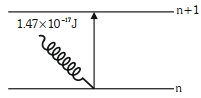
\(\Delta E = R _{ H } Z ^2\left(\frac{1}{ n _1^2}-\frac{1}{ n _2^2}\right)\)\(1.47 \times 10^{-17}=2.18 \times 10^{-15} \times 9\left(\frac{1}{n^2}-\frac{1}{(n+1)^2}\right)\)
\(\frac{1.47}{1.96}=\frac{3}{4}=\frac{1}{n^2}-\frac{1}{(n+1)^2}\)
So, \(n =1\)
-
- (A) \(796\)
- (B) \(798\)
- (C) \(797\)
- (D) \(785\)
જવાબ અને ઉકેલ જુઓ
સાચો જવાબ: (B)
For one photon \(E = hv\)For one mole photon,
\(E=6 \cdot 023 \times 10^{23} \times 6.626 \times 10^{-34} \times 2 \times 10^{12}\)
-
- (A) \(r_0=a_0\)
- (B) \(r_0=4 a_0\)
- (C) \(r _0=\frac{ a _0}{2}\)
- (D) \(r_0=2 a_0\)
જવાબ અને ઉકેલ જુઓ
સાચો જવાબ: (D)
At node \(\Psi_{2 s }=0\)\(\therefore 2-\frac{ r _0}{ a _0}=0\)
\(\therefore r _0=2 a _0\)
- 68. \(3s\) કક્ષક માં એક ઈલેકટ્રોન નું કક્ષકીય કોણીય વેગમાન \(\frac{x h}{2 \pi}\) છે.તો \(x\) નું મુલ્ય \(.......\) છે. 2023 સરળ
- (A) \(1\)
- (B) \(2\)
- (C) \(3\)
- (D) \(0\)
જવાબ અને ઉકેલ જુઓ
સાચો જવાબ: (D)
\(l\) for \(3s\) orbital is \(0\).
Orbital angular momentum \(=\) \(\sqrt{l(l+1)} \frac{h}{2\pi}\)
\(= \sqrt{0(0+1)} \frac{h}{2\pi} = 0\)
Given \(=\) \(\frac{x h}{2 \pi}\)
\(x = 0\)
-
- (A) \(6\)
- (B) \(5\)
- (C) \(4\)
- (D) \(7\)
જવાબ અને ઉકેલ જુઓ
સાચો જવાબ: (D)
\(\lambda_{ d }=\frac{ h }{ mv }=\frac{ h }{\sqrt{2 mKE }}=\frac{6.6 \times 10^{-34}}{\sqrt{2 \times 9 \times 10^{-31} \times 4.5 \times 10^{-29}}}\)\(=\frac{6.6 \times 10^{-34}}{\sqrt{9^2 \times 10^{-60}}}\)
\(=\frac{6.6 \times 10^{-34}}{9 \times 10^{-30}}=\frac{6.6}{9} \times 10^{-4}\)
\(=7.3 \times 10^{-5}\,m\)
\(\text { Therefore Ans }=7\)
-
- (A) \(2\)
- (B) \(3\)
- (C) \(1\)
- (D) \(4\)
જવાબ અને ઉકેલ જુઓ
સાચો જવાબ: (A)
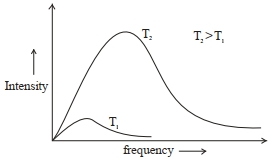
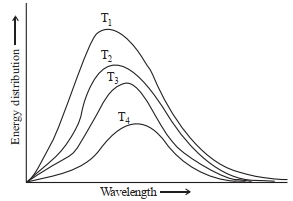
The spectrum of Black body radiation is explained using quantization of energy. With increase in temperature, peak of spectrum shifts to shorter wavelength or higher frequency. For above graph\(\rightarrow T _1 > T _2 > T _3 > T _4 \text {. }\)
- 71. એક આયન \(55\) પ્રોટોન સાથે તેની એકધનાત્મક અવસ્થા માં હાજર \(s-\)ઈલેકટ્રોનોની સંખ્યા શોધો. 2023 અઘરું
- (A) \(8\)
- (B) \(9\)
- (C) \(12\)
- (D) \(10\)
જવાબ અને ઉકેલ જુઓ
સાચો જવાબ: (D)
\(Z =55[ Cs ] \Rightarrow[ Xe ] 6 s ^1\)\(\left[ Cs ^{+}\right] \Rightarrow[ Xe ]\) i.e. upto \(5 s\) count \(e ^{-}\)of s-subshell i.e. \(1 s , 2 s , 3 s , 4 s , 5 s \Rightarrow 10\) electrons
- 72. હાઈડ્રોજન પરમાણુની પ્રથમ બ્હોર કક્ષામાં એક ઇલેકટ્રોનની ઊર્જા \(-2.18 \times 10^{-18}\,J\) છે.તો તેની તૃતીય બ્હોર કક્ષામાં ઊર્જા શોધો 2023 મધ્યમ
- (A) આ મૂલ્યનું \(\frac{1}{27}\)
- (B) આ મૂલ્યનું એક તૃતિયાંશ
- (C) આ મૂલયનું ત્રણ ગણું
- (D) આ મૂલ્યનું એક નવમાંશ \(\left(\frac{1}{9} t h\right)\)
જવાબ અને ઉકેલ જુઓ
સાચો જવાબ: (D)
\(E _{ n }=\frac{-2.18 \times 10^{-18} Z ^2}{ n ^2}\)\(\text { i.e. } E _{ n } \propto \frac{1}{ n ^2}\)
-
- (A) \(n =2\) થી \(n =1\)
- (B) \(n =1\) થી \(n =3\)
- (C) \(n =1\) થી \(n =2\)
- (D) \(n =3\) થી \(n =4\)
જવાબ અને ઉકેલ જુઓ
સાચો જવાબ: (A)
\(He ^{+}\)ion :\(\frac{1}{\lambda( H )}= R (1)^2\left[\frac{1}{ n _1^2}-\frac{1}{ n _2^2}\right]\)
\(\frac{1}{\lambda\left( He ^{+}\right)}= R (2)^2\left[\frac{1}{2^2}-\frac{1}{4^2}\right]\)
Given \(\lambda( H )=\lambda\left( He ^{+}\right)\)
\(R (1)^2\left[\frac{1}{ n _1^2}-\frac{1}{ n _2^2}\right]= R (4)\left[\frac{1}{2^2}-\frac{1}{4^2}\right]\)
\(\frac{1}{ n _1^2}-\frac{1}{ n _2^2}=\frac{1}{1^2}-\frac{1}{2^2}\)
On comparing \(n _1=1\) and \(n _2=2\)
-
- (A) \(\frac{5}{9 \lambda}\)
- (B) \(\frac{9 \lambda}{5}\)
- (C) \(\frac{36 \lambda}{5}\)
- (D) \(\frac{5 \lambda}{9}\)
જવાબ અને ઉકેલ જુઓ
સાચો જવાબ: (B)
For \(H : \frac{1}{\lambda}= R _{ H } \times 1^2\left(\frac{1}{1^2}-\frac{1}{\infty^2}\right)\)\(\frac{1}{\lambda_{ He ^{+}}}= R _{ H } \times 2^2 \times\left(\frac{1}{4}-\frac{1}{9}\right)\)
From \((1)\) and \((2)\) \(\frac{\lambda_{ He ^{+}}}{\lambda}=\frac{9}{5}\)
\(\lambda_{ He ^{+}}=\lambda \times \frac{9}{5}\)
\(\lambda_{ He ^{+}}=\frac{9 \lambda}{5}\)
- 75. \(Li ^{2+}\) ની \(2^{\text {nd }}\) કક્ષાની ત્રિજ્યા \(x\) છે. \(Be ^{3+}\) ની \(3^{\text {rd }}\) કક્ષાની એપેક્ષિત ત્રિજ્યા શોધો. 2023 અઘરું
- (A) \(\frac{9}{4} x\)
- (B) \(\frac{4}{9} x\)
- (C) \(\frac{27}{16} x\)
- (D) \(\frac{16}{27} x\)
જવાબ અને ઉકેલ જુઓ
સાચો જવાબ: (C)
\(Li ^{2+}\)\(r _2= x = k \times \frac{2^2}{3}=\frac{4 k }{2}\)
\(Be ^{3+}\)
\(r _3= y = k \times \frac{3^2}{4}\)
\(\frac{y}{x}=\frac{9}{4} \times \frac{3}{4}=\frac{27}{16}\)
\(y=\frac{27}{16} x\)
-
- (A) \(16\)
- (B) \(32\)
- (C) \(50\)
- (D) \(72\)
જવાબ અને ઉકેલ જુઓ
સાચો જવાબ: (B)
The number of electrons in the orbitals of sub-shell of \(n=4\) are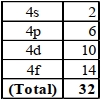
-
- (A) \(Ci ^{+}, Na ^{+}, Mg ^{2+}, Ca ^{2+}\)
- (B) \(\left. Ba ^{2+}, Sr ^{2+}, K +, Ca ^{2+}\right.\)
- (C) \(\left. N ^{3-}, O ^{2-}, F , S ^{2-}\right.\)
- (D) \(\left. K ^{+}, Cl ^{-}, Ca ^{2+}, Sc ^{3+}\right.\)
જવાબ અને ઉકેલ જુઓ
સાચો જવાબ: (D)
\(K ^{+} Cl ^1 Ca ^{2+} Sc ^{3+}\)\(\begin{array}{llll}18 & 18 & 18 & 18\end{array}\)
-
- (A) \(B > D > C > A\)
- (B) \(D > B > C > A\)
- (C) \(A > C > B > D\)
- (D) \(D > B > A > C\)
જવાબ અને ઉકેલ જુઓ
સાચો જવાબ: (B)
\((A)\) \(n =3 ; 1=0 ; m =0 ; 3 s\) orbital\((B)\) \(n =4 ; 1=0 ; m =0 ; 4 s\) orbital
\((C)\) \(n =3 ; 1=1 ; m =0 ; 3 p\) orbital
\((D)\) \(n =3 ; 1=2 ; m =0 ; 3 d\) orbital
As per Hund's rule energy is given by \(( n +l)\) value.
If value of \(( n +l)\) remains same then energy is given by \(n\) only.
-
- (A) \(5\)
- (B) \(4\)
- (C) \(3\)
- (D) \(2\)
જવાબ અને ઉકેલ જુઓ
સાચો જવાબ: (A)
Isoelectronic species \(O ^{2 \Theta}, F ^{\Theta}, Mg ^{2+}, Na ^{\oplus}, Al ^{3+}\) -
- (A) \(2\)
- (B) \(1\)
- (C) \(3\)
- (D) \(0\)
જવાબ અને ઉકેલ જુઓ
સાચો જવાબ: (B)
(A) This statement is correct. Line emission spectra (or atomic emission spectra) are indeed used to study the electronic structure of atoms. These spectra are produced when photons are emitted from atoms as excited electrons return to a lower energy level. Each line corresponds to a particular quantum leap between energy levels. (B) This statement is incorrect. The emission spectra of atoms in the gas phase do not show a continuous spread of wavelength from red to violet. Instead, they show distinct lines corresponding to specific electron transitions, hence they are known as line emission spectra. (C) This statement is correct. An absorption spectrum is like the photographic negative of an emission spectrum. In an absorption spectrum, light passes through a cold, dilute gas and atoms in the gas absorb at characteristic frequencies; since the re-emitted light is unlikely to be emitted in the same direction as the absorbed photon, this gives rise to dark lines (absence of light) in the spectrum. (D) This statement is correct. The element helium was indeed discovered in the sun through spectroscopy before it was found on Earth. The name helium comes from Helios, the Greek name for the sun. So, the number of incorrect statements is 1. - 81. નીચે આપેલામાંથી \(5\) ત્રિજ્યાકીય (રેડીઅલ) નોડસ ધરાવતા પરમાણ્વીય કક્ષકોની સંખ્યા \(......\) છે.\(7 s , 7 p , 6 s , 8 p , 8 d\) 2023 મધ્યમ
- (A) \(3\)
- (B) \(2\)
- (C) \(1\)
- (D) \(4\)
જવાબ અને ઉકેલ જુઓ
સાચો જવાબ: (A)
Radial node \(= n -\ell-1\)\(7 s \Rightarrow R \cdot N =7-0-1=6\)
\(7 p \Rightarrow R \cdot N =7-1-1=5\)
\(6 s \Rightarrow R \cdot N =6-0-1=5\)
\(8 p \Rightarrow R \cdot N =8-1-1=6\)
\(8 d \Rightarrow R \cdot N =8-2-1=5\)
So, Answer is \(3\)
-
- (A) \(1\)
- (B) \(0\)
- (C) \(2\)
- (D) \(3\)
જવાબ અને ઉકેલ જુઓ
સાચો જવાબ: (B)
A blackbody can emit and absorb all the wavelengths in electromagnetic spectrum \(\Rightarrow(A)\) is correct\(\Rightarrow(B),(C),(D)\) correct
-
- (A) \(3\)
- (B) \(4\)
- (C) \(2\)
- (D) \(5\)
જવાબ અને ઉકેલ જુઓ
સાચો જવાબ: (A)
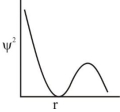
\(A, D\) and \(E\) statements are correct.For \(2 s\) orbital, the probability density first decreases and then increases.
At any distance from nucleus the probability density of finding electron is never zero and it always have some finite value.
-
- (A) બંને \(A\) અને \(R\) સાચા છે અને \(R\) એ \(A\)નું સાચી સમજૂતી નથી.
- (B) બંને \(A\) અને \(R\) સાચા છે અને \(R\) એ \(A\)નું સાચી સમજૂતી છે.
- (C) \(A\) ખોટું છે પણ \(R\) સાચું છે.
- (D) \(A\) સાચું છે પણ \(R\) ખોટું છે.
જવાબ અને ઉકેલ જુઓ
સાચો જવાબ: (B)
\(5 f\) orbital not buried as \(4 f\) orbitals so \(e ^{-}\) present in \(5 f\) orbital experience less nuclear attraction than \(e ^{-}\)present in \(4 f\) orbital. Hence electrons of 5 f orbital can take part in bonding to a far greater extent. -
- (A) બંને \(A\) અને \(R\) સાચા છે અને \(R\) એ \(A\)નું સાચી સમજૂતી નથી.
- (B) \(A\) સાચું છે પણ \(R\) ખોટું છે.
- (C) બંને \(A\) અને \(R\) સાચા છે અને \(R\) એ \(A\)નું સાચી સમજૂતી છે.
- (D) \(A\) ખોટું છે પણ \(R\) સાચું છે.
જવાબ અને ઉકેલ જુઓ
સાચો જવાબ: (B)
There is a characteristic minimum frequency, or "threshold frequency," for each metal below which the photoelectric effect is not seen. The ejected electrons leave with a specific amount of kinetic energy at a frequency \(v > v _0\) with an increase in light frequency of these electron kinetic energies also rise. -
- (A) બંને વિધાન \(I\) અને વિધાન \(II\) સાચાં છે.
- (B) વિધાન \(I\) સાચું છે.પરંતુ વિધાન \(II\) ખોટું છે.
- (C) વિધાન \(I\) ખોટું છે. પરંતુ વિધાન \(II\) સાચું છે.
- (D) બંને વિધાન \(I\) અને વિધાન \(II\) ખોટા છે.
જવાબ અને ઉકેલ જુઓ
સાચો જવાબ: (A)
According to Bohr's model the angular momentum is quantised and equal to \(\frac{ nh }{2 \pi}\).Heisenberg uncertainty principle explains orbital concept, which is based on probability of finding electron.
-
- (A) \(548\)
- (B) \(547\)
- (C) \(546\)
- (D) \(545\)
જવાબ અને ઉકેલ જુઓ
સાચો જવાબ: (A)
Heisenberg's uncertainty principle\(\Delta x \times \Delta p _{ x } \geq \frac{ h }{4 \pi}\)
\(\Rightarrow 2 a _{0} \times m \Delta v _{ r }=\frac{ h }{4 \pi}(\text { minimum })\)
\(\Rightarrow \Delta v _{ x}=\frac{ h }{4 \pi} \times \frac{1}{2 a _{0}} \times \frac{1}{ m }\)
\(=\frac{6.63 \times 10^{-34}}{4 \times 3.14 \times 2 \times 52.9 \times 10^{-12} \times 9.1 \times 10^{-31}}\)
\(=548273\; ms ^{-1}\)
\(=548.273\; km\;s ^{-1}\)
\(=548\; km\; s ^{-1}\)
-
- (A) \(235\)
- (B) \(325\)
- (C) \(399\)
- (D) \(435\)
જવાબ અને ઉકેલ જુઓ
સાચો જવાબ: (C)
Energy of one mole of photons \(=\frac{ hc }{\lambda} \times N _{ A }\)\(\frac{6.63 \times 10^{-34} \times 3 \times 10^{8}}{300 \times 10^{-9}} \times 6.02 \times 10^{23}\)
\(=399.13 \times 10^{3} \,Joule / mole\)
\(=399\, kJ / mole\)
-
- (A) \(1\) અને \(2\)
- (B) \(3\) અને \(2\)
- (C) \(1\) અને \(0\)
- (D) \(2\) અને \(1\)
જવાબ અને ઉકેલ જુઓ
સાચો જવાબ: (A)
Radial node \(= n - l -1\)\(=4-2-1\)
\(=1\)
Angular node \((l)=2\)
-
- (A) \(Sm ^{2+}\) and \(Er ^{3+}\)
- (B) \(Yb ^{2+}\) અને \(Lu ^{3+}\)
- (C) \(Tb ^{2+}\) અને \(Tm ^{4+}\)
- (D) \((A)\) અને \((C)\) બંને સાચા છે
જવાબ અને ઉકેલ જુઓ
સાચો જવાબ: (D)
\(Sm ^{2+} \rightarrow\) electron \(=60\)\(Er ^{3+} \rightarrow\) electron \(=65\)
\(Tb ^{2+} \rightarrow\) electron \(=63\)
\(Tm ^{4+} \rightarrow\) electron \(=65\)
all are \((not\,isoelectronic)\)
-
- (A) \(300\)
- (B) \(30\)
- (C) \(45\)
- (D) \(100\)
જવાબ અને ઉકેલ જુઓ
સાચો જવાબ: (A)
\(\phi=6.63 \times 10^{-19} \,J =\frac{ hc }{\lambda}=\frac{6.63 \times 10^{-34} \times 3 \times 10^{8}}{\lambda}\)\(\Rightarrow \lambda=3 \times 10^{-7} m =300\, nm\)
-
- (A) \(4\)
- (B) \(3\)
- (C) \(8\)
- (D) \(5\)
જવાબ અને ઉકેલ જુઓ
સાચો જવાબ: (A)
\({ }_{22}^{48} X ^{3-}\)No. of neutrons \(=26\)
No. of electrons \(=25\)
\(\%\) of extra neutrons
than electrons \(=\frac{26-25}{25} \times 100=4\)
- 93. હાઈડ્રોજન પરમાણુની \(3^{rd}\) બોહર કક્ષાની ત્રિજ્યા જો \(r_3\) હોય અને \(4^{th}\) બોહર કક્ષાની ત્રિજ્યા \(r_4\)હોય તો પછી .... 2022 મધ્યમ
- (A) \(r _{4}=\frac{9}{16} r_{3}\)
- (B) \(r_{4}=\frac{16}{9} r_{3}\)
- (C) \(r_{4}=\frac{3}{4} r_{3}\)
- (D) \(r_{4}=\frac{4}{3} r_{3}\)
જવાબ અને ઉકેલ જુઓ
સાચો જવાબ: (B)
\(r =0.529 \times \frac{ n ^{2}}{ Z }\)\(r _{3}=0.529 \times \frac{3^{2}}{1}\)
\(r_{4}=0.529 \times \frac{4^{2}}{1}\)
\(\frac{r_{4}}{r_{3}}=\frac{4^{2}}{3^{2}}=\frac{16}{9}\)
\(r _{4}=\frac{16 r _{3}}{9}\)
-
- (A) \(1757\)
- (B) \(1758\)
- (C) \(1756\)
- (D) \(1755\)
જવાબ અને ઉકેલ જુઓ
સાચો જવાબ: (B)
\(v_{e}=x v_{N}\)\(\lambda_{ e }=\lambda_{ N }\)
\(\Rightarrow \frac{ h }{ m _{ e } v _{ c }}=\frac{ h }{ m _{ N } v_{ N }}\)
\(v_{ e }=\frac{ m _{ N }}{ m _{ e }} \cdot v _{ N }\)
\(=\frac{1.6 \times 10^{-27}}{9.1 \times 10^{-31}} v_{ N }\)
\(v_{ e }=1758.24 \times v_{ N }\)
-
- (A) \(22\)
- (B) \(45\)
- (C) \(89\)
- (D) \(63\)
જવાબ અને ઉકેલ જુઓ
સાચો જવાબ: (A)
\(\Delta V =2.4 \times 10^{-26} ms ^{-1}\)\(\Delta x =10^{-7} m\)
\(\because \Delta p \cdot \Delta x =\frac{ h }{4 \pi}\)
\(\therefore m \Delta V \Delta x =\frac{ h }{4 \pi}\)
\(\Rightarrow m \times 2.4 \times 10^{-26} \times 10^{-7}=\frac{6.626 \times 10^{-34}}{4 \times \pi}\)
\(m =\frac{6.626}{9.6 \times \pi} \times 10^{-1}\)
\(m =0.02198 \,kg\)
\(m =21.98 \,gm\)
nearest integer \(=22\)
-
- (A) \(1\)
- (B) \(3\)
- (C) \(2\)
- (D) \(0\)
જવાબ અને ઉકેલ જુઓ
સાચો જવાબ: (C)
\(\lambda=\frac{ h }{\sqrt{2 mK }}\)\(K =\frac{ h ^{2}}{2 m \lambda^{2}}\)
\(K =\frac{ h ^{2}}{2 m \lambda^{2}}=\frac{43.9 \times 10^{-68}}{2 \times 9.1 \times 10^{-31} \times 10.89 \times 10^{-20}}\)
\(K =2.215 \times 10^{-18}\)
\(E _{ abs }= E _{\text {req }}+ K\)
\(\frac{ E _{\text {abs }}}{ E _{\text {req }}}=1+\frac{ K }{ E _{\text {req }}}=1+\frac{2.215 \times 10^{-18}}{13.6 \times 1.602 \times 10^{-19}}=2.0166\)
-
- (A) \(Br ^{-}\) અને \(Be ^{2+}\)
- (B) \(Cl ^{-}\) અને \(Li ^{+}\)
- (C) \(S ^{2-}\) અને \(K ^{+}\)
- (D) \(O ^{2-}\) અને \(Mg ^{2+}\)
જવાબ અને ઉકેલ જુઓ
સાચો જવાબ: (D)
Isoelectronic species have same no. of electrons \(Al ^{+3}, O ^{2-}, Mg ^{+2}\) all have \(10\) electrons. -
- (A) \(15\)
- (B) \(16\)
- (C) \(10\)
- (D) \(8\)
જવાબ અને ઉકેલ જુઓ
સાચો જવાબ: (C)
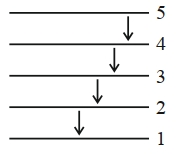
Maximum number of emission lines from \(\mathrm{n}^{\text {th }}\) energy state to ground state is given by:\(=\frac{\mathrm{n}(\mathrm{n}-1)}{2}=\frac{5(5-1)}{2}=\frac{20}{2}=10 \text { lines. }\)
-
- (A) \(D < B < A < C\)
- (B) \(D < A < B < C\)
- (C) \(B < D < A < C\)
- (D) \(B < D < C < A\)
જવાબ અને ઉકેલ જુઓ
સાચો જવાબ: (B)
Energy order of subshell decided by \(( n +\lambda)\) rule.\(A \Rightarrow 3 d \Rightarrow n +1=5\)
\(B \Rightarrow 4 p \Rightarrow n +\lambda=5\)
\(C \Rightarrow 4 d \Rightarrow n +\ell \Rightarrow 6\)
\(D \Rightarrow 3 s \Rightarrow( n +\ell)=4\)
\(D < A < B < C\)
-
- (A) \(4\)
- (B) \(1\)
- (C) \(2\)
- (D) \(3\)
જવાબ અને ઉકેલ જુઓ
સાચો જવાબ: (C)
Quantum no. of set \((B)\) and \((C)\) can be correct.\((A)\) and \((D)\) are wrong as \(n=\ell\) is not possible.
આ પેજ પર આ ફિલ્ટર મુજબ કોઈ પ્રશ્ન નથી.