


પરમાણુનું બંધારણ ના બધા પ્રશ્નો
નવા પહેલા178 માંથી 101–150 પ્રશ્નો
-
- (A) ફક્ત \(A\)
- (B) ફક્ત \(B\)
- (C) ફક્ત \(C\)
- (D) \((B)\) અને \((C)\)
જવાબ અને ઉકેલ જુઓ
સાચો જવાબ: (B)
Based on \(" n+1 "\) rule only \((B)\) has pair of electron in degenerate orbitals -
- (A) \(( D )>( B )>( C )>( A )\)
- (B) \((B) >( D )>( C )>( A )\)
- (C) \(( C )>( B )>( D )>( A )\)
- (D) \((B) >( C )>( D )>( A )\)
જવાબ અને ઉકેલ જુઓ
સાચો જવાબ: (A)
\((A)\) \(n+\ell=3+0=3\)\((B)\) \(n+\ell=4+0=4\)
\((C)\) \(n+\ell=3+1=4\)
\((D)\) \(n+\ell=3+2=5\)
Higher \(n+\ell\) value, higher the energy \& if same \(n +\ell\) value, then higher \(n\) value, higher the energy.Thus: \(D > B > C > A\).
-
- (A) \(n=3,1=2, m_{1}=0, s=+\frac{1}{2}\)
- (B) \(n=3,1=2, m_{1}=-2, s=+\frac{1}{2}\)
- (C) \(n=3,1=3, m_{1}=-3, s=-\frac{1}{2}\)
- (D) \(n =3,1=0, m _{1}=0, s =-\frac{1}{2}\)
જવાબ અને ઉકેલ જુઓ
સાચો જવાબ: (C)
\(1=0,1,2 \ldots(n-1)\)\(\therefore\) for \(n=3\)
\(1=0,1,2\)
\(1=3 \text {, }\)
not possible for \(n=3\)
-
- (A) \(( A ),( B )\) અને \(( C )\)
- (B) \(( A ),( C ),( D )\) અને \(( E )\)
- (C) \(( A ),( C )\) અને \(( D )\)
- (D) \(( A ),( B ),( C )\) અને \(( D )\)
જવાબ અને ઉકેલ જુઓ
સાચો જવાબ: (C)
\((A)\) Number of values of \(n =1,2,3 \ldots \infty\)\((B)\) Number of values of \(\ell=0\) to \(( n -1)\)
\((C)\) Number of values of \(m =-\ell\) to \(+\ell\)
Total values \(=2 \ell+1\)
\((D)\) Values of \(\operatorname{spin}=\pm \frac{1}{2}\)
\((E)\) For \(\ell=5\) number of orbitals \(=2 \ell+1=11\)
-
- (A) ન્યુક્લિયસની આસપાસનો વર્તુળાકાર માર્ગ જે માં એક ઈલેક્ટ્રોન ફરે છે તે બોહરની કક્ષા તરીકે પ્રસ્તાવિત છે.
- (B) કક્ષક એ એક પરમાણુમાં એક ઈલેકટ્રોન તરંગ વિધેય \((\Psi)\) છે.
- (C) બોહરની કક્ષાઓનું અસ્તિત્વ હાઈડ્રોજન વર્ણપટ દ્વારા આધારભૂત છે.
- (D) પરમાણ્વિક કક્ષક ફક્ત \(n\) અને \(1\) ક્વોન્ટમ આંકો વડે વર્ગીકૃત (characterised) થયેલ છે.
જવાબ અને ઉકેલ જુઓ
સાચો જવાબ: (D)
Atomic orbital is characterised by \(n , l,m\). -
- (A) બંને \(A\) અને \(R\) સાચા છે અને \(R\) એ \(A\) ની સચોટ સમજુતી છે.
- (B) બંને \(A\) અને \(R\) સાયા છે અને \(R\) એ \(A\) ની સાચી સમજૂતી નથી.
- (C) \(A\) સાયું છે, પરંતુ \(R\) ખોટું છે.
- (D) \(A\) ખોટું છે, પરંતુ \(R\) સાયું છે.
જવાબ અને ઉકેલ જુઓ
સાચો જવાબ: (A)
Energy of orbitals decreases on increasing the atomic number. -
- (A) \(32.1\)
- (B) \(0.624\)
- (C) \(8.58\)
- (D) \(976\)
જવાબ અને ઉકેલ જુઓ
સાચો જવાબ: (C)
\(W = h v\)\(=6.6 \times 10^{-34} \times 1.3 \times 10^{15}\)
\(=8.58 \times 10^{-19} \,J\)
-
- (A) \(3\)
- (B) \(4\)
- (C) \(2\)
- (D) \(1\)
જવાબ અને ઉકેલ જુઓ
સાચો જવાબ: (B)
We can not calculate \(I.E.\) of lithium atom. -
- (A) \(2\)
- (B) \(4\)
- (C) \(6\)
- (D) \(8\)
જવાબ અને ઉકેલ જુઓ
સાચો જવાબ: (A)
Total energy provided bySource per second \(=\frac{1000}{10}=100 \,{~J}\)
Energy required to eject electron \(=\frac{h c}{\lambda}\)
\(=\frac{6.626 \times 10^{-34}}{400 \times 10^{-9}} \times 3 \times 10^{8}\)
Number of electrons ejected
\(=\frac{\frac{100}{6.626 \times 10^{-34} \times 3 \times 10^{8}}}{400 \times 10^{-9}}\)
\(=\frac{400 \times 10^{-7} \times 10^{26}}{6.626 \times 3}\)
\(=\frac{40 \times 10^{-20}}{6.626 \times 3}\)
\(=2.01 \times 10^{20}\)
- 110. અનુક્રમે પરમાણુ ક્રમાંકો \(33, 53\) અને \(83\) ધરાવતાં \(X, Y\) અને \(Z\) તત્વોની લાક્ષણિકતાઓ શોધો. 2021 મધ્યમ
- (A) \(X\) અને \(Y\) અર્ધધાતુઓ છે અને \(Z\) એ ધાતુ છે.
- (B) \(X\) એ અર્ધધાતુ છે, \(Y\) એ અધાતુ અને \(Z\) એ ધાતુ છે.
- (C) \(X , Y\) અને \(Z\) ધાતુઓ છે.
- (D) \(X\) અને \(Z\) અધાતુઓ છે અને \(Y\) એ અર્ધધાતુ છે.
જવાબ અને ઉકેલ જુઓ
સાચો જવાબ: (B)
\(X ={ }_{33} As \rightarrow\) Metalloid\(Y ={ }_{53} I \rightarrow\) Nonmetal
\(Z ={ }_{83} Bi \rightarrow\) Metal
-
- (A) \(3 p\)
- (B) \(4 f\)
- (C) \(4 d\)
- (D) \(5 d\)
જવાબ અને ઉકેલ જુઓ
સાચો જવાબ: (D)
\(n-l-1=2\)\(1=2\)
\(n-2-1=2\)
\(n=5\)
-
- (A) ફક્ત \((C)\)
- (B) ફક્ત \((A)\)
- (C) ફક્ત \((A), (C)\) અને \((D)\)
- (D) ફક્ત \((A)\) અને \((D)\)
જવાબ અને ઉકેલ જુઓ
સાચો જવાબ: (D)
According to Bohr's theory :\((A)\) \(KE =13.6 \frac{ z ^{2}}{ n ^{2}} \frac{ eV }{\text { atom }} \Rightarrow KE \alpha \frac{ z ^{2}}{ n ^{2}}\)
\((B)\) speed of \(e ^{-} \alpha \frac{ z }{ n }\)
\(\therefore \quad v \times n \alpha z\)
\((C)\) Frequency of revolution of \(e ^{-}=\frac{ v }{2 \pi r }\)
\(\therefore\) frequency \(\alpha \frac{z^{2}}{n^{3}}\)
\((D)\) \(F =\frac{ kq _{1} q _{2}}{ r ^{2}}=\frac{ kze ^{2}}{ r ^{2}} \quad\left\{ r \alpha \frac{ n ^{2}}{ z }\right.\)
\(\Rightarrow F \alpha \frac{ Z }{\left(\frac{ n ^{2}}{ Z }\right)^{2}}\)
\(\Rightarrow F \alpha \frac{ z ^{3}}{ n ^{4}}\)
- 113. ચોક્કસ ભ્રમણકક્ષા \(n =4\) અને \(m _{ L }=-3\) ધરાવે છે. આ કક્ષાના રેડિયલ નોડની સંખ્યા .......... છે ? 2021 મધ્યમ
- (A) \(1\)
- (B) \(0\)
- (C) \(3\)
- (D) \(5\)
જવાબ અને ઉકેલ જુઓ
સાચો જવાબ: (B)
\(n =4\) and \(m _{\ell}=-3\)Hence, \(\ell\) value must be \(3\).
Now, number of radial nodes \(= n -\ell-1\)
\(=4-3-1=0\)
-
- (A) \(2\, s\)
- (B) \(3\, s\)
- (C) \(3\, p\)
- (D) \(2\, p\)
જવાબ અને ઉકેલ જુઓ
સાચો જવાબ: (B)
\(1=0 \Rightarrow\) \('s'\) orbital\(n-l-1=2\)
\(n-1=2\)
\(n =3\)
-
- (A) \(145\)
- (B) \(90\)
- (C) \(40\)
- (D) \(180\)
જવાબ અને ઉકેલ જુઓ
સાચો જવાબ: (D)
\(E=\frac{ hc }{\lambda} \times \frac{ N _{ A }}{1000}\)\(=\frac{6.63 \times 10^{-34} \times 3 \times 10^{8} \times 6.02 \times 10^{23}}{663 \times 10^{-9} \times 1000}\)
\(=3 \times 6.02 \times 10\, kJ\)
\(=180.6\, kJ\)
-
- (A) \(7\)
- (B) \(5\)
- (C) \(1\)
- (D) \(500\)
જવાબ અને ઉકેલ જુઓ
સાચો જવાબ: (B)
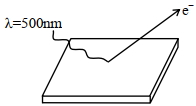
\(v:\) speed of electron having max. K.E.\(\Rightarrow\) from Einstein equation : \({E}=\phi+{K} \cdot {E}_{\cdot \max }\)
\(\Rightarrow \frac{{hc}}{\lambda}={h} v_{0}+\frac{1}{2} {mv}^{2}\)
\(\Rightarrow \frac{6.63 \times 10^{-34} \times 3 \times 10^{8}}{500 \times 10^{-9}}=6.63 \times 10^{-34} \times 4.3 \times 10^{14}+\frac{1}{2} {mv}^{2}\)
\(\Rightarrow \frac{6.63 \times 30 \times 10^{-20}}{5}=6.63 \times 4.3 \times 10^{-20}+\frac{1}{2} {mv}^{2}\)
\(\Rightarrow 11.271 \times 10^{-20} {~J}=\frac{1}{2} \times 9 \times 10^{-31} \times {v}^{2}\)
\(\Rightarrow {v}=5 \times 10^{5} \,{~m} / {sec}\)
-
- (A) \(1\)
- (B) \(4\)
- (C) \(2\)
- (D) \(3\)
જવાબ અને ઉકેલ જુઓ
સાચો જવાબ: (C)
Total energy per sec. \(=50\, {~J}\)\(50=\frac{{n} \times 6.63 \times 10^{-34} \times 3 \times 10^{8}}{795 \times 10^{-9}}\)
\({n}=1998.49 \times 10^{17}[{n}={no} .\) of photons per second \(]\)
\(=1.998 \times 10^{20}\)
\(\simeq 2 \times 10^{20}\)
\(={x} \times 10^{20}\)
\({x}=2\)
-
- (A) \(50\)
- (B) \(500\)
- (C) \(5\)
- (D) \(663\)
જવાબ અને ઉકેલ જુઓ
સાચો જવાબ: (A)
Energy emitted in \(0.1\, {sec}\).\(=0.1\, {sec} \cdot \times 10^{-3} \,\frac{{J}}{{s}}\)
\(=10^{-4}\, {~J}\)
If \('n'\) photons of \(\lambda=1000\, {~nm}\) are emitted,
\(\text { then ; } 10^{-4}={n} \times \frac{{hc}}{\lambda}\)
\(\Rightarrow 10^{-4}=\frac{{n} \times 6.63 \times 10^{-34} \times 3 \times 10^{8}}{1000 \times 10^{-9}}\)
\(\Rightarrow {n}=5.02 \times 10^{14}=50.2 \times 10^{13}\)
\(\Rightarrow 50\) (nearest integer)
-
- (A) \(1010\)
- (B) \(6135\)
- (C) \(3155\)
- (D) \(3845\)
જવાબ અને ઉકેલ જુઓ
સાચો જવાબ: (C)
\(\operatorname{mvr}=\frac{{nh}}{2 \pi}\)\(\text { K.E. }=\frac{{n}^{2} {~h}^{2}}{8 \pi^{2} {mr}^{2}} \quad=\frac{4 {~h}^{2}}{8 \pi^{2} {~m}\left(4 {a}_{0}\right)^{2}}\)
\(\quad\quad\quad\quad\quad\quad\quad\quad=\left(\frac{4}{8 \pi^{2} \times 16}\right) \frac{{h}^{2}}{{ma}_{0}^{2}}\)
\(\Rightarrow {x}=315.507\)
\(\Rightarrow 10 {x}=3155 \text { (nearest integer) }\)
-
- (A) \((B)\)
- (B) \((A)\)
- (C) \((D)\)
- (D) \((C)\)
જવાબ અને ઉકેલ જુઓ
સાચો જવાબ: (C)
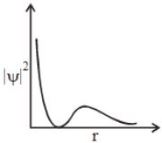
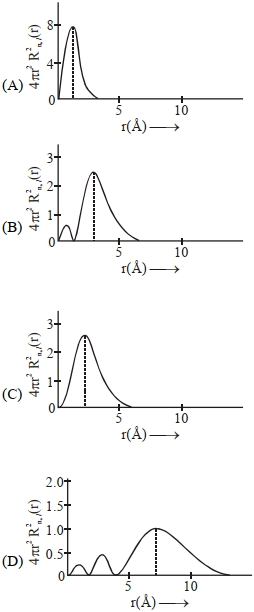
Number of radial nodes \(= n -\ell-1\)\(=3-0-1=2\)
Therefor corresponding graph is \((D)\)
Hence answer is (3)
-
- (A) \(9\)
- (B) \(4\)
- (C) \(5\)
- (D) \(6\)
જવાબ અને ઉકેલ જુઓ
સાચો જવાબ: (D)
De-broglie-wave length of electron:\(\lambda_{c}=\frac{h}{\sqrt{2 m({KE})}}\)
\(\because {e}^{-}\,{\text {is accelerated }}{\text { from rest }}{\Rightarrow {KE}={q} \times {V}}\)
\(\lambda=\frac{{h}}{\sqrt{2 {mqv}}}\)
\(=\frac{6.63 \times 10^{-34}}{\sqrt{2 \times 1.6 \times 10^{-19} \times 9.1 \times 10^{-31} \times 40 \times 10^{3}}}\)
\(=0.614 \times 10^{-11} \,{~m}\)
\(=6.16 \times 10^{-12} \,{~m}\)
Nearest integer \(=6\)
OR
\(=\frac{12.3}{\sqrt{V}} \,\mathring A\)
\(=\frac{12.3}{200}=6.15 \times 10^{-12}\, {~m}\)
-
- (A) \(7\)
- (B) \(9\)
- (C) \(12\)
- (D) \(18\)
જવાબ અને ઉકેલ જુઓ
સાચો જવાબ: (B)
Energy incident \(=\frac{ hc }{\lambda}\)\(=\frac{6.63 \times 10^{-34} \times 3.0 \times 10^{8}}{248 \times 10^{-9} \times 1.6 \times 10^{-19}} eV\)
\(=\frac{6.63 \times 3 \times 100}{248 \times 1.6}\)
\(=0.05 eV \times 100=5 eV\)
Now using \(E =\phi+ K . E\)
\(5=3+ K . E\)
\(K . E .=2 eV =3.2 \times 10^{-19} J\)
for debroglie wavelength \(\lambda=\frac{ h }{ mv }\)
\(K . E =\frac{1}{2} mv ^{2}\)
so \(v =\sqrt{\frac{2 KE }{ m }}\)
hence \(\lambda=\frac{ h }{\sqrt{2 KE \times m }}\)
\(=\frac{6.63 \times 10^{-34}}{\sqrt{2 \times 3.2 \times 10^{-19} \times 9.1 \times 10^{-31}}}\)
\(=\frac{6.63}{7.6} \times \frac{10^{-34}}{10^{-25}}=\frac{66.3 \times 10^{-10} m }{7.6}\)
\(=8.72 \times 10^{-10} m\)
\(\approx 9 \times 10^{-10} m\)
\(=9 ^o\)
-
- (A) \(\alpha\)-કણો નાના ખૂણાઓ દ્વારા અને ઓછી ઝડપ સાથે વિખરાયેલા સોનાના વરખમાંથી પસાર થાય છે.
- (B) બધા \(\alpha\)-કણો \(180^{\circ}\) દ્વારા પાછા ઉછળે છે.
- (C) \(\alpha\)-કણો વિશાળ ખૂણા પર વિચલિત હોય છે.
- (D) બધા \(\alpha\)-કણો ગતિમાં ઘટાડો કર્યા વગર સોનાના વરખમાંથી પસાર થાય છે
જવાબ અને ઉકેલ જુઓ
સાચો જવાબ: (A)
As in Thomson model, protons are diffused (charge is not centered) \(\alpha\)-particles deviate by small angles and due to repulsion from protons, their speeddecreases. - 124. \(n =5, m _{l}=+2\) સાથે કક્ષકોની સંખ્યા ...... છે. (નજીકનાં પૂર્ણાંકમાં રાઉન્ડ ઓફ કરો) 2021 મધ્યમ
- (A) \(3\)
- (B) \(2\)
- (C) \(1\)
- (D) \(0\)
જવાબ અને ઉકેલ જુઓ
સાચો જવાબ: (A)
For, \(n =5\)\(\ell=(0,1,2,3,4)\)
If \(\ell=0, m =0\)
\(\ell=1, m =\{-1,0,+1\}\)
\(\ell=2, m =\{-2,-1,0,+1,+2\}\)
\(\ell=3, m =\{-3,-2,-1,0,+1,+2,+3\}\)
\(\ell=4, m =\{-4,-3,-2,-1,0,+1,+2,+3,+4\}\)
\(5 d , 5 f\) and \(5 g\) subshell contain one-one orbital having \(m _{\ell}=+2\)
-
- (A) વિધાન \( (I) \) અને વિધાન \( (II) \) બંને ખોટા છે.
- (B) વિધાન \( (I) \) અને વિધાન \( (II) \) બંને સાચા છે.
- (C) વિધાન \( (I) \) ખોટું છે પણ વિધાન \( (II) \) સાચું છે.
- (D) વિધાન \( (I) \) સાચું છે પણ વિધાન \( (II) \) ખોટું છે.
જવાબ અને ઉકેલ જુઓ
સાચો જવાબ: (C)
Velocity of electron in Bohr's atom is given by\({V} \propto \frac{{Z}}{{n}}\)
\(Z=\) atomic number of atom, corresponds to \(+v e\) charge so as \(Z\) increase velocity increases so statement\(-I\) is wrong.
and as \('n'\) decreases velocity increases so statement\(-II\) is correct.
-
- (A) વિધાન \( I \) ખોટું છે પરંતુ વિધાન \( II \) સાચું છે.
- (B) વિધાન \( I \) અને વિધાન \( II \) બંને ખોટા છે.
- (C) વિધાન \( I \) સાચું છે પરંતુ વિધાન \( II \) ખોટું છે.
- (D) વિધાન \( I \) અને વિધાન \( II \) બંને સાચા છે.
જવાબ અને ઉકેલ જુઓ
સાચો જવાબ: (D)
Rutherford's gold foil experiment only proved that electrons are held towards nucleus by electrostatic forces of attraction and move in circular orbits with very high speeds.Bohr's model gave exact formula for simultaneous calculation of speed \(\&\) distance of electron from the nucleus, something which was deemed impossible according to Heisenberg.
-
- (A) બંને વિધાનો \(I\) અને \(II\) સાચા છે
- (B) વિધાન \(I\) ખોટું છે પરંતુ વિધાન \(II\) સાચું છે
- (C) બંને વિધાન \(I\) અને \(II\) ખોટા છે
- (D) વિધાન \(I\) સાચું છે પરંતુ \(II\) ખોટું છે
જવાબ અને ઉકેલ જુઓ
સાચો જવાબ: (B)
Statement\(-I\) is false since Bohr's theory accounts for the stability and spectrum of single electronic species \(\left( eg : He ^{+}, Li ^{2+}\right.\) etc \()\)Statement\(-II\) is true.
-
- (A) \(12\)
- (B) \(36\)
- (C) \(58\)
- (D) \(72\)
જવાબ અને ઉકેલ જુઓ
સાચો જવાબ: (C)
\(\Delta v=\frac{0.02}{100} \times 5 \times 10^{6}=10^{3} \,{~m} / {s}\)According to Heisenberg uncertainty principle
\(\Delta {X} \cdot \Delta {v}=\frac{{h}}{4 \pi \,{m}}\)
\({x} \times 10^{-9} \times 10^{3}=\frac{6.63 \times 10^{-34}}{4 \times 3.14 \times 9.1 \times 10^{-31}}\)
\({X} \times 10^{-9} \times 10^{3}=0.058 \times 10^{-3}\)
\({x}=\frac{0.058 \times 10^{-6}}{10^{-9}}=58\)
-
- (A) \(1\)
- (B) \(2\)
- (C) \(3\)
- (D) \(4\)
જવાબ અને ઉકેલ જુઓ
સાચો જવાબ: (B)
\(\lambda=\frac{ h }{\sqrt{2 mqV }}\)\(\frac{\lambda_{ Li }}{\lambda_{ p }}=\sqrt{\frac{ m _{ p }( e ) V }{ m _{ Li }(3 e )( V )}} \quad m _{ Li }=8.3 m _{ p }\)
\(\frac{\lambda_{ Li }}{\lambda_{ p }}=\sqrt{\frac{1}{8.3 \times 3}}=\frac{1}{5}=0.2=2 \times 10^{-1}\)
- 130. \({Zn}^{+}\) આયનમાં બાહ્યતમ ઇલેક્ટ્રોનની ચુંબકીય ક્વોન્ટમ આંકનું મૂલ્ય \(.....\) છે. 2021 મધ્યમ
- (A) \(1\)
- (B) \(0\)
- (C) \(3\)
- (D) \(2\)
જવાબ અને ઉકેલ જુઓ
સાચો જવાબ: (B)
\({Zn}^{+} \rightarrow 1 {~s}^{2} 2 {~s}^{2} 2 {p}^{6} 3 {~s}^{2} 3 {p}^{6} 3 {~d}^{10} 4 {~s}^{1}\)Outermost electron is in \(4 \,{~s}\) subshell \({m}=0\)
-
- (A) \(8 \pi a_{0}\)
- (B) \(2 \pi a_{0}\)
- (C) \(4 \pi a_{0}\)
- (D) \(6 \pi a_{0}\)
જવાબ અને ઉકેલ જુઓ
સાચો જવાબ: (A)
\(2 \pi r=n \lambda\)for \(\quad \mathrm{n}=1, \mathrm{r}=\mathrm{a}_{0}\)
\(\mathrm{n}=4, \mathrm{r}=16 \mathrm{a}_{0}\)
So, \(\quad 2 \pi \times 16 \mathrm{a}_{0}=4 \times \lambda\)
\(\lambda=8 \pi \mathrm{a}_{0}\)
-
- (A) \(6 s, 5 f, 6 d, 6 p\)
- (B) \(6 s, 6 p, 6 d, 6 f\)
- (C) \(6 s, 5 d, 5 f, 6 p\)
- (D) \(6 s, 4 f, 5 d, 6 p\)
જવાબ અને ઉકેલ જુઓ
સાચો જવાબ: (D)
As per \(( n +\ell)\) rule in \(6^{th}\) period, order of orbitals filling is \(6 s, 4 f, 5 d, 6 p\) -
- (A) \((II), (III), (IV)\)
- (B) \((I), (II), (III)\)
- (C) \((I), (III), (IV)\)
- (D) \((I), (II), (IV)\)
જવાબ અને ઉકેલ જુઓ
સાચો જવાબ: (B)
For balmer : \(\mathrm{n}_{1}=2, \mathrm{n}_{2}=3,4,5, \ldots \infty\)\(\bar{v}=\frac{1}{\lambda}=R_{H}\left[\frac{1}{2^{2}}-\frac{1}{n_{2}^{2}}\right]\)
\(\frac{1}{\lambda_{\text {longest }}}=\mathrm{R}_{\mathrm{H}}\left[\frac{1}{2^{2}}-\frac{1}{3^{2}}\right]\)
-
- (A) \(13\) એ અર્ધ ભરાયેલી સંયોજક પેટા કક્ષક
- (B) \(9\)એ પ્રથમ આલ્કલી ધાતુ છે
- (C) \(8\) એ ઉમદા વાયુ છે
- (D) \(6\) એ \(2 p-\) સંયોજક પેટા કક્ષક
જવાબ અને ઉકેલ જુઓ
સાચો જવાબ: (A)
\(l=0\) to \(( n +1)\)\(n =1 \quad n =2\)
\(l=0,1,2 \quad l=0,1,2,3\)
\((n+l) \Rightarrow \frac{1 s}{1} \frac{1 p}{2} \frac{1 d}{3} \quad \frac{2 s}{2} \frac{2 p}{3} \frac{2 d}{4} \frac{2 f}{5}\)
\(n=3\)
\(l=0,1,2,3,4\)
\(\frac{3 s }{3} \frac{3 p }{4} \frac{3 d }{5} \frac{3 f }{6} \frac{3 g }{7}\)
Now, in order to write electronic configuration, we need to apply \(( n +l)\) rule
Energy order : \(1 s <1 p <2 s <1 d <2 p <3 s <2 d\)
Option 1) \(13: 1 s^{2} 1 p^{6} 2 s^{2} 1 d^{3}\) is not half filled
Option 2) \(9: \quad 1 s^{2} 1 p^{6} 2 s^{1}\) is the first alkali metal because after losing one electron, it will achieve first noble gas configuration
Option \(3)\) \(8: \quad 1 s^{2} 1 p^{6}\) is the first noble gas because after \(1 p ^{6} e ^{-}\) will
Option \(4)\) \(6: \quad 1 s ^{2} 1 p ^{4}\) has \(1 p\) valence subshell.
- 135. લાયમન શ્રેણીમાં \(H\) પરમાણુની ટૂંકી તરંગલંબાઇ એ \(\lambda_{1}\) છે.\(He ^{+}\)ની બાલ્મર શ્રેણીની સૌથી લાંબી તરંગલંબાઇ કઈ છે: 2020 અઘરું
- (A) \(\frac{5 \lambda_{1}}{9}\)
- (B) \(\frac{27 \lambda_{1}}{5}\)
- (C) \(\frac{9 \lambda_{1}}{5}\)
- (D) \(\frac{36 \lambda_{1}}{5}\)
જવાબ અને ઉકેલ જુઓ
સાચો જવાબ: (C)
As we know \(\Delta E=\frac{h c}{\lambda}\)So \(\quad \lambda=\frac{ hc }{\Delta E } \quad\) for \(\lambda\) minimum i.e.
shortest; \(\Delta E=\) maximum
for Lyman series \(n=1 \&\) for \(\Delta E_{\text {max }}\)
Transition must be form \(n=\infty\) to \(n=1\)
So \(\quad \frac{1}{\lambda}= R _{ H } Z^{2}\left(\frac{1}{ n _{1}^{2}}-\frac{1}{ n _{2}^{2}}\right)\)3
\(\frac{1}{\lambda}= R _{ H } Z^{2}(1-0)\)
\(\frac{1}{\lambda}= R \times(1)^{2} \Rightarrow \lambda_{1}=\frac{1}{ R }\)
For longest wavelength \(\Delta E =\) minimum for Balmer series \(n =3\) to \(n =2\) will have \(\Delta E\) minimum
for \(He ^{+} Z =2\)
So \(\frac{1}{\lambda_{2}}= R _{ H } \times Z^{2}\left(\frac{1}{ n _{1}^{2}}-\frac{1}{ n _{2}^{2}}\right)\)
\(\frac{1}{\lambda_{2}}= R _{ H } \times 4\left(\frac{1}{4}-\frac{1}{9}\right)\)
\(\frac{1}{\lambda_{2}}= R _{ H } \times \frac{5}{9}\)
\(\lambda_{2}=\lambda_{1} \times \frac{9}{5}\)
-
- (A) \(8:3\)
- (B) \(3:2\)
- (C) \(3:8\)
- (D) \(2:3\)
જવાબ અને ઉકેલ જુઓ
સાચો જવાબ: (D)
\(\frac{\Delta R _{1}}{\Delta R _{2}}=\frac{\left( r _{4}- r _{3}\right)_{4^{2+}}}{\left( r _{4}- r _{3}\right)_{ He ^{+}}}=\frac{\frac{4^{2}}{3}-\frac{3^{2}}{3}}{\frac{4^{2}}{2}-\frac{3^{2}}{2}}=\frac{7 / 3}{7 / 2}=\frac{2}{3}\) -
- (A) \(4\)
- (B) \(8\)
- (C) \(16\)
- (D) \(2\)
જવાબ અને ઉકેલ જુઓ
સાચો જવાબ: (D)
For \(n=4\)\(\ell=0,1,2,3\)
\(\therefore 4 d \& 4 f\) subshell associated with \(n =4, m =-2\)

- 138. \(n=5,\;m_s=+\frac 12\) ક્વોન્ટમ સંખ્યા સાથે સંકળાયેલ ભ્રમણકક્ષાની સંખ્યા ........ થાય. 2020 મધ્યમ
- (A) \(11\)
- (B) \(25\)
- (C) \(15\)
- (D) \(50\)
જવાબ અને ઉકેલ જુઓ
સાચો જવાબ: (B)
No. of orbitals \(=n^{2}=5^{2}=25\)For \(n=5,\) no. of orbitals \(=n^{2}=25\)
Total number of orbitals is equal to no. of electrons having \(\mathrm{m}_{\mathrm{s}}=\frac{1}{2}\)
-
- (A) દૃશ્યમાન
- (B) માઇક્રોવેવ
- (C) પાર - જાંબલી
- (D) ક્ષ-કિરણ
જવાબ અને ઉકેલ જુઓ
સાચો જવાબ: (A)
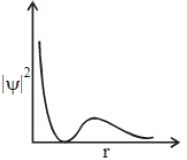
Balmer series give visible lines For \(H\)\(-\)atom - 140. \({\left| \psi \right|^2}\) અને \(r\)(radial distance) વચ્ચેનો આલેખ નીચે દર્શાવ્યો છે . તે .. . રજૂ કરે છે .
 2019 મધ્યમ
- (A) \(1s\) કક્ષક
- (B) \(3s\) કક્ષક
- (C) \(2s\) કક્ષક
- (D) \(2p\) કક્ષક
જવાબ અને ઉકેલ જુઓ
સાચો જવાબ: (C)
As we know that for \(s-\) orbital graph start from top and no. of radial node \(= n-l-1\) For \(2s\) orbital it will \(= 2-0-1=1\)\(\therefore \) The graph is of \(2s\)
-
- (A) \(I < III < II < IV\)
- (B) \(I < II < III < IV\)
- (C) \(IV < II < III < I\)
- (D) \(IV < III < II < I\)
જવાબ અને ઉકેલ જુઓ
સાચો જવાબ: (C)
According to Aufbau principle, the energy sequence is \(3p < 3d < 4p < 4d\) -
- (A) \(0.40\)
- (B) \(1.50\)
- (C) \(1.0\)
- (D) \(0.75\)
જવાબ અને ઉકેલ જુઓ
સાચો જવાબ: (D)
\(2\pi r = n\lambda \)\(\lambda = \frac{{2\pi r}}{n} = \frac{{2\pi {n^2}{a_0}}}{{n \times Z}} = 2\pi \frac{n}{Z}{a_0}\)
\(\lambda = 1.5\pi {a_0}\)
\(\therefore \,2\pi \frac{n}{Z}{a_0} = 1.5\pi {a_0}\)
\(\therefore \frac{n}{Z} = \frac{{1.5}}{2} = 0.75\)
- 143. હાઈડ્રોજન પરમાણુની ધરા અવસ્થાની ઊર્જા \(-13.6\, eV\) છે તો \(He^+\) આયનની દ્રીતીય ઉતેજિત અવસ્થા ( \(eV\) માં ) કેટલી થાય? 2019 મધ્યમ
- (A) \(-54.4\)
- (B) \(-3.4\)
- (C) \(-6.04\)
- (D) \(-27.2\)
જવાબ અને ઉકેલ જુઓ
સાચો જવાબ: (C)
\(E = - 13.6\frac{{{z^2}}}{{{n^2}}}\,eV\) \(E_{He}^ + = - 13.6\frac{4}{9}\) - 144. હાઈડ્રોજન વર્ણપટની બે વર્ણપટ શ્રેણીઓની સૌથી ટૂંકી તરંગ લંબાઈઓનો ગુણોતર \(9\) છે . તો વર્ણપટ શ્રેણીઓ જણાવો. 2019 મધ્યમ
- (A) લાયમેન અન પાશ્વન
- (B) બ્રેકેટ અન ફુન્ડ
- (C) પાશ્વન અન ફુન્ડ
- (D) બામર અને બ્રેકેટ
જવાબ અને ઉકેલ જુઓ
સાચો જવાબ: (A)
\(\frac{{\frac{1}{{{\lambda _2}}} = {R_H}\left( {\frac{1}{{n_1^2}} - \frac{1}{{n_2^2}}} \right){Z^2}}}{{\frac{1}{{{\lambda _1}}} = {R_H}\left( {\frac{1}{{n_1^2}} - \frac{1}{{n_2^2}}} \right){Z^2}}}\)As for shortest wavelength both \(n_1\) and \(n_2^1\) are \(\infty \)
\(\therefore \,\frac{{{\lambda _1}}}{{{\lambda _2}}} = \frac{9}{1} = \frac{{n_1^1}}{{n_1^2}}\)
Now if \(n_1^1=3\) and \(n_1\) is \(1\) it will justify the statement hence Lyman and Paschen is correct.
-
- (A) ઇલેક્ટ્રોન કેન્દ્ર થી \(2a_0\) અંતરે મળી શકે છે .
- (B) ન્યુક્લિઅસ પર ઇલેક્ટ્રોન મળવાની સંભાવના વધુ છે.
- (C) સરેરાશપણે તેની ગતિજ ઊર્જા કરતાં સ્થિતિજ ઊર્જાની માત્ર બમણી છે .
- (D) જ્યારે ઇલેક્ટ્રોન કેન્દ્ર થી \(a_0\) અંતરે હોય તેની કુલ ઊર્જા મહતમ હોય છે .
જવાબ અને ઉકેલ જુઓ
સાચો જવાબ: (D)
\(T.E = - K.E = \frac{{PE}}{2}\) The energy of electrons increases as they are away from the nucleus. The probability of finding the \(1s\) electron may be higher at \(a_0\) but the energy is not. The probability density of finding the electron is not zero at any place in the atom. So, the energy may be higher when it is far from \(a_0\) -
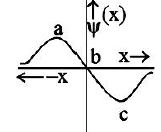
- (A) \(a\) અને \(b\) વિસ્તાર માં
- (B) \(a\) અને \(c\) વિસ્તાર માં
- (C) ફક્ત \(a\) વિસ્તારમાં
- (D) ફક્ત \(c\) વિસ્તારમાં
જવાબ અને ઉકેલ જુઓ
સાચો જવાબ: (B)
At \(a\) & \(c\), probability of finding electron is maximum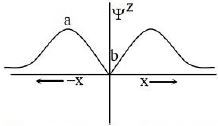
-
- (A) \(0.9\)
- (B) \(3.1\)
- (C) \(2.1\)
- (D) \(4\)
જવાબ અને ઉકેલ જુઓ
સાચો જવાબ: (C)
\(hv = \phi + h{v^o}\)\(\frac{1}{2}m{v^2} = hc\left( {\frac{1}{\lambda } - \frac{1}{{{\lambda _0}}}} \right)\)
\(hv = \phi + \frac{1}{2}m{v^2}\)
\(\phi = \frac{{6.626 \times {{10}^{ - 34}} \times 3 \times {{10}^8}}}{{4000 \times {{10}^{ - 10}}}}\) \( - \frac{1}{2} \times 9 \times {10^{ - 31}} \times {(6 \times {10^5})^2}\)
\(\phi = 3.35 \times {10^{ - 19}}\,J\)
\( \Rightarrow \phi \simeq 2.1\,eV\)
-
- (A) \(\frac{3}{4}\lambda \)
- (B) \(\frac{1}{2}\lambda \)
- (C) \(\frac{4}{9}\lambda \)
- (D) \(\frac{2}{3}\lambda \)
જવાબ અને ઉકેલ જુઓ
સાચો જવાબ: (C)
\(K.E = \frac{1}{2}m{u^2} = \frac{1}{2}\frac{{{m^2}{u^2}}}{m} = \frac{1}{2}\frac{{{P^2}}}{m}\)\(\frac{{hc}}{{{\lambda _1}}} = Wo + {(K.E)_1} = Wo + \frac{1}{2}\frac{{{P^2}}}{m}\)
\(\frac{{hc}}{{{\lambda _2}}} = Wo + {(K.E)_2} = Wo + \frac{1}{2}\frac{{{{(1.5P)}^2}}}{m}\)
On solving
\({\lambda _2} = \frac{4}{9}{\lambda _1}\)
Since the \(K.E\) is very high is comparison to work function, then we can assume that \(K.E+Wo = K.E\)
-
- (A) \(- R_H\) આંતર્છેદ ધરાવતો રેખીય
- (B) બિન રેખીય
- (C) \(R_H\) ઢાળ ધરાવતો રેખીય
- (D) \(- R_H\) ઢાળ ધરાવતો રેખીય
જવાબ અને ઉકેલ જુઓ
સાચો જવાબ: (D)
For emission line \(n_f < n_i\)\(\therefore \,\bar v = R{Z^2}\left[ {\frac{1}{{n_i^2}} - \frac{1}{{n_f^2}}} \right] = R\left[ {\frac{1}{{{8^2}}} - \frac{1}{{{n^2}}}} \right]\)
or, \(\bar v = {R_H}\left( {\frac{1}{{64}} - \frac{1}{{{n^2}}}} \right)\)
\( = \frac{{{R_H}}}{{64}} - \frac{{{R_H}}}{{{n^2}}}\)
\(\bar v = - {R_H}\left( {\frac{1}{n^2}} \right) + \frac{{{R_H}}}{{64}}\)
\(\therefore \,y = mx + c\)
Slope \(= -R_H\)
-
- (A) \(K\)
- (B) \(Na\)
- (C) \(H\)
- (D) \(Li\)
જવાબ અને ઉકેલ જુઓ
સાચો જવાબ: (A)
Greater the nuclear charge, stronger will be the attraction, hence lower will be energy of \(2s\)
આ પેજ પર આ ફિલ્ટર મુજબ કોઈ પ્રશ્ન નથી.