


All Structure of atom questions
Newest firstShowing 51–100 of 179 questions
-
- (A) \(4\)
- (B) \(7\)
- (C) \(8\)
- (D) \(6\)
Show answer and solution
Correct Answer: (D)
\(\mathrm{n}=4\)l \(\quad \mathrm{m}_{\ell}\)
\(0 \quad 0\)
\(1-1,0,+1\)
\(2-2,-1,0,+1,+2,+3\)
So number of orbital associated with
\(\mathrm{n}=4,\left|\mathrm{~m}_{\mathrm{l}}\right|=1\) are \(6\)
Now each orbital contain one \(e^{-}\)with \(\mathrm{m}_x=-\frac{1}{2}\)
-
- (A) \(A-IV, B-III, C-II, D-I\)
- (B) \(A-III, B-II, C-I, D-IV\)
- (C) \(A-I, B-IV, C-III, D-II\)
- (D) \(A-II, B-I, C-IV, D-III\)
Show answer and solution
Correct Answer: (B)
(\(A\)) \({ }_7 \mathrm{~N}:[\mathrm{He}] 2 \mathrm{~s}^2 2 \mathrm{p}^3\)(\(B\)) \({ }_{16} \mathrm{~S}:[\mathrm{Ne}] 2 \mathrm{~s}^2 3 \mathrm{p}^4\)
(\(C\)) \({ }_{35} \mathrm{Br}:[\mathrm{Ar}] 3 \mathrm{~d}^{10} 4 \mathrm{~s}^2 4 \mathrm{p}^5\)
(\(D\)) \({ }_{36} \mathrm{Kr}:[\mathrm{Ar}] 3 \mathrm{~d}^{10} 4 \mathrm{~s}^2 4 \mathrm{p}^6\)
-
- (A) \(A-II\), \(B-III\), \(C-I\), \(D-IV\)
- (B) \(A-I\), \(B-III\), \(C-II\), \(D-IV\)
- (C) \(A-II\), \(B-IV\), \(C-III\), \(D-I\)
- (D) \(A-I\), \(B-II\), \(C-III\), \(D-IV\)
Show answer and solution
Correct Answer: (C)
\(A - II\), \(B - IV\), \(C - III\), \(D - I\)Fact based.
-
- (A) \(11\)
- (B) \(10\)
- (C) \(12\)
- (D) \(13\)
Show answer and solution
Correct Answer: (B)
\(5^{\text {th }} \text { excited state } \Rightarrow n_1=6\)\(1^{\text {st }} \text { excited state } \Rightarrow n_2=2\)
\(\Delta n=n_1-n_2=6-2=4\)
Maximum number of spectral lines
\(=\frac{\Delta \mathrm{n}(\Delta \mathrm{n}+1)}{2}=\frac{4(4+1)}{2}=10\)
-
- (A) \(540\) and \(\frac{1}{683}\)
- (B) \(540\) and \(683\)
- (C) \(450\) and \(\frac{1}{683}\)
- (D) \(450\) and \(683\)
Show answer and solution
Correct Answer: (B)
The candela is the luminous intensity of a source that emits monochromatic radiation of frequency radiation of frequency \(540 \times 10^{12} \mathrm{~Hz}\) and has a radiant intensity in that direction of \(\frac{1}{683} \mathrm{w} / \mathrm{sr}\). It is unit of Candela. - 56. The correct set of four quantum numbers for the valence electron of rubidium atom \((Z=37)\) is _______. 2024 Hard
- (A) \(5,0,0,+\frac{1}{2}\)
- (B) \(5,0,1,+\frac{1}{2}\)
- (C) \(5,1,0,+\frac{1}{2}\)
- (D) \(5,1,1,+\frac{1}{2}\)
Show answer and solution
Correct Answer: (A)
\( \mathrm{Rb}=[\mathrm{Kr}] 5 \mathrm{~s}^1 \)\( \mathrm{n}=5 \)
\( l=0 \)
\( \mathrm{~m}=0 \)
\( \mathrm{~s}=+1 / 2 \text { or }-1 / 2\)
- 57. The de-Broglie's wavelength of an electron in the \(4^{\text {th }}\) orbit is _______. \(\pi a_0 .\left(a_0=\right.\) Bohr's radius) 2024 Medium
- (A) \(5\)
- (B) \(4\)
- (C) \(7\)
- (D) \(8\)
Show answer and solution
Correct Answer: (D)
\(2 \pi \mathrm{r}_{\mathrm{u}}=\mathrm{n} \lambda_{\mathrm{d}}\)\(2 \pi \mathrm{a}_0 \frac{\mathrm{n}^2}{\mathrm{z}}=\mathrm{n} \lambda_{\mathrm{d}}\)
\(2 \pi \mathrm{a}_0 \frac{4^2}{1}=4 \lambda_{\mathrm{d}}\)
\(\lambda_{\mathrm{d}}=8 \pi \mathrm{a}_0\)
- 58. The four quantum numbers for the electron in the outer most orbital of potassium (atomic no. \(19\)) are _______. 2024 Hard
- (A) \(\mathrm{n}=4, l=2, \mathrm{~m}=-1, s=+\frac{1}{2}\)
- (B) \(\mathrm{n}=4, l=0, \mathrm{~m}=0, s=+\frac{1}{2}\)
- (C) \(\mathrm{n}=3, l=0, \mathrm{~m}=1, s=+\frac{1}{2}\)
- (D) \(\mathrm{n}=2, l=0, \mathrm{~m}=0, s=+\frac{1}{2}\)
Show answer and solution
Correct Answer: (B)
\({ }_{19} \mathrm{K} \quad 1 \mathrm{~s}^2, 2 \mathrm{~s}^2, 2 \mathrm{p}^6, 3 \mathrm{~s}^2, 3 \mathrm{p}^6, 4 \mathrm{~s}^1 \text {. }\)Outermost orbital of potassium is \(4 \mathrm{~s}\) orbital
\(\mathrm{n}=4, \mathrm{l}=0, \mathrm{~m}_1=0, \mathrm{~s}= \pm \frac{1}{2}\)
-
- (A) \(494\)
- (B) \(490\)
- (C) \(499\)
- (D) \(445\)
Show answer and solution
Correct Answer: (A)
\(\mathrm{E}=\frac{1240}{\lambda(\mathrm{nm})} \mathrm{eV}\)\(=\frac{1240}{242} \mathrm{eV}\)
\(=5.12 \mathrm{eV}\)
\(=5.12 \times 1.6 \times 10^{-19}\)
\(=8.198 \times 10^{-19} \mathrm{~J} / \text { atom }\)
\(=494 \mathrm{~kJ} / \mathrm{mol}\)
-
- (A) \(14\)
- (B) \(35\)
- (C) \(18\)
- (D) \(16\)
Show answer and solution
Correct Answer: (D)
\(n=4\) can have,
So, Ans.\(16\)\(4\text s\) \(4\text q\) \(4\text d\) \(4\text f\) Total \(\text e^{-}\) \(2\) \(6\) \(10\) \(14\) Total \(\text e ^{-}\)with \(\text S =+\frac{1}{2}\) \(1\) \(3\) \(5\) \(7\) -
- (A) \(1\)
- (B) \(4\)
- (C) \(2\)
- (D) \(3\)
Show answer and solution
Correct Answer: (A)
For \(3 \mathrm{p}: \mathrm{n}=3, \ell=1\)Number of radial node \(=n-\ell-1\)
\(=3-1-1=1\)
-
- (A) \(22\)
- (B) \(25\)
- (C) \(30\)
- (D) \(35\)
Show answer and solution
Correct Answer: (A)
\(\mathrm{V}=2.18 \times 10^6 \times \frac{\mathrm{Z}}{\mathrm{n}}\)\(=21.8 \times 10^5 \times \frac{1}{1} \approx 22 \times 10^5 \text { (nearest) }\)
-
- (A) \(2\)
- (B) \(7\)
- (C) \(9\)
- (D) \(11\)
Show answer and solution
Correct Answer: (A)
\( \text { Noble gas configuration }=\mathrm{ns}^2 \mathrm{np}^6 \)\( {\left[\mathrm{Sr}^{2+}\right]=[\mathrm{Kr}\rfloor} \)
\( {\left[\mathrm{Cs}^{+}\right]=[\mathrm{Xe}]} \)
\( {\left[\mathrm{Yb}^{2+}\right]=[\mathrm{Xe}] 4 \mathrm{f}^{14}}\)
\( {\left[\mathrm{La}^{2+}\right]=[\mathrm{Xe}] 5 \mathrm{~d}^1} \)
\( {\left[\mathrm{~Pb}^{2+}\right]=[\mathrm{Xe}] 4 \mathrm{f}^{14} 5 \mathrm{~d}^{10} 6 \mathrm{~s}^2} \)
\( {\left[\mathrm{Fe}^{2+}\right]=[\mathrm{Ar}] 3 \mathrm{~d}^6}\)
- 64. Wavenumber for a radiation having \(5800 \mathring A\) wavelength is \(x \times 10 \mathrm{~cm}^{-1}\). The value of \(x\) is _______. 2024 Medium
- (A) \(1724\)
- (B) \(1725\)
- (C) \(1727\)
- (D) \(1730\)
Show answer and solution
Correct Answer: (A)
\(\bar{v} \text { (wave no.) }=\frac{1}{\lambda}=\frac{1}{5800 \times 10^{-8} \mathrm{~cm}}=17241\)OR
\(1724 \times 10 \mathrm{~cm}^{-1} \Rightarrow \mathrm{x}=1724\)
-
- (A) \(B > D > C > A\)
- (B) \(D > B > C > A\)
- (C) \(A > C > B > D\)
- (D) \(D > B > A > C\)
Show answer and solution
Correct Answer: (B)
\((A)\) \(n =3 ; 1=0 ; m =0 ; 3 s\) orbital\((B)\) \(n =4 ; 1=0 ; m =0 ; 4 s\) orbital
\((C)\) \(n =3 ; 1=1 ; m =0 ; 3 p\) orbital
\((D)\) \(n =3 ; 1=2 ; m =0 ; 3 d\) orbital
As per Hund's rule energy is given by \(( n +l)\) value.
If value of \(( n +l)\) remains same then energy is given by \(n\) only.
-
- (A) \(170\)
- (B) \(180\)
- (C) \(270\)
- (D) \(250\)
Show answer and solution
Correct Answer: (C)
\(r \propto \frac{ n ^2}{ Z }\)\(r _{ He ^{+}} = r _{ H } \times \frac{ n ^2}{ Z }\)
\(r _{ He ^{+}} =0.6 \times \frac{(3)^2}{2}\)
\(=2.7 \mathring A\)
\(r _{ He ^{+}} =270\,pm\)
-
- (A) \(2\)
- (B) \(3\)
- (C) \(1\)
- (D) \(4\)
Show answer and solution
Correct Answer: (A)
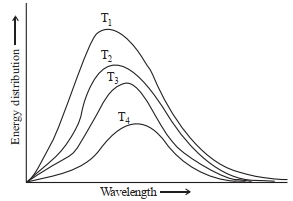
The spectrum of Black body radiation is explained using quantization of energy. With increase in temperature, peak of spectrum shifts to shorter wavelength or higher frequency. For above graph\(\rightarrow T _1 > T _2 > T _3 > T _4 \text {. }\)
-
- (A) Both \(A\) and \(R\) are true but \(R\) is NOT the correct explanation of \(A\)
- (B) Both \(A\) and \(R\) are true and \(R\) is the correct explanation of \(A\)
- (C) \(A\) is false but \(R\) is true
- (D) \(A\) is true but \(R\) is false
Show answer and solution
Correct Answer: (B)
\(5 f\) orbital not buried as \(4 f\) orbitals so \(e ^{-}\) present in \(5 f\) orbital experience less nuclear attraction than \(e ^{-}\)present in \(4 f\) orbital. Hence electrons of 5 f orbital can take part in bonding to a far greater extent. -
- (A) Both \(A\) and \(R\) are correct but \(R\) is NOT the correct explanation of \(A\)
- (B) \(A\) is correct but \(R\) is not correct
- (C) Both \(A\) and \(R\) are correct and \(R\) is the correct explanation of \(A\)
- (D) \(A\) is not correct but \(R\) is correct
Show answer and solution
Correct Answer: (B)
There is a characteristic minimum frequency, or "threshold frequency," for each metal below which the photoelectric effect is not seen. The ejected electrons leave with a specific amount of kinetic energy at a frequency \(v > v _0\) with an increase in light frequency of these electron kinetic energies also rise. -
- (A) Both Statement \(I\) and Statement \(II\) are correct.
- (B) Statement \(I\) is correct but Statement \(II\) is incorrect.
- (C) Statement \(I\) is incorrect but Statement \(II\) is correct
- (D) Both Statement \(I\) and Statement \(II\) are incorrect.
Show answer and solution
Correct Answer: (A)
According to Bohr's model the angular momentum is quantised and equal to \(\frac{ nh }{2 \pi}\).Heisenberg uncertainty principle explains orbital concept, which is based on probability of finding electron.
-
- (A) \(16\)
- (B) \(32\)
- (C) \(50\)
- (D) \(72\)
Show answer and solution
Correct Answer: (B)
The number of electrons in the orbitals of sub-shell of \(n=4\) are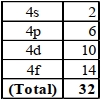
-
- (A) \(2\)
- (B) \(3\)
- (C) \(1\)
- (D) \(4\)
Show answer and solution
Correct Answer: (C)
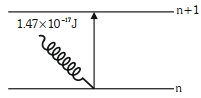
\(\Delta E = R _{ H } Z ^2\left(\frac{1}{ n _1^2}-\frac{1}{ n _2^2}\right)\)\(1.47 \times 10^{-17}=2.18 \times 10^{-15} \times 9\left(\frac{1}{n^2}-\frac{1}{(n+1)^2}\right)\)
\(\frac{1.47}{1.96}=\frac{3}{4}=\frac{1}{n^2}-\frac{1}{(n+1)^2}\)
So, \(n =1\)
-
- (A) \(\frac{1}{27}\) of this value
- (B) One third of this value
- (C) Three times of this value
- (D) \(\frac{1}{9}\) th of this value
Show answer and solution
Correct Answer: (D)
\(E _{ n }=\frac{-2.18 \times 10^{-18} Z ^2}{ n ^2}\)\(\text { i.e. } E _{ n } \propto \frac{1}{ n ^2}\)
-
- (A) \(796\)
- (B) \(798\)
- (C) \(797\)
- (D) \(785\)
Show answer and solution
Correct Answer: (B)
For one photon \(E = hv\)For one mole photon,
\(E=6 \cdot 023 \times 10^{23} \times 6.626 \times 10^{-34} \times 2 \times 10^{12}\)
- 75. The number of atomic orbitals from the following having \(5\) radial nodes is \(.......\). \(7 s , 7 p , 6 s , 8 p , 8 d\) 2023 Medium
- (A) \(3\)
- (B) \(2\)
- (C) \(1\)
- (D) \(4\)
Show answer and solution
Correct Answer: (A)
Radial node \(= n -\ell-1\)\(7 s \Rightarrow R \cdot N =7-0-1=6\)
\(7 p \Rightarrow R \cdot N =7-1-1=5\)
\(6 s \Rightarrow R \cdot N =6-0-1=5\)
\(8 p \Rightarrow R \cdot N =8-1-1=6\)
\(8 d \Rightarrow R \cdot N =8-2-1=5\)
So, Answer is \(3\)
-
- (A) \(3\)
- (B) \(4\)
- (C) \(2\)
- (D) \(5\)
Show answer and solution
Correct Answer: (A)
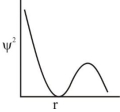
\(A, D\) and \(E\) statements are correct.For \(2 s\) orbital, the probability density first decreases and then increases.
At any distance from nucleus the probability density of finding electron is never zero and it always have some finite value.
-
- (A) \(2\)
- (B) \(1\)
- (C) \(3\)
- (D) \(0\)
Show answer and solution
Correct Answer: (B)
(A) This statement is correct. Line emission spectra (or atomic emission spectra) are indeed used to study the electronic structure of atoms. These spectra are produced when photons are emitted from atoms as excited electrons return to a lower energy level. Each line corresponds to a particular quantum leap between energy levels. (B) This statement is incorrect. The emission spectra of atoms in the gas phase do not show a continuous spread of wavelength from red to violet. Instead, they show distinct lines corresponding to specific electron transitions, hence they are known as line emission spectra. (C) This statement is correct. An absorption spectrum is like the photographic negative of an emission spectrum. In an absorption spectrum, light passes through a cold, dilute gas and atoms in the gas absorb at characteristic frequencies; since the re-emitted light is unlikely to be emitted in the same direction as the absorbed photon, this gives rise to dark lines (absence of light) in the spectrum. (D) This statement is correct. The element helium was indeed discovered in the sun through spectroscopy before it was found on Earth. The name helium comes from Helios, the Greek name for the sun. So, the number of incorrect statements is 1. -
- (A) \(1\)
- (B) \(0\)
- (C) \(2\)
- (D) \(3\)
Show answer and solution
Correct Answer: (B)
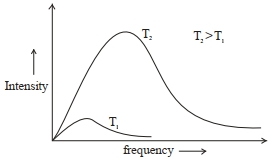
A blackbody can emit and absorb all the wavelengths in electromagnetic spectrum \(\Rightarrow(A)\) is correct\(\Rightarrow(B),(C),(D)\) correct
- 79. The number of s-electrons present in an ion with \(55\) protons in its unipositive state is 2023 Hard
- (A) \(8\)
- (B) \(9\)
- (C) \(12\)
- (D) \(10\)
Show answer and solution
Correct Answer: (D)
\(Z =55[ Cs ] \Rightarrow[ Xe ] 6 s ^1\)\(\left[ Cs ^{+}\right] \Rightarrow[ Xe ]\) i.e. upto \(5 s\) count \(e ^{-}\)of s-subshell i.e. \(1 s , 2 s , 3 s , 4 s , 5 s \Rightarrow 10\) electrons
- 80. The orbital angular momentum of an electron in \(3 s\) orbital is \(\frac{x h}{2 \pi}\). The value of.\(x\) is \(..........\). 2023 Easy
- (A) \(1\)
- (B) \(2\)
- (C) \(3\)
- (D) \(0\)
Show answer and solution
Correct Answer: (D)
\(l\) for \(3s\) orbital is \(0\).
Orbital angular momentum \(=\) \(\sqrt{l(l+1)} \frac{h}{2\pi}\)
\(= \sqrt{0(0+1)} \frac{h}{2\pi} = 0\)
Given \(=\) \(\frac{x h}{2 \pi}\)
\(x = 0\)
-
- (A) \(\frac{9}{4} x\)
- (B) \(\frac{4}{9} x\)
- (C) \(\frac{27}{16} x\)
- (D) \(\frac{16}{27} x\)
Show answer and solution
Correct Answer: (C)
\(Li ^{2+}\)\(r _2= x = k \times \frac{2^2}{3}=\frac{4 k }{2}\)
\(Be ^{3+}\)
\(r _3= y = k \times \frac{3^2}{4}\)
\(\frac{y}{x}=\frac{9}{4} \times \frac{3}{4}=\frac{27}{16}\)
\(y=\frac{27}{16} x\)
-
- (A) \(\frac{5}{9 \lambda}\)
- (B) \(\frac{9 \lambda}{5}\)
- (C) \(\frac{36 \lambda}{5}\)
- (D) \(\frac{5 \lambda}{9}\)
Show answer and solution
Correct Answer: (B)
For \(H : \frac{1}{\lambda}= R _{ H } \times 1^2\left(\frac{1}{1^2}-\frac{1}{\infty^2}\right)\)\(\frac{1}{\lambda_{ He ^{+}}}= R _{ H } \times 2^2 \times\left(\frac{1}{4}-\frac{1}{9}\right)\)
From \((1)\) and \((2)\) \(\frac{\lambda_{ He ^{+}}}{\lambda}=\frac{9}{5}\)
\(\lambda_{ He ^{+}}=\lambda \times \frac{9}{5}\)
\(\lambda_{ He ^{+}}=\frac{9 \lambda}{5}\)
-
- (A) \(5\)
- (B) \(4\)
- (C) \(3\)
- (D) \(2\)
Show answer and solution
Correct Answer: (A)
Isoelectronic species \(O ^{2 \Theta}, F ^{\Theta}, Mg ^{2+}, Na ^{\oplus}, Al ^{3+}\) -
- (A) \(r_0=a_0\)
- (B) \(r_0=4 a_0\)
- (C) \(r _0=\frac{ a _0}{2}\)
- (D) \(r_0=2 a_0\)
Show answer and solution
Correct Answer: (D)
At node \(\Psi_{2 s }=0\)\(\therefore 2-\frac{ r _0}{ a _0}=0\)
\(\therefore r _0=2 a _0\)
-
- (A) \(6\)
- (B) \(5\)
- (C) \(4\)
- (D) \(7\)
Show answer and solution
Correct Answer: (D)
\(\lambda_{ d }=\frac{ h }{ mv }=\frac{ h }{\sqrt{2 mKE }}=\frac{6.6 \times 10^{-34}}{\sqrt{2 \times 9 \times 10^{-31} \times 4.5 \times 10^{-29}}}\)\(=\frac{6.6 \times 10^{-34}}{\sqrt{9^2 \times 10^{-60}}}\)
\(=\frac{6.6 \times 10^{-34}}{9 \times 10^{-30}}=\frac{6.6}{9} \times 10^{-4}\)
\(=7.3 \times 10^{-5}\,m\)
\(\text { Therefore Ans }=7\)
-
- (A) \(Ci ^{+}, Na ^{+}, Mg ^{2+}, Ca ^{2+}\)
- (B) \(\left. Ba ^{2+}, Sr ^{2+}, K +, Ca ^{2+}\right.\)
- (C) \(\left. N ^{3-}, O ^{2-}, F , S ^{2-}\right.\)
- (D) \(\left. K ^{+}, Cl ^{-}, Ca ^{2+}, Sc ^{3+}\right.\)
Show answer and solution
Correct Answer: (D)
\(K ^{+} Cl ^1 Ca ^{2+} Sc ^{3+}\)\(\begin{array}{llll}18 & 18 & 18 & 18\end{array}\)
-
- (A) \(n =2\) to \(n =1\)
- (B) \(n =1\) to \(n =3\)
- (C) \(n =1\) to \(n =2\)
- (D) \(n =3\) to \(n =4\)
Show answer and solution
Correct Answer: (A)
\(He ^{+}\)ion :\(\frac{1}{\lambda( H )}= R (1)^2\left[\frac{1}{ n _1^2}-\frac{1}{ n _2^2}\right]\)
\(\frac{1}{\lambda\left( He ^{+}\right)}= R (2)^2\left[\frac{1}{2^2}-\frac{1}{4^2}\right]\)
Given \(\lambda( H )=\lambda\left( He ^{+}\right)\)
\(R (1)^2\left[\frac{1}{ n _1^2}-\frac{1}{ n _2^2}\right]= R (4)\left[\frac{1}{2^2}-\frac{1}{4^2}\right]\)
\(\frac{1}{ n _1^2}-\frac{1}{ n _2^2}=\frac{1}{1^2}-\frac{1}{2^2}\)
On comparing \(n _1=1\) and \(n _2=2\)
-
- (A) \(4\)
- (B) \(3\)
- (C) \(8\)
- (D) \(5\)
Show answer and solution
Correct Answer: (A)
\({ }_{22}^{48} X ^{3-}\)No. of neutrons \(=26\)
No. of electrons \(=25\)
\(\%\) of extra neutrons
than electrons \(=\frac{26-25}{25} \times 100=4\)
-
- (A) Only \(A\)
- (B) Only \(B\)
- (C) Only \(C\)
- (D) \((B)\) and \((C)\)
Show answer and solution
Correct Answer: (B)
Based on \(" n+1 "\) rule only \((B)\) has pair of electron in degenerate orbitals -
- (A) \(4\)
- (B) \(1\)
- (C) \(2\)
- (D) \(3\)
Show answer and solution
Correct Answer: (C)
Quantum no. of set \((B)\) and \((C)\) can be correct.\((A)\) and \((D)\) are wrong as \(n=\ell\) is not possible.
-
- (A) \(( A ),( B )\) and \(( C )\)
- (B) \(( A ),( C ),( D )\) and \(( E )\)
- (C) \(( A ),( C )\) and \(( D )\)
- (D) \(( A ),( B ),( C )\) and \(( D )\)
Show answer and solution
Correct Answer: (C)
\((A)\) Number of values of \(n =1,2,3 \ldots \infty\)\((B)\) Number of values of \(\ell=0\) to \(( n -1)\)
\((C)\) Number of values of \(m =-\ell\) to \(+\ell\)
Total values \(=2 \ell+1\)
\((D)\) Values of \(\operatorname{spin}=\pm \frac{1}{2}\)
\((E)\) For \(\ell=5\) number of orbitals \(=2 \ell+1=11\)
-
- (A) \(D < B < A < C\)
- (B) \(D < A < B < C\)
- (C) \(B < D < A < C\)
- (D) \(B < D < C < A\)
Show answer and solution
Correct Answer: (B)
Energy order of subshell decided by \(( n +\lambda)\) rule.\(A \Rightarrow 3 d \Rightarrow n +1=5\)
\(B \Rightarrow 4 p \Rightarrow n +\lambda=5\)
\(C \Rightarrow 4 d \Rightarrow n +\ell \Rightarrow 6\)
\(D \Rightarrow 3 s \Rightarrow( n +\ell)=4\)
\(D < A < B < C\)
-
- (A) Both \(A\) and \(R\) are true and \(R\) is the correct explanation of \(A\).
- (B) Both \(A\) and \(R\) are true but \(R\) is NOT the correct explanation of \(A\).
- (C) \(A\) is true but \(R\) is false.
- (D) \(A\) is false but \(R\) is true.
Show answer and solution
Correct Answer: (A)
Energy of orbitals decreases on increasing the atomic number. -
- (A) A circular path around the nucleus in which an electron moves is proposed as Bohr's orbit.
- (B) An orbital is the one electron wave function \((\Psi)\) in an atom.
- (C) The existence of Bohr's orbits is supported by hydrogen spectrum.
- (D) Atomic orbital is characterised by the quantum numbers \(n\) and \(l\) only
Show answer and solution
Correct Answer: (D)
Atomic orbital is characterised by \(n , l,m\). -
- (A) \(r _{4}=\frac{9}{16} r_{3}\)
- (B) \(r_{4}=\frac{16}{9} r_{3}\)
- (C) \(r_{4}=\frac{3}{4} r_{3}\)
- (D) \(r_{4}=\frac{4}{3} r_{3}\)
Show answer and solution
Correct Answer: (B)
\(r =0.529 \times \frac{ n ^{2}}{ Z }\)\(r _{3}=0.529 \times \frac{3^{2}}{1}\)
\(r_{4}=0.529 \times \frac{4^{2}}{1}\)
\(\frac{r_{4}}{r_{3}}=\frac{4^{2}}{3^{2}}=\frac{16}{9}\)
\(r _{4}=\frac{16 r _{3}}{9}\)
-
- (A) \(22\)
- (B) \(45\)
- (C) \(89\)
- (D) \(63\)
Show answer and solution
Correct Answer: (A)
\(\Delta V =2.4 \times 10^{-26} ms ^{-1}\)\(\Delta x =10^{-7} m\)
\(\because \Delta p \cdot \Delta x =\frac{ h }{4 \pi}\)
\(\therefore m \Delta V \Delta x =\frac{ h }{4 \pi}\)
\(\Rightarrow m \times 2.4 \times 10^{-26} \times 10^{-7}=\frac{6.626 \times 10^{-34}}{4 \times \pi}\)
\(m =\frac{6.626}{9.6 \times \pi} \times 10^{-1}\)
\(m =0.02198 \,kg\)
\(m =21.98 \,gm\)
nearest integer \(=22\)
-
- (A) \(1\)
- (B) \(3\)
- (C) \(2\)
- (D) \(0\)
Show answer and solution
Correct Answer: (C)
\(\lambda=\frac{ h }{\sqrt{2 mK }}\)\(K =\frac{ h ^{2}}{2 m \lambda^{2}}\)
\(K =\frac{ h ^{2}}{2 m \lambda^{2}}=\frac{43.9 \times 10^{-68}}{2 \times 9.1 \times 10^{-31} \times 10.89 \times 10^{-20}}\)
\(K =2.215 \times 10^{-18}\)
\(E _{ abs }= E _{\text {req }}+ K\)
\(\frac{ E _{\text {abs }}}{ E _{\text {req }}}=1+\frac{ K }{ E _{\text {req }}}=1+\frac{2.215 \times 10^{-18}}{13.6 \times 1.602 \times 10^{-19}}=2.0166\)
-
- (A) \(300\)
- (B) \(30\)
- (C) \(45\)
- (D) \(100\)
Show answer and solution
Correct Answer: (A)
\(\phi=6.63 \times 10^{-19} \,J =\frac{ hc }{\lambda}=\frac{6.63 \times 10^{-34} \times 3 \times 10^{8}}{\lambda}\)\(\Rightarrow \lambda=3 \times 10^{-7} m =300\, nm\)
-
- (A) \(( D )>( B )>( C )>( A )\)
- (B) \((B) >( D )>( C )>( A )\)
- (C) \(( C )>( B )>( D )>( A )\)
- (D) \((B) >( C )>( D )>( A )\)
Show answer and solution
Correct Answer: (A)
\((A)\) \(n+\ell=3+0=3\)\((B)\) \(n+\ell=4+0=4\)
\((C)\) \(n+\ell=3+1=4\)
\((D)\) \(n+\ell=3+2=5\)
Higher \(n+\ell\) value, higher the energy if same \(n +\ell\) value, then higher \(n\) value, higher the energy.Thus: \(D > B > C > A\).
-
- (A) \(235\)
- (B) \(325\)
- (C) \(399\)
- (D) \(435\)
Show answer and solution
Correct Answer: (C)
Energy of one mole of photons \(=\frac{ hc }{\lambda} \times N _{ A }\)\(\frac{6.63 \times 10^{-34} \times 3 \times 10^{8}}{300 \times 10^{-9}} \times 6.02 \times 10^{23}\)
\(=399.13 \times 10^{3} \,Joule / mole\)
\(=399\, kJ / mole\)
No questions on this page match these filters.