


રાસાયણિક બંધન અને આણ્વીય રચના ના બધા પ્રશ્નો
નવા પહેલા176 માંથી 101–150 પ્રશ્નો
-
- (A) \(2\)
- (B) \(10\)
- (C) \(3\)
- (D) \(4\)
જવાબ અને ઉકેલ જુઓ
સાચો જવાબ: (A)
The species with 2 lone pairs are XeF 4 and H 2 O . Therefore, the number of species with two lone pairs of electrons is \(2 .\)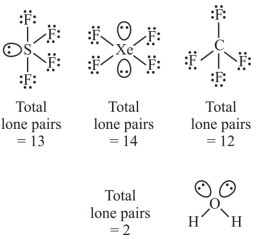
- 102. નીચે આપેલાને તેની સહસંયોજક લાક્ષણિકતાના (પ્રકૃતિ) ચઢતા ક્રમમાં ગોઠવો. \(CaF _{2}\),\(CaCl _{2}\),\(CaBr _{2}\),\(CaI _{2}\) 2022 મધ્યમ
- (A) \(B < A < C < D\)
- (B) \(A < B < C < D\)
- (C) \(A < B < D < C\)
- (D) \(A < C < B < D\)
જવાબ અને ઉકેલ જુઓ
સાચો જવાબ: (B)
According to Fajan's rule,Covalent character \(\propto\) size of Anion - 103. \(PF _{5}\) માં \(P\) વડે પ્રદર્શિત સંકરણ એ \(sp ^{x} d ^{y}\) તો \(y\) નું મૂલ્ય \(\dots\dots\) છે. 2022 સરળ
- (A) \(1\)
- (B) \(10\)
- (C) \(100\)
- (D) \(0.1\)
જવાબ અને ઉકેલ જુઓ
સાચો જવાબ: (A)
\(PF _{5} \Rightarrow sp ^{3} d\) hybridisation(\(5\) sigma bonds, zero lone pair on central atom)
Value of \(y=1\)
-
- (A) વિષુવવૃત્તીય સ્થાન અને \(90^{\circ}\) પર તેમાં બે અબંધકારક યુગ્મ - બંધકારક યુગ્મ અપાકર્ષણો છે.
- (B) વિષુવવૃત્તીય સ્થાન અને \(90^{\circ}\) પર તેમાં ત્રણ અબંધકારક યુગ્મ - બંધકારક યુગ્મ અપાકર્ષણો છે.
- (C) અક્ષીય સ્થાન અને \(90^{\circ}\) પર તેમાં ત્રણ અબંધકારક યુગ્મ - બંધકારક યુગ્મ અપાકર્ષણ છે.
- (D) અક્ષીય સ્થાન અને \(90^{\circ}\) પર બે અબંધકારક યુગ્મ - બંધકારક યુગ્મ અપાકર્ષણ છે.
જવાબ અને ઉકેલ જુઓ
સાચો જવાબ: (A)
\(sp ^{3} d\), See-Saw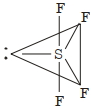
-
- (A) \((A)-(II), (B)-(I), (C)-(IV), (D)-(III)\)
- (B) \((A)-(III), (B)-(IV), (C)-(I), (D)-(II)\)
- (C) \((A)-(III), (B)-(I), (C)-(IV), (D)-(II)\)
- (D) \((A)-(III), (B)-(IV), (C)-(II), (D)-(I)\)
જવાબ અને ઉકેલ જુઓ
સાચો જવાબ: (C)
\((A)\) \(\psi_{M O}=\psi_{A}-\psi_{B}\) \((III)\,ABMO\)\((B)\) \(\mu= Q \times r\) \((I)\) Dipole moment
\((C)\) \(\frac{ N _{b}- N _{2}}{2}\) \((IV)\) Bond order
\((D)\) \(\psi_{M O}=\psi_{A}+\psi_{B}\) \((II)\) \(BMO\)
-
- (A) \(He _{2}^{+}\)
- (B) \(He _{2}^{-}\)
- (C) \(Be _{2}\)
- (D) \(O _{2}^{2-}\)
જવાબ અને ઉકેલ જુઓ
સાચો જવાબ: (C)
Chemical Species Bond Order \(He _{2}^{+}\) \(0.5\) \(He _{2}^{-}\) \(0.5\) \(Be _{2}\) \(0\) \(O _{2}^{2-}\) \(1\) According to \(M.O.T.\) If bond order of chemical species is zero then that chemical species does not exist.
- 107. \({AB}_{3}\) એક આંતરહેલોજન \(T-\) આકારનું પરમાણુ છે. \({A}\) પર ઇલેક્ટ્રોનની અયુગ્મિત જોડની સંખ્યા \(......\) છે. 2021 સરળ
- (A) \(2\)
- (B) \(3\)
- (C) \(4\)
- (D) \(1\)
જવાબ અને ઉકેલ જુઓ
સાચો જવાબ: (A)
\(T-\)shaped molecule means \(3\) sigma bond and \(2\) lone pairs of electron on central atom.
-
- (A) \(95\)
- (B) \(49\)
- (C) \(22\)
- (D) \(84\)
જવાબ અને ઉકેલ જુઓ
સાચો જવાબ: (B)
\(Fe \rightarrow[ Ar ] 4 s ^{2} 3 d ^{6}\)\(\uparrow \downarrow\) \(\uparrow\) \(\uparrow\) \(\uparrow\) \(\uparrow\) Number of unpaired \(e ^{-}=4\)
\(\mu=\sqrt{4(4+2)} \,B.M.\)
\(\mu=\sqrt{24}\, B.M\)
\(\mu=4.89\, B.M\)
\(\mu=48.9 \times 10^{-1}\, B.M\)
Nearest integer value will be \(49 .\)
-
- (A) \(30\)
- (B) \(25\)
- (C) \(20\)
- (D) \(15\)
જવાબ અને ઉકેલ જુઓ
સાચો જવાબ: (D)
\(AX\) is a covalent diatomic molecule.The molecule is \(NO\).
Total no. of electrons is \(15\).
-
- (A) વિધાન \(I\) ખોટું છે પણ વિધાન \(II\) સાચું છે.
- (B) બંને, વિધાન \(I\) અને વિધાન \(II\) સાચાં છે.
- (C) બંને, વિધાન \(I\) અને વિધાન \(II\) ખોટાં છે.
- (D) વિધાન \(I\) સાચું છે પણ વિધાન \(II\) ખોટું છે.
જવાબ અને ઉકેલ જુઓ
સાચો જવાબ: (D)
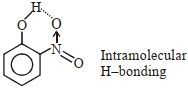
thus it is more volatile due to intramolecular \(H-\)bonding.Melting point depends on packing efficiency
-
- (A) \(0\)
- (B) \(1\)
- (C) \(2\)
- (D) \(3\)
જવાબ અને ઉકેલ જુઓ
સાચો જવાબ: (A)
સ્પષ્ટીકરણ:
1. \( \text{CO} \) નો બંધ-ક્રમાંક:
કાર્બન મોનોક્સાઇડ (\( \text{CO} \)) અણુમાં કુલ 14 ઇલેક્ટ્રોન હોય છે (\( 6 \) કાર્બનમાંથી અને \( 8 \) ઓક્સિજનમાંથી). આણ્વીય કક્ષક સિદ્ધાંત (Molecular Orbital Theory) મુજબ તેનો બંધ-ક્રમાંક નીચે પ્રમાણે મળે છે:
\( \text{CO}\text{ નો બંધ-ક્રમાંક} = 3 \)
2. \( \text{NO}^+ \) નો બંધ-ક્રમાંક:
નાઇટ્રોસોનિયમ આયન (\( \text{NO}^+ \)) પણ કુલ 14 ઇલેક્ટ્રોન ધરાવે છે (\( 7 \) નાઇટ્રોજનમાંથી, \( 8 \) ઓક્સિજનમાંથી અને ધન વીજભારના કારણે \( -1 \)). તે \( \text{CO} \) ની સાથે સમ-ઇલેક્ટ્રોનીય (isoelectronic) હોવાથી તેનો બંધ-ક્રમાંક પણ સમાન થાય છે:
\( \text{NO}^+\text{ નો બંધ-ક્રમાંક} = 3 \)
3. \( x \) ના મૂલ્યની ગણતરી:
બંનેના બંધ-ક્રમાંક વચ્ચેનો ચોખ્ખો તફાવત:
\( \text{તફાવત} = 3 - 3 = 0 \)
પ્રશ્નની શરત મુજબ આ તફાવત \( \frac{x}{2} \) સ્વરૂપે દર્શાવેલ છે:
\( \frac{x}{2} = 0 \implies x = 0 \)
આથી, સાચો જવાબ વિકલ્પ A છે. -
- (A) \(5.82,0\) અને \(0\, BM\)
- (B) \(4.90,0\) અને \(1.73\, BM\)
- (C) \(5.92,4.90\) અને \(0 \,BM\)
- (D) \(4.90,0\) અને \(2.83 \,BM\)
જવાબ અને ઉકેલ જુઓ
સાચો જવાબ: (B)
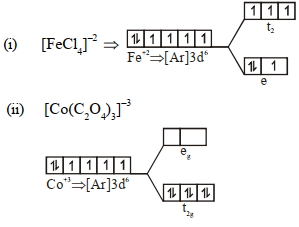
\((i)\) \(\left[ FeCl _{4}\right]^{-2}\)\(\mu =\sqrt{ n ( n +2)} \,BM\)
\(=\sqrt{4(4+2)}\, BM\)
\(=\sqrt{24}\, BM \Rightarrow 4.90\, BM\)
\((ii)\) \(\left[ Co \left( C _{2} O _{4}\right)_{3}\right]^{-3}\)
\(\mu=0\)
\((iii)\) \(MnO _{4}^{-2}\)
\(Mn ^{+6} \Rightarrow[ Ar ] 3 d ^{1} \quad \mu=\sqrt{ n ( n +2)} \,BM\)
\(=\sqrt{1(1+2)} \,BM\)
\(=\sqrt{3} BM \Rightarrow 1.73\, BM\)
-
- (A) વિકૃત સમત્રિકોણીય સમતલીય; \(135^{\circ}\) અને \(90^{\circ}\)
- (B) \(T-\)આકારનો; \(180^{\circ}\) અને \(90^{\circ}\)
- (C) સમત્રિકોણીય સમતલીય; \(120^{\circ}\)
- (D) રેખીય; \(180^{\circ}\)
જવાબ અને ઉકેલ જુઓ
સાચો જવાબ: (D)
Shape : Linear,\(I-I-I\) Bond angle \(\Rightarrow 180^{\circ}\)
- 114. \(I_{3}^{-}\)માં કેન્દ્રીય \(I\) અણુ પર ઇલેક્ટ્રોનની એયુગ્મિત જોડની સંખ્યા \(.......\) છે.
 2021 મધ્યમ
- (A) \(3\)
- (B) \(0\)
- (C) \(1\)
- (D) \(2\)
જવાબ અને ઉકેલ જુઓ
સાચો જવાબ: (A)
\({I}_{3}^{-}:\)The number of lone pairs of electron on the central atom is \(3 .\)
- 115. ઝેનોન સંયોજન \('A'\) એ આંશિક જળવિભાજન પર \(XeO _{2} F _{2}\) આપે છે. સંયોજનમાં હાજર રહેલા અયુગ્મીત ઇલેક્ટ્રોન જોડની સંખ્યા......... 2021 મધ્યમ
- (A) \(5\)
- (B) \(22\)
- (C) \(19\)
- (D) \(11\)
જવાબ અને ઉકેલ જુઓ
સાચો જવાબ: (C)
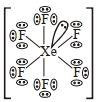
\(XeF _{6}+2 H _{2} O \longrightarrow XeO _{2} F _{2}+4 HF\)\(\quad\)(A) \(\quad\) (Limited water)
Structure of \('A'\)
\([Image]\)
Total \(l.p.\) on \(( A )=19\)
- 116. જલીય દ્રાવણમાં એક દ્વિસંયોજક આયનની (પરમાણુ ક્રમાંક \(29\)) સ્પીન ફકત ચુંબકીય ચાકમાત્રા .... \(BM\) છે. 2021 મધ્યમ
- (A) \(2\)
- (B) \(8\)
- (C) \(6\)
- (D) \(4\)
જવાબ અને ઉકેલ જુઓ
સાચો જવાબ: (A)
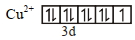
\(Z=29( Cu )\)\(Cu ^{2+}\) form \(\left[ Cu \left( H _{2} O \right)_{4}\right]^{2+}\) complex ion with \(H _{2} O.\)
\(\left[ Cu \left( H _{2} O \right)_{4}\right]^{2+} \Rightarrow Cu ^{2+}[ Ar ] 3 d ^{9}, H _{2} O \rightarrow WFL\)
number of unpaired \(e ^{-}=1\)
\(\mu=\sqrt{1(1+2)}\) \(B.M.\)
\(\mu=\sqrt{3} \Rightarrow 1.73 \,B.M . \Rightarrow \text { round off ans. } \Rightarrow 2\)
-
- (A) \(1\)
- (B) \(0\)
- (C) \(2\)
- (D) \(3\)
જવાબ અને ઉકેલ જુઓ
સાચો જવાબ: (B)
Molecular orbital configuration of \({O}_{2}^{2-}\) is\(\sigma_{1 {~s}}^{2} \sigma_{1 {~s}}^{*} \sigma_{2 {~s}}^{2} \sigma_{2 {~s}}^{*_{2}}\left(\pi 2 {p}_{{x}}^{2}=\pi 2 {p}_{{y}}^{2}\right)\left(\pi_{2 {px}}^{*}=\pi_{2 {py}}^{*}\right)\)
Zero unpaired electron
-
- (A) \(BF _{4}^{-}\)
- (B) \(XeF _{4}\)
- (C) \(SF _{4}\)
- (D) \(SiF _{4}\)
જવાબ અને ઉકેલ જુઓ
સાચો જવાબ: (C)
Species
Hybridisation Bond length \(BF _{4}^{\Theta}\) \(sp ^{3}\) (Tetrahedral) All bond lengths equal \(XeF _{4}\) \(sp ^{3} d ^{2}\) (sq. planar) All bond lengths equal \(SF _{4}\) \(sp ^{3} d ( see - saw )\) axial bond length \( > \) equitorial bond length \(SiF _{4}\) \(sp ^{3}\) (Tetrahedral) all bond lengths equal -
- (A) ફક્ત \(C\) અને \(D\)
- (B) ફક્ત \(A\) અને \(B\)
- (C) ફક્ત \(A\) અને \(C\)
- (D) ફક્ત \(B\) અને \(C\)
જવાબ અને ઉકેલ જુઓ
સાચો જવાબ: (B)
Isostructural means same structure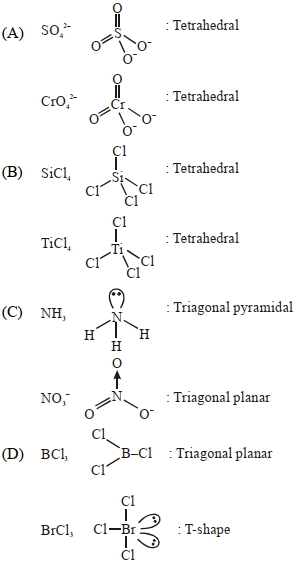
- 120. નીચેના આપેલા ઓક્સાઈડ્સમાં પેરામેગ્નેટિક ઓક્સાઈડની સંખ્યા છે? \({Li}_{2} {O}, {CaO}, {Na}_{2} {O}_{2}, {KO}_{2}, {MgO}\) અને \({K}_{2} {O}\) 2021 અઘરું
- (A) \(1\)
- (B) \(2\)
- (C) \(3\)
- (D) \(0\)
જવાબ અને ઉકેલ જુઓ
સાચો જવાબ: (A)
\({Li}_{2} {O} \quad \Rightarrow 2 {Li}^{+}\quad{O}^{2-}\)\({MgO} \Rightarrow {Mg}^{2+}\quad {O}^{2-}\)
\({CaO} \quad \Rightarrow {Ca}^{2+} \quad {O}^{2-}\)
\({K}_{2} {O} \Rightarrow 2 {~K}^{+} \quad{O}^{2-}\)
\({Na}_{2} {O}_{2} \Rightarrow 2 {Na}^{+} \quad {O}_{2}^{2-}\)
\({KO}_{2} \quad \Rightarrow {K}^{+} \quad {O}_{2}^{-}\)
\({O}_{2}^{-} \Rightarrow\) Complete octet, diamagnetic
\({O}^{2} \Rightarrow \sigma_{1 {~s}}^{2} \sigma_{1 {~s}}^{* 2} \sigma_{2 {~s}}^{2} \sigma_{2 {~s}}^{*_{2}} \sigma_{2 {px}}^{2} \pi_{2 {py}}^{2} \simeq \pi_{2 {pz}}^{2} \pi_{2 {py}}^{*_{2}} \simeq \pi_{2 {pz}}^{*_{2}}({dia})\)
\({O}_{2}^{-} \Rightarrow \sigma_{1 {~s}}^{2} \sigma_{1 {~s}}^{*_{2}} \sigma_{2 {~s}}^{2} \sigma_{2 {~s}}^{* 2} \sigma_{2 {px}}^{2} \pi_{2 {py}}^{2} \simeq \pi_{2 {p} z}^{2} \pi_{2 {py}}^{*} \simeq \pi_{2 {pz}}^{* 1}({para})\)
-
- (A) \({O}_{2}^{+}>{O}_{2}>{O}_{2}^{-}>{O}_{2}^{2-}\)
- (B) \({O}_{2}>{O}_{2}^{-}>{O}_{2}^{2-}>{O}_{2}^{+}\)
- (C) \({O}_{2}^{2-}>{O}_{2}^{+}>{O}_{2}^{-}>{O}_{2}\)
- (D) \({O}_{2}^{+}>{O}_{2}^{-}>{O}_{2}^{2-}>{O}_{2}\)
જવાબ અને ઉકેલ જુઓ
સાચો જવાબ: (A)
\(\sigma_{1 s}^{2}, \sigma_{1 s}^{* 2}, \sigma_{2 s}^{2}, \sigma_{2 s}^{*}, \sigma_{2 p_{2}}^{2}\)\(\pi_{2 p_{x}}^{2}=\pi_{2 p_{y}}^{2}, \pi_{2 p_{x}}^{*_{1}}=\pi_{2 p_{y}}^{*_{1}}, \sigma_{2 p_{2}}^{*}\)
Bond order of \({O}_{2} \Rightarrow 2\)
Bond order of \({O}_{2}^{-} \Rightarrow 1.5\)
Bond order of \({O}_{2}^{2-} \Rightarrow 1\)
Bond order of \({O}_{2}^{+} \Rightarrow 2.5\)
-
- (A) \(3\)
- (B) \(2\)
- (C) \(4\)
- (D) \(1\)
જવાબ અને ઉકેલ જુઓ
સાચો જવાબ: (A)
Hence non-pyramidal species are \({SO}_{3}, {NO}_{3}^{-}\) and \({CO}_{3}^{2-}\)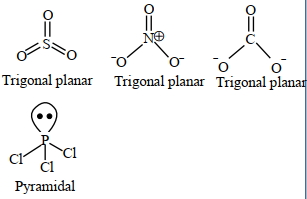
-
- (A) \({CO}_{3}^{2-}\)
- (B) \({O}_{2}\)
- (C) \({SO}_{2}\)
- (D) \({SO}_{3}\)
જવાબ અને ઉકેલ જુઓ
સાચો જવાબ: (A)
Among \({SO}_{3}, {O}_{2}, {SO}_{2}\) and \({CO}_{3}^{2-}\) only \({O}_{2}\) and \({CO}_{3}^{2-}\) has only one \(\pi\)-bond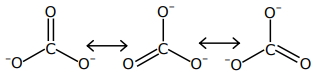
-
- (A) \(CuI\)
- (B) \(\left[{Cu}\left({NH}_{3}\right)_{4}\right] {Cl}_{2}\)
- (C) \({O}_{2}^{+}\)
- (D) \({O}_{2}^{-}\)
જવાબ અને ઉકેલ જુઓ
સાચો જવાબ: (A)
Species must not contain single unpaired\({O}_{2}^{+} \rightarrow \sigma_{1 {~s}}^{2}<\sigma_{1 {~s}}^{*}<\sigma_{2 {~s}}^{2}<\sigma_{2 {~s}}^{*}<\sigma_{2 {pz}}^{2}<\pi_{2 {px}}^{2}=\pi_{2 {py}}^{2}<\pi_{2 {px}}^{*}=\pi_{2 {py}}^{*}\)
unpaired \({e}^{-}=1 \ldots \mu=1.73\, {BM}\)
\((1)\) \({Cu}^{+} {I}^{-} {Cu}+\rightarrow[{Ar}] 3 {~d}^{10} \therefore\) unpaired \({e}^{-}=0\)
\({I}^{-} \rightarrow[{Xe}] \therefore\) unpaired \({e}^{-}=0\)
therefore \(\mu=0\)
\(3.\) \(\left[{Cu}\left({NH}_{3}\right)_{4}\right] {Cl}_{2}\)
\({Cu} \rightarrow[{A}] 3 {~d}^{3} \therefore\) unpaired \(=1 \quad \therefore \mu=1.73 \,{BM}\)
\(4.\) \({O}_{2}^{-} \rightarrow {d}\)
\(\sigma_{1 {~s}}^{2}<\sigma_{1 {~s}}^{* 2}<\sigma_{2 {~s}}^{2}<\sigma_{2 {~s}}^{* 2}<\sigma_{2 {px}}^{2}<\pi_{2 {px}}^{2}=\pi_{2 {py}}^{2}<\pi_{2 {px}}^{*_{1}}=\pi_{2 {py}}^{*}\)
\(\left(11 {e}^{-}\right)\)
\(\therefore\) unpaired \(\quad \therefore \mu=1.73\, {BM}\)
-
- (A) \(5\)
- (B) \(10\)
- (C) \(15\)
- (D) \(20\)
જવાબ અને ઉકેલ જુઓ
સાચો જવાબ: (B)
\(\sigma 1 {~s}^{2} \sigma 1^* {~s}^{2} \sigma 2 {~s}^{2} \sigma 2^* {~s}^{2} \sigma 2 {p}_{z}^{2} \pi 2 {p}_{{x}}^{2}=\pi 2 {p}_{{y}}^{2}\)\(\pi 2^* {p}_{{x}}^{2}=\pi 2^* {p}_{{y}}^{2}\)
- 126. પરમાણુમાં કેન્દ્રીય અણુમાં ઇલેક્ટ્રોનની બે અયુગ્મિત ઇલેક્ટ્રોનની જોડ હોય છે અને ત્રણ એકલ બંધ બનાવે છે. આ પરમાણુનો આકાર શું છે? 2021 મધ્યમ
- (A) ચિચૂડો
- (B) સમતલીય ત્રિકોણ
- (C) \(T-\) આકાર
- (D) ત્રિકોણીય પિરામિડ
જવાબ અને ઉકેલ જુઓ
સાચો જવાબ: (C)
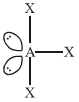
\(sp\) \(^{3}\) \(d\) hybridised\(T-\)shaped
-
- (A) \(243\)
- (B) \(1\)
- (C) \(173\)
- (D) \(143\)
જવાબ અને ઉકેલ જુઓ
સાચો જવાબ: (C)
\({B}_{2}^{+} \Rightarrow \sigma_{1 {~s}}^{2} \sigma_{1 {~s}}^{* 2} \sigma_{2 s}^{2} \sigma_{2 {~s}}^{* 2} \pi_{2 {py}}^{1} \simeq \pi_{2 {pz}}^{0}\)\(\Rightarrow 9 {e}^{-}\)
\(\mu=\sqrt{1(1+2)}=\sqrt{3}\, {BM}\)
\(=1.73 \,{BM}\)
\(=1.73 \times 10^{-2}\, {BM}\)
-
- (A) \(( a ) \rightarrow( iii ),( b ) \rightarrow( iv ),( c ) \rightarrow( i ),( d ) \rightarrow( ii )\)
- (B) \(( a ) \rightarrow( i ),( b ) \rightarrow( ii ),( c ) \rightarrow( iii ),( d ) \rightarrow( iv )\)
- (C) \(( a ) \rightarrow( ii ),( b ) \rightarrow( i ),( c ) \rightarrow( iv ),( d ) \rightarrow( iii )\)
- (D) \(( a ) \rightarrow( iv ),( b ) \rightarrow( iii ),( c ) \rightarrow( ii ),( d ) \rightarrow( i )\)
જવાબ અને ઉકેલ જુઓ
સાચો જવાબ: (A)
\((a)\) \(\quad Ne _{2}=\operatorname{Total} e ^{\Theta}=20\)B.O. \(=\frac{10-10}{2}=0\)
\((b)\) \(\quad N _{2}=\) Total \(e ^{\Theta}=14\)
B.O. \(=\frac{10-4}{2}=3\)
\((c)\) \(\quad F _{2}=\) Total \(e ^{\Theta}=18\)
B.O. \(=\frac{10-8}{2}=1\)
(d) \(O _{2}=\operatorname{Total} e ^{\theta}=16\)
B.O. \(=\frac{10-6}{2}=2\)
-
- (A) \(108\)
- (B) \(150\)
- (C) \(90\)
- (D) \(60\)
જવાબ અને ઉકેલ જુઓ
સાચો જવાબ: (A)
In gaseous triethyl amine the \("-C-N-C-"\) bond angle is \(108\) degree. -
- (A) \((a)-(i), (b)-(ii), (c)-(v)\) and \((d)-(iii)\)
- (B) \((a)-(ii), (b)-(i), (c)-(iv)\) and \((d)-(v)\)
- (C) \((a)-(iv), (b)-(iii), (c)-(ii)\) and \((d)-(v)\)
- (D) \((a)-(iii), (b)-(i), (c)-(v)\) and \((d)-(iv)\)
જવાબ અને ઉકેલ જુઓ
સાચો જવાબ: (D)
\((a)\) \({SF}_{4}-{sp}^{3} {~d}\) hybridisation\((b)\) \(IF_{5}-{sp}^{3} {~d}^{2}\) hybridisation
\((c)\) \({NO}_{2}^{+}-{sp}\) hybridisation
\((d)\) \({NH}_{4}^{+}-{sp}^{3}\) hybridisation
- 131. આ ઘટકો માં \(NO , NO ^{+}, NO ^{2+}, NO ^{-},\) લઘુત્તમ બંધની પ્રબળતા ધરાવતું એક કયું છે: 2020 અઘરું
- (A) \(NO ^{2+}\)
- (B) \(NO ^{+}\)
- (C) \(NO\)
- (D) \(NO ^{-}\)
જવાબ અને ઉકેલ જુઓ
સાચો જવાબ: (D)
Bond order of \(NO ^{2+}=2.5\)Bond order of \(NO ^{+}=3\)
Bond order of \(NO =2.5\)
Bond order of \(NO ^{-}=2\)
Bond order \(\alpha\) bond strength.
-
- (A) આયન-દ્વિધ્રુવીય > આયન-આયન > દ્વિધ્રુવીય-દ્વિધ્રુવીય
- (B) દ્વિધ્રુવીય-દ્વિધ્રુવીય > આયન-દ્વિધ્રુવીય > આયન-આયન
- (C) આયન-દ્વિધ્રુવીય > દ્વિધ્રુવીય-દ્વિધ્રુવીય > આયન-આયન
- (D) આયન-આયન > આયન-દ્વિધ્રુવીય > દ્વિધ્રુવીય-દ્વિધ્રુવીય
જવાબ અને ઉકેલ જુઓ
સાચો જવાબ: (D)
Interionic\(/\) Intermolecular forces \(\propto\) charge on the speciesIons are charged species whereas dipoles are partially charged.
\(\therefore\) Ion-Ion \(\,>\,\) Ion-dipole \(\,>\,\) dipole-dipole
Hence, option \(d\) is correct.
-
- (A) હાઈડ્રોજન બંધન અને લંડન વિક્ષેપન
- (B) દ્વિધ્રુવીય-દ્વિધ્રુવીય અને હાઈડ્રોજન બંધન
- (C) લંડન વિક્ષેપન અને દ્વિધ્રુવીય-દ્વિધ્રુવીય
- (D) લંડન વિક્ષેપન , દ્વિધ્રુવીય-દ્વિધ્રુવીય અને હાઈડ્રોજન બંધન
જવાબ અને ઉકેલ જુઓ
સાચો જવાબ: (C)
Ethyl acetate is polar molecule. Hence there will be dipole-dipole
attraction and london dispersion forces are present. -
- (A) સમચોરસ પિરામિડલ
- (B) ચતુષ્ફલકીય
- (C) સમચોરસ સમતલીય
- (D) લંબચોરસ સમતલીય
જવાબ અને ઉકેલ જુઓ
સાચો જવાબ: (A)
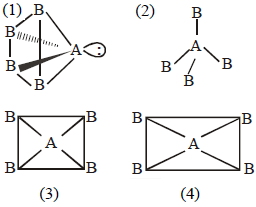
\((1)\) If \(AB _{4}\) molecule is a square pyramidal then it has one lone pair and their structure should be and it should be polar because dipole moment of lone pair of \('A'\) never be cancelled by others.\((2)\) If \(AB _{4}\) molecule is a tetrahedral then it has no lone pair and their structure should be and it should be non polar due to perfect symmetry.
\((3)\) If \(AB _{4}\), molecule is a square planar then it should be non polar because vector sum of dipole moment is zero.
\((4)\) If \(AB _{4}\) molecule is a rectangular planar then it should be non polar because vector sum of dipole moment is zero.
-
- (A) \(\mathrm{O}_{2}^{-}\) અથવા \(\mathrm{O}_{2}^{+}\)
- (B) \(\mathrm{O}_{2}\) અથવા \(\mathrm{O}_{2}^{+}\)
- (C) \(\mathrm{O}_{2}\) અથવા \(\mathrm{O}_{2}^{-}\)
- (D) \(\mathrm{O}_{2}, \mathrm{O}_{2}^{-}\) અથવા \(\mathrm{O}_{2}^{+}\)
જવાબ અને ઉકેલ જુઓ
સાચો જવાબ: (A)
\(\begin{array}{|c|c|c|} \hline & \text { unpaired electron } & \text { magnetic moment } \\ \hline O _{2}^{\oplus} & 1 & 1.73 B . M \\ \hline O _{2}^{\ominus} & 1 & 1.73 B . M \\ \hline O _{2} & 2 & 2.83 B.M \\ \hline \end{array}\) -
- (A) \(\underline{N}{H }_{3} \stackrel{ H ^{+}}{\longrightarrow}\)
- (B) \(\underline {Xe}F _{4}+ SbF _{5} \rightarrow\)
- (C) \(H _{2} \underline SO _{4}+ NaCl \xrightarrow{{420\,\,K}}\)
- (D) \(H _{3} \underline PO _{2} \xrightarrow{{ Disproportionation }}\)
જવાબ અને ઉકેલ જુઓ
સાચો જવાબ: (B)
\(XeF _{4}+ SbF _{5} \rightarrow\left[ XeF _{3}\right]^{+}\left[ SbF _{6}\right]^{-}\)\(sp ^{3} d ^{2}\,\,\,\,\, sp ^{3} d\,\,\, \quad sp ^{3} d\,\,\,\,\, \quad sp ^{3} d ^{2}\)
-
- (A) \(\left[ Ni ( CN )_{4}\right]^{2-}\)
- (B) \(\left[ CrF _{6}\right]^{3-}\)
- (C) \(BrF _{5}\)
- (D) \(XeF _{4}\)
જવાબ અને ઉકેલ જુઓ
સાચો જવાબ: (A)
\(\left[ Ni ( CN )_{4}\right]^{2-}\)\(dsp\)\(^{2}\) hybridisation.
-
- (A) સમત્રિકોણીય દ્વિપિરામિડલ
- (B) ચોરસ સમતલીય
- (C) ચતુષ્ફલકીય
- (D) પિરામિડલ
જવાબ અને ઉકેલ જુઓ
સાચો જવાબ: (A)
\(4 \sigma\) bonds \(+1\) lone pairShape (including lone pair of electrons) is Trigonal bipyramidal

-
- (A) \(Li^+ > Na^+ > K^+ > Cs^+ > Rb^+\)
- (B) \(Na^+> Li^+ > K^+ > Rb^+ > Cs^+\)
- (C) \(Na^+ > Li^+ > K^+ > Cs^+ > Rb^+\)
- (D) \(Li^+ > Na^+ > K^+ > Rb^+ > Cs^+\)
જવાબ અને ઉકેલ જુઓ
સાચો જવાબ: (D)
Hydration enthalpy depends upon ionic potential (charge/size). As ionic potential increases hydration enthalpy increases \({\Delta _{hyd}}{H^o} \propto \frac{q}{r}\) - 140. આણ્વિય કક્ષક સિદ્ધાંત મુજબ \(Li_2^ + \) અને \(Li_2^ - \) ના સંદર્ભમાં નીચેના પૈકી ક્યુ સાચુ છે ? 2019 મધ્યમ
- (A) \(Li_2^ + \) અસ્થાયી છે અને \(Li_2^ - \) સ્થાયી છે
- (B) \(Li_2^ + \) સ્થાયી છે અને \(Li_2^ - \) અસ્થાયી છે
- (C) બંને સ્થાયી છે
- (D) બંને અસ્થાયી છે
જવાબ અને ઉકેલ જુઓ
સાચો જવાબ: (C)
\(Li_2^+\):
કુલ ઇલેક્ટ્રોન = \(3 \times 2 - 1 = 5\)
MO ગોઠવણી: \((\sigma 1s)^2 (\sigma^* 1s)^2 (\sigma 2s)^1\)
બંધ ક્રમ (\(BO\)) = \(\frac{1}{2}(3 - 2) = 0.5\)
\(Li_2^-\):
કુલ ઇલેક્ટ્રોન = \(3 \times 2 + 1 = 7\)
MO ગોઠવણી: \((\sigma 1s)^2 (\sigma^* 1s)^2 (\sigma 2s)^2 (\sigma^* 2s)^1\)
બંધ ક્રમ (\(BO\)) = \(\frac{1}{2}(4 - 3) = 0.5\)
બંનેનો બંધ ક્રમ \(0.5\) હોવાથી, બંને સ્થાયી છે.
-
- (A) સૌથી ઓછી વિયોજન એન્થાલ્પી
- (B) સૌથી પ્રબળ વાન ડર વાલ્સ આંતરક્રિયા
- (C) પ્રબળ હાઇડ્રોજન બંધ
- (D) સૌથી ઓછી આયનીય લાક્ષણિકતા
જવાબ અને ઉકેલ જુઓ
સાચો જવાબ: (C)
\(HF\) has strong hydrogen bond. \(\therefore \) It has highest boiling point among hydrogen halides. The strong hydrogen bond is due to more difference in electronegativity between \(F\) and \(H\) atoms -
- (A) ફકત \(I\) અને \(II\)
- (B) \(I\), \(II\) અને \(III\)
- (C) ફકત \(I\) અને \(III\)
- (D) ફકત \(II\) અને \(III\)
જવાબ અને ઉકેલ જુઓ
સાચો જવાબ: (C)
\((i)\) \(VBT\) does not explain colour exhibited by complex of transition metal because splitting of \(d-\) orbitals in explained by \(CFT\). \((ii)\) \(VBT\) does not distinguish between strong and weak field complex. \((iii)\) \(VBT\) does not give quantitative interpretation of magnetic properties. \(\therefore \) According to question statement \(I\) and \(III\) are correct -
- (A) \([IF_6]^ -\)
- (B) \([ICl_4]^ -\)
- (C) \([ICl_2]^ -\)
- (D) \([BrF_2]^ -\)
જવાબ અને ઉકેલ જુઓ
સાચો જવાબ: (B)
\({[IC{l_4}]^ - } \to s{p^3}{d^2}\)\({[I{F_6}]^ - } \to s{p^3}{d^3}\)
\({[IC{l_2}]^ - } \to s{p^3}d\)
\({[Br{F_2}]^ - } \to s{p^3}d\)
- 144. નીચેના અણુ/આયન પૈકી ક્યો એક પ્રતિચુંબકીય છે અને સૌથી ઓછી બંધલંબાઇ ધરાવે છે ? \(C_2^{2-} ,N_2^{2-} ,O_2^{2-},O_2\) 2019 અઘરું
- (A) \(O_2^{2-}\)
- (B) \(C_2^{2-}\)
- (C) \(O_2\)
- (D) \(N_2^{2-}\)
જવાબ અને ઉકેલ જુઓ
સાચો જવાબ: (B)
\(C_2^{2 - } - {\sigma _{1s}}2{\sigma ^*}_{1s}2{\sigma _{2s}}2{\sigma ^*}_{2{s^2}}[{\pi _{2p_x^2}} = {\pi _2}p_y^2]{\sigma _{2p_z^2}}\)\(B.O = \frac{{10 - 4}}{2} = 3\) (diamagnetic)
\(N_2^{2 - } - {\sigma _{1s}}2{\sigma ^*}_{1s}2{\sigma _{2s}}2{\sigma ^*}_{2{s^2}}[{\pi _{2p_x^2}} = {\pi _2}p_y^2]{\sigma _{2p_z^2}}[{\pi _{2p_x^1}} = {\pi ^*}_{2p_y^1}]\)
\(B.O = \frac{{10 - 6}}{2} = 2\) (paramagnetic)
\(O_2^{2 - } - {\sigma _{1s}}2{\sigma ^*}_{1s}2{\sigma _{2s}}2{\sigma ^*}_{2s}2{\sigma _{2p_z^2}}[{\pi _{2p_x^2}} = {\pi _2}p_y^2]\,[{\pi _{2p_x^2}} = {\pi ^*}_2p_y^2]\)
\(B.O = \frac{{10 - 8}}{2} = 1\) (diamagnetic)
\({O_2} - {\sigma _{1s}}2{\sigma ^*}_{1s}2{\sigma _{2s}}2{\sigma ^*}_{2s}2{\sigma _{2p_z^2}}\,[{\pi _{2p_x^2}} = {\pi _2}p_y^2]\,[{\pi _{2p_x^2}} = {\pi ^*}_2p_y^2]\)
\(B.O = \frac{{10 - 6}}{2} = 2\) (paramagnetic)
-
- (A) \(O_2\)
- (B) \(NO\)
- (C) \(B_2\)
- (D) \(CO\)
જવાબ અને ઉકેલ જુઓ
સાચો જવાબ: (D)
\(CO\) is diamagnetic in nature due to absence of any unpaired electron. - 146. નીચેના પૈકી ક્યો અણુ ઋણાયનના સર્જન દ્વારા સ્થાયી બનવાની અપેક્ષા રાખી શકાય ? \(C_2 , O_2 , NO , F_2\) 2019 અઘરું
- (A) \(F_2\)
- (B) \(C_2\)
- (C) \(O_2\)
- (D) \(NO\)
જવાબ અને ઉકેલ જુઓ
સાચો જવાબ: (B)
\(C_2\) configuration\(\sigma 1{s^2}{\sigma ^*}1{s^2}\sigma 2{s^2}{\sigma ^*}2{s^2}_{\pi 2{p_z}^2}^{\pi 2{p_y}^2}\sigma 2Px\)
\(C_2^-\) configuration
\(\sigma 1{s^2}{\sigma ^*}1{s^2}\sigma 2{s^2}{\sigma ^*}2{s^2}_{\pi 2{p_z}^2}^{\pi 2{p_y}^2}\sigma 2P_x^1\)
- 147. નીચેના પૈકી પ્રક્રિયામાં ક્રમમાં બંધક્રમાંક વધે છે અને અનુચુંબકીય લાક્ષણિકતા પ્રતિચુંબકીયમાં બદલાઈ જાય છે ? 2019 અઘરું
- (A) \(NO\,\to \,NO^+\)
- (B) \(N_2\,\to \,N_2^+\)
- (C) \(O_2\,\to \,O_2^+\)
- (D) \(O_2\,\to \,O_2^{2-}\)
જવાબ અને ઉકેલ જુઓ
સાચો જવાબ: (A)
\(B.O\) \(\mathop {\mathop {NO}\limits_{0.5} }\limits_{Para} \to \mathop {\mathop {N{O^ + }}\limits_3 }\limits_{Dia} \) \(B.O\) \(\mathop {\mathop {{N_2}}\limits_3 }\limits_{Dia} \to \mathop {\mathop {N_2^ + }\limits_{2.5} }\limits_{Para} \)\(B.O\) \(\mathop {\mathop {{O_2}}\limits_2 }\limits_{Para} \to \mathop {\mathop {O_2^ + }\limits_{2.5} }\limits_{Para} \) \(B.O\) \(\mathop {\mathop {{O_2}}\limits_2 }\limits_{Para} \to \mathop {\mathop {O_2^{2 - }}\limits_1 }\limits_{Dia} \)
-
- (A) \(O_2^ + \)
- (B) \(N_2\)
- (C) \(O_2\)
- (D) \(N_2^ + \)
જવાબ અને ઉકેલ જુઓ
સાચો જવાબ: (D)
\({N_{{2^ \oplus }}} \Rightarrow BO = 2.5 \Rightarrow [\pi = Bond = 2\,\& \sigma - Bond = \frac{1}{2}]\)\({N_2} \Rightarrow B.O. = 3.0 \Rightarrow [\pi - Bond = 2\,\& \sigma - Bond = 1]\)
\({O_{{2^ \oplus }}} = B.O. \Rightarrow 2.5 \Rightarrow [\pi - Bond = 1.5\,\& \sigma - Bond = 1]\)
\({O_2} \Rightarrow B.O. \Rightarrow 2 \Rightarrow [\pi - Bond \Rightarrow 1\,\& \sigma - Bond = 1]\)
-
- (A) \(Sn\)
- (B) \(C\)
- (C) \(Ge\)
- (D) \(Si\)
જવાબ અને ઉકેલ જુઓ
સાચો જવાબ: (B)
It is due to the smallest atomic size of carbon in the given options. - 150. આણ્વિય આયન \(N_2^ + \) માટે, આણ્વિય કક્ષક આલેખમાં \({\sigma _{2p}}\) આણ્વિય કક્ષકમાં ઇલેક્ટ્રોનની સંખ્યા જણાવો. 2018 મધ્યમ
- (A) \(0\)
- (B) \(2\)
- (C) \(3\)
- (D) \(1\)
જવાબ અને ઉકેલ જુઓ
સાચો જવાબ: (D)
Total electrons in \(N_2^ + = (7 \times 2) - 1 = 13\)\(N_2^ + \to {\sigma _{1{s^2}}},\sigma _{1{s^2}}^*,{\sigma _{2{s^2}}},\sigma _{2{s^2}}^*,[\pi _{2{p_x}}^2 = \pi _{2{p_y}}^2]\sigma _{2{p_z}}^1\)
Number of electron in \({\sigma _2}_{{p_z}}\) is \(1\)
આ પેજ પર આ ફિલ્ટર મુજબ કોઈ પ્રશ્ન નથી.