


રાસાયણિક બંધન અને આણ્વીય રચના ના બધા પ્રશ્નો
નવા પહેલા176 માંથી 151–176 પ્રશ્નો
-
- (A) \(NF_3-\) સમતલીય ત્રિકોણ
- (B) \(BF_3-\) સમતલીય ત્રિકોણ
- (C) \(AsF_5-\) ત્રિકોણીય દ્વિપિરામિડ
- (D) \(H_2O-\) વળેલ \((bent)\)
જવાબ અને ઉકેલ જુઓ
સાચો જવાબ: (A)
\(NF_3\) has trigonal pyramidal geometry. \(N\) atom has one lone pair and three bond pairs of electrons. The electron pair geometry is tetrahedral and molecular geometry is trigonal pyramidal . The bond angles are lower than tetrahedral bond angles due to lone pair - lone pair and lone pair - bond pair repulsions. \(N\) atom is \(sp^3\) hybridised
-
- (A) બંધકારક \(\pi \) કક્ષક
- (B) અબંધકારક કક્ષક
- (C) બંધપ્રતિકારક \(\sigma \) કક્ષક
- (D) બંધપ્રતિકારક \(\pi \) કક્ષક
જવાબ અને ઉકેલ જુઓ
સાચો જવાબ: (D)
An antibonding \(\pi \) orbital best describes the diagram of a molecular orbital. Two orbitals laterally overlap to form pi bond. Out of phase combination, of these two \(p-\) orbitals, give \(\pi ^*\, MO\). -
- (A) \({H_2}O\, \to \,{H_3}{O^ + }\)
- (B) \(B{F_3}\, \to \,BF_4^ - \)
- (C) \(C{H_4}\, \to \,{C_2}{H_6}\)
- (D) \(N{H_3}\, \to \,NH_4^ + \)
જવાબ અને ઉકેલ જુઓ
સાચો જવાબ: (B)
\(B{F_3}\, \to \,BF_4^ - \)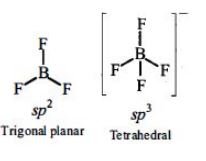
-
- (A) \(N{O^ + }\)
- (B) \(CO\)
- (C) \(O_2^{2 - }\)
- (D) \(B_2\)
જવાબ અને ઉકેલ જુઓ
સાચો જવાબ: (D)
Total electron\(NO^+\) \(14\)
\(CO\) \(14\)
\(O_2^{2-}\) \(18\)
\(B_2\) \(10\)
\(N{O^ + } \Rightarrow KK.\sigma {(2s)^2}{\sigma ^*}{(2s)^2}.{(\pi 2{p_x})^2}\)
\( = {(\pi 2{p_y})^2}.{(\sigma 2{p_z})^2}\) diamagnetic
\(CO \Rightarrow KK.\sigma {(2s)^2}{\sigma ^*}{(2s)^2}.{(\pi 2{p_x})^2}\)
\( = {(\pi 2{p_y})^2}.{(\sigma 2{p_z})^2}\) diamagnetic
\(O_2^{2 - } \Rightarrow KK.\sigma {(2s)^2}{\sigma ^*}{(2s)^2}.\sigma {(2{p_z})^2}{(\pi 2{p_x})^2}\)
\( = {(\pi 2{p_y})^2}.{\pi ^*}{(2{p_x})^2} = {\pi ^*}{(2{p_y})^2}\) diamagnetic
\({B_2} \Rightarrow KK.\sigma {(2s)^2}{\sigma ^*}{(2s)^2}.\pi {(2{p_x})^1} = \pi {(2{p_y})^1}\) paramagnetic
-
- (A) \(BF_3, NF_3, CO_3^{2 - }\)
- (B) \(CO_3^{2 - } , NO_3^- , SO_3\)
- (C) \(NH_3, SO_3, CO_3^{2 - }\)
- (D) \(NCl_3, BCl_3, SO_3\)
જવાબ અને ઉકેલ જુઓ
સાચો જવાબ: (B)
Group Hybridization Shape \((1)\) \(BF_3\)
\(NF_3\)
\(CO_3^{2-}\)
\(sp^2\)
\(sp^3\)
\(sp^2\)
Triangular Planar \((TP)\)
Tetrahedral \((T)\)
\(T.P.\)
\((2)\) \(CO_3^{2-}\)
\(NO_3^-\)
\(SO_3\)
\(sp^2\)
\(sp^2\)
\(sp^2\)
\(\left. \begin{gathered}
T.P. \hfill \\
T.P. \hfill \\
T.P. \hfill \\
\end{gathered} \right\}\) (all have same hybridization)\((3)\) \(NH_3\)
\(SO_3\)
\(CO_3^{2-}\)
\(sp^3\)
\(sp^2\)
\(sp^2\)
\(T\)
\(T.P.\)
\(T.P.\)
\((4)\) \(NCl_3\)
\(BCl_3\)
\(SO_3\)
\(sp^3\)
\(sp^2\)
\(sp^2\)
\(T\)
\(T.P.\)
\(T.P.\)
-
- (A) \(NO_3^-\)
- (B) \(NO_2\)
- (C) \(NO_2^+\)
- (D) \(NO_2^-\)
જવાબ અને ઉકેલ જુઓ
સાચો જવાબ: (C)
The hybridization of \(\mathrm{NO}_{2}^{+}\) is sp.It is a linear molecule.
Rest does not have sp hybridization.
Therefore, the correct option is C.
-
- (A) \(PCl_5,\,IF_5,\, XeO_2F_2\)
- (B) \(BF_3,\,PCl_3,\,XeO_3\)
- (C) \(SF_4,\,XeF_4,\,CCl_4\)
- (D) \(ClF_3,\, XeOF_2,\, XeF_3^+\)
જવાબ અને ઉકેલ જુઓ
સાચો જવાબ: (D)
\(Cl{I_3} \to \) Hybridisation \( = 3 + \frac{1}{2}[7 - 3] = 5\,(s{p^3}d)\)\(XeOF_2 \to \) Hybridisation \( = 3 + \frac{1}{2}[8 - 4] = 5\,(s{p^3}d)\)
\(XeF_3^+ \to \) Hybridisation \( = 3 + \frac{1}{2}[8 - 3 - 1] = 5\,(s{p^3}d)\)
All molecules have \(sp^3d\) hybridization and \(2\) lone pairs. Hence all have identical ( \(T-\) shape).
-
- (A) \(0.5\)
- (B) \(0.05\)
- (C) \(0\)
- (D) \(1.0\)
જવાબ અને ઉકેલ જુઓ
સાચો જવાબ: (B)
\(1\,e = 1.602 \times {10^{ - 19}}\,C\)\(1\,esu = 3.33 \times {10^{ - 10}}\,C\)
\(\frac{{1\,e}}{{1\,esu}} = \frac{{1.602 \times {{10}^{ - 19}}\,C}}{{3.33 \times {{10}^{ - 10}}\,C}}\)
\(1\,e = 4.802 \times {10^{ - 10}}\,esu\,\)
Dipole moment \(= q \times \) distance
\( \Rightarrow \,1\,D \approx {10^{ - 18}}\,esu\,cm\)
\(0.38 \times {10^{ - 18}}\,esu\,cm = q \times (1.61 \times {10^{ - 8}}\,cm)\)
\(q = 2.36 \times {10^{ - 11}}\,esu\)
\(q = \frac{{2.36 \times {{10}^{ - 11}}\,esu}}{{4.802 \times {{10}^{ - 10}}\,esu}}\)
\(q = 0.049\)
\(q \approx 0.05\) fractional charge
-
- (A) વિધાન ખોટુ છે, કારણ સાચુ છે
- (B) વિધાન સાચુ છે, કારણ ખોટુ છે
- (C) વિધાન અને કારણ સાચા છે અને કારણ એ વિધાનનુ સાચુ સ્પષ્ટિકરણ છે
- (D) વિધાન અને કારણ સાચા છે અને કારણ એ વિધાનનુ સાચુ સ્પષ્ટિકરણ નથી
જવાબ અને ઉકેલ જુઓ
સાચો જવાબ: (B)
Assertion is correct but reason is incorrect. Bonding \(MO\) shows constructive interference of the combining electron oxide waves. -
- (A) સમતલીય પંચકોણીય
- (B) અષ્ટફલકીય
- (C) ચતુષ્ફલકિય પિરામિડલ
- (D) ત્રિકોણીય દ્વિપિરામિડલ
જવાબ અને ઉકેલ જુઓ
સાચો જવાબ: (C)
In \(XeOF_4\), \(Xe\) is \(sp^3d^2\), hybridised having \(6\) bond pairs and \(1\) lone pair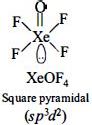
-
- (A) એક \(\sigma \) અને એક \(\pi\) બંધ
- (B) એક \(\sigma \) અને બે \(\pi\) બંધ
- (C) બે \(\sigma \) અને બે \(\pi \) બંધ
- (D) બે \(\sigma \) અને એક \(\pi \) બંધ
જવાબ અને ઉકેલ જુઓ
સાચો જવાબ: (B)
The structure of \(CaC_2\) is \(Ca^{2+}\) \([: C \equiv C :]^{2-}\) i.e, one \(\sigma \) and two \(\pi \) bonds - 162. \(LiCl, RbCl, BeCl_2\) અને \(MgCl_2\) પૈકી સૌથી વધુ અને સૌથી ઓછુ આયનીય લક્ષણ ધરાવતા સંયોજનો અનુક્રમે જણાવો. 2014 અઘરું
- (A) \(LiCl\) and \(RbCl\)
- (B) \(RbCl\) અને \(BeCl_2\)
- (C) \(MgCl_2\) અને \(BeCl_2\)
- (D) \(RbCl\) અને \(MgCl_2\)
જવાબ અને ઉકેલ જુઓ
સાચો જવાબ: (B)
According to Fajan's rules smaller, highly charged cation has greatest covalent character while large anion with smaller charge has greatest ionic character -
- (A) \(N_2 > O_2^- > O_2\)
- (B) \(O_2^- > O_2 > N_2\)
- (C) \(N_2 > O_2 > O_2^-\)
- (D) \(O_2 > O_2^- > N_2\)
જવાબ અને ઉકેલ જુઓ
સાચો જવાબ: (C)
The bond order of \(N_2,\) \(O_2,\) and \(O_2^-\) are respectively \(3,2\) and \(1.5\)Since higher bond order implies higher bond dissociation energy hence the correct orde will be
\(N_2 > O_2 > O_2^-\)
-
- (A) \(N_2\)
- (B) \(NO\)
- (C) \(CO\)
- (D) \(O_3\)
જવાબ અને ઉકેલ જુઓ
સાચો જવાબ: (B)
The molecular orbital configuration of the molecules given isTotal no. of electrons in \(NO\)
\(=7(N)+8(O)=15\)
Hence \(E.C.\) of \(NO\)
\(KK{[\sigma 2s]^2}{[{\sigma ^*}(2s)]^2}{[\sigma 2{p_z}]^2}\)
\({[\pi (2{p_x})]^2}[\pi {(2{p_y})^2}]{[{\pi ^*}(2{p_x})]^1}\)
Due to presence of one unpaired electron
\(NO\) is paramagnetic.
Except \(NO\) all are diamagnetic dur to absence of unpaired electrons.
-
- (A) \((CH_3)_3N\)
- (B) \((SiH_3)_3 N\)
- (C) \(P(CH_3)_3\)
- (D) \(P(SiH_3)_3\)
જવાબ અને ઉકેલ જુઓ
સાચો જવાબ: (B)
In case of \(N(SiH_3)_3\, N\) atom is \(sp^2\) hybridised, the lone pair is present in \(2p\) orbital and it is transferred to empty \(d\) orbital of \(Si\) forming \(d\pi -p\pi \) bond . Hence nitrogen with \(sp^2\) hybridization has trigonal planar shape. -
- (A) \(N_2\)
- (B) \(O_2^ - \)
- (C) \(N_2^{2 + }\)
- (D) \(O_2^{2 - }\)
જવાબ અને ઉકેલ જુઓ
સાચો જવાબ: (B)
\(O_2^ - (17) = KK{(\sigma 2s)^2}({\sigma ^*}2{s^2}){(\sigma 2{p_x})^2}\)\({(\pi 2{p_y})^2}{(\pi 2{p_z})^2}{({\pi ^*}2{p_y})^2}{({\pi ^*}2{p_z})^1}\)
one unpaired electron - Paramagnetic
-
- (A) \(Li_2 < Li_2^+ < Li_2^-\)
- (B) \(Li_2^- < Li_2^+ < Li_2\)
- (C) \(Li_2 < Li_2^- < Li_2^+\)
- (D) \(Li_2^- < Li_2 < Li_2^+\)
જવાબ અને ઉકેલ જુઓ
સાચો જવાબ: (B)
Correct option(b) \(\mathrm{Li}_{2}-<\mathrm{Li}_{2}^{+}<\mathrm{Li}_{2}\)
Explanation:
\(\mathrm{Li}_{2}(3+3=6)=\sigma 1 \mathrm{s}^{2}, \quad \hat{\sigma} 1 \mathrm{s}^{2}, \sigma 2 \mathrm{s}^{2}\)
Bond order \(=\frac{N_{b}-N_{a}}{2}=\frac{4-2}{2}=1\)
\(\mathrm{Li}_{2}^{+}(3+3-1=5)=\sigma 1 \mathrm{s}^{2}, \dot{\sigma}^{2} 1 s^{2}, \cdot \sigma 2 s^{1}\)
Bond order \(=\frac{3-2}{2}=\frac{1}{2}=0.5\)
Bond order \(=\frac{4-3}{2}=\frac{1}{2}=0.5\)
Stability order is \(\mathrm{Li}_{2}>\mathrm{Li}_{2}^{+}>\mathrm{Li}_{2}^{-}\) (because Li \(_{2}^{-}\) have more number of electrons in antibonding orbitals which destabilises the species).
-
- (A) \(61\)
- (B) \(38\)
- (C) \(35.5\)
- (D) \(41.5\)
જવાબ અને ઉકેલ જુઓ
સાચો જવાબ: (D)
Given \(e = 1.60 \times 10^{-19}\,C\)\(d = 9.17 \times 10^{-11}\,m\)
From \(\mu = e \times d\)
\(\mu = 1.60 \times 10^{-19} \times 9.17 \times 10^{-11}\)
\(= 14.672 \times 10^{-30}\)
\(\%\) ionic character \( = \frac{{Observed\,dipole\,moment}}{{Dipole\,moment\,for\,100\% \,ionic\,bond}}\)
\( = \frac{{6.104 \times {{10}^{ - 30}}}}{{14.672 \times {{10}^{ - 30}}}} \times 100\)
\( = 41.5\% \)
-
- (A) \(H_{2}^+, He_2^{2-}\)
- (B) \(H_{2}^-, He_2^{2-}\)
- (C) \(H_{2}^{+2}, He_2\)
- (D) \(H_{2}^-, He_2^{2+}\)
જવાબ અને ઉકેલ જુઓ
સાચો જવાબ: (C)
Species having zero or negative bond order do not exist.\(\mathrm{H}_{2}^{2+}(1+1-2=0)=\sigma 1 \mathrm{s}^{0}\)
Bond order \(=0\)
\(\mathrm{He}_{2}(2+2=4)=\sigma 1 \mathrm{s}^{2},{ }^{\star} \mathrm{fs}^{2}\)
Bond order \(=\frac{N_{0}-N_{a}}{2}=\frac{2-2}{2}=0\)
\(\mathrm{So}, \mathrm{both} \mathrm{H}_{2}^{2+}\) and \(\mathrm{He}_{2}\) do not exist.
-
- (A) \(CO_2, NO_2, ClO_2, SiO_2\)
- (B) \(PCl_3,Al Cl_3, BCl_3, SbCl_3\)
- (C) \(BF_3, NF_3, PF_3,Al F_3\)
- (D) \(BF_4^- , CCl_4 , NH_4^+ , PCl_4^+\)
જવાબ અને ઉકેલ જુઓ
સાચો જવાબ: (D)
All have tetrahedral structure -
- (A) \(PdCl_4^{2 - }\)
- (B) \(FeCl_4^{2 - }\)
- (C) \(CoCl_4^{2 - }\)
- (D) \(NiCl_4^{2 - }\)
જવાબ અને ઉકેલ જુઓ
સાચો જવાબ: (A)
\([PdCl_4]^{2-}\) is \(dsp^2\) hybridized and square planar in shape. -
- (A) \(C_2\)
- (B) \(F_2\)
- (C) \(O_2\)
- (D) \(S_2\)
જવાબ અને ઉકેલ જુઓ
સાચો જવાબ: (A)
પ્રતિચુંબકીય વર્તણૂક દર્શાવતા અણુઓ છે
A) \(C_2\) અને B) \(F_2\).
એક અણુ પ્રતિચુંબકીય હોય છે જો તેના બધા ઇલેક્ટ્રોન યુગ્મિત હોય અને અનુચુંબકીય હોય છે જો તેમાં એક અથવા વધુ અયુગ્મિત ઇલેક્ટ્રોન હોય. આણ્વીય કક્ષક (MO) સિદ્ધાંત મુજબ:
A) \(C_2\) (12 ઇલેક્ટ્રોન): ઇલેક્ટ્રોન રચના છે \((\sigma 1 s)^2( \left.\sigma^* 1 s\right)^2(\sigma 2 s)^2\left(\sigma^* 2 s\right)^2\left(\pi 2 p_x\right)^2\left(\pi 2 p_y\right)^2\). બધા ઇલેક્ટ્રોન યુગ્મિત છે. (પ્રતિચુંબકીય)
B) \(F_2\) (18 ઇલેક્ટ્રોન): ઇલેક્ટ્રોન રચના છે \(\sigma 1 s^2 \sigma^* 1 s^2 \sigma 2 s^2 \sigma^* 2 s^2 \sigma 2 p_z^2 \pi 2 p_x^2 \pi 2 p_y^2 \pi^* 2 p_x^2 \pi^* 2 p_y^2\). બધા ઇલેક્ટ્રોન યુગ્મિત છે. (પ્રતિચુંબકીય)
C) \(O _{ 2 }\) (16 ઇલેક્ટ્રોન): \(\pi^* 2 p_x\) અને \(\pi^* 2 p_y\) કક્ષકોમાં બે અયુગ્મિત ઇલેક્ટ્રોન ધરાવે છે. (અનુચુંબકીય)
D) \(S_2\) (32 ઇલેક્ટ્રોન): \(O_2\) ની જેમ, તે તેની ઉચ્ચતમ અધિકૃત આણ્વીય કક્ષકોમાં ( \(\pi^* 3 p\) ) બે અયુગ્મિત ઇલેક્ટ્રોન ધરાવે છે. (અનુચુંબકીય) -
- (A) \(ONCl\) અને \(ONO^-\) સમઇલેક્ટ્રોનીય છે
- (B) \(O_3\) અણુ વળેલો છે.
- (C) ઘનઅવસ્થામાં ઓઝોન જાંબલી કાળો છે.
- (D) ઓઝોન પ્રતિચુંબકીય વાયુ છે
જવાબ અને ઉકેલ જુઓ
સાચો જવાબ: (A)
(a) Number of electrons in\(\begin{array}{l}\mathrm{ONCl}=3.2 \mathrm{e}^{-} \\\mathrm{ONO}^{-}=24 \mathrm{e}^{-}\end{array}\)
Thus, ONCl and ONO- are not isoelectronic.
(b) \(\mathrm{O}_{3}\) has bent shape structure. Central atom O is \(s p^{2}\) hybridised with 1 lone pair of electrons.
(c) Ozone is violet-black in solid state.
(d) \(O_{3}\) has no unpaired electrons, thus it is diamagnetic.
-
- (A) \(XeF_4\)
- (B) \(IF_5\)
- (C) \(SbF_5\)
- (D) \(CF_4\)
જવાબ અને ઉકેલ જુઓ
સાચો જવાબ: (B)
The geometry of \(IF_5\) is square pyramidal with an unsymmetric charge distribution therefore this molecule is polar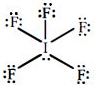
- 175. \(O_2^+ ; O_2 , O_2^-\) અને \(O_2^{2-}\) માટે \(O -O\) બંધમાં આંતરકેન્દ્રિય અંતર અનુક્રમે જણાવો. 2013 મધ્યમ
- (A) \(1.30\mathop {\,A}\limits^o ,1.49\,\mathop A\limits^o ,1.12\,\mathop A\limits^o ,1.21\,\mathop A\limits^o \)
- (B) \(1.49\mathop {\,A}\limits^o ,1.21\,\mathop A\limits^o ,1.12\,\mathop A\limits^o ,1.30\,\mathop A\limits^o \)
- (C) \(1.21\mathop {\,A}\limits^o ,1.12\,\mathop A\limits^o ,1.49\,\mathop A\limits^o ,1.30\,\mathop A\limits^o \)
- (D) \(1.12\mathop {\,A}\limits^o ,1.21\,\mathop A\limits^o ,1.30\,\mathop A\limits^o ,1.49\,\mathop A\limits^o \)
જવાબ અને ઉકેલ જુઓ
સાચો જવાબ: (D)
The bond length follows the order \(O_2^+ < O_2 < O_2^- < O_2^{2-}\) According to this the possible values are \(1.12\mathop {\,A}\limits^o ,1.21\,\mathop A\limits^o ,1.30\,\mathop A\limits^o ,1.49\,\mathop A\limits^o \) -
- (A) \({H_2} > {B_2} > L{i_2}\)
- (B) \(L{i_2} > {H_2} > {B_2}\)
- (C) \(L{i_2} > {B_2} > {H_2}\)
- (D) એકપણ નહીં
જવાબ અને ઉકેલ જુઓ
સાચો જવાબ: (D)
None of the given option is correct.The molecular orbital configuration of the given molecules is
\(H_2 = \sigma 1s^2\) (no electron anti-bonding)
\(L{i_2} = \sigma 1{s^2}\,{\sigma ^*}1{s^2}\,\sigma 2{s^2}\,\) (two anti - bonding electrons)
\({B_2} = \sigma 1{s^2}\,{\sigma ^*}1{s^2}\,\sigma 2{s^2}\,{\sigma ^*}2{s^2}\)
\(\left\{ {\pi 2p_y^1 = \pi 2p_z^1} \right\}\)
(\(4\) anti-bonding electrons)
Though the bond order of all the specie are same \((B.O=1)\) but stability is different.
This is due to difference in the presence of no. of anti-bonding electron.
Higher the no. of anti-bonding electron lower is the stability hence the correct order is
\(H_2 > Li_2 >B_2\)

આ પેજ પર આ ફિલ્ટર મુજબ કોઈ પ્રશ્ન નથી.