


All Chemical bonding and molecular structure questions
Newest firstShowing 101–150 of 179 questions
- 101. The correct order of bound orders of \(C _{2}^{2-}, N _{2}^{2-}\) and \(O _{2}^{2-}\) is, respectively. 2022 Medium
- (A) \(C _{2}^{2-}< N _{2}^{2-}< O _{2}^{2-}\)
- (B) \(O _{2}^{2-}< N _{2}^{2-}< C _{2}^{2-}\)
- (C) \(C _{2}^{2-}< O _{2}^{2-}< N _{2}^{2-}\)
- (D) \(N _{2}^{2-}< C _{2}^{2-}< O _{2}^{2-}\)
Show answer and solution
Correct Answer: (B)
Species \(\quad\) Bond order\(C _{2}^{2-} \quad\quad\quad\quad 3\)
\(N _{2}^{2-} \quad\quad\quad\quad 2\)
\(O _{2}^{2-} \quad\quad\quad\quad 1\)
-
- (A) \(HCN < H _{2} O < NH _{3}\)
- (B) \(HCN < CH _{4}< NH _{3}\)
- (C) \(CH _{4}< HCN < NH _{3}\)
- (D) \(CH _{4}< NH _{3}< HCN\)
Show answer and solution
Correct Answer: (C)
Order of \(H\)-Bonding\(CH _{4}\,<\, HCN \,<\, NH _{3}\)
\(NCH \ldots NCH\)
\(H _{2} NH \ldots NH _{3}\)
- 103. The hybridization of \(P\) exhibited in \(P F_{5}\) is \(s p^{x} d^{y}\). The value of \(y\) is \(...\) 2022 Easy
- (A) \(1\)
- (B) \(10\)
- (C) \(100\)
- (D) \(0.1\)
Show answer and solution
Correct Answer: (A)
\(PF _{5} \Rightarrow sp ^{3} d\) hybridisation(\(5\) sigma bonds, zero lone pair on central atom)
Value of \(y=1\)
-
- (A) \(1\)
- (B) \(2\)
- (C) \(3\)
- (D) \(4\)
Show answer and solution
Correct Answer: (D)
Paramagnetic \(B _{2}, C _{2}^{-}, O _{2}^{+}, He _{2}^{+}\) - 105. The number of \(sp ^{3}\) hybridised carbons in an acyclic neutral compound with molecular formula \(C _{4} H _{5} N\) is. 2022 Medium
- (A) \(0\) or \(1\)
- (B) \(2\)
- (C) \(3\)
- (D) \(4\)
Show answer and solution
Correct Answer: (A)
\(DU =4+1-\left(\frac{5-1}{2}\right)=3\)\(CH _{2}= C = CH = CH = NH\)
Zero \(sp ^{3}\) carbon
- 106. Which of the following pair of molecules contain odd electron molecule and an expanded octet molecule? 2022 Medium
- (A) \(BCl _{3}\) and \(SF _{6}\)
- (B) \(NO\) and \(H _{2} SO _{4}\)
- (C) \(SF _{6}\) and \(H _{2} SO _{4}\)
- (D) \(BCl _{3}\) and \(NO\)
Show answer and solution
Correct Answer: (B)
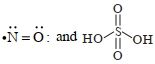
(A) \(BCl _{3} \rightarrow\) Even Electron molecule\(SF _{6} \rightarrow\) Expanded octet molecule
(B) \(NO \rightarrow\) Odd Electron molecule
\(H _{2} SO _{4} \rightarrow\) Expanded octet.
(C) \(SF _{6} \rightarrow\) Even Electron molecule
\(H _{2} SO _{4} \rightarrow\) Expanded octet.
(D) \(BCl _{3} \rightarrow\) Even Electron molecule
\(NO \rightarrow\) Odd Electron molecule
\(S \rightarrow 12e^{-}\) in outer orbit.
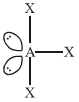
- 107. A central atom in a molecule has two lone pairs of electrons and forms three single bonds. The shape of this molecule is 2021 Medium
- (A) see-saw
- (B) planar triangular
- (C) \(T-\)shaped
- (D) trigonal pyramidal
Show answer and solution
Correct Answer: (C)
\(sp\) \(^{3}\) \(d\) hybridised\(T-\)shaped
-
- (A) \(5\)
- (B) \(22\)
- (C) \(19\)
- (D) \(11\)
Show answer and solution
Correct Answer: (C)
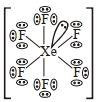
\(XeF _{6}+2 H _{2} O \longrightarrow XeO _{2} F _{2}+4 HF\)\(\quad\)(A) \(\quad\) (Limited water)
Structure of \('A'\)
\([Image]\)
Total \(l.p.\) on \(( A )=19\)
- 109. \(\mathrm{AB}_{3}\) is an interhalogen \(T-\)shaped molecule. The number of lone pairs of electrons on \(\mathrm{A}\) is ...... . 2021 Easy
- (A) \(2\)
- (B) \(3\)
- (C) \(4\)
- (D) \(1\)
Show answer and solution
Correct Answer: (A)
\(T-\)shaped molecule means \(3\) sigma bond and \(2\) lone pairs of electron on central atom.
- 110. According to molecular orbital theory, the number of unpaired electron(s) in \(\mathrm{O}_{2}^{2-}\) is : 2021 Medium
- (A) \(1\)
- (B) \(0\)
- (C) \(2\)
- (D) \(3\)
Show answer and solution
Correct Answer: (B)
Molecular orbital configuration of \(\mathrm{O}_{2}^{2-}\) is\(\sigma_{1 \mathrm{~s}}^{2} \sigma_{1 \mathrm{~s}}^{*} \sigma_{2 \mathrm{~s}}^{2} \sigma_{2 \mathrm{~s}}^{*_{2}}\left(\pi 2 \mathrm{p}_{\mathrm{x}}^{2}=\pi 2 \mathrm{p}_{\mathrm{y}}^{2}\right)\left(\pi_{2 \mathrm{px}}^{*}=\pi_{2 \mathrm{py}}^{*}\right)\)
Zero unpaired electron
- 111. According to molecular theory, the species among the following that does not exist is 2021 Easy
- (A) \(He _{2}^{+}\)
- (B) \(He _{2}^{-}\)
- (C) \(Be _{2}\)
- (D) \(O _{2}^{2-}\)
Show answer and solution
Correct Answer: (C)
Chemical Species Bond Order \(He _{2}^{+}\) \(0.5\) \(He _{2}^{-}\) \(0.5\) \(Be _{2}\) \(0\) \(O _{2}^{2-}\) \(1\) According to \(M.O.T.\) If bond order of chemical species is zero then that chemical species does not exist.
-
- (A) \(30\)
- (B) \(25\)
- (C) \(20\)
- (D) \(15\)
Show answer and solution
Correct Answer: (D)
\(AX\) is a covalent diatomic molecule.The molecule is \(NO\).
Total no. of electrons is \(15\).
-
- (A) Statement \(I\) is false but Statement \(II\) is true
- (B) Both statement \(I\) and statement \(II\) are true
- (C) Both statement \(I\) and statement \(II\) are false
- (D) Statement \(I\) is true but statement \(II\) is false
Show answer and solution
Correct Answer: (D)
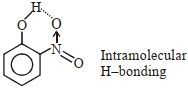
thus it is more volatile due to intramolecular \(H-\)bonding.Melting point depends on packing efficiency
- 114. Identify the species having one \(\pi\)-bond and maximum number of canonical forms from the following : 2021 Medium
- (A) \(\mathrm{CO}_{3}^{2-}\)
- (B) \(\mathrm{O}_{2}\)
- (C) \(\mathrm{SO}_{2}\)
- (D) \(\mathrm{SO}_{3}\)
Show answer and solution
Correct Answer: (A)
Among \(\mathrm{SO}_{3}, \mathrm{O}_{2}, \mathrm{SO}_{2}\) and \(\mathrm{CO}_{3}^{2-}\) only \(\mathrm{O}_{2}\) and \(\mathrm{CO}_{3}^{2-}\) has only one \(\pi\)-bond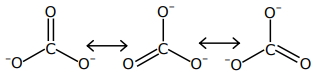
-
- (A) \(108\)
- (B) \(150\)
- (C) \(90\)
- (D) \(60\)
Show answer and solution
Correct Answer: (A)
In gaseous triethyl amine the \("-C-N-C-"\) bond angle is \(108\) degree. -
- (A) \(\mathrm{O}_{2}^{+}>\mathrm{O}_{2}>\mathrm{O}_{2}^{-}>\mathrm{O}_{2}^{2-}\)
- (B) \(\mathrm{O}_{2}>\mathrm{O}_{2}^{-}>\mathrm{O}_{2}^{2-}>\mathrm{O}_{2}^{+}\)
- (C) \(\mathrm{O}_{2}^{2-}>\mathrm{O}_{2}^{+}>\mathrm{O}_{2}^{-}>\mathrm{O}_{2}\)
- (D) \(\mathrm{O}_{2}^{+}>\mathrm{O}_{2}^{-}>\mathrm{O}_{2}^{2-}>\mathrm{O}_{2}\)
Show answer and solution
Correct Answer: (A)
\(\sigma_{1 s}^{2}, \sigma_{1 s}^{* 2}, \sigma_{2 s}^{2}, \sigma_{2 s}^{*}, \sigma_{2 p_{2}}^{2}\)\(\pi_{2 p_{x}}^{2}=\pi_{2 p_{y}}^{2}, \pi_{2 p_{x}}^{*_{1}}=\pi_{2 p_{y}}^{*_{1}}, \sigma_{2 p_{2}}^{*}\)
Bond order of \(\mathrm{O}_{2} \Rightarrow 2\)
Bond order of \(\mathrm{O}_{2}^{-} \Rightarrow 1.5\)
Bond order of \(\mathrm{O}_{2}^{2-} \Rightarrow 1\)
Bond order of \(\mathrm{O}_{2}^{+} \Rightarrow 2.5\)
-
- (A) \(95\)
- (B) \(49\)
- (C) \(22\)
- (D) \(84\)
Show answer and solution
Correct Answer: (B)
\(Fe \rightarrow[ Ar ] 4 s ^{2} 3 d ^{6}\)\(\uparrow \downarrow\) \(\uparrow\) \(\uparrow\) \(\uparrow\) \(\uparrow\) Number of unpaired \(e ^{-}=4\)
\(\mu=\sqrt{4(4+2)} \,B.M.\)
\(\mu=\sqrt{24}\, B.M\)
\(\mu=4.89\, B.M\)
\(\mu=48.9 \times 10^{-1}\, B.M\)
Nearest integer value will be \(49 .\)
-
- (A) \(( a ) \rightarrow( iii ),( b ) \rightarrow( iv ),( c ) \rightarrow( i ),( d ) \rightarrow( ii )\)
- (B) \(( a ) \rightarrow( i ),( b ) \rightarrow( ii ),( c ) \rightarrow( iii ),( d ) \rightarrow( iv )\)
- (C) \(( a ) \rightarrow( ii ),( b ) \rightarrow( i ),( c ) \rightarrow( iv ),( d ) \rightarrow( iii )\)
- (D) \(( a ) \rightarrow( iv ),( b ) \rightarrow( iii ),( c ) \rightarrow( ii ),( d ) \rightarrow( i )\)
Show answer and solution
Correct Answer: (A)
\((a)\) \(\quad Ne _{2}=\operatorname{Total} e ^{\Theta}=20\)B.O. \(=\frac{10-10}{2}=0\)
\((b)\) \(\quad N _{2}=\) Total \(e ^{\Theta}=14\)
B.O. \(=\frac{10-4}{2}=3\)
\((c)\) \(\quad F _{2}=\) Total \(e ^{\Theta}=18\)
B.O. \(=\frac{10-8}{2}=1\)
(d) \(O _{2}=\operatorname{Total} e ^{\theta}=16\)
B.O. \(=\frac{10-6}{2}=2\)
-
- (A) \((a)-(i), (b)-(ii), (c)-(v)\) and \((d)-(iii)\)
- (B) \((a)-(ii), (b)-(i), (c)-(iv)\) and \((d)-(v)\)
- (C) \((a)-(iv), (b)-(iii), (c)-(ii)\) and \((d)-(v)\)
- (D) \((a)-(iii), (b)-(i), (c)-(v)\) and \((d)-(iv)\)
Show answer and solution
Correct Answer: (D)
\((a)\) \(\mathrm{SF}_{4}-\mathrm{sp}^{3} \mathrm{~d}\) hybridisation\((b)\) \(IF_{5}-\mathrm{sp}^{3} \mathrm{~d}^{2}\) hybridisation
\((c)\) \(\mathrm{NO}_{2}^{+}-\mathrm{sp}\) hybridisation
\((d)\) \(\mathrm{NH}_{4}^{+}-\mathrm{sp}^{3}\) hybridisation
-
- (A) \(1\)
- (B) \(2\)
- (C) \(3\)
- (D) \(0\)
Show answer and solution
Correct Answer: (A)
\(\mathrm{Li}_{2} \mathrm{O} \quad \Rightarrow 2 \mathrm{Li}^{+}\quad\mathrm{O}^{2-}\)\(\mathrm{MgO} \Rightarrow \mathrm{Mg}^{2+}\quad \mathrm{O}^{2-}\)
\(\mathrm{CaO} \quad \Rightarrow \mathrm{Ca}^{2+} \quad \mathrm{O}^{2-}\)
\(\mathrm{K}_{2} \mathrm{O} \Rightarrow 2 \mathrm{~K}^{+} \quad\mathrm{O}^{2-}\)
\(\mathrm{Na}_{2} \mathrm{O}_{2} \Rightarrow 2 \mathrm{Na}^{+} \quad \mathrm{O}_{2}^{2-}\)
\(\mathrm{KO}_{2} \quad \Rightarrow \mathrm{K}^{+} \quad \mathrm{O}_{2}^{-}\)
\(\mathrm{O}_{2}^{-} \Rightarrow\) Complete octet, diamagnetic
\(\mathrm{O}^{2} \Rightarrow \sigma_{1 \mathrm{~s}}^{2} \sigma_{1 \mathrm{~s}}^{* 2} \sigma_{2 \mathrm{~s}}^{2} \sigma_{2 \mathrm{~s}}^{*_{2}} \sigma_{2 \mathrm{px}}^{2} \pi_{2 \mathrm{py}}^{2} \simeq \pi_{2 \mathrm{pz}}^{2} \pi_{2 \mathrm{py}}^{*_{2}} \simeq \pi_{2 \mathrm{pz}}^{*_{2}}(\mathrm{dia})\)
\(\mathrm{O}_{2}^{-} \Rightarrow \sigma_{1 \mathrm{~s}}^{2} \sigma_{1 \mathrm{~s}}^{*_{2}} \sigma_{2 \mathrm{~s}}^{2} \sigma_{2 \mathrm{~s}}^{* 2} \sigma_{2 \mathrm{px}}^{2} \pi_{2 \mathrm{py}}^{2} \simeq \pi_{2 \mathrm{p} z}^{2} \pi_{2 \mathrm{py}}^{*} \simeq \pi_{2 \mathrm{pz}}^{* 1}(\mathrm{para})\)
-
- (A) \(5.82,0\) and \(0\, BM\)
- (B) \(4.90,0\) and \(1.73\, BM\)
- (C) \(5.92,4.90\) and \(0 \,BM\)
- (D) \(4.90,0\) and \(2.83 \,BM\)
Show answer and solution
Correct Answer: (B)
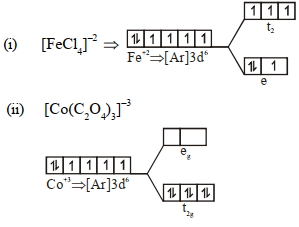
\((i)\) \(\left[ FeCl _{4}\right]^{-2}\)\(\mu =\sqrt{ n ( n +2)} \,BM\)
\(=\sqrt{4(4+2)}\, BM\)
\(=\sqrt{24}\, BM \Rightarrow 4.90\, BM\)
\((ii)\) \(\left[ Co \left( C _{2} O _{4}\right)_{3}\right]^{-3}\)
\(\mu=0\)
\((iii)\) \(MnO _{4}^{-2}\)
\(Mn ^{+6} \Rightarrow[ Ar ] 3 d ^{1} \quad \mu=\sqrt{ n ( n +2)} \,BM\)
\(=\sqrt{1(1+2)} \,BM\)
\(=\sqrt{3} BM \Rightarrow 1.73\, BM\)
- 122. The correct shape and \(I-I-I\) bond angles respectively in \(I _{3}^{-}\) ion are :- 2021 Easy
- (A) Distorted trigonal planar; \(135^{\circ}\) and \(90^{\circ}\)
- (B) \(T-\)shaped; \(180^{\circ}\) and \(90^{\circ}\)
- (C) Trigonal planar; \(120^{\circ}\)
- (D) Linear; \(180^{\circ}\)
Show answer and solution
Correct Answer: (D)
Shape : Linear,\(I-I-I\) Bond angle \(\Rightarrow 180^{\circ}\)
-
- (A) \(0\)
- (B) \(1\)
- (C) \(2\)
- (D) \(3\)
Show answer and solution
Correct Answer: (A)
Total electrons in CO = \(6 + 8 = 14\)
Total electrons in NO\(^+ = 7 + 8 - 1 = 14\)
Bond order for 14 electrons = \(\frac{10 - 4}{2} = 3\)
Bond order of CO = 3
Bond order of NO\(^+ = 3\)
Difference in bond orders = \(3 - 3 = 0\)
\(\frac{x}{2} = 0\)
\(x = 0\)
- 124. The number of lone pairs of electrons on the central \(I\) atom in \(I_{3}^{-}\) is \(.......\)
 2021 Medium
- (A) \(3\)
- (B) \(0\)
- (C) \(1\)
- (D) \(2\)
Show answer and solution
Correct Answer: (A)
\(\mathrm{I}_{3}^{-}:\)The number of lone pairs of electron on the central atom is \(3 .\)
-
- (A) \(3\)
- (B) \(2\)
- (C) \(4\)
- (D) \(1\)
Show answer and solution
Correct Answer: (A)
Hence non-pyramidal species are \(\mathrm{SO}_{3}, \mathrm{NO}_{3}^{-}\) and \(\mathrm{CO}_{3}^{2-}\)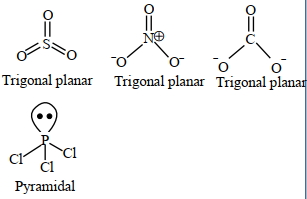
- 126. The spin only magnetic moment of a divalent ion in aqueous solution (atomic number 29\()\) is ...... \(BM.\) 2021 Medium
- (A) \(2\)
- (B) \(8\)
- (C) \(6\)
- (D) \(4\)
Show answer and solution
Correct Answer: (A)
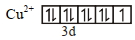
\(Z=29( Cu )\)\(Cu ^{2+}\) form \(\left[ Cu \left( H _{2} O \right)_{4}\right]^{2+}\) complex ion with \(H _{2} O.\)
\(\left[ Cu \left( H _{2} O \right)_{4}\right]^{2+} \Rightarrow Cu ^{2+}[ Ar ] 3 d ^{9}, H _{2} O \rightarrow WFL\)
number of unpaired \(e ^{-}=1\)
\(\mu=\sqrt{1(1+2)}\) \(B.M.\)
\(\mu=\sqrt{3} \Rightarrow 1.73 \,B.M . \Rightarrow \text { round off ans. } \Rightarrow 2\)
-
- (A) \(243\)
- (B) \(1\)
- (C) \(173\)
- (D) \(143\)
Show answer and solution
Correct Answer: (C)
\(\mathrm{B}_{2}^{+} \Rightarrow \sigma_{1 \mathrm{~s}}^{2} \sigma_{1 \mathrm{~s}}^{* 2} \sigma_{2 s}^{2} \sigma_{2 \mathrm{~s}}^{* 2} \pi_{2 \mathrm{py}}^{1} \simeq \pi_{2 \mathrm{pz}}^{0}\)\(\Rightarrow 9 \mathrm{e}^{-}\)
\(\mu=\sqrt{1(1+2)}=\sqrt{3}\, \mathrm{BM}\)
\(=1.73 \,\mathrm{BM}\)
\(=1.73 \times 10^{-2}\, \mathrm{BM}\)
- 128. The total number of electrons in all bonding molecular orbitals of \(O_{2}^{2-}\) is \(....\,.\) (Round off to the Nearest Integer). 2021 Hard
- (A) \(5\)
- (B) \(10\)
- (C) \(15\)
- (D) \(20\)
Show answer and solution
Correct Answer: (B)
\(\sigma 1 \mathrm{~s}^{2} \sigma 1^* \mathrm{~s}^{2} \sigma 2 \mathrm{~s}^{2} \sigma 2^* \mathrm{~s}^{2} \sigma 2 \mathrm{p}_{z}^{2} \pi 2 \mathrm{p}_{\mathrm{x}}^{2}=\pi 2 \mathrm{p}_{\mathrm{y}}^{2}\)\(\pi 2^* \mathrm{p}_{\mathrm{x}}^{2}=\pi 2^* \mathrm{p}_{\mathrm{y}}^{2}\)
-
- (A) \(BF _{4}^{-}\)
- (B) \(XeF _{4}\)
- (C) \(SF _{4}\)
- (D) \(SiF _{4}\)
Show answer and solution
Correct Answer: (C)
Species
Hybridisation Bond length \(BF _{4}^{\Theta}\) \(sp ^{3}\) (Tetrahedral) All bond lengths equal \(XeF _{4}\) \(sp ^{3} d ^{2}\) (sq. planar) All bond lengths equal \(SF _{4}\) \(sp ^{3} d ( see - saw )\) axial bond length \( > \) equitorial bond length \(SiF _{4}\) \(sp ^{3}\) (Tetrahedral) all bond lengths equal -
- (A) \(C\) and \(D\) only
- (B) \(A\) and \(B\) only
- (C) \(A\) and \(C\) only
- (D) \(B\) and \(C\) only
Show answer and solution
Correct Answer: (B)
Isostructural means same structure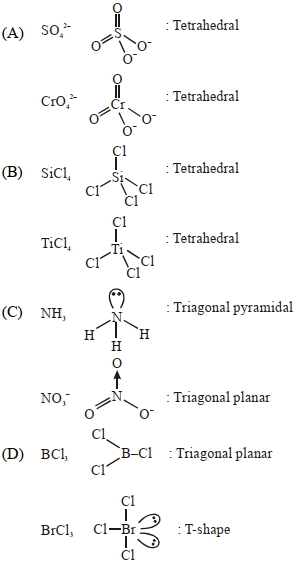
- 131. Which one of the following species doesn't have a magnetic moment of \(1.73\, \mathrm{BM}\). (spin only value)? 2021 Hard
- (A) \(CuI\)
- (B) \(\left[\mathrm{Cu}\left(\mathrm{NH}_{3}\right)_{4}\right] \mathrm{Cl}_{2}\)
- (C) \(\mathrm{O}_{2}^{+}\)
- (D) \(\mathrm{O}_{2}^{-}\)
Show answer and solution
Correct Answer: (A)
Species must not contain single unpaired\(\mathrm{O}_{2}^{+} \rightarrow \sigma_{1 \mathrm{~s}}^{2}<\sigma_{1 \mathrm{~s}}^{*}<\sigma_{2 \mathrm{~s}}^{2}<\sigma_{2 \mathrm{~s}}^{*}<\sigma_{2 \mathrm{pz}}^{2}<\pi_{2 \mathrm{px}}^{2}=\pi_{2 \mathrm{py}}^{2}<\pi_{2 \mathrm{px}}^{*}=\pi_{2 \mathrm{py}}^{*}\)
unpaired \(\mathrm{e}^{-}=1 \ldots \mu=1.73\, \mathrm{BM}\)
\((1)\) \(\mathrm{Cu}^{+} \mathrm{I}^{-} \mathrm{Cu}+\rightarrow[\mathrm{Ar}] 3 \mathrm{~d}^{10} \therefore\) unpaired \(\mathrm{e}^{-}=0\)
\(\mathrm{I}^{-} \rightarrow[\mathrm{Xe}] \therefore\) unpaired \(\mathrm{e}^{-}=0\)
therefore \(\mu=0\)
\(3.\) \(\left[\mathrm{Cu}\left(\mathrm{NH}_{3}\right)_{4}\right] \mathrm{Cl}_{2}\)
\(\mathrm{Cu} \rightarrow[\mathrm{A}] 3 \mathrm{~d}^{3} \therefore\) unpaired \(=1 \quad \therefore \mu=1.73 \,\mathrm{BM}\)
\(4.\) \(\mathrm{O}_{2}^{-} \rightarrow \mathrm{d}\)
\(\sigma_{1 \mathrm{~s}}^{2}<\sigma_{1 \mathrm{~s}}^{* 2}<\sigma_{2 \mathrm{~s}}^{2}<\sigma_{2 \mathrm{~s}}^{* 2}<\sigma_{2 \mathrm{px}}^{2}<\pi_{2 \mathrm{px}}^{2}=\pi_{2 \mathrm{py}}^{2}<\pi_{2 \mathrm{px}}^{*_{1}}=\pi_{2 \mathrm{py}}^{*}\)
\(\left(11 \mathrm{e}^{-}\right)\)
\(\therefore\) unpaired \(\quad \therefore \mu=1.73\, \mathrm{BM}\)
-
- (A) \(1.67\)
- (B) \(0.67\)
- (C) \(1.33\)
- (D) \(2.33\)
Show answer and solution
Correct Answer: (A)
\(3 \mathrm{Cl}_{2}+6 \mathrm{NaOH} \rightarrow 5 \mathrm{NaCl}+\mathrm{NaClO}_{3}+3 \mathrm{H}_{2} \mathrm{O}\)\(\quad \quad \quad \quad \quad \quad \quad \quad (\mathrm{X})\quad \quad \quad(\mathrm{Y})\)
\(\mathrm{NaCl}+\mathrm{AgNO}_{3} \rightarrow \mathrm{AgCl} \downarrow+\mathrm{NaNO}_{3}\)
\((\mathrm{X})\)
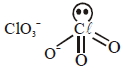
Bond order of \(\mathrm{Cl}-\mathrm{O}\) Bond \(=1+\frac{2}{3}=\frac{5}{3}\)
\(=1.66\) or \(1.67\)
- 133. If \(AB _{4}\) molecule is a polar molecule, a possible geometry of \(AB _{4}\) is : 2020 Medium
- (A) Square pyramidal
- (B) Tetrahedral
- (C) Square planar
- (D) Rectangular planar
Show answer and solution
Correct Answer: (A)
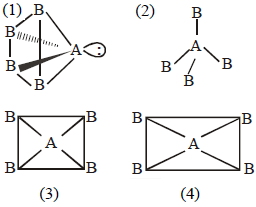
\((1)\) If \(AB _{4}\) molecule is a square pyramidal then it has one lone pair and their structure should be and it should be polar because dipole moment of lone pair of \('A'\) never be cancelled by others.\((2)\) If \(AB _{4}\) molecule is a tetrahedral then it has no lone pair and their structure should be and it should be non polar due to perfect symmetry.
\((3)\) If \(AB _{4}\), molecule is a square planar then it should be non polar because vector sum of dipole moment is zero.
\((4)\) If \(AB _{4}\) molecule is a rectangular planar then it should be non polar because vector sum of dipole moment is zero.
-
- (A) \(\mathrm{O}_{2}^{-}\) or \(\mathrm{O}_{2}^{+}\)
- (B) \(\mathrm{O}_{2}\) or \(\mathrm{O}_{2}^{+}\)
- (C) \(\mathrm{O}_{2}\) or \(\mathrm{O}_{2}^{-}\)
- (D) \(\mathrm{O}_{2}, \mathrm{O}_{2}^{-}\) or \(\mathrm{O}_{2}^{+}\)
Show answer and solution
Correct Answer: (A)
\(\begin{array}{|c|c|c|} \hline & \text { unpaired electron } & \text { magnetic moment } \\ \hline O _{2}^{\oplus} & 1 & 1.73 B . M \\ \hline O _{2}^{\ominus} & 1 & 1.73 B . M \\ \hline O _{2} & 2 & 2.83 B.M \\ \hline \end{array}\) - 135. Of the species, \(NO , NO ^{+}, NO ^{2+}, NO ^{-},\) the one with minimum bond strength is : 2020 Hard
- (A) \(NO ^{2+}\)
- (B) \(NO ^{+}\)
- (C) \(NO\)
- (D) \(NO ^{-}\)
Show answer and solution
Correct Answer: (D)
Bond order of \(NO ^{2+}=2.5\)Bond order of \(NO ^{+}=3\)
Bond order of \(NO =2.5\)
Bond order of \(NO ^{-}=2\)
Bond order \(\alpha\) bond strength.
- 136. The molecular geometry of \(S\,F _{6}\) is octahedral. What is the geometry of \(S\,F _{4}\) (including lone pair(s) of electrons, if any)? 2020 Medium
- (A) Trigonal bipyramidal
- (B) Square planar
- (C) Tetrahedral
- (D) Pyramidal
Show answer and solution
Correct Answer: (A)
\(4 \sigma\) bonds \(+1\) lone pairShape (including lone pair of electrons) is Trigonal bipyramidal

- 137. The molecule in which hybrid \(MOs\) involve only one \(d-\)orbital of the central atom is 2020 Hard
- (A) \(\left[ Ni ( CN )_{4}\right]^{2-}\)
- (B) \(\left[ CrF _{6}\right]^{3-}\)
- (C) \(BrF _{5}\)
- (D) \(XeF _{4}\)
Show answer and solution
Correct Answer: (A)
\(\left[ Ni ( CN )_{4}\right]^{2-}\)\(dsp\)\(^{2}\) hybridisation.
-
- (A) hydrogen bonding and London dispersion
- (B) Dipole-dipole and hydrogen bonding
- (C) London dispersion and dipole-dipole
- (D) London dispersion, dipole-dipole and hydrogen bonding
Show answer and solution
Correct Answer: (C)
Ethyl acetate is polar molecule. Hence there will be dipole-dipole
attraction and london dispersion forces are present. -
- (A) \(\underline{N}{H }_{3} \stackrel{ H ^{+}}{\longrightarrow}\)
- (B) \(\underline {Xe}F _{4}+ SbF _{5} \rightarrow\)
- (C) \(H _{2} \underline SO _{4}+ NaCl \xrightarrow{{420\,\,K}}\)
- (D) \(H _{3} \underline PO _{2} \xrightarrow{{ Disproportionation }}\)
Show answer and solution
Correct Answer: (B)
\(XeF _{4}+ SbF _{5} \rightarrow\left[ XeF _{3}\right]^{+}\left[ SbF _{6}\right]^{-}\)\(sp ^{3} d ^{2}\,\,\,\,\, sp ^{3} d\,\,\, \quad sp ^{3} d\,\,\,\,\, \quad sp ^{3} d ^{2}\)
-
- (A) ion-dipole > ion-ion > dipole-dipole
- (B) dipole-dipole > ion-dipole > ion-ion
- (C) ion-dipole > dipole-dipole > ion-ion
- (D) ion-ion > ion-dipole > dipole-dipole
Show answer and solution
Correct Answer: (D)
Interionic\(/\) Intermolecular forces \(\propto\) charge on the speciesIons are charged species whereas dipoles are partially charged.
\(\therefore\) Ion-Ion \(\,>\,\) Ion-dipole \(\,>\,\) dipole-dipole
Hence, option \(d\) is correct.
- 141. According to molecular orbital theory, which of the following is true with respect to \(Li_2^ + \) and \(Li_2^ - \) ? 2019 Medium
- (A) \(Li_2^ + \) is unstable and \(Li_2^ - \) is stable
- (B) \(Li_2^ + \) is stable and \(Li_2^ - \) is unstable
- (C) Both are stable
- (D) Both are unstable
Show answer and solution
Correct Answer: (C)
\(Li_2^+\): Electrons = 5
MO Config: \((\sigma_{1s})^2 (\sigma_{1s}^*)^2 (\sigma_{2s})^1\)
Bond Order = \(\frac{1}{2} (N_b - N_a) = \frac{1}{2} (3 - 2) = 0.5\)
\(Li_2^-\): Electrons = 7
MO Config: \((\sigma_{1s})^2 (\sigma_{1s}^*)^2 (\sigma_{2s})^2 (\sigma_{2s}^*)^1\)
Bond Order = \(\frac{1}{2} (N_b - N_a) = \frac{1}{2} (4 - 3) = 0.5\)
Both are stable.
- 142. Among the following molecules / ions \(C_2^{2-} ,N_2^{2-} ,O_2^{2-},O_2\) which one is diamagnetic and has the shortest bond length ? 2019 Hard
- (A) \(O_2^{2-}\)
- (B) \(C_2^{2-}\)
- (C) \(O_2\)
- (D) \(N_2^{2-}\)
Show answer and solution
Correct Answer: (B)
\(C_2^{2 - } - {\sigma _{1s}}2{\sigma ^*}_{1s}2{\sigma _{2s}}2{\sigma ^*}_{2{s^2}}[{\pi _{2p_x^2}} = {\pi _2}p_y^2]{\sigma _{2p_z^2}}\)\(B.O = \frac{{10 - 4}}{2} = 3\) (diamagnetic)
\(N_2^{2 - } - {\sigma _{1s}}2{\sigma ^*}_{1s}2{\sigma _{2s}}2{\sigma ^*}_{2{s^2}}[{\pi _{2p_x^2}} = {\pi _2}p_y^2]{\sigma _{2p_z^2}}[{\pi _{2p_x^1}} = {\pi ^*}_{2p_y^1}]\)
\(B.O = \frac{{10 - 6}}{2} = 2\) (paramagnetic)
\(O_2^{2 - } - {\sigma _{1s}}2{\sigma ^*}_{1s}2{\sigma _{2s}}2{\sigma ^*}_{2s}2{\sigma _{2p_z^2}}[{\pi _{2p_x^2}} = {\pi _2}p_y^2]\,[{\pi _{2p_x^2}} = {\pi ^*}_2p_y^2]\)
\(B.O = \frac{{10 - 8}}{2} = 1\) (diamagnetic)
\({O_2} - {\sigma _{1s}}2{\sigma ^*}_{1s}2{\sigma _{2s}}2{\sigma ^*}_{2s}2{\sigma _{2p_z^2}}\,[{\pi _{2p_x^2}} = {\pi _2}p_y^2]\,[{\pi _{2p_x^2}} = {\pi ^*}_2p_y^2]\)
\(B.O = \frac{{10 - 6}}{2} = 2\) (paramagnetic)
-
- (A) \(O_2\)
- (B) \(NO\)
- (C) \(B_2\)
- (D) \(CO\)
Show answer and solution
Correct Answer: (D)
\(CO\) is diamagnetic in nature due to absence of any unpaired electron. -
- (A) \(F_2\)
- (B) \(C_2\)
- (C) \(O_2\)
- (D) \(NO\)
Show answer and solution
Correct Answer: (B)
\(C_2\) configuration\(\sigma 1{s^2}{\sigma ^*}1{s^2}\sigma 2{s^2}{\sigma ^*}2{s^2}_{\pi 2{p_z}^2}^{\pi 2{p_y}^2}\sigma 2Px\)
\(C_2^-\) configuration
\(\sigma 1{s^2}{\sigma ^*}1{s^2}\sigma 2{s^2}{\sigma ^*}2{s^2}_{\pi 2{p_z}^2}^{\pi 2{p_y}^2}\sigma 2P_x^1\)
-
- (A) lowest dissociation enthalpy
- (B) strongest van der Waals’ interactions
- (C) strongest hydrogen bonding
- (D) lowest ionic character
Show answer and solution
Correct Answer: (C)
\(HF\) has strong hydrogen bond. \(\therefore \) It has highest boiling point among hydrogen halides. The strong hydrogen bond is due to more difference in electronegativity between \(F\) and \(H\) atoms - 146. In which of the following processes, the bond order has increased and paramagnetic character has changed to diamagnetic? 2019 Hard
- (A) \(NO\,\to \,NO^+\)
- (B) \(N_2\,\to \,N_2^+\)
- (C) \(O_2\,\to \,O_2^+\)
- (D) \(O_2\,\to \,O_2^{2-}\)
Show answer and solution
Correct Answer: (A)
\(B.O\) \(\mathop {\mathop {NO}\limits_{0.5} }\limits_{Para} \to \mathop {\mathop {N{O^ + }}\limits_3 }\limits_{Dia} \) \(B.O\) \(\mathop {\mathop {{N_2}}\limits_3 }\limits_{Dia} \to \mathop {\mathop {N_2^ + }\limits_{2.5} }\limits_{Para} \)\(B.O\) \(\mathop {\mathop {{O_2}}\limits_2 }\limits_{Para} \to \mathop {\mathop {O_2^ + }\limits_{2.5} }\limits_{Para} \) \(B.O\) \(\mathop {\mathop {{O_2}}\limits_2 }\limits_{Para} \to \mathop {\mathop {O_2^{2 - }}\limits_1 }\limits_{Dia} \)
-
- (A) \(Li^+ > Na^+ > K^+ > Cs^+ > Rb^+\)
- (B) \(Na^+> Li^+ > K^+ > Rb^+ > Cs^+\)
- (C) \(Na^+ > Li^+ > K^+ > Cs^+ > Rb^+\)
- (D) \(Li^+ > Na^+ > K^+ > Rb^+ > Cs^+\)
Show answer and solution
Correct Answer: (D)
Hydration enthalpy depends upon ionic potential (charge/size). As ionic potential increases hydration enthalpy increases\({\Delta _{hyd}}{H^o} \propto \frac{q}{r}\)
-
- (A) \(I\) and \(II\) only
- (B) \(I\), \(II\) and \(III\)
- (C) \(I\) and \(III\) only
- (D) \(II\) and \(III\) only
Show answer and solution
Correct Answer: (C)
\((i)\) \(VBT\) does not explain colour exhibited by complex of transition metal because splitting of \(d-\) orbitals in explained by \(CFT\).
\((ii)\) \(VBT\) does not distinguish between strong and weak field complex.
\((iii)\) \(VBT\) does not give quantitative interpretation of magnetic properties.
\(\therefore \) According to question statement \(I\) and \(III\) are correct -
- (A) \(Sn\)
- (B) \(C\)
- (C) \(Ge\)
- (D) \(Si\)
Show answer and solution
Correct Answer: (B)
It is due to the smallest atomic size of carbon in the given options. -
- (A) \([IF_6]^ -\)
- (B) \([ICl_4]^ -\)
- (C) \([ICl_2]^ -\)
- (D) \([BrF_2]^ -\)
Show answer and solution
Correct Answer: (B)
\({[IC{l_4}]^ - } \to s{p^3}{d^2}\)\({[I{F_6}]^ - } \to s{p^3}{d^3}\)
\({[IC{l_2}]^ - } \to s{p^3}d\)
\({[Br{F_2}]^ - } \to s{p^3}d\)
No questions on this page match these filters.