


JEE Mains 2023 Chemistry ના બધા પ્રશ્નો
25 પ્રકરણ349 માંથી 51–100 પ્રશ્નો
-
- (A) \(A\) સાચું નથી પણ \(R\) સાચું છે.
- (B) \(A\) સાચું છે પણ \(R\) સાચું નથી.
- (C) બંને \(A\) અને \(R\) સાચાં છે, પણ \(R\) એ \(A\) ની સાચી સમજૂતી આપતું નથી.
- (D) બંને \(A\) અને \(R\) સાચાં છે,\(R\) એ \(A\) ની સાચી સમજૂતી આપે છે.
જવાબ અને ઉકેલ જુઓ
સાચો જવાબ: (A)
The acid sensitive alcohol group reacts with \(HCl\), hence Clemmenson reduction is not suitable for above conversion.
-
- (A) બંને \(A\) અને \(R\) સાચા છે અને \(R\) એ \(A\)નું સાચી સમજૂતી છે.
- (B) \(A\) સાચું છે પણ \(R\) ખોટું છે.
- (C) બંને \(A\) અને \(R\) સાચા છે અને \(R\) એ \(A\)નું સાચી સમજૂતી નથી.
- (D) \(A\) ખોટું છે પણ \(R\) સાચું છે.
જવાબ અને ઉકેલ જુઓ
સાચો જવાબ: (A)
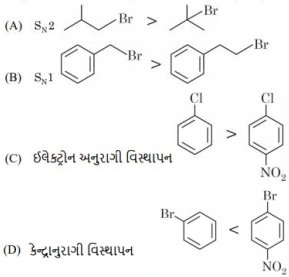
Butan\(-1-\)ol \(\left( CH _3 CH _2 CH _2 CH _2 OH \right)\) can undergo hydrogen bonding. Ethoxyethane \(\left( CH _3 CH _2-\right.\) \(O - CH _2 CH _3\) ) has no hydrogen (attached with \(F\), \(O , N\) ) which can undergo hydrogen bonding. More is the extent of intermolecular \(H\)-bonding, more will be association of molecules. Thus leading to higher boiling point.Hence both Assertion \((A)\) and Reason\((R)\) are true and \(( R )\) is the correct explanation of \(( A )\). - 53. અનુક્રમિત પ્રક્રિયાવિધી તરફ નીચે આપેલા યુગ્મો (જોડી) માટે સક્રિયતાનો સાચો ક્રમ ઓળખો. નીચે આપેલા વિકલ્પોમાથી સાચો જવાબ પસંદ કરો.
 2023 અઘરું
- (A) માત્ર (A), (B) અને (D)
- (B) માત્ર (A), (B), (C) અને (D)
- (C) માત્ર (A), (C) અને (D)
- (D) માત્ર (B), (C) અને (D)
જવાબ અને ઉકેલ જુઓ
સાચો જવાબ: (B)
All are correct\((A)\) \(S _{ N } 2\) reaction decreases with increase in steric crowding.
\((B)\) \(S _{ N } 1\) reaction increases with stability of carbocation.
\((C)\) EAS reaction decreases with decrease in electron density.
\((D)\) Presence of electron withdrawing group at ortho and para-position to a halogen in haloarene increase nucleophilic aryl substitution.
-
- (A) \(4\)
- (B) \(2\)
- (C) \(1\)
- (D) \(5\)
જવાબ અને ઉકેલ જુઓ
સાચો જવાબ: (A)
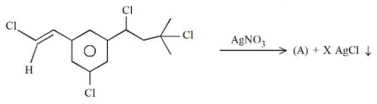
Total Possible Isomeric product \(=1+3=4\)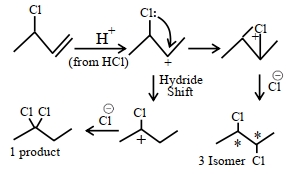
-
- (A) \(A > B > D > C\)
- (B) \(C > A > D > B\)
- (C) \(D > C > B > A\)
- (D) \(D > B > A > C\)
જવાબ અને ઉકેલ જુઓ
સાચો જવાબ: (D)
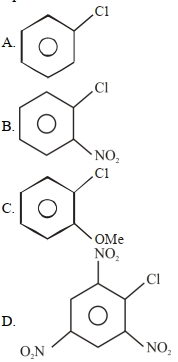
\((-M)\) group increases reactivity where as \((+M)\) group decreases reactivity of Halobenzene towards Nucleophilic substitution reaction.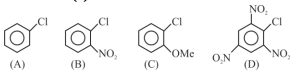
-
- (A) \(4\)
- (B) \(6\)
- (C) \(2\)
- (D) \(8\)
જવાબ અને ઉકેલ જુઓ
સાચો જવાબ: (C)
Benzylic and tertiary carbocations are stable. -
- (A) \(A - Br _{(b)} ; B - I _{( b )} ; C - Br _{( b )} ; D - Br _{( b )}\)
- (B) \(A - Br _{( a )} ; BI _{( a )} ; C - Br _{( b )} ; D - Br _{( a )}\)
- (C) \(A - Br _{( b )} ; B - I _{( a )} ; C - Br _{( a )} ; D - Br _{( a )}\)
- (D) \(A - Br _{( b )} ; B - I _{( a )} ; C - Br _{( a )} ; D - Br _{( a )}\)
જવાબ અને ઉકેલ જુઓ
સાચો જવાબ: (B)
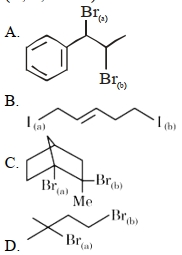
Stable is the carbocation, faster will be rate of \(SN1\) reaction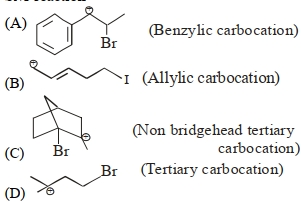
-
- (A) \(C Cl _2 F _2\)
- (B) \(C _2 HF _3\)
- (C) \(C _2 H _2 F _2\)
- (D) \(C _2 F _4\)
જવાબ અને ઉકેલ જુઓ
સાચો જવાબ: (A)
Freons are chlorofluoro carbon. - 59. નીચે આપેલા સંયોજનો માટે આપેલ ગુણધર્મ માટે સાચો ક્રમ શોધો. નીયે આપેલા વિકલ્પોમાંથી સાચો જવાબ પસંદ કરો.
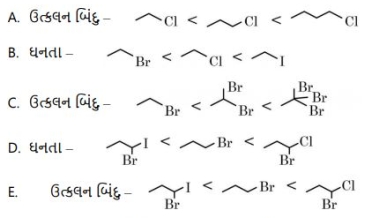 2023 મધ્યમ
- (A) ફક્ત \((B), (C)\) અને \((D)\)
- (B) ફક્ત \((A), (C)\) અને \((E)\)
- (C) ફક્ત \((A), (C)\) અને \((D)\)
- (D) ફક્ત \((A), (B)\) અને \((E)\)
જવાબ અને ઉકેલ જુઓ
સાચો જવાબ: (B)
Boiling point of alkyl halide increases with increase in size, mass of halogen atom and size of alkyl groupBoiling point of isomeric alkyl halide decreases with increase in branching
Density increases with increase in atomic mass of halogen atom
-
- (A) \(a > c > d > b\)
- (B) \(a > b > c > d\)
- (C) \(b > d > c > a\)
- (D) \(d > b > c > a\)
જવાબ અને ઉકેલ જુઓ
સાચો જવાબ: (C)
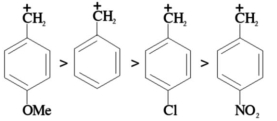
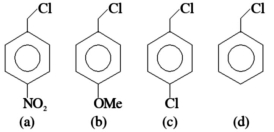
The rate of \(S_N 1\) reaction depends upon stability of carbocation which follows the order\(\therefore\) Reactivity order
\((b) > (d) > (c) > (a)\)
-
- (A) \(A\) ખોટું પણ \(R\) સાચું છે.
- (B) \(A\) સાચું પણ \(R\) ખોટું છે.
- (C) બંને \(A\) અને \(R\) સાચાં છે,પણ \(R\) એ \(A\) ની સમજૂતી આપે છે.
- (D) બંને \(A\) અને \(R\) સાચાં છે, \(R\) એ \(A\) ની સાચી સમજૂતી આપતું નથી.
જવાબ અને ઉકેલ જુઓ
સાચો જવાબ: (C)
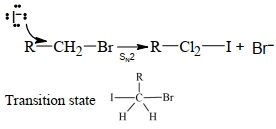
The rate of hydrolysis of alkyl chloride improves because of better Nucleophilicity of \(I ^{-}\). -
- (A) ઉપરની પ્રક્રિયામાં બનતી સંક્રાંત અવસ્થા એ સ્થાનિકૃત ઋણાયન (એનાયન) કરતા ઓછી ધ્રુવીય છે.
- (B) પ્રક્રિયા એસિટિક એસિડ માં પણ થઈ શકે છે.
- (C) પ્રક્રિયામાં વપરાતો દ્રાવક વેગનિર્ણાયક તબકકામાં બનતા આયનો ને દ્રાવકઆયોજિત \((solvates)\) કરે છે.
- (D) \(Br^-\) એ સ્પર્ધાત્મક કેન્દ્રાનુરાગી તરીકે વર્તી શકે છે.
જવાબ અને ઉકેલ જુઓ
સાચો જવાબ: (A)
This is finkelstein reactionClearly, the transition state is less polar than free anions. \(Br ^{-}\)and \(I ^{-}\)
Acetic acid is protic which does not support \(S _{ N } 2\)
Acetone does not solvate anion
\(Br ^{-}\)gets precipitated and hence can not compete with \(I\)
-
- (A) આ બધા ક્લોરોફ્લોરોકાર્બન સંયોજનો છે
- (B) આ બધા રસાયણો ચામડીનાં કેન્સરનું કારણ છે
- (C) આ બધા ક્લોરિન અને ક્લોરિન મોનોક્સાઈડ ના મૂલકો છે
- (D) બધા જ મૂલકોને ફ્રિયોન્સ કહે છે
જવાબ અને ઉકેલ જુઓ
સાચો જવાબ: (A)
Fact -
- (A) \(3\)
- (B) \(4\)
- (C) \(5\)
- (D) \(6\)
જવાબ અને ઉકેલ જુઓ
સાચો જવાબ: (A)
Total numbers of isomer \(=03\)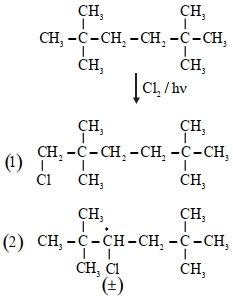
-
- (A) \(A-IV,B-III,C-II,D-I\)
- (B) \(A-III,B-I,C-IV,D-II\)
- (C) \(A-I,B-II,C-III,D-IV\)
- (D) \(A-I,B-III,C-IV,D-II\)
જવાબ અને ઉકેલ જુઓ
સાચો જવાબ: (B)
\(CH _3- CH _2- CH _2- Br + KOH ( Alc ) \rightarrow CH _3-\underset{\text { (Alkene) }}{ CH }= CH _2\)\(CH _3- CH _2- CH _2- Br + KCN ( Alc ) \rightarrow CH _3- CH _2- CH _2- CN\)
\(CH _3- CH _2- CH _2- Br + AgNO _2 \rightarrow CH _3- CH _2- CH _2- COO _2+ AgBr \downarrow\)
\(\left. CH _3- CH _2- CH _2- Br + CH _3- COOAg _2 \rightarrow CH _3- COO - CH _2\right)= CH _2- CH _3+ AgBr \downarrow\)
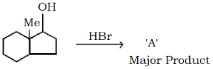
- 66. ઉપરની પ્રક્રિયામાં બનતા કાર્બોકેટાયનને સ્થિર કરવા માટે સંકળાયેલ અતિસંયુગ્મન બંધારણની સંખ્યા \(........\) છે.
 2023 અઘરું
- (A) \(6\)
- (B) \(5\)
- (C) \(4\)
- (D) \(7\)
જવાબ અને ઉકેલ જુઓ
સાચો જવાબ: (A)
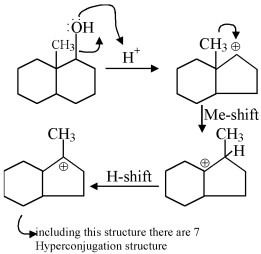
આપેલ પ્રક્રિયા માટે કાર્બોકેટાયન પુનઃરચના (rearrangement) ની ક્રિયાવિધિ નીચે મુજબ છે:
1. પ્રારંભિક કાર્બોકેટાયનનું નિર્માણ: આલ્કોહોલ (\( -\text{OH} \)) સમૂહના પ્રોટોનેશન અને પાણીના અણુ (\( \text{H}_2\text{O} \)) દૂર થવાથી 5-સભ્યવાળી રિંગ પર દ્વિતીયક (\( 2^\circ \)) કાર્બોકેટાયન બને છે.
2. 1,2-મિથાઇલ શિફ્ટ: સ્થિરતા વધારવા માટે, બ્રિજહેડ કાર્બન પર રહેલો મિથાઇલ સમૂહ (\( -\text{CH}_3 \)) નજીકના ધન વીજભારિત કાર્બન પર સ્થાનાંતરિત (1,2-shift) થાય છે. આનાથી બ્રિજહેડ સ્થાન પર ખૂબ જ સ્થિર તૃતીયક (\( 3^\circ \)) કાર્બોકેટાયન બને છે.
આલ્ફા-હાઇડ્રોજન (\( \alpha \)-H) ની ગણતરી:
આ સ્થિર તૃતીયક કાર્બોકેટાયન માટે, ધન વીજભારની નજીકના (\( \alpha \)) સ્થાનો નીચે મુજબ છે:
- 5-સભ્યવાળી રિંગમાં નજીકનો \( \text{-CH}_2- \) સમૂહ: 2 \( \alpha \)-હાઇડ્રોજન ધરાવે છે.
- 6-સભ્યવાળી રિંગમાં નજીકનો \( \text{-CH}_2- \) સમૂહ: 2 \( \alpha \)-હાઇડ્રોજન ધરાવે છે.
- નજીકનો બ્રિજહેડ \( \text{-CH}- \) કાર્બન: 1 \( \alpha \)-હાઇડ્રોજન ધરાવે છે.
કુલ \( \alpha \)-હાઇડ્રોજનની સંખ્યા = \( 2 + 2 + 1 = 5 \).
કુલ હાઇપરકન્જુગેશન બંધારણો:
કુલ હાઇપરકન્જુગેશન બંધારણોની સંખ્યા નીચેના સૂત્ર દ્વારા મેળવી શકાય છે:
કુલ બંધારણો = \( \alpha\text{-હાઇડ્રોજનની સંખ્યા} + 1 \) (મૂળ બંધારણ સાથે).
કુલ બંધારણો = \( 5 + 1 = 6 \).
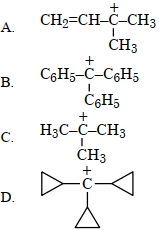
તેથી, વિકલ્પ A સાચો જવાબ છે. - 67. નીચે આપેલા કાર્બોકેટાયનો માટે હાઈડ્રોઈડ આકર્ષણ (બંધુતા)નો ઉતરતો ક્રમ શોધો. નીચે આપેલા વિકલ્પોમાથી સાચો જવાબ પસંદ કરો.
 2023 મધ્યમ
- (A) \(A,C,B,D\)
- (B) \(C,A,B,D\)
- (C) \(C,A,D,B\)
- (D) \(A,C,D,B\)
જવાબ અને ઉકેલ જુઓ
સાચો જવાબ: (B)
Stability order of cations is: \(C < A < B < D\) -
- (A) \(c\)
- (B) \(d\)
- (C) \(b\)
- (D) \(a\)
જવાબ અને ઉકેલ જુઓ
સાચો જવાબ: (A)
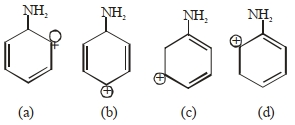
The \(+ M\) effect of \(NH _2\) is stabilizing the carbocation.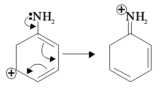
- 69. નીચે આપેલા સંયોજનોને એરોમેટિક ઇલેકટ્રોન અનુરાગી વિસ્થાપન પ્રક્રિયાના વેગના ચઢતાક્રમમાં ગોઠવો.
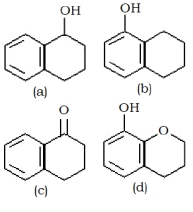 2023 અઘરું
- (A) \(d, b, c, a\)
- (B) \(b, c, a, d\)
- (C) \(c, a, b, d\)
- (D) \(d, b, a, c\)
જવાબ અને ઉકેલ જુઓ
સાચો જવાબ: (C)
Benzene becomes more reactive towards EAS when any substituent raises the electron density.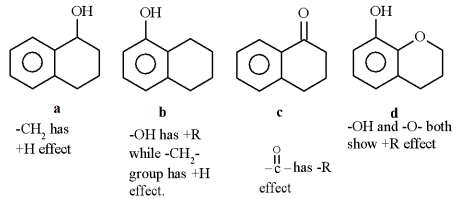
-
- (A) \(A\) ખોટું છે પણ \(R\) સાચું છે.
- (B) બંને \(A\) અને \(R\) સાચા છે અને \(R\) એ \(A\)નું સાચી સમજૂતી છે.
- (C) બંને \(A\) અને \(R\) સાચા છે અને \(R\) એ \(A\)નું સાચી સમજૂતી નથી.
- (D) \(A\) સાચું છે પણ \(R\) ખોટું છે.
જવાબ અને ઉકેલ જુઓ
સાચો જવાબ: (C)
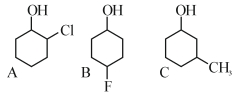
Acidic strength \(\alpha-\) I effect\(\alpha \frac{1}{+ I }\) effect
\(F , Cl\) exerts \(- I\) effect, Methyl exerts \(+ I\) effect, \(C\) is least acidic.
Among \(A\) and \(B\); since inductive effect is distance dependent, Extent of \(- I\) effect is higher in \(A\) followed by \(B\) even though \(F\) is stronger electron withdrawing group than \(Cl\). Thus, \(A\) is more acidic than \(B\).
-
- (A) \(c > b > a > d > e\)
- (B) \(e > d > a > b > c\)
- (C) \(a > d > e > b > c\)
- (D) \(d > a > e > c > b\)
જવાબ અને ઉકેલ જુઓ
સાચો જવાબ: (B)
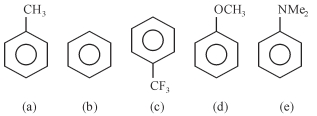
Higher the electron density on Benzene Ring, Higher its Reactivity towards electrophilic substitution Reaction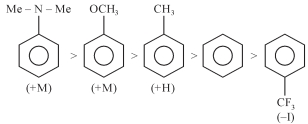
-
- (A) \(C , D , B , A\)
- (B) \(C, A, B, D\)
- (C) \(D, C, A, B\)
- (D) \(D , C , B , A\)
જવાબ અને ઉકેલ જુઓ
સાચો જવાબ: (B)
Based on Theory -
- (A) \(A-I, B-IV, C-II, D-III\)
- (B) \(A-III, B-II, C-I, D-IV\)
- (C) \(A-III, B-II, C-IV, D-I\)
- (D) \(A-III, B-II, C-IV, D-I\)
જવાબ અને ઉકેલ જુઓ
સાચો જવાબ: (D)
Basic Strength \(\alpha \frac{1}{ pK _{ b }}\)Order for \(pK _{ b }: A > B > D > C\)

-
- (A) \(0.02,0.02\)
- (B) \(0.01,0.01\)
- (C) \(0.02,0.01\)
- (D) \(0.01,0.02\)
જવાબ અને ઉકેલ જુઓ
સાચો જવાબ: (B)
\(\begin{array}{l}{\left[ Co \left( NH _3\right)_5 SO _4\right] Br + AgNO _3 \rightarrow AgBr \downarrow} \\ 0.01\, mol \qquad\quad \text { excess } \quad 0.01\,Mol \\ {\left[ Co \left( NH _3\right)_5 Br \right] SO _4+ BaCl _2 \rightarrow BaSO _4 \downarrow} \\ 0.01 mol \qquad\quad \text { excess } \quad 0.01\,Mol \\\end{array}\) -
- (A) \(A < E < D < C < B\)
- (B) \(E < A < D < C < B\)
- (C) \(E < A < B < D < C\)
- (D) \(A < E < C < B < D\)
જવાબ અને ઉકેલ જુઓ
સાચો જવાબ: (B)
\(A\). \(\left[ Fe ( CN )_6\right]^{3-} n =1\)\(B\). \(\left[ FeF _6\right]^{3-} n =5\)
\(C\). \(\left[ CoF _6\right]^{3-} n =4\)
\(D\). \(\left.[\text { Cr(oxalate })_3\right]^{3-} n =3\)
\(E\). \(\left[ Ni ( CO )_4\right] n =0\)
-
- (A) \(4.00\)
- (B) \(3.00\)
- (C) \(6.00\)
- (D) \(5.00\)
જવાબ અને ઉકેલ જુઓ
સાચો જવાબ: (D)
\(\left[ Co \left( NH _3\right)_4 Cl _2\right] Cl \Rightarrow\) Gives \(1\) mole \(AgCl\)\(\left[ Ni \left( H _2 O \right)_6\right] Cl _2 \Rightarrow\) Gives \(2\) moles \(AgCl\)
\(\left[ Pt \left( NH _3\right)_2 Cl _2\right] \Rightarrow\) Gives No \(AgCl\)
\(\left[ Pd \left( NH _3\right)_4\right] Cl _2 \Rightarrow\) Gives \(2\) moles \(AgCl\)
Total number of moles of \(AgCl =5\) mole.
-
- (A) ફકત \(A\) અને \(C\)
- (B) ફકત \(A\) અને \(E\)
- (C) ફકત \(D\) અને \(E\)
- (D) ફકત \(A,C\) અને \(E\)
જવાબ અને ઉકેલ જુઓ
સાચો જવાબ: (A)
\(Mg\) is present in chlorophyll and in black and white photography the developed film is fixed by washing with hypo solution which dissolves the undecomposed \(AgBr\) to form a complex ion \(\left[ Ag \left( S _2 O _3\right)_2\right]^{3-}\) - 78. \(\left[ Co \left( NH _3\right)_5 Cl \right] Cl _2\) માં કોબાલ્ટની પ્રાથમિક અને દ્રીતીય સયોજકતા અનુક્રમે કઈ છે ? 2023 મધ્યમ
- (A) \(3\) અને \(5\)
- (B) \(2\) અને \(6\)
- (C) \(2\) અને \(8\)
- (D) \(3\) અને \(6\)
જવાબ અને ઉકેલ જુઓ
સાચો જવાબ: (D)
\(\left[ Co \left( NH _3\right)_5 Cl \right] Cl _2\)Oxidation number of \(Co\) is \(+3\).
So primary valency is \(3\).
It is an octahedral complex so secondary valency \(6\) or Co-ordination number \(6\).
- 79. \(\left[ Co \left( NH _3\right)_6\right]^{3+}\) સંકીર્ણ માં કોબાલ્ટ આયનનું સંકરણ અને ચુંબકીય વર્તણૂંક અનુક્રમે શોધો. 2023 મધ્યમ
- (A) \(sp ^3 d _3^2\) અને અનુચુંબકીય
- (B) \(d ^2 sp _3^3\) અને પ્રતિચુંબકીય
- (C) \(d ^2 sp _3^3\) અને અનુચુંબકીય
- (D) \(sp ^{3^1} d ^2\) અને પ્રતિચુંબકીય
જવાબ અને ઉકેલ જુઓ
સાચો જવાબ: (C)
\(\left[ Co \left( NH _3\right)_6\right]^{+3}- d ^2 sp ^3\), diamagnetic -
- (A) બન્નેમાં \(6.92\,B.M.\)
- (B) \(4.89\,B.M.\) અને \(6.92\,B.M.\)
- (C) \(3.87\,B.M.\) અને \(1.732\,B.M.\)
- (D) \(5.92\,B.M.\) અને \(1.732\,B.M\)
જવાબ અને ઉકેલ જુઓ
સાચો જવાબ: (D)
\(\left[ Fe \left( H _2 O \right)_6\right]^{3+}\)\(\therefore \text { Unpaired } e ^{-}=5\)
\(\mu=\sqrt{ n ( n +2)}\)
\(=\sqrt{5(5+2)}\)
\(\mu=\sqrt{35}=5.92 \text { B.M. }\)
\({\left[ Fe ( CN )_6\right]^{-3}}\)
Pairing occur due to strong field ligand \(CN ^{-}\)
\(\therefore\) Unpaired \(e^-\) \(\Rightarrow 1\)
\(\mu=\sqrt{ n ( n +2)}\)
\(=\sqrt{1(1+2)}=\sqrt{3}=1.732 \text { B.M. }\)

- 81. એક ધાતુ આયન માટે, ગણતરી કરેલ ચુંબકીય ચાકમાત્રા \(4.90\,BM\) છે.આ ધાતુ આયન \(.......\) અયુગ્મિત ઈલેકટ્રોનોની સંખ્યા ધરાવે છે. 2023 મધ્યમ
- (A) \(6\)
- (B) \(8\)
- (C) \(4\)
- (D) \(5\)
જવાબ અને ઉકેલ જુઓ
સાચો જવાબ: (C)
\(\mu=\sqrt{n(n+2)}\,B M\)\(4.90=\sqrt{n(n+2)}\)
\(n=4\)
-
- (A) \(8\)
- (B) \(4\)
- (C) \(10\)
- (D) \(6\)
જવાબ અને ઉકેલ જુઓ
સાચો જવાબ: (D)
\(\left( NH _4\right)_3 PO _4 \cdot 12 MoO _3\)Let \(X =\) oxidation state of \(Mo\) in \(MoO _3\)
\(X +(-2) \times 3=0\)
\(X =+6\)
- 83. fac-[Co(NH \(\left.\left.NH _3\right)_3 Cl _3\right]\) સંકીર્ણ માં \(Cl - Co - Cl\) બંધ ખૂણા મૂલ્યો શોધો. 2023 મધ્યમ
- (A) \(90^{\circ}\) and \(180^{\circ}\)
- (B) \(90^{\circ}\)
- (C) \(180^{\circ}\)
- (D) \(90^{\circ}\) and \(120^{\circ}\)
જવાબ અને ઉકેલ જુઓ
સાચો જવાબ: (B)
The \(Cl - Co - Cl\) bond angle in above octahedral complex is \(90^{\circ}\)
-
- (A) ફકત \(B\) અને \(D\)
- (B) ફકત \(C\) અને \(D\)
- (C) ફકત \(A\) અને \(B\)
- (D) ફકત \(A\) અને \(C\)
જવાબ અને ઉકેલ જુઓ
સાચો જવાબ: (A)
Cis - Platin is used in chemotherapy to inhibits the growth of tumors. ( \(\operatorname{cis}\left[ Pt \left( NH _3\right)_2 Cl _2\right]\) ) -
- (A) \(481\)
- (B) \(482\)
- (C) \(480\)
- (D) \(483\)
જવાબ અને ઉકેલ જુઓ
સાચો જવાબ: (C)
\(\left( Ti ^{+3}\left( H _2 O \right)_6\right)^{3+}\)\(Ti ^{+3}: 3 d ^1\)
\(C.F.S.E.\) \(=-0.4 \times \Delta_0\)
\(=-\frac{96 \times 10^3}{ N _0}\,J\)
\(\Delta_0=\frac{96 \times 10^3}{0.4 \times 6 \times 10^{23}}\)
\(\frac{ hc }{\lambda}=\frac{96 \times 10^3}{0.4 \times 6 \times 10^{23}}\)
\(\lambda=\frac{0.4 \times 6 \times 10^{23} \times 6.4 \times 10^{-34} \times 3 \times 10^8}{96 \times 10^3}\)
\(=0.48 \times 10^{-6}\,m\)
\(=480 \times 10^{-9}\,m\)
\(=480\,nm\)
-
- (A) \(\left[ Co \left( H _2 O \right)_6\right]^{3+}\)
- (B) \(\left[ Co \left( NH _3\right)_5 Cl \right]^{2+}\)
- (C) \(\left[ Co \left( NH _3\right)_5 NO _2\right]^{2+}\)
- (D) \(\left[ Co \left( NH _3\right)_5 Cl \right]^{+}\)
જવાબ અને ઉકેલ જુઓ
સાચો જવાબ: (C)
\(\left(\left[ Co \left( NH _3\right)_5 NO _2\right]^{2+}\right.\)Two linkage isomers possible \(NO _2 \rightarrow\) Ambidentate ligand
-
- (A) \(CO < en < NH _3 < C _2 O _4^{2-} < S ^{2-}\)
- (B) \(S ^{2-} < C _2 O _4^{2-} < NH _3 < en < CO\)
- (C) \(NH _3 < en < CO < S ^{2-} < C _2 O _4^{2-}\)
- (D) \(S ^{2-} < NH _3 < en < CO < C _2 O _4^{2-}\)
જવાબ અને ઉકેલ જુઓ
સાચો જવાબ: (B)
The increasing order of field strength of ligands (according to spectrochemical series)\(S ^{2-} < C _2 O _4^{2-} < NH _3 < en < CO\)
-
- (A) સ્પેકટ્રોકેમિકલ શ્રેણીઓ નો ક્રમ
- (B) સંક્રાંતિ તત્ત્વ સંકીર્ણો ના ચુંબકીય ગુણધર્મો
- (C) ધાતુ સંકીર્ણોના રંગ
- (D) ધાતુ સંકીર્ણોની સ્થિરતા
જવાબ અને ઉકેલ જુઓ
સાચો જવાબ: (D)
Crystal field theory introduce spectrochemical series based upon the experimental values of \(\Delta\) but can't explain it's order. While other three points are explained by \(CFT\). Specially when the \(CFSE\) increases thermodynamic stability of the complex increases. -
- (A) \(4\)
- (B) \(2\)
- (C) \(6\)
- (D) \(8\)
જવાબ અને ઉકેલ જુઓ
સાચો જવાબ: (B)
\(\mu_{ s }=\sqrt{ n ( n +2)} BM \quad\) (n=no. of unpaired electrons)\(n\) \(V ^{3+}:[ Ar ] 3 d ^2 4 s ^0\) \(2\) \(Cr ^{3+}:[ Ar ] 3 d ^3 4 s ^0\) \(3\) \(Fe ^{2+}:[ Ar ] 3 d ^6 4 s ^0\) \(4\) \(Ni ^{3+}:[ Ar ] 3 d ^7 4 s ^0\) \(5\) \(Cr ^{3+}\) and \(Ni ^{3+}\) have same value of \(\mu_{ s }\)
-
- (A) \(\left[ NiCl _4\right]^{2-}\)
- (B) \(\left[ CoCl _6\right]^{3-}\)
- (C) \(\left[ CoF _6\right]^{3-}\)
- (D) \(\left[ Co \left( NH _3\right)_6\right]^{3+}\)
જવાબ અને ઉકેલ જુઓ
સાચો જવાબ: (D)
(1) Paramagnetic, High Spin and Tetrahedral(2) Paramagnetic, High Spin and Octahedral
(3) Paramagnetic, High Spin and Octahedral
(4) Diamagnetic, Low Spin and Octahedral
\(\left[ Co \left( NH _3\right)_6\right]^{3+}, CN =6(\text { Octahedral })\)
\(NH _3= SFL\)
\(Co ^{+3}=[ Ar ] 3 d ^6\)
Diamagnetic and Low spin complex

- 91. નીચે આપેલા પૈકી કયો સંકીર્ણ,રેખાંશિક સમધટક \((Meridional\,isomer)\)નાં રૂપે મળવાની સંભાવના છે. 2023 મધ્યમ
- (A) \(\left[ Co \left( NH _3\right)_3\left( NO _2\right)_3\right]\)
- (B) \(\left[ Co ( en )_3\right]\)
- (C) \(\left[ Co (\text { en })_2 Cl _2\right]\)
- (D) \(\left[ Pt \left( NH _3\right)_2 Cl _2\right]\)
જવાબ અને ઉકેલ જુઓ
સાચો જવાબ: (A)
\(\left[ MA _3 B _3\right]\) type of compound exists as facial and meridonial isomer.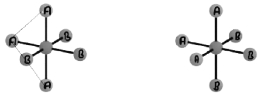
- 92. નીચે આપેલામાંથી કયો સંકીર્ણ આપેલ ચુંબકીય ક્ષેત્ર માં મહત્તમ આકર્ષણ પ્રદર્શિત (દર્શાવવુ) કરશે ? 2023 મધ્યમ
- (A) \(\left[ Zn \left( H _2 O \right)_6\right]^{2+}\)
- (B) \(\left[ Co \left( H _2 O \right)_6\right]^{2+}\)
- (C) \(\left[ Co ( en )_3\right]^{3+}\)
- (D) \(\left[ Ni \left( H _2 O _6\right]^{2+}\right.\)
જવાબ અને ઉકેલ જુઓ
સાચો જવાબ: (B)
Complex with maximum number of unpaired electron will exhibit maximum attraction to an applied magnetic field\({\left[ Zn \left( H _2 O \right)_6\right]^{2+} \rightarrow d ^{10} \text { system } \rightarrow t _{2 g }^6 eg ^4, 0 \text { unpaired } e ^{-}}\)
\({\left[ Co \left( H _2 O \right)_6\right]^{2+} \rightarrow d ^7 \text { system } \rightarrow t _{2 g }^5 eg ^2, 3 \text { unpaired } e ^{-}}\)
\({\left[ Co ( en )_3\right]^{3+} \rightarrow d ^6 \text { system } \rightarrow t _{2 g }^6 eg ^0, 0 \text { unpaired } e ^{-}}\)
\({\left[ Ni \left( H _2 O _6\right]^{2+} \rightarrow d ^8 \text { system } \rightarrow t _{2 g }^6 \text { eg }^2, 2 \text { unpaired } e ^{-}\right.}\)
-
- (A) \(Na _3\left[ CoCl _6\right]\)
- (B) \(\left[ Ni \left( NH _3\right)_6\right] Cl _2\)
- (C) \(K _3\left[ Co ( CN )_6\right]\)
- (D) \(\left[ Co \left( H _2 O \right)_6\right] Cl _2\)
જવાબ અને ઉકેલ જુઓ
સાચો જવાબ: (C)
\(Co ^{+3}= t _2 g ^6 eg ^0\)\(CN ^{-}\)-strong field ligand
All d-electrons should be paired \(\left(\mu_5=0\right)\)
Hence diamagnetic.
-
- (A) \(A\) ખોટું છે પણ \(R\) સાચું છે.
- (B) \(A\) સાચું છે પણ \(R\) ખોટું છે.
- (C) બંને \(A\) અને \(R\) સાચા છે અને \(R\) એ \(A\)નું સાચી સમજૂતી છે.
- (D) બંને \(A\) અને \(R\) સાચા છે અને \(R\) એ \(A\)નું સાચી સમજૂતી નથી.
જવાબ અને ઉકેલ જુઓ
સાચો જવાબ: (A)
Since \(H _2 O\) is strong field ligand compared to chloride and \(Co ^{3+}\) ion is present.\(\therefore\) CFSE is higher for \(\left[ Co \left( NH _3\right)_5 H _2 O \right]^{+3}\), hence it will absorb at lower wavelength.
-
- (A) સીસ \(-\left[ PtCl _2( en )_2\right]^{2+}\)
- (B) ટ્રાન્સ \(-\left[ PtCl _2( en )_2\right]^{2+}\)
- (C) સીસ \(-\left[ PtCl _2\left( NH _3\right)_2\right]\)
- (D) ટ્રાન્સ \(-\left[ Co \left( NH _3\right)_4 Cl _2\right]^{+}\)
જવાબ અને ઉકેલ જુઓ
સાચો જવાબ: (A)
this is chiral complex form
- 96. પ્રતિનીધી (મુખત્યાર) ધાતુ સંકીર્ણ \([M(en)(SCN)_4]\) માં ઉત્મદંતી લિગેન્ડની સંખ્યા \(..........\) છે. \([en =\) ઈથિલીનડાયએમાઈન] 2023 મધ્યમ
- (A) \(6\)
- (B) \(8\)
- (C) \(10\)
- (D) \(4\)
જવાબ અને ઉકેલ જુઓ
સાચો જવાબ: (D)
\(\left[ M ( en )( SCN )_4\right]\)Ambidentate ligand means two ligand site,
so ambidentate ligand is \(SCN\).
- 97. પોટેશિયમ ફેરોસાયનાઇડ માં, \(t_{2 g}\) કક્ષકોના સેટમાં ઇલેકટ્રોન ના યુગ્મો \(........\) છે. 2023 મધ્યમ
- (A) \(4\)
- (B) \(3\)
- (C) \(2\)
- (D) \(1\)
જવાબ અને ઉકેલ જુઓ
સાચો જવાબ: (B)
\(K _4\left[ Fe ( CN )_6\right]\)\(Fe ^{+2}=[ Ar ] 3 d ^6\)
\(CN ^{-}= SFL\)
\(t _{2 g }\) contain \(6\) electron so it become \(3\) pairs:-

- 98. સ્ફટિક ક્ષેત્ર વિપાટન ઊર્જા \(\left(\Delta_0\right)\) ની સૌથી ઊંયી માત્રા સાથેનો સંકીર્ણ છે તે \(.......\) 2023 મધ્યમ
- (A) \(\left[ Cr \left( OH _2\right)_6\right]^{3+}\)
- (B) \(\left[ Ti \left( OH _2\right)_6\right]^{3+}\)
- (C) \(\left[ Fe \left( OH _2\right)_6\right]^{3+}\)
- (D) \(\left[ Mn \left( OH _2\right)_6\right]^{3+}\)
જવાબ અને ઉકેલ જુઓ
સાચો જવાબ: (A)
\(Ti ^{+3}=67\,pm\) radius\(Cr ^{3+}=62\,pm\) radius
\(Mn ^{+3}=65\, pm\) radius
\(Fe ^{+3}=65\, pm\) radius
So, \(Cr ^{3+}\) has highest tendency to attract ligand.
-
- (A) \(2\)
- (B) \(3\)
- (C) \(4\)
- (D) \(1\)
જવાબ અને ઉકેલ જુઓ
સાચો જવાબ: (D)
Spin magnetic moment of \(\left[ Cr ( CN )_6\right]^{3-}\left( t _{2 g }^3 e _{ g }^0\right)\)\(\mu_1=\sqrt{3(3+2)}=\sqrt{15}\,BM\)
Spin magnetic moment of \(\left[ Cr \left( H _2 O \right)_6\right]^{3+}\left( t _{2 g }^3 e _{ g }^0\right)\)
\(\mu_2=\sqrt{3(3+2)}=\sqrt{15}\,BM\)
\(\frac{\mu_1}{\mu_2}=\frac{\sqrt{15}}{\sqrt{15}}=1\)
-
- (A) \(6\)
- (B) \(5\)
- (C) \(7\)
- (D) \(8\)
જવાબ અને ઉકેલ જુઓ
સાચો જવાબ: (C)
\(Co ^{2+}: 3 d ^7 4 s ^0, Cl ^{-}: WFL\)Configuration \(e ^4 t _2^3: m =4\)
Number of unpaired electrons \(=3\)
So, answer \(=7\)


આ પેજ પર આ ફિલ્ટર મુજબ કોઈ પ્રશ્ન નથી.