


JEE Mains 2023 Chemistry ના બધા પ્રશ્નો
25 પ્રકરણ349 માંથી 301–349 પ્રશ્નો
-
- (A) \(620\)
- (B) \(621\)
- (C) \(623\)
- (D) \(624\)
જવાબ અને ઉકેલ જુઓ
સાચો જવાબ: (A)
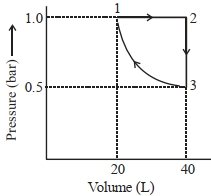
\(1 \rightarrow 2 \Rightarrow \text { Isobaric process }\)\(2 \rightarrow 3 \Rightarrow \text { Isochoric process }\)
\(3 \rightarrow 1 \Rightarrow \text { Isothermal process }\)
\(W = W _{1 \rightarrow 2}+ W _{2 \rightarrow 3}+ W _{3 \rightarrow 1}\)
\(=\left(- P \left( V _2- V _1\right)+0\left[- P _1 V _1 \ln \left(\frac{ V _2}{ V _1}\right)\right]\right)\)
\(=\left[-1 \times(40-20)+0+\left[-1 \times 20 \ln \left(\frac{20}{40}\right)\right]\right]\)
\(=-20+20 \ln 2\)
\(=-20+20 \times 2.3 \times 0.3\)
\(=-6.2 \text { bar } L\)
\(| W |=6.2 \text { bar } 1=620\,J\)
-
- (A) \(1070\)
- (B) \(1060\)
- (C) \(1050\)
- (D) \(1040\)
જવાબ અને ઉકેલ જુઓ
સાચો જવાબ: (A)
\(\Delta S =\frac{\Delta H }{ T _{ mp }}\)\(28.4=\frac{30.4 \times 1000}{ T _{ mp }}\)
\(T _{ mp }=1070.422\,K\)
-
- (A) \(180\)
- (B) \(360\)
- (C) \(90\)
- (D) \(45\)
જવાબ અને ઉકેલ જુઓ
સાચો જવાબ: (B)
\(C _6 H _{12} O _6( s )+6 O _2 \rightarrow 6 CO _2( g )+6 H _2 O ( l )\)Extra energy used to convert \(H _2 O (1)\) into \(H _2 O (1)\) into \(H _2 O ( g )\)
\(=\frac{1800}{2}=900\,kJ\)
\(900= n _{ H _2 O } \times 45\)
\(n _{ H _2 O }=\frac{900}{45}=20\,mole\)
\(W _{ H _2 O }=20 \times 18=360\,g\)
-
- (A) \(6\)
- (B) \(4\)
- (C) \(8\)
- (D) \(2\)
જવાબ અને ઉકેલ જુઓ
સાચો જવાબ: (D)
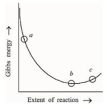
For, Spontaneous process \(dG < 0\)For, Equilibrium \(dG =0\)
For, Nonspontaneous process \(dG > 0\)
\(\therefore\) \(A\) Wrong
\(B\) Correct
\(C\) Correct
\(D\) Wrong
- 305. જ્યારે મિથેન પ્રણાલી \(A\) અને \(B\) માં અનુક્રમે દહન થાય તો શું થાય છે ?
2023 મધ્યમપ્રણાલી \(A\) પ્રણાલી \(B\) સમોષ્મી પ્રણાલી ડાયથર્મીક પાત્ર - (A)
પ્રણાલી \(A\) પ્રણાલી \(B\) સમોષ્મી પ્રણાલી તાપમાન વધે છે. - (B)
પ્રણાલી \(A\) પ્રણાલી \(B\) તાપમાનમાં ઘટાડો ડાયથર્મિક પ્રણાલી - (C)
પ્રણાલી \(A\) પ્રણાલી \(B\) તાપમાનમાં ઘટાડો તાપમાન સરખું રહે છે. - (D)
પ્રણાલી \(A\) પ્રણાલી \(B\) તાપમાન સરખું રહે છે. તાપમાન વધે છે.
જવાબ અને ઉકેલ જુઓ
સાચો જવાબ: (A)
Adiabatic boundary does not allow heat exchange thus heat generated in container can't escape out thereby increasing the temperature.In case of Diathermic container, heat flow can occur to maintain the constant temperature.
- (A)
-
- (A) \(1100\)
- (B) \(1200\)
- (C) \(1000\)
- (D) \(1600\)
જવાબ અને ઉકેલ જુઓ
સાચો જવાબ: (B)
Power of heater \(=60\,W\) \(=60\,J / sec\)Total energy emitted \(=60 \times 100=6000\,J\)
Heat capacity \(\times\) temp difference \(=6000\)
Heat capacity \(=\frac{6000}{5}=1200\,JK ^{-1}\)
-
- (A) \(4\)
- (B) \(8\)
- (C) \(2\)
- (D) \(6\)
જવાબ અને ઉકેલ જુઓ
સાચો જવાબ: (A)
Extensive \(\Rightarrow\) Mole, Volume, Gibbs free energy.Intensive \(\Rightarrow\) Molar mass, Molar heat capacity, Molarity, \(E ^\theta\) cell.
-
- (A) \(3\)
- (B) \(2\)
- (C) \(4\)
- (D) \(1\)
જવાબ અને ઉકેલ જુઓ
સાચો જવાબ: (C)
\(A \rightarrow\) Endothermic (Atomisation)\(B \rightarrow\) Endothermic (Atomisation)
\(C \rightarrow\) Endothermic (Vapourisation)
\(D \rightarrow\) Exothermic (Combustion)
\(E \rightarrow\) Endothermic (Dissolution)
-
- (A) ફક્ત \(C\) અને \(D\)
- (B) ફક્ત \(B\) અને \(C\)
- (C) ફક્ત \(A\) અને \(B\)
- (D) ફક્ત \(B\) અને \(D\)
જવાબ અને ઉકેલ જુઓ
સાચો જવાબ: (B)
Only \((B)\) and \((C)\) are correct.\((B)\) \(G = H - TS\)
At constant \(T\)
\(\Delta G =\Delta H - T \Delta S\)
(A) First law is given by
\(\Delta U = Q + W\)
If we apply constant \(P\) and reversible work
\(\Delta U = Q - P \Delta V\)
(C)By definition of entropy change
\(dS =\frac{ dq _{ rer }}{ T }\)
At constant \(T\)
\(\Delta S=\frac{q_{\text {rev }}}{T}\)
(D) \(H = U + PV\)
For ideal gas
\(H = U + nRT\)
At constant \(T\)
\(\Delta H =\Delta U +\Delta nRT\)
-
- (A) \(6\)
- (B) \(3\)
- (C) \(12\)
- (D) \(9\)
જવાબ અને ઉકેલ જુઓ
સાચો જવાબ: (A)
\(\because \Delta G ^{\circ}=- RT \ln K _{ eq }\)\(\text { and } K _{ eq }=\frac{ K _{ f }}{ K _{ b }}\)
\(\therefore K _{ eq }=\frac{10^3}{10^2}=10\)
\(\therefore \Delta G =- RT \ln 10\)
\(\Rightarrow-(8.3 \times 300 \times 2.3)=-5.7\,kJ\,mole ^{-1} \approx 6\,kJ\)
\(\text { mole }{ }^{-1}(\text { nearest integer) }\)
\(\text { Ans }=6\)
- 311. પ્રમાણિત રિડક્ષન પોટેન્શિયલ \(M ^{+} / M\) કે જે રિડ્યુસીંગ સામર્થ્ય (શક્તિ)નું માપ આપે છે, ના ઉપર નિર્ભર નથી તે \(........\) 2023 મધ્યમ
- (A) આયનીકરણ ઊર્જા
- (B) ઉર્ધ્વપાતન શક્તિ (ઉર્જા)
- (C) જલીયકરણ એન્થાલ્પી
- (D) બંધવિયોજન એન્થાલ્પી
જવાબ અને ઉકેલ જુઓ
સાચો જવાબ: (A)
Factual -
- (A) \(3\)
- (B) \(2\)
- (C) \(5\)
- (D) \(4\)
જવાબ અને ઉકેલ જુઓ
સાચો જવાબ: (D)
\(Fe _2 O _3+2 Al \rightarrow Al _2 O _3+2 Fe\)Molar mass \(160\,g \quad 27\,g\)
\(\left(\Delta H _{ f }^0\right)_{\text {reaction }}=\left[\left(\Delta H _{ f }^0\right)_{ Al _2 O _3}+2\left(\Delta H _{ f }^0\right)_{ Fe }\right]- \left[\left(\Delta H _{ f }^0\right)_{ Fe _2 O _3}+2\left(\Delta H _{ f }^0\right)_{ Al }\right]\)
\(=[-1700+0]-[-840+0]\)
\(=-860\,kJ / mol\)
\(\text { Total mass of mixture }= Fe _2 O _3+ Al (1: 2 \text { molar }\)
\(\text { ratio })\)
\(=160+2 \times 27\)
\(=214\,g / mol\)
\(\text { Heat evolved per gram }=\frac{860}{214}=4\,kJ / g\)
-
- (A) \(NaI < NaBr < NaCl < NaF\)
- (B) \(NaF < NaCl < NaBr < NaI\)
- (C) \(NaCl < NaF < NaBr < NaI\)
- (D) \(NaI < NaBr < NaF < NaCl\)
જવાબ અને ઉકેલ જુઓ
સાચો જવાબ: (A)
For a given metal \(\Delta_{ f } H ^0\) always becomes less negative from fluoride to iodide. - 314. \(Be ( OH )_2\) ની \(Sr ( OH )_2\) સાથે પ્રક્રિયા કરતાં નીપજ એક આયનીક ક્ષાર છે. નીચે આપેલામાંથી આ પ્રક્રિયાને સંબંધિત ખોટો વિકલ્પ પસંદ કરો. 2023 મધ્યમ
- (A) \(Be\) એ આયનીક ક્ષારમાં સમચતુષ્ફલકીય રીતે સંવર્ગ પામેલ છે.
- (B) આ પ્રક્રિયા એ એસિડ-બેઈઝ તટસ્થીકરણ પ્રક્રિયાનું એક ઉદાહરણ છે.
- (C) બંંને \(Sr\) અને \(Be\) તત્વો આયનીક ક્ષારમાં હાજર છે.
- (D) તત્વ \(Be\) એ આયનીક ક્ષારના કેટાયનિક ભાગમાં હાજર છે.
જવાબ અને ઉકેલ જુઓ
સાચો જવાબ: (D)
\(Be ( OH )_2\) is amphoteric in nature.\(Sr ( OH )_2\) is basic in nature.
These two undergo acid - base reaction to form a salt.
\(Be ( OH )_2+ Sr ( OH )_2 \rightarrow Sr \left[ Be ( OH )_4\right]\)
(salt)
-
- (A) \(Si - Si > C - C > Sn - Sn > Ge - Ge\)
- (B) \(Si - Si > C - C > Ge - Ge > Sn - Sn\)
- (C) \(C - C > Si - Si > Sn - Sn > Ge - Ge\)
- (D) \(C - C > Si - Si > Ge - Ge > Sn - Sn\)
જવાબ અને ઉકેલ જુઓ
સાચો જવાબ: (D)
(Bond enthalpy order \(C - C > Si - Si > Ge - Ge > Sn - Sn )\) -
- (A) તે ઈલેકટ્રોનિક બિનસ્થાનીકૃત ધરાવે છે.
- (B) તે બનાના બંધ (banana bond) ધરાવે છે.
- (C) તે પાણી સાથે પ્રક્રિયા કરી શકે છે.
- (D) તે ચક્રિય સંયોજન છે.
જવાબ અને ઉકેલ જુઓ
સાચો જવાબ: (C)
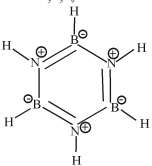
Borazine is \(B _3 N _3 H _8\)\(B _8 N _3 H _6+9 H _2 O \rightarrow 3 NH _3+3 H _8 BO _3+3 H _2\)
-
- (A) \(BBr _3 > BI _3 > BCI _3 > BF _3\)
- (B) \(BCl _3 > BF _3 > BBr _3 > BI _3\)
- (C) \(BF _3 > BCl _3 > BBr _3 > BI _3\)
- (D) \(BI _3 > BBr _3 > BCl _3 > BF _3\)
જવાબ અને ઉકેલ જુઓ
સાચો જવાબ: (D)
Extent of back bonding, reduces down the group leading to more Lewis acidic strength \(BF _3 > BCl _3 > BBr _3 > BI _3\) (extent of back bonding) \((2 p-2 p)(2 p-3 p)(2 p-4 p)(2 p-5 p)\)\(BF _3 < BCl _3 < BBr _3 < BI _3\) (lewis acidic nature)
- 318. \(CuSo_4\) સાથેની બોરેકસ મણકા કસોટી દરમ્યાન, ઓકિસડાઈઝિંગ જ્યોત માં વાદળી લીલા રંગનો મણકો નીચેના ના બનવાને કારણે જોવા મળે છે. તે શોધો. 2023 અઘરું
- (A) \(Cu _3 B _2\)
- (B) \(Cu\)
- (C) \(Cu \left( BO _2\right)_2\)
- (D) \(CuO\)
જવાબ અને ઉકેલ જુઓ
સાચો જવાબ: (C)
Blue green colour is due to formation of \(Cu \left( BO _2\right)_2\)\(CuSO _4 \stackrel{\Delta}{\longrightarrow} CuO + SO _3\)
\(CuO + B _2 O _3 \rightarrow Cu \left( BO _2\right)_2\)
- 319. એક સારી ગુણવત્તાવાળા સિમેન્ટ માટે, સિલિકા થી એલ્યુમીનાની ગુણોત્તર મળી આવે છે તે \(........\) 2023 અઘરું
- (A) \(3\)
- (B) \(4.5\)
- (C) \(2\)
- (D) \(1.5\)
જવાબ અને ઉકેલ જુઓ
સાચો જવાબ: (A)
For good quality cement, the ratio of silica \(\left( SlO _2\right)\) to Alumina \(\left( Al _2 O _3\right)\) should be between \(2.5\) to \(4\). -
- (A) \(Ga\) એ \(Al\) કરતાં વધારે વિદ્યુતઋણ ઋણમય છે અને તે \(GaAlCl _4\) ક્ષારના કેટાયનિક ભાગ તરીકે હાજર છે.
- (B) \(GaAlCl _4\) ક્ષારમાં \(Ga\) નો ઓકિસડેશન અવસ્થા \(+3\) છે.
- (C) \(GaAlCl _4\) માં \(Cl\) એ \(Al\) અને \(Ga\) એમ બંને સાથે બંધ બનાવે છે.
- (D) \(GaAlCl _4\) માં \(Ga\) એ \(Cl\) સાથે સંવર્ગીત છે.
જવાબ અને ઉકેલ જુઓ
સાચો જવાબ: (A)
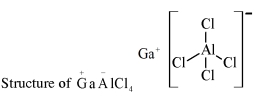
Gallous tetrachloro aluminate \(Ga ^{+} AlCl _4^{-}\)\(2 Ga + Ga ^{+} GaCl _4^{-}+2 Al _2 Cl _6 \stackrel{190^{\circ}}{\longrightarrow} 4 Ga ^{+} AlCl _4^{-}\)
Ga is cationic part of salt \(GaAlCl _4\).
-
- (A) બંને \(A\) અને \(R\) સાચાં છે પણ \(R\) સાચું નથી \(A\) ની સાચી સમજૂતી આપતું નથી.
- (B) \(A\) અને\(R\) બંને સાચા છે અને\(R\) એ \(A\) ની સાચી સમજૂતી છે.
- (C) \(A\) સાચું નથી પણ \(R\) સાચું છે.
- (D) \(A\) સાચું છે પણ \(R\) સાચું નથી.
જવાબ અને ઉકેલ જુઓ
સાચો જવાબ: (B)
The oxide which form acid on dissolving in water is acidic oxide. -
- (A) બોરિક એસિડમાં પ્રબળ આયનિક બંધ
- (B) બોરિક એસિડમાં પ્રબળ વાન્ડર વાલ્ફપાસ્પરિક ક્રિયા
- (C) બોરિક એસિડમાં પ્રબળ હાઈડ્રોજન બંધ
- (D) Strong covalent bond in \(BF _3\)
જવાબ અને ઉકેલ જુઓ
સાચો જવાબ: (C)
Boric acid has strong hydrogen bonding while \(BF _3\) does not. Therefore boric acid is solid. -
- (A) વિધાન \(I\) ખોટું છે. પરંતુ વિધાન \(II\) સાચું છે.
- (B) બંને વિધાન \(I\) અને વિધાન \(II\) સાચાં છે.
- (C) વિધાન \(I\) સાચું છે.પરંતુ વિધાન \(II\) ખોટું છે.
- (D) બંને વિધાન \(I\) અને વિધાન \(II\) ખોટા છે.
જવાબ અને ઉકેલ જુઓ
સાચો જવાબ: (B)
Boron is non- metallic in nature. It is extremely hard and black coloured solid. It exists in many allotropic forms. Due to very strong crystalline lattice, boron has unusually high melting point and boiling point.Element \(B\) \(Al\) \(Ga\) \(In\) \(TI\) Melting point \(2453\) \(933\) \(303\) \(430\) \(576\) Boiling point \(3923\) \(2740\) \(2676\) \(2353\) \(1730\) -
- (A) બંને વિધાન\(-I\) અને વિધાન\(-II\) સાચા છે
- (B) વિધાન\(-I\) ખોટું છે, પરંતુ વિધાન\(-II\) સાચું છે.
- (C) બંને વિધાન\(-I\) અને વિધાન\(-II\) ખોટા છે
- (D) વિધાન\(-I\) સાચું છે, પરંતુ વિધાન\(-II\) ખોટું છે
જવાબ અને ઉકેલ જુઓ
સાચો જવાબ: (D)
Statement- \(I\) is correct.\(Ni\) is used in Hydrogenation of unsaturated fat to make edible fats.
Statements\(-II\) is false as hydride of Silicon is electron precise and neither electron deficient nor electron rich.
-
- (A) બંને વિધાન \(I\) અને વિધાન \(II\) સાચા છે.
- (B) વિધાન \(I\) સાચું છે.પણ વિધાન \(II\) ખોટું છે.
- (C) બંને વિધાન \(I\) અને વિધાન \(II\) ખોટા છે.
- (D) બંને વિધાન \(I\) અને વિધાન \(II\) સાચાં છે.
જવાબ અને ઉકેલ જુઓ
સાચો જવાબ: (C)
(Borax Bead Test)On treatment with metal salt, boric anhydride forms metaborate of the metal which gives different colours in oxidising and reducing flame.
For example, in the case of copper sulphate, following reactions occur.
\(CuSO _4+ B _2 O _3 \longrightarrow Cu \left( BO _2\right)_2+ SO _3\)
Two reactions may take place in reducing flame (Luminous flame)
\((i)\) The blue-green \(Cu \left( BO _2\right)_2\) is reduced to colourless cuprous metaborate as :
\(2 Cu ( BO _2 )_2+2 NaBO _2+ C \underset{\text { flame }}{\stackrel{\text { Luminous }}{\longrightarrow}} 2 CuBO _2+\) \( Na _2 B _4 O _7+ CO\)
\((ii)\) Cupric metaborate may be reduced to metallic copper and bead appears red opaque.
\(2 Cu \left( BO _2\right)_2+4 NaBO _2+2 C \underset{\text { fuminous }}{\stackrel{\text { flame }}{\longrightarrow}} 2 Cu +\) \(2 Na _2 B _4 O _7+2 CO\)
-
- (A) વિધાન\(-I\) ખોટું છે, પરંતુ વિધાન\(-II\) સાચું છે
- (B) બંને વિધાન\(-I\) અને વિધાન\(-II\) સાચાં છે
- (C) વિધાન\(-I\) સાચું છે પરંતુ વિધાન\(-II\) ખોટું છે.
- (D) બંને વિધાન\(-I\) અને વિધાન\(-II\) ખોટા છે.
જવાબ અને ઉકેલ જુઓ
સાચો જવાબ: (B)
The first ionization energies (as in NCERT) are as follows:\(B\) : \(801\,kJ / mol\)
\(Al : 577\,kJ / mol\)
Ga : \(579\,kJ / mol\)
\(Ga :[ Ar ] 3 d ^{10} 4 s ^2 4 p ^1\)
-
- (A) \(A-IV, B-I, C-II, D-III\)
- (B) \(A-IV, B-III, C-I, D-II\)
- (C) \(A-II, B-III, C-IV, D-I\)
- (D) \(A-IV, B-III, C-II, D-I\)
જવાબ અને ઉકેલ જુઓ
સાચો જવાબ: (D)
Cobalt catalyst \(\rightarrow\) Methanol productionSyn gas \(\rightarrow\) Coal gasification
\(\left( C _{\text {(Redhot coke) }}+ H _2 O ( g ) \rightarrow CO + H _2\right)\)
Nickel catalyst \(\rightarrow\) Water gas production
Brine solution \(\rightarrow\) Production
(aq. \(NaCl ) \quad\left(\begin{array}{l} H _2 \rightarrow \text { Cathode } \\ Cl _2 \rightarrow \text { anode }\end{array}\right)\)
-
- (A) \(2\)
- (B) \(3\)
- (C) \(1\)
- (D) \(4\)
જવાબ અને ઉકેલ જુઓ
સાચો જવાબ: (C)
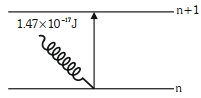
\(\Delta E = R _{ H } Z ^2\left(\frac{1}{ n _1^2}-\frac{1}{ n _2^2}\right)\)\(1.47 \times 10^{-17}=2.18 \times 10^{-15} \times 9\left(\frac{1}{n^2}-\frac{1}{(n+1)^2}\right)\)
\(\frac{1.47}{1.96}=\frac{3}{4}=\frac{1}{n^2}-\frac{1}{(n+1)^2}\)
So, \(n =1\)
-
- (A) \(796\)
- (B) \(798\)
- (C) \(797\)
- (D) \(785\)
જવાબ અને ઉકેલ જુઓ
સાચો જવાબ: (B)
For one photon \(E = hv\)For one mole photon,
\(E=6 \cdot 023 \times 10^{23} \times 6.626 \times 10^{-34} \times 2 \times 10^{12}\)
-
- (A) \(r_0=a_0\)
- (B) \(r_0=4 a_0\)
- (C) \(r _0=\frac{ a _0}{2}\)
- (D) \(r_0=2 a_0\)
જવાબ અને ઉકેલ જુઓ
સાચો જવાબ: (D)
At node \(\Psi_{2 s }=0\)\(\therefore 2-\frac{ r _0}{ a _0}=0\)
\(\therefore r _0=2 a _0\)
- 331. \(3s\) કક્ષક માં એક ઈલેકટ્રોન નું કક્ષકીય કોણીય વેગમાન \(\frac{x h}{2 \pi}\) છે.તો \(x\) નું મુલ્ય \(.......\) છે. 2023 સરળ
- (A) \(1\)
- (B) \(2\)
- (C) \(3\)
- (D) \(0\)
જવાબ અને ઉકેલ જુઓ
સાચો જવાબ: (D)
\(l\) for \(3s\) orbital is \(0\).
Orbital angular momentum \(=\) \(\sqrt{l(l+1)} \frac{h}{2\pi}\)
\(= \sqrt{0(0+1)} \frac{h}{2\pi} = 0\)
Given \(=\) \(\frac{x h}{2 \pi}\)
\(x = 0\)
-
- (A) \(6\)
- (B) \(5\)
- (C) \(4\)
- (D) \(7\)
જવાબ અને ઉકેલ જુઓ
સાચો જવાબ: (D)
\(\lambda_{ d }=\frac{ h }{ mv }=\frac{ h }{\sqrt{2 mKE }}=\frac{6.6 \times 10^{-34}}{\sqrt{2 \times 9 \times 10^{-31} \times 4.5 \times 10^{-29}}}\)\(=\frac{6.6 \times 10^{-34}}{\sqrt{9^2 \times 10^{-60}}}\)
\(=\frac{6.6 \times 10^{-34}}{9 \times 10^{-30}}=\frac{6.6}{9} \times 10^{-4}\)
\(=7.3 \times 10^{-5}\,m\)
\(\text { Therefore Ans }=7\)
-
- (A) \(2\)
- (B) \(3\)
- (C) \(1\)
- (D) \(4\)
જવાબ અને ઉકેલ જુઓ
સાચો જવાબ: (A)
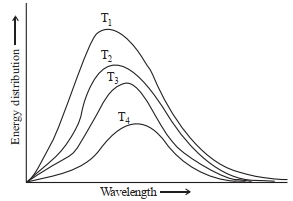
The spectrum of Black body radiation is explained using quantization of energy. With increase in temperature, peak of spectrum shifts to shorter wavelength or higher frequency. For above graph\(\rightarrow T _1 > T _2 > T _3 > T _4 \text {. }\)
- 334. એક આયન \(55\) પ્રોટોન સાથે તેની એકધનાત્મક અવસ્થા માં હાજર \(s-\)ઈલેકટ્રોનોની સંખ્યા શોધો. 2023 અઘરું
- (A) \(8\)
- (B) \(9\)
- (C) \(12\)
- (D) \(10\)
જવાબ અને ઉકેલ જુઓ
સાચો જવાબ: (D)
\(Z =55[ Cs ] \Rightarrow[ Xe ] 6 s ^1\)\(\left[ Cs ^{+}\right] \Rightarrow[ Xe ]\) i.e. upto \(5 s\) count \(e ^{-}\)of s-subshell i.e. \(1 s , 2 s , 3 s , 4 s , 5 s \Rightarrow 10\) electrons
- 335. હાઈડ્રોજન પરમાણુની પ્રથમ બ્હોર કક્ષામાં એક ઇલેકટ્રોનની ઊર્જા \(-2.18 \times 10^{-18}\,J\) છે.તો તેની તૃતીય બ્હોર કક્ષામાં ઊર્જા શોધો 2023 મધ્યમ
- (A) આ મૂલ્યનું \(\frac{1}{27}\)
- (B) આ મૂલ્યનું એક તૃતિયાંશ
- (C) આ મૂલયનું ત્રણ ગણું
- (D) આ મૂલ્યનું એક નવમાંશ \(\left(\frac{1}{9} t h\right)\)
જવાબ અને ઉકેલ જુઓ
સાચો જવાબ: (D)
\(E _{ n }=\frac{-2.18 \times 10^{-18} Z ^2}{ n ^2}\)\(\text { i.e. } E _{ n } \propto \frac{1}{ n ^2}\)
- 336. હાઈડ્રોજન વર્ણપટમાં કઈ સંક્રાંતિએ \(He { }^{+}\)વર્ણપટમાં બામર પ્રકારની સંક્રાંતિમાં \(n =4\) માંથી \(n =2\) જેવી જ સમાન તરંગલંબાઈ ધરાવતી હશે ? 2023 મધ્યમ
- (A) \(n =2\) થી \(n =1\)
- (B) \(n =1\) થી \(n =3\)
- (C) \(n =1\) થી \(n =2\)
- (D) \(n =3\) થી \(n =4\)
જવાબ અને ઉકેલ જુઓ
સાચો જવાબ: (A)
\(He ^{+}\)ion :\(\frac{1}{\lambda( H )}= R (1)^2\left[\frac{1}{ n _1^2}-\frac{1}{ n _2^2}\right]\)
\(\frac{1}{\lambda\left( He ^{+}\right)}= R (2)^2\left[\frac{1}{2^2}-\frac{1}{4^2}\right]\)
Given \(\lambda( H )=\lambda\left( He ^{+}\right)\)
\(R (1)^2\left[\frac{1}{ n _1^2}-\frac{1}{ n _2^2}\right]= R (4)\left[\frac{1}{2^2}-\frac{1}{4^2}\right]\)
\(\frac{1}{ n _1^2}-\frac{1}{ n _2^2}=\frac{1}{1^2}-\frac{1}{2^2}\)
On comparing \(n _1=1\) and \(n _2=2\)
- 337. લાયમન શ્રેણીઓમાં હાઈડ્રોજન પરમાણુની સૌથી નાનામાં નાની તરંગલંબાઈ \(\lambda\) છે.\(He^+\) ની બામર શ્રેણીઆમમાં સૌથી લાંબામાં લાબી તરંગલંબાઈ શું છે? 2023 અઘરું
- (A) \(\frac{5}{9 \lambda}\)
- (B) \(\frac{9 \lambda}{5}\)
- (C) \(\frac{36 \lambda}{5}\)
- (D) \(\frac{5 \lambda}{9}\)
જવાબ અને ઉકેલ જુઓ
સાચો જવાબ: (B)
For \(H : \frac{1}{\lambda}= R _{ H } \times 1^2\left(\frac{1}{1^2}-\frac{1}{\infty^2}\right)\)\(\frac{1}{\lambda_{ He ^{+}}}= R _{ H } \times 2^2 \times\left(\frac{1}{4}-\frac{1}{9}\right)\)
From \((1)\) and \((2)\) \(\frac{\lambda_{ He ^{+}}}{\lambda}=\frac{9}{5}\)
\(\lambda_{ He ^{+}}=\lambda \times \frac{9}{5}\)
\(\lambda_{ He ^{+}}=\frac{9 \lambda}{5}\)
- 338. \(Li ^{2+}\) ની \(2^{\text {nd }}\) કક્ષાની ત્રિજ્યા \(x\) છે. \(Be ^{3+}\) ની \(3^{\text {rd }}\) કક્ષાની એપેક્ષિત ત્રિજ્યા શોધો. 2023 અઘરું
- (A) \(\frac{9}{4} x\)
- (B) \(\frac{4}{9} x\)
- (C) \(\frac{27}{16} x\)
- (D) \(\frac{16}{27} x\)
જવાબ અને ઉકેલ જુઓ
સાચો જવાબ: (C)
\(Li ^{2+}\)\(r _2= x = k \times \frac{2^2}{3}=\frac{4 k }{2}\)
\(Be ^{3+}\)
\(r _3= y = k \times \frac{3^2}{4}\)
\(\frac{y}{x}=\frac{9}{4} \times \frac{3}{4}=\frac{27}{16}\)
\(y=\frac{27}{16} x\)
-
- (A) \(16\)
- (B) \(32\)
- (C) \(50\)
- (D) \(72\)
જવાબ અને ઉકેલ જુઓ
સાચો જવાબ: (B)
The number of electrons in the orbitals of sub-shell of \(n=4\) are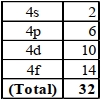
-
- (A) \(Ci ^{+}, Na ^{+}, Mg ^{2+}, Ca ^{2+}\)
- (B) \(\left. Ba ^{2+}, Sr ^{2+}, K +, Ca ^{2+}\right.\)
- (C) \(\left. N ^{3-}, O ^{2-}, F , S ^{2-}\right.\)
- (D) \(\left. K ^{+}, Cl ^{-}, Ca ^{2+}, Sc ^{3+}\right.\)
જવાબ અને ઉકેલ જુઓ
સાચો જવાબ: (D)
\(K ^{+} Cl ^1 Ca ^{2+} Sc ^{3+}\)\(\begin{array}{llll}18 & 18 & 18 & 18\end{array}\)
-
- (A) \(B > D > C > A\)
- (B) \(D > B > C > A\)
- (C) \(A > C > B > D\)
- (D) \(D > B > A > C\)
જવાબ અને ઉકેલ જુઓ
સાચો જવાબ: (B)
\((A)\) \(n =3 ; 1=0 ; m =0 ; 3 s\) orbital\((B)\) \(n =4 ; 1=0 ; m =0 ; 4 s\) orbital
\((C)\) \(n =3 ; 1=1 ; m =0 ; 3 p\) orbital
\((D)\) \(n =3 ; 1=2 ; m =0 ; 3 d\) orbital
As per Hund's rule energy is given by \(( n +l)\) value.
If value of \(( n +l)\) remains same then energy is given by \(n\) only.
- 342. નીચે આપેલ સેટ માંથી સમઈલેકટ્રોનીય સ્પીસીઝોની કુલ સંખ્યા \(......\) છે. \(O ^{2-}, F ^{-}, Al , Mg ^{2+}, Na ^{+}, O ^{+}, Mg , Al ^{3+}, F\) 2023 મધ્યમ
- (A) \(5\)
- (B) \(4\)
- (C) \(3\)
- (D) \(2\)
જવાબ અને ઉકેલ જુઓ
સાચો જવાબ: (A)
Isoelectronic species \(O ^{2 \Theta}, F ^{\Theta}, Mg ^{2+}, Na ^{\oplus}, Al ^{3+}\) -
- (A) \(2\)
- (B) \(1\)
- (C) \(3\)
- (D) \(0\)
જવાબ અને ઉકેલ જુઓ
સાચો જવાબ: (B)
(A) This statement is correct. Line emission spectra (or atomic emission spectra) are indeed used to study the electronic structure of atoms. These spectra are produced when photons are emitted from atoms as excited electrons return to a lower energy level. Each line corresponds to a particular quantum leap between energy levels. (B) This statement is incorrect. The emission spectra of atoms in the gas phase do not show a continuous spread of wavelength from red to violet. Instead, they show distinct lines corresponding to specific electron transitions, hence they are known as line emission spectra. (C) This statement is correct. An absorption spectrum is like the photographic negative of an emission spectrum. In an absorption spectrum, light passes through a cold, dilute gas and atoms in the gas absorb at characteristic frequencies; since the re-emitted light is unlikely to be emitted in the same direction as the absorbed photon, this gives rise to dark lines (absence of light) in the spectrum. (D) This statement is correct. The element helium was indeed discovered in the sun through spectroscopy before it was found on Earth. The name helium comes from Helios, the Greek name for the sun. So, the number of incorrect statements is 1. - 344. નીચે આપેલામાંથી \(5\) ત્રિજ્યાકીય (રેડીઅલ) નોડસ ધરાવતા પરમાણ્વીય કક્ષકોની સંખ્યા \(......\) છે.\(7 s , 7 p , 6 s , 8 p , 8 d\) 2023 મધ્યમ
- (A) \(3\)
- (B) \(2\)
- (C) \(1\)
- (D) \(4\)
જવાબ અને ઉકેલ જુઓ
સાચો જવાબ: (A)
Radial node \(= n -\ell-1\)\(7 s \Rightarrow R \cdot N =7-0-1=6\)
\(7 p \Rightarrow R \cdot N =7-1-1=5\)
\(6 s \Rightarrow R \cdot N =6-0-1=5\)
\(8 p \Rightarrow R \cdot N =8-1-1=6\)
\(8 d \Rightarrow R \cdot N =8-2-1=5\)
So, Answer is \(3\)
-
- (A) \(1\)
- (B) \(0\)
- (C) \(2\)
- (D) \(3\)
જવાબ અને ઉકેલ જુઓ
સાચો જવાબ: (B)
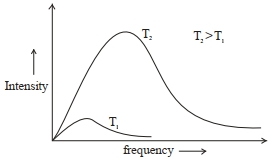
A blackbody can emit and absorb all the wavelengths in electromagnetic spectrum \(\Rightarrow(A)\) is correct\(\Rightarrow(B),(C),(D)\) correct
-
- (A) \(3\)
- (B) \(4\)
- (C) \(2\)
- (D) \(5\)
જવાબ અને ઉકેલ જુઓ
સાચો જવાબ: (A)
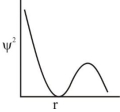
\(A, D\) and \(E\) statements are correct.For \(2 s\) orbital, the probability density first decreases and then increases.
At any distance from nucleus the probability density of finding electron is never zero and it always have some finite value.
-
- (A) બંને \(A\) અને \(R\) સાચા છે અને \(R\) એ \(A\)નું સાચી સમજૂતી નથી.
- (B) બંને \(A\) અને \(R\) સાચા છે અને \(R\) એ \(A\)નું સાચી સમજૂતી છે.
- (C) \(A\) ખોટું છે પણ \(R\) સાચું છે.
- (D) \(A\) સાચું છે પણ \(R\) ખોટું છે.
જવાબ અને ઉકેલ જુઓ
સાચો જવાબ: (B)
\(5 f\) orbital not buried as \(4 f\) orbitals so \(e ^{-}\) present in \(5 f\) orbital experience less nuclear attraction than \(e ^{-}\)present in \(4 f\) orbital. Hence electrons of 5 f orbital can take part in bonding to a far greater extent. -
- (A) બંને \(A\) અને \(R\) સાચા છે અને \(R\) એ \(A\)નું સાચી સમજૂતી નથી.
- (B) \(A\) સાચું છે પણ \(R\) ખોટું છે.
- (C) બંને \(A\) અને \(R\) સાચા છે અને \(R\) એ \(A\)નું સાચી સમજૂતી છે.
- (D) \(A\) ખોટું છે પણ \(R\) સાચું છે.
જવાબ અને ઉકેલ જુઓ
સાચો જવાબ: (B)
There is a characteristic minimum frequency, or "threshold frequency," for each metal below which the photoelectric effect is not seen. The ejected electrons leave with a specific amount of kinetic energy at a frequency \(v > v _0\) with an increase in light frequency of these electron kinetic energies also rise. -
- (A) બંને વિધાન \(I\) અને વિધાન \(II\) સાચાં છે.
- (B) વિધાન \(I\) સાચું છે.પરંતુ વિધાન \(II\) ખોટું છે.
- (C) વિધાન \(I\) ખોટું છે. પરંતુ વિધાન \(II\) સાચું છે.
- (D) બંને વિધાન \(I\) અને વિધાન \(II\) ખોટા છે.
જવાબ અને ઉકેલ જુઓ
સાચો જવાબ: (A)
According to Bohr's model the angular momentum is quantised and equal to \(\frac{ nh }{2 \pi}\).Heisenberg uncertainty principle explains orbital concept, which is based on probability of finding electron.
આ પેજ પર આ ફિલ્ટર મુજબ કોઈ પ્રશ્ન નથી.