


All JEE Mains 2023 Chemistry questions
25 chaptersShowing 51–100 of 366 questions
-
- (A) \(487\)
- (B) \(430\)
- (C) \(438\)
- (D) \(458\)
Show answer and solution
Correct Answer: (D)
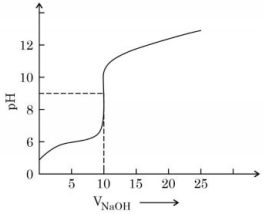
\(CH _3 COOH + NaOH \rightarrow CH _3 COONa + H _2 O\)\(pH = pKa +\log _{10} \frac{[ salt ]}{[\text { acid }]}\)
\(pH =4.76+\log _{10} \frac{2}{3}\)
\(pH =4.58=458 \times 10^{-2}\)
-
- (A) \(2\)
- (B) \(3\)
- (C) \(5\)
- (D) \(4\)
Show answer and solution
Correct Answer: (C)
\({\left[ Ba ^{+2}\right]=\frac{25 \times 0.05}{50}=0.025 M }\)\({\left[ F ^{-}\right]=\frac{25 \times 0.02}{50}=0.01 M }\)
\({\left[ Ba ^{+2}\right]\left[ F ^{-}\right]^2=25 \times 10^{-7}}\)
\(K _{ sp }=5 \times 10^{-7} \text { (given) }\)
\(\text { Ratio }=\frac{\left[ Ba ^{+2}\right]\left[ F ^{-}\right]^2}{ K _{ sp }}=5\)
-
- (A) \(185\)
- (B) \(186\)
- (C) \(184\)
- (D) \(183\)
Show answer and solution
Correct Answer: (B)
Total milimoles of \(H ^{+}=(600 \times 0.01)+(400 \times 0.01 \times 2)\)\(=14\)
\(\left[ H ^{+}\right]=\frac{14}{1000}=14 \times 10^{-3}\)
\(pH =3-\log 14\)
\(=1.86\)
\(=186 \times 10^{-2}\)
-
- (A) \(9080\)
- (B) \(9079\)
- (C) \(9081\)
- (D) \(9082\)
Show answer and solution
Correct Answer: (B)
In resultant solution\(n _{ NH _3}=0.1-0.02=0.08\)
\(n _{ NH _4 Cl }= n _{ NH _4^{+}}=0.1+0.02=0.12\)
\(pOH = pK _{ b }+\log \frac{\left[ NH _4^{+}\right]}{\left[ NH _3\right]}\)
\(=4.745+\log \frac{0.12}{0.08}\)
\(=4.745+\log \frac{3}{2}\)
\(=4.745+0.477-0.301\)
\(pOH =4.921\)
\(pH =14- pH\)
\(=9.079\)
-
- (A) \(8000\)
- (B) \(9000\)
- (C) \(7000\)
- (D) \(6000\)
Show answer and solution
Correct Answer: (B)
\(\left(M_1 \times V_1\right)=\left(M_2 \times V_2\right)\)\(V _2=10\,L\)
\(\text { Water added }=10-1\)
\(=9 \text { Litre }\)
\(=9000\,mL\)
-
- (A) \(9\)
- (B) \(8\)
- (C) \(10\)
- (D) \(7\)
Show answer and solution
Correct Answer: (C)
\(AgCl ( s ) \rightarrow Ag _{ S }^{+} \text {(aq.) }+ Cl ^{-} \text {(aq.) }\)\(K _{ sp }= S ^2=\left(\frac{1.43}{143.4} \times 10^{-3}\right)^2=10^{-10}\)
\(-\log K _{ sp }=10\)
-
- (A) \(\left(\frac{ K _{ eq }}{108 c ^4}\right)^{\frac{1}{5}}\)
- (B) \(\left(\frac{ K _{ eq }}{6 c ^5}\right)^{\frac{1}{5}}\)
- (C) \(\left(\frac{K_{e q}}{5 c^4}\right)^{\frac{1}{5}}\)
- (D) \(\left(\frac{ K _{ eq }}{25 c ^2}\right)^{\frac{1}{5}}\)
Show answer and solution
Correct Answer: (A)
\(A _2 B _3 \text { (aq.) } \rightleftharpoons 2 A _{\text {(aq.) }}^{3+}+3 B _{\text {(aq) }}^{2-}\)\(K _{ eq }=\frac{\left[ A ^{3+}\right]^2\left[ B ^{2-}\right]^3}{\left[ A _2 B _3\right]}=\frac{4 c ^2 \alpha^2 \times 27 c ^3 \alpha^3}{ c (1-\alpha)}\)
\(K _{ eq }=\frac{108 c ^5 \alpha^5}{ c } \alpha=\left(\frac{ K _{ eq }}{108 c ^4}\right)^{\frac{1}{5}}\)
-
- (A) \(KHg _2 I _2\)
- (B) \(KHgI _3\)
- (C) \(K _2 Hg _4\)
- (D) \(HgI _2\)
Show answer and solution
Correct Answer: (C)
Nessler's reagent is \(K _2 HgI _4\). -
- (A) Statement \(I\) is correct but Statement \(II\) is incorrect.
- (B) Statement \(I\) is incorrect but statement \(II\) is correct.
- (C) Both Statement \(I\) and Statement \(II\) are incorrect.
- (D) Both statement \(I\) and Statement \(II\) are correct.
Show answer and solution
Correct Answer: (C)
Methyl orange is weak base .Benzenoid structure (Yellow Coloured) \(\rightleftharpoons\) Quinonoid structure (Red Coloured)
Statement \(I\) - FALSE
Statement \(II\) - FALSE
-
- (A) \(85\)
- (B) \(84\)
- (C) \(83\)
- (D) \(82\)
Show answer and solution
Correct Answer: (A)
Concentration of calcium lactate \(=0.005\,M ,:\) concentration of lactate ion \(=(2 \times 0.005)\,M\). Calcium lactate is a salt of weak acid \(+\) strong base \(\therefore\) Salt hydrolysis will take place.\(pH =7+\frac{1}{2}( pKa +\log C )\)
\(=7+\frac{1}{2}(5+\log (2 \times 0.005))\)
\(=7+\frac{1}{2}[5-2 \log 10]=7+\frac{1}{2} \times 3=8.5=85 \times 10^{-1}\)
-
- (A) \(Fe ^{3+}\)
- (B) \(Zn ^{2+}\)
- (C) \(CO ^{2+}\)
- (D) \(Ni ^{2+}\)
Show answer and solution
Correct Answer: (A)
\(Zn ^{2+}, Co ^{2+}, Ni ^{2+}= IV ^{\text {th }} \text { Group }\)\(Fe ^{3+}= III ^{ rd } \text { Group }\)
-
- (A) Methyl orange may be used for a weak acid vs weak base titration.
- (B) Methyl orange is a suitable indicator for a strong acid vs weak base titration
- (C) Phenolphthalein is a suitable indicator for a weak acid vs strong base titration
- (D) Phenolphthalein may be used for a strong acid vs strong base titration.
Show answer and solution
Correct Answer: (A)
Indicator \(pH\) range Methyl orange \(3.2-4.5\) Phenolpthalein \(8.3-10.5\) Methyl orange may be used for a strong acid vs strong base and strong acid vs weak base titration. Phenolpthalein may be used for a strong acid vs strong base and weak acid vs strong base titration.
-
- (A) \(5\)
- (B) \(4\)
- (C) \(3\)
- (D) \(2\)
Show answer and solution
Correct Answer: (A)
\(\because pH =12\)\(\therefore\left[ H ^{+}\right]=10^{-12}\,M\)
\(\therefore\left[ OH ^{-}\right]=10^{-2}\,M\)
\(\therefore\left[ Ca ( OH )_2\right]=5 \times 10^{-3}\,M\)
\(5 \times 10^{-3}=\frac{\text { milli moles of } Ca ( OH )_2}{100\,mL }\)
\(\text { milli moles of } Ca ( OH )_2=5 \times 10^{-1}\)
\(\text { Ans. }=5\)
-
- (A) \(13\)
- (B) \(12\)
- (C) \(11\)
- (D) \(10\)
Show answer and solution
Correct Answer: (A)
Let a mole \(Pb \left( NO _3\right)_2\) be added\(Pb \left( NO _3\right)_2 \rightarrow Pb ^{2+}+2 NO _3^{-}\)
a \(\quad\quad\quad\quad\quad\quad\) a \(\quad\qquad 2 a\)
\(\Delta T _{ b }=0.15=0.5[3 a ] \Rightarrow a =0.1\)
\(Pb _{( aq )}^{2+}+2 Cl _{( aq )}^{-} \rightarrow PbCl _2( s )\)
\(\begin{array}{llc} t =0 & 0.1 & 0.2 \\ t =\infty & (0.1- x ) & (0.2-2 x )\end{array}\)
In final solution
\(\Delta T _{ f }=0.8=1.8\left[\frac{0.3-3 x +0.2+0.2}{1}\right]\)
\(\Rightarrow x =\frac{2.3}{27}\)
\(\Rightarrow K _{ sp }=\left(0.1-\frac{2.3}{27}\right)\left(0.2-\frac{4.6}{27}\right)^2=13 \times 10^{-6}\)
-
- (A) \(100\)
- (B) \(12\)
- (C) \(10\)
- (D) \(18\)
Show answer and solution
Correct Answer: (C)
Buffer of \(HOAc\) and \(NaOAc\)\(pH = pKa +\log \frac{0.1}{0.01}\)
\(5= pKa +1\)
\(pKa =4\)
\(Ka =10^{-4}\)
\(x =10\)
-
- (A) \(233\)
- (B) \(232\)
- (C) \(231\)
- (D) \(234\)
Show answer and solution
Correct Answer: (A)
\(K _2 SO _4 \longrightarrow 2 K ^{+}+ SO _4{ }^{2-}\)\(0.1 M \quad\quad 0.2 M \quad0.1 M\)
\(BaSO _4 \rightleftharpoons Ba ^{+2}+ SO _4{ }^{2-}\)
\(a - S \quad S \quad S +0.1 \approx 0.1\)
\(K _{ SP }= S \times 10^{-1}\)
\(\Rightarrow 1 \times 10^{-10}= S \times 10^{-1}\)
\(\Rightarrow S =10^{-9} mol L^{-1 }\)
So, \(S =10^{-9} \times 233\,g\,L ^{-1}\)
So, Answer : \(233\)
-
- (A) \(1\)
- (B) \(2\)
- (C) \(3\)
- (D) \(4\)
Show answer and solution
Correct Answer: (B)
\((B)\) \(pk _{ In }=-\log \left(4 \times 10^{-10}\right)=9.4\)Indicator range
\(\Rightarrow pk _{\text {In }} \pm 1\)
i.e. \(8.4\) to \(10.4\)
\((D)\) In acidic medium, phenolphthalein is in unionized form and is colourless.
-
- (A) Mercury
- (B) Potassium
- (C) Iodine
- (D) Oxygen
Show answer and solution
Correct Answer: (D)
(Nessler's Reagent \(\rightarrow K _2\left[ HgI _4\right]\) -
- (A) (B), (C),(D)
- (B) (A), (D)
- (C) (A), (B), (C)
- (D) (B), (C)
Show answer and solution
Correct Answer: (D)
\((A)\) \(pH\) of \(10^{-8} M HCl\) is in acidic range (6.98).\((B)\) Conjugate Base of \(H _2 PO _4^{-}\)is \(HPO _4^{2-}\)
\((C)\) \(K _{ w }\) increases with increasing Temperature, as the temperature increases, the dissociation of water increases.
\((D)\) At half neutralisation point, half of the acid is present in the form of salt.
\(pH = Pk _{ a }+\log \frac{1}{1}= Pk _{ a }\)
-
- (A) \(74\)
- (B) \(75\)
- (C) \(72\)
- (D) \(73\)
Show answer and solution
Correct Answer: (B)
Assume reaction starts with \(1\) mole \(A\)\(\left( t _{1 / 2}=\frac{ a }{2 k }, K =\frac{1}{2 \times 50}\right.\)
For \(75 \%\) completion
\(a -\frac{ a }{4}= kt\)
\(t =\frac{3}{4} \frac{ a }{ k }=\frac{3}{4} \times \frac{100}{ a }=75\)
-
- (A) \(2510\)
- (B) \(2530\)
- (C) \(2540\)
- (D) \(2520\)
Show answer and solution
Correct Answer: (D)
\(\log \frac{ K _{300}}{ K _{200}}=\frac{ E _{ a }}{2.3 \times 8.314}\left(\frac{1}{ T _1}-\frac{1}{ T _2}\right)\)\(\log \frac{0.05}{0.03}=\frac{ Ea }{2.305 \times 8.314} \times\left[\frac{1}{200}-\frac{1}{300}\right]\)
\(E _{ a }=2519.88\,J \Rightarrow E _{ a }=2520\,J\)
-
- (A) \(4\)
- (B) \(6\)
- (C) \(8\)
- (D) \(2\)
Show answer and solution
Correct Answer: (D)
\(t_{ LAS }=\frac{1}{ K } \ln \left(\frac{ a }{ a - x }\right)=\frac{1}{ K } \ln \left(\frac{100}{90}\right)\)\(t _{10 s }=\frac{2.303}{ K }(\log 10-\log 9)\)
\(t _{10 s }=\frac{2.093}{ K } \times(0.04)\)
Similarly,
\(t _{90 \% 6}=\frac{1}{ K } \ln \left(\frac{100}{10}\right)\)
\(t _{90 s }=\frac{2.303}{ K }\)
\(\frac{t_{9 rP _6}}{t_{10 \%}}=\frac{1}{0.04}=25\)
\(e^k=\frac{a}{a-x}\)
\(\frac{a-x}{a}=e^{-k t}\)3
\(1-\frac{x}{a}=e^{-k t}\)
\(x=a\left(1-e^{-l a t}\right)\)
\(\alpha=\frac{x}{a}=\left(1-e^{-b}\right)\)
-
- (A) \(2100\)
- (B) \(2000\)
- (C) \(2300\)
- (D) \(2200\)
Show answer and solution
Correct Answer: (D)
\(t _{\frac{1}{2}}=10\) minutes\(\left( P _{ A }\right)_{30 \min }=\left( P _{ A }\right)_0\left(\frac{1}{2}\right)^{30 / 10}\)
\(\left( P _{ A }\right)_{30 \min }=100\,mm\,Hg\)
\(A ( g ) \rightarrow 2 B ( g )+ C ( g )\)
\(\begin{array}{lccc}\text { at } t =0 & 800\,mm & 0 & 0 \\ \text { at } t =30 & 100\,mm & 1400\,mm & 700\,mm \end{array}\)
Total pressure after \(30\) minutes \(=2200\,mm\,Hg\)
-
- (A) \(4\)
- (B) \(2\)
- (C) \(6\)
- (D) \(8\)
Show answer and solution
Correct Answer: (B)
\(\frac{1}{t_{1 / 2}}=\frac{1}{3}+\frac{1}{12}=\frac{4+1}{12}=\frac{5}{12}\)\(t_{1 / 2}=\frac{12}{5} min =2.4\)
\(\approx 2\)
-
- (A) \(0.5\)
- (B) \(2\)
- (C) \(1\)
- (D) \(0\)
Show answer and solution
Correct Answer: (B)
\(t _{1 / 2} \propto\left( P _0\right)^{1- n }\)\(\frac{\left( t _{1 / 2}\right)_1}{\left( t _{1 / 2}\right)_2}=\frac{\left( P _0\right)_1^{1- n }}{\left( P _{0_2}\right)_2^{1- n }}\)
\(\Rightarrow\left(\frac{4}{2}\right)=\left(\frac{50}{100}\right)^{1- n }\)
\(\Rightarrow 2=\left(\frac{1}{2}\right)^{1- n }\)
\(\Rightarrow 2=(2)^{ n -1}\)
\(\Rightarrow n -1=1\)
\(\Rightarrow=2\)
-
- (A) \(1351\)
- (B) \(1352\)
- (C) \(1353\)
- (D) \(1350\)
Show answer and solution
Correct Answer: (D)
\(\frac{t_1}{t_2}=\frac{\frac{1}{ K } \ln \frac{ a _0}{0.4 a _0}}{\frac{1}{ K } \ln \frac{ a _0}{0.1 a _0}}\)\(\frac{540}{ t _2}=\frac{\ln \frac{10}{4}}{\ln 10}\)
\(\frac{540}{ t _2}=\frac{\log 10-\log 4}{\log 10}\)
\(\frac{540}{ t _2}=\frac{1-0.6}{1}\)
\(\Rightarrow \frac{540}{ t _2}=0.4\)
\(\Rightarrow t _2=\frac{540}{0.4}=1350\,sec\)
-
- (A) \(80\) and \(2\)
- (B) \(40\) and \(4\)
- (C) \(160\) and \(4\)
- (D) \(80\) and \(4\)
Show answer and solution
Correct Answer: (A)
\(r = K [ A ]^1[ B ]^1\)\(0.1= K (20)^1(0.5)^1\)
\(0.40= K ( x )^1(0.5)^1\)
\(0.80= K (40)^1( y )^1\)
\(\text { From (i) and (ii) }\)
\(x=80\)
\(\text { From (i) and (iii) }\)
\(y=2\)
-
- (A) \(2\)
- (B) \(4\)
- (C) \(6\)
- (D) \(8\)
Show answer and solution
Correct Answer: (A)
Only option \((B)\) is correct as order cannot be determined -
- (A) \(4\)
- (B) \(6\)
- (C) \(2\)
- (D) \(8\)
Show answer and solution
Correct Answer: (C)
As unit of rate constant is (conc.) \({ }^{1-n}\) time \(^{-1}\)\(n =2\)
-
- (A) \(4\)
- (B) \(6\)
- (C) \(8\)
- (D) \(2\)
Show answer and solution
Correct Answer: (D)
\(K = Ae ^{-\frac{ E _{ a }}{ RT }}\)\(K _1= Ae ^{-\frac{\left( E _{ a }\right)_1}{ RT }}\)
\(K _2= Ae ^{-\frac{\left( E _{ a }\right)_2}{ RT }}\)
\(\frac{ K _2}{ K _1}= e ^{\frac{\left( E _{ a }\right)_1-\left( E _{ a }\right)_2}{ RT }}\)
\(\log \frac{ K _2}{ K _1}=\frac{\left( E _{ a }\right)_1-\left( E _{ a }\right)_2}{2.3 RT }\)
\(=\frac{(41.4-30) \times 1000}{2.3 \times 8.3 \times 300}=1.99\)
\(\approx 2\)
-
- (A) \(30\)
- (B) \(60\)
- (C) \(15\)
- (D) \(20\)
Show answer and solution
Correct Answer: (B)
\(t _{1 / 2}= T _{50}=30\,min\)\(T _{75}=2 t _{1 / 2}=30 \times 2=60\,min\)
-
- (A) \(620\)
- (B) \(623\)
- (C) \(622\)
- (D) \(625\)
Show answer and solution
Correct Answer: (B)
\(A + B \rightarrow P\)\(\begin{array}{ll} t =0 & 7\,g \\ t = t & 2\, g \end{array}\)
at constant volume
\(t =\frac{2.303}{ K } \log \frac{[ A ]_0}{[ A ]_{ t }}\)
\(=\frac{2 \cdot 303}{2 \cdot 011 \times 10^{-3}} \log \frac{7}{2}\)
\(=\frac{2 \cdot 303 \times 0 \cdot 544}{2 \cdot 011 \times 10^{-3}}\)
\(=622.989\)
\(\approx 623\)
-
- (A) \(332\)
- (B) \(331\)
- (C) \(336\)
- (D) \(333\)
Show answer and solution
Correct Answer: (D)
\(KClO _3+6 FeSO _4+3 H _2 SO _4 \rightarrow KCl + 3 Fe _2\left( SO _4\right)_3+3 H _2 O\)\(ROR =-\frac{\Delta\left[ KClO _3\right]}{\Delta t }=\frac{-1}{6} \frac{\Delta\left[ FeSO _4\right]}{\Delta t }\)
\(=\frac{+1}{3} \frac{\Delta\left[ Fe _2\left( SO _4\right)_3\right]}{\Delta t }\)
\(\frac{\Delta\left[ Fe _2\left( SO _4\right)_3\right]}{\Delta t }=\frac{1}{2} \frac{-\Delta\left[ FeSO _4\right]}{\Delta t }\)
\(=\frac{1}{2} \frac{(10-8.8)}{30 \times 60}\)
\(=0.333 \times 10^{-3}\)
\(=333 \times 10^{-6}\,mol\,litre ^{-1}\,sec ^{-1}\)
-
- (A) \(4\)
- (B) \(2\)
- (C) \(3\)
- (D) \(1\)
Show answer and solution
Correct Answer: (C)
\(A _{ t }= A _0 \times \frac{12.5}{100}=\frac{ A _0}{8} \quad[87.5 \% \text { complete }]\)\(A _0 \stackrel{ t _{1 / 2}}{\longrightarrow} \frac{ A _0}{2} \stackrel{ t _{ H / 2}}{\longrightarrow} \frac{ A _0}{4} \stackrel{ t _{ L / 2}}{\longrightarrow} \frac{ A _0}{8}\)
\(t _{87.5}=3 t _{1 / 2}\)
\(\therefore x =3\)
-
- (A) 1
- (B) 2
- (C) 3
- (D) 4
Show answer and solution
Correct Answer: (C)
\[
A: k=A e^{-\frac{F a}{R T}}
\]
As Ea increases k decreases
B : Temperature coefficient \(=\frac{ k _{T+10}}{ k _T}\)
Option ( C ) is wrong. \(\Delta k\) may be greater or lesser depending on temperature.
\(D : \ln k=\operatorname{In} A-\frac{E a}{R T}\) -
- (A) \(1\)
- (B) \(2\)
- (C) \(3\)
- (D) \(4\)
Show answer and solution
Correct Answer: (B)
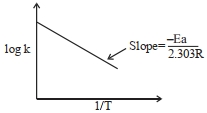
\(k = A \cdot e ^{- Ea / RT }\)\(\log k =\log A -\frac{ Ea }{2.303 R } \cdot \frac{1}{T}\)
Higher is Ea, stronger is the temperature dependence of \(k\) (i.e. steeper the slope)
\(\Rightarrow \frac{1}{ k } \frac{ dk }{ dT }=\frac{ Ea }{ R } \frac{1}{ T ^2}\)
\(\Rightarrow \frac{ dk }{ dT }= A \times e ^{-\frac{ Ea }{ R }} \cdot \frac{ Ea }{ RT ^2}\)
-
- (A) \(2\)
- (B) \(3\)
- (C) \(1\)
- (D) \(4\)
Show answer and solution
Correct Answer: (C)
\((A)\) For zero order \(t_{1 / 2}=\frac{[ A ]_0}{2 K }\) as concentration decreases half life decreases (Correct statement)\((B)\) If order w.r.t. that reactant is zero then it will not affect rate of reaction. (Correct statement)
\((C)\) Order can be fractional but molecularity can not be (Incorrect statement)
\((D)\) For zero order reaction unit is \(mol L ^{-1} s ^{-1}\) and for second order reaction unit is \(mol ^{-1} Ls ^{-1}\) (Correct statement)
-
- (A) \(16\)
- (B) \(15\)
- (C) \(17\)
- (D) \(14\)
Show answer and solution
Correct Answer: (C)
\(C=\frac{C_o}{2^n}=\frac{C_o}{32}\)\(n =5\)
\(t =5 t _{1 / 2}\)
\(=\frac{5 \times 0.693}{20}=\frac{0.693}{4}\)
\(=0.17325\,min =17.325 \times 10^{-2}\,min\)
-
- (A) \(4\)
- (B) \(3\)
- (C) \(5\)
- (D) \(6\)
Show answer and solution
Correct Answer: (B)
\(RDS : NOBr _2+ NO \rightarrow 2 NOBr\)\(\left. r = K \left[ NOBr _2\right] NO \right] \quad--- \text { (i) }\)
\(Keq =\frac{\left[ NOBr _2\right]}{[ NO ]\left[ Br _2\right]}----- \text { (ii) }\)
\(\text { From (i) and (ii) }\)
\(r = K \cdot Keq \cdot[ NO ]\left[ Br _2\right][ NO ]\)
\(r = K ^{\prime}[ NO ]^2\left[ Br _2\right]\)
\(\text { Overall order }=3\)
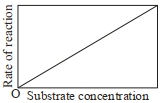
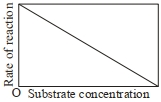
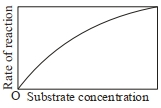
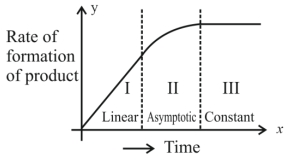
- 90. The variation of the rate of an enzyme catalyzed reaction with substrate concentration is correctly represented by graph 2023 Medium
- (A) \(b\)
- (B) \(c\)
- (C) \(d\)
- (D) \(a\)
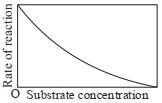
Show answer and solution
Correct Answer: (B)
Fact base - (A) \(b\)
- 91. Arrange the following compounds in increasing order of rate of aromatic electrophilic substitution reaction
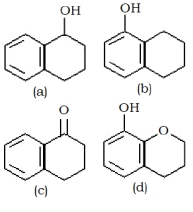 2023 Hard
- (A) \(d, b, c, a\)
- (B) \(b, c, a, d\)
- (C) \(c, a, b, d\)
- (D) \(d, b, a, c\)
Show answer and solution
Correct Answer: (C)
Benzene becomes more reactive towards EAS when any substituent raises the electron density.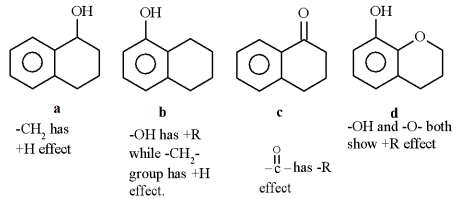
- 92. Decreasing order of reactivity towards electrophilie substitution for the following compounds is:
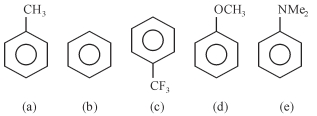 2023 Medium
- (A) \(c > b > a > d > e\)
- (B) \(e > d > a > b > c\)
- (C) \(a > d > e > b > c\)
- (D) \(d > a > e > c > b\)
Show answer and solution
Correct Answer: (B)
Higher the electron density on Benzene Ring, Higher its Reactivity towards electrophilic substitution Reaction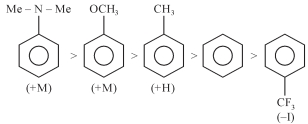
-
- (A) \(A\) is false but \(R\) is true
- (B) Both \(A\) and \(R\) are correct and \(R\) is the correct explanation of \(A\)
- (C) Both \(A\) and \(R\) are correct but \(R\) is NOT the correct explanation of \(A\)
- (D) \(A\) is true but \(R\) is false
Show answer and solution
Correct Answer: (C)
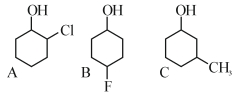
Acidic strength \(\alpha-\) I effect\(\alpha \frac{1}{+ I }\) effect
\(F , Cl\) exerts \(- I\) effect, Methyl exerts \(+ I\) effect, \(C\) is least acidic.
Among \(A\) and \(B\); since inductive effect is distance dependent, Extent of \(- I\) effect is higher in \(A\) followed by \(B\) even though \(F\) is stronger electron withdrawing group than \(Cl\). Thus, \(A\) is more acidic than \(B\).
-
- (A) \(C , D , B , A\)
- (B) \(C, A, B, D\)
- (C) \(D, C, A, B\)
- (D) \(D , C , B , A\)
Show answer and solution
Correct Answer: (B)
Based on Theory -
- (A) \(A-I, B-IV, C-II, D-III\)
- (B) \(A-III, B-II, C-I, D-IV\)
- (C) \(A-III, B-II, C-IV, D-I\)
- (D) \(A-III, B-II, C-IV, D-I\)
Show answer and solution
Correct Answer: (D)
Basic Strength \(\alpha \frac{1}{ pK _{ b }}\) Order for \(pK _{ b }: A > B > D > C\)
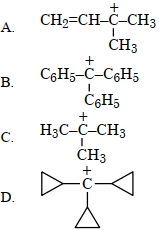
- 96. The decreasing order of hydride affinity for following carbocations is: Choose the correct answer from the options given below:
 2023 Medium
- (A) \(A,C,B,D\)
- (B) \(C,A,B,D\)
- (C) \(C,A,D,B\)
- (D) \(A,C,D,B\)
Show answer and solution
Correct Answer: (B)
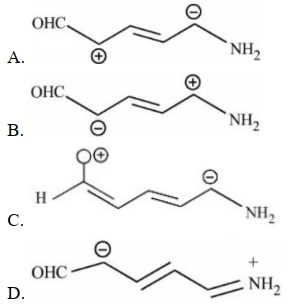
Stability order of cations is: \(C < A < B < D\) -
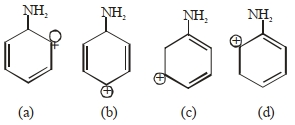
- (A) \(c\)
- (B) \(d\)
- (C) \(b\)
- (D) \(a\)
Show answer and solution
Correct Answer: (A)
The \(+ M\) effect of \(NH _2\) is stabilizing the carbocation.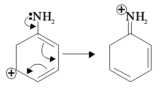
-
- (A) \(N _2 H _4 \cdot HCl\)
- (B) \(CH _3 NH _2 \cdot HCl\)
- (C) \(NH _4 Cl\)
- (D) \(NH _2 OH . HCl\)
Show answer and solution
Correct Answer: (B)
\(CH _3 NH _2 . HCl \underset{\text { fusion }}{\stackrel{ Na }{\longrightarrow}} NaCN\) and \(NaCl\)\(NaCN\) gives \(+ve\) test for nitrogen and
\(NaCl\) gives \(+ve\) test for halogen
- 99. Following tetrapeptide can be represented as \(( F , L , D , Y , I , Q , P\) are one letter codes for amino acids)
 2023 Hard
- (A) \(FIQY\)
- (B) \(FLDY\)
- (C) \(YQLF\)
- (D) \(PLDY\)
Show answer and solution
Correct Answer: (B)
Hydrolysis of the given tetrapeptide will give the following:
-
- (A) Both Statement \(I\) and Statement \(II\) are incorrect
- (B) Both Statement \(I\) and Statement \(II\) are correct
- (C) Statement \(I\) is correct but Statement \(II\) is incorrect
- (D) Statement \(I\) is incorrect but Statement \(II\) is correct
Show answer and solution
Correct Answer: (C)
Statement \(-1\) is (True)Pure aniline is colourless liquid
Statement \(-2\) is (False)
Aniline becomes dark brown due to action of air and light [oxidation]
No questions on this page match these filters.