


Chapters asked in 2018
22 chapters- 1Qs STD 11 Organic chemistry purification and characterization
- 1Qs STD 12 D and f- block elements
- 1Qs STD 11 Redox reactions
- 1Qs STD 12 Biomolecules
- 2Qs STD 11 Equilibrium - II (icon Equilibrium)
- 3Qs STD 12 Chemical kinetics
- 1Qs STD 11 Organic chemistry reaction mechanism
- 2Qs STD 12 Amines
- 1Qs STD 12 Alcohol, phenol and ethers
- 5Qs STD 12 Co-ordination chemistry Most asked
- 3Qs STD 12 P -Block elements - ll
- 2Qs STD 12 Electrochemistry
- 2Qs STD 12 Solution and colligative properties
- 3Qs STD 11 Some basic concept of chemistry
- 1Qs STD 11 Hydricarbon
- 1Qs STD 11 Organic chemistry Nomenclature of organic compounds
- 4Qs STD 11 Chemical bonding and molecular structure Most asked
- 2Qs STD 11 Classification of elements and periodicity in properties
- 4Qs STD 11 Equilibrium - 1 (chemical Equilibrium)
- 5Qs STD 11 Thermodynamics and thermochemistry Most asked
- 3Qs STD 11 P-Block elements - I
- 3Qs STD 11 Structure of atom
All JEE Mains 2018 Chemistry questions
22 chaptersShowing 1–50 of 51 questions
-
- (A) \(II\) moves slower and has higher \(R_f\) value than \(I\)
- (B) \(II\) moves faster and has higher \(R_f\) value than \(I\)
- (C) \(I\) moves faster and has higher \(R_f\) value than \(II\)
- (D) \(I\) moves slower and has higher \(R_f\) value than \(I\)
Show answer and solution
Correct Answer: (B)
Since, adsorption of \(I > II\), \(I\) is firmly attached to column (stationary phase). Hence, it will move slowly and will move little distance. Also \(II\) is loosely attached to column (stationary phase). Hence, it will move faster and will move large distance -
- (A) \(Mn\)
- (B) \(Cr\)
- (C) \(V\)
- (D) \(Ti\)
Show answer and solution
Correct Answer: (A)
\(Mn{O_2} + KOH + KN{O_3} \to \mathop {{K_2}Mn{O_4}}\limits_{(dark\,\,green)} + KN{O_2} + {H_2}O\)\(MnO_4^{2 - } + 4{H^ + }\xrightarrow[{tionation}]{{dispropor}}\mathop {2MnO_4^ - }\limits_{(dark\,purple)} + Mn{O_2} + 2{H_2}O\)
- 3. In \(KO_2\), the nature of oxygen species and the oxidation state of oxygen atom are, respectively 2018 Hard
- (A) Superoxide and \(-1\)
- (B) Superoxide and \(-1/2\)
- (C) Peroxide and \(-1/2\)
- (D) Oxide and \(-2\)
Show answer and solution
Correct Answer: (B)
In \(KO_2\), the nature of oxygen species and the oxidation state of oxygen atom are superoxide (superoxide ion is \(O_2^-\)) and \(-1/2\) respectively.Let \(x\) be oxidation state of oxygen. The oxidation state of \(K\) is \(+1.\) Hence
\(+1+2(x)=0\)
\(2x=-1\)
\(x=-\frac {1}{2}\)
-
- (A) Cellulose and amylose have \(1,4-\) glycosidic linkage
- (B) Lactose contains \(\beta -D-\) galactose and \(\beta -D-\) glucose
- (C) Maltose and lactose have \(1,4-\) glycosidic linkage
- (D) Sucrose and amylose have \(1 ,2-\) glycosidic linkage
Show answer and solution
Correct Answer: (D)
In amylose \(1, 4-\alpha -\) glycosidic linkage is present -
- (A) \(55\,mL\,\frac{M}{{10}}\,HCl + 45\,mL\,\frac{M}{{10}}\,NaOH\)
- (B) \(75\,mL\,\frac{M}{5}\,HCl + 25\,mL\,\frac{M}{5}\,NaOH\)
- (C) \(100\,mL\,\frac{M}{{10}}\,HCl + 100\,mL\,\frac{M}{{10}}\,NaOH\)
- (D) \(60\,mL\,\frac{M}{{10}}HCl + 40\,mL\,\frac{M}{{10}}NaOH\)
Show answer and solution
Correct Answer: (B)
\(75\,mL\,\frac{M}{5}\,HCl + 25\,ml\,\frac{M}{5}\,NaOH\)\(25\,mL\,\frac{M}{5}\,NaOH\,\) will neutralise \(25\,mL\,\frac{M}{5}\,HCl\)
\(75 - 25 = 50\,mL\,\frac{M}{5}\,HCl\) will remain.
Total volume will be \(75 + 25 = 100\,mL\)
\(50\,mL\,\frac{M}{5}\,HCl\) is diluted to \(100\,mL\)
\([{H^ + }] = [HCl] = \frac{M}{5} \times \frac{{50}}{{100}} = \frac{M}{{10}}\)
\(pH = - {\log _{10}}[{H^ + }] = - {\log _{10}}\,\frac{M}{{10}} = 1\)
-
- (A) \(1.798\)
- (B) \(0.36\)
- (C) \(17.95\)
- (D) \(0.18\)
Show answer and solution
Correct Answer: (D)
\({({K_{sp}})_{PbC{l_2}}} = 3.2 \times {10^{ - 8}} = 32 \times {10^{ - 9}}\)\(PbC{l_2} \leftrightarrow \mathop {P{b^{2 + }}}\limits_s + \mathop {2C{l^ - }}\limits_{2s} \)
\({K_{sp}} = [p{b^{2 + }}]{[C{l^ - }]^2}\)
\({K_{sp}} = 4{s^3} = 32 \times {10^{ - 9}}\)
\({s^3} = 8 \times {10^{ - 9}}\)
\(s = 2 \times {10^{ - 3}}\,M\)
\(\frac{w}{{M.W.}} \times \frac{1}{{{V_L}}} = 2 \times {10^{ - 3}}\)
\(\frac{{0.1}}{{278}} \times \frac{1}{{{V_L}}} = 2 \times {10^{ - 3}}\)
\({V_L} = \frac{{0.1 \times 1000}}{{278 \times 2}} = 0.18\,L\)
-
- (A) \(3.2\)
- (B) \(2.5\)
- (C) \(4.1\)
- (D) \(5\)
Show answer and solution
Correct Answer: (C)
The half life \(t_{1/2}\,=\,10\,days\)The decay constant
\(k\, = \,\frac{{0.693}}{{{t_{1/2}}}}\, = \,\frac{{0.693}}{{10\,\,days}}\, = \,0.0693\,\,day{s^{ - 1}}\)
The time required for one fourth conversion
\(t\, = \,\frac{{2.303}}{k}\,{\log _{10}}\frac{a}{{a - x}}\)
\( = \,\frac{{2.303}}{{0.0693\,\,da{y^{ - 1}}}}\,{\log _{10}}\,\frac{1}{{1 - (1/4)}} = 4.1\,days\)
-
- (A) \(2\)
- (B) \(3\)
- (C) \(0\)
- (D) \(1\)
Show answer and solution
Correct Answer: (D)
First order reaction as halflife is constant.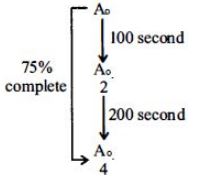
-
- (A) \(136.25\)
- (B) \(106.25\)
- (C) \(175.0\)
- (D) \(116.25\)
Show answer and solution
Correct Answer: (B)
\({N_2}{O_5}\, \to \,2N{O_2}\, + \,\frac{1}{2}{O_2}\)At \(t=0\) \(50\) \(0\) \(0\)
At \(t=50\,min\) \(50-p_1\) \(2p_1\) \(\frac {p_1}{2}\)
Total pressure at \(50\,\min\)
\(=\,50-p_1+2p_1+\frac {p_1}{2}=87.5\)
\(50+\frac {3p_1}{2}=87.5\)
\(\frac{{3{p_1}}}{2}\, = \,37.5\)
\(\therefore \,\,{p_1}\, = \frac{{\,37.5\, \times 2}}{3}\, = \,25\)
At \(t=100\,min\) \(50-p_2\) \(2p_2\) \(\frac {p_2}{2}\)
\(50\,\min\) is half life period
For \(100\,\min\) i.e., for \(2\) half lives \(50-p_2=12.5\)
\(\therefore \,\,{p_2}\, = 37.5\,mm\) of \(Hg\)
Total pressure at \(100\,\min\)
\( = {\mkern 1mu} 50 - {p_2} + 2{p_2} + \frac{{{p_2}}}{2}\)
\( = {\mkern 1mu} 50 + \frac{{3{p_2}}}{2}\, = \,50 + \frac{3}{2} \times 37.5\)
\(=\,50\,+\,56.25\)
\(=\,106.25\,mm\) of \(Hg\)
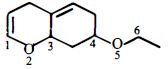
- 10. On the treatment of the following compound with a strong acid, the most susceptible site for bond cleavage is
 2018 Hard
- (A) \(O2- C3\)
- (B) \(O5 - C6\)
- (C) \(C4- O5\)
- (D) \(C1 - O2\)
Show answer and solution
Correct Answer: (B)
The lone pair of electrons on \(O2\) is involved in resonance with \(C= C\). Hence \(O2\) will not be protonated. The lone pair of electrons on \(O5\) is not involved in resonance with \(C\, = C\). Hence, \(O5\) will be protonated. Chloride ion will then attack least substituted \(C\) atom \((C6)\) -
- (A) \((D) < (C) < (B) < (A)\)
- (B) \((A) < (D) < (B) < (C)\)
- (C) \((A) < (B) < (C) < (D)\)
- (D) \((A) < (D) < (C) < (B)\)
Show answer and solution
Correct Answer: (B)
Aromatic diazonium salts are more stable than aliphatic diazonium salts. The higher stability of aryl diazonium salts is due to resonance. Electron donating substituents increase electron density on benzene ring. Hereby they increase the stability of diazonium salts. Electron withdrawing substituents decrease electron density on benzene ring. Hereby they decrease the stability of diazonium salts. \(-COCH_3\) group is electron withdrawing and hence, diazonium salts from \((D)\) is less stable than that from \((B)\). Although \(- O- COCH_3\) is electron donating substituent, but it is present in meta position. Hence, it will not have significant effect on stability. the increasing order of diazotisation is \((A) < (D) < (B) < (C)\). -
- (A) \((A) < (B) < ( D) < (C)\)
- (B) \((A)<(B) <(C) <(D)\)
- (C) \((B) <(A) < (C) <(D)\)
- (D) \((B) <(A) <(D)<(C)\)
Show answer and solution
Correct Answer: (A)
In the given substituted benzene rings, the substitutents methoxy \((- OCH_3)\) and amino \((-NH_2)\) are strongly activating groups while methyl \((- CH_3)\) is weakly activating and chloro \((- Cl) \) is a deactivating group towards electrophilic aromatic substituation reaction. Since among methyl and methoxy group, methoxy group is more reactive than methyl group, \(( c)\) is more reactive than \((d)\). Although amino group is strongly activating group, it gets protonated in presence of acid to form anilinium ion \(\left( { - \mathop N\limits^ + {H_3}} \right)\) which is strongly deactivating. Hence, \((a)\) is less reactive than \((c)\) and \((d)\) . Chloro group is also deactivating group but less deactivating than \(\left( { - \mathop N\limits^ + {H_3}} \right)\). Thus order is \((a) < (b) < (d) < (c)\). Note: The activating groups increases the electron density on benzene ring and increases the rate of electrophilic aromatic substitution reaction. The deactivating groups decreases the electron density on benzene ring and decreases the rate of electrophilic aromatic substitution reaction. - 13. The total number of optically active compounds formed in the following reaction is \([Figure]\) \(\xrightarrow{{HBr}}\)
 2018 Hard
- (A) \(0\)
- (B) \(6\)
- (C) \(4\)
- (D) \(2\)
Show answer and solution
Correct Answer: (C)
The total number of optically active compounds formed is four. The product has two chiral \(C\) atoms. Thus, it has \(2^n\, = 2^2\, = 4\) stereoisomers
- 14. In Wilkinson's catalyst, the hybridization of central metal ion and its shape are respectively 2018 Hard
- (A) \(sp^3d,\) trigonal bipyramidal
- (B) \(d^2sp^3,\) octahedral
- (C) \(dsp^2,\) square planar
- (D) \(sp^3,\) tetrahedral
Show answer and solution
Correct Answer: (C)
Wilkinson catalyst is \([RhCl(PPh_3)_3].\) -
- (A) \([NiCl_4]^{2-} -\) square-planar; \([Ni(CN)_4]^{2-} -\) paramagnetic
- (B) \([Ni( CN)_4]^{2-} -\) tetrahedral; \([Ni(CO)_4] -\) paramagnetic
- (C) \([NiCl_4]^{2-} -\) paramagnetic; \([Ni(CO)_4] -\) tetrahedral
- (D) \([NiCl_4]^{2-} -\) dimagnetic; \([Ni(CO)_4] -\) squareplanar
Show answer and solution
Correct Answer: (C)
\([Ni(CN)]^{2-}\) is square planar, diamagnetic (\(0\) unpaired electrons) with \(dsp^2\) hybridisation.\([Ni(CO)_4] -\) is tetrahedral,diamagnetic (\(0\) unpaired electrons) with \(sp^3\) hybridisation. \([NiCl_4]^{2-}\) is tetrahedral, paramagnetic (\(2\) unpaired electrons) with \(sp^3\) hybridisation.Hence, the option \((c)\) is the correct answer -
- (A) \({\left[ {ZnC{l_4}} \right]^{2 - }} > {\left[ {NiC{l_4}} \right]^{2 - }} > {\left[ {CoC{l_4}} \right]^{2 - }} > {\left[ {MnC{l_4}} \right]^{2 - }}\)
- (B) \({\left[ {CoC{l_4}} \right]^{2 - }} > {\left[ {MnC{l_4}} \right]^{2 - }} > {\left[ {NiC{l_4}} \right]^{2 - }} > {\left[ {ZnC{l_4}} \right]^{2 - }}\)
- (C) \({\left[ {NiC{l_4}} \right]^{2 - }} > {\left[ {CoC{l_4}} \right]^{2 - }} > {\left[ {MnC{l_4}} \right]^{2 - }} > {\left[ {ZnC{l_4}} \right]^{2 - }}\)
- (D) \({\left[ {MnC{l_4}} \right]^{2 - }} > {\left[ {CoC{l_4}} \right]^{2 - }} > {\left[ {NiC{l_4}} \right]^{2 - }} > {\left[ {ZnC{l_4}} \right]^{2 - }}\)
Show answer and solution
Correct Answer: (D)
The complex having higher number of unpaired electrons will have higher value of spin only magnetic moment.In all these complexes, the central metal ion is in \(+2\) oxidation state.
\(Zn^{2+}\) has \(3d^{10}\) outer electronic configuration with \(0\) unpaired electron.
\(Ni^{2+}\) has \(3d^8\) outer electronic configuration with \(2\) unpaired electrons.
\(Co^{2+}\) has \(3d^7\) outer electronic configuration with \(3\) unpaired electrons.
\(Mn^{2+}\) has \(3d^5\) outer electronic configuration with \(5\) unpaired electrons.
Hence the correct order of spin - only magnetic moments is
\({[MnC{l_4}]^{2 - }}\, > \,{[CoC{l_4}]^{2 - }}\, > \,{[NiC{l_4}]^{2 - }}\, > \,{[ZnC{l_4}]^{2 - }}\)
- 17. The total number of possible isomers for squareplanar \([Pt(Cl)(NO_2)(NO_3)(SCN)]^{2-}\) is: 2018 Hard
- (A) \(16\)
- (B) \(12\)
- (C) \(8\)
- (D) \(24\)
Show answer and solution
Correct Answer: (B)
The square planar complex of the type \([Mabcd]^{n±}\), where all four ligands are different, has \(3\) geometrical isomers. But if one of the ligands is ambidentate, then \(2\times3\, = 6\) geometrical isomers are possible. But if two ligands are ambidentate, then \(4\times3\, = 12\) geometrical isomers are possible. In the given example, \(NO_2^-\) and \(SCN^-\) are ambidentate ligands -
- (A) Potassium tris(oxalato) chromate \((III)\)
- (B) Penta aqua chloro chromium \((III)\) chloride
- (C) Aqua chlorobis ( ethylenediamine) cobalt \((II)\) chloride
- (D) Potassium ammine tri chloro platinate \((II)\)
Show answer and solution
Correct Answer: (C)
\([Co(H_2O)Cl(en)_2]Cl\)
- 19. In \(XeO_3F_2\), the number ofbond pair \((s)\), \(\pi -\) bond \((s)\) and lone pair \((s)\) on \(Xe\) atom respectively are: 2018 Hard
- (A) \(5, 3, 0\)
- (B) \(5, 2, 0\)
- (C) \(4,2,2\)
- (D) \(4,4,0\)
Show answer and solution
Correct Answer: (A)
Structure of \(XeO_3F_2\)
-
- (A) \(9\)
- (B) \(6\)
- (C) \(12\)
- (D) \(18\)
Show answer and solution
Correct Answer: (C)
The number of \(P-O\) bonds in \(P_4O_6\, = 12\)
-
- (A) \(XeOF_4(+6)\) and \(XeO_3(+6)\)
- (B) \(XeO_2(+4)\) and \(XeO_3(+6)\)
- (C) \(XeOF_4(+6)\) and \(XeO_2F_2(+6)\)
- (D) \(XeO_2F_2(+6)\) and \(XeO_2(+4)\)
Show answer and solution
Correct Answer: (C)
\(Xe{{F}_{6}}\,+\,{{H}_{2}}O\,\xrightarrow[hydrolysis]{particle}\underset{'X'}{\mathop{\overset{+6}{\mathop{Xe}}\,O{{F}_{4}}}}\,\,+\,2HF\)\(Xe\mathop {O{F_4}}\limits_{'X'} \, + {H_2}O\, \to \mathop {\mathop {Xe}\limits^{ + 6} {O_2}{F_2}}\limits_{'Y'} \, + \,2HF\)
-
- (A) \(109\)
- (B) \(98.1\)
- (C) \(9.81\)
- (D) \(10.9\)
Show answer and solution
Correct Answer: (C)
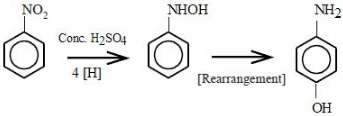
\(9. 65\) ampere current was passed for \(1 .0\) hour ( \(3600\) seconds) Number of moles of electrons passed \( = \frac{{I(A) \times t(s)}}{{96500}} = \frac{{9.65A \times 3600s}}{{96500}} = 0.36\,moles\)\({C_6}{H_5}N{O_2}\, + \,4{e^ - } + 4{H^ + } \to \,{\text{p - Aminophenol}} + {H_2}O\)
\(4\) moles of electrons will reduce \(1\) mole of nitrobenzene to \(p-\) aminophenol. \(0.36\) moles of electrons will reduce \(\frac{{0.36}}{4} = 0.09\) moles of nitrobenzene to \(p-\) aminophenol \(p-\) aminophenol molar mass \(= 109 .14\,\,g/mol\) Mass of \(p-\) aminophenol obtained \(= 109.14\,g/mol \times 0.09\,mol = 9.81\,g\)
-
- (A) \(2.0\)
- (B) \(0.1\)
- (C) \(0.5\)
- (D) \(1.0\)
Show answer and solution
Correct Answer: (D)
Reduction at cathode:\(2{e^ - }\, + \,2{H_2}O\, \to \,{H_2}\, + \,2O{H^ - }\)
(valence factor) \(H_2=2\)
At \(NTP\) \(22400\,mL\) of \(H_2=1\,mole\) of \(H_2\,\,112\,mL\) of
\({H_2}\, = \,\frac{1}{{22400}}\, \times \,112\, = \,0.005\,mole\) of \(H_2\)
Moles of \(H_2\) produced
\( = \frac{{I\, \times t}}{{96500}}\, \times \) mole ratio
\(0.005 = \frac{{I\, \times 965}}{{96500}}\, \times \frac{{1\,\,mole\,\,of\,\,{H_2}}}{{2\,\,mole\,\,of\,\,{e^ - }}}\)
\(I\,=\,1.0\,A\)
-
- (A) \(37.5\)
- (B) \(75\)
- (C) \(150\)
- (D) \(50\)
Show answer and solution
Correct Answer: (C)
Molar mass of octane \(=\,114\,g/mol\)From the lowering of vapour pressure we have,
\(\frac{{\Delta P}}{P} = \frac{{\frac{{{W_2}}}{{{M_2}}}}}{{\frac{{{W_2}}}{{{M_2}}} + \frac{{{W_1}}}{{{M_1}}}}}\)
\(\frac{{75}}{{100}} = \frac{{\frac{{{W_2}}}{{50\,g/mol}}}}{{\frac{{{W_2}}}{{50\,g/mol}} + \frac{{114\,g}}{{114\,g/mol}}}}\)
\(0.75 = \frac{{\frac{{{W_2}}}{{50}}}}{{\frac{{{W_2}}}{{50\,}} + 1}}\)
\(\frac{{{W_2}}}{{50}} + 1\, = \,\frac{{{W_2}}}{{50\, \times \,0.75}}\)
\({W_2}\, = \,150\,g\)
Note : \(W_2\) vand \(M_2\) are mass and molar mass of solute and \(W_1\) and \(M_1\) are mass and molar mass of octane.
-
- (A) \(\frac{3}{4}\)
- (B) \(\frac{1}{2}\)
- (C) \(\frac{1}{4}\)
- (D) \(\frac{4}{3}\)
Show answer and solution
Correct Answer: (A)
The relationship between molar masses of the two solvents is\(M_X\,=\,\frac {3}{4}M_Y\) .... \((i)\)
The relative lowering of vapour pressure of two solution is
\({\left( {\frac{{\Delta P}}{P}} \right)_X}\, = \,m{\left( {\frac{{\Delta P}}{P}} \right)_Y}\)
But, the relative loering of vaoour pressure of solutin is directly proportional to the mole fraction of solution.
Given \(5\,molal\) solution , mans \(5\,molal\) of solute are dissolved in \(1\,kg\) (or \(1000\,g\)) of solvent.
The number of moles of solvent \(=\,\frac {1000\,g}{M}\)
The mole fraction of solution \(=\,\frac {5}{1000/M}\)
\(=M\times \,\frac {5}{1000}\)
hence \(M_X\times \frac {5}{1000}\) \(=\,m\times M_Y\times \frac {5}{1000}\) .... \((ii)\)
Substitute equation \((i)\) in equation \((ii)\)
\(\frac {3}{4}\times M_Y\times \frac {5}{1000}\) \(=\,m\times M_Y\times \frac {5}{1000}\)
\(m=\frac {3}{4}\)
-
- (A) \(0.35\)
- (B) \(0.54\)
- (C) \(0.41\)
- (D) \(0.48\)
Show answer and solution
Correct Answer: (D)
No of moles of oxygen in \(0.16\,g\) of oxygen molecule\( = \frac{{0.16\,g}}{{32\,g/mol}} = 0.005\,mole\)
\(2NaCl{O_3}\xrightarrow{\Delta }2NaCl + 3{O_2}\)
According to the reaction,
\(3\) moles of \(O_2\) \(=\) \(2\) moles of \(NaCl\) \(=\) \(2\) moles of \(AgCl\)
Molar mass of \(AgCl = 143.5\,g/mol\)
\(0.005\) moles of \(O_2\) will ppt. \( = 0.005 \times \frac{2}{3}\) moles \(AgCl\)
\(= 0.0033\) moles of \(AgCl\)
\(\therefore \) Mass of \(AgCl\) (in \(g\)) obtained will be
\(= 143.5\,g/mol \times 0.0033\) \(moles\) \(= 0.48\,g\)
-
- (A) \(6.023 \times {10^9}\)
- (B) \(6.023 \times {10^{23}}\)
- (C) \(6.023 \times {10^{21}}\)
- (D) \(6.023 \times {10^{20}}\)
Show answer and solution
Correct Answer: (D)
Given percentage of chlorine in an hydrocarbon \(= 3.55\%\) i,e.,\(100\,g\) of chlorohydrocarbon has \(3.55\,g\) of chlorine.
\(1\,g\) of chlorohydrocarbon will have \(\frac{{3.55}}{{100}} = 0.0355\,g\) of chlorine.
Atomic wt. of \(Cl = 35.5\,g/mol\)
Number of moles of \(Cl\) \( = \frac{{0.0355\,g}}{{35.5\,g/mol}} = 0.001\) \(mole\)
Number of atoms of \(Cl = 0.001\,mole\) \(\times 6.023 \times 10^{23}\,mol^{-1}\)
\(= 6.023 \times 10^{20}\)
-
- (A) \(Ba(N_3)_2(s)\to Ba(C) + 3N_2(g)\)
- (B) \((NH_4)_2Cr_2O_7(s) \to \)\(N_2(g) + 4H_2O(g) + Cr_2O_3(s)\)
- (C) \(2NH_3(g)\to N_2(g) + 3H_2(g)\)
- (D) \(2NH_4NO_3(s) \to \)\(2N_2(g) + 4H_2O(g) + O_2(g)\)
Show answer and solution
Correct Answer: (C)
\((a)\) Molar mass of \(Ba(N_3)_2(s) = 221\,g/mol\)\(1\) mole of \(Ba(N_3)_2(s)\) will give \(3\) moles of \(N_2\)
hence \(\frac{{1\,g}}{{221\,g/mol}}\) moles of \(Ba(N_3)_2(s)\) will give \(3 \times \frac{1}{{221}} = 0.014\) moles of \(N_2\)
\((b)\) Molar mass of \({(N{H_4})_2}C{r_2}{O_7} = 252\,g/mol.\,\)
\(1\) mole of \({(N{H_4})_2}C{r_2}{O_7}\) will give \(1\) mole of \(N_2\)
hence \(\frac{{1\,g}}{{252\,g/mol}}\) moles of \({(N{H_4})_2}C{r_2}{O_7}\) will give \(1 \times \frac{1}{{252}} = 0.0039\) moles of \(N_2\)
\((c)\) Molar mass of \(NH_3 = 17\,g/mol.\)
\(2\) mole of \(NH_3\) will give \(1\) mole of \(N_2\)
hence \(\frac{{1\,g}}{{17\,g/mol}}\) moles of \(NH_3\) will give \(\frac{1}{{2 \times 17}} = 0.0297\) moles of \(N_2.\)
\((d)\) Molar mass of \(NH_4NO_3 = 80\,g/mol.\)
\(1\) mole of \(NH_4NO_3\) will give \(1\) mole of \(N_2\)
hence \(\frac{{1\,g}}{{80\,g/mol}}\) moles \(NH_4NO_3\) will give \(1 \times \frac{1}{{80}} = 0.0125\) moles of \(N_2\)
Hence Thermal decomposition of \(NH_3\) will produce maximum amount of \(N_2\)
-
- (A) \(Y\) will have higher dipole moment and higher boiling point than \(X\)
- (B) \(Y\) will have higher dipole moment and lower boiling point than \(X\)
- (C) \(X\) will have lower dipole moment and lower boiling point than \(Y\)
- (D) \(X\) will have higher dipole moment and higher boiling point than \(Y\)
Show answer and solution
Correct Answer: (D)
When \(2-\) butyne is treated with \(H_2/\) Lindlar's catalyst, compound \(X\) (cis \(-2-\) butene) is produced as the major product; and when treated with \(Na/liq\,NH_3\) it produces \(Y\) (trans \(-2-\) butene) as the major product. Cisisomer \((X)\) will have higher dipole moment and higher boiling point than trans \((Y)\). -
- (A) \((A)-(s); (B)-(r); (C)-(q); (D)-(p)\)
- (B) \((A)-(r); (B)-(s); (C)-(p); (D)-(q)\)
- (C) \((A)-(r); (B)-(s); (C)-(q); (D)-(p)\)
- (D) \((A)-(s); (B)-(r); (C)-(p); (D)-(q)\)
Show answer and solution
Correct Answer: (B)
\(\to \) Phenelzine contains hydrazine
\(\to \) Chloroxylenol contains phenol
\(\to \) Uracil is the pyrimidine base
\(\to \) Ranitidine contains furan ring - 31. In the molecular orbital diagram for the molecular ion, \(N_2^ + \) , the number of electrons in the \({\sigma _{2p}}\) molecular orbital is 2018 Medium
- (A) \(0\)
- (B) \(2\)
- (C) \(3\)
- (D) \(1\)
Show answer and solution
Correct Answer: (D)
Total electrons in \(N_2^ + = (7 \times 2) - 1 = 13\)\(N_2^ + \to {\sigma _{1{s^2}}},\sigma _{1{s^2}}^*,{\sigma _{2{s^2}}},\sigma _{2{s^2}}^*,[\pi _{2{p_x}}^2 = \pi _{2{p_y}}^2]\sigma _{2{p_z}}^1\)
Number of electron in \({\sigma _2}_{{p_z}}\) is \(1\)
-
- (A) \(NF_3-\) trigonal planar
- (B) \(BF_3-\) trigonal planar
- (C) \(AsF_5-\) trigonal bipyramidal
- (D) \(H_2O-\) bent
Show answer and solution
Correct Answer: (A)
\(NF_3\) has trigonal pyramidal geometry. \(N\) atom has one lone pair and three bond pairs of electrons. The electron pair geometry is tetrahedral and molecular geometry is trigonal pyramidal . The bond angles are lower than tetrahedral bond angles due to lone pair - lone pair and lone pair - bond pair repulsions. \(N\) atom is \(sp^3\) hybridised
-
- (A) A bonding \(\pi \) orbital
- (B) A non - bonding orbital
- (C) An antibonding \(\sigma \) orbital
- (D) An antibonding \(\pi \) orbital
Show answer and solution
Correct Answer: (D)
An antibonding \(\pi \) orbital best describes the diagram of a molecular orbital. Two orbitals laterally overlap to form pi bond. Out of phase combination, of these two \(p-\) orbitals, give \(\pi ^*\, MO\). -
- (A) \({H_2}O\, \to \,{H_3}{O^ + }\)
- (B) \(B{F_3}\, \to \,BF_4^ - \)
- (C) \(C{H_4}\, \to \,{C_2}{H_6}\)
- (D) \(N{H_3}\, \to \,NH_4^ + \)
Show answer and solution
Correct Answer: (B)
\(B{F_3}\, \to \,BF_4^ - \)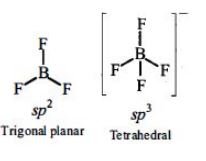
- 35. For \(Na^+ , Mg^{2+}, F^-\) and \(O^{2-}\); the correct order of increasing Ionic radii is 2018 Medium
- (A) \({O^{2 - }} < {F^ - } < N{a^ + } < M{g^{ 2+}}\)
- (B) \(N{a^ + } < M{g^{ 2+}} < {F^ - } < {O^{2 - }}\)
- (C) \(M{g^{ 2+}} < N{a^ + } < {F^ - } < {O^{2 - }}\)
- (D) \(M{g^{ 2+}} < {O^{2 - }} < N{a^ + } < {F^ - }\)
Show answer and solution
Correct Answer: (C)
All species are isoelectronic \((10e^-)\). isoelectronic series, when negative charge increases the radius of ion increases\(\therefore M{g^{ 2+}} < N{a^ + } < {F^ - } < {O^{2 - }}\)
-
- (A) \(O> F > Cl\)
- (B) \(F > O > Cl\)
- (C) \(F > Cl > O\)
- (D) \(Cl> F > O\)
Show answer and solution
Correct Answer: (D)
On moving from left to right across a period, the electron affinity becomes more negative. On moving from top to bottom in a group, the electron affinity becomes less negative. Chlorine has more negative electron affinity than fluorine, Because adding an electron to fluorine (\(2p\) orbital) causes greater repulsion than adding an electron to chlorine (\(3p\) orbital) which is larger in size -
- (A) \(1844\)
- (B) \(2068\)
- (C) \(4281\)
- (D) \(4763\)
Show answer and solution
Correct Answer: (C)
In the reaction \({A_2} \leftrightarrow 2A\)Initially, Let \([{A_2}] = 1\,M\) and \([A] = 0\,M\)
After \(20\%\) dissociation , \(80\%\) of \(A_2\) remains.
\([{A_2}] = 1 \times \frac{{80}}{{100}} = 0.8\,M\)
\(20\%\) of \(1\,M\) is
\(1 \times \frac{{20}}{{100}} = 0.2.\,[A] = 2 \times 0.2 = 0.4\,M\)
The equilibrium constant
\(K = \frac{{{{[A]}^2}}}{{[{A_2}]}};\) \(K = \frac{{{{[0.4]}^2}}}{{[0.8]}} = 0.2\)
\(\Delta {G^o} = - RT\,\ln \,K = - 8.314\,J{K^{ - 1}}\,mo{l^{ - 1}}\)
\( \times 320\,K \times \ln \,0.2 = 4281\,J/mol\)
-
- (A) \(2.5\)
- (B) \(4\)
- (C) \(2\)
- (D) \(3\)
Show answer and solution
Correct Answer: (A)
Initially \(2\) moles of \(CO\) are present.At equilibrium, \(1\) mole of \(CO\) is present
Hence, \(2-1=1\) moles of \(CO\) has reacted.
\(1\) mole of \(CO\) will react with \(1\) mole of \(Cl_2\) to from \(1\) mole of \(COCl_2\).
\(3-1=2\) moles of \(Cl_2\) remains at equilibrium
The equlibrium constant
\({K_c} = \frac{{[COC{l_2}]}}{{[CO][C{l_2}]}} = \frac{{\frac{{1\,mol}}{{5\,L}}}}{{\frac{{1\,mol}}{{5\,L}} \times \frac{{2\,mol}}{{5\,L}}}} = 2.5\)
- 39. In which of the following reactions, an increase in the volume of the container will favour the formation of products? 2018 Medium
- (A) \(4NH_3(g) + 5O_2(g)\) \(\rightleftharpoons\) \(4NO(g) + 6H_2O(l)\)
- (B) \(2NO_2(g)\) \(\rightleftharpoons\) \(2NO(g)+O_2(g)\)
- (C) \(3O_2\) \(\rightleftharpoons\) \(2O_3(g)\)
- (D) \(H_2(g)+I_2(g)\) \(\rightleftharpoons\) \(2HI(g)\)
Show answer and solution
Correct Answer: (B)
Volume \( \uparrow P \downarrow \), reaction proceeds in which direction where the number of moles of gases increases. -
- (A) addition of an inert gas at constant pressure
- (B) lowering the temperature
- (C) increasing the pressure
- (D) addition of an inert gas at constant volume
Show answer and solution
Correct Answer: (A)
Reaction at equilibirium \({N_2}{O_4}\, \rightleftharpoons \,2N{O_2}\)According to Le chatelier's principle-
\((a)\) addition of an inert gas at constant pressure will increase volume and equilibirium shifts towards more number of molecules.
\((b)\) Decomposition of \(N_2O_4\) will be endothermic, so reaction wil move in forward reaction when temperature is increased.So, It is incorrect. It will not effect reaction (volume is constant)
\((c)\) Increasing the pressure on a gas reaction shifts the position of equilibirium towards
the side with fewer molecules. So, It will move in backward direction which leads to formation of \(N_2O_4\) from \(NO_2\) -
- (A) \( - 5\)
- (B) \( + 5\)
- (C) \( 18\)
- (D) \( -18\)
Show answer and solution
Correct Answer: (B)
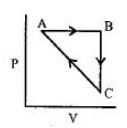
\(\Delta {U_{AB}} = {q_{AB}} + {W_{AB}} = 2 + ( - 5) = - 3\,kJ/mol\)\(\Delta {U_{BC}} = - 5\,kJ/mol\)
For cyclic procrss, \(\Delta U=0\)
\(\Delta {U_{AB}} + \Delta {U_{BC}} + \Delta {U_{CA}} = 0\)
\(\Delta {U_{CA}} = - \Delta {U_{AB}} - \Delta {U_{BC}}\)
\(\Delta {U_{CA}} = - ( - 3) - ( - 5) = 8\,kJ/mol\)
\(\Delta {U_{CA}} = {q_{CA}} + {W_{CA}}\)
\(8 = {q_{CA}} + 3\)
\({q_{CA}} = + 5\,kJ/mol\)
Heat absorbed has positive sign.
-
- (A) \(100\)
- (B) \(1\)
- (C) \(10\)
- (D) \(0.1\)
Show answer and solution
Correct Answer: (C)
\(\Delta G_{rxn}^o = {\Delta _f}{G^o}(vapour) - {\Delta _f}{G^o}(liquid)\)\(\Delta G_{rxn}^o = 103 - 100.7 = 2.3\,kcal/mol\)
\( = 2300\,cal/mol\)
\(\Delta G_{rxn}^o = - RT\,\ln \,K\)
\(2300\,cal/mol = - 2\,cal\,mol\,K \times 500\,K \times \ln \,K\)
\(\ln \,K = 2.3\)
\(K = 10 \,atm = \)Vapour pressure of liquid \('S'\) Vapour pressure of liquid \('S'\) at \(500\,K\) is approximately equal to \(10\,atm.\)
-
- (A) \(C\) (diamond) \(\to\) \(C\) (graphite)
- (B) \(N_2(g,\,1\,atm) \to N_2(g,\,5\,atm)\)
- (C) \(N_2(g,\,273\,K) \to N_2(g,\,300\,K)\)
- (D) \(H_2(g) \to 2H(g)\)
Show answer and solution
Correct Answer: (B)
\((a)\) When diamond is converted into graphite when it is heated to \(1500\,^oC\) and entropy is increased so \(\Delta S > 0\)
\((b)\) When pressure increases then molecules of gas will come closer and intermolecular distance decreases so entropy will also decrease and \(\Delta S < 0\)
\((c)\) When we increase the temperature of a gas then random ness is increased due to kinetic energy gained by molecules. So, \(\Delta S > 0\)
\((d)\) \(H_2\) molecule is converted into atoms, the no. of particles increases . Thus entropy will increase. So, \(\Delta S > 0\) -
- (A) \({N_2}(g) + 3{H_2}(g) \to 2N{H_3}(g)\)
- (B) \(2HI(g) \to H_2(g) + I_2(g)\)
- (C) \(2SO_2 (g) + O_2 (g) \to 2SO_3 (g)\)
- (D) \(2NO_2 (g) \to N_2O_4 (g)\)
Show answer and solution
Correct Answer: (B)
\(\Delta H = \Delta U + \Delta {n_g}RT\)\(2HI(g) \to {H_2}(g) + {I_2}(g);\Delta {n_g} = (1 + 1) - 2 = 0\)
\(\therefore \,\Delta H = \Delta U + 0\)
-
- (A) \(-112.4\)
- (B) \(-56.2\)
- (C) \(-208\)
- (D) \(-168.2\)
Show answer and solution
Correct Answer: (B)
\((i)\,2F{e_2}{O_3}(s) \to 4Fe(s) + 3{O_2}(g);\)\({\Delta _r}{G^o} = + 1487.0\,kJ\,mo{l^{ - 1}}\)
\((ii)\,2CO(g) + {O_2}(g) \to 2C{O_2}(g);\)
\({\Delta _r}{G^o} = - 514.4\,kJ\,mo{l^{ - 1}}\)
Multiple reaction \((ii)\) with \(3\),we get
\((iii)\,6CO(g) + 3{O_2}(g) \to 6C{O_2}(g);\)
\({\Delta _r}{G^o} = 3 \times - 514.4 = - 1543.2\,kJ\,mo{l^{ - 1}}\)
When we add reaction \((i)\) and reaction \((iii)\), we get reaction \((iv)\)
\((iv)\,2F{e_2}{O_3}(s) + 6CO(g) \to 4Fe(s) + 6C{O_2}(g)\)
Free energy change, \({\Delta _r}{G^o}\) for the reaction will be
\(1487.0 - 1543.2 = - 56.2\,kJ\,mo{l^{ - 1}}\)
-
- (A) \(B\)
- (B) \(Al\)
- (C) \(In\)
- (D) \(Ga\)
Show answer and solution
Correct Answer: (A)
\(BCl_3\)\(B+C{{l}_{2}}\to \underset{\begin{smallmatrix}
[does\,not\,dimerise\,due\,to\, \\
(p\pi -p\pi )back\,bonding]
\end{smallmatrix}}{\mathop{BC{{l}_{3}}}}\,\xrightarrow{N{{H}_{3}}}\)\(BCl_3\) is electron deficient but it does not form dimer like \(Al,Ga\) or \(In\) because its electron deficiency is complemented by the formation of co-ordinate bond between lone pair of electron of chlorine and empty unhybridized \(p-\) orbital of boron forming \(p\pi -p\pi\) bonding.
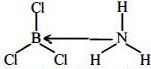
- 47. In graphite and diamond, the percentage of \(p-\) characters of the hybrid orbitals in hybridisation are respectively 2018 Hard
- (A) \(33\) and \(25\)
- (B) \(67\) and \(75\)
- (C) \(50\) and \(75\)
- (D) \(33\) and \(75\)
Show answer and solution
Correct Answer: (B)
\(\%\) of \(p-\) in graphite \({(sp)^2} = \frac{2}{3} \times 100 = 67\% \)\(\%\) of \(p-\) in diamond \({(sp)^3} = \frac{3}{4} \times 100 = 75\% \)
-
- (A) \(LiCl,AlH_3\) and \(SiH_4\)
- (B) \(LiCl, AlCl_3\) and \(SiH_4\)
- (C) \(LiH,AlCl_3\) and \(SiCl_2\)
- (D) \(LiH, AlH_3\) and \(SiH_4\)
Show answer and solution
Correct Answer: (B)
\(SiCl_4 + LiAlH_4\to LiCl + AlCl_3 + SiH_4\) -
- (A) \(4\)
- (B) \(5.5\)
- (C) \(4.5\)
- (D) \(5\)
Show answer and solution
Correct Answer: (C)
\(\lambda = 250\,nm = 2500\,\mathop A\limits^o \)\(E = \frac{{hc}}{\lambda } = \frac{{12400}}{{2500}} = 4.96\,eV\)
\(KE = \) stopping potential \( = 0.5\,eV\)
\(E = {W_0} + K.E.\)
\(4.96 = {W_0} + 0.5\)
\({W_0} = 4.46 \approx 4.5\,eV\)
- 50. The de-Broglie's wavelength of electron present in first Bohr orbit of \('H'\) atom is 2018 Hard
- (A) \(4 \times 0.529\,\mathop A\limits^o \)
- (B) \(2\pi \times 0.529\,\mathop A\limits^o \)
- (C) \(\frac{{0.529}}{{2\pi }}\mathop A\limits^o \)
- (D) \(0.529\,\mathop A\limits^o \)
Show answer and solution
Correct Answer: (B)
First Bohr orbit of \(H\) atom has radius\(r = 0.529\,\mathop A\limits^o \)
Also, the angular momentum is quantised.
\(mvr = \frac{h}{{2\pi }}\)
\(2\pi r = \frac{h}{{mv}} = \lambda \)
\(\lambda = 2\pi \times 0.529\,\mathop A\limits^o \)


No questions on this page match these filters.
Other years
Frequently asked
How many JEE Mains 2018 Chemistry questions are on ExamBro?
51 questions, each with the correct answer and a full solution.
Which JEE Mains 2018 Chemistry chapter is asked the most?
Co-ordination chemistry, with 5 questions, followed by Thermodynamics and thermochemistry with 5.
How difficult are JEE Mains 2018 Chemistry questions?
0% are easy, 22% medium and 78% hard.