


પ્રશ્નો
4 પ્રશ્નો4 માંથી 1–4 પ્રશ્નો
-
- (A) \(100\)
- (B) \(1\)
- (C) \(10\)
- (D) \(0.1\)
જવાબ અને ઉકેલ જુઓ
સાચો જવાબ: (C)
\(\Delta G_{rxn}^o = {\Delta _f}{G^o}(vapour) - {\Delta _f}{G^o}(liquid)\)\(\Delta G_{rxn}^o = 103 - 100.7 = 2.3\,kcal/mol\)
\( = 2300\,cal/mol\)
\(\Delta G_{rxn}^o = - RT\,\ln \,K\)
\(2300\,cal/mol = - 2\,cal\,mol\,K \times 500\,K \times \ln \,K\)
\(\ln \,K = 2.3\)
\(K = 10 \,atm = \)Vapour pressure of liquid \('S'\) Vapour pressure of liquid \('S'\) at \(500\,K\) is approximately equal to \(10\,atm.\)
-
- (A) \(-112.4\)
- (B) \(-56.2\)
- (C) \(-208\)
- (D) \(-168.2\)
જવાબ અને ઉકેલ જુઓ
સાચો જવાબ: (B)
\((i)\,2F{e_2}{O_3}(s) \to 4Fe(s) + 3{O_2}(g);\)\({\Delta _r}{G^o} = + 1487.0\,kJ\,mo{l^{ - 1}}\)
\((ii)\,2CO(g) + {O_2}(g) \to 2C{O_2}(g);\)
\({\Delta _r}{G^o} = - 514.4\,kJ\,mo{l^{ - 1}}\)
Multiple reaction \((ii)\) with \(3\),we get
\((iii)\,6CO(g) + 3{O_2}(g) \to 6C{O_2}(g);\)
\({\Delta _r}{G^o} = 3 \times - 514.4 = - 1543.2\,kJ\,mo{l^{ - 1}}\)
When we add reaction \((i)\) and reaction \((iii)\), we get reaction \((iv)\)
\((iv)\,2F{e_2}{O_3}(s) + 6CO(g) \to 4Fe(s) + 6C{O_2}(g)\)
Free energy change, \({\Delta _r}{G^o}\) for the reaction will be
\(1487.0 - 1543.2 = - 56.2\,kJ\,mo{l^{ - 1}}\)
-
- (A) \( - 5\)
- (B) \( + 5\)
- (C) \( 18\)
- (D) \( -18\)
જવાબ અને ઉકેલ જુઓ
સાચો જવાબ: (B)
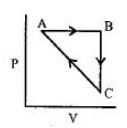
\(\Delta {U_{AB}} = {q_{AB}} + {W_{AB}} = 2 + ( - 5) = - 3\,kJ/mol\)\(\Delta {U_{BC}} = - 5\,kJ/mol\)
For cyclic procrss, \(\Delta U=0\)
\(\Delta {U_{AB}} + \Delta {U_{BC}} + \Delta {U_{CA}} = 0\)
\(\Delta {U_{CA}} = - \Delta {U_{AB}} - \Delta {U_{BC}}\)
\(\Delta {U_{CA}} = - ( - 3) - ( - 5) = 8\,kJ/mol\)
\(\Delta {U_{CA}} = {q_{CA}} + {W_{CA}}\)
\(8 = {q_{CA}} + 3\)
\({q_{CA}} = + 5\,kJ/mol\)
Heat absorbed has positive sign.
-
- (A) \(C\) (હીરો) \(\to\) \(C\) (ગ્રેફાઇટ)
- (B) \(N_2(g,\,1\,atm) \to N_2(g,\,5\,atm)\)
- (C) \(N_2(g,\,273\,K) \to N_2(g,\,300\,K)\)
- (D) \(H_2(g) \to 2H(g)\)
જવાબ અને ઉકેલ જુઓ
સાચો જવાબ: (B)
\((a)\) When diamond is converted into graphite when it is heated to \(1500\,^oC\) and entropy is increased so \(\Delta S > 0\) \((b)\) When pressure increases then molecules of gas will come closer and intermolecular distance decreases so entropy will also decrease and \(\Delta S < 0\) \((c)\) When we increase the temperature of a gas then random ness is increased due to kinetic energy gained by molecules. So, \(\Delta S > 0\) \((d)\) \(H_2\) molecule is converted into atoms, the no. of particles increases . Thus entropy will increase. So, \(\Delta S > 0\)
આ પેજ પર આ ફિલ્ટર મુજબ કોઈ પ્રશ્ન નથી.