


2018 में पूछे गए अध्याय
17 अध्याय- 1प्रश्न STD 11 साम्यावस्था - 2
- 1प्रश्न STD 12 जैव-अणु
- 1प्रश्न STD 12 ऐमीन
- 3प्रश्न STD 12 उपसहसंयोजन यौगिक सबसे ज़्यादा पूछा गया
- 1प्रश्न STD 12 D- एवं f-ब्लॉक के तत्व
- 1प्रश्न STD 12 P-ब्लॉक के तत्व - 2
- 2प्रश्न STD 12 रासायनिक बलगतिकी
- 2प्रश्न STD 12 वैद्युत रसायन
- 1प्रश्न STD 12 Solution and colligative properties
- 2प्रश्न STD 11 रसायन विज्ञान की कुछ मूल अवधारणाएँ
- 1प्रश्न STD 11 Organic chemistry Nomenclature of organic compounds
- 3प्रश्न STD 11 रासायनिक आबंधन तथा आण्विक संरचना सबसे ज़्यादा पूछा गया
- 1प्रश्न STD 11 तत्त्वों का वर्गीकरण एवं गुणधर्मों में आवर्तिता
- 3प्रश्न STD 11 साम्यावस्था - 1 सबसे ज़्यादा पूछा गया
- 3प्रश्न STD 11 ऊष्मागतिकी
- 2प्रश्न STD 11 P-ब्लॉक तत्त्व
- 2प्रश्न STD 11 परमाणु की संरचना
JEE Mains 2018 Chemistry के सभी प्रश्न
17 अध्याय30 में से 1–30 प्रश्न
-
- (A) \(1.798\)
- (B) \(0.36\)
- (C) \(17.95\)
- (D) \(0.18\)
उत्तर और हल देखें
सही उत्तर: (D)
\({({K_{sp}})_{PbC{l_2}}} = 3.2 \times {10^{ - 8}} = 32 \times {10^{ - 9}}\)\(PbC{l_2} \leftrightarrow \mathop {P{b^{2 + }}}\limits_s + \mathop {2C{l^ - }}\limits_{2s} \)
\({K_{sp}} = [p{b^{2 + }}]{[C{l^ - }]^2}\)
\({K_{sp}} = 4{s^3} = 32 \times {10^{ - 9}}\)
\({s^3} = 8 \times {10^{ - 9}}\)
\(s = 2 \times {10^{ - 3}}\,M\)
\(\frac{w}{{M.W.}} \times \frac{1}{{{V_L}}} = 2 \times {10^{ - 3}}\)
\(\frac{{0.1}}{{278}} \times \frac{1}{{{V_L}}} = 2 \times {10^{ - 3}}\)
\({V_L} = \frac{{0.1 \times 1000}}{{278 \times 2}} = 0.18\,L\)
-
- (A) सेलुलोस तथा ऐमिलोस में \(1,4-\) ग्लाइकोसिडीय बंध होता है।
- (B) लैक्टोस में \(\beta -D-\) गैलैक्टोस तथा \(\beta -D-\) ग्लूकोस उपस्थित होते हैं।
- (C) माल्टोस तथा लैक्टोस में \(1,4-\) ग्लाइकोसिडीय बंध होता है।
- (D) सुक्रोस तथा ऐमिलोस में \(1 ,2-\) ग्लाइकोसिडीय बंध होता है।
उत्तर और हल देखें
सही उत्तर: (D)
In amylose \(1, 4-\alpha -\) glycosidic linkage is present -
- (A) \((A) < (B) < ( D) < (C)\)
- (B) \((A)<(B) <(C) <(D)\)
- (C) \((B) <(A) < (C) <(D)\)
- (D) \((B) <(A) <(D)<(C)\)
उत्तर और हल देखें
सही उत्तर: (A)
In the given substituted benzene rings, the substitutents methoxy \((- OCH_3)\) and amino \((-NH_2)\) are strongly activating groups while methyl \((- CH_3)\) is weakly activating and chloro \((- Cl) \) is a deactivating group towards electrophilic aromatic substituation reaction. Since among methyl and methoxy group, methoxy group is more reactive than methyl group, \(( c)\) is more reactive than \((d)\). Although amino group is strongly activating group, it gets protonated in presence of acid to form anilinium ion \(\left( { - \mathop N\limits^ + {H_3}} \right)\) which is strongly deactivating. Hence, \((a)\) is less reactive than \((c)\) and \((d)\) . Chloro group is also deactivating group but less deactivating than \(\left( { - \mathop N\limits^ + {H_3}} \right)\). Thus order is \((a) < (b) < (d) < (c)\). Note: The activating groups increases the electron density on benzene ring and increases the rate of electrophilic aromatic substitution reaction. The deactivating groups decreases the electron density on benzene ring and decreases the rate of electrophilic aromatic substitution reaction. -
- (A) पोटैशियम ट्रिस(आक्सैलेटो)क्रोमेट \((III)\)
- (B) पेन्टाएक्वाक्लोरोक्रोमियम \((III)\) क्लोराइड
- (C) एक्वाक्लो रो बिस ( एथिलीनडाइऐमीन ) कोबाल्ट \((II)\) क्लोराइड
- (D) पोटैशियम ऐमीनट्राईक्लोरोप्लेटिनेट \((II)\)
उत्तर और हल देखें
सही उत्तर: (C)
\([Co(H_2O)Cl(en)_2]Cl\)
-
- (A) \(\left[ NiCl _{1}\right]^{2-} -\) वर्ग \(-\) समतली; \(\left[ Ni ( CN )_{4}\right]^{2-}-\) अनुचुम्बकीय
- (B) \(\left[ NiCl _{4}\right]^{2-}-\) चतुष्फलंकीय; \(\left[ Ni ( CO )_{4}\right]-\) अनुचुम्बकीय
- (C) \(\left[ Ni ( Cl )_{4}\right]^{2-} -\) अनुचुम्बकीय; \(\left[ Ni ( CO )_{4}\right]-\) चतुष्कलकीय
- (D) \(\left[ NiCl _{4}\right]^{2-}-\) प्रतिचुम्बकीय; \(\left[ Ni ( CO )_{4}\right]-\) वर्ग \(-\) समतली
उत्तर और हल देखें
सही उत्तर: (C)
\([Ni(CN)]^{2-}\) is square planar, diamagnetic (\(0\) unpaired electrons) with \(dsp^2\) hybridisation.\([Ni(CO)_4] -\) is tetrahedral,diamagnetic (\(0\) unpaired electrons) with \(sp^3\) hybridisation. \([NiCl_4]^{2-}\) is tetrahedral, paramagnetic (\(2\) unpaired electrons) with \(sp^3\) hybridisation.Hence, the option \((c)\) is the correct answer -
- (A) \(sp^3d,\) त्रिसमनताक्ष द्विपिरैमिडी
- (B) \(d^2sp^3,\) अष्टफलकीय
- (C) \(dsp^2,\) वर्ग समतली
- (D) \(sp^3,\) चतुष्फलकीय
उत्तर और हल देखें
सही उत्तर: (C)
Wilkinson catalyst is \([RhCl(PPh_3)_3].\) -
- (A) \(Mn\)
- (B) \(Cr\)
- (C) \(V\)
- (D) \(Ti\)
उत्तर और हल देखें
सही उत्तर: (A)
\(Mn{O_2} + KOH + KN{O_3} \to \mathop {{K_2}Mn{O_4}}\limits_{(dark\,\,green)} + KN{O_2} + {H_2}O\)\(MnO_4^{2 - } + 4{H^ + }\xrightarrow[{tionation}]{{dispropor}}\mathop {2MnO_4^ - }\limits_{(dark\,purple)} + Mn{O_2} + 2{H_2}O\)
-
- (A) \(XeOF_4(+6)\) तथा \(XeO_3(+6)\)
- (B) \(XeO_2(+4)\) तथा \(XeO_3(+6)\)
- (C) \(XeOF_4(+6)\) तथा \(XeO_2F_2(+6)\)
- (D) \(XeO_2F_2(+6)\) तथा \(XeO_2(+4)\)
उत्तर और हल देखें
सही उत्तर: (C)
\(Xe{{F}_{6}}\,+\,{{H}_{2}}O\,\xrightarrow[hydrolysis]{particle}\underset{'X'}{\mathop{\overset{+6}{\mathop{Xe}}\,O{{F}_{4}}}}\,\,+\,2HF\)\(Xe\mathop {O{F_4}}\limits_{'X'} \, + {H_2}O\, \to \mathop {\mathop {Xe}\limits^{ + 6} {O_2}{F_2}}\limits_{'Y'} \, + \,2HF\)
-
- (A) \(136.25\)
- (B) \(106.25\)
- (C) \(175.0\)
- (D) \(116.25\)
उत्तर और हल देखें
सही उत्तर: (B)
\({N_2}{O_5}\, \to \,2N{O_2}\, + \,\frac{1}{2}{O_2}\)At \(t=0\) \(50\) \(0\) \(0\)
At \(t=50\,min\) \(50-p_1\) \(2p_1\) \(\frac {p_1}{2}\)
Total pressure at \(50\,\min\)
\(=\,50-p_1+2p_1+\frac {p_1}{2}=87.5\)
\(50+\frac {3p_1}{2}=87.5\)
\(\frac{{3{p_1}}}{2}\, = \,37.5\)
\(\therefore \,\,{p_1}\, = \frac{{\,37.5\, \times 2}}{3}\, = \,25\)
At \(t=100\,min\) \(50-p_2\) \(2p_2\) \(\frac {p_2}{2}\)
\(50\,\min\) is half life period
For \(100\,\min\) i.e., for \(2\) half lives \(50-p_2=12.5\)
\(\therefore \,\,{p_2}\, = 37.5\,mm\) of \(Hg\)
Total pressure at \(100\,\min\)
\( = {\mkern 1mu} 50 - {p_2} + 2{p_2} + \frac{{{p_2}}}{2}\)
\( = {\mkern 1mu} 50 + \frac{{3{p_2}}}{2}\, = \,50 + \frac{3}{2} \times 37.5\)
\(=\,50\,+\,56.25\)
\(=\,106.25\,mm\) of \(Hg\)
-
- (A) \(2\)
- (B) \(3\)
- (C) \(0\)
- (D) \(1\)
उत्तर और हल देखें
सही उत्तर: (D)
First order reaction as halflife is constant.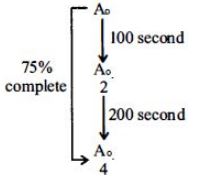
-
- (A) \(109\)
- (B) \(98.1\)
- (C) \(9.81\)
- (D) \(10.9\)
उत्तर और हल देखें
सही उत्तर: (C)
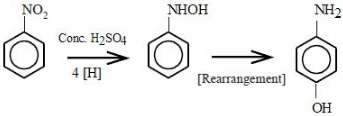
\(9. 65\) ampere current was passed for \(1 .0\) hour ( \(3600\) seconds) Number of moles of electrons passed \( = \frac{{I(A) \times t(s)}}{{96500}} = \frac{{9.65A \times 3600s}}{{96500}} = 0.36\,moles\)\({C_6}{H_5}N{O_2}\, + \,4{e^ - } + 4{H^ + } \to \,{\text{p - Aminophenol}} + {H_2}O\)
\(4\) moles of electrons will reduce \(1\) mole of nitrobenzene to \(p-\) aminophenol. \(0.36\) moles of electrons will reduce \(\frac{{0.36}}{4} = 0.09\) moles of nitrobenzene to \(p-\) aminophenol \(p-\) aminophenol molar mass \(= 109 .14\,\,g/mol\) Mass of \(p-\) aminophenol obtained \(= 109.14\,g/mol \times 0.09\,mol = 9.81\,g\)
-
- (A) \(2.0\)
- (B) \(0.1\)
- (C) \(0.5\)
- (D) \(1.0\)
उत्तर और हल देखें
सही उत्तर: (D)
Reduction at cathode:\(2{e^ - }\, + \,2{H_2}O\, \to \,{H_2}\, + \,2O{H^ - }\)
(valence factor) \(H_2=2\)
At \(NTP\) \(22400\,mL\) of \(H_2=1\,mole\) of \(H_2\,\,112\,mL\) of
\({H_2}\, = \,\frac{1}{{22400}}\, \times \,112\, = \,0.005\,mole\) of \(H_2\)
Moles of \(H_2\) produced
\( = \frac{{I\, \times t}}{{96500}}\, \times \) mole ratio
\(0.005 = \frac{{I\, \times 965}}{{96500}}\, \times \frac{{1\,\,mole\,\,of\,\,{H_2}}}{{2\,\,mole\,\,of\,\,{e^ - }}}\)
\(I\,=\,1.0\,A\)
-
- (A) \(37.5\)
- (B) \(75\)
- (C) \(150\)
- (D) \(50\)
उत्तर और हल देखें
सही उत्तर: (C)
Molar mass of octane \(=\,114\,g/mol\)From the lowering of vapour pressure we have,
\(\frac{{\Delta P}}{P} = \frac{{\frac{{{W_2}}}{{{M_2}}}}}{{\frac{{{W_2}}}{{{M_2}}} + \frac{{{W_1}}}{{{M_1}}}}}\)
\(\frac{{75}}{{100}} = \frac{{\frac{{{W_2}}}{{50\,g/mol}}}}{{\frac{{{W_2}}}{{50\,g/mol}} + \frac{{114\,g}}{{114\,g/mol}}}}\)
\(0.75 = \frac{{\frac{{{W_2}}}{{50}}}}{{\frac{{{W_2}}}{{50\,}} + 1}}\)
\(\frac{{{W_2}}}{{50}} + 1\, = \,\frac{{{W_2}}}{{50\, \times \,0.75}}\)
\({W_2}\, = \,150\,g\)
Note : \(W_2\) vand \(M_2\) are mass and molar mass of solute and \(W_1\) and \(M_1\) are mass and molar mass of octane.
-
- (A) \(6.023 \times {10^9}\)
- (B) \(6.023 \times {10^{23}}\)
- (C) \(6.023 \times {10^{21}}\)
- (D) \(6.023 \times {10^{20}}\)
उत्तर और हल देखें
सही उत्तर: (D)
Given percentage of chlorine in an hydrocarbon \(= 3.55\%\) i,e.,\(100\,g\) of chlorohydrocarbon has \(3.55\,g\) of chlorine.
\(1\,g\) of chlorohydrocarbon will have \(\frac{{3.55}}{{100}} = 0.0355\,g\) of chlorine.
Atomic wt. of \(Cl = 35.5\,g/mol\)
Number of moles of \(Cl\) \( = \frac{{0.0355\,g}}{{35.5\,g/mol}} = 0.001\) \(mole\)
Number of atoms of \(Cl = 0.001\,mole\) \(\times 6.023 \times 10^{23}\,mol^{-1}\)
\(= 6.023 \times 10^{20}\)
-
- (A) \(0.35\)
- (B) \(0.54\)
- (C) \(0.41\)
- (D) \(0.48\)
उत्तर और हल देखें
सही उत्तर: (D)
No of moles of oxygen in \(0.16\,g\) of oxygen molecule\( = \frac{{0.16\,g}}{{32\,g/mol}} = 0.005\,mole\)
\(2NaCl{O_3}\xrightarrow{\Delta }2NaCl + 3{O_2}\)
According to the reaction,
\(3\) moles of \(O_2\) \(=\) \(2\) moles of \(NaCl\) \(=\) \(2\) moles of \(AgCl\)
Molar mass of \(AgCl = 143.5\,g/mol\)
\(0.005\) moles of \(O_2\) will ppt. \( = 0.005 \times \frac{2}{3}\) moles \(AgCl\)
\(= 0.0033\) moles of \(AgCl\)
\(\therefore \) Mass of \(AgCl\) (in \(g\)) obtained will be
\(= 143.5\,g/mol \times 0.0033\) \(moles\) \(= 0.48\,g\)
-
- (A) \((A)-(s); (B)-(r); (C)-(q); (D)-(p)\)
- (B) \((A)-(r); (B)-(s); (C)-(p); (D)-(q)\)
- (C) \((A)-(r); (B)-(s); (C)-(q); (D)-(p)\)
- (D) \((A)-(s); (B)-(r); (C)-(p); (D)-(q)\)
उत्तर और हल देखें
सही उत्तर: (B)
\(\to \) Phenelzine contains hydrazine
\(\to \) Chloroxylenol contains phenol
\(\to \) Uracil is the pyrimidine base
\(\to \) Ranitidine contains furan ring - 17. आणिवक आयन, \(N _{2}^{+}\) के लिए आणिव्वक कक्षक डायग्राम में, \(\sigma_{2 p}\) आणिवक कक्षक में इलेक्ट्रॉनों की संख्या है 2018 मध्यम
- (A) \(0\)
- (B) \(2\)
- (C) \(3\)
- (D) \(1\)
उत्तर और हल देखें
सही उत्तर: (D)
Total electrons in \(N_2^ + = (7 \times 2) - 1 = 13\)\(N_2^ + \to {\sigma _{1{s^2}}},\sigma _{1{s^2}}^*,{\sigma _{2{s^2}}},\sigma _{2{s^2}}^*,[\pi _{2{p_x}}^2 = \pi _{2{p_y}}^2]\sigma _{2{p_z}}^1\)
Number of electron in \({\sigma _2}_{{p_z}}\) is \(1\)
-
- (A) \(NF_3-\) त्रिसमनताक्ष समतली
- (B) \(BF_3-\) त्रिसमनताक्ष समतली
- (C) \(AsF_5-\) त्रिसमनताक्ष द्विपिरैमिडी
- (D) \(H_2O-\) बंकित
उत्तर और हल देखें
सही उत्तर: (A)
\(NF_3\) has trigonal pyramidal geometry. \(N\) atom has one lone pair and three bond pairs of electrons. The electron pair geometry is tetrahedral and molecular geometry is trigonal pyramidal . The bond angles are lower than tetrahedral bond angles due to lone pair - lone pair and lone pair - bond pair repulsions. \(N\) atom is \(sp^3\) hybridised
-
- (A) \({H_2}O\, \to \,{H_3}{O^ + }\)
- (B) \(B{F_3}\, \to \,BF_4^ - \)
- (C) \(C{H_4}\, \to \,{C_2}{H_6}\)
- (D) \(N{H_3}\, \to \,NH_4^ + \)
उत्तर और हल देखें
सही उत्तर: (B)
\(B{F_3}\, \to \,BF_4^ - \)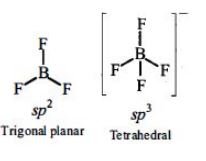
- 20. \(Na ^{+}, Mg ^{2+}, F ^{-}\) तथा \(O ^{2-}\) के लिये, आयनिक त्रिज्याओं का बढ़ता सही क्रम है 2018 मध्यम
- (A) \({O^{2 - }} < {F^ - } < N{a^ + } < M{g^{ 2+}}\)
- (B) \(N{a^ + } < M{g^{ 2+}} < {F^ - } < {O^{2 - }}\)
- (C) \(M{g^{ 2+}} < N{a^ + } < {F^ - } < {O^{2 - }}\)
- (D) \(M{g^{ 2+}} < {O^{2 - }} < N{a^ + } < {F^ - }\)
उत्तर और हल देखें
सही उत्तर: (C)
All species are isoelectronic \((10e^-)\). isoelectronic series, when negative charge increases the radius of ion increases\(\therefore M{g^{ 2+}} < N{a^ + } < {F^ - } < {O^{2 - }}\)
-
- (A) \(1844\)
- (B) \(2068\)
- (C) \(4281\)
- (D) \(4763\)
उत्तर और हल देखें
सही उत्तर: (C)
In the reaction \({A_2} \leftrightarrow 2A\)Initially, Let \([{A_2}] = 1\,M\) and \([A] = 0\,M\)
After \(20\%\) dissociation , \(80\%\) of \(A_2\) remains.
\([{A_2}] = 1 \times \frac{{80}}{{100}} = 0.8\,M\)
\(20\%\) of \(1\,M\) is
\(1 \times \frac{{20}}{{100}} = 0.2.\,[A] = 2 \times 0.2 = 0.4\,M\)
The equilibrium constant
\(K = \frac{{{{[A]}^2}}}{{[{A_2}]}};\) \(K = \frac{{{{[0.4]}^2}}}{{[0.8]}} = 0.2\)
\(\Delta {G^o} = - RT\,\ln \,K = - 8.314\,J{K^{ - 1}}\,mo{l^{ - 1}}\)
\( \times 320\,K \times \ln \,0.2 = 4281\,J/mol\)
-
- (A) नियत दाब पर एक अक्रिय गैस डालने से
- (B) ताप को कम करने से
- (C) दाब को बढ़ाने से
- (D) नियत आयतन पर एक अक्रिय गैस डालने से
उत्तर और हल देखें
सही उत्तर: (A)
Reaction at equilibirium \({N_2}{O_4}\, \rightleftharpoons \,2N{O_2}\)According to Le chatelier's principle-
\((a)\) addition of an inert gas at constant pressure will increase volume and equilibirium shifts towards more number of molecules.
\((b)\) Decomposition of \(N_2O_4\) will be endothermic, so reaction wil move in forward reaction when temperature is increased.So, It is incorrect. It will not effect reaction (volume is constant)
\((c)\) Increasing the pressure on a gas reaction shifts the position of equilibirium towards
the side with fewer molecules. So, It will move in backward direction which leads to formation of \(N_2O_4\) from \(NO_2\) - 23. निम्न अभिक्रियाओं में से किसमें पात्र के आयतन में वृद्धि उत्पाद बनने में अनुकूल पड़ेगी ? 2018 मध्यम
- (A) \(4NH_3(g) + 5O_2(g)\) \(\rightleftharpoons\) \(4NO(g) + 6H_2O(l)\)
- (B) \(2NO_2(g)\) \(\rightleftharpoons\) \(2NO(g)+O_2(g)\)
- (C) \(3O_2\) \(\rightleftharpoons\) \(2O_3(g)\)
- (D) \(H_2(g)+I_2(g)\) \(\rightleftharpoons\) \(2HI(g)\)
उत्तर और हल देखें
सही उत्तर: (B)
Volume \( \uparrow P \downarrow \), reaction proceeds in which direction where the number of moles of gases increases. -
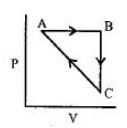
- (A) \( - 5\)
- (B) \( + 5\)
- (C) \( 18\)
- (D) \( -18\)
उत्तर और हल देखें
सही उत्तर: (B)
\(\Delta {U_{AB}} = {q_{AB}} + {W_{AB}} = 2 + ( - 5) = - 3\,kJ/mol\)\(\Delta {U_{BC}} = - 5\,kJ/mol\)
For cyclic procrss, \(\Delta U=0\)
\(\Delta {U_{AB}} + \Delta {U_{BC}} + \Delta {U_{CA}} = 0\)
\(\Delta {U_{CA}} = - \Delta {U_{AB}} - \Delta {U_{BC}}\)
\(\Delta {U_{CA}} = - ( - 3) - ( - 5) = 8\,kJ/mol\)
\(\Delta {U_{CA}} = {q_{CA}} + {W_{CA}}\)
\(8 = {q_{CA}} + 3\)
\({q_{CA}} = + 5\,kJ/mol\)
Heat absorbed has positive sign.
-
- (A) \({N_2}(g) + 3{H_2}(g) \to 2N{H_3}(g)\)
- (B) \(2HI(g) \to H_2(g) + I_2(g)\)
- (C) \(2SO_2 (g) + O_2 (g) \to 2SO_3 (g)\)
- (D) \(2NO_2 (g) \to N_2O_4 (g)\)
उत्तर और हल देखें
सही उत्तर: (B)
\(\Delta H = \Delta U + \Delta {n_g}RT\)\(2HI(g) \to {H_2}(g) + {I_2}(g);\Delta {n_g} = (1 + 1) - 2 = 0\)
\(\therefore \,\Delta H = \Delta U + 0\)
-
- (A) \(C\) (हीरा) \(\to\) \(C\) (ग्रेफाइट)
- (B) \(N_2(g,\,1\,atm) \to N_2(g,\,5\,atm)\)
- (C) \(N_2(g,\,273\,K) \to N_2(g,\,300\,K)\)
- (D) \(H_2(g) \to 2H(g)\)
उत्तर और हल देखें
सही उत्तर: (B)
\((a)\) When diamond is converted into graphite when it is heated to \(1500\,^oC\) and entropy is increased so \(\Delta S > 0\)
\((b)\) When pressure increases then molecules of gas will come closer and intermolecular distance decreases so entropy will also decrease and \(\Delta S < 0\)
\((c)\) When we increase the temperature of a gas then random ness is increased due to kinetic energy gained by molecules. So, \(\Delta S > 0\)
\((d)\) \(H_2\) molecule is converted into atoms, the no. of particles increases . Thus entropy will increase. So, \(\Delta S > 0\) - 27. ग्रेफाइट तथा डायमंड के संकरण में, संकर कक्षकों के \(p-\) गुणों की प्रतिशतता क्रमशः होगी : 2018 कठिन
- (A) \(33\) तथा \(25\)
- (B) \(67\) तथा \(75\)
- (C) \(50\) तथा \(75\)
- (D) \(33\) तथा \(75\)
उत्तर और हल देखें
सही उत्तर: (B)
\(\%\) of \(p-\) in graphite \({(sp)^2} = \frac{2}{3} \times 100 = 67\% \)\(\%\) of \(p-\) in diamond \({(sp)^3} = \frac{3}{4} \times 100 = 75\% \)
-
- (A) \(B\)
- (B) \(Al\)
- (C) \(In\)
- (D) \(Ga\)
उत्तर और हल देखें
सही उत्तर: (A)
\(BCl_3\)\(B+C{{l}_{2}}\to \underset{\begin{smallmatrix}
[does\,not\,dimerise\,due\,to\, \\
(p\pi -p\pi )back\,bonding]
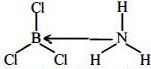
\end{smallmatrix}}{\mathop{BC{{l}_{3}}}}\,\xrightarrow{N{{H}_{3}}}\)\(BCl_3\) is electron deficient but it does not form dimer like \(Al,Ga\) or \(In\) because its electron deficiency is complemented by the formation of co-ordinate bond between lone pair of electron of chlorine and empty unhybridized \(p-\) orbital of boron forming \(p\pi -p\pi\) bonding.
-
- (A) विद्युत क्षेत्र में स्पेक्ट्रल रेखाओं के विपाटन को स्टार्क प्रभाव कहते हैं।
- (B) ताप के बढ़ने पर, एक कृष्णिका से निकलने वाले विकरणण की आवृत्ति, निम्न तरंगदैर्ध्य से उच्च तरंगदैर्ध्य की ओर जाती है।
- (C) फोटान का संवेग तथा तरंगदैर्ध्य दोनों होते हैं।
- (D) रिडबर्ग स्थिरांक का मात्रक, ऊर्जा का मात्रक होता है।
उत्तर और हल देखें
सही उत्तर: (B)
When temperature is increased, black bodyemit high energy radiation, from higher wavelength to lower wavelength . Rydberg constant has unit of length i.e. \(cm^{-1}\) -
- (A) \(4\)
- (B) \(5.5\)
- (C) \(4.5\)
- (D) \(5\)
उत्तर और हल देखें
सही उत्तर: (C)
\(\lambda = 250\,nm = 2500\,\mathop A\limits^o \)\(E = \frac{{hc}}{\lambda } = \frac{{12400}}{{2500}} = 4.96\,eV\)
\(KE = \) stopping potential \( = 0.5\,eV\)
\(E = {W_0} + K.E.\)
\(4.96 = {W_0} + 0.5\)
\({W_0} = 4.46 \approx 4.5\,eV\)

इस पेज पर इन फ़िल्टर से कोई प्रश्न नहीं मिला।
अन्य वर्ष
अक्सर पूछे जाने वाले प्रश्न
ExamBro पर JEE Mains 2018 Chemistry के कितने प्रश्न हैं?
30 प्रश्न, हर एक सही उत्तर और पूरे हल के साथ।
JEE Mains 2018 Chemistry का कौन-सा अध्याय सबसे ज़्यादा पूछा जाता है?
उपसहसंयोजन यौगिक, 3 प्रश्नों के साथ; उसके बाद रासायनिक आबंधन तथा आण्विक संरचना, 3 प्रश्नों के साथ।
JEE Mains 2018 Chemistry के प्रश्न कितने कठिन होते हैं?
0% आसान, 23% मध्यम और 77% कठिन।