


D અને f-વિભાગનાં તત્ત્વો ના બધા પ્રશ્નો
નવા પહેલા209 માંથી 151–200 પ્રશ્નો
-
- (A) \({Cr}-{O}-{Cr}\) બંધ રેખીય સંમિતિય છે.
- (B) \({Cr}-{O}-{Cr}\) બંધ બિન-રેખીય સંમિતિય છે.
- (C) \({Cr}-{O}-{Cr}\) બંધ રેખીય બિન-સંમિતિય છે.
- (D) \({Cr}-{O}-{Cr}\) બંધ બિન-રેખીય બિન-સંમિતિય છે.
જવાબ અને ઉકેલ જુઓ
સાચો જવાબ: (B)
dichromate ion contain non-linear symmetrical \({Cr}-{O}-{Cr}\) Bond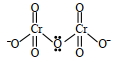
- 152. ડાયક્રોમેટ આયનની બેઈઝ સાથે પ્રક્રિયા કરવામાં આવે છે. તો બનતી નીપજમાં \(Cr\) નો ઓક્સિડેશન આંક ........... 2021 સરળ
- (A) \(3\)
- (B) \(4\)
- (C) \(5\)
- (D) \(6\)
જવાબ અને ઉકેલ જુઓ
સાચો જવાબ: (D)
\(Cr _{2} O _{7}^{2-}+ OH ^{-} \longrightarrow CrO _{4}^{2-}\)Oxidation state of \(Cr\) in \(CrO _{4}^{2-}\) is \(+6\)
-
- (A) \(X = SO _{2}, Y = Cr _{2} O _{3}\)
- (B) \(X = SO _{3}, Y = Cr _{2} O _{3}\)
- (C) \(X = SO _{2}, Y = Cr _{2}\left( SO _{4}\right)_{3}\)
- (D) \(X = SO _{3}, Y = Cr _{2}\left( SO _{4}\right)_{3}\)
જવાબ અને ઉકેલ જુઓ
સાચો જવાબ: (C)
\(SO _{2}+ dil H _{2} SO _{4} \longrightarrow SO _{3}( g )\)\(Cr _{2}\left( SO _{4}\right)_{3}\)
-
- (A) \(4 f^{7} 6 {~s}^{2}\)
- (B) \(4 f^{6}\)
- (C) \(4 f^{7}\)
- (D) \(4 f^{6} 6 {~s}^{2}\)
જવાબ અને ઉકેલ જુઓ
સાચો જવાબ: (C)
\({Eu} \rightarrow[{Xe}] 4 {f}^{7} 6 {~s}^{2}\)\({Eu}^{2+} \rightarrow[{Xe}] 4 {f}^{7}\)
- 155. \({Ga}^{+}\) આયનના વેલેન્સ ઇલેક્ટ્રોન માટે ચુંબકીય ક્વોન્ટમ આંક \( ..... \) છે (પરમાણ્વીય ક્રમાંક \({Ga}=31\) ) 2021 મધ્યમ
- (A) \(0\)
- (B) \(1\)
- (C) \(2\)
- (D) \(3\)
જવાબ અને ઉકેલ જુઓ
સાચો જવાબ: (A)
\({Ga}^{+}: {1s}^{2} \,2 {~s}^{2}\, 2 {P}^{6}\, 3 {~s}^{2} \,3 {p}^{6}\, 3 {~d}^{10} \,4 {~s}^{2}\)last orbital \(=\) \({s}\)
The azimuthal quantum number for the valenceelectrons \((4s-\)subshell) of \({Ga}+\) ion is zero\((0).\)
- 156. \({Gd}^{2+}\)ની ધરા અવસ્થાની ઇલેક્ટ્રોનિક રચનામાં \(4 f\) ઇલેક્ટ્રોનની સંખ્યા \(........\) છે. [પરમામાણ્વીય ક્રમાંક \({Gd}=64\) ] 2021 મધ્યમ
- (A) \(7\)
- (B) \(6\)
- (C) \(1\)
- (D) \(8\)
જવાબ અને ઉકેલ જુઓ
સાચો જવાબ: (A)
The electronic configuration of\({ }_{64} {Gd}:[{Xe}] 4 {f}^{7} 5 {~d}^{1} 6 {~s}^{2}\)
So the electronic configuration of
\({ }_{64} {Gd}^{2+}:[{Xe}] 4 {f}^{7} 5 {~d}^{1} 6 {~s}^{0}\)
\(i.e.\) the number of \(4 {f}\) electrons in the ground state electronic configuration of \({Gd}^{2+}\) is \(7\)
-
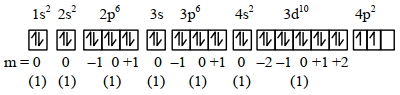
- (A) \(4\)
- (B) \(6\)
- (C) \(5\)
- (D) \(7\)
જવાબ અને ઉકેલ જુઓ
સાચો જવાબ: (D)
Completely filled orbital with \({m}_{\ell}=0\) are\(=1+1+1+1+1+1+1\)
\(=7\)
So Answer is \(7\)
-
- (A) \(1.73,3.87,0\)
- (B) \(0,3.87,1.73\)
- (C) \(3.87,1.73,0\)
- (D) \(1.73,0,3.87\)
જવાબ અને ઉકેલ જુઓ
સાચો જવાબ: (A)
\(\mu=\sqrt{n(n+2)} B M\)\(n=\) number of unpaired electrons
\(T_{i}^{i+3}=\text { Ar }] 3 d^{1} \quad \quad\quad n=1 \quad \quad \mu=1.73\, {BM}\)
\({V}^{+2}= \text { [Ar]3d }^{3} \quad \quad \quad {n}=3 \quad \quad \mu=3.87\, {BM}\)
\({Sc}^{+3}=[{Ar}] 3 {~d}^{0} 4 {~s}^{0} \quad \quad {n}=0 \quad \quad \mu=0\)
- 159. નીચે આપેલા લેન્થનોઈડસ પૈકી કયો એક \(MO _{2}\) બનાવશે નહીં ? \([M\) એ લેન્થેનોઈડ ધાતુ છે.] 2021 સરળ
- (A) \(\operatorname{Pr}\)
- (B) \(Dy\)
- (C) \(Nd\)
- (D) \(Yb\)
જવાબ અને ઉકેલ જુઓ
સાચો જવાબ: (D)
\(Y b\) is the only element that do not form \(MO _{2}\) type oxide -
- (A) \(Cr < Zn < Co < Cu < Fe\)
- (B) \(Zn < Cu < Co < Fe < Cr\)
- (C) \(Zn < Cr < Fe < Co < Cu\)
- (D) \(Cr < Fe < Co < Cu < Zn\)
જવાબ અને ઉકેલ જુઓ
સાચો જવાબ: (C)
\(Density /g cm^{-3}\)\(\begin{array}{*{20}{c}} {Zn}& < &{Cr}& < &{Fe}& < &{Co}& < &{Cu} \\ \downarrow &{}& \downarrow &{}& \downarrow &{}& \downarrow &{}& \downarrow \\ {7.1}&{}&{7.19}&{}&{7.8}&{}&{8.7}&{}&{8.9} \end{array}\)
-
- (A) \(Cr ^{+}\) અને \(Mn ^{2+}\)
- (B) \(Ni ^{2+}\) અને \(Cu ^{+}\)
- (C) \(Fe ^{2+}\) અને \(Co ^{+}\)
- (D) \(V ^{2+}\) અને \(Cr ^{+}\)
જવાબ અને ઉકેલ જુઓ
સાચો જવાબ: (A)
\(\begin{array}{ll}\text { Option }-1 & Mn ^{+2}[ Ar ] 3 d ^{5}, Cr ^{+}[ Ar ] 3 d ^{5} \\ \text { Option }-2 & Ni ^{+2}[ Ar ] 3 d ^{8}, Cu ^{+}[ Ar ] 3 d ^{10} \\ \text { Option }-3 & Fe ^{+2}[ Ar ] 3 d ^{6}, Co ^{+}[ Ar ] 3 d ^{7} 4 s ^{1} \\ \text { Option }-4 & V ^{+2}[ Ar ] 3 d ^{3}, Cr ^{+}[ Ar ] 3 d ^{5}\end{array}\) -
- (A) વિધાન \(I\) ખોટું છે પરંતુ વિધાન \(II\) સાચું છે.
- (B) વિધાન \(I\) સાચું છે પરંતુ વિધાન \(II\) ખોટું છે.
- (C) બન્ને, વિધાનો \(I\) અને વિધાન \(II\) સાચાં છે.
- (D) બન્ને, વિધાનો \(I\) અને વિધાન \(II\) ખોટાં છે.
જવાબ અને ઉકેલ જુઓ
સાચો જવાબ: (C)
The \(+3\) oxidation state of lanthanide is most stable and therefore lanthanide in \(+4\) oxidation state has strong tendence to gain \(e ^{-}\) and converted into \(+3\) and therefore act as strong oxidizing agent.\(eg Ce ^{+4}\) And there fore \(CeO _{2}\) is used to oxidized alcohol aldehyde and ketones.
Lanthanide in \(+2\) oxidation state has strong tendency to loss \(e ^{-}\) and converted into \(+3\) oxidation state therefore act as strong reducing agent.
\(\therefore EuSO _{4}\) act as strong reducing agent.
-
- (A) વિધાન \(I\) સાચું છે પણ વિધાન \(II\) ખોટું છે.
- (B) બંને વિધાન \(I\) અને વિધાન \(II\) સાચા છે.
- (C) વિધાન \(I\) ખોટું છે પણ વિધાન \(II\) સાચું છે.
- (D) બંને વિધાન \(I\) અને વિધાન \(II\) ખોટા છે.
જવાબ અને ઉકેલ જુઓ
સાચો જવાબ: (A)
\(2 KMnO _{4} \stackrel{573 K }{\longrightarrow} K _{2} MnO _{4}+ MnO _{2}+ O _{2}\)Potassium Potassium
permanganate \(\quad\) manganate
Statement\(-I\) is correct.
Statement\(-II\) is incorrect
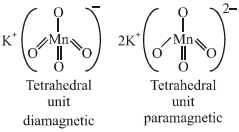
-
- (A) બંને વિધાન \(I\) અને વિધાન \(II\) સાચા છે.
- (B) વિધાન \(I\) ખોટું છે પણ વિધાન \(II\) સાચું છે.
- (C) બંને વિધાન \(I\) અને વિધાન \(II\) ખોટા છે.
- (D) વિધાન \(I\) સાચું છે પણ વિધાન \(II\) ખોટું છે.
જવાબ અને ઉકેલ જુઓ
સાચો જવાબ: (D)
The \(E ^{\circ}\) value for \(Ce ^{4+} / Ce ^{3+}\) is \(+1.74 V\) because the most stable oxidation state of lanthanide series elements is \(+3\) .It means \(Ce ^{3+}\) is more stable than \(Ce ^{4+}\)
-
- (A) \(Fe\)
- (B) \({Mn}\)
- (C) \({Cr}\)
- (D) \(Co\)
જવાબ અને ઉકેલ જુઓ
સાચો જવાબ: (C)
Elements of group \(7,8,9\) do not form hydrides thus \({Cr}\) will only form hydride among the given elements \((Fe, {Mn}, {Co})\) -
- (A) \({ClO}_{2}^{-}, {F}_{2}, {MnO}_{4}^{-}\) અને \({Cr}_{2} {O}_{7}^{2-}\)
- (B) \({Cr}_{2} {O}_{7}^{2-}, {MnO}_{4}^{-}, {ClO}_{2}^{-}\) અને \({Cl}_{2}\)
- (C) \({MnO}_{4}^{-}, {ClO}_{2}^{-}, {Cl}_{2}\) અને \({Mn}^{3+}\)
- (D) \({ClO}_{4}^{-}, {MnO}_{4}^{-}, {ClO}_{2}^{-}\) અને \({F}_{2}\)
જવાબ અને ઉકેલ જુઓ
સાચો જવાબ: (C)
No option contains all species that show disproportionation reaction.\({MnO}_{4}^{-}\)
\(Mn\) is in \(+7\) oxidation state (highest) hence cannot be simultaneously oxidized or reduced
-
- (A) \({Nd}\)
- (B) \({Yb}\)
- (C) \({La}\)
- (D) \({Ce}\)
જવાબ અને ઉકેલ જુઓ
સાચો જવાબ: (B)
Ytterbium shows \(+2\) oxidation state with diamagnetic nature -
- (A) \({CuCl}_{2}\)
- (B) \({AgCl}\)
- (C) \({ZnCl}_{2}\)
- (D) \({Cu}_{2} {Cl}_{2}\)
જવાબ અને ઉકેલ જુઓ
સાચો જવાબ: (A)
\((A)\) \({CuCl}_{2}+{nH}_{2} {O} \rightarrow {Cu}_{\left({aq}_{.}\right)}^{+2}\)\(\quad\quad\quad\quad\quad\quad\quad\quad\)blue colour
\((B)\) \({AgCl}+{nH}_{2} {O} \rightarrow\) Insoluble
\((C)\) \({ZnCl}_{2}+{nH}_{2} {O} \rightarrow {Zn}_{\left({aq}_{.}\right)}^{+2}\)
\(\quad\quad\quad\quad\quad\quad\quad\quad\)Colourless
\((D)\) \({Cu}_{2} {Cl}_{2}+{nH}_{2} {O} \rightarrow\) Insoluble
- 169. \({Np}({Z}=93)\)ની ઇલેક્ટ્રોનિક રચના ધરા અવસ્થામાં \(f\) ઇલેક્ટ્રોનની સંખ્યા \(.......\) છે. 2021 સરળ
- (A) \(2\)
- (B) \(5\)
- (C) \(4\)
- (D) \(6\)
જવાબ અને ઉકેલ જુઓ
સાચો જવાબ: (C)
\({Np}=1 {~s}^{2} 2 {~s}^{2} 2 {p}^{6} 3 {~s}^{2} 3 {p}^{6} 4 {~s}^{2} 3 {~d}^{10} 4 {p}^{6} 5 {~s}^{2} 4 {~d}^{10} 5 {p}^{6} 6 {~s}^{2}\)\(4 {f}^{14} 5 {~d}^{10} 6 {p}^{6} 7 {~s}^{2}-5 {f}^{4} 6 {~d}^{1}\)
Total no. of \('f'\) electron \(=14 {e}^{-}+4 {e}^{-}=18\)
-
- (A) \({Sc}^{3+}, {V}^{5+}, {Ti}^{4+}\)
- (B) \({Cu}^{2+}, {Cr}^{3+}, {Sc}^{+}\)
- (C) \({Ni}^{2+}, {Mn}^{7+}, {Hg}^{2+}\)
- (D) \({Cu}^{+}, {Zn}^{2+}, {Mn}^{4+}\)
જવાબ અને ઉકેલ જુઓ
સાચો જવાબ: (B)
\({Cu}^{2+}:[{Ar}] 3 {~d}^{9} 4 {~s}^{0}\)\({Cr}^{3+}:[{Ar}] 3 {~d}^{3} 4 {~s}^{0}\)
\({Sc}^{+}:[{Ar}] 3 {~d}^{1} 4 {~s}^{1}\)
All are coloured and paramagnetic due to presence of unpaired \({e}^{-}\)
-
- (A) \((a)>(d)>(c)>(b)>(e)\)
- (B) \(({d})>({a})>({b})>({c})>({e})\)
- (C) \((a)>(c)>(d)>(b)>(e)\)
- (D) \((c)>(a)>(d)>(e)>(b)\)
જવાબ અને ઉકેલ જુઓ
સાચો જવાબ: (A)
\((a)\) \(\stackrel{+6}{{C}} {rO}_{3}\)\((b)\) \(\stackrel{+3} {Fe}_{2} {O}_{3}\)
\((c)\) \(\stackrel{+4} {MnO}_{2}\)
\((d)\) \(\stackrel{+5} {V}_{2} {O}_{5}\)
\((e)\) \(\stackrel{+1} {Cu}_{2} {O}\)
So order of oxidation state \(a>d>c>b>e\)
- 172. \({V}_{2} {O}_{3}\) અને \({CrO}\) ઓક્સાઇડનો સ્વભાવ પ્રકાર અનુક્રમે \({X}\) અને \({Y}\) તરીકે અનુક્રમિત છે. \({X}\) અને \({Y}\)નો સાચો સમૂહ છે: 2021 મધ્યમ
- (A) \({X}=\) બેઝિક \(\quad {Y}=\) ઊભયગુણી
- (B) \({X}=\) ઊભયગુણી \(\quad {Y}=\) બેઝિક
- (C) \({X}=\) એસિડિક \(\quad {Y}=\) એસિડિક
- (D) \({X}=\) બેઝિક \(\quad {Y}=\) બેઝિક
જવાબ અને ઉકેલ જુઓ
સાચો જવાબ: (D)
\({V}_{2} {O}_{3}-\) basic\(CrO-\) basic
-
- (A) \(24\)
- (B) \(66\)
- (C) \(89\)
- (D) \(12\)
જવાબ અને ઉકેલ જુઓ
સાચો જવાબ: (D)
\({ }_{23} V: 1 s^{2} 2 s^{2} 2 p^{6} 3 s^{2} 3 p^{6} 3 d^{3} 4 s^{2}\)Number of electrons in p-orbitals is equal to \(12.00\)
-
- (A) \(Dy\)
- (B) \(Eu\)
- (C) \(Ce\)
- (D) \(Tb\)
જવાબ અને ઉકેલ જુઓ
સાચો જવાબ: (B)
Fact -
- (A) \(Cu\)
- (B) \(Hg\)
- (C) \(Au\)
- (D) \(Ni\)
જવાબ અને ઉકેલ જુઓ
સાચો જવાબ: (C)
Atomic radius of \(Ag\) and \(Au\) is nearly same due to lanthanide contraction. - 176. દ્વિસંયોજક યુરોપિયમ અને ત્રિસંયોજક સિરિયમની ઇલેક્ટ્રોન રચના જણાવો. (પરમાણ્વિય ક્રમાંક : \(\mathrm{Xe}=54, \mathrm{Ce}=58, \mathrm{Eu}=63\) ) 2020 મધ્યમ
- (A) \([\mathrm{Xe}] 4 \mathrm{f}^{4}\) અને \([\mathrm{Xe}] 4 \mathrm{f}^{9}\)
- (B) \([\mathrm{Xe}] 4 \mathrm{f}^{7}\) અને \([\mathrm{Xe}] 4 \mathrm{f}^{1}\)
- (C) \([\mathrm{Xe}] 4 \mathrm{f}^{7} 6 \mathrm{s}^{2}\) અને \([\mathrm{Xe}] 4 \mathrm{f}^{2} 6 \mathrm{s}^{2}\)
- (D) \([\mathrm{Xe}] 4 \mathrm{f}^{2}\) અને \([\mathrm{Xe}] 4 \mathrm{f}^{7}\)
જવાબ અને ઉકેલ જુઓ
સાચો જવાબ: (B)
\(\mathrm{Eu}_{63} \Rightarrow[\mathrm{Xe}] 4 \mathrm{f}^{7} 5 \mathrm{d}^{\circ} 6 \mathrm{s}^{2}\)\(\mathrm{Eu}^{2+} \Rightarrow[\mathrm{Xe}] 4 \mathrm{f}^{7}\)
\(\mathrm{Ce}_{58} \Rightarrow[\mathrm{Xe}] 4 \mathrm{f}^{1} 5 \mathrm{d}^{1} 6 \mathrm{s}^{2}\)
\(\mathrm{Ce}^{3+} \Rightarrow[\mathrm{Xe}] 4 \mathrm{f}^{1}\)
- 177. \(Gd ^{3+}( Z =64)\) ની સાચી ઇલેક્ટ્રોનિક રચના અને સ્પિન ફક્ત ચુંબકીય ચાકમાત્રા \((BM)\) અનુક્રમે કઈ છે? 2020 મધ્યમ
- (A) \([ Xe ] 5 f ^{7}\) અને \(8.9\)
- (B) \([ Xe ] 4 f ^{7}\) અને \(7.9\)
- (C) \([ Xe ] 5 f ^{7}\) અને \(7.9\)
- (D) \([ X e ] 4 f ^{7}\) અને \(8.9\)
જવાબ અને ઉકેલ જુઓ
સાચો જવાબ: (B)
Electronic configuration of \(Gd ^{3+}\) is\(64 Gd ^{3+}=[ Xe ] 4 f ^{7}\)
\(Gd ^{3+}\) having \(7\) unpaired electrons.
Magnetic moment \((\mu)=\sqrt{n(n+2)}\) \(B.M.\)
\(\mu=\sqrt{7(7+2)} B \cdot M\)
\(=7.9 B . M\)
\(n \Rightarrow\) Number of unpaired electrons.

-
- (A) \(21,32,53,64\)
- (B) \(21,25,42,72\)
- (C) \(9,17,34,38\)
- (D) \(37,42,50,64\)
જવાબ અને ઉકેલ જુઓ
સાચો જવાબ: (B)
Tranition elements \(=21\) to \(30\)\(37\) to \(48\)
\(57\) \(\&\) \(72\) to \(80\)
Ans. \(21,25,42\, \& 72\)
-
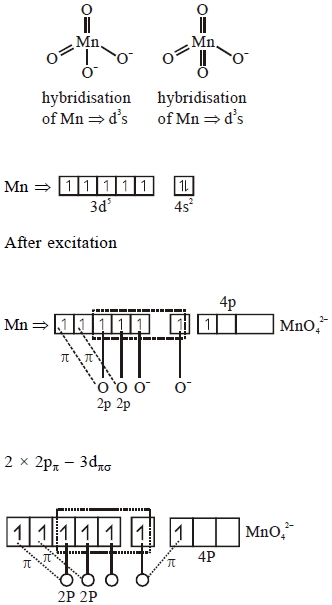
- (A) મેંગેનેટ અને પરમેંગેનેટ આયનોમાં, \( pi \) બંધન \(p- \) ઓક્સિજનના ભ્રમણકક્ષાના સંમિશ્રણ મેંગેનીઝના \(d-\) ભ્રમણકક્ષા દ્વારા થાય છે
- (B) મેંગેનેટ આયન લીલો રંગનો અને પરમેંગેનેટ આયન જાંબુડિયા રંગનો છે
- (C) મેંગેનેટ અને પરમેંગેનેટ આયન પેરામેગ્નેટિક છે
- (D) મેંગેનેટ અને પરમેંગેનેટ આયન ચતુષ્ફલકીય છે
જવાબ અને ઉકેલ જુઓ
સાચો જવાબ: (C)
Option \(1)\) Manganate \(\Rightarrow MnO _{4}^{2-}\)Permanganate \(\Rightarrow MnO _{4}^{-}\)
\(2 \times 2 P _{\pi}-3 d _{\pi}\)
\(1 \times 2 P _{\pi}-4 P _{\pi}\)
\((2)\) \(MnO _{4}^{2-} \Rightarrow\) green
\(MnO _{\stackrel -4} \Rightarrow\) purple/violet
\((3)\) Manganate contains \(1\) unpaired electron hence it is paramagnetic
where as permanganetic contains no unpaired electrons hence it is diamagnetic.
\((4)\) Both have d's hybridisation hence both have tetrahedral geometry.
-
- (A) લેન્થેનોઈડ ધાતુ
- (B) એક્ટિનોઈડ ધાતુ
- (C) એક્ટિનોઈડ અને સંક્રાતિ ધાતુ
- (D) લેન્થેનોઈડ અને એક્ટિનોઈડ ધાતુ
જવાબ અને ઉકેલ જુઓ
સાચો જવાબ: (A)
Alloys of lanthanides with Fe are called Misch metal, which consists of a lanthanoid metal \((\sim 95 \%)\) and iron \((\sim 5 \%)\) and traces of \(S , C , Ca\) and \(Al\). -
- (A) સમૂહ \(11\) અને સમૂહ \(4\)
- (B) ઓકટીનોઇડ્સ અને સમૂહ \(4\)
- (C) ઓકટીનોઇડ્સ અને સમૂહ \(6\)
- (D) સમૂહ \(6\) અને ઓકટીનોઇડ્સ
જવાબ અને ઉકેલ જુઓ
સાચો જવાબ: (B)
Element with atomic no. \(101\) is an Actinoid element. -
- (A) \(KI\) અને \(KMnO_4\)
- (B) \(MnO_2\) અને \(KIO_3\)
- (C) \(KIO_3\) અને \(MnO_2\)
- (D) \(KI\) અને \(K_2MnO_4\)
જવાબ અને ઉકેલ જુઓ
સાચો જવાબ: (B)
\(Mn{O_2}\,\xrightarrow{{4KOH,\,{O_2}}}\mathop {2{K_2}Mn{O_4}}\limits_{(Green)} \, + \,2{H_2}O\)\(3{K_2}Mn{O_4}\,\xrightarrow{{4\,HCl}}\mathop {2KMn{O_4}}\limits_{(purple)} \, + \,Mn{O_2}\, + \,2{H_2}O\)
\(2KMn{O_4}\,\xrightarrow{{{H_2}O,\,KI}}2Mn{O_2}\, + \,2KOH\, + \,KI{O_3}\)
-
- (A) \(K_2MnO_4, KMnO_4\) અને \(SO_2\)
- (B) \(K_3MnO_4, K_2MnO_4\) અને \(Cl_2\)
- (C) \(K_2MnO_4, KMnO_4\) અને \(Cl_2\)
- (D) \(KMnO_4, K_2MnO_4\) અને \(Cl_2\)
જવાબ અને ઉકેલ જુઓ
સાચો જવાબ: (D)
\(\mathop {2KMn{O_4}\,}\limits_{(X)} \xrightarrow[\Delta ]{{513\,\,K}}\,\mathop {{K_2}Mn{O_4}}\limits_{(Y)} \, + \,Mn{O_2}\, + {O_{2(g)}}\)\(Mn{O_2}\, + \,4NaCl\, + 4{H_2}S{O_4}\, \to \) \(MnC{{l}_{2}}\,+\,4NaHS{{O}_{4}}\,+\,2{{H}_{2}}O\,+\underset{\begin{smallmatrix}
(Z) \\
pungent
\\
gas
\end{smallmatrix}}{\mathop{\,C{{l}_{2(g)}}}}\,\) -
- (A) તેઓ ધાત્ત્વિક વાહકતા ધરાવે છે.
- (B) તેઓના ગલનબિંદુ ઊંચા હોય છે.
- (C) તેઓ રાસાયણિક રીતે સક્રિય છે.
- (D) તેઓ ઘણા સખત હોય છે.
જવાબ અને ઉકેલ જુઓ
સાચો જવાબ: (C)
In case of interstial compounds there is presence of small atoms (or impurity) in the lattice of metal. So interstial compounds are hard, high melting point and chemically inert. -
- (A) બર્કેલિયમ \((Bk)\) અને કેલિફોર્નિયમ \((Cf)\)
- (B) નોબેલિયમ \((No)\) અને લોરેન્શિયમ \((Lr)\)
- (C) એક્ટિનિયમ \((Ac)\) અને થોરીયમ \((Th)\)
- (D) નેપ્ચ્યુનિયમ \((Np)\) અને પ્લુટોનિયમ \((Pu)\)
જવાબ અને ઉકેલ જુઓ
સાચો જવાબ: (D)
નેપ્ચ્યુનિયમ \((Np)\) અને પ્લુટોનિયમ \((Pu)\)
-
- (A) પરમાણ્વિય અને આયનીય ત્રિજ્યા બન્નેમાં વધારો.
- (B) પરમાણ્વિય ત્રિજ્યામાં ઘટાડો અને આયનીય ત્રિજ્યામાં વધારો
- (C) પરમાણ્વિય અને આયનીય ત્રિજ્યા બન્નેમાં ઘટાડો
- (D) પરમાણ્વિય ત્રિજ્યામાં વધારો અને આયનિય ત્રિજ્યામાં ઘટાડો
જવાબ અને ઉકેલ જુઓ
સાચો જવાબ: (C)
Atomic and ionic radii decreases -
- (A) \(Fe\)
- (B) \(Cu\)
- (C) \(V\)
- (D) \(Zn\)
જવાબ અને ઉકેલ જુઓ
સાચો જવાબ: (D)
Due to weak metallic bonding. -
- (A) \(Cu\)
- (B) \(Ti\)
- (C) \(Sc\)
- (D) \(V\)
જવાબ અને ઉકેલ જુઓ
સાચો જવાબ: (C)
\(Sc^{3+}\) has noble gas configuration hence only \(+3\) exists. -
- (A) \(Mn < Ti < Zn < Ni\)
- (B) \(Zn < Ni < Mn < Ti\)
- (C) \(Ti < Mn < Zn < Ni\)
- (D) \(Ti < Mn < Ni < Zn\)
જવાબ અને ઉકેલ જુઓ
સાચો જવાબ: (D)
As \(Zn\) is fully filled and left to right in group \(IP\) increases. -
- (A) \(Gd^{3+}\)
- (B) \(La^{3+}\)
- (C) \(Lu^{3+}\)
- (D) \(Sm^{3+}\)
જવાબ અને ઉકેલ જુઓ
સાચો જવાબ: (D)
\(Sm^{3+}\,(4f^5) =\) yellow colour, other ions have stable electron configurations with half filled or full-filled electron configuration. - 191. સંકિર્ણ \([M(H_2O)_6]Cl_2\) માં ધાતુ આયનની કઈ જોડી \(3.9\, BM\) ની ફક્ત સ્પિન ચુંબકીય ચાકમાત્રા આપે છે? 2019 અઘરું
- (A) \(V^{2+}\) અને \(Co^{2+}\)
- (B) \(V^{2+}\) અને \(Fe^{2+}\)
- (C) \(Co^{2+}\) અને \(Fe^{2+}\)
- (D) \(Cr^{2+}\) અને \(Mn^{2+}\)
જવાબ અને ઉકેલ જુઓ
સાચો જવાબ: (A)
\(H_2O\) is weak field ligand and magnetic moment \(=\) moment \(=\,\sqrt {n(n+2)} \,BM\)Solving for \('n'\) we get it as \(3;\) i.e., no. of unpaired electron \(=\,3\)
\(F{e^{2 + }}\, = \,{t_{2g}}^4\,{e_g}^2\)
\(C{o^{2 + }}\, = \,{t_{2g}}^5\,{e_g}^2\)
\({V^{2 + }}\, = \,t_{2g}^3\,{e_g}^0\)
\(\therefore \,\,M\) is \(V,\,Co\)
- 192. \(Ti^{2+}, V^{2+}, Ti^{3+}\) અને \(Sc^{3+}\) ના જલીયકરણ પામેલા આયનો ધ્યાનમાં લો. તો તેની ફક્ત સ્પીન આધારિત ચુંબકીય ચાકમાત્રાનો સાચો ક્રમ જણાવો. 2019 અઘરું
- (A) \(Ti^{3+} < T^{2+} < Sc^{3+} < V^{2+}\)
- (B) \(Sc^{3+} < Ti^{3+} < Ti^2 < V^{2+}\)
- (C) \(V^{2+} < Ti^{2+} < Ti^{3+} < Sc^{3+}\)
- (D) \(Sc^{3+} < Ti^{3+} < V^{2+} < Ti^{2+}\)
જવાબ અને ઉકેલ જુઓ
સાચો જવાબ: (B)
\(T{i^{ + 2}}\, = \,1{s^2}\,2{s^2}\,2{p^6}\,3{s^2}\,3{p^6}\,3{d^2}\)unpaired electron \(=\,2\)
spin only magnetic moment \((\mu )\, = \,\sqrt {2(2 + 2)} \, = \,\sqrt 8 \,B.M\)
\(T{i^{ + 3}}\, = \,1{s^2}\,2{s^2}\,2{p^6}\,3{s^2}\,3{p^6}\,3{d^1}\)
unpaired electron \(=\,1\)
\((\mu )\, = \,\sqrt {1(1 + 2)} \, = \,\sqrt 3 \,B.M\)
\({V^{ + 2}}\, = \,1{s^2}\,2{s^2}\,2{p^6}\,3{s^2}\,3{p^6}\,3{d^3}\)
\((\mu )\, = \,\sqrt {3(3 + 2)} \, = \,\sqrt {15} \,B.M\)
\(S{c^{ + 3}}\, = \,1{s^2}\,2{s^2}\,2{p^6}\,3{s^2}\,3{p^6}\)
\((\mu )\, =0\)
-
- (A) \((a)-(iii)\); \((b)-(iv)\); \((c)-(i)\); \((d)-(ii)\)
- (B) \((a)-(iv)\); \((b)-(iii)\); \((c)-(ii)\); \((d)-(i)\)
- (C) \((a)-(ii)\); \((b)-(iii)\); \((c)-(i)\); \((d)-(iv)\)
- (D) \((a)-(iii)\); \((b)-(i)\); \((c)-(ii)\); \((d)-(iv)\)
જવાબ અને ઉકેલ જુઓ
સાચો જવાબ: (D)
\(V_2O_5\) is used in contact process for \(H_2SO_4\) \(TiCl_4/Al(Me)_3\) Ziegler natal catalyst used fin polymerization \(PdCl_2\) is used in ethanol formation Iron oxide is used in Haber process for \(NH_3\) -
- (A) \(6\) અને \(4\)
- (B) \(7\) અને \(6\)
- (C) \(4\) અને \(6\)
- (D) \(6\) અને \(7\)
જવાબ અને ઉકેલ જુઓ
સાચો જવાબ: (D)
The highest oxidation state of \(U\) and \(Pu\) is \(6+\) and \(7+\) respectively. -
- (A) \(Mn\)
- (B) \(Cr\)
- (C) \(V\)
- (D) \(Ti\)
જવાબ અને ઉકેલ જુઓ
સાચો જવાબ: (A)
\(Mn{O_2} + KOH + KN{O_3} \to \mathop {{K_2}Mn{O_4}}\limits_{(dark\,\,green)} + KN{O_2} + {H_2}O\) \(MnO_4^{2 - } + 4{H^ + }\xrightarrow[{tionation}]{{dispropor}}\mathop {2MnO_4^ - }\limits_{(dark\,purple)} + Mn{O_2} + 2{H_2}O\) -
- (A) \(Cr^{2+}\)
- (B) \(MnO_4^{2 - }\)
- (C) \(MnO_4^{3 - }\)
- (D) \(Cu^+\)
જવાબ અને ઉકેલ જુઓ
સાચો જવાબ: (B)
In \(MnO_4^{-2}\) manganese is in \(+6\) oxidation state which is having highest stability. \(MnO_4^{2-}\) disproportionates in neutral or acidic solution. \(3MnO_4^{2 - }\, + \,4{H^ + }\, \to \,2MnO_4^{2 - }\, + \,Mn{O_2}\, + \,2{H_2}O\) -
- (A) \(VO_2\)
- (B) \(MnO_2\)
- (C) \(TiO_2\)
- (D) \(CrO_2\)
જવાબ અને ઉકેલ જુઓ
સાચો જવાબ: (D)
Out of all the four given metallic oxides \(C r O_{2}\) is attacted by magnetic field very strongly. The effect persists even when the magnetic field is removed. Thus \(C r O_{2}\) is metallic and ferromagnetic in nature. -
- (A) \(Co^{3+}\) અને \(Cr^{3+}\)
- (B) \(Co^{3+}\) અને \(Co^{3+}\)
- (C) \(Cr^{3+}\) અને \(Cr^{3+}\)
- (D) \(Cr^{3+}\) અને \(Co^{3+}\)
જવાબ અને ઉકેલ જુઓ
સાચો જવાબ: (C)
A ruby is a crystal of alumina, aluminum oxide \((Al_2O_3)\) containing a trace of chromium \((III)\) ions replacing some of the aluminum ions. In ruby, each \(Al^{3+}\) ion and \(Cr^{3+}\) ion is surrounded by six oxide ions in an octahedral arrangement. The origin of the color of emeralds is similar to that of the color of rubies. However, the bulk of an emerald crystal is composed of beryl, beryllium aluminum silicate \((Be_3 Al_2(SiO_3)_6)\) instead of the alumina which forms rubies. The color is produced by chromium \((III)\) ions, which replace some of the aluminum ions in the crystal. In emeralds, the \(Cr^{3+}\) is surrounded by six silicate ions, rather than the six oxide ions in ruby. Therefore, the color (green) of emeralds is different from that of ruby -
- (A) \(Co^{2+}\)
- (B) \(Cu^{2+}\)
- (C) \(Zn^{2+}\)
- (D) \(Fe^{2+}\)
જવાબ અને ઉકેલ જુઓ
સાચો જવાબ: (A)
\(Zn^{2+}\) salts are white. Usually \(Fe^{2+}\) salts are rarely pink. \(Cu^{2+}\) salts are usually blue in hydrated form. \(Co^{2+}\) is pink in aqueous solution -
- (A) \(L\to M\) સંક્રાંતિ ભાર નું સ્થળાંતર
- (B) \(\sigma - \sigma ^*\) સંક્રાંતિ
- (C) \(M\to L\) સંક્રાંતિ ભાર નું સ્થળાંતર
- (D) \(d - d\) સંક્રાંતિ
જવાબ અને ઉકેલ જુઓ
સાચો જવાબ: (A)
\(K M n O_{4} \rightarrow K^{+}+M n O_{4}^{-}\)\(\therefore \ln M n O_{4}^{-},\) Mn has \(+7\) oxidation state having no electron in d-orbitals. It ts considered that higher the oxidation state of metal, greater is the tendency to occur \(L \rightarrow M\) charge transfer,
because ligand is able to donate the electron into the vacant ( - orbital of metal.
since, charge transfer is laporate as well as spin allowed, therefore, it shows colour
આ પેજ પર આ ફિલ્ટર મુજબ કોઈ પ્રશ્ન નથી.