


D- एवं f-ब्लॉक के तत्व के सभी प्रश्न
नए पहले204 में से 151–200 प्रश्न
- 151. \(Ga ^{+}\)आयन के संयोजकता इलेक्ट्रॉनों की दिगंशीय क्वांटम संख्या है ( \(Ga\) की परमाणु संख्या \(= 31\)) 2021 मध्यम
- (A) \(0\)
- (B) \(1\)
- (C) \(2\)
- (D) \(3\)
उत्तर और हल देखें
सही उत्तर: (A)
\(\mathrm{Ga}^{+}: \mathrm{1s}^{2} \,2 \mathrm{~s}^{2}\, 2 \mathrm{P}^{6}\, 3 \mathrm{~s}^{2} \,3 \mathrm{p}^{6}\, 3 \mathrm{~d}^{10} \,4 \mathrm{~s}^{2}\)last orbital \(=\) \(\mathrm{s}\)
The azimuthal quantum number for the valenceelectrons \((4s-\)subshell) of \(\mathrm{Ga}+\) ion is zero\((0).\)
- 152. \(Gd ^{2+}\) के आद्य अवस्था इलेक्ट्रॉनिक विन्यास में \(4 f\) इलेक्ट्रॉनों की संख्या है............। [Gd की परमाणु संख्या \(=64]\) 2021 मध्यम
- (A) \(7\)
- (B) \(6\)
- (C) \(1\)
- (D) \(8\)
उत्तर और हल देखें
सही उत्तर: (A)
The electronic configuration of\({ }_{64} \mathrm{Gd}:[\mathrm{Xe}] 4 \mathrm{f}^{7} 5 \mathrm{~d}^{1} 6 \mathrm{~s}^{2}\)
So the electronic configuration of
\({ }_{64} \mathrm{Gd}^{2+}:[\mathrm{Xe}] 4 \mathrm{f}^{7} 5 \mathrm{~d}^{1} 6 \mathrm{~s}^{0}\)
\(i.e.\) the number of \(4 \mathrm{f}\) electrons in the ground state electronic configuration of \(\mathrm{Gd}^{2+}\) is \(7\)
-
- (A) \(4\)
- (B) \(6\)
- (C) \(5\)
- (D) \(7\)
उत्तर और हल देखें
सही उत्तर: (D)
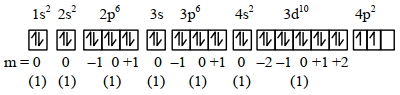
Completely filled orbital with \(\mathrm{m}_{\ell}=0\) are\(=1+1+1+1+1+1+1\)
\(=7\)
So Answer is \(7\)
- 154. \(Ho ^{3+}\) आयन के \(4 f\) कक्षकों में उपस्थित इलेक्ट्रॉनों की संख्या..........है। (दिया है \(Ho\) की परमाणु संख्या \(=67\) ) 2021 आसान
- (A) \(10\)
- (B) \(15\)
- (C) \(20\)
- (D) \(36\)
उत्तर और हल देखें
सही उत्तर: (A)
\(\mathrm{Ho}=[\mathrm{Xe}] 4 \mathrm{f}^{11} 6 \mathrm{~s}^{2}\)\(\mathrm{Ho}^{3+}=[\mathrm{Xe}] 4 \mathrm{f}^{10}\)
So number of \(\mathrm{e}^{-}\)present \(4 \mathrm{f}\) is \(10 .\)
- 155. जिस आद्य अवस्था इलेक्ट्रान विन्यास (वाह्यतम) के होते हुए भी \(Eu ^{2+}\) एक प्रबल अपचायक कर्मक है, वह है: [परमाणु क्रमांक : \(Eu =63]\) 2021 आसान
- (A) \(4 f^{7} 6 \mathrm{~s}^{2}\)
- (B) \(4 f^{6}\)
- (C) \(4 f^{7}\)
- (D) \(4 f^{6} 6 \mathrm{~s}^{2}\)
उत्तर और हल देखें
सही उत्तर: (C)
\(\mathrm{Eu} \rightarrow[\mathrm{Xe}] 4 \mathrm{f}^{7} 6 \mathrm{~s}^{2}\)\(\mathrm{Eu}^{2+} \rightarrow[\mathrm{Xe}] 4 \mathrm{f}^{7}\)
-
- (A) \(170\)
- (B) \(173\)
- (C) \(181\)
- (D) \(141\)
उत्तर और हल देखें
सही उत्तर: (B)
\(gm\) equi. of \(CrO _{4}^{2-}= S _{2} O _{3}^{2-}\)\(0.154 \times 3 \times v =0.25 \times 40 \times 8\)
\(v =173.16=173 \,ml\)
-
- (A) \(1.73,3.87,0\)
- (B) \(0,3.87,1.73\)
- (C) \(3.87,1.73,0\)
- (D) \(1.73,0,3.87\)
उत्तर और हल देखें
सही उत्तर: (A)
\(\mu=\sqrt{n(n+2)} B M\)\(n=\) number of unpaired electrons
\(T_{i}^{i+3}=\text { Ar }] 3 d^{1} \quad \quad\quad n=1 \quad \quad \mu=1.73\, \mathrm{BM}\)
\(\mathrm{V}^{+2}= \text { [Ar]3d }^{3} \quad \quad \quad \mathrm{n}=3 \quad \quad \mu=3.87\, \mathrm{BM}\)
\(\mathrm{Sc}^{+3}=[\mathrm{Ar}] 3 \mathrm{~d}^{0} 4 \mathrm{~s}^{0} \quad \quad \mathrm{n}=0 \quad \quad \mu=0\)
-
- (A) कथन \(I\) असत्य है परन्तु कथन \(II\) सत्य हैं।
- (B) कथन \(I\) सत्य है परन्तु कथन \(II\) असत्य हैं।
- (C) दोनों कथन \(I\) तथा \(II\) सत्य हैं।
- (D) दोनों कथन \(I\) तथा \(II\) असत्य हैं।
उत्तर और हल देखें
सही उत्तर: (C)
The \(+3\) oxidation state of lanthanide is most stable and therefore lanthanide in \(+4\) oxidation state has strong tendence to gain \(e ^{-}\) and converted into \(+3\) and therefore act as strong oxidizing agent.\(eg Ce ^{+4}\) And there fore \(CeO _{2}\) is used to oxidized alcohol aldehyde and ketones.
Lanthanide in \(+2\) oxidation state has strong tendency to loss \(e ^{-}\) and converted into \(+3\) oxidation state therefore act as strong reducing agent.
\(\therefore EuSO _{4}\) act as strong reducing agent.
-
- (A) दोनो कथन \(I\) तथा कथन \(II\) सत्य हैं।
- (B) कथन \(I\) असत्य है परन्तु कथन \(II\) सत्य है।
- (C) दोनों कथन \(I\) तथा कथन \(II\) असत्य हैं।
- (D) कथन \(I\) सत्य है परन्तु कथन \(II\) असत्य है।
उत्तर और हल देखें
सही उत्तर: (D)
The \(E ^{\circ}\) value for \(Ce ^{4+} / Ce ^{3+}\) is \(+1.74 V\) because the most stable oxidation state of lanthanide series elements is \(+3\) .It means \(Ce ^{3+}\) is more stable than \(Ce ^{4+}\)
-
- (A) कथन \(I\) सत्य है तथा कथन \(II\) असत्य है।
- (B) कथन \(I\) तथा कथन \(II\) दोनों सत्य है।
- (C) कथन \(I\) असत्य है तथा कथन \(II\) सत्य है।
- (D) कथन \(I\) तथा कथन \(II\) दोनों असत्य है।
उत्तर और हल देखें
सही उत्तर: (A)
\(2 KMnO _{4} \stackrel{573 K }{\longrightarrow} K _{2} MnO _{4}+ MnO _{2}+ O _{2}\)Potassium Potassium
permanganate \(\quad\) manganate
Statement\(-I\) is correct.
Statement\(-II\) is incorrect
-
- (A) \((a)>(d)>(c)>(b)>(e)\)
- (B) \((\mathrm{d})>(\mathrm{a})>(\mathrm{b})>(\mathrm{c})>(\mathrm{e})\)
- (C) \((a)>(c)>(d)>(b)>(e)\)
- (D) \((c)>(a)>(d)>(e)>(b)\)
उत्तर और हल देखें
सही उत्तर: (A)
\((a)\) \(\stackrel{+6}{{C}} {rO}_{3}\)\((b)\) \(\stackrel{+3} {Fe}_{2} {O}_{3}\)
\((c)\) \(\stackrel{+4} {MnO}_{2}\)
\((d)\) \(\stackrel{+5} {V}_{2} {O}_{5}\)
\((e)\) \(\stackrel{+1} {Cu}_{2} {O}\)
So order of oxidation state \(a>d>c>b>e\)
-
- (A) \(Fe\)
- (B) \(\mathrm{Mn}\)
- (C) \(\mathrm{Cr}\)
- (D) \(Co\)
उत्तर और हल देखें
सही उत्तर: (C)
Elements of group \(7,8,9\) do not form hydrides thus \(\mathrm{Cr}\) will only form hydride among the given elements \((Fe, \mathrm{Mn}, \mathrm{Co})\) -
- (A) \(\mathrm{Nd}\)
- (B) \(\mathrm{Yb}\)
- (C) \(\mathrm{La}\)
- (D) \(\mathrm{Ce}\)
उत्तर और हल देखें
सही उत्तर: (B)
Ytterbium shows \(+2\) oxidation state with diamagnetic nature - 164. निम्नलिखित में से कौन सा नाइट्रोजन के वायुमंडल में जल में घोलने पर रंगीन विलियन देता है \(?\) 2021 कठिन
- (A) \(\mathrm{CuCl}_{2}\)
- (B) \(\mathrm{AgCl}\)
- (C) \(\mathrm{ZnCl}_{2}\)
- (D) \(\mathrm{Cu}_{2} \mathrm{Cl}_{2}\)
उत्तर और हल देखें
सही उत्तर: (A)
\((A)\) \(\mathrm{CuCl}_{2}+\mathrm{nH}_{2} \mathrm{O} \rightarrow \mathrm{Cu}_{\left(\mathrm{aq}_{.}\right)}^{+2}\)\(\quad\quad\quad\quad\quad\quad\quad\quad\)blue colour
\((B)\) \(\mathrm{AgCl}+\mathrm{nH}_{2} \mathrm{O} \rightarrow\) Insoluble
\((C)\) \(\mathrm{ZnCl}_{2}+\mathrm{nH}_{2} \mathrm{O} \rightarrow \mathrm{Zn}_{\left(\mathrm{aq}_{.}\right)}^{+2}\)
\(\quad\quad\quad\quad\quad\quad\quad\quad\)Colourless
\((D)\) \(\mathrm{Cu}_{2} \mathrm{Cl}_{2}+\mathrm{nH}_{2} \mathrm{O} \rightarrow\) Insoluble
- 165. निम्नलिखित सेटों में से किस एक में सभी सदस्य (स्पीशीज) असमानुपातन अभिक्रिया दर्शाते हैं। 2021 मध्यम
- (A) \(\mathrm{ClO}_{2}^{-}, \mathrm{F}_{2}, \mathrm{MnO}_{4}^{-}\)तथा \(\mathrm{Cr}_{2} \mathrm{O}_{7}^{2-}\)
- (B) \(\mathrm{Cr}_{2} \mathrm{O}_{7}^{2-}, \mathrm{MnO}_{4}^{-}, \mathrm{ClO}_{2}^{-}\)तथा \(\mathrm{Cl}_{2}\)
- (C) \(\mathrm{MnO}_{4}^{-}, \mathrm{ClO}_{2}^{-}, \mathrm{Cl}_{2}\) तथा \(\mathrm{Mn}^{3+}\)
- (D) \(\mathrm{ClO}_{4}^{-}, \mathrm{MnO}_{4}^{-}, \mathrm{ClO}_{2}^{-}\)तथा \(\mathrm{F}_{2}\)
उत्तर और हल देखें
सही उत्तर: (C)
No option contains all species that show disproportionation reaction.\(\mathrm{MnO}_{4}^{-}\)
\(Mn\) is in \(+7\) oxidation state (highest) hence cannot be simultaneously oxidized or reduced
-
- (A) \(Cr < Zn < Co < Cu < Fe\)
- (B) \(Zn < Cu < Co < Fe < Cr\)
- (C) \(Zn < Cr < Fe < Co < Cu\)
- (D) \(Cr < Fe < Co < Cu < Zn\)
उत्तर और हल देखें
सही उत्तर: (C)
\(Density /g cm^{-3}\)\(\begin{array}{*{20}{c}} {Zn}& < &{Cr}& < &{Fe}& < &{Co}& < &{Cu} \\ \downarrow &{}& \downarrow &{}& \downarrow &{}& \downarrow &{}& \downarrow \\ {7.1}&{}&{7.19}&{}&{7.8}&{}&{8.7}&{}&{8.9} \end{array}\)
-
- (A) \(Cr ^{+}\) तथा \(Mn ^{2+}\)
- (B) \(Ni ^{2+}\) तथा \(Cu ^{+}\)
- (C) \(Fe ^{2+}\) तथा \(Co ^{+}\)
- (D) \(V ^{2+}\) तथा \(Cr ^{+}\)
उत्तर और हल देखें
सही उत्तर: (A)
\(\begin{array}{ll}\text { Option }-1 & Mn ^{+2}[ Ar ] 3 d ^{5}, Cr ^{+}[ Ar ] 3 d ^{5} \\ \text { Option }-2 & Ni ^{+2}[ Ar ] 3 d ^{8}, Cu ^{+}[ Ar ] 3 d ^{10} \\ \text { Option }-3 & Fe ^{+2}[ Ar ] 3 d ^{6}, Co ^{+}[ Ar ] 3 d ^{7} 4 s ^{1} \\ \text { Option }-4 & V ^{+2}[ Ar ] 3 d ^{3}, Cr ^{+}[ Ar ] 3 d ^{5}\end{array}\) - 168. \(Np ( Z =93)\) के लिए आद्य अवस्था के इलेक्ट्रॉनिक विन्यास में \(f\) इलेक्ट्रॉनों की संख्या है (निकटतम पूर्णांक में) 2021 आसान
- (A) \(2\)
- (B) \(5\)
- (C) \(4\)
- (D) \(6\)
उत्तर और हल देखें
सही उत्तर: (C)
\(\mathrm{Np}=1 \mathrm{~s}^{2} 2 \mathrm{~s}^{2} 2 \mathrm{p}^{6} 3 \mathrm{~s}^{2} 3 \mathrm{p}^{6} 4 \mathrm{~s}^{2} 3 \mathrm{~d}^{10} 4 \mathrm{p}^{6} 5 \mathrm{~s}^{2} 4 \mathrm{~d}^{10} 5 \mathrm{p}^{6} 6 \mathrm{~s}^{2}\)\(4 \mathrm{f}^{14} 5 \mathrm{~d}^{10} 6 \mathrm{p}^{6} 7 \mathrm{~s}^{2}-5 \mathrm{f}^{4} 6 \mathrm{~d}^{1}\)
Total no. of \('f'\) electron \(=14 \mathrm{e}^{-}+4 \mathrm{e}^{-}=18\)
-
- (A) \(\mathrm{Sc}^{3+}, \mathrm{V}^{5+}, \mathrm{Ti}^{4+}\)
- (B) \(\mathrm{Cu}^{2+}, \mathrm{Cr}^{3+}, \mathrm{Sc}^{+}\)
- (C) \(\mathrm{Ni}^{2+}, \mathrm{Mn}^{7+}, \mathrm{Hg}^{2+}\)
- (D) \(\mathrm{Cu}^{+}, \mathrm{Zn}^{2+}, \mathrm{Mn}^{4+}\)
उत्तर और हल देखें
सही उत्तर: (B)
\(\mathrm{Cu}^{2+}:[\mathrm{Ar}] 3 \mathrm{~d}^{9} 4 \mathrm{~s}^{0}\)\(\mathrm{Cr}^{3+}:[\mathrm{Ar}] 3 \mathrm{~d}^{3} 4 \mathrm{~s}^{0}\)
\(\mathrm{Sc}^{+}:[\mathrm{Ar}] 3 \mathrm{~d}^{1} 4 \mathrm{~s}^{1}\)
All are coloured and paramagnetic due to presence of unpaired \(\mathrm{e}^{-}\)
- 170. तत्वों की \(3\, d\) श्रेणी के लिए \(M ^{2+} / M\) के इलेक्ट्रोड विभव का मान जिसके लिए धनात्मक है, वह है 2021 आसान
- (A) \(Zn\)
- (B) \(Fe\)
- (C) \(Co\)
- (D) \(Cu\)
उत्तर और हल देखें
सही उत्तर: (D)
Only copper shows positive value for electrode potential of \(M ^{2+} / M\) of \(3 d-\)series elements.\(E ^{\Theta} / V _{\left( Cu ^{2+} / Cu \right)}:+0.34\)
-
- (A) \(24\)
- (B) \(66\)
- (C) \(89\)
- (D) \(12\)
उत्तर और हल देखें
सही उत्तर: (D)
\({ }_{23} V: 1 s^{2} 2 s^{2} 2 p^{6} 3 s^{2} 3 p^{6} 3 d^{3} 4 s^{2}\)Number of electrons in p-orbitals is equal to \(12.00\)
-
- (A) \(Cu\)
- (B) \(Hg\)
- (C) \(Au\)
- (D) \(Ni\)
उत्तर और हल देखें
सही उत्तर: (C)
Atomic radius of \(Ag\) and \(Au\) is nearly same due to lanthanide contraction. - 173. द्विसंयोजक यूरोपियम तथा त्रिसंयोजक सीरियम के इलेक्ट्रॉनिक विन्यास हैं : (परमाणु संख्या \(: Xe =54, Ce =58, Eu =63\) ) 2020 मध्यम
- (A) \([\mathrm{Xe}] 4 \mathrm{f}^{4}\) तथा \([\mathrm{Xe}] 4 \mathrm{f}^{9}\)
- (B) \([\mathrm{Xe}] 4 \mathrm{f}^{7}\) तथा \([\mathrm{Xe}] 4 \mathrm{f}^{1}\)
- (C) \([\mathrm{Xe}] 4 \mathrm{f}^{7} 6 \mathrm{s}^{2}\) तथा \([\mathrm{Xe}] 4 \mathrm{f}^{2} 6 \mathrm{s}^{2}\)
- (D) \([\mathrm{Xe}] 4 \mathrm{f}^{2}\) तथा \([\mathrm{Xe}] 4 \mathrm{f}^{7}\)
उत्तर और हल देखें
सही उत्तर: (B)
\(\mathrm{Eu}_{63} \Rightarrow[\mathrm{Xe}] 4 \mathrm{f}^{7} 5 \mathrm{d}^{\circ} 6 \mathrm{s}^{2}\)\(\mathrm{Eu}^{2+} \Rightarrow[\mathrm{Xe}] 4 \mathrm{f}^{7}\)
\(\mathrm{Ce}_{58} \Rightarrow[\mathrm{Xe}] 4 \mathrm{f}^{1} 5 \mathrm{d}^{1} 6 \mathrm{s}^{2}\)
\(\mathrm{Ce}^{3+} \Rightarrow[\mathrm{Xe}] 4 \mathrm{f}^{1}\)
- 174. \(Gd ^{3+}( Z =64)\) के सही इलेक्ट्रॉनिक विन्यास तथा केवल चक्रण चुम्बकीय आघूर्ण \(( BM\) में) हैं : 2020 मध्यम
- (A) \([ Xe ] 5 f ^{7}\) तथा \(8.9\)
- (B) \([ Xe ] 4 f ^{7}\) तथा \(7.9\)
- (C) \([ Xe ] 5 f ^{7}\) तथा \(7.9\)
- (D) \([ X e ] 4 f ^{7}\) तथा \(8.9\)
उत्तर और हल देखें
सही उत्तर: (B)
Electronic configuration of \(Gd ^{3+}\) is\(64 Gd ^{3+}=[ Xe ] 4 f ^{7}\)
\(Gd ^{3+}\) having \(7\) unpaired electrons.
Magnetic moment \((\mu)=\sqrt{n(n+2)}\) \(B.M.\)
\(\mu=\sqrt{7(7+2)} B \cdot M\)
\(=7.9 B . M\)
\(n \Rightarrow\) Number of unpaired electrons.

-
- (A) मैंगनेट तथा परमेंगनेट आयनों में ऑक्सीजन के \(p\)-कक्षकों तथा तथा मैंगनीज के \(d\)-कक्षकों के अतिव्यापन के द्वारा \(\pi\)-आबंध बनते हैं।
- (B) मेंगनेट आयन हरे रंग का है तथा परमैंगनेट आयन बैंगनी / जामुनी रंग का है।
- (C) मैंगनेट तथा परमैंगनेट आयन अनुचुंबकीय होते हैं।
- (D) मैंगनेट तथा परमैंगनेट आयन चतुष्फलकीय होते हैं।
उत्तर और हल देखें
सही उत्तर: (C)
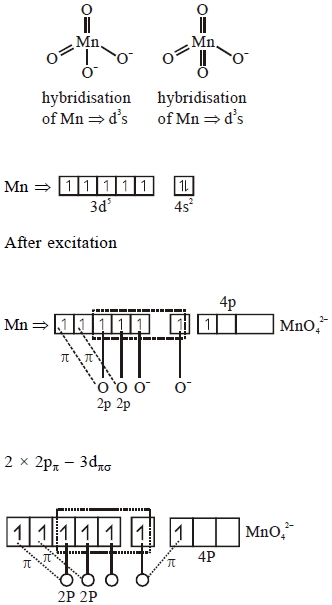
Option \(1)\) Manganate \(\Rightarrow MnO _{4}^{2-}\)Permanganate \(\Rightarrow MnO _{4}^{-}\)
\(2 \times 2 P _{\pi}-3 d _{\pi}\)
\(1 \times 2 P _{\pi}-4 P _{\pi}\)
\((2)\) \(MnO _{4}^{2-} \Rightarrow\) green
\(MnO _{\stackrel -4} \Rightarrow\) purple/violet
\((3)\) Manganate contains \(1\) unpaired electron hence it is paramagnetic
where as permanganetic contains no unpaired electrons hence it is diamagnetic.
\((4)\) Both have d's hybridisation hence both have tetrahedral geometry.
-
- (A) लैन्थैनाइड धातुएँ
- (B) ऐक्टिनाइड धातुएँ
- (C) ऐक्टिनाइड तथा संक्रमण धातुएँ
- (D) लैन्थैनायड तथा ऐक्टिनायड धातुएँ
उत्तर और हल देखें
सही उत्तर: (A)
Alloys of lanthanides with Fe are called Misch metal, which consists of a lanthanoid metal \((\sim 95 \%)\) and iron \((\sim 5 \%)\) and traces of \(S , C , Ca\) and \(Al\). -
- (A) वर्ग \(11\) तथा वर्ग \(4\) से
- (B) ऐक्टिनोयड तथा वर्ग \(4\) से
- (C) ऐक्टिनोयड तथा वर्ग \(6\) से
- (D) वर्ग \(6\) तथा ऐक्टिनोयडों से
उत्तर और हल देखें
सही उत्तर: (B)
Element with atomic no. \(101\) is an Actinoid element. -
- (A) Dy
- (B) Eu
- (C) Ce
- (D) Tb
उत्तर और हल देखें
सही उत्तर: (B)
Fact -
- (A) \(21,32,53,64\)
- (B) \(21,25,42,72\)
- (C) \(9,17,34,38\)
- (D) \(37,42,50,64\)
उत्तर और हल देखें
सही उत्तर: (B)
Tranition elements \(=21\) to \(30\)\(37\) to \(48\)
\(57\) \(\&\) \(72\) to \(80\)
Ans. \(21,25,42\, \& 72\)
-
- (A) \(KI\) तथा \(KMnO_4\)
- (B) \(MnO_2\) तथा \(KIO_3\)
- (C) \(KIO_3\) तथा \(MnO_2\)
- (D) \(KI\) तथा \(K_2MnO_4\)
उत्तर और हल देखें
सही उत्तर: (B)
\(Mn{O_2}\,\xrightarrow{{4KOH,\,{O_2}}}\mathop {2{K_2}Mn{O_4}}\limits_{(Green)} \, + \,2{H_2}O\)\(3{K_2}Mn{O_4}\,\xrightarrow{{4\,HCl}}\mathop {2KMn{O_4}}\limits_{(purple)} \, + \,Mn{O_2}\, + \,2{H_2}O\)
\(2KMn{O_4}\,\xrightarrow{{{H_2}O,\,KI}}2Mn{O_2}\, + \,2KOH\, + \,KI{O_3}\)
-
- (A) \(K_2MnO_4, KMnO_4\) तथा \(SO_2\)
- (B) \(K_3MnO_4, K_2MnO_4\) तथा \(Cl_2\)
- (C) \(K_2MnO_4, KMnO_4\) तथा \(Cl_2\)
- (D) \(KMnO_4, K_2MnO_4\) तथा \(Cl_2\)
उत्तर और हल देखें
सही उत्तर: (D)
\(\mathop {2KMn{O_4}\,}\limits_{(X)} \xrightarrow[\Delta ]{{513\,\,K}}\,\mathop {{K_2}Mn{O_4}}\limits_{(Y)} \, + \,Mn{O_2}\, + {O_{2(g)}}\)\(Mn{O_2}\, + \,4NaCl\, + 4{H_2}S{O_4}\, \to \) \(MnC{{l}_{2}}\,+\,4NaHS{{O}_{4}}\,+\,2{{H}_{2}}O\,+\underset{\begin{smallmatrix}
(Z) \\
pungent
\\
gas
\end{smallmatrix}}{\mathop{\,C{{l}_{2(g)}}}}\,\) -
- (A) उनमें धात्विक चालकता होती है
- (B) उनके गलनांक उच्च होते हैं
- (C) वे रासायनिक रूप से अभिक्रियाशील होते हैं
- (D) वे बहुत कठोर होते हैं
उत्तर और हल देखें
सही उत्तर: (C)
In case of interstial compounds there is presence of small atoms (or impurity) in the lattice of metal. So interstial compounds are hard, high melting point and chemically inert. - 183. एक्टीन्वायडों की सम्भव ऑक्सीकरण अवस्थाओं की उच्चतम संख्या निम्न में से किसके द्वारा प्रदर्शित होती है? 2019 मध्यम
- (A) बर्केलियम \((Bk)\) तथा केलीफोर्नियम \((Cf)\)
- (B) नोबेलियम \((No)\) तथा लारेन्सियम \((Lr)\)
- (C) एक्टीनियम \((Ac)\) तथा थोरियम \((Th)\)
- (D) नेप्ट्यूनियम \(( Np )\) तथा प्लुटोनियम \(( Pu )\)
उत्तर और हल देखें
सही उत्तर: (D)
नेप्ट्यूनियम \( ( Np ) \) तथा प्लुटोनियम \( ( Pu ) \)
-
- (A) \(Fe\)
- (B) \(Cu\)
- (C) \(V\)
- (D) \(Zn\)
उत्तर और हल देखें
सही उत्तर: (D)
Due to weak metallic bonding. -
- (A) \((a)-(iii)\); \((b)-(iv)\); \((c)-(i)\); \((d)-(ii)\)
- (B) \((a)-(iv)\); \((b)-(iii)\); \((c)-(ii)\); \((d)-(i)\)
- (C) \((a)-(ii)\); \((b)-(iii)\); \((c)-(i)\); \((d)-(iv)\)
- (D) \((a)-(iii)\); \((b)-(i)\); \((c)-(ii)\); \((d)-(iv)\)
उत्तर और हल देखें
सही उत्तर: (D)
\(V_2O_5\) is used in contact process for \(H_2SO_4\) \(TiCl_4/Al(Me)_3\) Ziegler natal catalyst used fin polymerization \(PdCl_2\) is used in ethanol formation Iron oxide is used in Haber process for \(NH_3\) -
- (A) \(Mn < Ti < Zn < Ni\)
- (B) \(Zn < Ni < Mn < Ti\)
- (C) \(Ti < Mn < Zn < Ni\)
- (D) \(Ti < Mn < Ni < Zn\)
उत्तर और हल देखें
सही उत्तर: (D)
As \(Zn\) is fully filled and left to right in group \(IP\) increases. -
- (A) \(Cu\)
- (B) \(Ti\)
- (C) \(Sc\)
- (D) \(V\)
उत्तर और हल देखें
सही उत्तर: (C)
\(Sc^{3+}\) has noble gas configuration hence only \(+3\) exists. -
- (A) \(V^{2+}\) तथा \(Co^{2+}\)
- (B) \(V^{2+}\) तथा \(Fe^{2+}\)
- (C) \(Co^{2+}\) तथा \(Fe^{2+}\)
- (D) \(Cr^{2+}\) तथा \(Mn^{2+}\)
उत्तर और हल देखें
सही उत्तर: (A)
\(H_2O\) is weak field ligand and magnetic moment \(=\) moment \(=\,\sqrt {n(n+2)} \,BM\)Solving for \('n'\) we get it as \(3;\) i.e., no. of unpaired electron \(=\,3\)
\(F{e^{2 + }}\, = \,{t_{2g}}^4\,{e_g}^2\)
\(C{o^{2 + }}\, = \,{t_{2g}}^5\,{e_g}^2\)
\({V^{2 + }}\, = \,t_{2g}^3\,{e_g}^0\)
\(\therefore \,\,M\) is \(V,\,Co\)
- 189. \(Ti ^{2+}, V ^{2+}, Ti ^{3+}\) तथा \(Sc ^{3+}\) के जलयोजित आयनों पर विचार कीजिये । उनके स्पिन-मात्र चुम्बकीय आघूर्णों का सही क्रम है 2019 कठिन
- (A) \(Ti^{3+} < T^{2+} < Sc^{3+} < V^{2+}\)
- (B) \(Sc^{3+} < Ti^{3+} < Ti^2 < V^{2+}\)
- (C) \(V^{2+} < Ti^{2+} < Ti^{3+} < Sc^{3+}\)
- (D) \(Sc^{3+} < Ti^{3+} < V^{2+} < Ti^{2+}\)
उत्तर और हल देखें
सही उत्तर: (B)
\(T{i^{ + 2}}\, = \,1{s^2}\,2{s^2}\,2{p^6}\,3{s^2}\,3{p^6}\,3{d^2}\)unpaired electron \(=\,2\)
spin only magnetic moment \((\mu )\, = \,\sqrt {2(2 + 2)} \, = \,\sqrt 8 \,B.M\)
\(T{i^{ + 3}}\, = \,1{s^2}\,2{s^2}\,2{p^6}\,3{s^2}\,3{p^6}\,3{d^1}\)
unpaired electron \(=\,1\)
\((\mu )\, = \,\sqrt {1(1 + 2)} \, = \,\sqrt 3 \,B.M\)
\({V^{ + 2}}\, = \,1{s^2}\,2{s^2}\,2{p^6}\,3{s^2}\,3{p^6}\,3{d^3}\)
\((\mu )\, = \,\sqrt {3(3 + 2)} \, = \,\sqrt {15} \,B.M\)
\(S{c^{ + 3}}\, = \,1{s^2}\,2{s^2}\,2{p^6}\,3{s^2}\,3{p^6}\)
\((\mu )\, =0\)
-
- (A) परमाणुक तथा आयनिक त्रिज्याओं दोनों का बढ़ना
- (B) परमाणुक त्रिज्याओं का घटना तथा आयनिक त्रिज्याओं का बढ़ना
- (C) परमाणुक तथा आयनिक त्रिज्याओं दोनों का घटना
- (D) परमाणुक त्रिज्याओं का बढ़ना तथा आयनिक त्रिज्याओं का घटना
उत्तर और हल देखें
सही उत्तर: (C)
Atomic and ionic radii decreases -
- (A) \(Gd^{3+}\)
- (B) \(La^{3+}\)
- (C) \(Lu^{3+}\)
- (D) \(Sm^{3+}\)
उत्तर और हल देखें
सही उत्तर: (D)
\(Sm^{3+}\,(4f^5) =\) yellow colour, other ions have stable electron configurations with half filled or full-filled electron configuration. -
- (A) \(6\) तथा \(4\)
- (B) \(7\) तथा \(6\)
- (C) \(4\) तथा \(6\)
- (D) \(6\) तथा \(7\)
उत्तर और हल देखें
सही उत्तर: (D)
The highest oxidation state of \(U\) and \(Pu\) is \(6+\) and \(7+\) respectively. -
- (A) \(Mn\)
- (B) \(Cr\)
- (C) \(V\)
- (D) \(Ti\)
उत्तर और हल देखें
सही उत्तर: (A)
\(Mn{O_2} + KOH + KN{O_3} \to \mathop {{K_2}Mn{O_4}}\limits_{(dark\,\,green)} + KN{O_2} + {H_2}O\)\(MnO_4^{2 - } + 4{H^ + }\xrightarrow[{tionation}]{{dispropor}}\mathop {2MnO_4^ - }\limits_{(dark\,purple)} + Mn{O_2} + 2{H_2}O\)
-
- (A) \(VO_2\)
- (B) \(MnO_2\)
- (C) \(TiO_2\)
- (D) \(CrO_2\)
उत्तर और हल देखें
सही उत्तर: (D)
Out of all the four given metallic oxides \(C r O_{2}\) is attacted by magnetic field very strongly. The effect persists even when the magnetic field is removed. Thus \(C r O_{2}\) is metallic and ferromagnetic in nature. -
- (A) \(Cr^{2+}\)
- (B) \(MnO_4^{2 - }\)
- (C) \(MnO_4^{3 - }\)
- (D) \(Cu^+\)
उत्तर और हल देखें
सही उत्तर: (B)
In \(MnO_4^{-2}\) manganese is in \(+6\) oxidation state which is having highest stability.\(MnO_4^{2-}\) disproportionates in neutral or acidic solution.
\(3MnO_4^{2 - }\, + \,4{H^ + }\, \to \,2MnO_4^{2 - }\, + \,Mn{O_2}\, + \,2{H_2}O\)
- 196. रूबी एवं इमेराल्ड में जिन संक्रमण धातुओं के आयनों की उपस्थिति के कारण रंग होता है, वे क्रमशः हैं। 2016 कठिन
- (A) \(Co^{3+}\) तथा \(Cr^{3+}\)
- (B) \(Co^{3+}\) तथा \(Co^{3+}\)
- (C) \(Cr^{3+}\) तथा \(Cr^{3+}\)
- (D) \(Cr^{3+}\) तथा \(Co^{3+}\)
उत्तर और हल देखें
सही उत्तर: (C)
A ruby is a crystal of alumina, aluminum oxide \((Al_2O_3)\) containing a trace of chromium \((III)\) ions replacing some of the aluminum ions. In ruby, each \(Al^{3+}\) ion and \(Cr^{3+}\) ion is surrounded by six oxide ions in an octahedral arrangement. The origin of the color of emeralds is similar to that of the color of rubies. However, the bulk of an emerald crystal is composed of beryl, beryllium aluminum silicate \((Be_3 Al_2(SiO_3)_6)\) instead of the alumina which forms rubies. The color is produced by chromium \((III)\) ions, which replace some of the aluminum ions in the crystal. In emeralds, the \(Cr^{3+}\) is surrounded by six silicate ions, rather than the six oxide ions in ruby. Therefore, the color (green) of emeralds is different from that of ruby -
- (A) \((NH_4)_3 [As (Mo_3O_{10})_4]\)
- (B) \(BaCrO_4\)
- (C) \(Zn_2[Fe(CN)_6]\)
- (D) \(K_3[Co(NO_2)_6]\)
उत्तर और हल देखें
सही उत्तर: (C)
\(Z n_{2}\left[F e(C N)_{6}\right], K_{3}\left[C o\left(N O_{2}\right)_{6}\right] \) and \(\left(N H_{4}\right)_{3} A s\left[M o_{3} O_{l 0}\right]_{4}\) show color due to d-d transition while \(B a C r O_{4}\) is coloured due to charge transfer phenomenon.Further according to spectrochemical series the strong ligand possessing complex has higher energy and hence lower wavelength. Therefore, complexes containing \(N O_{2}, N H_{4}^{+}, O^{2-}\) etc., ligands show yellow colour while \(\mathrm{CN}^{-}\) forces the complex to impart white colour.
Spectrochemical series \(I^{-} < B r^{-} < S^{2-} < S C N^{-} < C I^{-} < N O_{3}^{-} < N_{3}^{-} < F^{-} < O H^{-}\)
\( < C_{2} O_{4}^{2-}=H_{2} O < N C S^{-} < C H_{3} C N < p y < N H_{3} < e n\)
\( < b i p y < phen < N o_{2}^{-} < p p h_{3} < C N^{-}=C O\)
- 198. एक गुलाबी लवण, गरम करने पर नीला हो जाता है। लवण में किस धनायन के होने की सर्वाधिक संभावना है ? 2015 मध्यम
- (A) \(Co^{2+}\)
- (B) \(Cu^{2+}\)
- (C) \(Zn^{2+}\)
- (D) \(Fe^{2+}\)
उत्तर और हल देखें
सही उत्तर: (A)
\(Zn^{2+}\) salts are white. Usually \(Fe^{2+}\) salts are rarely pink. \(Cu^{2+}\) salts are usually blue in hydrated form. \(Co^{2+}\) is pink in aqueous solution -
- (A) \(L \rightarrow M\) आवेश स्थानांतरण संक्रमण
- (B) \(\sigma-\sigma^{*}\) संक्रमण
- (C) \(M \rightarrow L\) आवेश स्थानांतरण संक्रमण
- (D) \(d - d\) संक्रमण
उत्तर और हल देखें
सही उत्तर: (A)
\(K M n O_{4} \rightarrow K^{+}+M n O_{4}^{-}\)\(\therefore \ln M n O_{4}^{-},\) Mn has \(+7\) oxidation state having no electron in d-orbitals. It ts considered that higher the oxidation state of metal, greater is the tendency to occur \(L \rightarrow M\) charge transfer,
because ligand is able to donate the electron into the vacant ( - orbital of metal.
since, charge transfer is laporate as well as spin allowed, therefore, it shows colour
-
- (A) \(Na _{2} Cr _{2} O _{7}\) की विलयता \(K _{2} Cr _{2} O _{7}\) से कम है।
- (B) आयतनी विश्लेषण में \(Na _{2} Cr _{2} O _{7}\) एक प्राथमिक मानक है।
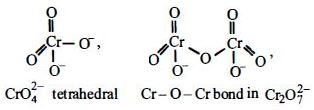
- (C) \(CrO _{4}^{2-}\) चतुष्फलकीय आकार का है।
- (D) \(Cr _{2} O _{7}^{2-}\) में एक \(Cr - O - Cr\) आबंध है।
उत्तर और हल देखें
सही उत्तर: (A)
\(Na_2Cr_2O_7\) is used as primary standard in volumetryHydration energy of \(Na^+\) is greater then \(K^+\). Because of smaller size of \(Na^+\) , \(Na_2Cr_2O_7\) is more soluble than \(K_2Cr_2O_7\).
इस पेज पर इन फ़िल्टर से कोई प्रश्न नहीं मिला।