


D અને f-વિભાગનાં તત્ત્વો ના બધા પ્રશ્નો
નવા પહેલા209 માંથી 201–209 પ્રશ્નો
-
- (A) \(K_2Cr_2O_7\) કરતા \(Na_2Cr_2O_7\) ઓછો દ્રાવ્ય છે
- (B) \(Na_2Cr_2O_7\) એ કદમાપક પૃથ્થકરણમાં પ્રાથમિક માપદંડ છે
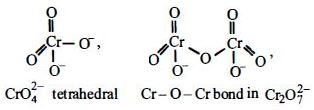
- (C) \(CrO_4^{2-}\) સમચતુષ્કલકીય આકારનો છે
- (D) \(CrO_7^{2-}\) માં \(Cr- O- Cr\) બંધ હોય છે.
જવાબ અને ઉકેલ જુઓ
સાચો જવાબ: (A)
\(Na_2Cr_2O_7\) is used as primary standard in volumetryHydration energy of \(Na^+\) is greater then \(K^+\). Because of smaller size of \(Na^+\) , \(Na_2Cr_2O_7\) is more soluble than \(K_2Cr_2O_7\).
-
- (A) \((NH_4)_3 [As (Mo_3O_{10})_4]\)
- (B) \(BaCrO_4\)
- (C) \(Zn_2[Fe(CN)_6]\)
- (D) \(K_3[Co(NO_2)_6]\)
જવાબ અને ઉકેલ જુઓ
સાચો જવાબ: (C)
\(Z n_{2}\left[F e(C N)_{6}\right], K_{3}\left[C o\left(N O_{2}\right)_{6}\right] \) and \(\left(N H_{4}\right)_{3} A s\left[M o_{3} O_{l 0}\right]_{4}\) show color due to d-d transition while \(B a C r O_{4}\) is coloured due to charge transfer phenomenon.Further according to spectrochemical series the strong ligand possessing complex has higher energy and hence lower wavelength. Therefore, complexes containing \(N O_{2}, N H_{4}^{+}, O^{2-}\) etc., ligands show yellow colour while \(\mathrm{CN}^{-}\) forces the complex to impart white colour.
Spectrochemical series \(I^{-} < B r^{-} < S^{2-} < S C N^{-} < C I^{-} < N O_{3}^{-} < N_{3}^{-} < F^{-} < O H^{-}\)
\( < C_{2} O_{4}^{2-}=H_{2} O < N C S^{-} < C H_{3} C N < p y < N H_{3} < e n\)
\( < b i p y < phen < N o_{2}^{-} < p p h_{3} < C N^{-}=C O\)
- 203. જ્યારે \(H_2S\) એ એસિડિક \(K_2Cr_2O_7\)નું દ્રાવણ સાથે પ્રક્રિયા કરે ત્યારે નીચેના પૈકી ક્યુ ઉત્પન્ન થશે નહિ? 2014 મધ્યમ
- (A) \(CrSO_4\)
- (B) \(Cr_2(SO_4)_3\)
- (C) \(K_2SO_4\)
- (D) \(S\)
જવાબ અને ઉકેલ જુઓ
સાચો જવાબ: (A)
\(K_2Cr_2O_7+ 4H_2SO_4+ 3H_2S\) \(\longrightarrow\) \(K_2SO_4 + Cr_2 (SO_4)_3 + 7H_2O + 3S\) -
- (A) \(Ti\,(22)\)
- (B) \(V\,(23)\)
- (C) \(Cr\,(24)\)
- (D) \(Mn\,(25)\)
જવાબ અને ઉકેલ જુઓ
સાચો જવાબ: (D)
Maganese exhibits the large number of oxidation states. The most common oxidation states of \(Mn\) are \(+ 2 , + 3 ,+ 4, + 6\) and \(+7.\) - 205. વેનેડિયમના એક ક્લોરો સંયોજનની ફક્ત સ્પિન ચુંબકીય ચાકમાત્રા \(1.73\,\,BM\) છે. આ વેનેડિયમ ક્લોરાઈડનું સૂત્ર જણાવો. 2014 અઘરું
- (A) \(VCl_2\)
- (B) \(VCl_4\)
- (C) \(VCl_3\)
- (D) \(VCl_5\)
જવાબ અને ઉકેલ જુઓ
સાચો જવાબ: (B)
\(\mu = \sqrt {n(n + 2)} \)\(1.73 = \sqrt {n(n + 2)} \)
On calculating the value of \(n\) we find \(n=1\)
No. of unpaired electrons \(= 1\)
hence its consfiguration will be
\(V(23) = [Ar] 3d^3\,4s^2\)
\(V^{4+} = [Ar]3d^1\)
Its chloride has the formula \(VCl_4\)
-
- (A) \(MnSO_4\)
- (B) \(Mn_2O_7\)
- (C) \(MnO_2\)
- (D) \(Mn_2O_3\)
જવાબ અને ઉકેલ જુઓ
સાચો જવાબ: (B)
\(KMnO_4\) reacts with \(H_2SO_4\) to form \(Mn_2O_7\) which is highly explosive substance \(2KMn{O_4} + {H_2}S{O_4} \to {K_2}S{O_4} + M{n_2}{O_7} + {H_2}O\) - 207. જ્યારે પોટેશિયમ ડાયક્રોમેટને સાંદ્ર સલ્ફયુરિક એસિડ અને દ્રાવ્ય ક્લોરાઇડ સાથે ગરમ કરવામાં આવે ત્યારે ... ની બ્રાઉન-લાલ રંગની બાષ્પ મળે છે. 2013 અઘરું
- (A) \(CrO3\)
- (B) \(CrCl_3\)
- (C) \(CrO_2Cl_2\)
- (D) \(Cr_2O_3\)
જવાબ અને ઉકેલ જુઓ
સાચો જવાબ: (C)
Solid potassium dichromate when heated with concentrated sulphuric acid and a soluble chloride gives orange red vapours of a volatile oily liquid \(Cr{O_2}C{l_2}\) \(K_2Cr_2O_7 + 4NaCl + 6H_2SO_4\) \(\longrightarrow\) \(\begin{array}{l} 2KHS{O_4} + 4NaHS{O_4} + 2Cr{O_2}C{l_2}\\ \,\,\,\,\,\,\,\,\,\,\,\,\,\,\,\,\,\,\,\,\,\,\,\,\,\,\,\,\,\,\,\,\,\,\,\,\,\,\,\,\,\,\,\,\,\,\,{\rm{chromyl \,chloride}} \end{array}\) -
- (A) \(Cu_2O\) એ રંગવિહીન છે
- (B) કોપર \((I)\) સંયોજનો રંગહીન હોય છે સિવાય કે ચાર્જ ટ્રાન્સફરથી રંગ પરિણામ આવે છે
- (C) કોપર \((I)\) સંયોજન એ ડાયમેગ્નેટીક છે
- (D) \(Cu_2S\) કાળો છે
જવાબ અને ઉકેલ જુઓ
સાચો જવાબ: (A)
\(Cu_2O\) is red in colour. -
- (A) \(Cr(Z=24)\)
- (B) \(Mn(Z = 25)\)
- (C) \(Fe(Z=26)\)
- (D) \(Co(Z = 27)\)
જવાબ અને ઉકેલ જુઓ
સાચો જવાબ: (D)
\(E^{0}_{C r^{3+} / C r^{2+}}=\,-\,0.41\, V \)\(\mathrm{E}^{0}_{\mathrm{Fe}^{3+} / \mathrm{Fe}^{2+}}=+0.77 \,\mathrm{V}\)
\(\mathrm{E}^{0}_{\mathrm{Co}^{3+} / \mathrm{Co}^{2+}}=+1.97\, \mathrm{V}\)
\(E^{0}_{\mathrm{Mn}^{3+} / \mathrm{Mn}^{2+}}=+1.57\, \mathrm{V}\)
આ પેજ પર આ ફિલ્ટર મુજબ કોઈ પ્રશ્ન નથી.