


All D and f- block elements questions
Newest firstShowing 151–200 of 211 questions
-
- (A) Statement \(I\) is false but statement \(II\) is true
- (B) Statment \(I\) is true but statement \(II\) is false
- (C) Both statement \(I\) and statement \(II\) are true
- (D) Both statement \(I\) and statement \(II\) are false
Show answer and solution
Correct Answer: (C)
The \(+3\) oxidation state of lanthanide is most stable and therefore lanthanide in \(+4\) oxidation state has strong tendence to gain \(e ^{-}\) and converted into \(+3\) and therefore act as strong oxidizing agent.\(eg Ce ^{+4}\) And there fore \(CeO _{2}\) is used to oxidized alcohol aldehyde and ketones.
Lanthanide in \(+2\) oxidation state has strong tendency to loss \(e ^{-}\) and converted into \(+3\) oxidation state therefore act as strong reducing agent.
\(\therefore EuSO _{4}\) act as strong reducing agent.
-
- (A) Statement \(I\) is true but statement \(II\) is false
- (B) Both statement \(I\) and statement \(II\) are true
- (C) Statement \(I\) is false but statement \(II\) is true
- (D) Both statement \(I\) and statement \(II\) are false
Show answer and solution
Correct Answer: (A)
\(2 KMnO _{4} \stackrel{573 K }{\longrightarrow} K _{2} MnO _{4}+ MnO _{2}+ O _{2}\)Potassium Potassium
permanganate \(\quad\) manganate
Statement\(-I\) is correct.
Statement\(-II\) is incorrect
-
- (A) Both statement \(I\) and statement \(II\) are correct
- (B) Statement \(I\) is incorrect but statement \(II\) is correct
- (C) Both statement \(I\) and statement \(II\) are incorrect
- (D) Statement \(I\) is correct but statement \(II\) is incorrect
Show answer and solution
Correct Answer: (D)
The \(E ^{\circ}\) value for \(Ce ^{4+} / Ce ^{3+}\) is \(+1.74 V\) because the most stable oxidation state of lanthanide series elements is \(+3\) .It means \(Ce ^{3+}\) is more stable than \(Ce ^{4+}\)
-
- (A) \(170\)
- (B) \(173\)
- (C) \(181\)
- (D) \(141\)
Show answer and solution
Correct Answer: (B)
\(gm\) equi. of \(CrO _{4}^{2-}= S _{2} O _{3}^{2-}\)\(0.154 \times 3 \times v =0.25 \times 40 \times 8\)
\(v =173.16=173 \,ml\)

-
- (A) linear symmetrical \(\mathrm{Cr}-\mathrm{O}-\mathrm{Cr}\) bond.
- (B) non-linear symmetrical \(\mathrm{Cr}-\mathrm{O}-\mathrm{Cr}\) bond.
- (C) linear unsymmetrical \(\mathrm{Cr}-\mathrm{O}-\mathrm{Cr}\) bond.
- (D) non-linear unsymmetrical \(\mathrm{Cr}-\mathrm{O}-\mathrm{Cr}\) bond.
Show answer and solution
Correct Answer: (B)
dichromate ion contain non-linear symmetrical \(\mathrm{Cr}-\mathrm{O}-\mathrm{Cr}\) Bond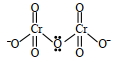
- 156. In which of the following pairs, the outer most electronic configuration will be the same ? 2021 Easy
- (A) \(Cr ^{+}\) and \(Mn ^{2+}\)
- (B) \(Ni ^{2+}\) and \(Cu ^{+}\)
- (C) \(Fe ^{2+}\) and \(Co ^{+}\)
- (D) \(V ^{2+}\) and \(Cr ^{+}\)
Show answer and solution
Correct Answer: (A)
\(\begin{array}{ll}\text { Option }-1 & Mn ^{+2}[ Ar ] 3 d ^{5}, Cr ^{+}[ Ar ] 3 d ^{5} \\ \text { Option }-2 & Ni ^{+2}[ Ar ] 3 d ^{8}, Cu ^{+}[ Ar ] 3 d ^{10} \\ \text { Option }-3 & Fe ^{+2}[ Ar ] 3 d ^{6}, Co ^{+}[ Ar ] 3 d ^{7} 4 s ^{1} \\ \text { Option }-4 & V ^{+2}[ Ar ] 3 d ^{3}, Cr ^{+}[ Ar ] 3 d ^{5}\end{array}\) -
- (A) \(\mathrm{ClO}_{2}^{-}, \mathrm{F}_{2}, \mathrm{MnO}_{4}^{-}\)and \(\mathrm{Cr}_{2} \mathrm{O}_{7}^{2-}\)
- (B) \(\mathrm{Cr}_{2} \mathrm{O}_{7}^{2-}, \mathrm{MnO}_{4}^{-}, \mathrm{ClO}_{2}^{-}\)and \(\mathrm{Cl}_{2}\)
- (C) \(\mathrm{MnO}_{4}^{-}, \mathrm{ClO}_{2}^{-}, \mathrm{Cl}_{2}\) and \(\mathrm{Mn}^{3+}\)
- (D) \(\mathrm{ClO}_{4}^{-}, \mathrm{MnO}_{4}^{-}, \mathrm{ClO}_{2}^{-}\)and \(\mathrm{F}_{2}\)
Show answer and solution
Correct Answer: (C)
No option contains all species that show disproportionation reaction.\(\mathrm{MnO}_{4}^{-}\)
\(Mn\) is in \(+7\) oxidation state (highest) hence cannot be simultaneously oxidized or reduced
-
- (A) \(10\)
- (B) \(15\)
- (C) \(20\)
- (D) \(36\)
Show answer and solution
Correct Answer: (A)
\(\mathrm{Ho}=[\mathrm{Xe}] 4 \mathrm{f}^{11} 6 \mathrm{~s}^{2}\)\(\mathrm{Ho}^{3+}=[\mathrm{Xe}] 4 \mathrm{f}^{10}\)
So number of \(\mathrm{e}^{-}\)present \(4 \mathrm{f}\) is \(10 .\)
- 159. Number of electrons that Vanadium \((Z=23)\) has in p-orbitals is equal to \(......\) 2021 Medium
- (A) \(24\)
- (B) \(66\)
- (C) \(89\)
- (D) \(12\)
Show answer and solution
Correct Answer: (D)
\({ }_{23} V: 1 s^{2} 2 s^{2} 2 p^{6} 3 s^{2} 3 p^{6} 3 d^{3} 4 s^{2}\)Number of electrons in p-orbitals is equal to \(12.00\)
-
- (A) \(X = SO _{2}, Y = Cr _{2} O _{3}\)
- (B) \(X = SO _{3}, Y = Cr _{2} O _{3}\)
- (C) \(X = SO _{2}, Y = Cr _{2}\left( SO _{4}\right)_{3}\)
- (D) \(X = SO _{3}, Y = Cr _{2}\left( SO _{4}\right)_{3}\)
Show answer and solution
Correct Answer: (C)
\(SO _{2}+ dil H _{2} SO _{4} \longrightarrow SO _{3}( g )\)\(Cr _{2}\left( SO _{4}\right)_{3}\)
- 161. Potassium permanganate on heating at \(513\, \mathrm{~K}\) gives a product which is : 2021 Medium
- (A) paramagnetic and colourless
- (B) diamagnetic and green
- (C) diamagnetic and colourless
- (D) paramagnetic and green
Show answer and solution
Correct Answer: (D)
\(2 \mathrm{KMnO}_{4} \xrightarrow[200^{o}C]{\Delta} \mathrm{K}_{2} \mathrm{MnO}_{4}+{+\mathrm{MnO}_{2}}+\mathrm{O}_{2}\)\(\quad \quad \quad \quad \quad \quad \quad Green\quad \quad \quad Black\)
In \(\mathrm{K}_{2} \mathrm{MnO}_{4}\), manganese oxidation state is \(+6\) and hence it has one unpaired \(\mathrm{e}^{-}\).
- 162. The Azimuthal quantum number for the valence electrons of \(\mathrm{Ga}^{+}\)ion is \(.....\) (Atomic number of \(\mathrm{Ga}=31\) ) 2021 Medium
- (A) \(0\)
- (B) \(1\)
- (C) \(2\)
- (D) \(3\)
Show answer and solution
Correct Answer: (A)
\(\mathrm{Ga}^{+}: \mathrm{1s}^{2} \,2 \mathrm{~s}^{2}\, 2 \mathrm{P}^{6}\, 3 \mathrm{~s}^{2} \,3 \mathrm{p}^{6}\, 3 \mathrm{~d}^{10} \,4 \mathrm{~s}^{2}\)last orbital \(=\) \(\mathrm{s}\)
The azimuthal quantum number for the valenceelectrons \((4s-\)subshell) of \(\mathrm{Ga}+\) ion is zero\((0).\)
-
- (A) \((a)>(d)>(c)>(b)>(e)\)
- (B) \((\mathrm{d})>(\mathrm{a})>(\mathrm{b})>(\mathrm{c})>(\mathrm{e})\)
- (C) \((a)>(c)>(d)>(b)>(e)\)
- (D) \((c)>(a)>(d)>(e)>(b)\)
Show answer and solution
Correct Answer: (A)
\((a)\) \(\stackrel{+6}{{C}} {rO}_{3}\)\((b)\) \(\stackrel{+3} {Fe}_{2} {O}_{3}\)
\((c)\) \(\stackrel{+4} {MnO}_{2}\)
\((d)\) \(\stackrel{+5} {V}_{2} {O}_{5}\)
\((e)\) \(\stackrel{+1} {Cu}_{2} {O}\)
So order of oxidation state \(a>d>c>b>e\)
- 164. The electrode potential of \(M ^{2+} / M\) of \(3 d-\) series elements shows positive value of 2021 Easy
- (A) \(Zn\)
- (B) \(Fe\)
- (C) \(Co\)
- (D) \(Cu\)
Show answer and solution
Correct Answer: (D)
Only copper shows positive value for electrode potential of \(M ^{2+} / M\) of \(3 d-\)series elements.\(E ^{\Theta} / V _{\left( Cu ^{2+} / Cu \right)}:+0.34\)
-
- (A) \(4 f^{7} 6 \mathrm{~s}^{2}\)
- (B) \(4 f^{6}\)
- (C) \(4 f^{7}\)
- (D) \(4 f^{6} 6 \mathrm{~s}^{2}\)
Show answer and solution
Correct Answer: (C)
\(\mathrm{Eu} \rightarrow[\mathrm{Xe}] 4 \mathrm{f}^{7} 6 \mathrm{~s}^{2}\)\(\mathrm{Eu}^{2+} \rightarrow[\mathrm{Xe}] 4 \mathrm{f}^{7}\)
-
- (A) \(\mathrm{X}=\) basic \(\quad \mathrm{Y}=\) amphoteric
- (B) \(\mathrm{X}=\) amphoteric \(\quad \mathrm{Y}=\) basic
- (C) \(\mathrm{X}=\) acidic \(\quad \mathrm{Y}=\) acidic
- (D) \(\mathrm{X}=\) basic \(\quad \mathrm{Y}=\) basic
Show answer and solution
Correct Answer: (D)
\(\mathrm{V}_{2} \mathrm{O}_{3}-\) basic\(CrO-\) basic
- 167. The number of \(4 f\) electrons in the ground state electronic configuration of \(\mathrm{Gd}^{2+}\) is ........ . [Atomic number of \(\mathrm{Gd}=64\) ] 2021 Medium
- (A) \(7\)
- (B) \(6\)
- (C) \(1\)
- (D) \(8\)
Show answer and solution
Correct Answer: (A)
The electronic configuration of\({ }_{64} \mathrm{Gd}:[\mathrm{Xe}] 4 \mathrm{f}^{7} 5 \mathrm{~d}^{1} 6 \mathrm{~s}^{2}\)
So the electronic configuration of
\({ }_{64} \mathrm{Gd}^{2+}:[\mathrm{Xe}] 4 \mathrm{f}^{7} 5 \mathrm{~d}^{1} 6 \mathrm{~s}^{0}\)
\(i.e.\) the number of \(4 \mathrm{f}\) electrons in the ground state electronic configuration of \(\mathrm{Gd}^{2+}\) is \(7\)
- 168. The number of \(f\) electrons in the ground state electronic configuration of \(\mathrm{Np}(\mathrm{Z}=93)\) is ....... . 2021 Easy
- (A) \(2\)
- (B) \(5\)
- (C) \(4\)
- (D) \(6\)
Show answer and solution
Correct Answer: (C)
\(\mathrm{Np}=1 \mathrm{~s}^{2} 2 \mathrm{~s}^{2} 2 \mathrm{p}^{6} 3 \mathrm{~s}^{2} 3 \mathrm{p}^{6} 4 \mathrm{~s}^{2} 3 \mathrm{~d}^{10} 4 \mathrm{p}^{6} 5 \mathrm{~s}^{2} 4 \mathrm{~d}^{10} 5 \mathrm{p}^{6} 6 \mathrm{~s}^{2}\)\(4 \mathrm{f}^{14} 5 \mathrm{~d}^{10} 6 \mathrm{p}^{6} 7 \mathrm{~s}^{2}-5 \mathrm{f}^{4} 6 \mathrm{~d}^{1}\)
Total no. of \('f'\) electron \(=14 \mathrm{e}^{-}+4 \mathrm{e}^{-}=18\)
-
- (A) \(\mathrm{Sc}^{3+}, \mathrm{V}^{5+}, \mathrm{Ti}^{4+}\)
- (B) \(\mathrm{Cu}^{2+}, \mathrm{Cr}^{3+}, \mathrm{Sc}^{+}\)
- (C) \(\mathrm{Ni}^{2+}, \mathrm{Mn}^{7+}, \mathrm{Hg}^{2+}\)
- (D) \(\mathrm{Cu}^{+}, \mathrm{Zn}^{2+}, \mathrm{Mn}^{4+}\)
Show answer and solution
Correct Answer: (B)
\(\mathrm{Cu}^{2+}:[\mathrm{Ar}] 3 \mathrm{~d}^{9} 4 \mathrm{~s}^{0}\)\(\mathrm{Cr}^{3+}:[\mathrm{Ar}] 3 \mathrm{~d}^{3} 4 \mathrm{~s}^{0}\)
\(\mathrm{Sc}^{+}:[\mathrm{Ar}] 3 \mathrm{~d}^{1} 4 \mathrm{~s}^{1}\)
All are coloured and paramagnetic due to presence of unpaired \(\mathrm{e}^{-}\)
-
- (A) \(1.73,3.87,0\)
- (B) \(0,3.87,1.73\)
- (C) \(3.87,1.73,0\)
- (D) \(1.73,0,3.87\)
Show answer and solution
Correct Answer: (A)
\(\mu=\sqrt{n(n+2)} B M\)\(n=\) number of unpaired electrons
\(T_{i}^{i+3}=\text { Ar }] 3 d^{1} \quad \quad\quad n=1 \quad \quad \mu=1.73\, \mathrm{BM}\)
\(\mathrm{V}^{+2}= \text { [Ar]3d }^{3} \quad \quad \quad \mathrm{n}=3 \quad \quad \mu=3.87\, \mathrm{BM}\)
\(\mathrm{Sc}^{+3}=[\mathrm{Ar}] 3 \mathrm{~d}^{0} 4 \mathrm{~s}^{0} \quad \quad \mathrm{n}=0 \quad \quad \mu=0\)
-
- (A) \(Cr < Zn < Co < Cu < Fe\)
- (B) \(Zn < Cu < Co < Fe < Cr\)
- (C) \(Zn < Cr < Fe < Co < Cu\)
- (D) \(Cr < Fe < Co < Cu < Zn\)
Show answer and solution
Correct Answer: (C)
\(Density /g cm^{-3}\)\(\begin{array}{*{20}{c}} {Zn}& < &{Cr}& < &{Fe}& < &{Co}& < &{Cu} \\ \downarrow &{}& \downarrow &{}& \downarrow &{}& \downarrow &{}& \downarrow \\ {7.1}&{}&{7.19}&{}&{7.8}&{}&{8.7}&{}&{8.9} \end{array}\)
-
- (A) \(\mathrm{Nd}\)
- (B) \(\mathrm{Yb}\)
- (C) \(\mathrm{La}\)
- (D) \(\mathrm{Ce}\)
Show answer and solution
Correct Answer: (B)
Ytterbium shows \(+2\) oxidation state with diamagnetic nature - 173. Which one of the following lanthanoids does not form \(MO _{2} ?\) [\(M\) is lanthanoid metal] 2021 Easy
- (A) \(\operatorname{Pr}\)
- (B) \(Dy\)
- (C) \(Nd\)
- (D) \(Yb\)
Show answer and solution
Correct Answer: (D)
\(Y b\) is the only element that do not form \(MO _{2}\) type oxide -
- (A) \(Fe\)
- (B) \(\mathrm{Mn}\)
- (C) \(\mathrm{Cr}\)
- (D) \(Co\)
Show answer and solution
Correct Answer: (C)
Elements of group \(7,8,9\) do not form hydrides thus \(\mathrm{Cr}\) will only form hydride among the given elements \((Fe, \mathrm{Mn}, \mathrm{Co})\) - 175. Which one of the following when dissolved in water gives coloured solution in nitrogen atmosphere? 2021 Hard
- (A) \(\mathrm{CuCl}_{2}\)
- (B) \(\mathrm{AgCl}\)
- (C) \(\mathrm{ZnCl}_{2}\)
- (D) \(\mathrm{Cu}_{2} \mathrm{Cl}_{2}\)
Show answer and solution
Correct Answer: (A)
\((A)\) \(\mathrm{CuCl}_{2}+\mathrm{nH}_{2} \mathrm{O} \rightarrow \mathrm{Cu}_{\left(\mathrm{aq}_{.}\right)}^{+2}\)\(\quad\quad\quad\quad\quad\quad\quad\quad\)blue colour
\((B)\) \(\mathrm{AgCl}+\mathrm{nH}_{2} \mathrm{O} \rightarrow\) Insoluble
\((C)\) \(\mathrm{ZnCl}_{2}+\mathrm{nH}_{2} \mathrm{O} \rightarrow \mathrm{Zn}_{\left(\mathrm{aq}_{.}\right)}^{+2}\)
\(\quad\quad\quad\quad\quad\quad\quad\quad\)Colourless
\((D)\) \(\mathrm{Cu}_{2} \mathrm{Cl}_{2}+\mathrm{nH}_{2} \mathrm{O} \rightarrow\) Insoluble
-
- (A) lanthanoid metals
- (B) actinoid metals
- (C) actinoid and transition metals
- (D) lanthanoid and actinoid metals
Show answer and solution
Correct Answer: (A)
Alloys of lanthanides with Fe are called Misch metal, which consists of a lanthanoid metal \((\sim 95 \%)\) and iron \((\sim 5 \%)\) and traces of \(S , C , Ca\) and \(Al\). -
- (A) \(Cu\)
- (B) \(Hg\)
- (C) \(Au\)
- (D) \(Ni\)
Show answer and solution
Correct Answer: (C)
Atomic radius of \(Ag\) and \(Au\) is nearly same due to lanthanide contraction. - 178. The correct electronic configuration and spin only magnetic moment (BM) of \(Gd ^{3+}( Z =64)\), respectively, are 2020 Medium
- (A) \([ Xe ] 5 f ^{7}\) and \(8.9\)
- (B) \([ Xe ] 4 f ^{7}\) and \(7.9\)
- (C) \([ Xe ] 5 f ^{7}\) and \(7.9\)
- (D) \([ X e ] 4 f ^{7}\) and \(8.9\)
Show answer and solution
Correct Answer: (B)
Electronic configuration of \(Gd ^{3+}\) is\(64 Gd ^{3+}=[ Xe ] 4 f ^{7}\)
\(Gd ^{3+}\) having \(7\) unpaired electrons.
Magnetic moment \((\mu)=\sqrt{n(n+2)}\) \(B.M.\)
\(\mu=\sqrt{7(7+2)} B \cdot M\)
\(=7.9 B . M\)
\(n \Rightarrow\) Number of unpaired electrons.

- 179. The electronic configurations of bivalent europium and trivalent cerium are (atomic number : \(\mathrm{Xe}=54, \mathrm{Ce}=58, \mathrm{Eu}=63\) ) 2020 Medium
- (A) \([\mathrm{Xe}] 4 \mathrm{f}^{4}\) and \([\mathrm{Xe}] 4 \mathrm{f}^{9}\)
- (B) \([\mathrm{Xe}] 4 \mathrm{f}^{7}\) and \([\mathrm{Xe}] 4 \mathrm{f}^{1}\)
- (C) \([\mathrm{Xe}] 4 \mathrm{f}^{7} 6 \mathrm{s}^{2}\) and \([\mathrm{Xe}] 4 \mathrm{f}^{2} 6 \mathrm{s}^{2}\)
- (D) \([\mathrm{Xe}] 4 \mathrm{f}^{2}\) and \([\mathrm{Xe}] 4 \mathrm{f}^{7}\)
Show answer and solution
Correct Answer: (B)
\(\mathrm{Eu}_{63} \Rightarrow[\mathrm{Xe}] 4 \mathrm{f}^{7} 5 \mathrm{d}^{\circ} 6 \mathrm{s}^{2}\)\(\mathrm{Eu}^{2+} \Rightarrow[\mathrm{Xe}] 4 \mathrm{f}^{7}\)
\(\mathrm{Ce}_{58} \Rightarrow[\mathrm{Xe}] 4 \mathrm{f}^{1} 5 \mathrm{d}^{1} 6 \mathrm{s}^{2}\)
\(\mathrm{Ce}^{3+} \Rightarrow[\mathrm{Xe}] 4 \mathrm{f}^{1}\)
-
- (A) Group \(11\) and Group \(4\)
- (B) Actinoids and Group \(4\)
- (C) Actinoids and Group \(6\)
- (D) Group \(6\) and Actinoids
Show answer and solution
Correct Answer: (B)
Element with atomic no. \(101\) is an Actinoid element. -
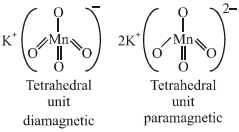
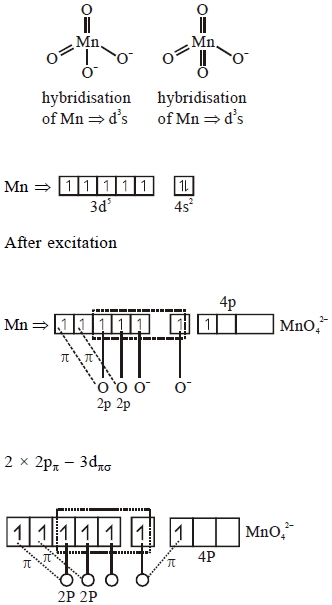
- (A) In manganate and permanganate ions, the \(\pi\) \(-\)bonding takes place by overlap of \(p-\)orbitals of oxygen and \(d-\)orbitals of manganese
- (B) Manganate ion is green in colour and permanganate ion in purple in colour
- (C) Manganate and permanganate ions are paramagnetic
- (D) Manganate and permanganate ions are tetrahedral
Show answer and solution
Correct Answer: (C)
Option \(1)\) Manganate \(\Rightarrow MnO _{4}^{2-}\)Permanganate \(\Rightarrow MnO _{4}^{-}\)
\(2 \times 2 P _{\pi}-3 d _{\pi}\)
\(1 \times 2 P _{\pi}-4 P _{\pi}\)
\((2)\) \(MnO _{4}^{2-} \Rightarrow\) green
\(MnO _{\stackrel -4} \Rightarrow\) purple/violet
\((3)\) Manganate contains \(1\) unpaired electron hence it is paramagnetic
where as permanganetic contains no unpaired electrons hence it is diamagnetic.
\((4)\) Both have d's hybridisation hence both have tetrahedral geometry.
-
- (A) Dy
- (B) Eu
- (C) Ce
- (D) Tb
Show answer and solution
Correct Answer: (B)
Fact -
- (A) \(21,32,53,64\)
- (B) \(21,25,42,72\)
- (C) \(9,17,34,38\)
- (D) \(37,42,50,64\)
Show answer and solution
Correct Answer: (B)
Tranition elements \(=21\) to \(30\)\(37\) to \(48\)
\(57\) \(\&\) \(72\) to \(80\)
Ans. \(21,25,42\, \& 72\)
-
- (A) \(KI\) and \(KMnO_4\)
- (B) \(MnO_2\) and \(KIO_3\)
- (C) \(KIO_3\) and \(MnO_2\)
- (D) \(KI\) and \(K_2MnO_4\)
Show answer and solution
Correct Answer: (B)
\(Mn{O_2}\,\xrightarrow{{4KOH,\,{O_2}}}\mathop {2{K_2}Mn{O_4}}\limits_{(Green)} \, + \,2{H_2}O\)\(3{K_2}Mn{O_4}\,\xrightarrow{{4\,HCl}}\mathop {2KMn{O_4}}\limits_{(purple)} \, + \,Mn{O_2}\, + \,2{H_2}O\)
\(2KMn{O_4}\,\xrightarrow{{{H_2}O,\,KI}}2Mn{O_2}\, + \,2KOH\, + \,KI{O_3}\)
- 185. Consider the hydrated ions of \(Ti^{2+}, V^{2+}, Ti^{3+}\) and \(Sc^{3+}\). The correct order of their spin-only magnetic moments is 2019 Hard
- (A) \(Ti^{3+} < T^{2+} < Sc^{3+} < V^{2+}\)
- (B) \(Sc^{3+} < Ti^{3+} < Ti^2 < V^{2+}\)
- (C) \(V^{2+} < Ti^{2+} < Ti^{3+} < Sc^{3+}\)
- (D) \(Sc^{3+} < Ti^{3+} < V^{2+} < Ti^{2+}\)
Show answer and solution
Correct Answer: (B)
\(T{i^{ + 2}}\, = \,1{s^2}\,2{s^2}\,2{p^6}\,3{s^2}\,3{p^6}\,3{d^2}\)unpaired electron \(=\,2\)
spin only magnetic moment \((\mu )\, = \,\sqrt {2(2 + 2)} \, = \,\sqrt 8 \,B.M\)
\(T{i^{ + 3}}\, = \,1{s^2}\,2{s^2}\,2{p^6}\,3{s^2}\,3{p^6}\,3{d^1}\)
unpaired electron \(=\,1\)
\((\mu )\, = \,\sqrt {1(1 + 2)} \, = \,\sqrt 3 \,B.M\)
\({V^{ + 2}}\, = \,1{s^2}\,2{s^2}\,2{p^6}\,3{s^2}\,3{p^6}\,3{d^3}\)
\((\mu )\, = \,\sqrt {3(3 + 2)} \, = \,\sqrt {15} \,B.M\)
\(S{c^{ + 3}}\, = \,1{s^2}\,2{s^2}\,2{p^6}\,3{s^2}\,3{p^6}\)
\((\mu )\, =0\)
-
- (A) \((a)-(iii)\); \((b)-(iv)\); \((c)-(i)\); \((d)-(ii)\)
- (B) \((a)-(iv)\); \((b)-(iii)\); \((c)-(ii)\); \((d)-(i)\)
- (C) \((a)-(ii)\); \((b)-(iii)\); \((c)-(i)\); \((d)-(iv)\)
- (D) \((a)-(iii)\); \((b)-(i)\); \((c)-(ii)\); \((d)-(iv)\)
Show answer and solution
Correct Answer: (D)
\(V_2O_5\) is used in contact process for \(H_2SO_4\) \(TiCl_4/Al(Me)_3\) Ziegler natal catalyst used fin polymerization \(PdCl_2\) is used in ethanol formation Iron oxide is used in Haber process for \(NH_3\) -
- (A) \(Mn < Ti < Zn < Ni\)
- (B) \(Zn < Ni < Mn < Ti\)
- (C) \(Ti < Mn < Zn < Ni\)
- (D) \(Ti < Mn < Ni < Zn\)
Show answer and solution
Correct Answer: (D)
As \(Zn\) is fully filled and left to right in group \(IP\) increases. - 188. The effect of lanthanoid contraction in the lanthanoid series of elements by the large means 2019 Easy
- (A) increase in both atomic and ionic radii
- (B) decrease in atomic radii and increase in ionic radii
- (C) decrease in both atomic and ionic radii
- (D) increase in atomic radii and decrease in ionic radii
Show answer and solution
Correct Answer: (C)
Atomic and ionic radii decreases -
- (A) \(Cu\)
- (B) \(Ti\)
- (C) \(Sc\)
- (D) \(V\)
Show answer and solution
Correct Answer: (C)
\(Sc^{3+}\) has noble gas configuration hence only \(+3\) exists. -
- (A) \(6\) and \(4\)
- (B) \(7\) and \(6\)
- (C) \(4\) and \(6\)
- (D) \(6\) and \(7\)
Show answer and solution
Correct Answer: (D)
The highest oxidation state of \(U\) and \(Pu\) is \(6+\) and \(7+\) respectively. -
- (A) \(Gd^{3+}\)
- (B) \(La^{3+}\)
- (C) \(Lu^{3+}\)
- (D) \(Sm^{3+}\)
Show answer and solution
Correct Answer: (D)
\(Sm^{3+}\,(4f^5) =\) yellow colour, other ions have stable electron configurations with half filled or full-filled electron configuration. -
- (A) berkelium \((Bk)\) and californium \((Cf)\)
- (B) nobelium \((No)\) and lawrencium \((Lr)\)
- (C) actinium \((Ac)\) and thorium \((Th)\)
- (D) neptunium \((Np)\) and plutonium \((Pu)\)
Show answer and solution
Correct Answer: (D)
neptunium \( (Np) \) and plutonium \( (Pu) \)
- 193. The pair of metal ions that can give a spin-only magnetic moment of \(3.9\, BM\) for the complex \([M(H_2O)_6]Cl_2\) is 2019 Hard
- (A) \(V^{2+}\) and \(Co^{2+}\)
- (B) \(V^{2+}\) and \(Fe^{2+}\)
- (C) \(Co^{2+}\) and \(Fe^{2+}\)
- (D) \(Cr^{2+}\) and \(Mn^{2+}\)
Show answer and solution
Correct Answer: (A)
\(H_2O\) is weak field ligand and magnetic moment \(=\) moment \(=\,\sqrt {n(n+2)} \,BM\)Solving for \('n'\) we get it as \(3;\) i.e., no. of unpaired electron \(=\,3\)
\(F{e^{2 + }}\, = \,{t_{2g}}^4\,{e_g}^2\)
\(C{o^{2 + }}\, = \,{t_{2g}}^5\,{e_g}^2\)
\({V^{2 + }}\, = \,t_{2g}^3\,{e_g}^0\)
\(\therefore \,\,M\) is \(V,\,Co\)
-
- (A) they have metallic conductivity
- (B) they have high melting points
- (C) they are chemically reactive
- (D) they are very hard
Show answer and solution
Correct Answer: (C)
In case of interstial compounds there is presence of small atoms (or impurity) in the lattice of metal. So interstial compounds are hard, high melting point and chemically inert. -
- (A) \(Fe\)
- (B) \(Cu\)
- (C) \(V\)
- (D) \(Zn\)
Show answer and solution
Correct Answer: (D)
Due to weak metallic bonding. -
- (A) \(K_2MnO_4, KMnO_4\) and \(SO_2\)
- (B) \(K_3MnO_4, K_2MnO_4\) and \(Cl_2\)
- (C) \(K_2MnO_4, KMnO_4\) and \(Cl_2\)
- (D) \(KMnO_4, K_2MnO_4\) and \(Cl_2\)
Show answer and solution
Correct Answer: (D)
\(\mathop {2KMn{O_4}\,}\limits_{(X)} \xrightarrow[\Delta ]{{513\,\,K}}\,\mathop {{K_2}Mn{O_4}}\limits_{(Y)} \, + \,Mn{O_2}\, + {O_{2(g)}}\)\(Mn{O_2}\, + \,4NaCl\, + 4{H_2}S{O_4}\, \to \) \(MnC{{l}_{2}}\,+\,4NaHS{{O}_{4}}\,+\,2{{H}_{2}}O\,+\underset{\begin{smallmatrix}
(Z) \\
pungent
\\
gas
\end{smallmatrix}}{\mathop{\,C{{l}_{2(g)}}}}\,\) -
- (A) \(Mn\)
- (B) \(Cr\)
- (C) \(V\)
- (D) \(Ti\)
Show answer and solution
Correct Answer: (A)
\(Mn{O_2} + KOH + KN{O_3} \to \mathop {{K_2}Mn{O_4}}\limits_{(dark\,\,green)} + KN{O_2} + {H_2}O\)\(MnO_4^{2 - } + 4{H^ + }\xrightarrow[{tionation}]{{dispropor}}\mathop {2MnO_4^ - }\limits_{(dark\,purple)} + Mn{O_2} + 2{H_2}O\)
- 198. The transition metal ions responsible for colour in ruby and emerald are, respectively 2016 Hard
- (A) \(Co^{3+}\) and \(Cr^{3+}\)
- (B) \(Co^{3+}\) and \(Co^{3+}\)
- (C) \(Cr^{3+}\) and \(Cr^{3+}\)
- (D) \(Cr^{3+}\) and \(Co^{3+}\)
Show answer and solution
Correct Answer: (C)
A ruby is a crystal of alumina, aluminum oxide \((Al_2O_3)\) containing a trace of chromium \((III)\) ions replacing some of the aluminum ions. In ruby, each \(Al^{3+}\) ion and \(Cr^{3+}\) ion is surrounded by six oxide ions in an octahedral arrangement. The origin of the color of emeralds is similar to that of the color of rubies. However, the bulk of an emerald crystal is composed of beryl, beryllium aluminum silicate \((Be_3 Al_2(SiO_3)_6)\) instead of the alumina which forms rubies. The color is produced by chromium \((III)\) ions, which replace some of the aluminum ions in the crystal. In emeralds, the \(Cr^{3+}\) is surrounded by six silicate ions, rather than the six oxide ions in ruby. Therefore, the color (green) of emeralds is different from that of ruby -
- (A) \(VO_2\)
- (B) \(MnO_2\)
- (C) \(TiO_2\)
- (D) \(CrO_2\)
Show answer and solution
Correct Answer: (D)
Out of all the four given metallic oxides \(C r O_{2}\) is attacted by magnetic field very strongly. The effect persists even when the magnetic field is removed. Thus \(C r O_{2}\) is metallic and ferromagnetic in nature. -
- (A) \(Cr^{2+}\)
- (B) \(MnO_4^{2 - }\)
- (C) \(MnO_4^{3 - }\)
- (D) \(Cu^+\)
Show answer and solution
Correct Answer: (B)
In \(MnO_4^{-2}\) manganese is in \(+6\) oxidation state which is having highest stability.\(MnO_4^{2-}\) disproportionates in neutral or acidic solution.
\(3MnO_4^{2 - }\, + \,4{H^ + }\, \to \,2MnO_4^{2 - }\, + \,Mn{O_2}\, + \,2{H_2}O\)
No questions on this page match these filters.