


JEE Mains 2020 Physics ના બધા પ્રશ્નો
30 પ્રકરણ383 માંથી 251–300 પ્રશ્નો
-
- (A) \(\frac{ x _{2}^{2}}{ x _{1}^{2}}\)
- (B) \(\frac{x_{1}^{3}}{x_{2}^{3}}\)
- (C) \(\frac{x_{1}}{x_{2}}\)
- (D) \(\frac{ x _{2}}{ x _{1}}\)
જવાબ અને ઉકેલ જુઓ
સાચો જવાબ: (C)
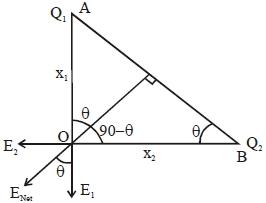
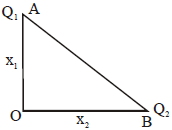
\(E _{2}=\) electric field due to \(Q _{2}\)\(=\frac{ kQ _{2}}{ x _{2}^{2}}\)
\(E _{1}=\frac{ k Q _{1}}{ x _{1}^{2}}\)
From diagram
\(\tan \theta=\frac{ E _{2}}{ E _{1}}=\frac{ x _{1}}{ x _{2}}\)
\(\frac{ kQ _{2}}{ x _{2}^{2} \times \frac{ k Q _{1}}{ x _{1}^{2}}}=\frac{ x _{1}}{ x _{2}}\)
\(\frac{ Q _{2} x _{1}^{2}}{ Q _{1} x _{2}^{2}}=\frac{ x _{1}}{ x _{2}}\)
\(\frac{Q_{2}}{Q_{1}}=\frac{x_{2}}{x_{1}}\)
\(\frac{Q_{1}}{Q_{2}}=\frac{x_{1}}{x_{2}}\)
-
- (A) \(\frac{18}{54}\)
- (B) \(\frac{21}{34}\)
- (C) \(\frac{17}{54}\)
- (D) \(\frac{18}{34}\)
જવાબ અને ઉકેલ જુઓ
સાચો જવાબ: (D)
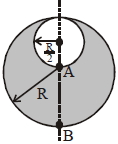
Fill the empty space with \(+\rho\) and \(-\rho\) charge density.\(\left|\mathrm{E}_{\mathrm{A}}\right|=0+\frac{\operatorname{k\rho} \cdot \frac{4}{3} \pi\left(\frac{\mathrm{R}}{2}\right)^{3}}{\left(\frac{\mathrm{R}}{2}\right)^{2}}=\operatorname{k\rho} \frac{4}{3} \pi\left(\frac{\mathrm{R}}{2}\right)\)
\(\left|\mathrm{E}_{\mathrm{B}}\right|=\frac{\mathrm{k} \rho \cdot \frac{4}{3} \pi \mathrm{R}^{3}}{\mathrm{R}^{2}}-\frac{\mathrm{k} \rho \cdot \frac{4}{3} \pi\left(\frac{\mathrm{R}}{2}\right)^{3}}{\left(\frac{3 \mathrm{R}}{2}\right)^{2}}\)
\(=\operatorname{k\rho} \frac{4}{3} \pi \mathrm{R}-\mathrm{k} \rho \frac{4}{3} \pi \frac{\mathrm{R}}{18}=\mathrm{k} \rho \cdot \frac{4}{3} \pi\left(\frac{17 \mathrm{R}}{18}\right)\)
\(\frac{E_{A}}{E_{B}}=\frac{9}{17}=\frac{18}{34}\)
-
- (A) \((-\hat{i}+3 \hat{j}-2 \hat{k})\)
- (B) \((+\hat{i}-3 \hat{j}-2 \hat{k})\)
- (C) \((+\hat{i}+3 \hat{j}-2 \hat{k})\)
- (D) \((-\hat{i}-3 \hat{j}+2 \hat{k})\)
જવાબ અને ઉકેલ જુઓ
સાચો જવાબ: (C)
since \(\overrightarrow{\mathrm{r}}\) and \(\overrightarrow{\mathrm{p}}\) are perpendicular to each othertherefore point lies on the equitorial plane.
Therefore electric field at the point will be
antiparallel to the dipole moment.
i.e. \(\overrightarrow{\mathrm{E}} \|-\overrightarrow{\mathrm{p}}\)
\(\overrightarrow{\mathrm{E}} \|(\hat{\mathrm{i}}+3 \hat{\mathrm{j}}-2 \hat{\mathrm{k}})\)
-
- (A) માત્ર જ્યારે ગાઉસીયન સપાટી સમસ્થિતિમાન સપાટી હોય ત્યારે જ
- (B) સપાટી માટે \(|\overrightarrow{\mathrm{E}}|=\) અચળ હોય ત્યારે જ
- (C) કોઈ પણ પ્રકારની ગાઉસીયન સપાટી
- (D) જ્યારે ગાઉસીયન સપાટી સમસ્થિતિમાન સપાટી અને સપાટી પર \(|\overrightarrow{\mathrm{E}}|\) અચળ હોય
જવાબ અને ઉકેલ જુઓ
સાચો જવાબ: (D)
\(|\overrightarrow{\mathrm{E}}|\) should be constant on the surface and the surface should be equipotential. -
- (A) \(9\)
- (B) \(12\)
- (C) \(6\)
- (D) \(3\)
જવાબ અને ઉકેલ જુઓ
સાચો જવાબ: (B)
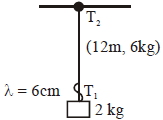
\(V \propto \lambda \quad T _{2}=8 g\)\(T _{1}=2 g\)
\(\frac{ V _{1}}{ V _{2}}=\frac{\lambda_{1}}{\lambda_{2}}\)
\(\lambda_{2}=\frac{ V _{2}}{ V _{1}} \lambda_{1}=\sqrt{\frac{ T _{2}}{ T _{1}}} \times \lambda_{1}\)
\(=\sqrt{\frac{8 g }{2 g }} \lambda_{1}=2 \times 6=12 cm\)
-
- (A) \(10.2 \times 10^{2} \;\mathrm{N}\)
- (B) \(5.15 \times 10^{3}\; \mathrm{N}\)
- (C) \(2.50 \times 10^{4}\; \mathrm{N}\)
- (D) \(30.5 \times 10^{4}\; \mathrm{N}\)
જવાબ અને ઉકેલ જુઓ
સાચો જવાબ: (B)
Velocity of transverse wave \(\mathrm{V} \propto \sqrt{\mathrm{T}}\)\(\mathrm{v} \rightarrow \frac{\mathrm{V}}{2} \Rightarrow \mathrm{T} \rightarrow \mathrm{T}^{\prime}=\frac{\mathrm{T}}{4}\)
\(\mathrm{T}^{\prime}=\frac{2.06 \times 10^{4}}{4}=5.15 \times 10^{3} \mathrm{N}\)
-
- (A) \(35\)
- (B) \(55\)
- (C) \(20\)
- (D) \(40\)
જવાબ અને ઉકેલ જુઓ
સાચો જવાબ: (A)
\(\rho_{\text {wire }}=9 \times 10^{-3} \frac{ kg }{ cm ^{3}}=\frac{9 \times 10^{-3}}{10^{-6}} kg / m ^{3}\)\(=9000 kg / m ^{2}\)
\(( A = CSA\) of wire \()\)
\(\left( Y =9 \times 10^{10} Nm ^{2}\right)\)
\(\left(\right.\) Strain \(\left.=4.9 \times 10^{-4}\right)\)
\(\Rightarrow L =1 m =\frac{\lambda}{2} \Rightarrow \lambda=2 m\)
\(\Rightarrow v=f \lambda \Rightarrow \sqrt{\frac{T}{\mu}}=f \lambda\)
Where \(Y=\frac{T / A}{\text { strain }} \Rightarrow T=Y . A .\) strain
\(\Rightarrow \sqrt{\frac{ Y . A . strain }{ m / L }}= f \times 2 \Rightarrow \sqrt{\frac{ Y . A I . \text { strain }}{ M }}= f \times 2\)
\(\Rightarrow \sqrt{\frac{ Y \times V \times \text { strain }}{ M }}= f \times 2 \Rightarrow \sqrt{\frac{ Y \times \text { strain }}{\rho}}= f \times 2\)
\(f =\frac{1}{2} \sqrt{\frac{ Y \times \text { strain }}{\rho}}=\frac{1}{2} \sqrt{\frac{9 \times 10^{10} \times 4.9 \times 10^{-4}}{9000}}\)
\(f=\frac{1}{2} \sqrt{\frac{9 \times 10^{3}}{9} \times 4.9}=\frac{1}{2} \sqrt{4900}=\frac{70}{2}=35 Hz\)
-
- (A) \(1100\)
- (B) \(3300\)
- (C) \(2200\)
- (D) \(550\)
જવાબ અને ઉકેલ જુઓ
સાચો જવાબ: (C)
\(\Rightarrow \lambda=2\left(l_{2}-l_{1}\right) \Rightarrow 2 \times(24.5-17)\)\(\Rightarrow 2 \times 7.5=15 cm\)
\(\& v = f \lambda \Rightarrow 330=\lambda \times 15 \times 10^{-2}\)
\(\lambda=\frac{330}{15} \times 100 \Rightarrow \frac{1100 \times 100}{5}\)
\(\Rightarrow 2200 Hz\)
-
- (A) \(92\)
- (B) \(106\)
- (C) \(125\)
- (D) \(136\)
જવાબ અને ઉકેલ જુઓ
સાચો જવાબ: (B)
\(v_{s}=\sqrt{\frac{\gamma P}{\rho}}\)\(\frac{\mathrm{v}_{\mathrm{gas}}}{\mathrm{v}_{\mathrm{air}}}=\sqrt{\frac{\rho_{\mathrm{air}}}{\rho_{\mathrm{gas}}}}\)
\(\Rightarrow \frac{\mathrm{v}_{\mathrm{gas}}}{300}=\frac{1}{\sqrt{2}}\)
\(\Rightarrow \mathrm{v}_{\mathrm{gas}}=\frac{300}{\sqrt{2}}\)
\(\therefore \mathrm{v}_{\mathrm{grs}}=150 \sqrt{2}\)
Now \(\mathrm{n}_{2}-\mathrm{n}_{1}=\frac{\mathrm{v}_{\mathrm{gss}}}{2 \ell}=\frac{150 \sqrt{2}}{2(1)}=75 \sqrt{2}\)
\(\Rightarrow \Delta \mathrm{n}=106.06 \mathrm{Hz}\)
-
- (A) \(91\)
- (B) \(71\)
- (C) \(81\)
- (D) \(61\)
જવાબ અને ઉકેલ જુઓ
સાચો જવાબ: (A)
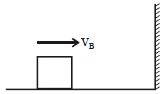
\(f _{1}=\left(\frac{330}{330- v _{ B }}\right) 420\)\(f _{2}=\left(\frac{330+ v _{0}}{330}\right)\left(\frac{330}{330- v _{ B }}\right) 420\)
\(490=\left(\frac{330+ v _{ B }}{330- v _{ B }}\right) 420\)
\(\frac{7}{6}=\frac{330+ v _{ B }}{330- v _{ B }}\)
\(v _{ B }=\frac{330}{13} m / s\)
\(=\frac{330}{13} \times \frac{18}{5} \approx 91 km / hr\)
-
- (A) \(36\)
- (B) \(24\)
- (C) \(18\)
- (D) \(54\)
જવાબ અને ઉકેલ જુઓ
સાચો જવાબ: (D)
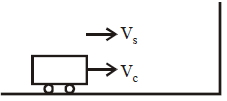
\(f _{1}=\) frequency heard by wall \(= f _{ s }=\left(\frac{ v _{ s }}{ v _{ s }- v _{ c }}\right)\)\(f _{2}=\) frequency heard by driver after reflection from wall
\(f_{2}=\left(\frac{v_{s}+v_{c}}{v_{s}}\right) f_{1}=\left(\frac{v_{s}+v_{c}}{v_{s}-v_{c}}\right) f_{0}\)
\(\frac{f_{2}}{f_{0}}=\frac{v_{s}-v_{c}}{v_{s}+v_{c}}\)
\(\frac{48}{44}=\frac{v_{s}-v_{c}}{v_{s}+v_{c}}\)
\(12\left( v _{ s }+ v _{ c }\right)=11\left( v _{ s }- v _{ c }\right)\)
\(23 v _{ c }= v _{ s }\)
\(v _{ c }=\frac{ v _{ s }}{23}=\frac{345}{23}=15 m / s\)
\(=\frac{15 \times 18}{5}=54 km / hr\)
-
- (A) \(1,2,3, \ldots \ldots\)
- (B) \(\frac{1}{2}, \frac{1}{4}, \frac{1}{6}, \ldots\)
- (C) \(1,3,5, \ldots\)
- (D) \(\frac{1}{1}, \frac{1}{3}, \frac{1}{5}, \ldots\)
જવાબ અને ઉકેલ જુઓ
સાચો જવાબ: (D)
Given \(T\) to \(C\,\, 1.5 m\)\(C\) to \(C\, 5 m\)
\(T\) to \(C =\left(2 n _{1}+1\right) \frac{\lambda}{2}\)
\(C\) to \(C = n _{2} \lambda\)
\(\frac{1.5}{5}=\frac{\left(2 n _{1}+1\right)}{2 n _{2}} \Rightarrow 3 n _{2}=10 n _{1}+5\)
\(n _{1}=1, n _{2}=5 \rightarrow \lambda=1\)
\(n _{1}=4, n _{2}=15 \rightarrow \lambda=1 / 3\)
\(n _{1}=7, n _{2}=25 \rightarrow \lambda=1 / 5\)
-
- (A) \(10\,mm\)
- (B) \(\frac{3}{100}\, mm\)
- (C) \(1\, mm\)
- (D) \(\frac{1}{10}\, mm\)
જવાબ અને ઉકેલ જુઓ
સાચો જવાબ: (B)
\(\Delta p = B k S_{0}\)\(=\rho v ^{2} \times \frac{\omega}{ v } \times S _{0}\)
\(\Rightarrow S _{0}=\frac{\Delta p }{\rho v \omega}\)
\(\approx \frac{10}{1 \times 300 \times 1000} m\)
\(=\frac{1}{30} mm \approx \frac{3}{100} mm\)
-
- (A) \(8.1 \;m\)
- (B) \(5.1 \;m\)
- (C) \(1.1 \;m\)
- (D) \(2.1 \;m\)
જવાબ અને ઉકેલ જુઓ
સાચો જવાબ: (D)
\(\frac{\mathrm{nv}}{2 \ell}=420\)\(\frac{(\mathrm{n}+1) \mathrm{v}}{2 \ell}=490\)
\(\frac{v}{2 \ell}=70\)
\(\ell=\frac{\mathrm{v}}{140}=\frac{1}{140} \sqrt{\frac{540}{6 \times 10^{-3}}}=\frac{1}{140} \sqrt{90 \times 10^{3}}\)
\(\ell=\frac{300}{140}=2.142\)
-
- (A) \(\frac{1}{8}\; \mathrm{m} / \mathrm{s}\)
- (B) \(\frac{1}{2}\; \mathrm{m} / \mathrm{s}\)
- (C) \(1 \; \mathrm{m} / \mathrm{s}\)
- (D) \(\frac{1}{4}\; \mathrm{m} / \mathrm{s}\)
જવાબ અને ઉકેલ જુઓ
સાચો જવાબ: (D)
\(v_{1}=\left(\frac{c}{c-v}\right) v_{0}\)\(v_{2}=\left(\frac{c}{c+v}\right) v_{0}\)
beat frequency \(=v_{1}-v_{2}\)
\(=\mathrm{cv}_{0} \quad\left(\frac{1}{\mathrm{c}-\mathrm{v}}-\frac{1}{\mathrm{c}+\mathrm{v}}\right)\)
\(=c v_{0}\left(\frac{c+v-c+v}{c^{2}-v^{2}}\right)=\frac{2 c v_{0}^{2} v}{c^{2}-v^{2}}\)
\(\approx \frac{2 \mathrm{cv}_{0} \mathrm{v}}{\mathrm{c}^{2}}=\frac{2 \mathrm{v}_{0} \mathrm{v}}{\mathrm{c}}=2\)
\(\Rightarrow \frac{2 \times 1400 \times v}{350}=2\)
\(\Rightarrow \mathrm{v}=\frac{1}{4} \mathrm{m} / \mathrm{s}\)
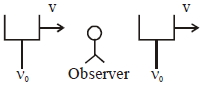
-
- (A) \(5.8 \mathrm{I}_{0}\)
- (B) \(0.2 \mathrm{I}_{0}\)
- (C) \(\mathrm{I}_{0}\)
- (D) \(3 \mathrm{I}_{0}\)
જવાબ અને ઉકેલ જુઓ
સાચો જવાબ: (A)
Let amplitude of each wave is \(A.\)Resultant wave equation
\(=A \sin \omega t+A \sin \left(\omega t-\frac{\pi}{4}\right)+A \sin \left(\omega t+\frac{\pi}{4}\right)\)
\(=\mathrm{A} \sin \omega \mathrm{t}+\sqrt{2} \mathrm{A} \sin \omega \mathrm{t}\)
\(=(\sqrt{2}+1) \mathrm{A} \sin \omega \mathrm{t}\)
Resultant wave amplitude \(=(\sqrt{2}+1) \mathrm{A}\)
as \(I \propto A ^{2}\)
so \(\frac{\mathrm{I}}{\mathrm{I}_{0}}=(\sqrt{2}+1)^{2}\)
\(I=5.8 \mathrm{I}_{0}\)
-
- (A) \(0.44\)
- (B) \(1.5\)
- (C) \(2.25\)
- (D) \(1.25\)
જવાબ અને ઉકેલ જુઓ
સાચો જવાબ: (C)
\(f =\frac{1}{2 \ell} \sqrt{\frac{ T }{\mu}}\)For identical string \(l\) and \(\mu\) will be same
\(f \propto \sqrt{ T }\)
\(\frac{450}{300}=\sqrt{\frac{T_{x}}{T_{y}}}\)
\(\frac{T_{x}}{T_{y}}=\frac{9}{4}=2.25\)
-
- (A) \(0.02\; mm\)
- (B) \(0.04\; mm\)
- (C) \(0.03\; mm\)
- (D) \(0.01\; mm\)
જવાબ અને ઉકેલ જુઓ
સાચો જવાબ: (C)
\(\mathrm{v}=\sqrt{\frac{\mathrm{T}}{\mu}}\)\(90=\sqrt{\frac{\mathrm{YA}}{\mathrm{m}}}=\sqrt{\frac{16 \times 10^{11} \times 10^{-6} \times \Delta l}{6 \times 10^{-3}}}\)
\(=\frac{8100 \times 3}{8} \times 10^{-8}=\Delta l=0.03\;mm\)
-
- (A) \(\frac{2}{\sqrt{3}}\)
- (B) \(\frac{\sqrt{2}}{3}\)
- (C) \(\frac{2}{3}\)
- (D) \(\frac{3}{\sqrt{2}}\)
જવાબ અને ઉકેલ જુઓ
સાચો જવાબ: (A)
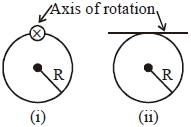
Moment of inertia in case \((i)\) is \(I _{1}\)Moment of inertia in case \((ii)\) is \(I_{2}\)
\(I_{1}=2 M R^{2}\)
\(I _{2}=\frac{3}{2} MR ^{2}\)
\(T _{1}=2 \pi \sqrt{\frac{ I _{1}}{ Mgd }} ; T _{2}=2 \pi \sqrt{\frac{ I _{2}}{ Mgd }}\)
\(\frac{ T _{1}}{ T _{2}}=\sqrt{\frac{ I _{1}}{ I _{2}}}=\sqrt{\frac{2 MR ^{2}}{\frac{3}{2} MR ^{2}}}=\frac{2}{\sqrt{3}}\)
-
- (A) \(\frac{1}{2}\)
- (B) \(\frac{1}{\sqrt{2}}\)
- (C) \(1\)
- (D) \(\sqrt{2}\)
જવાબ અને ઉકેલ જુઓ
સાચો જવાબ: (D)
At equilibrium position\(V _{0}=\omega_{0} A =\sqrt{\frac{ K }{ m }} A....(i)\)
\(V =\omega A '=\sqrt{\frac{ K }{\frac{ m }{2}}} A '...(ii)\)
\(\therefore \quad A'= \sqrt{2} A\)
\(P_{i}=P_{f}\)
\(mV_0=\frac m{2} V\)
\(m(A \omega)=\frac{m}{2}\left(A^{\prime} \omega^{\prime}\right)\)
\(m A \sqrt{\frac{k}{m}}=\frac{m}{2} A^{\prime} \sqrt{\frac{k}{m / 2}}\)
\(m^{2} A^{2}\left[\frac{K}{m}\right]=\frac{m^{2}}{42}\left(A^{\prime}\right)^{2} \frac{k}{m} \times v\)
\(2 A^{2}=\left(A^{\prime}\right)^{2} \Rightarrow A^{\prime}=\sqrt{2}\)
-
- (A) \(\sqrt{\frac{g}{y_{0}}}\)
- (B) \(\sqrt{\frac{g}{2 y_{0}}}\)
- (C) \(\frac{1}{2} \sqrt{\frac{g}{y_{0}}}\)
- (D) \(\sqrt{\frac{2 g}{y_{0}}}\)
જવાબ અને ઉકેલ જુઓ
સાચો જવાબ: (B)
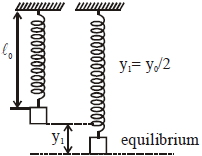
\(y = y _{0} \sin ^{2} \omega t\)\(y =\frac{ y _{0}}{2}(1-\cos 2 \omega t )\)
\(y -\frac{ y _{0}}{2}=-\frac{ y _{0}}{2} cos 2 \omega t\)
Amplitude : \(\frac{y_{0}}{2}\)
\(\frac{y_{0}}{2}=\frac{m g}{K}\)
\(2 \omega=\sqrt{\frac{K}{m}}=\sqrt{\frac{2 g}{y_{0}}}\)
\(\omega=\sqrt{\frac{g}{2 y_{0}}}\)
-
- (A) \(f =\frac{1}{2 \pi} \sqrt{\frac{ YA }{ mL }}\)
- (B) \(f=\frac{1}{2 \pi} \sqrt{\frac{Y L}{m A}}\)
- (C) \(f=\frac{1}{2 \pi} \sqrt{\frac{m A}{Y L}}\)
- (D) \(f =\frac{1}{2 \pi} \sqrt{\frac{ mL }{ YA }}\)
જવાબ અને ઉકેલ જુઓ
સાચો જવાબ: (A)
An elastic wire can be treated as a spring with\(K =\frac{ Y A }{\ell}\)
\(T =2 \pi \sqrt{\frac{ m }{ k }}\)
\(f=\frac{1}{2 \pi} \sqrt{\frac{k}{m}}=\frac{1}{2 \pi} \sqrt{\frac{Y A}{m \ell}}\)
-
- (A) \(\mathrm{L} \leftrightarrow \mathrm{m}, \mathrm{C} \leftrightarrow \frac{1}{\mathrm{k}}, \mathrm{R} \leftrightarrow \mathrm{b}\)
- (B) \(\mathrm{L} \leftrightarrow \frac{1}{\mathrm{b}}, \mathrm{C} \leftrightarrow \frac{1}{\mathrm{m}}, \mathrm{R} \leftrightarrow \frac{1}{\mathrm{k}}\)
- (C) \(\mathrm{L} \leftrightarrow \mathrm{m}, \mathrm{C} \leftrightarrow \mathrm{k}, \mathrm{R} \leftrightarrow \mathrm{b}\)
- (D) \(\mathrm{L} \leftrightarrow \mathrm{k}, \mathrm{C} \leftrightarrow \mathrm{b}, \mathrm{R} \leftrightarrow \mathrm{m}\)
જવાબ અને ઉકેલ જુઓ
સાચો જવાબ: (A)
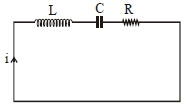
By \(kVL\)\(-\mathrm{L} \frac{\mathrm{di}}{\mathrm{dt}}-\frac{\mathrm{q}}{\mathrm{C}}-\mathrm{iR}=0\)
\(\mathrm{L} \frac{\mathrm{d}^{2} \mathrm{q}}{\mathrm{dt}^{2}}+\frac{1}{\mathrm{C}} \mathrm{q}+\mathrm{R} \frac{\mathrm{dq}}{\mathrm{dt}}=0\)
for damped oscillator
net force \(=-\mathrm{kx}-\mathrm{bv}=\mathrm{ma}\)
\(\frac{m d^{2} x}{d t^{2}}+k x+\frac{b d x}{d t}=0\)
by comparing : Equivalence is
\(\mathrm{L} \rightarrow \mathrm{m}: \mathrm{C} \rightarrow \frac{1}{\mathrm{K}} ; \mathrm{R} \rightarrow \mathrm{b}\)
-
- (A) \(( A ),( B )\) અને \(( D )\)
- (B) \(( B ),( C )\) અને \(( D )\)
- (C) \((A)\) અને \((D)\)
- (D) \(( A ),( B )\) અને \(( C )\)
જવાબ અને ઉકેલ જુઓ
સાચો જવાબ: (D)
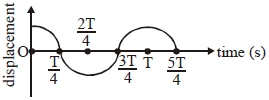
Sol. \((A)\) \(F =\) ma \(\quad a =-\omega^{2} x\)at \(\frac{3 T }{4}\) displacement zero \(( x =0),\) so \(a =0\)
\(F=0\)
\((B)\) at \(t=T \quad\) displacement \((x)=A\) \(x\) maximum, So acceleration is maximum.
\((C)\) \(V =\omega \sqrt{ A ^{2}- x ^{2}}\)
\(V _{\max }\) at \(x =0\)
\(V _{\max }= A \omega\)
at \(t =\frac{ T }{4}, x =0, \quad\) So \(V _{ max }\)
\((D)\) \(KE = PE\)
\(\therefore\) at \(x=\frac{A}{\sqrt{2}}\)
at \(t=\frac{T}{2} \quad x=-A \quad\) (So not possible)
-
- (A) \(A-IV, B-I, C-II, D-III\)
- (B) \(A-IV, B-II, C-I, D-III\)
- (C) \(A-III, B-IV, C-II, D-I\)
- (D) \(A-II, B-III, C-I, D-IV\)
જવાબ અને ઉકેલ જુઓ
સાચો જવાબ: (A)
\(\gamma=\frac{ C _{ p }}{ C _{ v }}=1+\frac{2}{ f }\)where \('f'\) is degree of freedom
\((A)\) Monoatomic \(f=3, \gamma=1+\frac{2}{3}=\frac{5}{3}\)
\((B)\) Diatomic rigid molecules,
\(f=5, \gamma=1+\frac{2}{3}=\frac{7}{5}\)
\((C)\) Diatomic non-rigid molecules
\(f=7, \gamma=1+\frac{2}{7}=\frac{9}{7}\)
\((D)\) Triatomic rigid molecules
\(f=6, \gamma=1+\frac{2}{6}=\frac{4}{3}\)
-
- (A) \(7:9\)
- (B) \(5:7\)
- (C) \(3:5\)
- (D) \(5:9\)
જવાબ અને ઉકેલ જુઓ
સાચો જવાબ: (B)
Degree of freedom of a diatomic molecule if vibration is absent \(=5\)Degree of freedom of a diatomic molecule if vibration is present \(=7\)
\(\therefore C_{v}^{A}=\frac{f_{A}}{2} R=\frac{5}{2} R\) and \(C_{v}^{B}=\frac{f_{B}}{2} R=\frac{7}{2} R\)
\(\therefore \quad \frac{C_{\mathrm{v}}^{\mathrm{A}}}{C_{\mathrm{v}}^{\mathrm{B}}}=\frac{5}{7}\)
-
- (A) \(1.09\)
- (B) \(4.67\)
- (C) \(1.83\)
- (D) \(2.3\)
જવાબ અને ઉકેલ જુઓ
સાચો જવાબ: (A)
\(\lambda=\frac{1}{\sqrt{2} \pi \mathrm{n}_{\mathrm{v}} \mathrm{d}^{2}}\)\(\tau=\frac{\lambda}{\mathrm{v}}=\frac{1}{\sqrt{2} \pi \mathrm{n}_{\mathrm{v}} \mathrm{d}^{2} \mathrm{v}}=\frac{1}{\sqrt{2} \pi \mathrm{n}_{\mathrm{v}} \mathrm{d}^{2}} \sqrt{\frac{\mathrm{M}}{3 \mathrm{RT}}}\)
\(\frac{\tau_{1}}{\tau_{2}}=\sqrt{\frac{M_{1}}{M_{2}}} \frac{d_{2}^{2}}{d_{1}^{2}}\)
\(=\sqrt{\frac{40}{140}} \frac{(0.1)^{2}}{(0.07)^{2}}\)
\(=1.09\)
-
- (A) \((C)\) અને \((D)\)
- (B) \((A)\) અને \((B)\)
- (C) \((A)\) અને \((D)\)
- (D) \((B)\) અને \((C)\)
જવાબ અને ઉકેલ જુઓ
સાચો જવાબ: (D)
The mean free path of molecules of an ideal gas is given as\(\lambda=\frac{ V }{\sqrt{2} \pi d ^{2} N }\)
\(V =\) Volume of container
where: \(N =\) No of molecules
Hence with increasing temp since volume of container does not change (closed container), so mean free path is unchanged.
Average collision time
\(=\frac{\text { mean free path }}{V_{ av }}=\frac{\lambda}{(\text { avg speed of molecules })}\)
\(\because\) avg speed \(\alpha \sqrt{ T }\)
\(\therefore\) Avg coll. time \(\alpha \frac{1}{\sqrt{ T }}\)
Hence with increase in temperature the average collision time decreases.
-
- (A) \(1.50\)
- (B) \(1.42\)
- (C) \(1.45\)
- (D) \(1.47\)
જવાબ અને ઉકેલ જુઓ
સાચો જવાબ: (B)
For \(1^{\text {st }}\) gas \(\frac{C_{P_{1}}}{C_{V_{1}}}=\frac{5}{3} \Rightarrow C_{P_{1}}=5 x\) and \(C_{V_{1}}=3 x\)For \(2^{\text {nd }}\) gas \(\frac{C_{P_{2}}}{C_{V_{2}}}=\frac{4}{3} \Rightarrow C_{P_{2}}=4 x\) and \(C_{V_{2}}=3 x\)
Now for mixture \(\mathrm{C}_{\mathrm{P}}=\frac{\mathrm{n}_{1} \mathrm{C}_{\mathrm{P}}+\mathrm{n}_{2} \mathrm{C}_{\mathrm{B}_{2}}}{\mathrm{n}_{1}+\mathrm{n}_{2}}=\frac{17 \mathrm{R}}{5}\)
\(C_{V}=\frac{n_{1} C_{V_{1}}+n_{2} C_{V_{3}}}{n_{1}+n_{2}}=\frac{12 R}{5}\)
\(\Rightarrow \frac{C_{p}}{C_{v}}=\frac{2(5 x)+3(4 x)}{2(3 x)+3(3 x)}=\frac{17}{12}\)
\(\Rightarrow \frac{C_{P}}{C_{V}} \approx 1.42\)
-
- (A) \(5\)
- (B) \(3\)
- (C) \(6\)
- (D) \(7\)
જવાબ અને ઉકેલ જુઓ
સાચો જવાબ: (C)
\(nC _{ P }(50)=160\)\(nC _{ v }(100)=240\)
\(\Rightarrow \frac{ C _{ p }}{2 C _{ v }}=\frac{160}{240}=\frac{\gamma}{2}\)
\(\therefore \gamma=\frac{4}{3}\) and \(f =\frac{2}{\gamma-1}=6\)
-
- (A) \(150\)
- (B) \(176\)
- (C) \(145\)
- (D) \(135\)
જવાબ અને ઉકેલ જુઓ
સાચો જવાબ: (A)
\(PV = nRT\)\(P \Delta V + V \Delta P =0 \quad(\) for constant temp. \()\)
\(P \Delta V = n R \Delta T \quad(\) for constant pressure)
\(\Delta T =\frac{ P \Delta V }{ nR }\)
\(\Delta P =-\frac{ P \Delta V }{ V } \quad(\Delta V\) is same in both cases \()\)
\(\frac{\Delta T }{\Delta P }=\frac{ P \Delta V }{ nR } \frac{ V }{- P \Delta V }=\frac{- V }{ nR }=-\frac{ T }{ P }\)
\(( PV = nRT )\)
\(\left(\frac{ V }{ nR }=\frac{ T }{ P }\right) \quad\left|\frac{\Delta T }{\Delta P }\right|=\left|\frac{-300}{2}\right|=150\)
-
- (A) \(U =\frac{5}{2} RT\) અને \(\gamma=\frac{6}{5}\)
- (B) \(U =5 RT\) અને \(\gamma=\frac{7}{5}\)
- (C) \(U =5 RT\) અને \(\gamma=\frac{6}{5}\)
- (D) \(U =\frac{5}{2} RT\) અને \(\gamma=\frac{7}{5}\)
જવાબ અને ઉકેલ જુઓ
સાચો જવાબ: (D)
Total degree of freedom \(=3+2=5\)\(U =\frac{ nfRT }{2} \Rightarrow \frac{5 RT }{2}\)
\(\gamma \Rightarrow \frac{ C _{ P }}{ C _{ V }} \Rightarrow 1+\frac{2}{ f } \Rightarrow 1+\frac{2}{5} \Rightarrow \frac{7}{5}\)
-
- (A) \(5\)
- (B) \(10\)
- (C) \(13\)
- (D) \(9\)
જવાબ અને ઉકેલ જુઓ
સાચો જવાબ: (A)
\(P V = n R T\)\(P _{1} V _{1} =nR\times 250\)
\(P _{2}\left(2 V _{1}\right)=\frac{5 n }{4} R \times 2000\)
Divide
\(\frac{ P _{1}}{2 P _{2}}=\frac{4 \times 250}{5 \times 2000}\)
\(\frac{P_{1}}{P_{2}}=\frac{1}{5}\)
\(\frac{P_{2}}{P_{1}}=5\)
-
- (A) \(4.5\)
- (B) \(1.5\)
- (C) \(2.5\)
- (D) \(3\)
જવાબ અને ઉકેલ જુઓ
સાચો જવાબ: (D)
\(DOF =3+3=6\)\(U =\frac{ f }{2} nRT =3 RT\)
-
- (A) \(11\)
- (B) \(15\)
- (C) \(20\)
- (D) \(13\)
જવાબ અને ઉકેલ જુઓ
સાચો જવાબ: (B)
\(u =\frac{ f _{1} n _{1} RT }{2}+\frac{ f _{2} n _{2} RT }{2}\)\(u =\frac{5}{2} \times 3 RT +\frac{3 \times 5 RT }{2}=15 RT\)
-
- (A) \(\frac{67}{45}\)
- (B) \(\frac{19}{13}\)
- (C) \(\frac{23}{15}\)
- (D) \(\frac{40}{27}\)
જવાબ અને ઉકેલ જુઓ
સાચો જવાબ: (B)
\(\frac{C_{P}}{C_{V}} \operatorname{mix}=\frac{n_{1} C_{P_{1}}+n_{2} C_{P_{2}}}{n_{1} C_{V_{1}}+n_{2} C_{V_{2}}}\)\(\frac{C_{P}}{C_{V}} \operatorname{mix}=\frac{n \times\left(\frac{5 R}{2}\right)+2 n\left(\frac{7 R}{2}\right)}{n \times \frac{3 R}{2}+2 n\left(\frac{5 R}{2}\right)}\)
\(\frac{C_{P}}{C_{V}}=\frac{19}{13}\)
-
- (A) \(45\)
- (B) \(41\)
- (C) \(38\)
- (D) \(49\)
જવાબ અને ઉકેલ જુઓ
સાચો જવાબ: (B)
\(V _{ rms }=\sqrt{\frac{3 RT }{ M }}\)\(V _{ N _{2}}= V _{ H _{2}}\)
\(\sqrt{\frac{3 RT _{ N _{2}}}{ M _{ N _{2}}}}=\sqrt{\frac{3 RT _{ H _{2}}}{ M _{ H _{2}}}}\)
\(\frac{573}{28}=\frac{ T _{ H _{2}}}{2} \Rightarrow T _{ H _{2}}=40.928\)
- 288. \(P\) દબાણ અને \(T\) તાપમાને એક પાતળો વાયુ છે,આ વાયુના અણુની ક્રમિક અથડામણ વચ્ચેનો સમય તાપમાન \(T\) સાથે કેવી રીતે બદલાય? 2020 મધ્યમ
- (A) \(\sqrt{ T }\)
- (B) \(\frac{1}{ T }\)
- (C) \(\frac{1}{\sqrt{ T }}\)
- (D) \(T\)
જવાબ અને ઉકેલ જુઓ
સાચો જવાબ: (C)
\(v _{ avg } \propto \sqrt{ T }\)\(t _{0}:\) mean time
\(\lambda:\) mean free path
\(t _{0}=\frac{\lambda}{ v _{avg }} \times \frac{1}{\sqrt{ T }}\)
-
- (A) \(\left(\frac{1}{2}\right)^{\frac{\gamma+1}{2}}\)
- (B) \(2\)
- (C) \(\frac 12\)
- (D) \(\left(\frac{1}{2}\right)^{\gamma}\)
જવાબ અને ઉકેલ જુઓ
સાચો જવાબ: (A)
\({\lambda \propto V}\)The average time between the collisions of the gas molecules is nothing but the mean free path divided by the root mean square speed of the gas molecules.
\(\mathrm{So}\)
\(\Longrightarrow\left[\text { Time }=t=\frac{\lambda}{v_{R M S}}\right]\)
Now we also know that :-
\(v_{R M S} \propto \sqrt{P V}\)
Using the above we get :-
\(\Longrightarrow t \propto V \times \sqrt{\frac{1}{P V}}\)
\(\Longrightarrow t \propto \sqrt{\frac{V^{2}}{P V}}\)
\(\Longrightarrow t \propto \sqrt{\frac{V}{P}}\)
adiabatic process then \(PV^{\gamma}=constant\)
then \(t \propto V^{\frac{\gamma+1}{2}}\)
-
- (A) \(5.8 \times 10^{18}\)
- (B) \(5.8 \times 10^{16}\)
- (C) \(4.0 \times 10^{18}\)
- (D) \(4.0 \times 10^{16}\)
જવાબ અને ઉકેલ જુઓ
સાચો જવાબ: (C)
\(n =\frac{ PV }{ RT }, \frac{3}{2} kT =4 \times 10^{-14}\)\(N =\frac{ PV }{ RT } \times Na\)
\(=\frac{2 \times 13.6 \times 980 \times 4}{\frac{8}{3} \times 10^{-14}}=3.99 \times 10^{18}\)
-
- (A) \(8000\)
- (B) \(8502\)
- (C) \(8791\)
- (D) \(8561\)
જવાબ અને ઉકેલ જુઓ
સાચો જવાબ: (C)
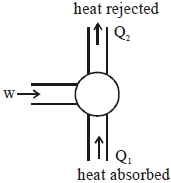
\(W + Q _{1}= Q _{2}\)\(W = Q _{2}- Q _{1}\)
\(C.O.P. =\frac{ Q _{1}}{ W }=\frac{ Q _{1}}{ Q _{2}- Q _{1}}=\frac{273}{300-273}=\frac{ Q _{1}}{ W }\)
\(W =\frac{27}{273} \times 80 \times 100 \times 4.2\)
\(Q _{2}= W+Q_{1}\)
\(Q _{2}=\frac{27}{273} \times 80 \times 100 \times 4.2+80 \times 100 \times 4.2\)
\(Q _{2}=\frac{300}{273} \times 80 \times 100=8791.2 cal\)
-
- (A) \(1818\)
- (B) \(2020\)
- (C) \(1576\)
- (D) \(1734\)
જવાબ અને ઉકેલ જુઓ
સાચો જવાબ: (A)
\(\mathrm{PV} ^\gamma=\) constant\(\mathrm{TV} ^{\gamma-1}=\mathrm{C}\)
\(300 \times \mathrm{V}^{\frac{7}{5}-1}=\mathrm{T}_{2}\left(\frac{\mathrm{V}}{16}\right)^{\frac{7}{5}-1}\)
\(300 \times 2^{4 \times \frac{2}{5}}=\mathrm{T}_{2}\)
Isobaric process
\(\mathrm{V}=\frac{\mathrm{nRT}}{\mathrm{P}}\)
\(\mathrm{V}_{2}=\mathrm{kT}_{2}\)
\(2 \mathrm{V}_{2}=\mathrm{KT}_{\mathrm{f}}\)
\(\frac{1}{2}=\frac{\mathrm{T}_{2}}{\mathrm{T}_{\mathrm{f}}} \Rightarrow \mathrm{T}_{\mathrm{f}}=2 \mathrm{T}_{2}\)
\(\mathrm{T}_{\mathrm{f}}=2 \times 300 \times 2^{\frac{8}{5}}=1818.85\)
-
- (A) \(\mathrm{T}=\frac{2 \mathrm{T}_{1} \mathrm{T}_{2}}{\mathrm{T}_{1}+\mathrm{T}_{2}}\)
- (B) \(\mathrm{T}=\sqrt{\mathrm{T}_{1} \mathrm{T}_{2}}\)
- (C) \(\mathrm{T}=\frac{\mathrm{T}_{1}+\mathrm{T}_{2}}{2}\)
- (D) \(T=0\)
જવાબ અને ઉકેલ જુઓ
સાચો જવાબ: (C)
\(\frac{\mathrm{Q}_{\mathrm{H}}}{\mathrm{Q}_{\mathrm{L}}}=\frac{\mathrm{T}_{1}}{\mathrm{T}}\) and \(\mathrm{W}=\mathrm{Q}_{\mathrm{H}}-\mathrm{Q}_{\mathrm{L}}\)\(\frac{\mathrm{Q}_{\mathrm{L}}}{\mathrm{Q}_{\mathrm{L}}^{\prime}}=\frac{\mathrm{T}}{\mathrm{T}_{2}}\) and \(\mathrm{W}=\mathrm{Q}_{\mathrm{L}}-\mathrm{Q}_{\mathrm{L}}\)
From \((1)\) and \((2)\)
we get \(\mathrm{T}=\frac{\mathrm{T}_{1}+\mathrm{T}_{2}}{2}\)
-
- (A) અપ્રતિવર્તી સમતાપી
- (B) અપ્રતિવર્તી સમોષ્મી
- (C) પ્રતિવર્તી સમોષ્મી
- (D) પ્રતિવર્તી સમતાપી
જવાબ અને ઉકેલ જુઓ
સાચો જવાબ: (B)
Bursting of helium balloon is irreversible \(\&\) adiabatic. -
- (A) \(269.5\)
- (B) \(260.6\)
- (C) \(250.5\)
- (D) \(266.67\)
જવાબ અને ઉકેલ જુઓ
સાચો જવાબ: (D)
As work done on gas and heat supplied to the gas are zero,total internal energy of gases remain same
\(u _{1}+ u _{2}= u _{1}^{\prime}+ u _{2}^{\prime}\)
\((0.1) C _{ v }(200)+(0.05) C _{ v }(400)=(0.15) C _{ v } T\)
\(T =\frac{800}{3} k =266.67 k\)
-
- (A) \(46\)
- (B) \(45.78\)
- (C) \(55.78\)
- (D) \(50.23\)
જવાબ અને ઉકેલ જુઓ
સાચો જવાબ: (B)
Diatomic \(f=5\)\(\gamma=7 / 5\)
\(T _{ i }= T =273+2 0 =293 K\)
\(V_{i}=V\)
\(V _{ f }= V / 10\)
Adiabatic \(TV ^{\gamma-1}=\) constant
\(T _{1} V _{1}^{\gamma-1}= T _{2} V _{2}^{\gamma-1}\)
\(T \cdot V ^{7 / 5-1}= T _{2}\left(\frac{ V }{10}\right)^{7 / 5-1}\)
\(\Rightarrow T _{2}= T .10^{2 / 5}\)
\(\Delta U =\frac{ nfR \left( T _{2}- T _{1}\right)}{2}=\frac{5 \times 5 \times \frac{25}{3} \times\left( T \cdot 10^{2 / 5}- T \right)}{2}\)
\(=\frac{25 \times 25 \times}{6} T \left(10^{2 / 5}-1\right)\)
\(=\frac{625 \times 293 \times\left(10^{2 / 5}-1\right)}{6}\)
\(=4.033 \times 10^{3} \approx 4 kJ\)
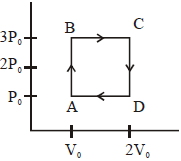
- 297. એક એન્જિન એક પરમાણ્વિક આદર્શ વાયુ પર કાર્ય કરે છે જેના એક ચક્ર માટે નીચે ગ્રાફ આપેલ છે. તો આ એન્જિનની કાર્યક્ષમતા(\(\%\) માં) લગભગ કેટલી હશે?
 2020 અઘરું
- (A) \(19\)
- (B) \(25\)
- (C) \(27\)
- (D) \(30\)
જવાબ અને ઉકેલ જુઓ
સાચો જવાબ: (A)
\(W _{ ABCDA }=2 P _{0} V _{0}\)\(Q_{\text {in }}=Q_{A B}+Q_{B C}\)
\(Q _{ AB }= nC \left( T _{ B }- T _{ A }\right)\)
\(=\frac{ n 3 R }{2}\left( T _{ B }- T _{ A }\right)\)
\(=\frac{3}{2}\left(P_{B} V_{B}-P_{A} V_{A}\right)\)
\(=\frac{3}{2}\left(3 P_{B} V_{0}=P_{0} V_{0}\right)=3 P_{0} V_{0}\)
\(Q _{ BC }= nC _{ P }\left( T _{ C }- T _{ B }\right)\)
\(=\frac{ n 5 R }{2}\left( T _{ C }- T _{ B }\right)\)
\(=\frac{5}{2}\left(P_{C} V_{C}-P_{B} V_{B}\right)\)
\(=\frac{5}{2}\left(6 P _{0} V _{0}-3 P _{0} V _{0}\right)=\frac{15}{2} P _{0} V _{0}\)
\(\eta=\frac{ W }{ Q _{ in }} \times 100=\frac{2 P _{0} V _{0}}{3 P _{0} V _{0}+\frac{15}{2} P _{0} V _{0}} \times 100\)
\(\eta=\frac{400}{21}=19.04 \approx 19\)
\(\eta=19\)
-
- (A) \(E _{ AB }= E _{ AC }= E _{ AD }, W _{ AB }>0, W _{ AC }=0,\) \(W _{ AD }>0\)
- (B) \(E _{ AB }< E _{ AC }< E _{ AD }, W _{ AB }>0, W _{ AC }> W _{ AD }\)
- (C) \(E _{ AB }= E _{ AC }< E _{ AD }, W _{ AB }>0, W _{ AC }=0\) \(W _{ AD }<0\)
- (D) \(E _{ AB }> E _{ AC }> E _{ AD }, W _{ AB }< W _{ AC }< W _{ AD }\)
જવાબ અને ઉકેલ જુઓ
સાચો જવાબ: (A)
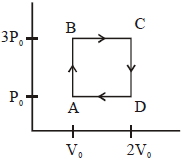
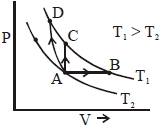
\(\Delta U = nC _{ v } \Delta T =\) same\(AB \rightarrow\) volume is increasing \(\Rightarrow W >0\)
\(AD \rightarrow\) volume is decreasing \(\Rightarrow W <0\)
\(AC \rightarrow\) volume is constant \(\Rightarrow W =0\)
-
- (A) \(326\)
- (B) \(\frac{1}{32}\)
- (C) \(32\)
- (D) \(128\)
જવાબ અને ઉકેલ જુઓ
સાચો જવાબ: (D)
In adiabatic process\(PV ^\gamma= constant\)
\(P \left(\frac{ m }{\rho}\right)^{\gamma}= constant\)
as mass is constant
\(P \propto \rho^{Y}\)
\(\frac{P_{f}}{P_{i}}=\left(\frac{\rho_{f}}{\rho_{i}}\right)^{\gamma}=(32)^{7 / 5}=2^{7}=128\)
-
- (A) \(640\)
- (B) \(400\)
- (C) \(980\)
- (D) \(40\)
જવાબ અને ઉકેલ જુઓ
સાચો જવાબ: (C)
\(\eta=\frac{\text { Work done }}{\text { Heat supplied }}\)\(\frac{1}{2}=\eta=\frac{1915-40+125- Q }{1915+125}\)
\(\frac{1}{2}=\frac{2000- Q }{2040}\)
\(2040=4000-2 Q\)
\(2 Q =1960\)
\(Q =980 J\)
આ પેજ પર આ ફિલ્ટર મુજબ કોઈ પ્રશ્ન નથી.