


All JEE Mains 2020 Physics questions
31 chaptersShowing 251–300 of 401 questions
-
- (A) \(\sqrt{\frac{2}{a}}\)
- (B) \(\sqrt{\frac{1}{a}}\)
- (C) \(a\)
- (D) \(\sqrt{\frac{3}{a}}\)
Show answer and solution
Correct Answer: (D)
\(E = E _{0}\left(1- ax ^{2}\right)\)\(W =\int q E\, d x = q E _{0} \int_{0}^{ x _{0}}\left(1- ax ^{2}\right) dx\)
\(=q E_{0}\left[x_{0}-\frac{a x_{0}^{3}}{3}\right]\)
For \(\Delta KE =0, \quad W =0\)
Hence \(x _{0}=\sqrt{\frac{3}{ a }}\)
-
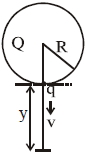
- (A) \(v^{2}=2 y\left[\frac{q Q}{4 \pi \epsilon_{0} R(R+y) m}+g\right]\)
- (B) \(v^{2}=y\left[\frac{q Q}{4 \pi \epsilon_{0} R^{2} y m}+g\right]\)
- (C) \(v^{2}=2 y\left[\frac{q Q R}{4 \pi \epsilon_{0}(R+y)^{3} m}+g\right]\)
- (D) \(v^{2}=y\left[\frac{q Q}{4 \pi \epsilon_{0} R(R+y) m}+g\right]\)
Show answer and solution
Correct Answer: (A)
\(\frac{ kQq }{ R }+ mgy\)\(=\frac{ kQq }{ R + y }+\frac{1}{2} mv ^{2}\)
\(v ^{2}=2 gy +\frac{2 kQqy }{ mR ( R + y )}\)
-
- (A) increase by \(\frac{2 q^{2}}{3 \pi \varepsilon_{0} d }\)
- (B) increase by \(\frac{3 q^{2}}{4 \pi \varepsilon_{0} d }\)
- (C) decrease by \(\frac{4 q^{2}}{3 \pi \varepsilon_{0} d }\)
- (D) decrease by \(\frac{q^{2}}{4 \pi \varepsilon_{0} d }\)
Show answer and solution
Correct Answer: (C)
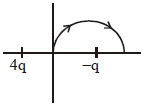
Potential of \(- q\) is same as initial and final point of the path therefore potential due to \(4 q\) will only change and as potential is decreasing the energy will decrease Decrease in potential energy \(=q\left( V _{ i }- V _{ f }\right)\)Decrease in potential energy
\(=q\left[\frac{ k 4 q }{ d / 2}-\frac{ k 4 q }{3 d / 2}\right]=\frac{4 q ^{2}}{3 \pi \varepsilon_{0} d }\)
-
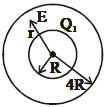
- (A) \(\frac{3 Q_{1}}{16 \pi \varepsilon_{0} R}\)
- (B) \(\frac{ Q _{2}}{4 \pi \varepsilon_{0} R }\)
- (C) \(\frac{3 Q _{1}}{4 \pi \varepsilon_{0} R }\)
- (D) \(\frac{3 Q _{2}}{4 \pi \varepsilon_{0} R }\)
Show answer and solution
Correct Answer: (A)
\(E =\frac{ KQ _{1}}{ r ^{2}}\)\(\Delta V =\int_{ R }^{4 R } E dr =\frac{3 KQ _{1}}{4 R }\)
-
- (A) \(\left(\frac{\mathrm{R}_{2}}{\mathrm{R}_{1}}\right)\)
- (B) \(\left(\frac{\mathrm{R}_{1}}{\mathrm{R}_{2}}\right)^{3}\)
- (C) \(\left(\frac{\mathrm{R}_{1}}{\mathrm{R}_{2}}\right)\)
- (D) \(\left(\frac{\mathrm{R}_{1}}{\mathrm{R}_{2}}\right)^{2}\)
Show answer and solution
Correct Answer: (D)
\(\mathrm{E}_{1}=\frac{\mathrm{KQ}_{1}}{\mathrm{R}_{1}^{2}}\)\(\mathrm{E}_{2}=\frac{\mathrm{KQ}_{2}}{\mathrm{R}_{2}^{2}}\)
\(\frac{E_{1}}{E_{2}}=\frac{R_{1}}{R_{2}}\)
\(\cfrac{\frac{\mathrm{KQ}_{1}}{\mathrm{R}_{1}^{2}}}{\frac{\mathrm{KQ}_{2}}{\mathrm{R}_{2}^{2}}}=\frac{\mathrm{R}_{1}}{\mathrm{R}_{2}}\)
\(\frac{Q_{1}}{Q_{2}}=\frac{R_{1}^{3}}{R_{2}^{3}}\)
\(\frac{\mathrm{V}_{1}}{\mathrm{V}_{2}}=\frac{\mathrm{KQ}_{1} / \mathrm{R}_{1}}{\mathrm{KQ}_{2} / \mathrm{R}_{2}}=\frac{\mathrm{R}_{1}^{2}}{\mathrm{R}_{2}^{2}}\)
-
- (A) \(3.2\; \mu \mathrm{F}\)
- (B) \(8.4\; \mu \mathrm{F}\)
- (C) \(1.6\; \mu \mathrm{F}\)
- (D) \(4.2\; \mu \mathrm{F}\)
Show answer and solution
Correct Answer: (C)
\(\mathrm{C}_{1}+\mathrm{C}_{2}=10\)\(\frac{1}{2} \mathrm{C}_{2} \mathrm{V}^{2}=4 \times \frac{1}{2} \mathrm{C}_{1} \mathrm{V}^{2}\)
\(\therefore \quad \mathrm{C}_{2}=4 \mathrm{C}_{1}\)
\(\therefore \quad \mathrm{C}_{1}=2 \;and\; \mathrm{C}_{2}=8\)
For series combination
\(C_{e q}=\frac{C_{1} C_{2}}{C_{1}+C_{2}}=1.6\)
-
- (A) \(5:7\)
- (B) \(1:2\)
- (C) \(10:7\)
- (D) \(2:1\)
Show answer and solution
Correct Answer: (D)
\(q \Delta V =\frac{1}{2} mV ^{2} \Rightarrow v =\sqrt{\frac{2 q \Delta V }{ m }}\)\(\therefore \frac{ V _{1}}{ V _{2}}=\sqrt{\frac{ e }{ m } \frac{4 m }{ e }}=2\)
-
- (A) \(5.45\)
- (B) \(16.36\)
- (C) \(10.90\)
- (D) \(18.00\)
Show answer and solution
Correct Answer: (B)
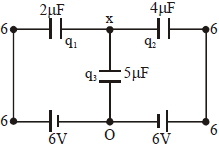
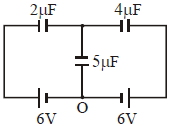
Let potential of point \(O \quad v _{0}=0\)Now, using junction analysis
We can say, \(\quad q_{1}+q_{2}+q_{3}=0\)
\(2(x-6)+4(x-6)+5(x)=0\)
\(x=\frac{36}{11} \quad q_{3}=\frac{36(5)}{11}=\frac{180}{11}\)
\(q _{3}=16.36 \mu C\)
-
- (A) \(590\)
- (B) \(450\)
- (C) \(650\)
- (D) \(160\)
Show answer and solution
Correct Answer: (A)
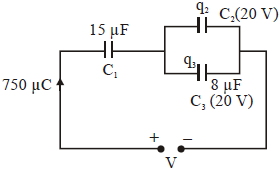
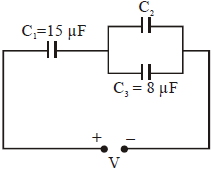
\(q _{3}=20 \times 8=160 \mu C\)\(\therefore q _{2}=750-160=590 \mu C\)
-
- (A) \(V =\frac{10 q }{4 \pi \epsilon_{0} R } ; E =\frac{10 q }{4 \pi \epsilon_{0} R ^{2}}\)
- (B) \(V =0, E =\frac{10 q }{4 \pi \epsilon_{0} R ^{2}}\)
- (C) \(V =0, E =0\)
- (D) \(V =\frac{10 q }{4 \pi \varepsilon_{0} R } ; E =0\)
Show answer and solution
Correct Answer: (C)
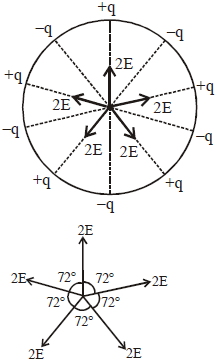
Sol. Potential of centre \(= V =\quad \Sigma\left(\frac{ kq }{ R }\right)\)\(V _{ C }=\frac{ K (\Sigma q )}{ R }\)
\(V _{ C }=\frac{ K (0)}{ R }=0\)
Electric field at centre \(\overrightarrow{ E }_{ B }=\Sigma \overrightarrow{ E }\)
Let \(E\) be electric field produced by each charge at the centre, then resultant electric field will be
\(E _{ C }=0,\) since equal electric field vectors are acting at equal angle so their resultant is equal to zero.
-
- (A) \(4.5\)
- (B) \(4.16\)
- (C) \(0\)
- (D) \(1.5\)
Show answer and solution
Correct Answer: (D)
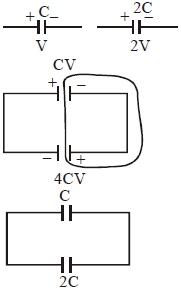
\(Q _{1}= CV \quad Q _{2}=2 C \times 2 V =4 CV\)\(\Rightarrow\) By conservation of charge
\(q_{i}=q_{f}\)
\(Q_{1}+Q_{2}=q_{1}+q_{2}\)
\(4 CV - CV =( C +2 C ) V _{ C }\)
\(v _{ C }=\frac{3 CV }{3 C } \Rightarrow V\)
\(\Rightarrow \frac{1}{2} \times(3 C) \times V_{ c }^{2}\)
\(=\frac{1}{2} \times 3 C \times V ^{2}=\frac{3}{2} CV ^{2}\)
-
- (A) \(\frac{ p }{ a } \sqrt{\frac{1}{\pi \varepsilon_{0} ma }}\)
- (B) \(\frac{ p }{ a } \sqrt{\frac{3}{2 \pi \varepsilon_{0} ma }}\)
- (C) \(\frac{ p }{ a } \sqrt{\frac{1}{2 \pi \varepsilon_{0} ma }}\)
- (D) \(\frac{p}{a} \sqrt{\frac{2}{\pi \varepsilon_{0} m a}}\)
Show answer and solution
Correct Answer: (C)
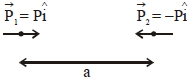
Using energy conservation\(KE _{ i }+ PE _{ i }= KE _{ f }+ PE _{ f }\)
\(O +\frac{2 KP }{ a ^{3}} \times P =\frac{1}{2} mv ^{2} \times 2+0\)
\(V =\sqrt{\frac{2 P ^{2}}{4 \pi \varepsilon_{0} a ^{3} m }}=\frac{ P }{ a } \sqrt{\frac{1}{2 \pi \varepsilon_{0} am }}\)
-
- (A) \(6\, \mu C\) and \(3\, \mu C\)
- (B) \(+4.5\, \mu C\) and \(-4.5\, \mu C\)
- (C) \(3\, \mu C\) and \(6 \mu C\)
- (D) \(4.5\, \mu C\) on both
Show answer and solution
Correct Answer: (A)
Now\(Q _{1}+ Q _{2}= Q _{1}+ Q _{2}^{\prime}=12 \mu C -3 \mu C =9 \mu C\)
\(\& V_1=V_{2} \Rightarrow \frac{K Q_{1}^{\prime}}{\frac{2 R}{3}}=\frac{K Q_{2}^{\prime}}{\frac{R}{3}}\)
\(Q _{1}^{\prime}=2 Q _{2}^{\prime} \Rightarrow 2 Q _{2}^{\prime}+ Q _{2}^{\prime}=9 \mu C\)
\(\Rightarrow Q _{2}^{\prime}=3 \mu C\)
\(\ \quad Q_{1}^{\prime}=6 \mu C\)
-
- (A) \(y=\frac{q E d}{m V_{0}^{2}}\left(\frac{d}{2}-x\right)\)
- (B) \(y=\frac{q E d}{m V_{0}^{2}}(x-d)\)
- (C) \(y =\frac{ qEd }{ mV _{0}^{2}} x\)
- (D) \(y =\frac{ qEd ^{2}}{ mV _{0}^{2}} x\)
Show answer and solution
Correct Answer: (A)
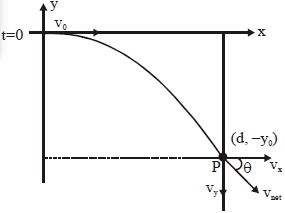
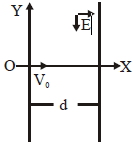
Let particle have charge \(q\) and mass \({ }^{\prime} m ^{\prime}\)Solve for \((q,m)\) mathematically
\(F _{ x }=0, a _{ x }=0,( v )_{ x }=\) constant
time taken to reach at \(P ^{\prime}=\frac{ d }{ V _{0}}= t _{0}( let )\)\(\ldots(1)\)
(Along \(-y), y_{0}=0+\frac{1}{2} \cdot \frac{q E}{m} \cdot t_{0}^{2}....(2)\)
\(v_{x}=v_{0}\)
\(v=u+a t\) (along -ve \('y'\))
speed \(v _{ y 0}=\frac{ q E }{ m } \cdot t _{0}\)
\(\tan \theta=\frac{ v _{ y }}{ v _{ x }}=\frac{ qEt _{0}}{ m \cdot v _{ o }},\left( t _{ o }=\frac{ d }{ v _{ o }}\right)\)
\(\tan \theta=\frac{q Ed }{ m \cdot v _{0}^{2}}\)
\(\operatorname{slope}=\frac{-q \operatorname{Ed}}{m v_{0}^{2}}\)
Now we have to find eq \(^{n}\) of straight line whose slope is \(\frac{-q Ed }{ mv _{0}^{2}}\) and it pass through
point \(\rightarrow\left( d ,- y _{0}\right)\)
Because after \(x > d\)
No electric field \(\Rightarrow F _{\text {net }}=0, \overrightarrow{ v }=\) const.
\(y=m x+c,\left\{\begin{array}{l}m=\frac{q E d}{m v_{0}^{2}} \\ \left(d,-y_{0}\right)\end{array}\right\}\)
\(-y_{0}=\frac{-q E d}{m v_{0}^{2}} \cdot d+c \Rightarrow c=-y_{0}+\frac{q E d^{2}}{m v_{0}^{2}}\)
Put the value
\(y=\frac{-q E d}{m v_{0}^{2}} x-y_{0}+\frac{q E d^{2}}{m v_{0}^{2}}\)
\(y _{0}=\frac{1}{2} \cdot \frac{ qE }{ m }\left(\frac{ d }{ v _{0}}\right)^{2}=\frac{1}{2} \frac{ q Ed ^{2}}{ mv _{0}^{2}}\)
\(y =\frac{- qEdx }{ mv _{0}^{2}}-\frac{1}{2} \frac{ qEd ^{2}}{ mv _{0}^{2}}+\frac{ qEd ^{2}}{ mv _{0}^{2}}\)
\(y=\frac{-q E d}{m v_{0}^{2}} x+\frac{1}{2} \frac{q E d^{2}}{m v_{0}^{2}}\)
\(y=\frac{q E d}{m v_{0}^{2}}\left(\frac{d}{2}-x\right)\)
-
- (A) \((-\hat{i}+3 \hat{j}-2 \hat{k})\)
- (B) \((+\hat{i}-3 \hat{j}-2 \hat{k})\)
- (C) \((+\hat{i}+3 \hat{j}-2 \hat{k})\)
- (D) \((-\hat{i}-3 \hat{j}+2 \hat{k})\)
Show answer and solution
Correct Answer: (C)
since \(\overrightarrow{\mathrm{r}}\) and \(\overrightarrow{\mathrm{p}}\) are perpendicular to each othertherefore point lies on the equitorial plane.
Therefore electric field at the point will be
antiparallel to the dipole moment.
i.e. \(\overrightarrow{\mathrm{E}} \|-\overrightarrow{\mathrm{p}}\)
\(\overrightarrow{\mathrm{E}} \|(\hat{\mathrm{i}}+3 \hat{\mathrm{j}}-2 \hat{\mathrm{k}})\)
-
- (A) \(48\)
- (B) \(52\)
- (C) \(56\)
- (D) \(60\)
Show answer and solution
Correct Answer: (A)
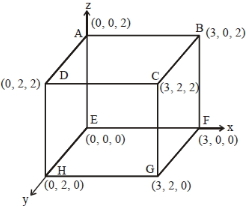
The flux passes through \(\mathrm{ABCD}(\mathrm{x}-\mathrm{y})\) plane is zero, because electric field parallel to surface. Flux of the electric field through surface \(BCGF\) \((y-z)\)At BCGF (electric field) \(\Rightarrow \overrightarrow{\mathrm{E}}=12 \hat{\mathrm{i}}-\left(\mathrm{y}^{2}+1\right) \hat{\mathrm{j}}\)
\((x=3 m)\)
Flux \(\phi_{\mathrm{II}}=12 \times 4=48 \mathrm{Nm}^{2}{ / \mathrm{C}}\)
So \(\phi_{\mathrm{I}}-\phi_{\mathrm{II}}=0-48=-48 \mathrm{Nm}^{2}{ / \mathrm{C}}\)
\(\therefore\) Correct answer \(-48\)
-
- (A) \(\frac{ x _{2}^{2}}{ x _{1}^{2}}\)
- (B) \(\frac{x_{1}^{3}}{x_{2}^{3}}\)
- (C) \(\frac{x_{1}}{x_{2}}\)
- (D) \(\frac{ x _{2}}{ x _{1}}\)
Show answer and solution
Correct Answer: (C)
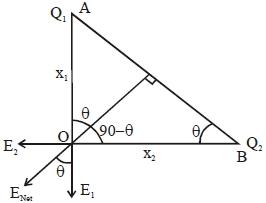
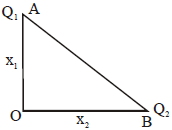
\(E _{2}=\) electric field due to \(Q _{2}\)\(=\frac{ kQ _{2}}{ x _{2}^{2}}\)
\(E _{1}=\frac{ k Q _{1}}{ x _{1}^{2}}\)
From diagram
\(\tan \theta=\frac{ E _{2}}{ E _{1}}=\frac{ x _{1}}{ x _{2}}\)
\(\frac{ kQ _{2}}{ x _{2}^{2} \times \frac{ k Q _{1}}{ x _{1}^{2}}}=\frac{ x _{1}}{ x _{2}}\)
\(\frac{ Q _{2} x _{1}^{2}}{ Q _{1} x _{2}^{2}}=\frac{ x _{1}}{ x _{2}}\)
\(\frac{Q_{2}}{Q_{1}}=\frac{x_{2}}{x_{1}}\)
\(\frac{Q_{1}}{Q_{2}}=\frac{x_{1}}{x_{2}}\)
-
- (A) \(\frac{18}{54}\)
- (B) \(\frac{21}{34}\)
- (C) \(\frac{17}{54}\)
- (D) \(\frac{18}{34}\)
Show answer and solution
Correct Answer: (D)
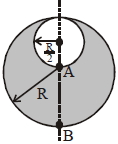
Fill the empty space with \(+\rho\) and \(-\rho\) charge density.\(\left|\mathrm{E}_{\mathrm{A}}\right|=0+\frac{\operatorname{k\rho} \cdot \frac{4}{3} \pi\left(\frac{\mathrm{R}}{2}\right)^{3}}{\left(\frac{\mathrm{R}}{2}\right)^{2}}=\operatorname{k\rho} \frac{4}{3} \pi\left(\frac{\mathrm{R}}{2}\right)\)
\(\left|\mathrm{E}_{\mathrm{B}}\right|=\frac{\mathrm{k} \rho \cdot \frac{4}{3} \pi \mathrm{R}^{3}}{\mathrm{R}^{2}}-\frac{\mathrm{k} \rho \cdot \frac{4}{3} \pi\left(\frac{\mathrm{R}}{2}\right)^{3}}{\left(\frac{3 \mathrm{R}}{2}\right)^{2}}\)
\(=\operatorname{k\rho} \frac{4}{3} \pi \mathrm{R}-\mathrm{k} \rho \frac{4}{3} \pi \frac{\mathrm{R}}{18}=\mathrm{k} \rho \cdot \frac{4}{3} \pi\left(\frac{17 \mathrm{R}}{18}\right)\)
\(\frac{E_{A}}{E_{B}}=\frac{9}{17}=\frac{18}{34}\)
-
- (A) Only when the Gaussian surface is an equipotential surface
- (B) Only when \(|\overrightarrow{\mathrm{E}}|=\) constant on the surface.
- (C) For any choice of Gaussian surface.
- (D) Only when the Gaussian surface is an equipotential surface and \(|\overrightarrow{\mathrm{E}}|\) is constant on the surface.
Show answer and solution
Correct Answer: (D)
\(|\overrightarrow{\mathrm{E}}|\) should be constant on the surface and the surface should be equipotential. -
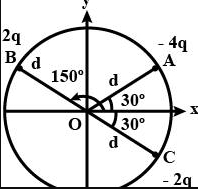
- (A) \(\frac{2 \sqrt{3} q}{\pi \varepsilon_{0} d^{2}}\)
- (B) \(\frac{\sqrt{3} \mathrm{q}}{4 \pi \varepsilon_{0} \mathrm{d}^{2}}\)
- (C) \(\frac{3 \sqrt{3} \mathrm{q}}{4 \pi \varepsilon_{0} \mathrm{d}^{2}}\)
- (D) \(\frac{\sqrt{3} q}{\pi \varepsilon_{0} d^{2}}\)
Show answer and solution
Correct Answer: (D)
\(\mathrm{E}_{\mathrm{x}}=\frac{\mathrm{K}(4 \mathrm{q})}{\mathrm{R}^{2}} \cos 30^{\circ}+\frac{\mathrm{K}(2 \mathrm{q})}{\mathrm{R}^{2}} \cos 30^{\circ}+\frac{\mathrm{K}(2 \mathrm{q})}{\mathrm{R}^{2}} \cos 30^{\circ}\) -
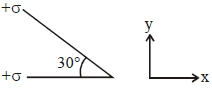
- (A) \(\frac{\sigma}{\varepsilon_{0}}\left[\left(1+\frac{\sqrt{3}}{2}\right) \hat{\mathrm{y}}+\frac{\hat{\mathrm{x}}}{2}\right]\)
- (B) \(\frac{\sigma}{2 \varepsilon_{0}}\left[\left(1-\frac{\sqrt{3}}{2}\right) \hat{\mathrm{y}}-\frac{\hat{\mathrm{x}}}{2}\right]\)
- (C) \(\frac{\sigma}{2 \varepsilon_{0}}\left[(1+\sqrt{3}) \hat{\mathrm{y}}+\frac{\hat{\mathrm{x}}}{2}\right]\)
- (D) \(\frac{\sigma}{2 \varepsilon_{0}}\left[(1+\sqrt{3}) \hat{\mathrm{y}}-\frac{\hat{\mathrm{x}}}{2}\right]\)
Show answer and solution
Correct Answer: (B)
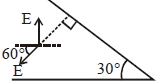
Electric field due to each sheet is uniform and equal to \(\mathrm{E}=\frac{\sigma}{2 \varepsilon_{0}}\)Now net electric field between plates
\(\overrightarrow{\mathrm{E}}_{\mathrm{net}} =\mathrm{E} \cos 60^{\circ}(-\hat{\mathrm{x}})+\left(\mathrm{E}-\mathrm{E} \sin 60^{\circ}\right)(\hat{\mathrm{y}})\)
\(=\frac{\sigma}{2 \varepsilon_{0}}\left[-\frac{\hat{\mathrm{x}}}{2}+\left(1-\frac{\sqrt{3}}{2}\right) \hat{\mathrm{y}}\right]\)
-
- (A) \(36\)
- (B) \(24\)
- (C) \(18\)
- (D) \(54\)
Show answer and solution
Correct Answer: (D)
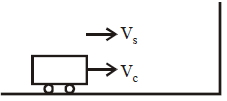
\(f _{1}=\) frequency heard by wall \(= f _{ s }=\left(\frac{ v _{ s }}{ v _{ s }- v _{ c }}\right)\)\(f _{2}=\) frequency heard by driver after reflection from wall
\(f_{2}=\left(\frac{v_{s}+v_{c}}{v_{s}}\right) f_{1}=\left(\frac{v_{s}+v_{c}}{v_{s}-v_{c}}\right) f_{0}\)
\(\frac{f_{2}}{f_{0}}=\frac{v_{s}-v_{c}}{v_{s}+v_{c}}\)
\(\frac{48}{44}=\frac{v_{s}-v_{c}}{v_{s}+v_{c}}\)
\(12\left( v _{ s }+ v _{ c }\right)=11\left( v _{ s }- v _{ c }\right)\)
\(23 v _{ c }= v _{ s }\)
\(v _{ c }=\frac{ v _{ s }}{23}=\frac{345}{23}=15 m / s\)
\(=\frac{15 \times 18}{5}=54 km / hr\)
-
- (A) \(92\)
- (B) \(106\)
- (C) \(125\)
- (D) \(136\)
Show answer and solution
Correct Answer: (B)
\(v_{s}=\sqrt{\frac{\gamma P}{\rho}}\)\(\frac{\mathrm{v}_{\mathrm{gas}}}{\mathrm{v}_{\mathrm{air}}}=\sqrt{\frac{\rho_{\mathrm{air}}}{\rho_{\mathrm{gas}}}}\)
\(\Rightarrow \frac{\mathrm{v}_{\mathrm{gas}}}{300}=\frac{1}{\sqrt{2}}\)
\(\Rightarrow \mathrm{v}_{\mathrm{gas}}=\frac{300}{\sqrt{2}}\)
\(\therefore \mathrm{v}_{\mathrm{grs}}=150 \sqrt{2}\)
Now \(\mathrm{n}_{2}-\mathrm{n}_{1}=\frac{\mathrm{v}_{\mathrm{gss}}}{2 \ell}=\frac{150 \sqrt{2}}{2(1)}=75 \sqrt{2}\)
\(\Rightarrow \Delta \mathrm{n}=106.06 \mathrm{Hz}\)
-
- (A) \(\frac{1}{8}\; \mathrm{m} / \mathrm{s}\)
- (B) \(\frac{1}{2}\; \mathrm{m} / \mathrm{s}\)
- (C) \(1 \; \mathrm{m} / \mathrm{s}\)
- (D) \(\frac{1}{4}\; \mathrm{m} / \mathrm{s}\)
Show answer and solution
Correct Answer: (D)
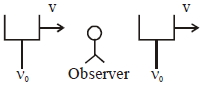
\(v_{1}=\left(\frac{c}{c-v}\right) v_{0}\)\(v_{2}=\left(\frac{c}{c+v}\right) v_{0}\)
beat frequency \(=v_{1}-v_{2}\)
\(=\mathrm{cv}_{0} \quad\left(\frac{1}{\mathrm{c}-\mathrm{v}}-\frac{1}{\mathrm{c}+\mathrm{v}}\right)\)
\(=c v_{0}\left(\frac{c+v-c+v}{c^{2}-v^{2}}\right)=\frac{2 c v_{0}^{2} v}{c^{2}-v^{2}}\)
\(\approx \frac{2 \mathrm{cv}_{0} \mathrm{v}}{\mathrm{c}^{2}}=\frac{2 \mathrm{v}_{0} \mathrm{v}}{\mathrm{c}}=2\)
\(\Rightarrow \frac{2 \times 1400 \times v}{350}=2\)
\(\Rightarrow \mathrm{v}=\frac{1}{4} \mathrm{m} / \mathrm{s}\)
-
- (A) \(10.2 \times 10^{2} \;\mathrm{N}\)
- (B) \(5.15 \times 10^{3}\; \mathrm{N}\)
- (C) \(2.50 \times 10^{4}\; \mathrm{N}\)
- (D) \(30.5 \times 10^{4}\; \mathrm{N}\)
Show answer and solution
Correct Answer: (B)
Velocity of transverse wave \(\mathrm{V} \propto \sqrt{\mathrm{T}}\)\(\mathrm{v} \rightarrow \frac{\mathrm{V}}{2} \Rightarrow \mathrm{T} \rightarrow \mathrm{T}^{\prime}=\frac{\mathrm{T}}{4}\)
\(\mathrm{T}^{\prime}=\frac{2.06 \times 10^{4}}{4}=5.15 \times 10^{3} \mathrm{N}\)
-
- (A) \(9\)
- (B) \(12\)
- (C) \(6\)
- (D) \(3\)
Show answer and solution
Correct Answer: (B)
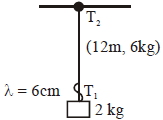
\(V \propto \lambda \quad T _{2}=8 g\)\(T _{1}=2 g\)
\(\frac{ V _{1}}{ V _{2}}=\frac{\lambda_{1}}{\lambda_{2}}\)
\(\lambda_{2}=\frac{ V _{2}}{ V _{1}} \lambda_{1}=\sqrt{\frac{ T _{2}}{ T _{1}}} \times \lambda_{1}\)
\(=\sqrt{\frac{8 g }{2 g }} \lambda_{1}=2 \times 6=12 cm\)
-
- (A) \(35\)
- (B) \(55\)
- (C) \(20\)
- (D) \(40\)
Show answer and solution
Correct Answer: (A)
\(\rho_{\text {wire }}=9 \times 10^{-3} \frac{ kg }{ cm ^{3}}=\frac{9 \times 10^{-3}}{10^{-6}} kg / m ^{3}\)\(=9000 kg / m ^{2}\)
\(( A = CSA\) of wire \()\)
\(\left( Y =9 \times 10^{10} Nm ^{2}\right)\)
\(\left(\right.\) Strain \(\left.=4.9 \times 10^{-4}\right)\)
\(\Rightarrow L =1 m =\frac{\lambda}{2} \Rightarrow \lambda=2 m\)
\(\Rightarrow v=f \lambda \Rightarrow \sqrt{\frac{T}{\mu}}=f \lambda\)
Where \(Y=\frac{T / A}{\text { strain }} \Rightarrow T=Y . A .\) strain
\(\Rightarrow \sqrt{\frac{ Y . A . strain }{ m / L }}= f \times 2 \Rightarrow \sqrt{\frac{ Y . A I . \text { strain }}{ M }}= f \times 2\)
\(\Rightarrow \sqrt{\frac{ Y \times V \times \text { strain }}{ M }}= f \times 2 \Rightarrow \sqrt{\frac{ Y \times \text { strain }}{\rho}}= f \times 2\)
\(f =\frac{1}{2} \sqrt{\frac{ Y \times \text { strain }}{\rho}}=\frac{1}{2} \sqrt{\frac{9 \times 10^{10} \times 4.9 \times 10^{-4}}{9000}}\)
\(f=\frac{1}{2} \sqrt{\frac{9 \times 10^{3}}{9} \times 4.9}=\frac{1}{2} \sqrt{4900}=\frac{70}{2}=35 Hz\)
-
- (A) \(8.1 \;m\)
- (B) \(5.1 \;m\)
- (C) \(1.1 \;m\)
- (D) \(2.1 \;m\)
Show answer and solution
Correct Answer: (D)
\(\frac{\mathrm{nv}}{2 \ell}=420\)\(\frac{(\mathrm{n}+1) \mathrm{v}}{2 \ell}=490\)
\(\frac{v}{2 \ell}=70\)
\(\ell=\frac{\mathrm{v}}{140}=\frac{1}{140} \sqrt{\frac{540}{6 \times 10^{-3}}}=\frac{1}{140} \sqrt{90 \times 10^{3}}\)
\(\ell=\frac{300}{140}=2.142\)
-
- (A) \(10\,mm\)
- (B) \(\frac{3}{100}\, mm\)
- (C) \(1\, mm\)
- (D) \(\frac{1}{10}\, mm\)
Show answer and solution
Correct Answer: (B)
\(\Delta p = B k S_{0}\)\(=\rho v ^{2} \times \frac{\omega}{ v } \times S _{0}\)
\(\Rightarrow S _{0}=\frac{\Delta p }{\rho v \omega}\)
\(\approx \frac{10}{1 \times 300 \times 1000} m\)
\(=\frac{1}{30} mm \approx \frac{3}{100} mm\)
-
- (A) \(1,2,3, \ldots \ldots\)
- (B) \(\frac{1}{2}, \frac{1}{4}, \frac{1}{6}, \ldots\)
- (C) \(1,3,5, \ldots\)
- (D) \(\frac{1}{1}, \frac{1}{3}, \frac{1}{5}, \ldots\)
Show answer and solution
Correct Answer: (D)
Given \(T\) to \(C\,\, 1.5 m\)\(C\) to \(C\, 5 m\)
\(T\) to \(C =\left(2 n _{1}+1\right) \frac{\lambda}{2}\)
\(C\) to \(C = n _{2} \lambda\)
\(\frac{1.5}{5}=\frac{\left(2 n _{1}+1\right)}{2 n _{2}} \Rightarrow 3 n _{2}=10 n _{1}+5\)
\(n _{1}=1, n _{2}=5 \rightarrow \lambda=1\)
\(n _{1}=4, n _{2}=15 \rightarrow \lambda=1 / 3\)
\(n _{1}=7, n _{2}=25 \rightarrow \lambda=1 / 5\)
-
- (A) \(1100\)
- (B) \(3300\)
- (C) \(2200\)
- (D) \(550\)
Show answer and solution
Correct Answer: (C)
\(\Rightarrow \lambda=2\left(l_{2}-l_{1}\right) \Rightarrow 2 \times(24.5-17)\)\(\Rightarrow 2 \times 7.5=15 cm\)
\(\& v = f \lambda \Rightarrow 330=\lambda \times 15 \times 10^{-2}\)
\(\lambda=\frac{330}{15} \times 100 \Rightarrow \frac{1100 \times 100}{5}\)
\(\Rightarrow 2200 Hz\)
-
- (A) \(0.02\; mm\)
- (B) \(0.04\; mm\)
- (C) \(0.03\; mm\)
- (D) \(0.01\; mm\)
Show answer and solution
Correct Answer: (C)
\(\mathrm{v}=\sqrt{\frac{\mathrm{T}}{\mu}}\)\(90=\sqrt{\frac{\mathrm{YA}}{\mathrm{m}}}=\sqrt{\frac{16 \times 10^{11} \times 10^{-6} \times \Delta l}{6 \times 10^{-3}}}\)
\(=\frac{8100 \times 3}{8} \times 10^{-8}=\Delta l=0.03\;mm\)
-
- (A) \(91\)
- (B) \(71\)
- (C) \(81\)
- (D) \(61\)
Show answer and solution
Correct Answer: (A)
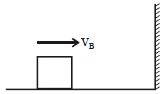
\(f _{1}=\left(\frac{330}{330- v _{ B }}\right) 420\)\(f _{2}=\left(\frac{330+ v _{0}}{330}\right)\left(\frac{330}{330- v _{ B }}\right) 420\)
\(490=\left(\frac{330+ v _{ B }}{330- v _{ B }}\right) 420\)
\(\frac{7}{6}=\frac{330+ v _{ B }}{330- v _{ B }}\)
\(v _{ B }=\frac{330}{13} m / s\)
\(=\frac{330}{13} \times \frac{18}{5} \approx 91 km / hr\)
-
- (A) \(5.8 \mathrm{I}_{0}\)
- (B) \(0.2 \mathrm{I}_{0}\)
- (C) \(\mathrm{I}_{0}\)
- (D) \(3 \mathrm{I}_{0}\)
Show answer and solution
Correct Answer: (A)
Let amplitude of each wave is \(A.\)Resultant wave equation
\(=A \sin \omega t+A \sin \left(\omega t-\frac{\pi}{4}\right)+A \sin \left(\omega t+\frac{\pi}{4}\right)\)
\(=\mathrm{A} \sin \omega \mathrm{t}+\sqrt{2} \mathrm{A} \sin \omega \mathrm{t}\)
\(=(\sqrt{2}+1) \mathrm{A} \sin \omega \mathrm{t}\)
Resultant wave amplitude \(=(\sqrt{2}+1) \mathrm{A}\)
as \(I \propto A ^{2}\)
so \(\frac{\mathrm{I}}{\mathrm{I}_{0}}=(\sqrt{2}+1)^{2}\)
\(I=5.8 \mathrm{I}_{0}\)
-
- (A) \(0.44\)
- (B) \(1.5\)
- (C) \(2.25\)
- (D) \(1.25\)
Show answer and solution
Correct Answer: (C)
\(f =\frac{1}{2 \ell} \sqrt{\frac{ T }{\mu}}\)For identical string \(l\) and \(\mu\) will be same
\(f \propto \sqrt{ T }\)
\(\frac{450}{300}=\sqrt{\frac{T_{x}}{T_{y}}}\)
\(\frac{T_{x}}{T_{y}}=\frac{9}{4}=2.25\)
-
- (A) \(\frac{1}{2}\)
- (B) \(\frac{1}{\sqrt{2}}\)
- (C) \(1\)
- (D) \(\sqrt{2}\)
Show answer and solution
Correct Answer: (D)
At equilibrium position\(V _{0}=\omega_{0} A =\sqrt{\frac{ K }{ m }} A....(i)\)
\(V =\omega A '=\sqrt{\frac{ K }{\frac{ m }{2}}} A '...(ii)\)
\(\therefore \quad A'= \sqrt{2} A\)
\(P_{i}=P_{f}\)
\(mV_0=\frac m{2} V\)
\(m(A \omega)=\frac{m}{2}\left(A^{\prime} \omega^{\prime}\right)\)
\(m A \sqrt{\frac{k}{m}}=\frac{m}{2} A^{\prime} \sqrt{\frac{k}{m / 2}}\)
\(m^{2} A^{2}\left[\frac{K}{m}\right]=\frac{m^{2}}{42}\left(A^{\prime}\right)^{2} \frac{k}{m} \times v\)
\(2 A^{2}=\left(A^{\prime}\right)^{2} \Rightarrow A^{\prime}=\sqrt{2}\)
-
- (A) \(\mathrm{L} \leftrightarrow \mathrm{m}, \mathrm{C} \leftrightarrow \frac{1}{\mathrm{k}}, \mathrm{R} \leftrightarrow \mathrm{b}\)
- (B) \(\mathrm{L} \leftrightarrow \frac{1}{\mathrm{b}}, \mathrm{C} \leftrightarrow \frac{1}{\mathrm{m}}, \mathrm{R} \leftrightarrow \frac{1}{\mathrm{k}}\)
- (C) \(\mathrm{L} \leftrightarrow \mathrm{m}, \mathrm{C} \leftrightarrow \mathrm{k}, \mathrm{R} \leftrightarrow \mathrm{b}\)
- (D) \(\mathrm{L} \leftrightarrow \mathrm{k}, \mathrm{C} \leftrightarrow \mathrm{b}, \mathrm{R} \leftrightarrow \mathrm{m}\)
Show answer and solution
Correct Answer: (A)
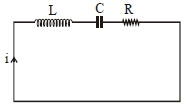
By \(kVL\)\(-\mathrm{L} \frac{\mathrm{di}}{\mathrm{dt}}-\frac{\mathrm{q}}{\mathrm{C}}-\mathrm{iR}=0\)
\(\mathrm{L} \frac{\mathrm{d}^{2} \mathrm{q}}{\mathrm{dt}^{2}}+\frac{1}{\mathrm{C}} \mathrm{q}+\mathrm{R} \frac{\mathrm{dq}}{\mathrm{dt}}=0\)
for damped oscillator
net force \(=-\mathrm{kx}-\mathrm{bv}=\mathrm{ma}\)
\(\frac{m d^{2} x}{d t^{2}}+k x+\frac{b d x}{d t}=0\)
by comparing : Equivalence is
\(\mathrm{L} \rightarrow \mathrm{m}: \mathrm{C} \rightarrow \frac{1}{\mathrm{K}} ; \mathrm{R} \rightarrow \mathrm{b}\)
-
- (A) \(\frac{2}{\sqrt{3}}\)
- (B) \(\frac{\sqrt{2}}{3}\)
- (C) \(\frac{2}{3}\)
- (D) \(\frac{3}{\sqrt{2}}\)
Show answer and solution
Correct Answer: (A)
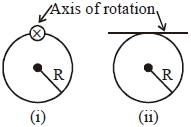
Moment of inertia in case \((i)\) is \(I _{1}\)Moment of inertia in case \((ii)\) is \(I_{2}\)
\(I_{1}=2 M R^{2}\)
\(I _{2}=\frac{3}{2} MR ^{2}\)
\(T _{1}=2 \pi \sqrt{\frac{ I _{1}}{ Mgd }} ; T _{2}=2 \pi \sqrt{\frac{ I _{2}}{ Mgd }}\)
\(\frac{ T _{1}}{ T _{2}}=\sqrt{\frac{ I _{1}}{ I _{2}}}=\sqrt{\frac{2 MR ^{2}}{\frac{3}{2} MR ^{2}}}=\frac{2}{\sqrt{3}}\)
-
- (A) \(f =\frac{1}{2 \pi} \sqrt{\frac{ YA }{ mL }}\)
- (B) \(f=\frac{1}{2 \pi} \sqrt{\frac{Y L}{m A}}\)
- (C) \(f=\frac{1}{2 \pi} \sqrt{\frac{m A}{Y L}}\)
- (D) \(f =\frac{1}{2 \pi} \sqrt{\frac{ mL }{ YA }}\)
Show answer and solution
Correct Answer: (A)
An elastic wire can be treated as a spring with\(K =\frac{ Y A }{\ell}\)
\(T =2 \pi \sqrt{\frac{ m }{ k }}\)
\(f=\frac{1}{2 \pi} \sqrt{\frac{k}{m}}=\frac{1}{2 \pi} \sqrt{\frac{Y A}{m \ell}}\)
-
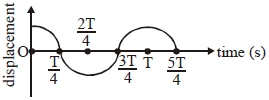
- (A) \(( A ),( B )\) and \(( D )\)
- (B) \(( B ),( C )\) and \(( D )\)
- (C) \((A)\) and \((D)\)
- (D) \(( A ),( B )\) and \(( C )\)
Show answer and solution
Correct Answer: (D)
Sol. \((A)\) \(F =\) ma \(\quad a =-\omega^{2} x\)at \(\frac{3 T }{4}\) displacement zero \(( x =0),\) so \(a =0\)
\(F=0\)
\((B)\) at \(t=T \quad\) displacement \((x)=A\) \(x\) maximum, So acceleration is maximum.
\((C)\) \(V =\omega \sqrt{ A ^{2}- x ^{2}}\)
\(V _{\max }\) at \(x =0\)
\(V _{\max }= A \omega\)
at \(t =\frac{ T }{4}, x =0, \quad\) So \(V _{ max }\)
\((D)\) \(KE = PE\)
\(\therefore\) at \(x=\frac{A}{\sqrt{2}}\)
at \(t=\frac{T}{2} \quad x=-A \quad\) (So not possible)
-
- (A) \(\sqrt{\frac{g}{y_{0}}}\)
- (B) \(\sqrt{\frac{g}{2 y_{0}}}\)
- (C) \(\frac{1}{2} \sqrt{\frac{g}{y_{0}}}\)
- (D) \(\sqrt{\frac{2 g}{y_{0}}}\)
Show answer and solution
Correct Answer: (B)
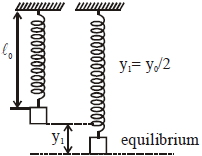
\(y = y _{0} \sin ^{2} \omega t\)\(y =\frac{ y _{0}}{2}(1-\cos 2 \omega t )\)
\(y -\frac{ y _{0}}{2}=-\frac{ y _{0}}{2} cos 2 \omega t\)
Amplitude : \(\frac{y_{0}}{2}\)
\(\frac{y_{0}}{2}=\frac{m g}{K}\)
\(2 \omega=\sqrt{\frac{K}{m}}=\sqrt{\frac{2 g}{y_{0}}}\)
\(\omega=\sqrt{\frac{g}{2 y_{0}}}\)
-
- (A) \(11\)
- (B) \(15\)
- (C) \(20\)
- (D) \(13\)
Show answer and solution
Correct Answer: (B)
\(u =\frac{ f _{1} n _{1} RT }{2}+\frac{ f _{2} n _{2} RT }{2}\)\(u =\frac{5}{2} \times 3 RT +\frac{3 \times 5 RT }{2}=15 RT\)
-
- (A) \((C)\) and \((D)\)
- (B) \((A)\) and \((B)\)
- (C) \((A)\) and \((D)\)
- (D) \((B)\) and \((C)\)
Show answer and solution
Correct Answer: (D)
The mean free path of molecules of an ideal gas is given as\(\lambda=\frac{ V }{\sqrt{2} \pi d ^{2} N }\)
\(V =\) Volume of container
where: \(N =\) No of molecules
Hence with increasing temp since volume of container does not change (closed container), so mean free path is unchanged.
Average collision time
\(=\frac{\text { mean free path }}{V_{ av }}=\frac{\lambda}{(\text { avg speed of molecules })}\)
\(\because\) avg speed \(\alpha \sqrt{ T }\)
\(\therefore\) Avg coll. time \(\alpha \frac{1}{\sqrt{ T }}\)
Hence with increase in temperature the average collision time decreases.
-
- (A) \(4.5\)
- (B) \(1.5\)
- (C) \(2.5\)
- (D) \(3\)
Show answer and solution
Correct Answer: (D)
\(DOF =3+3=6\)\(U =\frac{ f }{2} nRT =3 RT\)
-
- (A) \(\frac{67}{45}\)
- (B) \(\frac{19}{13}\)
- (C) \(\frac{23}{15}\)
- (D) \(\frac{40}{27}\)
Show answer and solution
Correct Answer: (B)
\(\frac{C_{P}}{C_{V}} \operatorname{mix}=\frac{n_{1} C_{P_{1}}+n_{2} C_{P_{2}}}{n_{1} C_{V_{1}}+n_{2} C_{V_{2}}}\)\(\frac{C_{P}}{C_{V}} \operatorname{mix}=\frac{n \times\left(\frac{5 R}{2}\right)+2 n\left(\frac{7 R}{2}\right)}{n \times \frac{3 R}{2}+2 n\left(\frac{5 R}{2}\right)}\)
\(\frac{C_{P}}{C_{V}}=\frac{19}{13}\)
-
- (A) \(7:9\)
- (B) \(5:7\)
- (C) \(3:5\)
- (D) \(5:9\)
Show answer and solution
Correct Answer: (B)
Degree of freedom of a diatomic molecule if vibration is absent \(=5\)Degree of freedom of a diatomic molecule if vibration is present \(=7\)
\(\therefore C_{v}^{A}=\frac{f_{A}}{2} R=\frac{5}{2} R\) and \(C_{v}^{B}=\frac{f_{B}}{2} R=\frac{7}{2} R\)
\(\therefore \quad \frac{C_{\mathrm{v}}^{\mathrm{A}}}{C_{\mathrm{v}}^{\mathrm{B}}}=\frac{5}{7}\)
- 297. In a dilute gas at pressure \(P\) and temperature \(T\), the mean time between successive collisions of a molecule varies with \(T\) as 2020 Medium
- (A) \(\sqrt{ T }\)
- (B) \(\frac{1}{ T }\)
- (C) \(\frac{1}{\sqrt{ T }}\)
- (D) \(T\)
Show answer and solution
Correct Answer: (C)
\(v _{ avg } \propto \sqrt{ T }\)\(t _{0}:\) mean time
\(\lambda:\) mean free path
\(t _{0}=\frac{\lambda}{ v _{avg }} \times \frac{1}{\sqrt{ T }}\)
-
- (A) \(5\)
- (B) \(10\)
- (C) \(13\)
- (D) \(9\)
Show answer and solution
Correct Answer: (A)
\(P V = n R T\)\(P _{1} V _{1}= nR\times 250\)
\(P _{2}\left(2 V _{1}\right)=\frac{5 n }{4} R \times 2000\)
Divide
\(\frac{ P _{1}}{2 P _{2}}=\frac{4 \times 250}{5 \times 2000}\)
\(\frac{P_{1}}{P_{2}}=\frac{1}{5}\)
\(\frac{P_{2}}{P_{1}}=5\)
-
- (A) \(A-IV, B-I, C-II, D-III\)
- (B) \(A-IV, B-II, C-I, D-III\)
- (C) \(A-III, B-IV, C-II, D-I\)
- (D) \(A-II, B-III, C-I, D-IV\)
Show answer and solution
Correct Answer: (A)
\(\gamma=\frac{ C _{ p }}{ C _{ v }}=1+\frac{2}{ f }\)where \('f'\) is degree of freedom
\((A)\) Monoatomic \(f=3, \gamma=1+\frac{2}{3}=\frac{5}{3}\)
\((B)\) Diatomic rigid molecules,
\(f=5, \gamma=1+\frac{2}{3}=\frac{7}{5}\)
\((C)\) Diatomic non-rigid molecules
\(f=7, \gamma=1+\frac{2}{7}=\frac{9}{7}\)
\((D)\) Triatomic rigid molecules
\(f=6, \gamma=1+\frac{2}{6}=\frac{4}{3}\)
-
- (A) \(U =\frac{5}{2} RT\) and \(\gamma=\frac{6}{5}\)
- (B) \(U =5 RT\) and \(\gamma=\frac{7}{5}\)
- (C) \(U =5 RT\) and \(\gamma=\frac{6}{5}\)
- (D) \(U =\frac{5}{2} RT\) and \(\gamma=\frac{7}{5}\)
Show answer and solution
Correct Answer: (D)
Total degree of freedom \(=3+2=5\)\(U =\frac{ nfRT }{2} \Rightarrow \frac{5 RT }{2}\)
\(\gamma \Rightarrow \frac{ C _{ P }}{ C _{ V }} \Rightarrow 1+\frac{2}{ f } \Rightarrow 1+\frac{2}{5} \Rightarrow \frac{7}{5}\)
No questions on this page match these filters.